The study explores the impact of COVID-19 on the Bangladeshi economy. The researcher found that In Bangladesh, there were huge impacts of COVID-19 on various sector. There was a substantial impact on Readymade Garments Sector for spreading of corona virus diseases, losses of the RMG sector was gradually increasing in the COVID-19 pandemic, SME had also adversely effected by COVID-19, many enterprises closed their business activities during shutdown of industries for minimizing the spread of corona virus, Tourism sector also effect by the corona virus, lockdown of all cities provided restrictions on moving one city to another even one country to another, All the educational institutions closed during the pandemic, Capital market, Remittance, and GDP also fall down due to COVID-19. By seeing the before COVID-19 and during COVID-19 trends, the researcher concluded that there was a huge impact of COVID-19 on various sector. Government and Non-government institutions help people to fight this virus. We give some recommendations, which are given by researchers, policymakers, or international organizations. We do not know when this virus goes forever. We may live with this virus for a long term. We can minimize the impact of corona virus in our economy.
## I. INTRODUCTION
At the end of December 2019, Public health officials from China notify the World Health Organization that they are suffering a serious problem. People are suffering from an unknown virus was causing pneumonia like illness in Wuhan City (Verge media). They quickly identified that it was a coronavirus. They also said it was rapidly spreading through outside of the Wuhan. This virus now spreading all over the world. In Bangladesh there is a huge problems arises for this virus. The Bangladesh government lockdown many cities when they see that there are many people spreading this virus. All the educational, governmental and nongovernmental institutions and RMG sectors are temporarily shut down. The Asian Development Bank (ADB) anticipated that GDP of the world may lose from $0.089\%$ to $40\%$ due to COVID-19. Besides the developed countries, underdeveloped countries may suffer from this virus. Bangladesh is one of them. There are huge effect by this COVID-19 situation such as national and international trade, Transport, Remittance, Private Job sectors and many more. The aim of this paper is to explore the impact of COVID-19 on Readymade Garments, Small and Medium Enterprise sector, Tourism sector, Educational sector, Capital market, Remittance, and GDP growth.
Research Objectives: The main objectives of the paper is to determine the impact of COVID-19 on the economy of Bangladesh. Various objectives are given below:
- To show the scenario of COVID-19 impact on the economy in Bangladesh.
- To overview the solution given by Policymaker, Researcher, and International Organization.
- To propose some recommendation about minimizing the impact of COVID-19.
## II. LITERATURE REVIEW
Many researches was conducted by the researcher of various country about the impact of COVID-19 on the economy. Siddiquee and Faruk (2020) Shahriar et al. (2021) Hassan et al. (2020, Hina et al. (2021), Indrajith (2021) and many other researchers found that there was a significant effect of COVID-19 on the economy.
Siddiquee and Faruk (2020) conducted a research about impact of corona virus (COVID-19) on the economy of Bangladesh. They revealed many sectors that were influenced by corona virus such as investments, production, price levels, bills, advances, wages, foreign trade and remittances. The researcher used secondary data which was collected from Bangladesh Bank (BB) Bangladesh Bureau of Statistics (BBS), and the Ministry of Finance (MoF). They found that the local and foreign demand decreased, production reduced, Wages Rate index in the service and industry sector fall down that time due to COVID-19. Advances had no impact of COVID-19 but investment and bills have effected by the COVID-19. RMG sector also had an impact. According to Shahriar et al. (2021), there is additional strain on the labor market because of the outbreak of COVID-19. Due to the pandemic, several organizations have halted their recruitment processes to save money and so increase the number of Bangladeshi graduates who are out of work. As a result, the goal of this research is to find out how COVID-19 influences the employability of Bangladeshi graduates, which has a knock-on effect on household budgets and the overall health of the country's economy. These studies also show that graduates' lack of employability is primarily due to a lack of demand for qualified workers and an abundance of qualified candidates on the job market, as well as a weak educational system.
Hassan et al (2020, examine the impact of COVID-19 on the economy especially on Agriculture. The article contains a concise overview of the COVID-19 situation worldwide, its effects on fisheries, aquaculture, the agriculture of fruits, vegetables, and ornamental plants, as well as the status of the global and Bangladeshi food supply at the present time. The COVID-19 outbreak slowed down the GDP as well as other important economic sectors and indicators in Bangladesh as well as around the world, according to the cause-effect relationship theory. In addition to the economic blow, it is dealing with an uneven supply of food in all of its outlets. The short- and long-term projected scenario revealed that, in all South Asian nations, the service and manufacturing sectors are more severely impacted than the agricultural sector.
Indrajith (2021) studied about the Gross Domestic Product (GDP), tourism, employment, poverty, inflation, and export earnings in relation to Sri Lanka's economic crisis caused by COVID-19. Additionally, it is disclosed that the COVID-19 has a negative impact on employment and GDP. Due to customers' panicked purchases and disruptions in domestic production and distribution, the economy is put under further inflationary pressure. The government's further import restrictions drastically decrease imports, and the severe devaluation of the Sri Lankan Rupee raises the cost of imported goods. Additionally, the COVID-19 epidemic has had a severe impact on the textile and apparel industries as well as tourism. Lack of interest in working was a contributing factor to the rising unemployment rate, which was brought on by health concerns and a lack of job openings. Another study on USA conducted by Klein and Smith (2021), found that cities with core industries based on the mobility of information would experience higher unemployment rates at the end of 2020. Furthermore, they also find that the Hispanic or Latino populations are larger in the hardest-hit locations, which reflects the demographics of the workforce in the industries that are most affected and in the vulnerable areas. Shang and Zhang (2021) concluded a study about COVID-19 and it's impact on global economy. The goal of the study was to compare the effects of different types of capitalist systems on the economy when disease outbreaks like the current coronavirus epidemic occur. With regard to the coordinated market economies of Germany, Sweden, and Japan as well as the liberal market economies of Australia, New Zealand, the United Kingdom, and Australia, the data analysis included an evaluation of the effects of the SARS, H1N1, and COVID19 viruses. According to the analysis, the LME economies were more susceptible to the effects of disease epidemics than the CME economies, where the disease's effects were tempered by government interference.
## III. METHODOLOGY OF THE STUDY
Secondary was the vital sources to collect the data. Secondary data were collected from newspaper, articles, magazines and COVID-19 related website. Various books and article related to COVID-19 were also the valuable resource. For the aim of the literature review of the study, we studied various kinds of articles, journals, newspaper etc. After collecting information from reliable source this information are analyzed, and depict tables and graphs to acquire best results. The results showed impact of COVID-19 on various sectors by using the previous to recent years trend of all the sector. To illustrate data MS Office package is used here systematically.
## IV. COVID-19 AND ITS IMPACT ON THE ECONOMY OF BANGLADESH
### a) Readymade Garments Sector
The readymade garments (RMG) sector in Bangladesh is the largest foreign currency earning industry. This is a hard time for Bangladesh as well as the whole world due to Coronavirus. Due to COVID-19 RMG sector in Bangladesh is suffering a crisis, with close down new business and cancelation of most of the existing orders. The RMG sector is the most crucial sector of Bangladesh (Maheen Sultan et. al). 3 billion dollars order cancellations occurred in the RMG industry in Bangladesh. Around 2 million workers and 4 million people (backward linkage industries, accessories, packaging factories, and transportation sector are directly involved in the RMG industry. Both export and import and export oriented industries are also at risk. The foreign earning (remittance) will come down so that foreign reserves in our country will also hit. Garment workers are coming back to Dhaka in this shutdown. The risk of COVID-19 diseases is also increased because there are huge numbers of workers working together in garments in Bangladesh (M Shahriar Azad Bhuiyan). According to Rana Dutta (2020), Coronavirus pandemic disrupts the supply chain of raw materials of the garments industry in Bangladesh. China is the most vital country that exports almost $50\%$ of garments related raw material in Bangladesh. If this situation stays for a long time, it will break the entire supply chain management. For the COVID-19 pandemic not only China but also US and EU buyer are not travelling to Asian countries including Bangladesh. On the other hand, Bangladesh is also not travelling to any country, which they depend on for both import and export. In this situation, no business in our country cannot properly do their work. Almost every business is going to be static if this crisis will be continuing. This makes a huge loss in the garments sector in Bangladesh. If we see the comparative statement on export of RMG, it shows that export of RMG is increased gradually over the years.
Comparative Statement on Export of RMG And (Total Export of Bangladesh)
<table><tr><td>Year</td><td>Export of RMG
(in Million Us$)</td><td>Total Export Of Bangladesh
(in Million Us$)</td><td>% of RMG's to Total Export</td></tr><tr><td>2010-11</td><td>17914.46</td><td>22924.38</td><td>78.15</td></tr><tr><td>2011-12</td><td>19089.73</td><td>24301.90</td><td>78.55</td></tr><tr><td>2012-13</td><td>21515.73</td><td>27027.36</td><td>79.61</td></tr><tr><td>2013-14</td><td>24491.88</td><td>30186.62</td><td>81.13</td></tr><tr><td>2014-15</td><td>25491.40</td><td>31208.94</td><td>81.68</td></tr><tr><td>2015-16</td><td>28094.16</td><td>34257.18</td><td>82.01</td></tr><tr><td>2016-17</td><td>28149.84</td><td>34655.90</td><td>81.23</td></tr><tr><td>2017-18</td><td>30614.76</td><td>36668.17</td><td>83.49</td></tr><tr><td>2018-19</td><td>34133.27</td><td>40535.04</td><td>84.21</td></tr></table>
### b) Crisis on Remittances
In 2019, Over 10 million migrants from Bangladesh sent 18 billion dollar that have a great importance in the economy. International remittances typically represent about $7\%$ of Bangladesh's GDP. However, the COVID-19 pandemic had a serious impact on migrants from overseas in Bangladesh. They are mainly concentrated in countries with lockdown measures. Given the large number of Bangladeshi immigrants in the Middle East, the secondary economic effects of slow demand and falling oil prices may also put pressure on remittance flows.
The World Bank estimates that by 2020 total remittances from Bangladesh migrant workers will fall to
$ 14 billion, which will be 25% decreased from the previous year. According to data released by the Bangladesh Bank, remittances fell 25% this month compared to the same period, indicating that, unfortunately, a World Bank forecast is likely to be available. The decline in these benefits (traditionally averaging between $ 300 and $ 600 per month) will result in a significant loss of income for millions of households in Bangladesh.
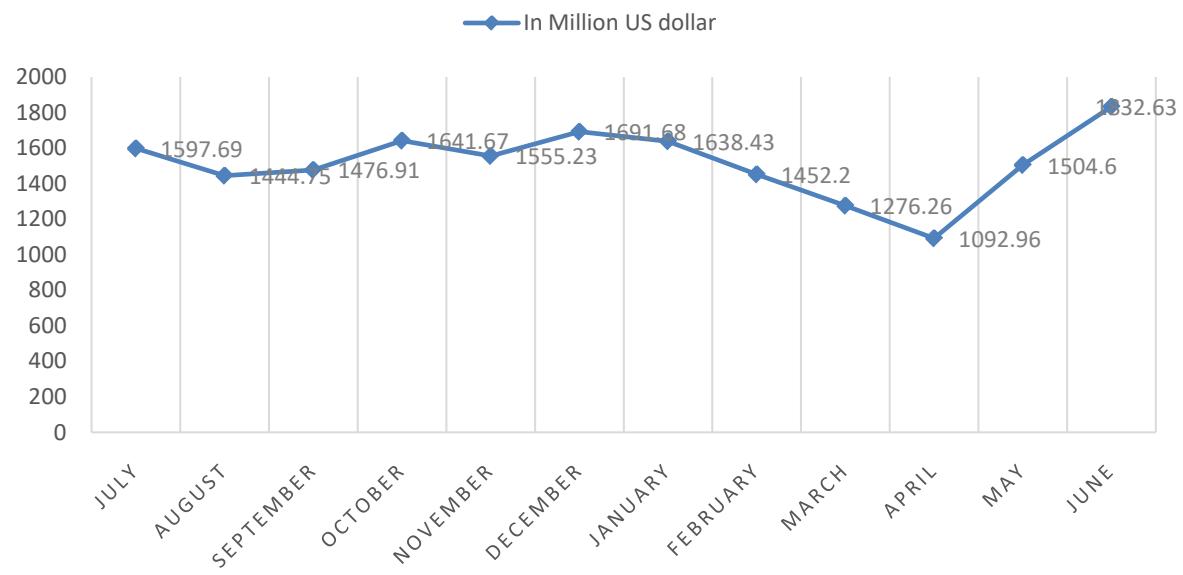
<table><tr><td colspan="2">Remittances</td></tr><tr><td>2019-2020</td><td>In Million US dollar</td></tr><tr><td>July</td><td>1597.69</td></tr><tr><td>August</td><td>1444.75</td></tr><tr><td>September</td><td>1476.91</td></tr><tr><td>October</td><td>1641.67</td></tr><tr><td>November</td><td>1555.23</td></tr><tr><td>December</td><td>1691.68</td></tr><tr><td>January</td><td>1638.43</td></tr><tr><td>February</td><td>1452.20</td></tr><tr><td>March</td><td>1276.26</td></tr><tr><td>April</td><td>1092.96</td></tr><tr><td>May</td><td>1504.60</td></tr><tr><td>June</td><td>1832.63</td></tr></table>
IN MILLION US DOLLAR
The table 2 and chart 1 shows the remittance changings in July 2019 to June 2020. As we see in the chart and table remittance growth decline February as compare to January, remittance growth decline March as compare to February, remittance growth decline April as compare to March. We see that in March and April of 2020 remittance are computed 1276.26, 1092.96 respectively, and these amounts are lower than the previous months.
### c) Crisis on GDP Growth
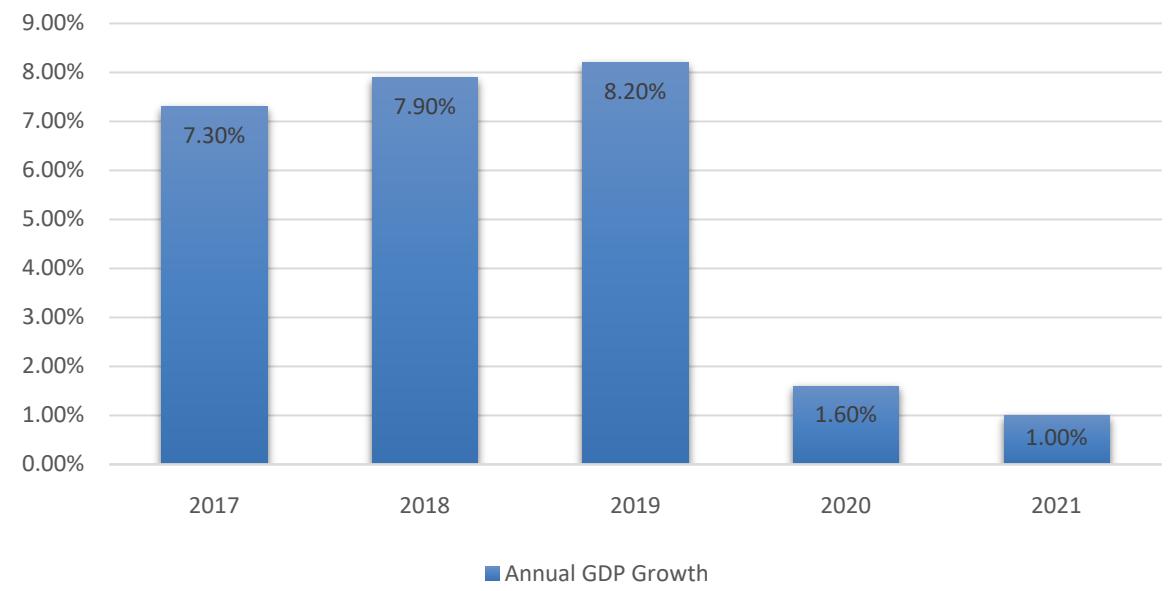
The World Bank (WB) on June 8 released a hard-hitting forecast for the global economic outlook for June 2020. The growth rate of GDP will fall to $1.6\%$ in the
current fiscal year. It may also fall sharply to $1\%$ in the next (2021) financial year. Because of the coronavirus pandemic, the country's GDP growth rate will decline from a record $8.15\%$ in the previous fiscal year to $1.6\%$ in the current fiscal year. Earlier, the Economist Intelligence Unit (EIU) forecast that Bangladesh's GDP growth rate would be $1.6\%$. If the World Bank forecast to reduce GDP growth to $1.6\%$, it will be the lowest level in Bangladesh in 37 years. According to World Bank indicators (WDI) data, the country's GDP growth rate was 2.13 percent in the fiscal year 1981-82 (Mohsin Bhuiyan).
Annual GDP Growth
Source: World Bank's Website
### d) Crisis on Capital Market
Global financial markets are suddenly responding to the ongoing coronavirus pandemic. The Covid-19 pandemic could have a major impact on the financial markets and institutions of almost every affected country. Bangladesh is one of them. Although the stock market has not been shown to dominate the Bangladeshi capital financing market, the Covid-19 pandemic is not easily spare it.
From February 2020, the volatile stock market in Bangladesh has begun to show the negative effects from the coronavirus pandemic. During the pandemic period from February 27, 2020, to June 10,2020, the market value of stocks decreased by $11.50\%$ compared to the daily average. The market fluctuation (standard deviation) is $2.20\%$ (according to annual calculations, up to $98.30\%$ ). From last week of March 2020, the Dhaka stock exchange and Chittagong stock exchange was closed due to lockdown situation in Bangladesh. May 31, 2020, Dhaka stock exchange and Chittagong stock exchange resumed operations. However, the situation does not seem to have much hope yet. A few weeks before the announcement of the lockdown, the Bangladesh Securities and Exchange Commission (BSEC) introduced a price for all stocks of listed securities to restore the normal downward trend in the market. However, this does not appear to have had a significant impact on declining trade, and the onset of the Covid-19 pandemic has been exacerbated by adverse micro- and macro-effects. After the market recovery, investors turned gloomy and worried about the general economic and financial uncertainty, which was reflected in a sharp decline in trading activity. The main exchange transaction price reached its lowest level in 13 years in 2020 on June 5 that amounted to 430 million Tk. Given the unprecedented uncertainty and uncertainty caused by the Covid-19 pandemic, the Bangladeshi stock market could see difficult and severe consequences in the coming days (Suborna Barua. Et al).
### e) Impact on Global Education System
The Covid-19 pandemic has had a major impact on the global education system. Schools, colleges and universities around the world have been closed to prevent the virus from spreading, as it is essential to avoid community gathering and maintain social distance to prevent the spread of the disease. Such an intervention is necessary in order to implement the "stay at home" approach in all ways. However, long-term closures face a variety of challenges for educational institutions and students. Of course, various temporary coping mechanisms have been put in place in the education system to deal with the unpredictable effects of the Covid-19 pandemic. Educational institutions in various countries have been closed. Due to the situation of Covid-19, the educational institution
(EI) will be closed from March 2020. At the start of the pandemic, Covid-19 extended national plans to close educational institutions until 2020. In March, however, now the time has been extended in almost all countries. In the United States, some institutions have announced that they will close this school year, while others have announced that they will remain closed until further notice. Australia is reopening schools, although many schools have not closed here (Coronavirus Covid-19 Update, 2020).
Canadian Education Minister Stephen Lece has announced that all schools will be closed by at least May 31. In Japan, the state of emergency will continue until May 6, so educational institutions will also remain closed ("Coronavirus: Japan declares national emergency"). On April 27, BBC News has announced that China's Educational institutions has begun to open. Wuhan, where started the pandemic, will open schools from May 6. ("Coronavirus: Schools Start Reopening in China's Biggest Cities"). The duration of Educational institutions closure depends on the situation of Covid-19 in these countries (Nazmul et.al, 2020).
### f) Impact on Tourism Industry
Tourism is a way of movement for most people in the modern world. According to the WTO (2020), International tourism supports sustainable growth for decades in a row. The report states that in 2019 there is 1.5 billion international tourists visited. Expected to reach 1.8 until 2030. The number of international tourists will reach 1 billion. The economic sector accounted for $4.4\%$ of GDP in 2018. (World Bank, 2019). Bangladesh's international tourism spending is $ 1.208 billion, In South Asian countries, it has quite reasonable value. Since the beginning of March, the Bangladeshi tourism industry has been adversely affected by the COVID-19 outbreak. Since early April, the number of COVID-19 patients in Bangladesh has continued to increase. Since mid-March, Bangladesh's local government has initiated a strict embargo on going tourists places. Hotel and motel owners must discourage tourists from living on their premises. As a result, tourism-related activities have stagnated. In addition, many domestic and foreign flights were canceled to prevent the spreading of virus.
The cancellation of flights has exacerbated the current economic situation. In order to prevent the spread of COVID-19, entry visas for tourists from all countries/ regions have been suspended. Since the beginning of the pandemic, the suspension of Chinese transactions due to the COVID-19 epidemic will affect not only China's GDP but also the world economy, as China accounts for about $15\%$ of total GDP and trades with almost all countries. In terms of goods and services, Bangladesh has special trade relations with China. Bangladesh's total exports to China amounted to $ 861 million, representing $2.2\%$ of total Chinese exports, and imports accounted for $ 15.1 billion, or $34\%$
of total Chinese exports. Due to the COVID-19 outbreak in January-December this year, Bangladesh's tourism industry could suffer 60 billion trail losses as the sector is most affected by the pandemic. The TOAB reports on April, 2020 that Travel agencies lost nearly 15 billion taka and sack 5,000 people to their job. However, it was reported to have lost 3.40 trillion Taka and had a ticket value of 3.05 trillion Taka. Losses over the past three months have been 1.86 trillion Taka and 1 billion Taka (TOAB, 2020). In Bangladesh, about 4 million people are directly or indirectly involved in tourism and travel. PATA (2020) estimates that COVID-19 currently provides around 300,000 jobs in industry. Figure 2 shows the number of risk assessment jobs faced by the tourism sector (Santusand Sohel, 2020).
### g) Impact on Small and Medium Enterprise
The COVID-19 mandate and changes in health-related needs continue to affect business owners. From 2020 May (Second month after the introduction of restrictions on social exclusion), CPS data estimates from national representatives show that small business activity has declined sharply. From February 2020 to May 2020, the number of active business owners in the U.S. has dropped from \(15 million. Up to 12.8 million, i.e. \(15\%\). The amount of Business owner in May 2020 actually rebounded a little from the April low of 11.7 million. The partial recovery increased 1.1 million business owners, or \(7\%\), in February. While the return is encouraging, it still shows a significant short-term decline in business activity. In contrast, between the beginning and the end of the Great Recession, the number of active business owners fell by 730,000, or \(5\%\). Overall, business ownership is relatively stable throughout the business cycle (Fairlie 2013; Parker 2018).
Between February and May, Business owners were lost2.2 million(15 percent), including a significant decrease in subgroups such as owners who worked about two days a week (19 percent), and owners who worked four days a week (21 percent) incorporated businesses (11%). Judging from the total working time of all business owners, it decreased by 20 percent. Because of all these measures, May has been quite renewed from April's losses, but continues to show big losses.(Fairlie, 2020)
Small and medium-sized enterprises are the major point in the Bangladeshi economy and have directly created 7.8 million jobs, of which 31.2 million providing the livelihood. The COVID-19 pandemic has affected all walks of life and businesses, but those most affected by the shortest cash cycle, supply chain disruption and loss of sales are already vulnerable SMEs. In order to gain a comprehensive understanding of the current impact of the crisis on SMEs, Light Castle Partners & Sheba collaborated on an independent study on the impact of COVID-19 on Bangladeshi SMEs. The study was conducted in late April. More than 230 respondents from SMEs in total in Bangladesh were involved in Trading and Production (48.4%), including perishable and cereals, poultry, dairy products, fisheries, jute and various industries and Service industry (51.6%), including food and catering, electrical services, laundry, beauty salons, MFS agencies and restaurants. They found Small and medium Enterprises locks hung over the business and generating 0 revenue. 28% of Small and medium Enterprises revenue drop at least 50%. Two-thirds of the Small and medium Enterprises have window of less than 4 months to survive in present situation. 40 percent of Small and medium Enterprises from service industry took a big hit and losses more than 50% percent (Light Castle Partner).
Recovery Ideas Given by Policymaker, Researcher and International Organization:
Shang-Jin Wei gives ten key to minimize the effect of Covid-19 on the book of Mitigating the COVID Economic Crisis: Act Fast and Do Whatever It Takes.
1. Accelerate the preparation before an outbreak hit. There will be a huge demand of testing kits, masks, protective cloths, hospital beds, and ventilator. Every country should collect this materials as soon as possible. Because these material is the major element to reduce and track the virus.
2. If the supply of local health products is limited, consider increasing imports from China, Japan, and other countries with related potential. Bangladesh need to import this material because some elements are rare in this country.
3. Develop appropriate emergency management plans to ensure that there are sufficient hospital beds used for infectious diseases, especially large-scale outbreaks, especially ICU beds.
4. Give advice to the normal people early, clearly, and forcefully to reduce the spread of the virus.
5. If there is, any sign of outbreak take necessary step to ensure social distancing as soon as possible.
6. The need for immediate assistance to employee, businesses and financial companies settles quickly.
7. Make a better use of technology such as offline retail shopping changed by online shopping.
8. Internet use in the all sector should increase that can give enhancement of long term economic growth.
9. A worldwide cooperative economic stimulus plan will be more effective than taking individual action to reduce the pressures of a global recession.
10. Minimizing the tariffs and non-tariff trade barriers in this situation can also assist a country to fight a pandemic-induced recession
Coronavirus pandemic give huge losses in various sectors in the economy. Readymade garments, Education, Tourism, Capital Market etc are mostly effected by pandemic. There are some solution given by authorities.
World Economic Forum said that the improved stimulus package announced by the Prime Minister is admirable and a step in the proper direction. The package provided nearly $ 2.5 billion in short-term working capital financing for small and medium-sized industries. This is a bold step to protect the livelihoods of workers in this sector. This is the scale of this crisis and even such an incentive plan should be seen as a means of stopping it. What is even more worrying is that data from the Bangladesh Bureau of Statistics show that the informal sector in Bangladesh employs more than 50 million people. While this will have a major impact on the livelihoods of workers in the formal economy, there is no doubt that the informal sector will be hit harder. The Prime Minister rightly saw this as a challenge, and her decision to distribute food aid through Bangladesh's existing social security programs (such as feeding vulnerable groups and expanding vulnerable groups for six months) was also to be welcomed.
World Economic Forum suggest some solution to reduce the effect of this pandemic:
Bangladesh government should think about an unconditional cash transfer program is $95 per month for the first three months, which equates to a minimum wage in the formal Bangladeshi sector. It will cost the government about$ 14 billion, or $4\%$ of GDP. While such cash transfer programs will always face specific problems, Bangladesh has a very modern network of mobile financial services that can improve the coverage of the program. Coordinated efforts may be made to involve non- governmental organizations working in the informal sector, mobile financial service providers and governments to provide much-needed social assistance. In taking such a positive step, Bangladesh will have to abandon its usual prudent and disciplined fiscal policy to keep its budget deficit below $5\%$ of GDP.
Asian Development Bank responses to the COVID-19 outbreak: Asian Development Banks quickly and flexibly give feedback to the members. Some solutions are given by ADB.
- Asian Development Banks give 20 billion dollar assistance package for the affected country in Asia and Pacific for saving lives and ensure economies recoveries as fast as possible.
- Asian Development Banks delivering grants for food programs who are in crisis and medical needs like PPE, test kits, and laboratories.
- Asian Development Banks providing budget support with affordable term for their developing members.
- Asian Development Banks analyze the economic impact due to COVID-19 and better plan to recovery.
- Asian Development Banks provides finance for trade and supply chain.
- Asian Development Banks wages support schemes help to lose job of low-wage worker.
- Asian Development Banks cash transfer program and other social security measures are targeted at poor and vulnerable groups and families, as well as women and girls.
- Asian Development Banks coordinate with international financial institutions, WHO and UN agencies and development organizations.
- Hasanul Banna (2020) an economist give some solution to minimize the effect:
- The Government of Bangladesh and the Bangladesh Bank must make sure the troubled economy continues to function during the virus outbreak. In this regard, the government should entrust financial and non-financial institutions, educational institutions, all governments and NGOs need to create a cloud database Work from home so they can continue their work In this case, and it goes smoothly.
- Lowering the interest rates by Bangladesh is a possible response because the shock is not just about demand management problems, but a multifaceted crisis that need to respond to monetary, fiscal and health policies.
- The government should increase budget in health sector. To prevent the effect of the virus government should initiate health insurance policy.
- It is necessary to support vulnerable families and businesses As a means of isolation and fear of infection may suddenly halt economic activity
- It is also necessary to increase liquidity reserves for companies in affected industries in order to avoid debt default. In addition, reducing fixed charges, tax and credit tolerance will also reduce the pressure on companies facing a sharp drop in demand.
Recommendations: COVID-19 is a serious for our economy as well as our overall life. We do not know how and when this problem will be solved. But for safety of life we should maintain some rules regulation. Prevention is necessary to solve this problem. Here we suggest some recommendations about minimizing the impact of COVID-19 on economy.
- General people should aware of this problem. Social distancing is the best solution to stop spreading this virus.
- Internet is another major element to continue any kind of business, government and non-government institution. By using internet people can easily doing their work by staying at home.
- Educational Institutions should take necessary steps to prevent the loss due to shut down all the institutions. Telecommunication Service Provider, Government, and all the educational institution
- should help the student for digital learning. Now students can learn wherever they belong they do not go to school, college, and University.
- Reducing internet cost, tax, vat can help to reduce the SME and other Industries.
- Corporate Social Responsibility may be the better solution to prevent this pandemic. Banks, Financial Institutions, or any other Industry can help people by CSR activities. It will be helpful for our country. A lot of amount was used by previous year by doing CSR. This year all institutions should maintain CSR for preventing the loss due to COVID-19.
- Government should create fund for SME, RMG, and Tourism Industry. Because these sectors may suffer a serious loss due to COVID-19.
## V. CONCLUSION
The COVID-19 outbreak has dealt a severe blow to many countries with poor economic conditions prolonged lockdown partially or completely stops all economic activity, therefore low-income people are mostly unemployed, and they do not have access to food and social safety programs. The Bangladeshi government has announced a huge stimulus plan that will be helpful for affected people and their family. In this research, the researcher showed that there was a huge impact on economy will happened due to COVID-19. The RMG sector, GDP, Tourism sector, Capital market and Education sector were in danger. Each sector of the country were suffering loss due to lockdown. Garments were closed down for COVID-19. Export rate decreased and industry facing huge losses. Social awareness and internet could reduce some losses during COVID-19. In this study, the researcher describes some a researcher's recommendation regarding to Minimizing the impact of COVID-19. Lastly, the researcher suggests some possible solution which can be helpful for Bangladesh.
Generating HTML Viewer...
References
16 Cites in Article
N Alam,D Ruba,S Rowshan (2020). Impact of Covid-19 pandemic on global education systems.
(2020). One Year of Living with COVID-19.
M Bhuiyan (2020). World Bank forecasts only 1.6% GDP growth for Bangladesh.
Kashfia Sharmeen (2020). Stock Market Trading through Mobile Application: An Analysis of Reaction to COVID-19.
R Baldwin,W Mauro (2020). Mitigating the COVID Economic Crisis: Act Fast and Do Whatever It Takes.
No ethics committee approval was required for this article type.
Data Availability
Not applicable for this article.
How to Cite This Article
Md. Rasel Molla. 2026. \u201cImpact of COVID-19 on the Economy of Bangladesh\u201d. Global Journal of Management and Business Research - B: Economic & Commerce GJMBR-B Volume 23 (GJMBR Volume 23 Issue B1).
Explore published articles in an immersive Augmented Reality environment. Our platform converts research papers into interactive 3D books, allowing readers to view and interact with content using AR and VR compatible devices.
Your published article is automatically converted into a realistic 3D book. Flip through pages and read research papers in a more engaging and interactive format.
Our website is actively being updated, and changes may occur frequently. Please clear your browser cache if needed. For feedback or error reporting, please email [email protected]
Thank you for connecting with us. We will respond to you shortly.