
I. INTRODUCTION
In the globalized business environment, businesses continuously update their technology and working paradigms. AI has brought revolutionary developments to many fields; its effects are evident in banking systems, IT systems, research, manufacturing, and logistics. In addition, AI is also slowly permeating the domain of HRM, a space where human judgment is considered paramount for candidate selection.
AI can be used to access and rapidly filter an abundance of digital resumes, job positions on job-posting sites, and professional networks (such as LinkedIn profiles, etc.) and assemble a narrow selection of the best candidates for any of an organizations' specific roles/functions. Many big companies have started using AI for recruitment, including L'Oreal (cosmetics), Adecco (staffing), Hays (recruitment), and Deloitte (a multinational professional services network). According to a recent study by the Sage Group, of talent has been hired with the help of AI (Case, 2021). These examples highlight that AI is in the initial stages of application by human resource (HR) departments and it seems likely that it will become a vital part of the recruitment and selection process in the coming years.
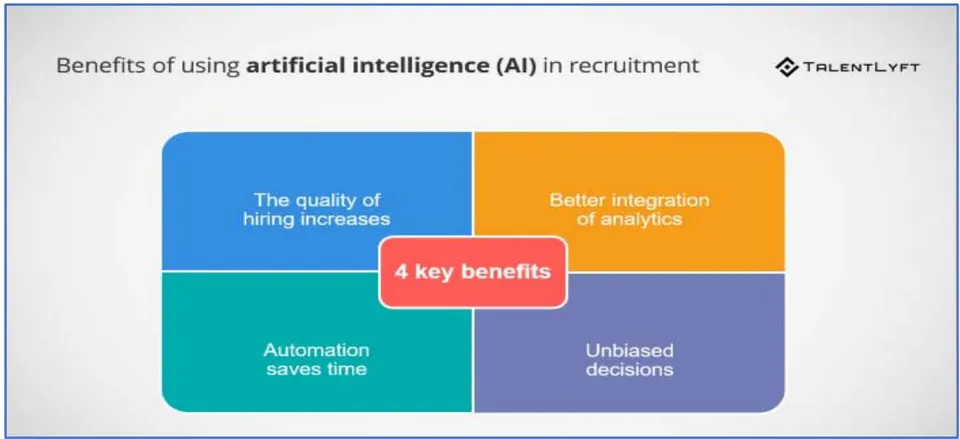
AI recruitment applications are appealing to organizations and have seen considerable development in recent years due to the key benefits they offer. AI-based tools automate repetitive tasks, crunch external data, and present recruiters with a simplified view. This allows them to skip the manual work required to process the raw data and make final hiring decisions with more deliberation, leading to increased quality in the hiring process (Source: Talent Lyft, 2022). AI-based tools also check recruiter decision-making bias, reducing the number of biased decisions made by recruiters. Finally, AI-based tools integrate the hiring process with recruitment data analytics.
II. LITERATURE REVIEW
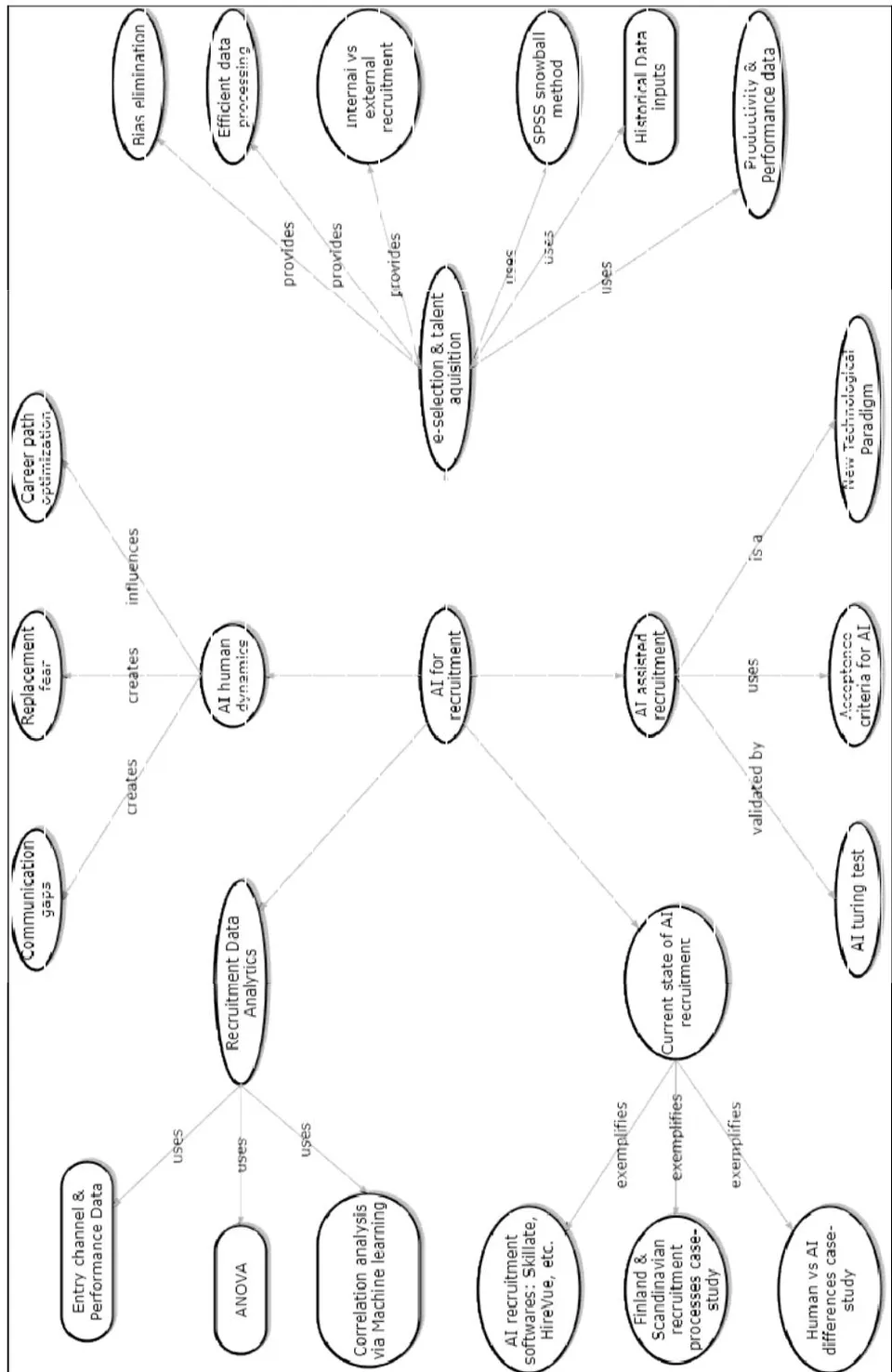
Existing literature demonstrates that AI-enabled recruitment (AIER) greatly impacts the business world. Figure 2 (below) gives a map of this literature, which highlights the following key points. Firstly, AIER creates complex AI-human dynamics with positive/negative impacts such as job replacement or career enhancements. Secondly, AIER has been examined inaction in case studies in both Finnish and Scand in avian recruitment processes. As of 2021, AI-accelerated tools such as Skill ate and HireVue assist with HR recruitment. Thirdly, AIER provides organizations with recruitment data analytics for continuous analysis and improvement using tools like ANOVA and machine learning. Finally, in some cases, AIER leads to e-selection (i.e., electronic selection) and allows organizations to close geographical gaps in the recruitment of employees as well as increase hiring efficiency by reducing bias.
A survey of the existing literature identifies the gaps that exist in the application of AI in HR recruitment systems. Liu et al. (2021) observe that every business must attract and recruit strong talent to develop their organization in today's competitive world. These authors investigated HR teams that consolidated performance scores and corresponding recruitment entry channels (campus, online, internal transfers, and referrals). The performance scores included three dimensions of an employee's performance: subjective awareness, job satisfaction, and job self-dedication. This data was then processed through AI regression analysis to determine the correlation coefficient's T-value and how predictable the entry channel was as an indicator of performance. Dijkkamp (2019) used an exploratory research method with a case study to investigate the organization AI recruiting, which supported the study by allowing access to company documents, presentations, communications, conversational interviews, and policy documents (Dijkkamp, 2019). The author collected different perspectives from the company's HR professionals, including asking them about AI replacing their jobs. Through the case study, Dijkkamp was able to map changes to the HR teams once AI was integrated into their workflow. Geetha and BanthuSree Reddy (2018) examined how AI influenced recruitment strategy and evaluated AI's value in an organization. Their study utilized a literature review, which found that HR professionals'view of AI replacing their jobs was not a concern. Rather, study findings suggest that AI eases HR's mundane activities and allows more time for effective work. Johansson and Herranen (2019) used a combination of conversational interviews with company employees of various designations and literature reviews to explore the application of AI in HRM and its impact on the traditional recruitment process. Firstly, these authors found that AI in HRM is very new and involves high one-time integration and HR training costs. Secondly, AI can cater to about half of the recruitment process, but the rest requires human-specific capabilities that are beyond current AI. Finally, AI integration in HRM gives companies access to a larger candidate pool, speeds up parts of the recruitment process, and handles the more mundane HR tasks. Bhalgat (2019) used a wide-scale literature survey that included topics such as information technology (IT) in recruitment, recruitment strategy and planning, and AI in recruitment and its risks. Bhalgat concluded that the use of AI-based applications in recruitment is an emerging field that is growing rapidly with technological innovations and data expansion. In particular, the growth of AI helps HRM optimize the recruitment process by eliminating repetitive tasks (like sourcing and screening) that otherwise fall to HR staff. In their study of an AI recruitment integration application, Son et al. (2019) note that AI-based interview tools improve communication between the applicant and the recruiter;
the authors scale this experience to the interviews of thousands of applicants. The paper observes that AI has the potential to evaluate employee experiences, train employees in various job skills, and make decisions necessary for business management. Klucin (2020) states that only large companies try AI in recruitment, pointing out that using AI for recruitment is a new process still caught up in ongoing research, and there are feasibility concerns making it work with recruitment in actual practice. Nawaz (2020) studied facial recognition AI applications and their impact on recruitment, and found that the AI applications could accurately judge an applicant's body language during job interviews. Johnson et al. (2021t) argue that e-recruitment with AI helps talent acquisition in the tourism and hospitality industry. Arslan et al. (2021)observe that AI challenges for HRM users create closer connections between leaders and their departments. These authors described the close collaboration between AI-based tools and human workers in Industry 4.0, noting that the AIs' interaction data accumulated over time. Leadership AI-based tools then used this accumulated data to recommend the best advice (regarding decision-making) for their team to reduce their challenges and improve their workflow. Wan Ibrahim and Hassan (2019) also examined the implications of AI in HRM in Industry 4.0 (where of the workforce is retiring and more jobs are being automated). These authors evaluated the pros and cons of AI in HRM. Kekkonen (2020) applied AI to HRM analyses of highly skilled specialists and senior managers, finding that recruitment specialists followed an abductive approach* The author analyzed the recruitment and selection process theory (or practice) by interviewing recruitment specialists. Vedapradha et al. (2019) reviewed the adaptability of AI and how this impacts the performance of employees. Lahti (2020) observes that the rapid growth of technology always creates new business opportunities, which applies to AI recruitment. Hovland (2021) notes that the advent of AI innovated internal HRM processes and contributed to unbiased and fair recruitment and selection processes. This paper exemplifies the affordance-actualization theory in HRM. Mujtaba (2020) and Veluchamy et al. (2021) both state that using AI in recruitment creates inherent bias leading to career issues. The paper discusses using tools to reduce bias and add fairness in order to create optimal career pathways for workers, which they state is necessary given the radical changes in AI integration. Rezzani (2021) suggests there are problems with user acceptance of AI in an industrial IT environment. The paper explains bias, ethical concerns, and the human/Al mix in decision-making (Rezzani, 2021). Abou Hamdan (2019) addresses the application of AI for screening resumes to improve HRM efficiency and reduce errors and bias. Cavaliereet al. (2021) studied the recent increase of e-recruitment over traditional recruitment and its associated reasons, such as COVID-19 restrictions, faster paperwork, availability of technology, and reliable internet reachability.
III. GAPS IN RESEARCH
Current literature appraises the impact of AI in HRM and related issues of job replacement to some extent, however, studies typically take a broad approach to these topics and do not engage with specifics. For example, no studies have so far surveyed the difficulty of using AI software tools and the impact of this on the sourcing, screening, and selection stages of the recruitment process. The literature also does not yet detail what specific aspects of each recruitment phase (e.g., sourcing, interviewing, decision-making) are covered by AI-based software. It further does not yet offer projected job loss statistics connected to using AI-based software for different job functions, nor does it cover job replacement risk, given that AI performs a job function which can directly cause professionals to retrain.
Some studies have investigated issues of bias in recruitment due to AI-based software, both in regard to pre-existing bias in the data that trains the AI, and bias added by a human during data labeling. Others examine ethical issues related to bias, such as sex, race, ethnicity, or religion, being included in recruitment decision making via the data given to the AI. However, the literature does not dig deep into various sources of bias to ascertain the root cause, and ignores related issues such as limited AI training data and short-term decision-making history. The literature also does not suggest any options for improving the AI-based software and reducing or removing the bias. It further does not cover the ethical impact on decisions made through AI inputs that typically ignore human-specific aspects. In summarizing these omissions, three concerning issues surface that require further investigation: (a) AI-based software's lack of transparency in Ail earning and decision-making can magnify biases, impacting the talent pool; (b) AI can break the non-discrimination policy (based on sex, race, ethnicity, or religion) as it pulls this data from sourcing channels (such as LinkedIn, monster.com, etc.); and (c) compared to face-to-face human interviews, AI hiring decisions inherently ignore candidates' other abilities that may not be reflected in sourced data (such as resumes), potentially leading to inappropriate hiring decisions and/or under-performing talent.
In this regard, while literature offers some case studies of AI-based software being used in interviews, it does not cover job-function-specific AI-based interviews and does not investigate the efficacy of AI-based software in comparison with human interviews. The literature also does not survey the impacts of AI applications on both HR and non-HR teams in an organization. This is a vital element of understanding these impacts, since job functions are significantly different, as are their related implications.
IV. RESEARCH QUESTION AND RESEARCH PROBLEM
The literature reviewed for this paper suggests that AI-based tools and AIER bring efficiency and innovation to HRM, thus improving recruitment processes. AIER can be a game-changer, for (a) HR professionals, as it allows them to invest time in more valuable business goals; (b) organizations, as it scales recruiting up rapidly with lower bias; and (c) even job candidates, as it leads to predictable expectations between the applicant and the recruiter. Despite its benefits, however, certain key limitations can create risk for organizations in utilizing AIER. In addition, as a bleeding-edge technology, the use of AIER requires both specialized training and the adaptation of organizational processes, which means time and staff resources must be routed to this end. These limitations pose a costly investment for organizations, and evidence suggests that this has slowed AIER adoption in HRM. Given this complex situation, this paper poses the research question, Is there value in using artificial intelligence in the recruitment and selection process?
V. RESEARCH METHODOLOGY
The literature review has described the essential theoretical elements and secondary data regarding the use of AI in HRM. Literature was obtained from various sources, including: google search; google scholar; researchgate.net; iopscience.iop.org; various journal titles in business and management, system sciences, and tourism; emerald.com; scirp.org; the Journal of Critical Reviews; and sciencedirect.com. Study of the literature provided insights into the various relevant research areas and assisted in identifying the research gaps, some of which may be addressed by the research proposed by this paper.
The next phase of the research methodology will use surveys to gather data from HR teams in various companies with the intention of discovering the different uses of AI tools in HR recruitment functions. Survey data will be the primary data source, and additional secondary data will be garnered from existing research. To begin with, a sample size of HR employees will be established across various companies. Next, to conduct the survey, a questionnaire will sent to the identified HR employee sample (see Appendix for the proposed questionnaire). Online tools such as Survey Monkey and Google Forms will be used for the survey process. Data will then be analyzed through statistical methods. Based on this analysis and data visualization, inferences will be drawn about the usefulness and limitations of AI in the various recruitment phases.
VI. ANALYSIS AND CONCLUSIONS
Using AI-based software in the recruitment and selection process can enhance the value of HRM job functions in an organization. With the help of AI, HR teams can work more efficiently and effectively as they spend less time on repetitive tasks, such as resume review, shortlisting, data processing, etc. Instead, HR teams are able to focus on more essential job functions, such as recruitment planning, compensation management, and employee performance management, etc. (Rojewska, 2022).
In certain cases, AI-enabled recruitment has demonstrated a high-level of performance in comparison to the traditional recruitment process, nearly making the HR recruiter's job function redundant. However, it is essential to note that AI does not have the level of judgment and sensibility that is abundant in humans. Given this difference, it could be suggested that any organization considering AI for HR may need to separate areas of the HRM job function that require more complex judgment and sensibility from the objective parts to ensure that AI can contribute to recruitment effectively.
APPENDIX: RESEARCH QUESTIONNAIRE
The following questionnaire consists of qualitative and quantitative questions as part of the research data collection to extract information on all aspects of AI in HRM functions.
Quantitative Questions
Do you work in a private recruitment agency or in an HR role in an organization?
Does your organization have an in-house recruitment team, or do you outsource it?
In which sector does your organization operate?
- Does the company build products, provide services
(or both) as the main part of its business?
Do you use in-house software or the vendor-provided software for HRM?
Is the hiring process software in your organization AI-based?
What stages of the hiring process are covered by AI-based software?
What AI-based software applications are available in the recruitment market? Why and who chose that software?
Does AI-based software interest you in hiring now or in the future?
How many days a week do you spend sourcing, screening, and selecting candidates?
How much time (please provide in hours or days) has been saved using AI-based software for sourcing, screening, and selecting over the last week?
What cost savings can AI-based recruitment bring to the company?
What was the revenue per employee (this is public information for a public company) before using AI, and what is it after using AI?
What is the percentage of Al-based hires versus human judgment-based hires?
Indicate what percentage of HRM functions are getting easier with AI-based tools.
Indicate how many HRM function jobs will be lost due to AI-based software.
Indicate how beneficial (extremely, moderate, not at all) AI-based software is for recruitment and selection.
Indicate how risky (extremely, moderate, not at all) it is to use AI-based software for recruitment and selection.
Indicate the level of trust (very, somewhat, not at all) of HR teams using AI-based software for recruitment.
Indicate the readiness (fully ready, not fully ready, not at all ready) of the current state of AI technology for recruitment.
Indicate the challenges (huge, moderate, small, none) to be solved in Al-based software for recruitment.
Indicate the increase in efficiency (huge, moderate, small, none) provided by using AI-based software applications for HRM functions.
Qualitative questions
Why are the job search websites (like monster.com) relied upon for recruitment?
How does AI-based software help in finding the best talent?
Is AI-based software the future of hiring? If yes, why?
Is investing in AI-based recruitment profitable for an organization? If yes, why?
How can AI save time in the screening process of recruitment?
How can AI help bring cost savings to the company?
Under which conditions will AI-based recruitment replace the conventional recruitment process?
How can AI and HR professionals work together when AI handles recruitment?
Does the use of AI-based software lead to effective recruitment? If yes, why?
Is your organization resistant to switching to AI-based recruitment? If yes, why?
Why would AI-based software applications increase and easier to integrate in the future?
Which areas of HR would AI decisions be better than human judgment?
Why does AI-based recruitment replace existing HRM jobs?
Is AI-based software hard to use without prior training? If yes, why?
Are there concerns about using AI-based recruitment from the HR side? If yes, why?
Are there concerns about using AI-based recruitment from the applicant's side? If yes, why?
Are applicants informed that recruitment is done or based on AI decisions?
Is AI-based software capable of handling functions that require more personal engagement? If yes, why?
Why do you think AI-based recruitment software not understand applicants' motivation, mindset, or future behavior?
Why is AI-based software inefficient when the number of applicants is small or applied in a very specialized job function?
Under which conditions would human judgment overrule or supersede AI decisions?
Under which conditions would Al decision overrule or supersedes human judgment?