The Mediating Effect of Affective Commitment on Transformational Leadership-Organizational Citizenship Behavior Relationship: The Role of Psychological Empowerment as Moderator
The notion of organizational citizenship behavior as an important variable has been recognized either by academicians or practitioners. However, the determinants of organizational citizenship behavior were still debatable. The purpose of this study was to investigate the role of affective commitment and psychological empowerment as mediating and moderating variables respectively. The numbers of usable respondents in this study were 64 employees at Staffing & Human Resources Development AgencyWest Sumatera, Indonesia. The results of the study revealed that transformational leadership had a positive and significant effect on affective commitment and organizational citizenship behavior. The variables of affective commitment and psychological empowerment were found to have a positive and significant effect on organizational citizenship behavior.
## I. INTRODUCTION
Civil servants (ASN) are people who are considered capable to carry out the tasks assigned by the state. In carrying out their duties, ASN is assisted by Freelance Daily Workers (THL) whom employees are generally recruited based on the needs of the organization. ASN and THL are in charge of running the wheels of government. In addition, ASN and THL are also tasked with performing service functions for the community. In carrying out their duties, ASN and THL are supervised by organizations tasked with enforcing and paying attention to their authorities and responsibilities. A human resource development agency is one of the organization apparatuses tasked with organizing personnel affairs such as recruitment, employee arrangement, promotion, promotion, discipline enforcement, education and training, and career development to managing employee pensions for all employees serving in the service.
On the other hand, changes in organizational needs and applicable laws and regulations require Staffing & Human Resources Development Agency to be observant and quickly adapt to existing changes, so that local government performance can run as well as possible. The STAFFING & HUMAN RESOURCES DEVELOPMENT AGENCY must also be fast in processing each task as quickly as possible because it must adjust to the schedule set by the central agency.
Social exchange theory reveals that if employees are treated positively by their organization, they tend to return the favor to their organization with positive things (Blau, 1964). Helping each other in the work environment is indeed known as organizational citizenship behavior (OCB). OCB is part of the extra-role behavior introduced by Organ in the 1980s. OCB can be conceptualized as a choice behavior that is not a formal responsibility of an employee but it supports the running of the organization effectively (Robbins & Judge, 2008). OCB can also be defined as all actions related to offering assistance to colleagues, without expecting prompt feedback on the part of colleagues who receive the assistance (Nguni, Sleegers, & Denessen, 2006).
Previous researchers have found that transformational leadership (TL) affects OCB (Zaki et al., 2021; Jha, 2014; Khalili, 2017; Suliman & Al Obaidli, 2013; Zacher & Jimmieson, 2013), but several other researchers have found that TL does not affect OCB (Arifiani, Astuti, & Ruhana, 2016; Juniartha, Wardana, & Putra, 2016). Thus, there is still a research gap as the basis for the need for further research related to the relationship between TL and OCB. Referring to the inconsistent effect of TL on OCB, this study examines the role of psychological empowerment (PE) in moderating the effect of TL on OCB and the mediating impact of affective commitment (AC) between TL and OCB.
## II. LITERATURE REVIEW
OCB can be explained as a choice behavior that is not a formal task of an employee but supports the running of the organization effectively (Robbins & Judge, 2008). OCB can also be defined as behavior based on personal desires that are carried out outside of their formal duties and are not directly or explicitly related to the formal reward system (Sule & Priansa, 2018). Of the many factors that trigger the emergence of OCB, this study only focuses on 3 factors, namely affective commitment, transformational leadership (Wirawan, 2013), and individual characteristics of employees/organizational members (Sule & Priansa, 2018).
TL is a form of leadership that affects employees so that employees feel trust, pride, loyalty, and respect for leaders and are motivated to do more than what is expected (Yukl, 2010). TL is concerned with the ability of leaders to motivate human resources in the organization to be willing to work for high-level goals that are considered to be beyond their interests (Sule & Priansa, 2018). Empirical research conducted by Zaki et al., (2021) found that TL had a positive effect on OCB. Other studies also found that TL had a positive effect on OCB (Zaki et al., 2021; Jha, 2014; Khalili, 2017; Suliman & Al Obaidli, 2013; Zacher & Jimmieson, 2013). Based on the results of these previous studies, the first hypothesis can be developed as follows:
$H_{1}$: TL has a positive effect on OCB.
Besides affecting OCB, TL was also found to have a positive influence on AC (Ratina et al., 2021; Gyensare, Anku-tsede, Sanda, & Okpoti, 2016; Jauhari, Singh, & Kumar, 2017; Ribeiro, Yucel, & Gomes, 2018). This finding means that the better TL, the higher AC. Therefore, the second hypothesis can be developed as follows:
$H_{2}$: TL has a Positive Effect on AC
ACis defined as a feeling of love for the organization that causes the emergence of a willingness to stay and appreciate the value of the relationship that has been established because it has become part of the organization (Zurnali, 2010). The affective commitment was chosen as one of the variables because it is considered a major component of organizational commitment (Mercurio, 2015). Several previous studies had empirically proven that AChad a positive effect on OCB (Bilgin, Kuzey, Torlak, & Uyar, 2015; Jain, 2016; Lau, Mclean, Lien, & Hsu, 2016; Ng & Feldman, 2011). Thus, the third hypothesis can be developed as follows:
$H_{3}$: AC has a Positive Effect on OCB
Furthermore, several other researchers had empirically proven that AC mediates the relationship between TL and OCB (Kim, Lee, Murrmann, & George, 2012; Lee, Woo, & Kim, 2017; Nohe & Hertel, 2017). Based on the results of the previous research, the fourth hypothesis can be developed as follows:
$H_{4}$: AC Mediates the Relationship between TL and OCB
PE is considered as a person's beliefs about competence, meaningfulness, self-determination, and the impact of every action he takes (Anshie Thirion-Fourie, 2012). In addition, PP can also be defined as an increase in intrinsic task motivation which is manifested in four cognitions that reflect an individual's orientation to his work role: competence, impact, meaning, and self-determination (Yusuf & Syarif, 2018). Previous research found that PE had a positive effect on OCB (Islam, Khan, & Bukhari, 2016; Joo & Jo, 2017; Kasekende, Munene, Otengei, & Ntayi, 2016). Thus, the fifth hypothesis can be developed as follows:
$H_{5}$: PE has a Positive Effect on OCB.
In addition, research conducted by Jha (2014) revealed that PE played a moderator on the effect of TL on OCB. Thus, the sixth hypothesis can be developed as follows:
$H_{6}$: PE Moderates the Relationship between TL and OCB
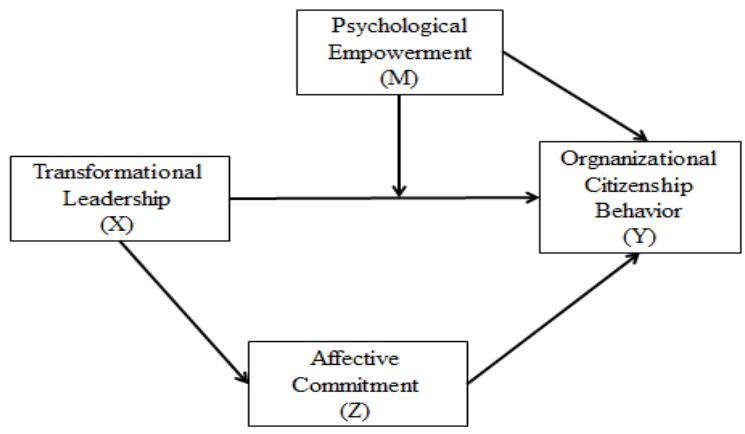 Figure 1: Theoretical Framework
## III. METHOD
The object of this research was STAFFING & HUMAN RESOURCES DEVELOPMENT AGENCY of West Sumatera Province. The number population of the study was 128.680 employees, while the sample was 398 employees. To get the samples, this study performed simple random sampling. Primary data collection using a closed questionnaire. The OCB variable was measured by 5 dimensions, namely: altruism, civic virtue, courtesy, conscientiousness, and sportsmanship, where the five dimensions were measured by 20 statement items developed by (Morrison, 1994). TLwas measured by 4 dimensions: inspirational motivation, idealized influence, intellectual stimulation, and individual consideration, and the four dimensions were measured by 19 statement items (Avolio & Bass, 2004). Moreover, the PE variable had 4 dimensions, namely: meaning, competence, self-determination, and impact, which were measured using 12 statement items (Spreitzer, 1995). While AC was measured by 8 statement items (Meyer, Allen, & Smith, 1993). All variables in this study were measured using a Likert-5 scale. To test the hypothesis, this study performed the Smart-PLS software.
## IV. RESULT AND DISCUSSION
Next, some descriptive statistics of the sample are provided. A profile of the participating employees in the study is presented in Table 1.
Table 1: The Profile of Participating Employees
<table><tr><td>Demographic</td><td>Categories</td><td>Frequency</td><td>(%)</td></tr><tr><td rowspan="2">Gender</td><td>Male</td><td>164</td><td>41.21</td></tr><tr><td>Female</td><td>234</td><td>58.79</td></tr><tr><td rowspan="4">Age</td><td>18-27 years old</td><td>87</td><td>21.88</td></tr><tr><td>28-38 years old</td><td>193</td><td>48.44</td></tr><tr><td>39-49 years old</td><td>50</td><td>12.50</td></tr><tr><td>50-60 years old</td><td>68</td><td>17.19</td></tr><tr><td rowspan="3">Education</td><td>Senior High School</td><td>62</td><td>15.60</td></tr><tr><td>Undergraduate</td><td>305</td><td>76.60</td></tr><tr><td>Master</td><td>31</td><td>7.80</td></tr><tr><td rowspan="4">Working experience</td><td>Less than 8 years</td><td>205</td><td>51.60</td></tr><tr><td>9 - 18 years</td><td>125</td><td>31.30</td></tr><tr><td>19 - 27 years</td><td>62</td><td>15.60</td></tr><tr><td>More than 27 years</td><td>6</td><td>1.60</td></tr></table>
Table 1 displayed that the majority of respondents were female which accounted for 234 employees (58.79%). Next, the majority of respondents were between 28-38 years old which accounted for 193 employees (48.44%) while the educational background of participating employees was undergraduate 305 employees (76.60%). Furthermore, the majority of respondents had a working period of fewer than 8 years which accounted for 205 employees (51.60%).
Moreover, the Measurement Assessment Model (MMA) specifies the relationship between latent variables and their indicators (Hair et., 20. The MMA defines how each indicator relates to its latent variable. The MMA consists of convergent validity and discriminant validity. The convergent validity which consists of outer loading $>0.7$, Cronbach's alpha (CA) $>0.7$, composite reliability $(\mathrm{CR}) > 0.7$, average variance extracted $(\mathrm{AVE}) > 0.5$, while discriminant validity consists of Fornell-Larcker criterion (Sefnedi, 2019). The results of the MMA analysis can be seen as follows:
Table 2: Convergent Validity
<table><tr><td>Variables</td><td>Valid Items</td><td>Outer loading</td><td>Cronbach's Alpha (CA)</td><td>Composite Reliability (CR)</td><td>Average Variance Extracted (AVE)</td></tr><tr><td>Organizational Citizenship Behavior (OCB)</td><td>13</td><td>0,770-0,869</td><td>0,962</td><td>0,966</td><td>0,689</td></tr><tr><td>Affective Commitment (AC)</td><td>8</td><td>0,860-0,916</td><td>0,961</td><td>0,967</td><td>0,786</td></tr><tr><td>Transformational Leadership (TL)</td><td>13</td><td>0,739-0,882</td><td>0,964</td><td>0,968</td><td>0,698</td></tr><tr><td>Psychological Empowerment (PE)</td><td>10</td><td>0,845-0896</td><td>0,966</td><td>0,970</td><td>0,763</td></tr></table>
Based on the results of the convergent validity analysis presented in table 2 above, it showed that the variable of OCB had 13 valid statement items with the outer loading value ranging from 0.770 to 0.869. All statement items on the variable of AC were declared valid with the outer loading value ranging from 0.860 to 0.916. Meanwhile, the variables of TL and PE had 13 and 10 valid statement items respectively, where all statement items had an outer loading value above 0.70.
In addition, Table 2 displayed the CA and CR values for the four research variables (OCB, AC, TL, and PE) greater than 0.70 and the AVE values above 0.5. Thus, all the requirements in the outer model were met.
Next, discriminant validity describes the uniqueness of a variable from other variables. The results of the discriminant analysis using the Fornell-Larcker criterion can be seen as follows:
Table 3: Discriminant Validity-Fornell-Larcker Method
<table><tr><td>Variables</td><td>TL *PE</td><td>Affective Commitment (AC)</td><td>Transformational Leadership (TL)</td><td>Organizational Citizenship Behavior (OCB)</td><td>Psychological Empowerment (PE)</td></tr><tr><td>TL *PE</td><td>1.000</td><td>-</td><td>-</td><td>-</td><td>-</td></tr><tr><td>Affective Commitment (AC)</td><td>0.376</td><td>0.887</td><td>-</td><td>-</td><td>-</td></tr><tr><td>Transformational Leadership (TL)</td><td>0.374</td><td>0.786</td><td>0.836</td><td>-</td><td>-</td></tr><tr><td>Organizational Citizenship Behavior(OCB)</td><td>0.470</td><td>0.791</td><td>0.828</td><td>0.830</td><td>-</td></tr><tr><td>Psychological Empowerment (PE)</td><td>0.190</td><td>0.732</td><td>0.729</td><td>0.730</td><td>0.874</td></tr></table>
Table 3 revealed that the correlation coefficient of a variable with the variable itself was greater than the other variables. For instance, the correlation between AC and AC was 0.887, where the correlation value was greater than the correlation between AC and TL (0.86), AC and OCB (0.791), and AC and PE (0.732). This means that there is a uniqueness in the AC variable. This uniqueness also occurred on other variables such as TL, OCB, and PE.
Moreover, the structural assessment model (SMA) described the relationship between latent variables based on substantive theory. The structural model was evaluated by R square $(R^2)$ and Q square $(Q^2)$. $R^2$ of endogenous variables in this study was useful to determine the magnitude of the effect of exogenous variables on endogenous variables. While $Q^2$ (predictive relevance) was to determine the capability or ability to predict exogenous variables using the blindfolding procedure.
Table 4: R square and Q square
<table><tr><td>Endogenous Variables</td><td>Rsquare</td><td>Qsquare</td></tr><tr><td>Organizational Citizenship Behavior (OCB)</td><td>0.778</td><td>0.511</td></tr><tr><td>Affective Commitment (AC)</td><td>0.618</td><td>0.473</td></tr></table>
Table 4 showed the R square value for OCB was 0.778 which means that the magnitude of the influence of TL, AC, and PE on OCB is $77.8\%$ (Strong). While the AC variable had an R square of 0.618 it could be interpreted that the variation of affective commitment was explained by TL of $61.8\%$ (Medium). Furthermore predictive relevance variable used Q square where the value must be greater than zero (Hair et al., 2014). In Table 4, it could be seen that the value of Q square on the OCB variable was 0.511 which means that the ability of TL, AC, and PE in predicting OCB belongs to the strong category. Meanwhile, the Q square on the AC variable was 0.473, which means that TL's ability to predict AC is classified into a strong category.
Moreover, the results of hypothesis testing in the study by using the bootstrapping method (500 subsamples) were as follows:
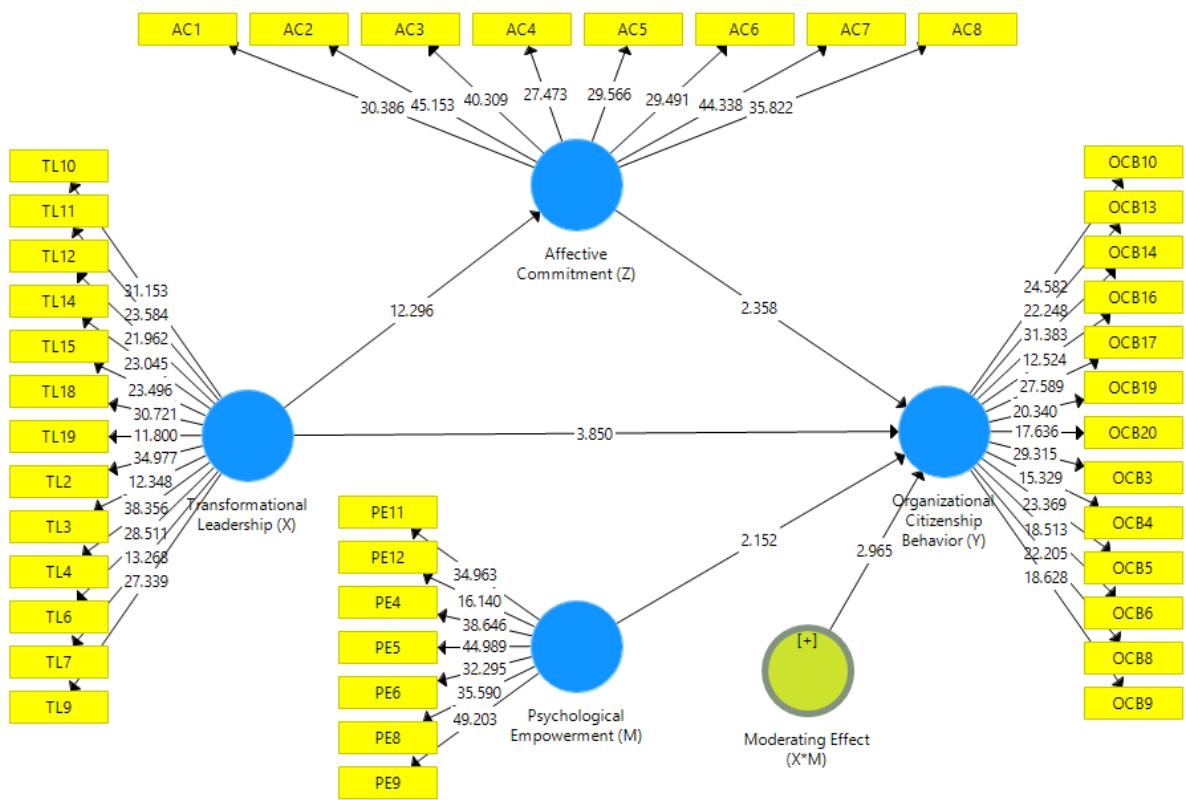
Table 5: Summary of Hypothesis Testing
<table><tr><td>Directions</td><td>Original Sample</td><td>T-Statistics</td><td>P-Values</td><td>Hypotheses</td></tr><tr><td>TL →OCB</td><td>0.430</td><td>3.850</td><td>0.000</td><td>H1supported</td></tr><tr><td>TL → AC</td><td>0.786</td><td>12.296</td><td>0.000</td><td>H2supported</td></tr><tr><td>AC →OCB</td><td>0.250</td><td>2.358</td><td>0.019</td><td>H3supported</td></tr><tr><td>TL → AC →OCB</td><td>0.197</td><td>2.322</td><td>0.021</td><td>H4supported</td></tr><tr><td>PE →OCB</td><td>0.195</td><td>2.152</td><td>0.032</td><td>H5supported</td></tr><tr><td>TL*PE →OCB</td><td>0.239</td><td>2.965</td><td>0.003</td><td>H6supported</td></tr></table>
Table 5 revealed that TL had a positive and significant effect on OCB because it had t-statistics of 3.850 (higher than 1.96) and p-values of 0.000 (less than 0.05). Therefore, the first hypothesis $(\mathsf{H}_1)$ was supported. This finding means that the better the TL implemented in STAFFING & HUMAN RESOURCES DEVELOPMENT AGENCY, the higher OCB will be. The findings of this study are in line with several previous studies which found that TL had a positive and significant effect on OCB (Zaki et al., 2021; Jha, 2014; Khalili, 2017; Suliman & Al Obaidli, 2013; Zacher & Jimmieson, 2013).
Furthermore, TL was also found to have a positive and significant effect on AC because it had t-statistics of 12.296 (higher than 1.96) and p-values of 0.000 (less than 0.05). Therefore, the second hypothesis $(\mathsf{H}_2)$ was supported. This finding can be interpreted as the better the TL implemented in STAFFING & HUMAN RESOURCES DEVELOPMENT AGENCY, the higher AC will be. The findings of this study are in line with several previous studies which found that TL had a positive and significant effect on AC (Ratina et al., 2021; Gyensare, Anku-tsede, Sanda, & Okpoti, 2016; Jauhari, Singh, & Kumar, 2017; Ribeiro, Yucel, & Gomes, 2018)
The results of hypothesis testing displayed that AC affected OCB positively and significantly because it had t-statistics of 2.358 (higher than 1.96) and p-values of 0.019 (less than 0.05). Therefore, the third hypothesis $(\mathsf{H}_3)$ in this study was supported. This finding means that the higher the AC of STAFFING & HUMAN RESOURCES DEVELOPMENT AGENCY employees, the higher OCB will be. The findings of this study are supported by several previous studies which found that AC had a positive and significant effect on OCB (Jain, 2016; Lau, Mclean, Lien, & Hsu, 2016; Bilgin, Kuzey, Torlak, & Uyar, 2015; Ng & Feldman, 2011).
Next, the results of the analysis revealed that AC mediated the relationship between TL and OCB because it had t-statistics of 2.322 (higher than 1.96) and p-values of 0.021 (less than 0.05). Therefore, the fourth hypothesis $(\mathsf{H}_4)$ in this study was supported. This finding means that the better the TL implemented in STAFFING & HUMAN RESOURCES DEVELOPMENT AGENCY, the higher the OCB and turn increase in the OCB of the employees.Interestingly, table 5 showed that TL had a positive effect on OCB (direct effect) which was indicated by the positive value of the original sample of 0.430. Likewise, the impact of the TL on OCB through AC (indirect effect) had a positive original sample value of 0.197. Thus, it is concluded that AC as a mediator between TL and OCB was classified into a complementary mediator type (Zhao et al., 2010).
The result of the fifth hypothesis testing this hypothesis was found that PE positively and significantly influenced OCB because it had t-statistics of 2.152 (higher than 1.96) and p-values of 0.032 (less than 0.05). Therefore, the fifth hypothesis $(\mathsf{H}_5)$ in this study was supported. This finding means that the higher the PE of STAFFING & HUMAN RESOURCES DEVELOPMENT AGENCY employees, the higher OCB will be. The findings of this study are in line with several previous studies which confirmed that PE had a positive and significant effect on OCB (Joo & Jo, 2017; Islam, Khan, & Bukhari, 2016; Kasekende, Munene, Otengei, & Ntayi, 2016)
The final hypothesis in this study was PE moderated the relationship between TL and OCB. The results of this hypothesis testing found t-statistics of 2,965 (higher than 1.96) and p-values of 0.003 (less than 0.05). Thus, the fifth hypothesis $(\mathsf{H}_5)$ in this study was supported. The finding means that PE moderates the relationship between TL and OCB. The finding is in line with the results of research conducted by Jha (2014). In addition, PE in moderating the relationship between TL and OCB had a quasi-moderator type (Sharma, Durand & Gur-Arie, 1981). This was because PE in addition to playing a role in moderating the relationship between TL and OCB also had a direct effect on OCB (See the results of the fifth hypothesis testing).
## V. CONCLUSION AND RECOMMENDATION
The study extended the literature on organizational citizenship behavior, affective commitment, transformational leadership, and psychological empowerment in the public organization. The results of this study suggested that the variable of transformational leadership was a significant predictor of affective commitment and organizational citizenship behavior. The affective commitment also was found to have a positive effect on organizational citizenship behavior. Furthermore, the affective commitment was proven to mediate the relationship between transformational leadership and organizational citizenship behavior. In addition, the result of the analysis displayed that psychological empowerment was an important variable in explaining organizational citizenship behavior and it also moderated the relationship between transformational leadership and organizational citizenship behavior.
This study has a limitation itself namely cross-sectional design. Therefore, a longitudinal study is recommended future to investigate the mediating effect of affective commitment and psychological empowerment as moderators. Thus, the next study could examine and evaluate the role of affective commitment as a mediator and psychological empowerment as a moderator on the relationship between transformational leadership and organizational citizenship behavior.
Generating HTML Viewer...
References
40 Cites in Article
Deogratius Kimolo,Nicholas Odhiambo,Sheilla Nyasha (2012). Inflation Dynamics in Post-Independence Rwanda.
R Arifiani,E Astuti,I Ruhana (2016). Pengaruh Kepemimpinan Transformasional Terhadap Organizational Citizenship Behavior dan Kepuasan Kerja (Studi pada Tenaga Perawat RSUD. Dr. Saiful Anwar Malang).
B Avolio,B Bass (2004). Multifactor Leadership Questionnaire. Manual and Sampler Set.
N Bilgin,C Kuzey,G Torlak,A Uyar (2015). An investigation of antecedents of organizational citizenship behavior in the Turkish hospitality industry : a structural equation approach.
Peter Blau (1964). Justice in Social Exchange.
Michael Gyensare,Olivia Anku-Tsede,Mohammed-Aminu Sanda,Christopher Okpoti (2016). Transformational leadership and employee turnover intention.
A Hassi (2018). You get what you appreciate": Effects of leadership on job satisfaction, affective commitment, and organizational citizenship behavior.
Talat Islam,Mubbsher Khan,Fida Bukhari (2016). The role of organizational learning culture and psychological empowerment in reducing turnover intention and enhancing citizenship behavior.
A Jain (2016). Volunteerism, affective commitment, and citizenship behavior: an empirical study in India.
Hemang Jauhari,Shailendra Singh,Manish Kumar (2017). How does transformational leadership influence proactive customer service behavior of frontline service employees? Examining the mediating roles of psychological empowerment and affective commitment.
Sumi Jha (2014). Transformational leadership and psychological empowerment.
Baek-Kyoo Joo,Sung Jo (2017). The effects of perceived authentic leadership and core self-evaluations on organizational citizenship behavior.
Joseph Hair,W Black,B Babin,R Anderson (2014). Multivariate Data Analysis: A Global Perspective.
I Juniartha,I Wardana,M Putra (2016). Pengaruh Kepemimpinan Transformasional Terhadap Organizational Citizenship Behavior (OCB) Melalui Mediasi Kepercayaan Kepada Atasan dan Kepuasan Kerja (Studi pada Pegawai Tetap Balai Diklat Industri Kementerian Perindustrian Republik Indonesia).
F Kasekende,J Munene,S Otengei,J Ntayi (2016). Linking teacher competencies to organizational citizenship behavior: the role of empowerment.
Ashkan Khalili (2017). Transformational leadership and organizational citizenship behavior.
Beomcheol Kim,Gyumin Lee,Suzanne Murrmann,Thomas George (2012). Motivational Effects of Empowerment on Employees’ Organizational Commitment.
Patricia Lau,Gary Mclean,Bella Ya-Hui Lien,Yen-Chen Hsu (2016). Self-rated and peer-rated organizational citizenship behavior, affective commitment, and intention to leave in a Malaysian context.
Ye Lee,Boyun Woo,Yukyoum Kim (2017). Transformational leadership and organizational citizenship behavior: Mediating role of affective commitment.
Zachary Mercurio (2015). Affective Commitment as a Core Essence of Organizational Commitment.
John Meyer,Natalie Allen,Catherine Smith (1993). Commitment to organizations and occupations: Extension and test of a three-component conceptualization..
E Morrison (1994). ROLE DEFINITIONS AND ORGANIZATIONAL CITIZENSHIP BEHAVIOR: THE IMPORTANCE OF THE EMPLOYEE'S PERSPECTIVE..
Thomas Ng,Daniel Feldman (2011). Affective organizational commitment and citizenship behavior: Linear and non-linear moderating effects of organizational tenure.
Samuel Nguni,Peter Sleegers,Eddie Denessen (2006). Transformational and transactional leadership effects on teachers' job satisfaction, organizational commitment, and organizational citizenship behavior in primary schools: The Tanzanian case.
Christoph Nohe,Guido Hertel (2017). Transformational Leadership and Organizational Citizenship Behavior: A Meta-Analytic Test of Underlying Mechanisms.
N Ratina,R Letariani,R Indradewa,T Syah (2020). The Effect of Transformational Leadership on Affective Commitment with Kob Satisfaction and Organizational Culture as an Intervening Variable.
Neuza Ribeiro,İlhami Yücel,Daniel Gomes (2018). How transformational leadership predicts employees’ affective commitment and performance.
S Robbins,T Judge (2008). Perilaku Organisasi Edisi ke-12.
Sefnedi Sefnedi (2019). THE IMPACT OF SERVICE QUALITY ON BANKING CUSTOMER LOYALTY: THE ROLE OF SATISFACTION AND SWITCHING COSTS AS MEDIATOR.
Subhash Sharma,Richard Durand,Oded Gur-Arie (1981). Identification and Analysis of Moderator Variables.
G Spreitzer (1995). PSYCHOLOGICAL, EMPOWERMENT IN THE WORKPLACE: DIMENSIONS, MEASUREMENT AND VALIDATION..
E Sule,D Priansa (2018). Kepemimpinan & Perilaku Organisasi (Membangun Organisasi Unggul di Era Perubahan) (I).
Abubakr Suliman,Hanan Al Obaidli (2013). Leadership and organizational citizenship behavior (OCB) in the financial service sector.
Wirawan (2013). Kepemimpinan: Teori, Psikologi, Perilaku Organisasi, Aplikasi dan Penelitian.
G Yukl (2010). Kepemimpinan dalam Organisasi (Terjemahan).
R Yusuf,D Syarif (2018). Komitmen Organisasi: Definisi, Dipengaruhi dan Mempengaruhi.
Hannes Zacher,Nerina Jimmieson (2013). Leader‐follower interactions: relations with OCB and sales productivity.
Muhammad Zaki,Azzim Al,Juhaizi Mohd Yusof2,Aishah Nur,Awi (2021). The Influence of Transformational leadership on Organizational Commitment and Organizational Citizenship Behavior (OCB) of Employees at Terengganu's Government Linked Companies (GLCS).
X Zhao,J Lynch,Q Chen (2010). Reconsidering Baron and Kenny: Myths and Truths about Mediation Analysis.
C Zurnali (2010). Learning Organization, Competency, organizational Commitment dan Customer Orientation: Knowledge Worker-Kerangka Riset Manajemen Sumberdaya Manusia di Masa Depan.
No ethics committee approval was required for this article type.
Data Availability
Not applicable for this article.
How to Cite This Article
Dorris Yadewani. 2026. \u201cThe Mediating Effect of Affective Commitment on Transformational Leadership-Organizational Citizenship Behavior Relationship: The Role of Psychological Empowerment as Moderator\u201d. Global Journal of Management and Business Research - B: Economic & Commerce GJMBR-B Volume 23 (GJMBR Volume 23 Issue B2).
Explore published articles in an immersive Augmented Reality environment. Our platform converts research papers into interactive 3D books, allowing readers to view and interact with content using AR and VR compatible devices.
Your published article is automatically converted into a realistic 3D book. Flip through pages and read research papers in a more engaging and interactive format.
Our website is actively being updated, and changes may occur frequently. Please clear your browser cache if needed. For feedback or error reporting, please email [email protected]
Thank you for connecting with us. We will respond to you shortly.
Lorem ipsum dolor sit amet, consectetur adipiscing elit. Ut elit tellus, luctus nec ullamcorper mattis, pulvinar dapibus leo.
The Mediating Effect of Affective Commitment on Transformational Leadership-Organizational Citizenship Behavior Relationship: The Role of Psychological Empowerment as Moderator