Online food delivery applications (FDAs), a novel alternative marketing channel, have been extensively adopted by both enterprises and customers in the restaurant sector. Despite the changing consumer attitude towards FDA services, there is still a dearth of research on understanding consumers’ continued intention to use FDA services in Bangladesh’s expanding food delivery market, particularly after the COVID-19 pandemic. To attain this goal, this study employed the widely used Extended Unified Theory of Acceptance and Use of Technology (UTAUT2). The model was tested was evaluated using partial least square structural equation modeling (PLS-SEM) on 350 respondents. According to the findings of the study, performance expectancy, social influence, facilitating conditions, hedonic motivation, price value, information quality, and convenience are all critical factors in maintaining the desire to utilize FDA services in Bangladesh. However, effort expectancy, habit, and time-saving were insignificant in the context of Bangladesh. This study contributes theoretically and practically to academics and practitioners working in areas related to online FDAs services.
## I. INTRODUCTION
Owing to the meteoric rise of the internet and digital communication technologies, mobile applications (apps) have become an integral component of modern life (Ahn, 2022; Kapoor & Vij, 2018). Online shopping through mobile apps has shaped people's lifestyles and society at large (Almarashdeh et al., 2019). The food delivery industry has expanded concurrently with technological advancement (Ahmed et al., 2015; Kapoor & Vij, 2018). The term "deliver" or "take-out" refers to "a service that delivers products, such as food, promptly after receiving customers' orders." At an earlier stage of the food delivery industry, telephone food ordering services were the standard means of restaurant delivery before the widespread use of mobile phones (Kimes, 2011). Of late, digital transformation has resulted in a cascade of changes in all kinds of business operations (Erjavec & Manfreda, 2022). The food delivery industry has not been an exception to these reforms, as indicated by the increased usage of food delivery apps (FDAs) (Amin et al., 2020; Ramesh et al., 2023). Consumers only need a smart device (i.e., smart mobile phone or tablet) and an internet connection to download the FDAs to visit restaurants and order food (Michaeli, 2015). Online food delivery services are gaining popularity as they offer clients with greater flexibility and convenience, especially those who are engaged in a hectic work schedule from home or the office (Chotigo & Kadono, 2021). FDAs include many functions and features that allow users to think about and plan meals from various outlets while being free to continue working. A growing number of restaurants are also responsible for the expansion of the online food delivery market in Bangladesh (Janairo, 2021). This is because they have merged with and created new FDAs as new ways to reach potential customers and increase sales volume in the highly competitive restaurant market, which has more than 4,36,274 restaurants (Siddiqi, 2021). In contrast, consumers could use it to choose high-quality food without preparing the meal, going to a restaurant, or waiting for the food to be ready (Saad, 2020). Consumers do not need physical contact with the restaurant in the buying process, even making payments; they may do so entirely using a mobile app and have their food delivered directly to their homes(Rigby, 2011). Users can also compare offers from different restaurants, share their dining experience with pictures and videos, and give "likes" and feedback on these mobile apps (Javed et al., 2021).
Since the launch of the "HungryNaki" online meal delivery service in 2013, Bangladeshi consumers have continued to embrace FDA services(Ahmed, 2017).Over time, several FDAs have started doing business in Bangladesh (Bappy & Mirdha, 2021; Hossain, 2022). However, services like this started up in other parts of the world around the 2000s. According to Worldometer (2023), Bangladesh has 169.34 million people, and the population density is around 1,265 people per square mile. The Association of Mobile Telecom Operators of Bangladesh (AMTOB) reports 183.89 million mobile phone users; of those, 114.07 million were Internet subscribers as of March 2023 (AMTOB, 2023). By 2025, there are predicted to be $62\%$ of all mobile phone users who use a smartphone, up from the current rate of $41\%$ (Bhuiyan, 2021). From 2023 to 2027, the e-commerce market in Bangladesh is anticipated to grow by $15.90\%$, resulting in a market volume of US $15.24 billion by the end of that period(AMTOB, 2023). Moreover, about half of the people \((50\%$ of them) in the country are under 25 years old, and this demographic is primarily interested in eating out at restaurants and fast food establishments (Amin et al., 2020). Prior literature has mainly concentrated on evaluating the organizational outcome of online food delivery services (Mahmud, 2019; Miah et al., 2022; Neger & Uddin, 2020; Showrav et al., 2021; Sumi & Ahmed, 2022). Habib and Hamadneh (2021) and Dsouza and Sharma (2021) argued that changing lifestyles, increased disposable income, working pressure in daily life, and increased technology dependency may lead to the improving popularity of online food delivery services. According to a survey report by Bappy and Mirdha (2021), daily online food delivery was around 100,000 parcels together in two major cities (i.e., Dhaka and Chittagong). From 2023 to 2027, it is projected to grow by $21.29\%$ in the online food delivery market of Bangladesh, resulting in a market volume of US\)2,106 million in 2027 (Statista, 2023). Thus, online food delivery service has indeed become more prevalent in Bangladesh since 2013. The available FDAs services in Bangladesh are HungryNaki, FoodPanda, Pathao Food, Shohoz Food, Khaas Food, Cookups, Foodfex, FoodMart, and Chaldal (Aryani et al., 2022; Maria, 2023).
Online food delivery services had a substantial impact on consumer behavioral intentions during the COVID-19 outbreak, especially among Bangladeshi urban consumers (Amit, 2020; Shankar et al., 2022). This is due to the fact that on March 26, 2020, Bangladesh implemented various restrictions on dine-in as part of the government's Movement Control Order (MCO) to prevent the spread of COVID-19 (Hassan, 2021). Resulting online food delivery services have become a lifeline for many restaurant businesses (Mehrolia et al., 2021; Muangmee et al., 2021). The surge of online food orders and delivery has witnessed the popularity of FDAs in this global pandemic. FDAs have also emerged as the best choice for people who want to purchase meals in a contactless manner or who want to stay at home with their families. The shift in customer online habits may fuel the growth of the online retail industry in Bangladesh, including the online food delivery business (Bappy & Mirdha, 2021; Kader, 2020). Despite the shifting consumer behavior toward FDA services, the majority of earlier research studies have paid increased attention to the evaluation of organizational outcomes for online food delivery services (Chai & Yat, 2019; Saad, 2020). However, there is still a lack of research on understanding consumer behavioral intention toward FDA services after the COVID-19 pandemic, especially in the growing food delivery market in Bangladesh (Musakwa & Petersen, 2023; Yapp & Kataraian, 2022). Hence, the purpose of the study is to identify the key determinants that may influence consumers for continued to use motivations of FDAs services through the lens of the Unified Theory of Acceptance and Use of Technology (UTAUT) (Venkatesh et al., 2003) and subsequent extensions of the UTAUT2(Slade et al., 2015; Venkatesh et al., 2012).
By addressing these gaps, our study adds three additional critical components to the model: information quality, convenience, and time-saving. Moreover, this research can shed light on the importance of consumer psychology in determining whether or not businesses will continue to offer FDA services after a pandemic, such as the one caused by the COVID-19 virus.
The following section of the paper goes through theoretical development and research hypotheses. The subsequent section covers the methodology, followed by the empirical findings and a discussion of the theoretical contributions and practical implications. Finally, the work concludes with limitations and implications for future research.
## II. LITERATURE AND HYPOTHESIS
### a) Food Delivery Applications (FDAs)
FDAs, which are a new type of online-to-offline service, connect dinners with their favorite restaurants by bridging the gap between online ordering and in-person delivery services (Zhao & Bacao, 2020). FDA provides various options and enables consumers to order from various host restaurants directly through its mobile phone application (Pillai et al., 2022). There are two main types of FDAs, as described by Ray et al. (2019). First, there are the restaurants themselves, which include Pizza Hut, KFC, and Domino's Pizza. Second, third-party intermediate platforms are becoming increasingly popular and have been widely embraced in Bangladesh. Some examples of these platforms include FoodPanda, HungryNaki, Pathao Food, Chaldal, and Foodfex (Maria, 2023). Customers can choose from a variety of restaurant options and place their orders through an FDA service platform on their mobile phones. The restaurant is responsible for receiving the customer's order and preparing the food after it has been paid for (An et al., 2023; Novita & Husna, 2020). The order is then brought to the consumer by a delivery man. Customers can use the app to monitor the progress of their orders and communicate with the drivers who are delivering them (Chakraborty, 2022). Hence, FDA services eliminate waiting in line, traveling for pick-up, and miscommunication, which often occurs in restaurants and phone orders (Gani et al., 2023).
A clearer picture of the FDA's service quality emerged during the COVID-19 outbreak(Hong et al., 2021). Hasan et al. (2023) stated that most customers utilized FDAs to avoid interacting with staff members and stay away from people in places. Accordingly, Khosasih and Lisana (2023) and Gani et al. (2023) revealed that consumers' habits in terms of information-seeking and decision-making regarding ready-to-eat food have significantly changed over this period. Thus, the FDA has created a new consumer market by providing 24/7 services via its extensive business and service model (Hasan et al., 2023; Pillai et al., 2022). Numerous studies have been undertaken in recent years in order to investigate the underlying driving forces that are responsible for the adoption and use of mobile FDAs services. Food image, hedonic, utilitarian, perceived informativeness (Khosasih & Lisana, 2023), service quality, price value, delivery experience, and convenience (Hasan et al., 2023), online review content (Shah et al., 2023), information quality, ease of use, and various food choice (Bao & Zhu, 2022). In addition, aggressive discounts, fulfillment, and multiple payments (Pandey et al., 2022), expectation confirmation, perceived usefulness, dinning attitude, satisfaction (Amin et al., 2020), delivery time, food conditions (Saad, 2020), societal pressure, customer experience, a searching of restaurants, quality control, listing (Ray et al., 2019), design, trustworthiness(Cho et al., 2019), and prior online purchase experience (Yeo et al., 2017).
Thus, the purpose of this study was to determine which aspects of the FDA's service technology best predict consumers' intentions to use a mobile food delivery service application. This study seeks to evaluate the UTAUT2 (Venkatesh et al., 2012) and some crucial determinants, including information quality, convenience, and time-saving, as they relate to consumers' continuous use intentions of FDA services.
### b) Continuance usage Intention
In the field of consumer behavior, consumers usually go through an evaluation process before deciding whether or not to make a repeat purchase (Oliver, 1980). Zeithaml et al. (1990) argue that before making a purchase, consumers form impressions of a product or service based on their prior knowledge and experiences. Customers judge the quality of the service and evaluate it in relation to the standards they had set for it initially. In this way, behavioral intention measures how likely it is that a user will do a specific action in the future. Customers are more likely to make repeat purchases when they feel their experiences have been positive (Kupfer et al., 2016). According to Bhattacherjee et al. (2008) and Bhattacherjee and Lin (2015), the likelihood of people continuing to use a technological product or service is equivalent to their likelihood of repeat purchases. Even though well-known behavioral models like the technology acceptance model (Davis, 1989) and the theory of planned behavior (Ajzen, 1991) have been used a lot to study what makes people accept new technological products and services, they can only explain users' behavior in the early stages of acceptance (Ambalov, 2018). Adoption and continuation of technology, in particular, are distinct actions both in terms of concept and over time (Bhattacherjee & Lin, 2015). Acceptance is an early stage of a person's experience with technology when they do not know anything about it. In later stages, other factors can affect a person's decision to keep using the technology (Arts et al., 2011; Kim & Malhotra, 2005). According to Bhattacherjee (2001) and Ambalov (2018), the long-term feasibility and success of new technology products or services are primarily dependent on their adoption and continued usage. This is true despite the fact that initial acceptance is an important factor. Consumers' persistent use of products or services, such as FDA services, can be better understood with the help of the UTAUT2 model (Santosa et al., 2021). As a result, it is critical to investigate UTAUT2's generalizability in various research contexts.
### c) Unified Theory of Acceptance and Use of Technology 2
Many models, including the technology acceptance model (TAM) (Davis, 1989), the theory of planned behavior (TPB) (Ajzen, 1991), a combined TAM and TPB (Taylor & Todd, 1995), and innovation diffusion theory (IDT) (Rogers, 1995), have been developed and extensively tested to predict users' behavioral intention to use new technology systems. In particular, the unified theory of acceptance and use of technology (UTAUT) model, which was developed by Venkatesh et al. (2003), has been modified with eight theories/models of technology acceptance that are widely used in mobile technology adoption. This modification was made to understand better how people accept and use new technologies. In the first version of the UTAUT model, there were supposed to be four different independent variables or constructs. These were performance expectancy, effort expectancy, social influence, and facilitating conditions. According to Venkatesh et al. (2012), the primary objective of the development of UTAUT2 was to place emphasis on the use context of individual consumers. The original UTAUT literature measures intent to adopt, while UTAUT2 measures intent to continue using (Erjavec & Manfreda, 2022; Venkatesh et al. 2003). Three additional variables- habit, hedonic motivation, and price value-were examined in the extended UTAUT2 model from the perspective of an individual's information system adoption and use intention. Additionally, the moderated relationships between factors like gender, age, experience, and voluntariness of use were confirmed by the UTAUT2. This study assessed UTAUT2 and information quality, convenience, and time-saving on users' continuance intention to use without including any moderating variables such as gender, age, experience, and voluntariness(Yap & Lee, 2023).
Table 1 presents a selected study on FDAs that attempted to apply UTAUT2 to understand the factors influencing customers' continued use of FDAs over the past few years. Researchers have mostly used the UTAUT theory as their main framework, but Musakwa and Petersen (2023) looked into UTAUT2, and Zhao and Bacao (2020) combined the task-technology fit mode and the expectancy confirmation theory into the UTAUT theory. Even though UTAUT is the underlying theory, not every researcher kept the original independent variables but instead added new variables to their research (Ali et al., 2023; Santos & Patiu, 2023). Venkatesh et al. (2012) revealed that UTAUT2 demonstrates significant results in elucidating the essential determinants of an individual's continued technology use. Extending or adapting UTAUT2 to diverse research contexts and theories concentrating on a specific context is essential for a deep knowledge of the focal phenomenon (Venkatesh et al., 2012).
This research has largely concentrated on the multi-dimensional attributes of FDAs and the characteristics and behavior of users. Figure 1 depicts the seven factors (i.e., performance expectancy, effort expectancy, social influence, facilitating conditions, price value, hedonic motivation and habit) proposed by Venkatesh et al. (2012) for the model of the current study. In addition to this, the same model will incorporate three more psychologically-related constructs, namely information quality, time-saving, and convenience.
Table 1: Studies on Online Food Delivery Apps (FDAs) using the UTAUT Theory
<table><tr><td>Relevant studies</td><td>Theoretical frameworks</td><td>Variables</td></tr><tr><td>(Musakwa & Petersen, 2023)</td><td>UTAUT2</td><td>PE, EE, SI, HM, PV, HB, FC, BI, UB</td></tr><tr><td>(Arora & Manchanda, 2023)</td><td>UTAUT2</td><td>PE, EE, SI, HB, PV, CI, CUI</td></tr><tr><td>(Ali et al., 2023)</td><td>UTAUT2</td><td>PE, EE, SI, PTR, MOUFA</td></tr><tr><td>(Santos & Patiu, 2023)</td><td>UTAUT2</td><td>IQ, PE, EE, SI, HM, FC, PV, HB, CUI, SAT,</td></tr><tr><td>(Ramos, 2022)</td><td>UTAUT2</td><td>EE, PE, food & beverage quality, and PV</td></tr><tr><td>(Taylor, 2021)</td><td>UTAUT2</td><td>PE, EE, SI, RK, TR, HM, PV, HB</td></tr><tr><td>(Alalwan, 2020)</td><td>UTAUT2</td><td>PE, EE, SI, FC, HM, PV, HB, ORV, ORT, OTR, SAT, CUI</td></tr><tr><td>(Zhao & Bacao, 2020)</td><td>UTAUT, ECM and TIF</td><td>PE, EE, SI, TR, TIF, COF, SAT, CUI</td></tr></table>
## i. Performance Expectancy
Performance expectancy was defined by Venkatesh et al. (2003) as "how much the use of technology in specific activities will benefit consumers." According to Alalwan (2020), performance expectancy refers to the perceived utility and benefits of a particular technology perceived by consumers to facilitate their tasks or activities productively. When consumer sperceive that a new technology will save them more time and effort than its predecessor, they are more likely to implement it. Therefore, the greater the perception that the utility and benefits of FDAs can enhance their lifestyles, the greater the intent to continue accepting and utilizing FDA services. Users are more likely to continue using a new app if it provides information more conveniently.
Performance expectation is synonymous with perceived usefulness and is also a major predictor of user behavioral intention (Holden & Karsh, 2010; Marangunic & Granic, 2015). Prior empirical studies have demonstrated a substantial association between performance expectations and continuance usage intention in domains such as mobile food ordering apps(Ramos, 2022), e-payment adoption (Santosa et al., 2021), and online games (Xu, 2014). Personalization in online food delivery apps corresponds to how appropriately and conveniently users can accomplish tasks such as navigating, selecting, and ordering foods, as performance expectancy is related to technology assisting in completing tasks vigorously and more quickly (Cheng et al., 2020). If consumers are presented with high-quality food photographs and relevant food content, their demand for more information and time to make judgments will be minimized, resulting in improved performance. Consequently, if users find online food delivery services via mobile applications useful, they are more likely to continue using them (Amalia, 2019; Khalil et al., 2020). As a result, the following hypothesis is proposed:
H1: Performance expectancy positively influences the continuous usage intention of FDA services.
## ii. Effort Expectancy
Effort expectancy is defined as the degree to which customers' perceived ease is connected with the usage of a given technology (Venkatesh et al., 2012). In the TAM paradigm, effort expectancy corresponds to perceived ease of use. Perceived ease of use of technology can encourage users to engage more with it (Okumus et al., 2018), but complexity can reduce users' intent to embrace or reuse it. Users in FDAs may order food without the intervention of restaurant or cafe employees. The design and structure of an FDA may improve consumers' capacity to process food orders and delivery in a timely and efficient manner (Gunden et al., 2020). As a result, the FDA's services are regarded as simple technology with a few steps in food ordering and multiple payment choices. Thus, effort expectancy is an essential factor significantly affecting users' behavioral intentions (Gunden et al., 2020; Saad, 2020). The greater the perceived ease of use of the FDA service, the more likely consumers would continue to use it beyond the initial adoption (Cho et al., 2019; Koiri et al., 2019; Pigatto et al., 2017; Roh & Park, 2019). A customer's willingness to continue using mobile food delivery apps may be influenced by their view of their simplicity and convenience of use, particularly after using the apps for a long time. The following hypothesis was developed based on the literature:
H2: Effort expectancy positively influences the continuous usage intention of FDA services.
## iii. Social Influence
Social influence is the extent to which users acquire willingness from the encouragement and support of their family members, peers, friends, and coworkers in deciding whether or not they will continue to utilize an application (Venkatesh et al., 2003). When users are encouraged and motivated by those near to them whose opinions they value, they develop an intention toward technology (Singh et al., 2020). Customers are more likely to consult their social network to obtain information about new technologies or social support to continue using them. Studies have demonstrated and empirically established the significance of social influence in predicting users' intention to continue using mobile wallet services (Singh et al., 2020), fitness apps (Dhiman et al., 2020), and online games (Xu, 2014).
Moreover, social influence may emerge when users begin comparing their opinions to those of others in the same social group (Khatimah et al., 2019). Regarding FDAs, users continue to use these applications if they receive social validation from their peers and family. According to Choi et al. (2014), the identification of friends or neighbors with the same predictions in recommendation systems can substantially affect users' attitudes toward new technologies. Consequently, it was hypothesized that:
H3: Social influence positively influences the continuous usage intention of FDA services.
## iv. Facilitating Condition
Facilitating condition refers to the degree to which an individual perceives that organizational and technical infrastructure supports the use of new technology (Venkatesh et al., 2003). Facilitating conditions also include the customers' perceptions of available resources and support (i.e., the system's access to instruction, guidance, and assistance) to perform the behavior (Nysveen & Pedersen, 2016). According to Zhang et al. (2011), facilitating conditions also play a significant role in determining the intention to continue using FDA services.
Users are more likely to stick with FDAs and less likely to switch services if they find the app's supporting features to be to their liking (Agarwal & Sahu, 2022). In order to make using FDAs more pleasurable, it may be proposed that customers think about an appropriate level of technological, operational, infrastructural, and human assistance (Osei et al., 2021). This led to the following hypothesis:
H4: Facilitating conditions positively influence the continuous usage intention of FDA services.
## v. Hedonic Motivation
Hedonic motivation is intrinsic and is connected to users' desire, entertainment, and pleasure after the experiences of using the products or services (Alalwan, 2020). It is also viewed as a critical influencer of consumers' intention to use new technology (Brown & Venkatesh, 2005). From an online food delivery service perspective, mobile delivery apps enable users to enjoy their favorite food without leaving their houses or workplaces. They may have their food delivered to their doorsteps.
If users enjoy using FDA services, it may encourage them to continue using them (Rasli et al., 2020). However, hedonic motivation is subjective; consumers can generate hedonic value through sensory, imaginative, and emotional experience-based pleasure during the buying process, influencing consumers' continuance usage intention towards FDA services (Rasli et al., 2020). Therefore, it was hypothesized that:
H5: Hedonic motivation positively influences the continuous usage intention of FDA services.
## vi. Price Value
The price value is the "consumers' cognitive exchange between perceived benefits of the applications and monetary cost for using them" (Venkatesh et al., 2012). Price value positively impacts intention to use as the advantage of technology use is more than currency benefits. Mobile app users usually consider the monetary amount incurred when they use the application. The relative advantage of online shopping is that it enables consumers to browse at different sites to compare prices, thus allowing them to purchase at a better bargain (Chiu et al., 2014). Thus, price value portrays the perceived benefits of using the app versus the monetary costs incurred using the app (Shaw & Sergueeva, 2019).
Additionally, Venkatesh et al. (2012) concluded that a positive price value could affect behavioral intention positively. Price value follows the ideas of perceived value (Venkatesh et al., 2012). Price value positively influences intention to use when the benefits of technology use are perceived to outweigh the monetary costs. The significant influence of perceived value over intention has been provided in some studies (Baabdullah et al., 2014). Regarding food delivery apps, consumers will use FDAs for a long time if the benefits are greater than the financial sacrifice. This is in line with the research from Hew et al. (2015), who described that price value influences behavioral intention. Alalwan (2020) showed that price is essential in attracting consumers and that particular quality value benefits the intention to reuse mobile food delivery apps. Jain et al. (2018) indicated that among the responsible factors of FDAs, signals and price fluctuations, discount offers, availability of comparative prices, and ease of choice are the prime exhibits. Rasli et al. (2020) found that attractive discounts, rewards, and cashback offers are also important factors that increase the popularity of the FDA service. In addition, mobile FDAs form alliances with restaurants, providing consumers with better promotional offers and tempting incentives as an alternative to physically dining at these locations. Hence, the following hypothesis is proposed:
H6: Price value positively influences the continuous usage intention of FDA services.
## vii. Habit
Habit is spontaneous tendencies performed automatically through learning (Limayem et al., 2007). Habit is a behavioral preference in the present, whereas intended use indicates the specific behavioral intention referring to future activities. Most habitual behavior of customers arises spontaneously and proceeds efficiently, effortlessly, and unconsciously due to their collected learning experience (Aarts et al., 1998). Research on habitual intentions has shown that habit has been a crucial factor in the potential adoption and usage of technology to facilitate behavioral improvements (Amoroso & Lim, 2017; Lee et al., 2019; Liao et al., 2006; Venkatesh et al., 2012).
In addition, when consumers are familiar with the FDA services, habits or past learning experiences may positively influence their continuous usage intention of FDAs (Chopdar & Sivakumar, 2019; Palau-Saumell et al., 2019). Thus, the following hypothesis proposes that:
H7: Habit positively influences the continuous usage intention of FDA services.
## viii. Information Quality
Information Quality (IQ) refers to the level of accuracy and consistency of the information provided by a firm related to its direction and product and service offerings(Zhou, 2011). Kaium et al. (2020) denoted that information quality describes various dimensions, including accuracy, currency, completeness, relevance, efficiency, scope, and timeliness. It is a vital determinant of a website's quality. Better information quality may provide enjoyment and positive behavioral intention (Santos & Patiu, 2023). In contrast, the poor quality of information may significantly affect business processes and causes client dissatisfaction (Rana et al., 2023). Very few studies have been conducted on the influence of information quality on continuance intention, especially in online food delivery services (Khalil et al., 2020; Nguyen et al., 2023; Rasli et al., 2020). Prasetyo et al. (2021) showed that users consider the basic features of FDAs and desire complete and updated information before their use. Lee et al. (2020) conducted a study on food safety push notifications and revealed that information quality significantly influences continuance usage intention. Information quality represents the foremost essential communication capability between a customer and a merchant and is thought to be the foundation for building trust (Zhou, 2013). Based on previous literature, the following statement was hypothesized:
H8: Information quality positively influences consumers' continuance usage intention of FDA services.
## ix. Time-Saving
Society is preoccupied with everyday activities and faces time constraints. As a result, items or services that can save them time are selected. In the context of FDA services, consumers perceive time savings as a critical element for measuring service quality (Banerjee et al., 2019). Users do not need to travel to a restaurant or café for meals or to wait in a restaurant for food to be given to them when they use FDAs (Chopdar & Sivakumar, 2019). Furthermore, time savings may raise a user's sense of self-control, which has been proven to increase the chance of continuing meal delivery apps in the future (Chai & Yat, 2019; Yeo et al., 2017). As a result, the following theory is proposed:
H8: Time-saving will positively influence the continuous usage intention of FDA services.
## x. Convenience
In simple terms, convenience is the time and effort required to obtain a service or purchase a product (Copeland, 1923). Convenience has been determined to play a critical role in creating customer choice for technology, as evidenced by the available literature (Chotigo & Kadono, 2021; Ozturk et al., 2016). Convenience is also known as the perceived benefit of mobile apps (Xu et al., 2019). In the context of mobile food delivery apps, the app allows users to order food anytime and anywhere. Not to mention that the food is subsequently delivered right to their doorsteps. Because of these factors, it encourages the user to reuse the application occasionally. According to Shah et al. (2021), they discovered that convenience significantly
influenced consumers' continuing intention. As a result, the following hypothesis is offered.
H10: Convenience positively influences the continuous usage intention of FDA services.
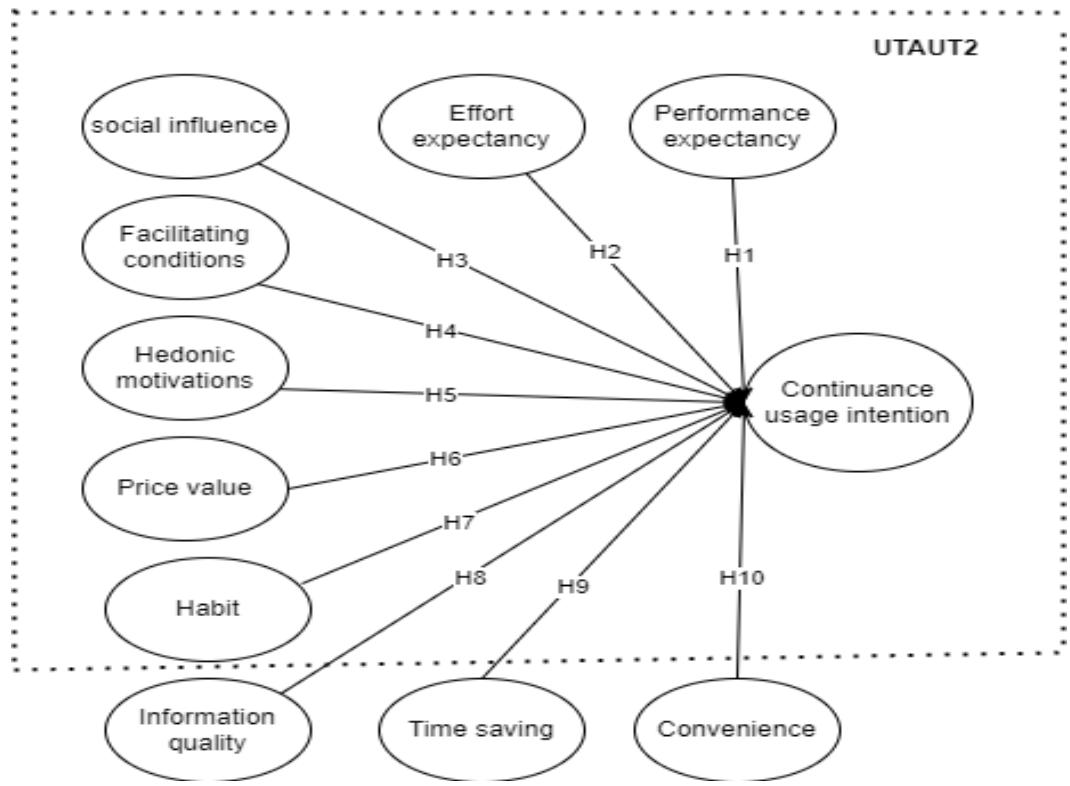 Fig. 1: The Conceptual Model
## III. METHODOLOGY
### a) Sampling and Data Collection
This study concentrated exclusively on food delivery applications FDAs service users residing in urban areas in Bangladesh. Due to time and resource constraints, the study adopted a convenience sampling method within a non-probability sampling technique, namely purposive sampling (Malhotra, 2010). Respondents who used an FDA and purchased food from it were eligible for this study. For this study, "Google Forms" was used to create an online questionnaire containing demographic and measurement items. The items of the questionnaire were originally written in English and then translated into Bengali using the back-translation process (Amin et al., 2020). The respondents communicated through Facebook and WhatsApp. We sent the questionnaire link to many Facebook and WhatsApp groups, such as faculty and student groups at Chittagong University, along with a cover letter to ensure the expediency of responding.
Moreover, the study utilized the snowballing technique by requesting respondents to forward the link to their personal Facebook pages and WhatsApp groups to get the maximum number of respondents (Taylor, 2021; Wang et al., 2019). The survey was open for one month, from January 15 to February 15, 2023. The G-Power program was used for the study, and a sample size of 140 respondents (at a minimum) was suggested. There were a total of 380 respondents participated in the survey. After excluding the incomplete responses, 350 (response rate of $54\%$ ) were chosen for data analysis.
Among them, 147 (42%) were men, and 203 (58%) were women. In terms of age, 79 respondents (22.57% of them) are below 24 years old, the majority, 182 respondents (52.43% of them) were between 25 and 39 ages, 16% of respondents were between 40 and 59 ages and the remaining 10% are above 60 years old. More than half of the respondents were unmarried. Only 26 respondents had a secondary level, 104 respondents had a higher secondary level, and 165 respondents had a university level of education. Almost all respondents had a monthly income of at least 20,000 to 39,000 BDT. Regarding occupation, students were 78, and 46.29% of respondents were government employees and professional job holders, respectively. With regards to frequency of FDAs use, the majority, 127 respondents (36.29% of them) reported above nine times in a month,
98 respondents (28% of them) used 7 to 8 times, and only 4% of them used one or two times in a week. In terms of FDAs used, the majority of respondents reported FoodPand, HungryNaki, and Pathao Food $23.14\%$, $15\%$ used, and $13\%$, respectively, only $2.58\%$
used other than these food delivery apps. Regarding respondents' FDA use experience, 245 respondents $(70\%)$ had been using FDAs for up to 2 years. The demographic profile of the respondents is shown in Table 2.
Table 2: Demographic Profile of Respondents (n = 350)
<table><tr><td>Variables</td><td>Characters</td><td>Number</td><td>Percentage (%)</td></tr><tr><td rowspan="2">Gender</td><td>Male</td><td>147</td><td>42</td></tr><tr><td>Female</td><td>203</td><td>58</td></tr><tr><td rowspan="4">Age</td><td>24 yrs. and Below</td><td>79</td><td>22.57</td></tr><tr><td>25-39 yrs.</td><td>182</td><td>52.43</td></tr><tr><td>40-59 yrs.</td><td>56</td><td>16</td></tr><tr><td>60 yrs. and above</td><td>35</td><td>10</td></tr><tr><td rowspan="2">Marital status</td><td>Single</td><td>195</td><td>55.71</td></tr><tr><td>Married</td><td>155</td><td>44.29</td></tr><tr><td rowspan="4">Educational level</td><td>Secondary level</td><td>26</td><td>7.42</td></tr><tr><td>Higher Secondary level</td><td>104</td><td>29.71</td></tr><tr><td>University</td><td>165</td><td>47.14</td></tr><tr><td>Other</td><td>55</td><td>15.71</td></tr><tr><td rowspan="4">Monthly income</td><td>Below Tk. 20,000</td><td>27</td><td>7.71</td></tr><tr><td>Tk. 20,000-39,000</td><td>144</td><td>41.14</td></tr><tr><td>Tk. 40,000-59,000</td><td>104</td><td>29.71</td></tr><tr><td>Above Tk. 60,000</td><td>75</td><td>21.43</td></tr><tr><td rowspan="8">Occupation</td><td>Student</td><td>78</td><td>22.29</td></tr><tr><td>Office worker</td><td>23</td><td>6.57</td></tr><tr><td>Sales & Service</td><td>54</td><td>15.43</td></tr><tr><td>Government employee</td><td>75</td><td>21.43</td></tr><tr><td>Professional job</td><td>87</td><td>24.86</td></tr><tr><td>Self-employed</td><td>20</td><td>5.71</td></tr><tr><td>Housewife</td><td>9</td><td>2.57</td></tr><tr><td>Other</td><td>4</td><td>1.14</td></tr><tr><td rowspan="5">Frequency of FDAs use per week</td><td>1-2 times</td><td>14</td><td>4</td></tr><tr><td>3-4 times</td><td>43</td><td>12.26</td></tr><tr><td>5-6 times</td><td>68</td><td>19.43</td></tr><tr><td>7-8 times</td><td>98</td><td>28</td></tr><tr><td>Above 9 times.</td><td>127</td><td>36.29</td></tr><tr><td rowspan="11">FDAs</td><td>HungryNaki</td><td>54</td><td>15.43</td></tr><tr><td>FoodPanda,</td><td>81</td><td>23.14</td></tr><tr><td>Pathao Food,</td><td>48</td><td>13.71</td></tr><tr><td>Shohoz Food,</td><td>32</td><td>9.14</td></tr><tr><td>Khaas Food,</td><td>25</td><td>7.14</td></tr><tr><td>Cookups,</td><td>14</td><td>4</td></tr><tr><td>Sheba Food,</td><td>13</td><td>3.71</td></tr><tr><td>Foodfex</td><td>24</td><td>6.86</td></tr><tr><td>FoodMart</td><td>17</td><td>4.86</td></tr><tr><td>Chaldal</td><td>33</td><td>9.43</td></tr><tr><td>Other</td><td>9</td><td>2.58</td></tr><tr><td rowspan="3">Use experience</td><td>Up to 1 yr.</td><td>56</td><td>16</td></tr><tr><td>1-2 yrs.</td><td>189</td><td>54</td></tr><tr><td>More than 2 yrs.</td><td>105</td><td>30</td></tr></table>
### b) Research Instrument
To verify the content validity of the survey instruments, two faculty members from the University of the First Author who have substantial experience with survey measurements examined them. In response to their criticism, some of the items' wording was modified.
In order to mitigate the risk associated with measurement errors, a pilot study was conducted on 20 FDA users in Bangladesh. Several elements of the pretest were modified slightly to improve their legibility and readability. We employed a five-point Likert scale ranging from "1 = strongly disagree" to "5 = strongly agree" to measure the items for the latent constructs. All of the items were derived from previous research. Table A1 lists the study items. The questionnaire contained 25 items previously developed and designed to assess the perception of online food delivery services applications, such as performance expectancy, effort expectancy, social influence, facilitating conditions, price value, hedonic motivation, and habit (Venkatesh et al., 2012), 11 items were used to assess the information quality (Lee et al., 2019), time-saving (Yeo et al., 2017) and convenience (Chotigo & Kadono, 2021). Three items were used to assess continuance usage intention (Cho et al., 2019).
## IV. DATA ANALYSIS
The descriptive statistics of a demographic profile were examined using the SPSS 25 packages, and the partial least squares structural equation modeling (PLS-SEM) with SmartPLS (SEM) version 3.2.8 was used to quantify the association between the variables. According to Hair Jr et al. (2017), one of the most prominent advantages of the PLS-SEM approach is that it possesses a strong predictive capacity for endogenous target variables, which is especially useful in highly completed models.
### a) Common Method Bias
Because the data for this study came from a single source (an experienced user), there is a chance of common method bias (CMB), which involves measuring both dependent and independent variables. Also, the study focused on statistical and methodological fixes before and after data collection to reduce the possibility of variance. Harman's single-factor test was used to figure out the CMB. In the principal component factor analysis, 11 of the factors had Eigen values that were greater than 1.0. These eleven factors explained $61\%$ of the variance. Also, the first factor did not explain most of the variance $(29.43\%)$. Based on the results, we can conclude that the CMB is not an issue for this research (Podsakoff & Organ, 1986).
## V. RESULT
### a) Measurement Model
We examined construct reliability, composite reliability, convergent validity, and discriminant validity using the approaches proposed by Hair et al. (2017). Composite reliability (CR), Cronbach's alpha greater than 0.7, and roh_A near 1.00 are indicative of high consistency (Hair et al., 2017). Table 3 demonstrations that the eleven constructs met the criteria for internal consistency. To show convergent validity, the value of the average variance extracted (AVE) should be greater than 0.5. This means that constructs are responsible for more than $50\%$ of the items in the suggested model (Hair et al., 2017). All of the latent variables attained convergent validity because their AVEs exceeded the 0.5 threshold (Table 3).
Table 3: Construct Reliability and AVE
<table><tr><td>Construct</td><td>CR</td><td>Cronbach's Alpha</td><td>Roh_A</td><td>AVE</td></tr><tr><td>CUI</td><td>0.797</td><td>0.879</td><td>0.815</td><td>0.523</td></tr><tr><td>PE</td><td>0.743</td><td>0.821</td><td>0.893</td><td>0.596</td></tr><tr><td>EE</td><td>0.801</td><td>0.911</td><td>0.967</td><td>0.667</td></tr><tr><td>SI</td><td>0.845</td><td>0.823</td><td>0.852</td><td>0.684</td></tr><tr><td>FC</td><td>0.783</td><td>0.846</td><td>0.812</td><td>0.521</td></tr><tr><td>HM</td><td>0.861</td><td>0.934</td><td>0.943</td><td>0.679</td></tr><tr><td>PV</td><td>0.754</td><td>0.784</td><td>0.921</td><td>0.583</td></tr><tr><td>HB</td><td>0.732</td><td>0.847</td><td>0.891</td><td>0.563</td></tr><tr><td>IQ</td><td>0.869</td><td>0.880</td><td>0.901</td><td>0.642</td></tr><tr><td>TS</td><td>0.812</td><td>0.921</td><td>0.957</td><td>0.691</td></tr><tr><td>CO</td><td>0.799</td><td>0.847</td><td>0.881</td><td>0.562</td></tr></table>
Table 4 presents an illustration of the Fornell and Lacker criteria for demonstrating discriminant validity (Fornell & Larcker, 1981). In order to accomplish this, we compared the square root of the average variance extracted (AVE) of each construct and the correlation of coefficients with other constructs. According to Hair et al. (2017), in the correlation matrix, the diagonal values (square root of AVE) must be greater than the off-diagonal values (the variables' correlations). The evidence presented in Table 4 demonstrated that all of the diagonal values were superior to the values that were found outside of the diagonal. As a consequence of this, the discriminant validity of the study constructs was demonstrated to
have been verified by the data. Additionally, Hair et al. (2017) recommended that factor loadings higher than
0.50 are acceptable. Table 5shows that all of the items in each construct had scores between 0.740 and 0.891.
Table 4: Discriminant validity Fornell and Lacker Criteria
<table><tr><td>Endogenous
Variables</td><td>CUI</td><td>PE</td><td>EE</td><td>SI</td><td>FC</td><td>HM</td><td>PV</td><td>HA</td><td>IQ</td><td>TS</td><td>CO</td></tr><tr><td>CUI</td><td>0.881</td><td></td><td></td><td></td><td></td><td></td><td></td><td></td><td></td><td></td><td></td></tr><tr><td>PE</td><td>0.471</td><td>0.864</td><td></td><td></td><td></td><td></td><td></td><td></td><td></td><td></td><td></td></tr><tr><td>EE</td><td>0.594</td><td>0.623</td><td>0.898</td><td></td><td></td><td></td><td></td><td></td><td></td><td></td><td></td></tr><tr><td>SI</td><td>0.385</td><td>0.457</td><td>0.624</td><td>0.82</td><td></td><td></td><td></td><td></td><td></td><td></td><td></td></tr><tr><td>FC</td><td>0.319</td><td>0.512</td><td>0.405</td><td>0.502</td><td>0.861</td><td></td><td></td><td></td><td></td><td></td><td></td></tr><tr><td>HM</td><td>0.688</td><td>0.348</td><td>0.555</td><td>0.3</td><td>0.675</td><td>0.825</td><td></td><td></td><td></td><td></td><td></td></tr><tr><td>PV</td><td>0.432</td><td>0.451</td><td>0.311</td><td>0.231</td><td>0.411</td><td>0.49</td><td>0.834</td><td></td><td></td><td></td><td></td></tr><tr><td>HT</td><td>0.213</td><td>0.392</td><td>0.347</td><td>0.457</td><td>0.546</td><td>0.561</td><td>0.356</td><td>0.823</td><td></td><td></td><td></td></tr><tr><td>IQ</td><td>0.349</td><td>0.451</td><td>0.411</td><td>0.511</td><td>0.299</td><td>0.43</td><td>0.501</td><td>0.433</td><td>0.891</td><td></td><td></td></tr><tr><td>TS</td><td>0.435</td><td>0.504</td><td>0.451</td><td>0.485</td><td>0.211</td><td>0.22</td><td>0.461</td><td>0.368</td><td>0.308</td><td>0.862</td><td></td></tr><tr><td>CO</td><td>0.342</td><td>0.281</td><td>0.234</td><td>0.51</td><td>0.343</td><td>0.431</td><td>0.21</td><td>0.452</td><td>0.611</td><td>0.541</td><td>0.873</td></tr></table>
Table 5: Cross Loading
<table><tr><td></td><td>CUI</td><td>PE</td><td>EE</td><td>SI</td><td>FC</td><td>HM</td><td>PV</td><td>HA</td><td>IQ</td><td>TS</td><td>CO</td></tr><tr><td>CUI 1</td><td>0.842</td><td>0.297</td><td>0.298</td><td>0.509</td><td>0.254</td><td>0.359</td><td>0.533</td><td>0.28</td><td>0.476</td><td>0.407</td><td>0.255</td></tr><tr><td>CUI 2</td><td>0.837</td><td>0.293</td><td>0.271</td><td>0.552</td><td>0.267</td><td>0.32</td><td>0.538</td><td>0.28</td><td>0.53</td><td>0.45</td><td>0.311</td></tr><tr><td>CUI 3</td><td>0.845</td><td>0.343</td><td>0.286</td><td>0.562</td><td>0.264</td><td>0.386</td><td>0.561</td><td>0.307</td><td>0.559</td><td>0.476</td><td>0.323</td></tr><tr><td>PE1</td><td>0.316</td><td>0.854</td><td>0.298</td><td>0.498</td><td>0.292</td><td>0.355</td><td>0.56</td><td>0.293</td><td>0.474</td><td>0.405</td><td>0.31</td></tr><tr><td>PE 2</td><td>0.271</td><td>0.74</td><td>0.286</td><td>0.397</td><td>0.206</td><td>0.37</td><td>0.484</td><td>0.29</td><td>0.374</td><td>0.249</td><td>0.184</td></tr><tr><td>PE 3</td><td>0.302</td><td>0.841</td><td>0.295</td><td>0.294</td><td>0.057</td><td>0.204</td><td>0.237</td><td>0.127</td><td>0.243</td><td>0.184</td><td>0.181</td></tr><tr><td>PE 4</td><td>0.357</td><td>0.886</td><td>0.305</td><td>0.316</td><td>0.111</td><td>0.192</td><td>0.295</td><td>0.173</td><td>0.229</td><td>0.195</td><td>0.209</td></tr><tr><td>EE 1</td><td>0.297</td><td>0.298</td><td>0.87</td><td>0.271</td><td>0.082</td><td>0.125</td><td>0.25</td><td>0.179</td><td>0.217</td><td>0.187</td><td>0.175</td></tr><tr><td>EE 2</td><td>0.297</td><td>0.292</td><td>0.859</td><td>0.299</td><td>0.028</td><td>0.169</td><td>0.261</td><td>0.197</td><td>0.302</td><td>0.172</td><td>0.195</td></tr><tr><td>EE 3</td><td>0.282</td><td>0.259</td><td>0.849</td><td>0.319</td><td>0.034</td><td>0.18</td><td>0.287</td><td>0.206</td><td>0.266</td><td>0.193</td><td>0.188</td></tr><tr><td>EE 4</td><td>0.317</td><td>0.337</td><td>0.873</td><td>0.361</td><td>0.042</td><td>0.218</td><td>0.3</td><td>0.176</td><td>0.355</td><td>0.238</td><td>0.203</td></tr><tr><td>SI 1</td><td>0.557</td><td>0.308</td><td>0.344</td><td>0.891</td><td>0.206</td><td>0.371</td><td>0.476</td><td>0.271</td><td>0.503</td><td>0.474</td><td>0.394</td></tr><tr><td>SI 2</td><td>0.526</td><td>0.297</td><td>0.305</td><td>0.848</td><td>0.195</td><td>0.36</td><td>0.455</td><td>0.283</td><td>0.444</td><td>0.417</td><td>0.391</td></tr><tr><td>SI 3</td><td>0.517</td><td>0.278</td><td>0.335</td><td>0.857</td><td>0.221</td><td>0.338</td><td>0.478</td><td>0.296</td><td>0.501</td><td>0.43</td><td>0.394</td></tr><tr><td>FC 1</td><td>0.519</td><td>0.289</td><td>0.328</td><td>0.21</td><td>0.851</td><td>0.395</td><td>0.488</td><td>0.33</td><td>0.432</td><td>0.437</td><td>0.413</td></tr><tr><td>FC 2</td><td>0.204</td><td>0.039</td><td>0.005</td><td>0.158</td><td>0.775</td><td>0.044</td><td>0.172</td><td>0.042</td><td>0.17</td><td>0.018</td><td>0.052</td></tr><tr><td>FC 3</td><td>0.216</td><td>0.06</td><td>0.079</td><td>0.203</td><td>0.76</td><td>0.13</td><td>0.223</td><td>0.093</td><td>0.219</td><td>0.077</td><td>0.069</td></tr><tr><td>FC 4</td><td>0.274</td><td>0.114</td><td>0.035</td><td>0.227</td><td>0.783</td><td>0.065</td><td>0.233</td><td>0.115</td><td>0.215</td><td>0.155</td><td>0.091</td></tr><tr><td>HM 1</td><td>0.277</td><td>0.094</td><td>0.032</td><td>0.19</td><td>0.076</td><td>0.808</td><td>0.195</td><td>0.039</td><td>0.207</td><td>0.051</td><td>0.067</td></tr><tr><td>HM 2</td><td>0.242</td><td>0.064</td><td>0.008</td><td>0.163</td><td>0.067</td><td>0.793</td><td>0.155</td><td>0.042</td><td>0.246</td><td>0.041</td><td>0.088</td></tr><tr><td>HM 3</td><td>0.37</td><td>0.148</td><td>0.157</td><td>0.351</td><td>0.1</td><td>0.811</td><td>0.316</td><td>0.212</td><td>0.303</td><td>0.176</td><td>0.189</td></tr><tr><td>PV 1</td><td>0.33</td><td>0.157</td><td>0.178</td><td>0.36</td><td>0.091</td><td>0.216</td><td>0.796</td><td>0.132</td><td>0.269</td><td>0.177</td><td>0.123</td></tr><tr><td>PV 2</td><td>0.34</td><td>0.18</td><td>0.207</td><td>0.341</td><td>0.061</td><td>0.327</td><td>0.833</td><td>0.172</td><td>0.263</td><td>0.158</td><td>0.19</td></tr><tr><td>PV 3</td><td>0.35</td><td>0.155</td><td>0.17</td><td>0.326</td><td>0.085</td><td>0.31</td><td>0.824</td><td>0.154</td><td>0.281</td><td>0.14</td><td>0.138</td></tr><tr><td>HB 1</td><td>0.383</td><td>0.187</td><td>0.195</td><td>0.365</td><td>0.064</td><td>0.23</td><td>0.345</td><td>0.837</td><td>0.281</td><td>0.157</td><td>0.174</td></tr><tr><td>HB 2</td><td>0.563</td><td>0.237</td><td>0.245</td><td>0.421</td><td>0.235</td><td>0.301</td><td>0.329</td><td>0.83</td><td>0.404</td><td>0.321</td><td>0.35</td></tr><tr><td>HB 3</td><td>0.555</td><td>0.297</td><td>0.316</td><td>0.516</td><td>0.209</td><td>0.319</td><td>0.382</td><td>0.858</td><td>0.547</td><td>0.352</td><td>0.406</td></tr><tr><td>HB 4</td><td>0.574</td><td>0.191</td><td>0.212</td><td>0.316</td><td>0.239</td><td>0.329</td><td>0.123</td><td>0.823</td><td>0.443</td><td>0.255</td><td>0.304</td></tr><tr><td>IQ 1</td><td>0.573</td><td>0.264</td><td>0.284</td><td>0.463</td><td>0.188</td><td>0.342</td><td>0.434</td><td>0.339</td><td>0.852</td><td>0.39</td><td>0.358</td></tr><tr><td>IQ 2</td><td>0.499</td><td>0.214</td><td>0.26</td><td>0.448</td><td>0.213</td><td>0.287</td><td>0.505</td><td>0.325</td><td>0.828</td><td>0.352</td><td>0.336</td></tr><tr><td>IQ 3</td><td>0.29</td><td>0.151</td><td>0.179</td><td>0.286</td><td>0.089</td><td>0.189</td><td>0.359</td><td>0.179</td><td>0.859</td><td>0.226</td><td>0.2</td></tr><tr><td>IQ 4</td><td>0.312</td><td>0.117</td><td>0.19</td><td>0.286</td><td>0.07</td><td>0.194</td><td>0.34</td><td>0.189</td><td>0.876</td><td>0.246</td><td>0.182</td></tr><tr><td>TS 1</td><td>0.323</td><td>0.199</td><td>0.2</td><td>0.284</td><td>0.076</td><td>0.172</td><td>0.364</td><td>0.234</td><td>0.266</td><td>0.829</td><td>0.162</td></tr><tr><td>TS 2</td><td>0.275</td><td>0.161</td><td>0.194</td><td>0.314</td><td>0.056</td><td>0.203</td><td>0.335</td><td>0.222</td><td>0.24</td><td>0.856</td><td>0.202</td></tr><tr><td>TS 3</td><td>0.535</td><td>0.243</td><td>0.312</td><td>0.497</td><td>0.221</td><td>0.303</td><td>0.505</td><td>0.231</td><td>0.371</td><td>0.887</td><td>0.365</td></tr><tr><td>TS 4</td><td>0.504</td><td>0.239</td><td>0.315</td><td>0.472</td><td>0.237</td><td>0.289</td><td>0.506</td><td>0.246</td><td>0.377</td><td>0.89</td><td>0.354</td></tr><tr><td>CO 1</td><td>0.527</td><td>0.222</td><td>0.33</td><td>0.481</td><td>0.264</td><td>0.314</td><td>0.486</td><td>0.205</td><td>0.338</td><td>0.382</td><td>0.879</td></tr><tr><td>CO 2</td><td>0.402</td><td>0.174</td><td>0.22</td><td>0.408</td><td>0.092</td><td>0.121</td><td>0.352</td><td>0.257</td><td>0.348</td><td>0.195</td><td>0.819</td></tr><tr><td>CO 3</td><td>0.37</td><td>0.154</td><td>0.186</td><td>0.373</td><td>0.018</td><td>0.129</td><td>0.331</td><td>0.218</td><td>0.333</td><td>0.231</td><td>0.808</td></tr></table>
### b) The Structural Model
After assessing the measurement model, the investigators evaluated the structure model. The structural model was verified by the coefficient of determinations (squared multiple correlations, $R^2$ ), the strength of the effect ( $f^2$ ), and the significance level of the path coefficient, as suggested by Hair et al. (2017). A total of 5,000 bootstrap samples were used to construct t-statistics and confidence ranges.
Table 6 demonstrates that all variables' variance inflation factor (VIF) evaluations were less than 5 (Hair et al., 2019). $R^2$ must be greater than the value of 0.20 to be considered the model sufficient. In this study, the model explained (58.3%) the variation in continuance intention ( $R^2 = 58.3\%$ ). Since the $R^2$ is higher than 0.45, the model used in this study has moderate explanatory power (Hair et al., 2019). Except for effort expectancy, habit, and time-saving, none of the variables exceeded the lower and upper confidence levels. In addition, it is essential to determine whether the exogenous constructs of performance expectancy, social influence, facilitating condition, hedonic motivation, price value, information quality, and convenience significantly influence the endogenous constructs.
Following Chin (1998) and Henseler et al. (2015), we examined the effect sizes (Cohen's $f^2$ value) to determine the significance of the effect size strength for the independent variables. This was measured using Cohen's (1988) criteria for effect sizes ( $f^2$ ), with 0.02 representing a small impact, 0.15 representing an average effect, and 0.35 representing a significant effect. All $f^2$ values in this study were well above the minimum threshold of 0.02. The Q2 value for continuance usage intention (0.222) was greater than zero, indicating the model has adequate predictive validity.
Table 6 shows that the results of the path coefficient showed that performance expectancy (H1: $\beta = 0.234$, $p < 0.001$ ); Social influence (H3: $\beta = 0.196$, $p < 0.001$ ); facilitating conditions (H4: $\beta = 0.221$, $p < 0.001$ ); hedonic motivation (H5: $\beta = 0.260$, $p < 0.001$ ); price value (H6: $\beta = 0.297$, $p < 0.001$ ); information quality (H8: $\beta = 0.342$, $p < 0.001$ ); and convenience (H10: $\beta = 0.320$, $p < 0.001$ ) are the factors that are significant and have a positive influence on users' continuance intention towards food delivery apps (FDAs) except for effort expectancy (H2: $\beta = 0.234$, $p < 0.093$ ); habit (H7: $\beta = 0.064$, $p < 0.083$ ); time savings (H9: $\beta = 0.053$, $p < 0.073$ ). The structural model of the study is depicted in Figure 2.
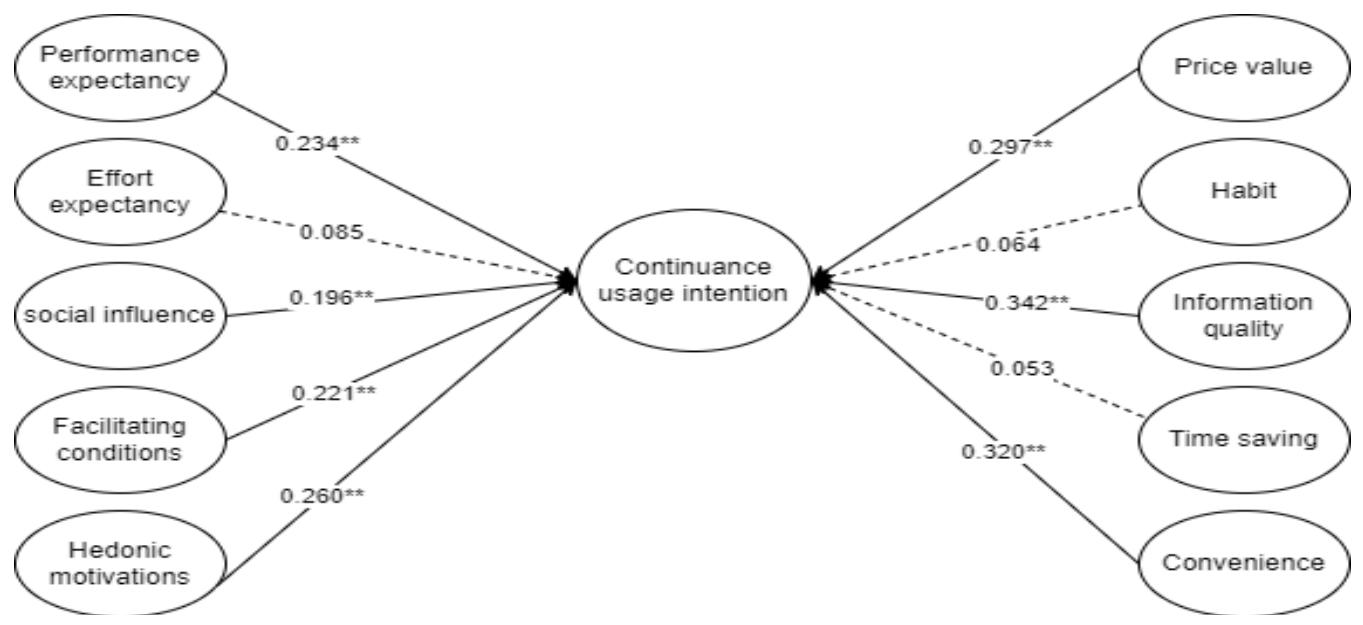 Fig. 2: The structural Equation Model with Parameter Estimates
Note: *p<0.05, **p<0.001. Non-Significant Paths are Shown in Dotted Lines.
Table 6: Result of Structural Model Analysis
<table><tr><td>Hypotheses</td><td>Relationship</td><td>Path Coefficient (β)</td><td>T-value</td><td>P-value</td><td>f2</td><td>Decision</td><td>VIF</td></tr><tr><td>H1</td><td>PE→CUI</td><td>0.234</td><td>3.563</td><td>0.001</td><td>0.020</td><td>Accepted</td><td>2.301</td></tr><tr><td>H2</td><td>EE→CUI</td><td>0.085</td><td>1.415</td><td>0.093</td><td>0.001</td><td>Rejected</td><td>1.675</td></tr><tr><td>H3</td><td>SI→CUI</td><td>0.196</td><td>2.341</td><td>0.001</td><td>0.023</td><td>Accepted</td><td>2.121</td></tr><tr><td>H4</td><td>FC→CUI</td><td>0.221</td><td>3.672</td><td>0.001</td><td>0.033</td><td>Accepted</td><td>2.232</td></tr><tr><td>H5</td><td>HM→CUI</td><td>0.26</td><td>4.121</td><td>0.001</td><td>0.022</td><td>Accepted</td><td>1.752</td></tr><tr><td>H6</td><td>PV→CUI</td><td>0.297</td><td>3.870</td><td>0.001</td><td>0.051</td><td>Accepted</td><td>2.451</td></tr><tr><td>H7</td><td>HT→CUI</td><td>0.064</td><td>1.231</td><td>0.083</td><td>0.021</td><td>Rejected</td><td>2.231</td></tr><tr><td>H8</td><td>IQ→CUI</td><td>0.342</td><td>5.342</td><td>0.001</td><td>0.024</td><td>Accepted</td><td>1.933</td></tr><tr><td>H9</td><td>TS→CUI</td><td>0.053</td><td>1.116</td><td>0.073</td><td>0.012</td><td>Rejected</td><td>1.578</td></tr><tr><td>H10</td><td>CO→CUI</td><td>0.32</td><td>4.360</td><td>0.001</td><td>0.031</td><td>Accepted</td><td>1.678</td></tr></table>
## VI. DISCUSSION AND IMPLICATIONS
### a) Discussion
The purpose of the present study was to evaluate the impact of 10 critical determinants of the extended UTAUT2 and an additional three factors (i.e., information quality, time-saving, and convenience) on consumers' intention to continue using FDA services after the COVID-19 pandemic, particularly in the context of Bangladesh. The findings of the study showed that performance expectancy, social influence, facilitating conditions, hedonic motivation, price value, information quality, and convenience positively influence users' continuance intention to use FDAs. These results are also supported by previous researchers, for instance, performance expectancy (Santos & Patiu, 2023), social influence (Santos & Patiu, 2023), facilitating conditions (Cheng et al., 2020), hedonic motivation (Rasli et al., 2020), price value (Rasli et al., 2020; Santos & Patiu, 2023), information quality (Rasli et al., 2020), convenience (Yapp & Kataraian, 2022).
In this study, however, users' continuous usage intention is not influenced by users' effort expectancy (Okumus et al., 2018; Rasli et al., 2020; Santos & Patiu, 2023) habit, and time-saving orientation (Koiri et al., 2019). The effort expectancy was found to be nonsignificant due to the fact that the majority of participants have a high level of education and, as a result, exert less effort in operating the FDAs. The majority of the survey respondents were between the ages of 25 and 39, making them members of a generation that is familiar with mobile applications and technology. As a result, individuals who utilize food delivery apps do not require a great deal of effort expectancy or habit. On the other hand, it was determined that the amount of time saved was inconsequential as a result of the delays experienced by the meal delivery service. Because of the country's notoriously poor traffic system, it may take up to an hour for a consumer in Bangladesh to receive an order. Therefore, enterprises that provide meal delivery services ought to be aware of how much time clients spend using their apps and how much effort they exert. If food delivery service providers are able to meet the expectations of their clients, those clients will become aware of the benefits offered by the provider's services, and they will feel content with those services. This will also add value to the enterprises.
### b) Theoretical Implications
The current study contributes to the growing corpus of literature investigating the usage of FDAs(Shah et al., 2023) and the UTAUT2 theory in the hospitality field. Theoretically, this study confirms several crucial constructs of UTAUT2 in the context of Bangladesh, including PE, SI, FC, HM, and PV. However, we found no significance in the EE and HT constructs. Moreover, this study added three additional determinants to the UTAUT2 model: time-saving (TS), information quality (IQ), and convenience (CO). By adding these three determinants, it is also confirmed that information quality and convenience contribute to continued usage intention. However, time-saving was revealed as an insignificant factor for the continued use of FDAs, an essential contribution of this study. In addition, this study contributes to the literature on online food delivery services, and its framework can be used as a basis for future research in the food delivery service industry. We also conducted a comprehensive literature review, which revealed that no analogous research had been conducted in the context of Bangladesh. Numerous studies were discovered in the neighboring nations, for instance, in Vietnam (Nam et al., 2021), Thailand (Jaroenwanit et al., 2022), Malaysia (Yapp & Kataraian, 2022), India (Bhotvawala et al., 2016).
### c) Practical Implications
In addition to theoretical contributions, this study provides practical implications for the FDAs developers, restaurant delivery service organizations, and the hospitality industry regarding the factors that should be considered in designing and marketing FDAs. The first implication of the findings is that quality information about FDAs induces customers to stick with using FDAs in the long run. Information such as food variety and quality, restaurant variety, price comparison of similar items, promotional marketing information, review of the restaurant's quality, choice of delivery brands, multiple payment systems, and more are critical to keeping customers loyal to FDAs. Second, convenience persuades customers to order food using FDAs continuously. Easy searching for quality food, for instance, suggesting the food ordered by the highest number of customers, reduction of risk in payment system, contactless order and payment, home delivery, and more should be considered while developing FDAs. Third, time saving is another important determinant for the continuance usage intention of FDAs. Quick ordering, prompt payment, speedy delivery, and swift navigation systems would save customers time. Thus, FDAs developers and food delivery organizations should consider these issues to keep their current users. Fourth, hedonic motivation is another influential factor for customer retention. The visual appeal of the website, pretty presentation of the food products in images, text, and video, gamification in the FDAs, hyper-link for broad information, celebrity endorsement of products, live product presentation through social media, and more can ensure the hedonic motivation of customer for continuous use of FDAs (Barua, 2022). Fifth, app developers may create long-term customer relationships by guiding healthy eating habits. For this, developers may include services such as monitoring calorie intake, preserving records of nutrition consumed, and enabling consumers to set their daily nutrition targets.
## VII. LIMITATION AND FURTHER STUDY
Although this study presents noteworthy theoretical and practical advances, it remains exempt from certain limitations. We did not consider any mediating or moderating variable in this research, although prior studies have suggested that investigating them provides a deep insight into the study (Barua & Barua, 2021; Barua et al., 2020; Wang et al., 2023). Therefore, future research may include variables such as gender, age, and experience as such constructs. Another limitation is that the sample used in this research was collected only from Chittagong, a metropolitan city in Bangladesh, which restricts the generalization of our findings. Future research may conduct cross-culture studies for a better understanding of the matter. Collecting data at only one period would be another limitation of the study because human behavior may change from time to time. Therefore, conducting a longitudinal study, according to Suhartanto et al. (2019) and Sagib and Barua (2014), would overcome this study's limitations.
### "APPENDIX"
Table A1: Measurement Items
<table><tr><td>Construct</td><td>Items</td><td>Measurement Indexes</td><td>Source (Adopted)</td></tr><tr><td rowspan="4">Performance Expectancy (PE)</td><td>PE 1</td><td>I find that food delivery apps are useful in my daily life.</td><td rowspan="13">(Venkatesh et al., 2012)</td></tr><tr><td>PE 2</td><td>I believe that using food delivery apps increases my chances of achieving tasks that are important to me.</td></tr><tr><td>PE 3</td><td>I believe that food delivery apps help me accomplish tasks more quickly.</td></tr><tr><td>PE4</td><td>I believe that using an online food delivery service application increases my productivity.</td></tr><tr><td rowspan="4">Effort Expectancy (EE)</td><td>EE1</td><td>Learning how to use food delivery apps is easy for me.</td></tr><tr><td>EE2</td><td>My interaction with food delivery apps is clear and understandable.</td></tr><tr><td>EE3</td><td>I find food delivery apps easy to use.</td></tr><tr><td>EE4</td><td>It is easy for me to become skillful at using food delivery apps.</td></tr><tr><td rowspan="3">Social Influence (SI)</td><td>SI1</td><td>People who are important to me are thankful that I should use food delivery apps to order food.</td></tr><tr><td>SI2</td><td>People who influence my behavior thank that I should use food delivery apps for ordering food.</td></tr><tr><td>SI3</td><td>People whose opinions that I value prefer that I use food delivery apps.</td></tr><tr><td rowspan="2">Facilitating Conditions (FC)</td><td>FC1</td><td>I have the resources necessary to use food delivery apps.</td></tr><tr><td>FC2</td><td>I have the knowledge necessary to use food delivery apps.</td></tr><tr><td rowspan="2"></td><td>FC3</td><td>Food delivery apps are compatible with other technologies I use.</td><td rowspan="12"></td></tr><tr><td>FC4</td><td>I can get help from others when I have difficulties using food delivery apps.</td></tr><tr><td rowspan="3">Hedonic Motivation (HM)</td><td>HM1</td><td>Using food delivery apps is fun.</td></tr><tr><td>HM2</td><td>Using food delivery apps is enjoyable.</td></tr><tr><td>HM3</td><td>Using food delivery apps is entertaining.</td></tr><tr><td rowspan="3">Price Value (PV)</td><td>PV1</td><td>Food delivery apps offer a reasonable price.</td></tr><tr><td>PV2</td><td>Using a food delivery app service is good value for money.</td></tr><tr><td>PV3</td><td>At current prices, food delivery apps provide good value.</td></tr><tr><td rowspan="4">Habit (HB)</td><td>HB1</td><td>The use of food delivery apps has become a habit for me.</td></tr><tr><td>HB2</td><td>I am addicted to using food delivery apps.</td></tr><tr><td>HB3</td><td>I must use food delivery apps.</td></tr><tr><td>HB4</td><td>Using food delivery apps has become natural to me.</td></tr><tr><td rowspan="3">Convenience (CO)</td><td>CO1</td><td>Using food delivery apps enables me to purchase food at any time I want.</td><td rowspan="3">(Chotigo & Kadono, 2021)</td></tr><tr><td>CO2</td><td>Using food delivery apps enables me to purchase food wherever I am.</td></tr><tr><td>CO3</td><td>I find that food delivery apps are convenient for purchasing food.</td></tr><tr><td rowspan="4">Time Saving (TS)</td><td>TS1</td><td>I believe that using FDA services are very useful in the online shopping process.</td><td rowspan="4">(Yeo et al., 2017)</td></tr><tr><td>TS2</td><td>I believe that using FDA services helps me accomplish things more quickly in the online purchasing process.</td></tr><tr><td>TS3</td><td>I believe that I can save time by using FDA services in the purchasing process.</td></tr><tr><td>TS4</td><td>It is important for me that purchase of food is done as quickly as possible using FDA services.</td></tr><tr><td rowspan="4">Information Quality (IQ)</td><td>IQ1</td><td>Using food delivery apps provides accurate information.</td><td rowspan="4">(Lee et al., 2019)</td></tr><tr><td>IQ2</td><td>Using food delivery apps provides believable information.</td></tr><tr><td>IQ3</td><td>Using food delivery apps provides information at the right level of detail.</td></tr><tr><td>IQ4</td><td>Using food delivery apps presents the information in an appropriate format.</td></tr><tr><td rowspan="3">Continuous Usage Intention (CUI)</td><td>CIU1</td><td>I intend to continue using food delivery apps in the future.</td><td rowspan="3">(Chotigo & Kadono, 2021)</td></tr><tr><td>CIU2</td><td>I would recommend using a food delivery app for family, colleagues, and friends.</td></tr><tr><td>CIU3</td><td>I intend to increase my use of food delivery apps when the opportunity arises.</td></tr></table>
Generating HTML Viewer...
References
114 Cites in Article
Henk Aarts,Bas Verplanken,Ad Van Knippenberg (1998). Predicting Behavior From Actions in the Past: Repeated Decision Making or a Matter of Habit?.
V Agarwal,R Sahu (2022). Predicting repeat usage intention towards O2O food delivery.
S Ahmed,R Palit,D Rokonuzzaman,Z Abdullah (2015). A Study of Mobile Application Usage in Bangladesh.
Jiseon Ahn (2022). Impact of cognitive aspects of food mobile application on customers’ behaviour.
Icek Ajzen (1991). The theory of planned behavior.
A Alalwan (2020). Mobile food ordering apps: An empirical study of the factors affecting customer e-satisfaction and continued intention to reuse.
M Ali,M Rahaman,W Latif,I Ahammad,M Karim (2023). Determinants of consumer motivation to use online food delivery apps: An empirical investigation of Bangladesh.
I Almarashdeh,G Jaradat,A Abuhamdah,M Alsmadi,M Alazzam,R Alkhasawneh,I Awawdeh (2019). The difference between shopping online using mobile apps and website shopping: A case study of service convenience.
F Amalia (2019). The used of modified UTAUT 2 model to analyze the continuance intention of travel mobile application.
Igor Ambalov (2018). A meta-analysis of IT continuance: An evaluation of the expectation-confirmation model.
M Amin,M Arefin,N Sultana,M Islam,I Jahan,A Akhtar (2020). Evaluating the customers' dining attitudes, e-satisfaction and continuance intention toward mobile food ordering apps (MFOAs): evidence from Bangladesh.
S Amit (2020). The future of on-demand food delivery and COVID-19.
Donald Amoroso,Ricardo Lim (2017). The mediating effects of habit on continuance intention.
Amtob (2023). 5.3. Mobile phone-based internet subscribers in Japan, 1999-2004.
Soyoung An,Thomas Eck,Huirang Yim (2023). Understanding Consumers’ Acceptance Intention to Use Mobile Food Delivery Applications through an Extended Technology Acceptance Model.
Nupur Arora,Parul Manchanda (2023). Investigating consumer intention to use food delivery mobile applications: an Indian perspective.
Joep Arts,Ruud Frambach,Tammo Bijmolt (2011). Generalizations on consumer innovation adoption: A meta-analysis on drivers of intention and behavior.
Dwi Aryani,Padmalini Singh,Yun Khor,Daisy Kee,Kornelia Selvia,Cui Lee,Yee Lee,Levisha Anantharavoo (2022). Factors Influencing Consumer Behavioral Intention to Use Food Delivery Services: A Study of Foodpanda.
Abdullah Baabdullah,Ali Alalwan,Nripendra Rana,Pushp Patil,Yogesh Dwivedi (2014). An integrated model for m-banking adoption in Saudi Arabia.
S Banerjee,D Jain,R Nayyar (2019). Measuring service quality of food delivery services: a study of generation Z.
Z Bao,Y Zhu (2022). Why customers have the intention to reuse food delivery apps: evidence from China.
S Bappy,R Mirdha (2021). Govt mulls policy on food delivery.
Zapan Barua (2022). COVID-19 Misinformation on Social Media and Public’s Health Behavior: Understanding the Moderating Role of Situational Motivation and Credibility Evaluations.
Zapan Barua,Adita Barua (2021). Acceptance and usage of mHealth technologies amid COVID-19 pandemic in a developing country: the UTAUT combined with situational constraint and health consciousness.
Zapan Barua,Sajib Barua,Salma Aktar,Najma Kabir,Mingze Li (2020). Effects of misinformation on COVID-19 individual responses and recommendations for resilience of disastrous consequences of misinformation.
Anol Bhattacherjee (2001). Understanding Information Systems Continuance: An Expectation-Confirmation Model1.
Anol Bhattacherjee,Chieh-Peng Lin (2015). A unified model of IT continuance: three complementary perspectives and crossover effects.
Anol Bhattacherjee,Johan Perols,Clive Sanford (2008). Information Technology Continuance: A Theoretic Extension and Empirical Test.
M Bhotvawala,H Balihallimath,N Bidichandani,M Khond (2016). A comparative Study on Customer Preference towards Aggregator food Delivery Services with Special reference to Zomato and Swiggy.
M Bhuiyan (2021). 62% of Bangladeshi users to have smartphones by.
Susan Brown,Viswanath Venkatesh (2005). Model of Adoption of Technology in Households: A Baseline Model Test and Extension Incorporating Household Life Cycle1.
L Chai,D Yat (2019). Online food delivery services: Making food delivery the new normal.
Debarun Chakraborty (2022). Exploring the meteoric rise of online food ordering apps (OFOAs): the moderating role of visibility.
Yanxia Cheng,Saurabh Sharma,Prashant Sharma,Kmmcb Kulathunga (2020). Role of Personalization in Continuous Use Intention of Mobile News Apps in India: Extending the UTAUT2 Model.
W Chin (1998). Issues and opinion on structural equation modelling.
Chao‐min Chiu,Eric Wang,Yu‐hui Fang,Hsin‐yi Huang (2014). Understanding customers' repeat purchase intentions in B2C e‐commerce: the roles of utilitarian value, hedonic value and perceived risk.
Meehee Cho,Mark Bonn,Jun Li (2019). Differences in perceptions about food delivery apps between single-person and multi-person households.
Jaewon Choi,Hong Lee,Farhana Sajjad,Habin Lee (2014). The influence of national culture on the attitude towards mobile recommender systems.
Prasanta Chopdar,V Sivakumar (2019). Understanding continuance usage of mobile shopping applications in India: the role of espoused cultural values and perceived risk.
J Chotigo,Y Kadono (2021). Comparative analysis of key factors encouraging food delivery app adoption before and during the COVID-19 pandemic in Thailand.
J Cohen (1988). Statistical power analysis for the behavioural sciences.
M Copeland (1923). Specific Performance of Cooperative Marketing Agreements: Mutuality.
F Davis (1989). Perceived usefulness, perceived ease of use, and user acceptance of information technology.
Neeraj Dhiman,Neelika Arora,Nikita Dogra,Anil Gupta (2020). Consumer adoption of smartphone fitness apps: an extended UTAUT2 perspective.
Durant Dsouza,Dipasha Sharma (2021). Online food delivery portals during COVID-19 times: an analysis of changing consumer behavior and expectations.
J Erjavec,A Manfreda (2022). Online shopping adoption during COVID-19 and social isolation: Extending the UTAUT model with herd behavior.
Claes Fornell,David Larcker (1981). Evaluating Structural Equation Models with Unobservable Variables and Measurement Error.
M Gani,A Faroque,A Muzareba,S Amin,M Rahman (2023). An integrated model to decipher online food delivery app adoption behavior in the COVID-19 pandemic.
Nefike Gunden,Cristian Morosan,Agnes Defranco (2020). Consumers’ intentions to use online food delivery systems in the USA.
Sufyan Habib,Nawaf Hamadneh (2021). Impact of Perceived Risk on Consumers Technology Acceptance in Online Grocery Adoption amid COVID-19 Pandemic.
J Hair,G Hult,C Ringle,M Sarstedt (2017). A primer on partial least squares structural equation modeling (PLS-SEM).
J Hair,J Risher,M Sarstedt,C Ringle (2019). When to use and how to report the results of PLS-SEM.
J Hair,L Matthews,R Matthews,M Sarstedt (2017). PLS-SEM or CB-SEM: updated guidelines on which method to use.
Shahedul Hasan,Md. Shohag,Imtiaz Chowdhury,Rubab Miswar,M Ashaduzzaman (2023). From eating out to online food ordering amid COVID-19: a case of food delivery apps.
M Hassan (2021). Covid-19: Bangladesh extends restrictions on public movement.
J Henseler,C Ringle,M Sarstedt (2015). A new criterion for assessing discriminant validity in variance-based structural equation modeling.
J.-J Hew,V.-H Lee,K.-B Ooi,J Wei (2015). What catalyses mobile apps usage intention: an empirical analysis.
R Holden,B.-T Karsh (2010). The technology acceptance model: its past and its future in health care.
Chanmi Hong,Hayeon Choi,Eun-Kyong (cindy) Choi,Hyun-Woo (david) Joung (2021). Factors affecting customer intention to use online food delivery services before and during the COVID-19 pandemic.
M Hossain (2022). Bangladesh's food delivery startups are scaling back and shotting down.
K Jain,I Sharma,G Singh (2018). An empirical study of factors determining wearable fitness tracker continuance among actual users.
Jose Janairo (2021). Unsustainable plastic consumption associated with online food delivery services in the new normal.
Pensri Jaroenwanit,Ali Abbasi,Patcharee Hongthong (2022). Determinants of customers’ intention to use online food delivery platforms in Thailand.
Maria Javed,Faisal Malik,Tahir Awan,Ruqia Khan (2021). Food Photo Posting on Social Media while Dining: An evidence using Embedded Correlational Mixed Methods Approach.
R Kader (2020). The State of online food delivery in Bangladesh at the beginning of 2020: Subsidies make true demand hard to guage.
Md Kaium,Yukun Bao,Mohammad Alam,Md. Hoque (2020). Understanding continuance usage intention of mHealth in a developing country.
A Kapoor,M Vij (2018). Technology at the dinner table: Ordering food online through mobile apps.
Aulia-Absari Khalil,Meyliana,Achmad Hidayanto,Harjanto Prabowo (2020). Identification of Factor Affecting Continuance Usage Intention of mHealth Application : A Systematic Literature Review.
Husnil Khatimah,Perengki Susanto (2019). Analysis Consumer Sustainable Intention of E-Money Using Theory DOI and Theory TPB.
Mikhael Khosasih,Lisana Lisana (2023). Intention to Adopt Online Food Delivery Using Augmented Reality Mobile Apps: A Perspective of SOR Framework.
Sung Kim,Naresh Malhotra (2005). A Longitudinal Model of Continued IS Use: An Integrative View of Four Mechanisms Underlying Postadoption Phenomena.
S Kimes (2011). The current state of online food ordering in the US restaurant industry.
S Koiri,S Mukherjee,S Dutta (2019). A study on determining the factors impacting consumer perception regarding the online food delivery apps in guwahati.
A Kupfer,L Ableitner,S Schöb,V Tiefenbeck (2016). Table 2: Gap in SME technology adoption: AI <i>vs</i> . human decision-making..
Suk Lee,Hye Sung,Hyeon Jeon (2019). Determinants of Continuous Intention on Food Delivery Apps: Extending UTAUT2 with Information Quality.
Yu-Ping Lee,Hsin-Yeh Tsai,Athapol Ruangkanjanases (2020). The Determinants for Food Safety Push Notifications on Continuance Intention in an E-Appointment System for Public Health Medical Services: The Perspectives of UTAUT and Information System Quality.
Chechen Liao,Prashant Palvia,Hong-Nan Lin (2006). The roles of habit and web site quality in e-commerce.
Herbjørn Nysveen,Per Pedersen (2016). Consumer adoption of RFID-enabled services. Applying an extended UTAUT model.
Bendegul Okumus,Faizan Ali,Anil Bilgihan,Ahmet Ozturk (2018). Psychological factors influencing customers’ acceptance of smartphone diet apps when ordering food at restaurants.
Richard Oliver (1980). A Cognitive Model of the Antecedents and Consequences of Satisfaction Decisions.
F Osei,G Agyemang,C Kankam-Kwarteng,O Amofah (2021). Customer use of online order for food delivery service: the application of UTAUT2 Model.
A Ozturk,K Nusair,F Okumus,N Hua (2016). The role of utilitarian and hedonic values on users' continued usage intention in a mobile hotel booking environment.
Ramon Palau-Saumell,Santiago Forgas-Coll,Javier Sánchez-García,Emilio Robres (1210). User Acceptance of Mobile Apps for Restaurants: An Expanded and Extended UTAUT-2.
Shweta Pandey,Deepak Chawla,Sandeep Puri (2022). Food delivery apps (FDAs) in Asia: an exploratory study across India and the Philippines.
Gessuir Pigatto,Joao Machado,Amanda Negreti,Lucas Machado (2017). Have you chosen your request? Analysis of online food delivery companies in Brazil.
S Pillai,W Kim,K Haldorai,H.-S Kim (2022). Online food delivery services and consumers' purchase intention: Integration of theory of planned behavior, theory of perceived risk, and the elaboration likelihood model.
Philip Podsakoff,Dennis Organ (1986). Self-Reports in Organizational Research: Problems and Prospects.
Yogi Prasetyo,Hans Tanto,Martinus Mariyanto,Christopher Hanjaya,Michael Young,Satria Persada,Bobby Miraja,Anak Redi (2021). Factors Affecting Customer Satisfaction and Loyalty in Online Food Delivery Service during the COVID-19 Pandemic: Its Relation with Open Innovation.
R Ramesh,Sundramurthy Venkatesa Prabhu,Bashyam Sasikumar,B Kiruthika Devi,P Prasath,S Praveena Rachel Kamala (2023). An empirical study of online food delivery services from applications perspective.
K Ramos (2022). Factors influencing customers' continuance usage intention of food delivery apps during COVID-19 quarantine in Mexico.
Sushil Rana,Urvashi Tandon,Harish Kumar (2023). Understanding medical service quality, system quality and information quality of Tele-Health for sustainable development in the Indian context.
M Rasli,N Zulkefli,N Salleh,F Ghani,N Razali,R Idris (2020). Determinants of Behavioural Intention on Online Food Delivery (OFD) APPS: Extending UTAUT2 with Information Quality.
Arghya Ray,Amandeep Dhir,Pradip Bala,Puneet Kaur (2019). Why do people use food delivery apps (FDA)? A uses and gratification theory perspective.
D Rigby (2011). The future of shopping.
Everett Rogers (1995). Diffusion of Innovations: Modifications of a Model for Telecommunications.
Minjung Roh,Kiwan Park (2019). Adoption of O2O food delivery services in South Korea: The moderating role of moral obligation in meal preparation.
A Saad (2020). Factors affecting online food delivery service in Bangladesh: an empirical study.
G Sagib,Z Barua (2014). Bangladeshi mobile banking service quality and customer satisfaction and loyalty.
M Santos,L Patiu (2023). Determinants of Continuance Usage Intention and Customer Service: Evidence from Food Delivery Application Users in the Philippines.
Allicia Santosa,Nuryanti Taufik,Faizal Prabowo,Mira Rahmawati (2021). Continuance intention of baby boomer and X generation as new users of digital payment during COVID-19 pandemic using UTAUT2.
A Shah,A Abbasi,X Yan (2023). Do online peer reviews stimulate diners' continued login behavior: Investigating the role of emotions in the O2O meal delivery apps context.
A Shah,X Yan,A Qayyum (2021). Adoption of mobile food ordering apps for O2O food delivery services during the COVID-19 outbreak.
Amit Shankar,Charles Jebarajakirthy,Preeti Nayal,Haroon Maseeh,Aman Kumar,Achchuthan Sivapalan (2022). Online food delivery: A systematic synthesis of literature and a framework development.
Norman Shaw,Ksenia Sergueeva (2019). The non-monetary benefits of mobile commerce: Extending UTAUT2 with perceived value.
D Showrav,M Hassan,S Anam,A Chakrabarty (2021). Factors influencing the rapid growth of online shopping during covid-19 pandemic time in Dhaka City, Bangladesh.
R Siddiqi (2021). BD hotel restaurant industry devastated now, following very high growth.
Nidhi Singh,Neena Sinha,Francisco Liébana-Cabanillas (2020). Determining factors in the adoption and recommendation of mobile wallet services in India: Analysis of the effect of innovativeness, stress to use and social influence.
Emma Slade,Yogesh Dwivedi,Niall Piercy,Michael Williams (2015). Modeling Consumers’ Adoption Intentions of Remote Mobile Payments in the United Kingdom: Extending UTAUT with Innovativeness, Risk, and Trust.
(2023). Online food delivery -Bangladesh.
Dwi Suhartanto,Mohd Helmi Ali,Kim Tan,Fauziyah Sjahroeddin,Lusianus Kusdibyo (2019). Loyalty toward online food delivery service: the role of e-service quality and food quality.
Razia Sumi,Mahjabeen Ahmed (2022). Investigating young consumers’ online buying behavior in COVID-19 pandemic: perspective of Bangladesh.
Scott Taylor (2021). Campus dining goes mobile: Intentions of college students to adopt a mobile food-ordering app.
Shirley Taylor,Peter Todd (1995). Understanding Information Technology Usage: A Test of Competing Models.
V Venkatesh,M Morris,G Davis,F Davis (2003). User acceptance of information.
No ethics committee approval was required for this article type.
Data Availability
Not applicable for this article.
How to Cite This Article
Mohammad Alauddin. 2026. \u201cConsumers Food Delivery Apps (FDAs) Continuance Intention: An Empirical Investigation using the Extended UTAUT2 Model\u201d. Global Journal of Management and Business Research - E: Marketing GJMBR-E Volume 23 (GJMBR Volume 23 Issue E2).
Explore published articles in an immersive Augmented Reality environment. Our platform converts research papers into interactive 3D books, allowing readers to view and interact with content using AR and VR compatible devices.
Your published article is automatically converted into a realistic 3D book. Flip through pages and read research papers in a more engaging and interactive format.
Our website is actively being updated, and changes may occur frequently. Please clear your browser cache if needed. For feedback or error reporting, please email [email protected]
Thank you for connecting with us. We will respond to you shortly.