Recreational activities have been argued to positively influence human health and quality of life. This study investigates the influence of recreation and holiday practices on the attitudes and performance of workers in manufacturing companies. Multistage sampling technique was adopted to select samples; purposive sampling method was employed in selecting Lagos and Ogun State and three Local Government Areas in each based on the concentration of manufacturing companies they have. Purposive and availability sampling was further used to select companies above ten years old and workers that have spent above five years and willing to partake in the study. Snow-balling method was lastly employed to select 300 respondents from the companies. Data were collected through the use of questionnaire and further analysed and presented through the use of tables, chart, simple percentages and t-test. Result revealed that there is no significant relationship (p = 0.177) between recreation and holiday practices and employee job satisfaction. The study however found that there is a significant relationship (p = 0.001) between recreation and holiday practices and employee performance.
## I. INTRODUCTION
Recreation has emerged as one of the primary social good which the rational citizen wants and which an organization or any institution might be expected to provide. In the turbulent business environment, the main aim of every manufacturing industry is to improve its productivity but this can never be possible without efficient performance of employees. Yet one of the major challenges facing many countries has been the need to improve the performance of employees. It is a common saying that "all work and no play make Jack a dull boy". This implies that, to bring out the best in workers, there is need for recreation in work schedule.
The call for reduction in the number of hours which workers spent while working received significant attentions after the Third World War in European countries and the United States (Labour Review, 1927). In the USA investigations have also brought about questions on what workers would be making use of the leisure time secured through the shorter workday for. Although, many organisations and individuals are passionate about jobs with suitable leisure hours and the importance of outdoor recreation to the well-being of the people has been particularly emphasized by the American Government (Labour Review, 1927). It is the interest of this study to establish the symbiotic effects of encouraging recreation and holiday at work places to both employers and employees.
According to Naude et al. (2012), leisure has impact on the overall quality of work life of employees and the physical health and safety of workers. Therefore, investigating the recreation and holiday practices that workers in manufacturing companies engage in during their leisure time is significant to national development given the role of manufacturing sector in an economy.
The manufacturing sector is a potential instrument of modernization, a creator of jobs, and a generator of positive spill-over effects (Nyameh, 2013). More so, the growth in manufacturing output has been a key element in the successful culture transformation of most economies that have seen sustained rises in their per capita income (Sajuyigbe et al., 2013). Focus should therefore be on manufacturing good products and those factors that may foster its growth. There is a need for managers of manufacturing industry to ensure that employees have enough time for leisure as this will help them to understand the need for creativity and to be committed to changing their behaviour at work, in new and improved ways (Robbins and Judge, 2013; Officha et al., 2013).
Many organizations have policies guiding the workers in pursuing their interest at heart to achieve their ultimate goal at the expense of their employees. Duly, most manufacturing companies are aware of recreation and holiday practices but at what level are the employee allowed to engage in it. Despite the advocacy of recreation to enhance better life for work-family life balance which definitely will serve as a booster, many manufacturing companies failed to have corresponding view growth as expected due to lack of effective holiday and recreation policy implementation. Nigeria as a case study has quite a lot of policies guiding workers, working hours and worker's safety, but there are some challenges such as poor implementation, initiatives, level or rank of workers etc. hindering effectiveness of the policies on workers
The choice of Lagos and Ogun State as study area for this research is as a result of the fact that these two states have been reported to have the highest number of manufacturing companies in Nigeria. Over $80\%$ of production activities in Nigeria have been reported to take place in these two states. According to data supplied by the Manufacturers Association of Nigeria (MAN), almost $95\%$ of manufacturing activities in the first half of the year 2019 took place in the two states (Odinaka, 2020). Lagos and Ogun State have also been reported to account for 3.2 trillion naira out of Nigeria's 3.7 trillion naira production output in the second half of the year 2021 (Femi, 2022). The two states were reported to be responsible for $86\%$ of manufactured goods consumed in Nigeria and exported. This further establishes the fact that Lagos and Ogun State are currently the industrial hub of Nigeria (Femi, 2022).
### a) Aim of Study
This study intends to investigate the attitudes and perception of manufacturing company workers in Lagos and Ogun State towards engaging in recreation and holiday activities in their work place with a view to underscoring its effect on job satisfaction and their performance at work.
### b) Objectives of Study
1. Identify factors that influence recreation and holiday practices among workers in manufacturing companies.
2. Identify activities that workers in manufacturing companies engage in for recreation and holiday purposes.
3. Investigate the perception of manufacturing company workers on the effect of recreation and holiday on their performance in their work place.
c) Research Hypotheses
This study is guided by the following ethical statements:
Hypothesis1:
Ho: Recreation and holiday have no significant effect on employee's job satisfaction.
Hypothesis 2:
Ho: Recreation and holiday practices have no significant effect on employee's job performance.
## II. LITERATURE BRIEF
Recreation is an essential part of human life and finds many different forms which are shaped naturally by individual interests but also by the surrounding social construction and availability of required facilities. Akintunde (2001), posit that recreation is a voluntary act, despite not compulsory, leisure (recreation period) has been made statutorily part of daily work place schedule in many organisations. Recreation can serve to combat social ills, just as at a fundamental level, educational and health services tackle ignorance and illness respectively but most private sector, commonly manufacturing companies rarely permit their workers to engage in recreational work, which at the end lead to lack of fitness and wellbeing of workers, lack of involvement in skillful worthwhile activities, stress and boredom. The advancement of recreation activities, leisure and holiday in all the sectors of the business economy (primary, secondary and tertiary) is very essential as this would help to enhance the level of mental, physical and social aspect of health of an individual in a society in furtherance for economic growth and development.
It has been reported that recreation formed a core element of most welfare programs in Australia and America (Brandes, 1976) and it has remained significant as part of personnel management strategy. Although, recreation as a strategy to improve productivity in work places can only be effective when workers are allowed to freely choose their recreational activities or made to at least have access to what interest them and that which can fascinate them into relaxation mood. Otherwise, the recreation period might not be judiciously utilized by workers, when this happens, the essence of creating a recreation time for workers in workplaces (improved productivity) would not be achieved. According to Akintunde and Ukpong (2010), the concept of recreation for workers revealed that every individual requires health fitness and the healthier a man is, the more productive he will be.
Aditi (2012), posit that outdoor recreation should be encouraged in work places as it promotes healthy relationship amongst employees as well as between management staff and their subordinates. Damaro and Aruoren (2015) reported that engagement in offsite events are employed by successful organisations as human resources development function and means of promoting recreational activities and enhancing team building among their employees. Manali (2012), further emphasize the essence of outdoor recreation as a means of relaxing our mind and something worth of investing in. Mokaya and Kipyegon (2014) also reported that work place recreations have effect on employee's performance and it motivates employees to stay committed to their job and contribute to organisational success.
Recreational activities can be communal or solitary, active or passive, outdoors or indoors, healthy or harmful, and useful for society or detrimental (Kyle et al., 2003). Recreation can also contribute to improving mental health by reducing stress and depression and enhancing emotional and psychological well-being. Recreation is an activity of body and mind which gives relief from tension and fatigue. Therefore, the implementation of recreation and holidaying practices as a sub-variable of performance management has been seen as a tool to enhance employee's productivity by managing their performances (Poister, 2003).
Naude et al. (2012) investigated the effect of leisure on the overall quality of work life of front office employees in a hotel group using a self-administered survey. The relationship between leisure time and leisure preferences and quality of work life was determined with the use of Confirmatory Factor Analyses and Spearman Correlation Coefficient. The study reported that, leisure has effect on the overall quality of work life and it also influences the physical health and safety of workers. Naude et al. (2012) also reported that the front office employees of the hotel group do not have sufficient time to engage in recreational activities during their leisure period. Brett and Stroh (2003), in a previous study reported that, a recent practice in workplace is for employees to engage themselves in work-leisure trade-off. This means employees bargaining to use their leisure period at work to engage in work-place assignment in order to get additional pay (reward) at work at the expense of their leisure time. This results in either getting lesser time or no time for recreation at all.
Lautizi et al. (2009) reported that compensation, such as pay, leave bonuses and promotion can influence performance levels. This has however affected manufacturing companies in reaching their set objective as it is understood that an organization's success and employee's performance relies heavily on how much attention is paid to its employee compensation policies. A leave of absence 'holiday' can be in form of compensation to a hardworking staff where by giving room for recreational activities which gives benefit of improved physical and mental health, rest, and social benefit of human potential development.
The manufacturing sector plays a vital role in a modern economy and has many dynamic benefits crucial for economic growth. In any advanced economy or even growing economy, the manufacturing sector is a leading sector in many respects. It is an avenue for increasing productivity in relation to import replacement and export expansion, creating foreign exchange earning capacity, rising employment and per capita income, which causes unique consumption patterns. Furthermore, it creates investment capital at a faster rate than any other sector of the economy while promoting wider and more effective linkages among different sectors (Oladejo and Yinus 2014). In terms of contributing to the Gross Domestic Products of Nigeria, the manufacturing sector is a major contributor. It is therefore imperative that researchers investigate the responsiveness of manufacturing companies to recreation and holiday practices being adopted and practiced. It is on this basis that this study focuses on investigating the recreation and holiday practices amongst workers in selected manufacturing companies in Lagos and Ogun State.
## III. METHODOLOGY
This study adopted descriptive survey as research design. Sampling was done through multistage sampling method. Lagos and Ogun State were purposively selected because of the high concentration of manufacturing companies in these two locations in Nigeria. Out of the twenty LGAs in Lagos State, purposive sampling method was further utilized in selecting three LGAs known for high concentration of manufacturing companies (namely: Ikeja, Oshodi-Isolo and Apapa LGAs). Also in Ogun State, out of the twenty LGAs present, purposive sampling method was used to select another three LGAs based on the high presence of manufacturing companies there (namely: Ado-Odo/Ota, Ifo and Sagamu LGAs). Purposive and availability sampling method was further used to select five manufacturing companies that are above ten years old in existence and willing to participate in the study across the industrial layout in each of the six selected LGAs, making a total of 30 companies. Snow-balling method was further employed to select 10 employees who have spent more than five years in their respective company from various departments/units in each of the selected manufacturing companies through their respective human resources manager. The total sample population was 300 respondents. Data were collected through the use of a well-structured questionnaire. Data gathered were analysed and presented through the use of tables, charts, simple percentage and t-test.
## IV. RESULTS AND DISCUSSION
### a) Distribution of Respondents According to Department/Unit in their Workplace
The distribution of respondents based on department/unit they belong to in their workplace is presented in figure 1. Majority (27.5%) of the respondents were in production department, 15% respondents were in operations department as well as 15% in Account department, 14% respondents were in administrative department, 11% respondents were in personnel department, 8% respondents were in marketing department, 7% respondents were in maintenance department and 2.5% respondents were in security department. This implies that bulk of the respondents for the study are from departments that are directly involved in production which is usually the center of focus in any manufacturing company, followed by operations account, administrative and personnel which are very key in decision making, especially on matters that relate to policy formulation and implementation. The issue of workers welfare is usually under the personnel and/or administrative department and the subject matters in this study "recreation and holiday" issues in an establishment is not likely going to be strange to them.
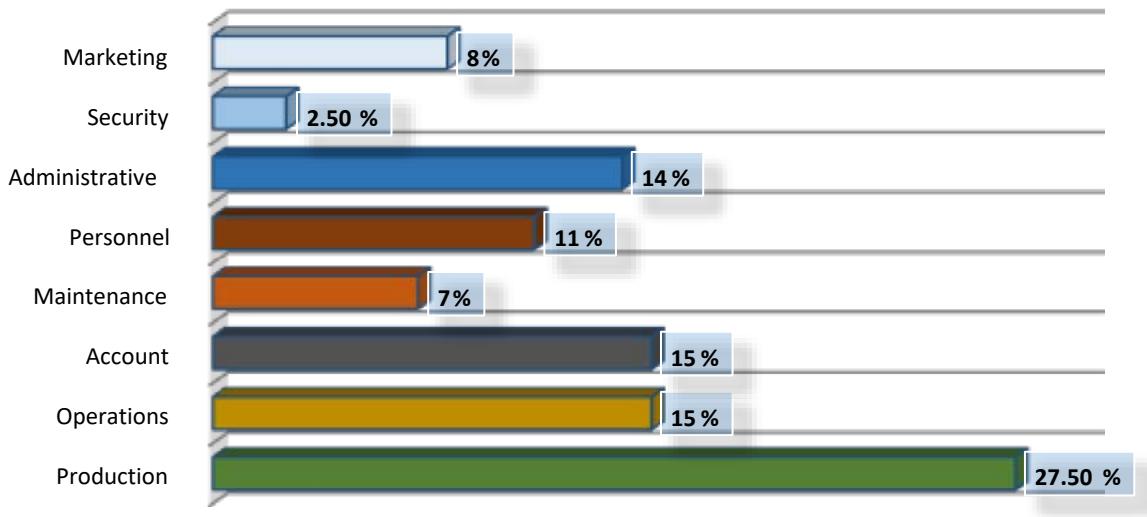 Figure 1: Distribution of Respondents According to Department/Unit in their Workplace
Source: Fieldwork (2021)
Given the above distribution of respondents in this study as shown in Figure 1, it is evident that most manufacturing workers have the largest pull of their workers in the production unit. The kind of workers in the production units of a company in collaboration with other units would define the kind of product the company offers. The level of input from the workers in terms of their performance at work also would influence the company's productivity. Hence the opinion of workers can be relied upon investigating to subject matter in this study.
### b) Influencers of Recreation and Holiday Practices in the Manufacturing Companies
Table 1 presents information on issues that influence the recreation and holiday practices of workers in the manufacturing companies. Majority (61.0%) of the respondents work for 5 days in a week, 19.0% work for 6 days in a week, 11% respondents work for 7 days in a week while the remaining 9.0% respondents work for 4 days in a week. Most (74.0%) of the respondents work for 8 hours per day, 17% work for 10 hours per day while the remaining 9.0% work for more than 10 hours per day. Also, most of the respondents (84.0%) do have break in between working hours while 16% of the respondents do not have break at all in between working hours. None the less, majority (63.7%) of the respondents have experienced going on work leave prior this study while 36.3% of the respondents have not gone on work leave before. In addition, 63.0% of the respondents received their leave bonus before proceeding on leave, 31.0% respondents received their leave bonus after leave while 6.0% does not receive leave bonus at all.
Table 1 equally shows that majority (31.7%) of the respondents are of the opinion that eligibility of employees for work leave should be based on years spent on the job, $28.0\%$ respondents opined that it should be based on employee's department, $24\%$ respondents opined that it should be based on employee's position in the organization while, $16.3\%$ respondents opined that it should be done indiscriminately. Most $(71.3\%)$ of respondents affirmed that they can spend from their personal income to go for recreation and holiday activities. Equally, majority $(80.7\%)$ of the respondents engages in recreational activities aside from their daily recreation at work which is usually characterized by short time while $19.5\%$ respondents do not engage in recreation outside their work period. Never the less, aside from daily recreation period at work, majority $(38.0\%)$ of the respondents engages in other recreational activities on monthly basis, $27.7\%$ respondents recreate on weekly basis while the remaining $34.3\%$ respondents recreate at any convenient time they like. The results from Table 1 indicates that even though not in all cases, most manufacturing companies have provision and policies that allows their workers partake in recreation and holiday activities. This is because majority of the respondents reported that they work for five days in a week for eight hours in a day which is the conventional work period in Nigeria. Hence they have their weekends and evening hours to their discretionary use. In addition, majority also reported that they do have daily break periods, annual leave and leave bonuses paid before proceeding on leave at their work places. This would encourage workers to engage in recreation and holiday activities as reported in table 1.
Table 1: Influencers of Recreation and Holiday Practices of the Respondents
<table><tr><td>Parameter</td><td>Responses</td><td>Frequency</td><td>Percentage (%)</td></tr><tr><td rowspan="5">Average Number of Days Respondents Work Per Week</td><td>4 days</td><td>26</td><td>9.0</td></tr><tr><td>5 days</td><td>183</td><td>61.0</td></tr><tr><td>6 days</td><td>58</td><td>19.0</td></tr><tr><td>7 days</td><td>33</td><td>11.0</td></tr><tr><td>Total</td><td>300</td><td>100</td></tr><tr><td colspan="4"></td></tr><tr><td rowspan="4">Hours of Work Per Day</td><td>8 hours</td><td>222</td><td>74.0</td></tr><tr><td>10 hours</td><td>51</td><td>17.0</td></tr><tr><td>>10 hours</td><td>27</td><td>9.0</td></tr><tr><td>Total</td><td>300</td><td>100</td></tr><tr><td colspan="4"></td></tr><tr><td rowspan="3">Availability of Break/Recreation Period at Work</td><td>Break Time Available</td><td>252</td><td>84.0</td></tr><tr><td>No Break Time</td><td>48</td><td>16.0</td></tr><tr><td>Total</td><td>300</td><td>100</td></tr><tr><td colspan="4"></td></tr><tr><td rowspan="3">Availability of Work Leave Period for Workers</td><td>Work Leave Available</td><td>191</td><td>63.7</td></tr><tr><td>No Work Leave</td><td>109</td><td>36.3</td></tr><tr><td>Total</td><td>300</td><td>100</td></tr><tr><td colspan="4"></td></tr><tr><td rowspan="4">Availability of Leave Bonus for Workers Going on Leave</td><td>Available Before Leave</td><td>189</td><td>63.0</td></tr><tr><td>Available After Leave</td><td>93</td><td>31.0</td></tr><tr><td>not Available at All</td><td>18</td><td>6.0</td></tr><tr><td>Total</td><td>300</td><td>100</td></tr><tr><td colspan="4"></td></tr><tr><td rowspan="5">Employee's Perception on the Eligibility Criteria for Work Leave</td><td>Position in the Workplace</td><td>72</td><td>24</td></tr><tr><td>Years on the Job</td><td>95</td><td>31.7</td></tr><tr><td>Departmental Basis</td><td>84</td><td>28</td></tr><tr><td>Indiscriminately</td><td>49</td><td>16.3</td></tr><tr><td>Total</td><td>300</td><td>100</td></tr><tr><td colspan="4"></td></tr><tr><td rowspan="3">Aside from Leave Bonus Paid at Work, can you Spend your Personal Money on Going for Holiday or Recreation Activities</td><td>Yes</td><td>214</td><td>71.3</td></tr><tr><td>No</td><td>86</td><td>28.7</td></tr><tr><td>Total</td><td>300</td><td>100</td></tr><tr><td colspan="4"></td></tr><tr><td rowspan="3">Do you Engage in Recreational Activities Aside from your Daily Break at Work</td><td>Yes</td><td>242</td><td>80.7</td></tr><tr><td>No</td><td>58</td><td>19.3</td></tr><tr><td>Total</td><td>300</td><td>100</td></tr><tr><td colspan="4"></td></tr><tr><td rowspan="4">How Often do you Engage in Recreational Activities Aside from Break at Work</td><td>Weekly</td><td>83</td><td>27.7</td></tr><tr><td>Monthly</td><td>114</td><td>38.0</td></tr><tr><td>Anytime</td><td>103</td><td>34.3</td></tr><tr><td>Total</td><td>300</td><td>100</td></tr></table>
### c) Activities Manufacturing Company Workers Engage in for Recreation and Holiday Purposes
Table 2 shows the activities engaged in by the respondents. The table indicates that amongst activities engaged in by workers in the manufacturing companies, engagement in exercise and games ranked highest $(9^{\text{th}})$ with $54.8\%$ of the respondents getting highly involved in exercise and game, $34.3\%$ of respondents are moderately involved while $11.0\%$ of the respondents are not involved in exercise and game. Activities engaged in for recreation and holiday that ranked close to exercise and games are listening to music $(8^{\mathrm{th}})$ and travelling $(7^{\mathrm{th}})$. However, clubbing ranked least amongst recreational activities engaged in by the workers. Activities that ranked close to clubbing are picnic and visit to cinema to watch movies. Other activities engaged in for the purpose of recreation and holiday areas presented in table 2.
That majority of the respondents engaged themselves in exercise and games could be as a result of the knowledge about the health benefits of keeping body and mind fit through regular exercise in addition to the fact that, some body exercise activities are relatively achievable within space, with or without equipment and cheaper in terms of cost compare to many other recreational activities. Listening to music is also relatively easy to achieve for recreational purpose because this can be done with ease almost everywhere. Travelling is not relatively as easy and cheap as engaging in body exercise and listening to music, but the fact that it is one of the highly ranked recreational activities the respondents engaged in could be as a result of the fact that majority of them have time and money relatively useful for this recreational purpose as evident in table 1.
None the less, issues relating to personality and willful allocation of relative scarce discretionary resources such as free time and money in addition to accessibility could be part of reasons why activities such as clubbing, picnic and going tocinemas ranked low amidst recreational activities that workers in manufacturing companies highly involve in.
Table 2: Activities Employee Engages in During Recreation and Holiday Periods
<table><tr><td>Activities</td><td>Highly Involved%</td><td>Moderately involved%</td><td>Not involved%</td><td>Mean Value</td><td>Std. Deviation</td><td>Rank</td></tr><tr><td>Exercise and game</td><td>54.8</td><td>34.3</td><td>11.0</td><td>1.56</td><td>0.684</td><td>9th</td></tr><tr><td>Picnic</td><td>35.7</td><td>41.9</td><td>21.4</td><td>1.86</td><td>0.784</td><td>2nd</td></tr><tr><td>Shopping</td><td>42.4</td><td>43.3</td><td>14.3</td><td>1.72</td><td>0.700</td><td>6th</td></tr><tr><td>Swimming</td><td>31.4</td><td>59.0</td><td>9.5</td><td>1.78</td><td>0.603</td><td>5th</td></tr><tr><td>Going to cinema/watching movies</td><td>34.3</td><td>46.7</td><td>17.6</td><td>1.83</td><td>0.707</td><td>3rd</td></tr><tr><td>Family retreat</td><td>35.7</td><td>46.2</td><td>18.1</td><td>1.83</td><td>0.736</td><td>3rd</td></tr><tr><td>Reading</td><td>41.9</td><td>32.9</td><td>22.9</td><td>1.80</td><td>0.793</td><td>4th</td></tr><tr><td>Listening to music</td><td>47.6</td><td>37.6</td><td>14.9</td><td>1.66</td><td>0.711</td><td>8th</td></tr><tr><td>Travelling</td><td>36.7</td><td>56.2</td><td>7.1</td><td>1.70</td><td>0.5</td><td>7th</td></tr><tr><td>Clubbing</td><td>25.7</td><td>19.0</td><td>54.3</td><td>2.31</td><td>0.891</td><td>1st</td></tr></table>
### d) Perception of Manufacturing Company Workers on the Effect of Recreation and Holiday Practices on their Work
Table 3 presents results on the perceived effect of recreation and holiday on employees' performance. The table shows that 'feeling physically relaxed' ranked highest $(11^{\text{th}})$ amongst the effects that the workers in the manufacturing companies perceived that recreation and holiday have on them. Majority of the respondents $(98.1\%)$ were in agreement with the statement that recreation and holiday make them feel physically relaxed. This is in agreement with Lautizi et al. (2009) that "recreational activities gives benefit of improved physical and mental health, rest, and social benefit of human potential development." Other perceived effect that ranked close to aforementioned effect are strengthening of family bond $(10^{\text{th}})$ and keeping mind healthy $(9^{\text{th}})$. This is also in agreement with the position of Poister (2003) that "recreation can also contribute to improving mental health by reducing stress and depression and enhancing emotional and psychological well-being". Parameters that ranked $8^{\text{th}}$ (resume work more energized after recreation) and $7^{\text{th}}$ (recreation relieves stress and tension) are also very key in a manufacturing company as this can help improve productivity and profit which is the goal of most companies. This is also in agreement with the Poister (2003) that "the implementation of recreation and holidaying practices as a sub-variable of performance management has been seen as a tool to enhance employee's productivity by managing their performances".
Table 3 further revealed that the least ranked amongst the perceived effect of recreation and holiday amongst workers in the manufacturing companies is "loss of interest in the work". This implies that going on recreational activities or holiday would not really make a worker lose interest in the work rather, this would make them more energetic and productive at work. This is in agreement with the position of Robbins and Judge (2013); Officha et al, (2013) that "there is a need for managers of manufacturing industry to ensure that employees have enough time for leisure as this will help them to understand the need for creativity and to be committed to changing their behaviour at work, in new and improved ways".
Table 3: Perceived Effect of Recreation and Holiday on Employees' Performance
<table><tr><td>You Feel Physically
Relaxed</td><td>70.0</td><td>28.1</td><td>1.9</td><td>-</td><td>-</td><td>1.30</td><td>0.231</td><td>11th</td></tr><tr><td>Family Bond is
Strengthened</td><td>61.4</td><td>36.7</td><td>1.9</td><td>-</td><td>-</td><td>1.40</td><td>0.280</td><td>10th</td></tr><tr><td>Gaining a Sense of Self
Confidence</td><td>48.1</td><td>46.7</td><td>4.3</td><td>1.0</td><td>-</td><td>1.58</td><td>0.388</td><td>4th</td></tr><tr><td>Loss of Interest in Work</td><td>3.8</td><td>6.7</td><td>8.6</td><td>33.3</td><td>47.6</td><td>4.14</td><td>1.157</td><td>1st</td></tr><tr><td>Aids to Gain a Sense of
Belonging</td><td>39.5</td><td>52.9</td><td>5.7</td><td>1.9</td><td>-</td><td>1.70</td><td>0.441</td><td>2nd</td></tr><tr><td>You Resume More
Energized than before</td><td>56.2</td><td>41.9</td><td>1.9</td><td>-</td><td>-</td><td>1.46</td><td>0.288</td><td>8th</td></tr><tr><td>Relieves You of Stress
and Tension</td><td>54.3</td><td>44.8</td><td>1.0</td><td>-</td><td>-</td><td>1.47</td><td>0.269</td><td>7th</td></tr><tr><td>Keeps Mind Healthy</td><td>61.0</td><td>38.1</td><td>1.0</td><td>-</td><td>-</td><td>1.38</td><td>0.238</td><td>gth</td></tr><tr><td>Increase Work
Motivation</td><td>51.9</td><td>46.2</td><td>1.0</td><td>-</td><td>-</td><td>1,67</td><td>3.877</td><td>3rd</td></tr><tr><td>Helps Maintain Work-
Life Balance</td><td>56.2</td><td>38.1</td><td>5.7</td><td>-</td><td>-</td><td>1.48</td><td>0.347</td><td>6th</td></tr><tr><td>Increase Productivity</td><td>52.9</td><td>45.2</td><td>1.9</td><td>-</td><td>-</td><td>1.49</td><td>0.289</td><td>5th</td></tr><tr><td>Improve Job
Satisfaction</td><td>45.7</td><td>51.4</td><td>1.9</td><td>1.0</td><td>-</td><td>1.58</td><td>0.340</td><td>4th</td></tr></table>
### e) Result of Hypotheses Test
i. Hypothesis 1: There is no Significant Relationship between Recreation and Holiday Practices and Employee Job Satisfaction
Table 4: Hypothesis 1 Result
<table><tr><td>N</td><td>Mean</td><td>Std. Deviation</td><td>t</td><td>Sig.</td><td>P-value</td></tr><tr><td>Recreational and Holiday Practices</td><td>300</td><td>1.661</td><td>0.252</td><td>-1.355</td><td>0.177</td></tr><tr><td>Job Satisfaction</td><td>300</td><td>1.713</td><td></td><td>0.497</td><td></td></tr></table>
Table 4 shows that the p-value is 0.177 which is greater than 0.05 (cut-off value) level of significance, this indicates that we accept the null hypothetical statement by affirming that there is no significant relationship between recreation and holiday practices and employee job satisfaction. This meant that allowing workers in the manufacturing companies to engage in recreational and holiday activities does not translate to job satisfaction for the workers. This result further aids the understanding of some workers' attitude to recreation and holiday practices as reported by Brett and Stroh (2003) in their research findings on the behaviour of some workers that do engage themselves in work-leisure trade-off, by bargaining to use their leisure period at work to engage in more work in order to get more pay (reward) at work, at the expense of their leisure time which is meant for recreational purposes. The implication of this result is that what brings about job satisfaction goes beyond permitting recreation and holiday practices. Other elements of job satisfaction such as career advancement, good pay etc. must be put in place to ensure job satisfaction for workers.
ii. Hypothesis 2: There is no Significant Relationship between Recreation and Holiday Practices and Employee Performance
Table 5: Hypothesis 2 Result
<table><tr><td>N</td><td>Mean</td><td>Std. Deviation</td><td>t</td><td>Sig. (2-tailed)</td><td>p-value</td></tr><tr><td>Recreational and Holiday Practices</td><td>300</td><td>1.661</td><td>0.252</td><td>-7.309</td><td>0.001**</td></tr><tr><td>Job performance</td><td>300</td><td>1.945</td><td>0.524</td><td></td><td></td></tr></table>
Table 5 shows that the p-value is 0.001 which is lesser than 0.05 (cut-off value) level of significance, this indicates that we reject the null hypothetical statement by reclaiming that there is a significant relationship between recreation and holiday practices and employee performance. This meant that allowing workers in the manufacturing companies to engage in recreational and holiday activities translate to improved employee performance. The implication of this result is that even though recreation and holiday may not solely or directly bring about job satisfaction for workers, it is directly impactful on employee performance which has a direct impact on the productivity of the company. This result is in agreement with the position of Mokaya and Kipyegon (2014), that work place recreation have effect on employee's performance and motivate employees to stay committed to their job and contribute to organizational success. In other words, improved employee performance would bring about increased productivity which will in-turn bring about increased revenue and profit which is one of the main goal of many manufacturing company.
## V. CONCLUSION AND RECOMMENDATION
This study found that most manufacturing companies in the study area have policies that permit workers to engage in recreation and holiday, and most of the workers engage in some recreation and holiday activities. The study however concludes that, recreation and holiday practice does not directly influence job satisfaction but it is directly influential on employee performance which is critical to organizational productivity. Therefore, employers should prioritize the overall fitness of their employees to make them highly productive. In view of the foregoing, the study recommends that organisations with good recreation and holiday practices should sustain it and improve on it in order to improve the performance of their employee and benefit from improved organizational productivity which may lead to increased profit for the organization. A collection of which can guarantee an improved economic growth for the nation.
Generating HTML Viewer...
References
18 Cites in Article
N Aditi (2010). Social Partnership between Employers and Employees: Key to Industrial harmony in Germany.
P Akintunde (2001). books: Athletics and Sports.
P Akintunde,Ukpong (2010). Enhancement of Worker's Productivity through Recreation and Exercise.
S Brandes (1976). American Welfare Capitalism, 1880-1940.
J Brett,L Stroh (2003). Working 61 Plus Hours a Week: Why Do Managers Do It.
O Damoro,Aruoren (2015). Outdoor Recreation Activities Among staff in Nigerian Academic Institutions; Spontaneous or Planned.
A Femi (2022). Lagos, Ogun Accounts for 3.2 trillion of Nigeria's 3.7 trillion Naira Production Output in Second-Half of the Year 2021.
Gerard Kyle,Alan Graefe,Robert Manning,James Bacon (2003). An Examination of the Relationship between Leisure Activity Involvement and Place Attachment among Hikers Along the Appalachian Trail.
Labour Review (1927). Labour Notes and Queries.
O Manali (2012). Benefits of Playing Sports: The Psychological and Physical Benefits of Carrying out Sports Activities.
S Mokaya,M Kipyegon (2014). Determinants of Employee Engagements in the Banking Industry in Kenya: Case of Cooperative Bank.
R Naude,S Kruger,Saayman Nyameh,J (2012). Application of the Maslow's hierarchy of need theory; impacts and implications on organizational culture, human resource and employee's performance.
M Officha,F Onwuemesi,I Enete,I Nzeamalu (2013). Assessing the Need for Developing and Managing Recreational Facilities In Nigeria.
Oladejo M.O,Yinus Oluwaseun (2014). An Assessment of the impact of Compensation Plan on workers Performance of selected Quoted Food and Beverages Manufacturing Companies in Nigeria.
T Poister (2003). Measuring performance in public and non-profit organizations.
S Robbins,T Judge (2013). Organisational Behaviour (15th Edition).
A Sajuyigbe,B Olaoye,M Adeyemi (2013). Impact of Reward on Employees Performance in a Selected Manufacturing Companies in Ibadan, Oyo State, Nigeria.
No ethics committee approval was required for this article type.
Data Availability
Not applicable for this article.
How to Cite This Article
Ibraheem Adesina KUKOYI. 2026. \u201cRecreation and Holiday Practices among Workers in Manufacturing Companies in Nigeria\u201d. Global Journal of Management and Business Research - A: Administration & Management GJMBR-A Volume 23 (GJMBR Volume 23 Issue A3).
Explore published articles in an immersive Augmented Reality environment. Our platform converts research papers into interactive 3D books, allowing readers to view and interact with content using AR and VR compatible devices.
Your published article is automatically converted into a realistic 3D book. Flip through pages and read research papers in a more engaging and interactive format.
Our website is actively being updated, and changes may occur frequently. Please clear your browser cache if needed. For feedback or error reporting, please email [email protected]
Thank you for connecting with us. We will respond to you shortly.