This study investigated the causal relationship between advertising and sales performance in selected companies in Mogadishu Somalia. Since advertising is applied in order to raise awareness among customers. Thus, it could maintain customer loyalty and then boost up the organization performance in terms of profitability of the organization and its value. However, it is not certain whether adverting can increase organization performance in Mogadishu Somalia because the cost may be too high for the organization to sustain it, thus it may have adverse effects on organizational performance. The specific objectives of this study were as follows: To examine how media advertising, Celebrity Advertising, Billboard Advertising affect sales performance in some selected companies in Mogadishu-Somalia. This study was guided by the theory of advertising promotions, advanced by Smith and Taylor (2003). The theory postulates that advertising promotions involve high costs and, hence, companies are always looking for ways to reduce the cost of promotions but still maintain the effectiveness of the promotional activities being carried out. This is where companies use joint promotions. This study employed a descriptive correlational and a cross sectional survey design. Therefore, the descriptive design enabled the researcher to determine the picture or document current conditions or attitudes to describe the effect of advertisement and sales performance of the selected companies in Mogadishu Somalia.
### CHAPTER ONE
#### INTRODUCTION
### a) Introduction
In this chapter, the author provides some background of information about the research area for readers, and then we would begun by discussing problem statement of the study, purpose of the study, objectives of the study, research questions, scope, significance, theoretical, operational definitions and conceptual framework.
### b) Background of the Study
Today, marketers commonly utilize multiple media channels within the same advertising campaign (Rinta-Kanto, 2012). Advertising problems often have far reaching effects on any company and if neglected can cause a great threat to the continued existence of the company, especially in the area of advertising as an aspect of corporate communication (Giles, 1997). In the light this statement, examining the impact of advertising on the sales volume of a company's product, is therefore a significant undertaking. The market is such that consumer tastes are increasingly differentiated and maintenance of high service quality in the face of rising costs of essential factors is needed (Adekoya, 2011). Since the market is also characterized by a multiplicity of advertisements, as Adekoya (2011) states, advertising of various company competing brands is increasing very rapidly and consumers are now more knowledgeable.
Historically, the practice of advertising is as old as man. According to Keller (2005), the need to advertise seems to be a part of human history seen since ancient times. One of the oldest means of advertising was the use of signs. Early craftsmen used signs to advertise their wares and some traders like the Phoenicians planted commercial messages on prominent rocks. These are considered to have been among the forerunners of today's advertising. However, excavations at Pompey reveal that each little shop had an inscription on the wall next to the entrance to tell the passersby whether the shop was the place to buy bread, drinks or other goods. A very important occurrence in the emergence of advertising was the discovery of a system of casting moveable type by the German, Johannes Guterberg in 1938, which revolutionized communication methods for the whole world (Keller, 2005).
William Catton, an early printer made advertising history in 1478 when he printed a handbill, regarded as the first printed English advert. In the handbill there was the advertisement of his book called "SALISBURY PYE", handbook of ruler for the guideline of the clergy at Easter (McHugh, 2000, 451).
Advertising is a major component of integrated marketing communication and its one of the most visible and expensive marketing activities. It is also considered to be among the great "traditional" promotional mix strategies which have been established by many companies nowadays. Advertising is defined as any paid form of non-personal communication about an organization, product, or idea by an identified sponsor (George and Michael, 2007; p. 17). Advertising plays an important role in marketing communication and it is seen as an effective way of promotion, may it be in the services or products because consumers are bombarded with arrays types of media such as news papers, magazines, radios, internet, direct mail and other mass media, in their daily. Thus, firms believe that advertising is advantage in the form of building awareness. A successful advertisement is able to increase the company's performance in many aspects; increased market share, increased sales performance which in turn generates higher profit, building reputable brand image and so on.
Advertising represent an importance mean by which organization communicate with their customer, both current and potential. Thus, having clear objective for advertising will aid operational decision making for advertising programs in effectively convey the intended message to the audience (Clow and Baack, 2006).
Advertising is any paid form of non personal presentation and promotion of ideas, goods, or services by an identified sponsor (Kotler and Armstrong, 2010). There are various forms of advertising like informative advertising, persuasive advertising, comparison advertising, and reminder advertising. Informative advertising is used to inform consumers about a new product, service or future or build primary demand. It describes available products and services, corrects false impressions and builds the image of the company, (Kotler, 2010). Advertising can be done through print media which includes news papers, magazines, brochures, Audio media for example Radio, and visual media which includes billboards, and television (Kotler and Armstrong 2010).
Sales performance describes the trend of collections in terms of revenue when comparing different periods (MC Cathy, 1994). The sales may be in form of offering products or services to consumers. A service is any activity or benefit that one party can offer to another that is essentially intangible and does not result in ownership of anything (Kotler and Armstrong, 2010). Sales volume is the core interest of every organization and is based on sales and profit. When volume goes up profits rises and management in organizations is made easier.
### c) Problem Statement
Advertising is any paid form of non-personal communication about an organization or its product to a target audience through a mass/broadcast medium by an identified sponsor. It should be observed that for any promotional activity to be called advertisement it must be paid for. In the real sense, it is the method used by companies for creating awareness of their products, as well as making new products known to the new and potential consumers. Advertisement in such a media as print (newspaper, magazines, billboards, flyers) or broadcast (radio, television) typically consist of pictures, headlines, information about the product and occasionally a response coupon. Broadcast advertisement on the other hand consists of an audio or video narrative that can range from 15seconds spots to longer segments known as infomercials, which generally last 30 to 60 minutes. (Busari 2002).
Advertising has become an essential marketing activity in the modern era of large scale production and serve competition in the market. It helps the introduction of new products in the market. A business enterprise can introduce itself and its product to the public through advertising. A new enterprise can't make an impact on the prospective customers without the help of advertising. Advertising enables quick publicity in the market. Marketing problems often have far reaching effects on any company and if neglected can cause a great threat to the continued existence of the company, especially in the area of advertising as an aspect of corporate communication. (Giles 1997).
In Somalia most companies are spending money in advertising their company product or services' brand and expect that consumers or those who read the advertisement will react positively towards their products or services brand and hence increase its profitability and sales performance.
However there is no certain measurement or evaluation of the effectiveness of advertising, whether it is able to increase the sales of the products, or just simply to build brand awareness.
To put up a simpler term, with the amount of resource poured in for advertising, does it actually boost up a sales performance is questionable. According to Gupta (2008) Advertising is also part of the total cost sales, although it is difficult compare to production cost and selling cost. The study therefore will attempt to investigate the relationship between advertisement and sales performance in Mogadishu Somalia.
### d) General Objective
This study investigated the causal relationship between advertising and sales performance in selected merchandizing companies in Mogadishu Somalia. Since advertising is applied in order to raise awareness among customers. Thus, it could maintain customer loyalty and then boost up the organization performance in terms of profitability of the organization and its value. However, it is not certain whether advertising can increase organization performance in Mogadishu Somalia because the cost may be too high for the organization to sustain it, thus it may have adverse effects on organizational performance.
## i. Specific objective
The specific of this study were as follows:
1. To examine how media advertising affects sales performance in some selected companies in Mogadishu, Somalia 2. To determine how celebrity advertising affects sales performance in some selected companies in Mogadishu, Somalia 3. To establish how billboard advertising affects sales performance in some selected companies in Mogadishu, Somalia.
e) Research Questions 1. How does media advertising affect organizational sales performance in selected companies in Mogadishu?
2. How does celebrity advertising affect organizational sales performance in selected companies in Mogadishu?
3. How does billboard advertising affect organizational sales performance in selected companies in Mogadishu?
f) Hypothesis 1. Media advertising does not significantly affect the organizational performance of selected companies in Mogadishu.
2. Billboard advertising does not significantly organizational performance of selected companies in Mogadishu
3. Celebrity advertising does not significantly affect organizational performance of selected companies in Mogadishu
### g) Scope of the Study
## i. Content Scope
The research focused on the contribution of advertising Promotion Strategy for merchandising companies and their sales performance, Mogadishu - Somalia.
## ii. Geographical Scope
The study was carried out in Mogadishu, the capital of Somalia. The study encompasses some selected Mogadishu merchandising companies.
## iii. Time Scope
The study focused on the influence of advertisement on sales performance in some selected merchandising companies in Mogadishu. The study will conduct between January 2014 and August 2014.
### h) Significance of the Study
The study will aid researchers who wish to carry out future research in the related field, which has not ventured under this study. The study will support organization to improve Advertising effectiveness in practical. This study will enhance decisions and actions on concrete knowledge issues about the private organizations by the research fund. And also improve the organizational profitability by minimizing wastage and unnecessary costs.
### i) Theoretical Framework
This study was guided by the theory of advertising promotions, advanced by Smith and Taylor (2003). The theory postulates that advertising promotions involve high costs and, hence, companies are always looking for ways to reduce the cost of promotions but still maintain the effectiveness of the promotional activities being carried out. This is where companies use joint promotions. Smith and Taylor (2003) state that joint promotions or cross promotions offer economical routes to target the same customers with relevant offers. It will adopt for this study because the study will test most of the advertising promotion tools and their relationship and contribution to the sales performance. This theory will prefer from other theories of promotion. As will apply in this study, the theory holds the advertising promotion would influence the growth of the organization in terms sales performance. This is true considering the fact that if advertising programs are being implemented effectively and efficiently this may stimulate customers' attention for the service than this may turn an increase in the sales volume as a result of market share growth, which means effect on financial and non financial of the organizational sales performance (Radley, 1996).
### j) Operational Definitions
## i. Advertising
Is any paid form of non-personal presentation and promotion of ideas, goods, or services, by an identified sponsor?
## ii. Media
Is a usage of television programs, newspapers, bus-stop posters, in-store displays, banner ads on the Web, or a flyer on Face book, in order to reach your desired audience (1979).
## iii. Celebrity Advertising
Is the use of a public figure's likeness for the purpose of selling a product or service?
## vi. Conceptual Framework
Celebrity advertising can be accomplished through celebrity endorsements, whereby the celebrity consents for his or her likeness to be used in advertisements for a certain brand (Miciak & Shanklin, 1994).
## iv. Billboard
A billboard is a large outdoor advertising structure (a billing board), typically found in high traffic areas such as alongside busy roads. Billboards present large advertisements to passing pedestrians and drivers.
## v. Sales Performance
Sales performance describes the trend of collections in terms of revenue when comparing different periods (MC Cathy, 1994).
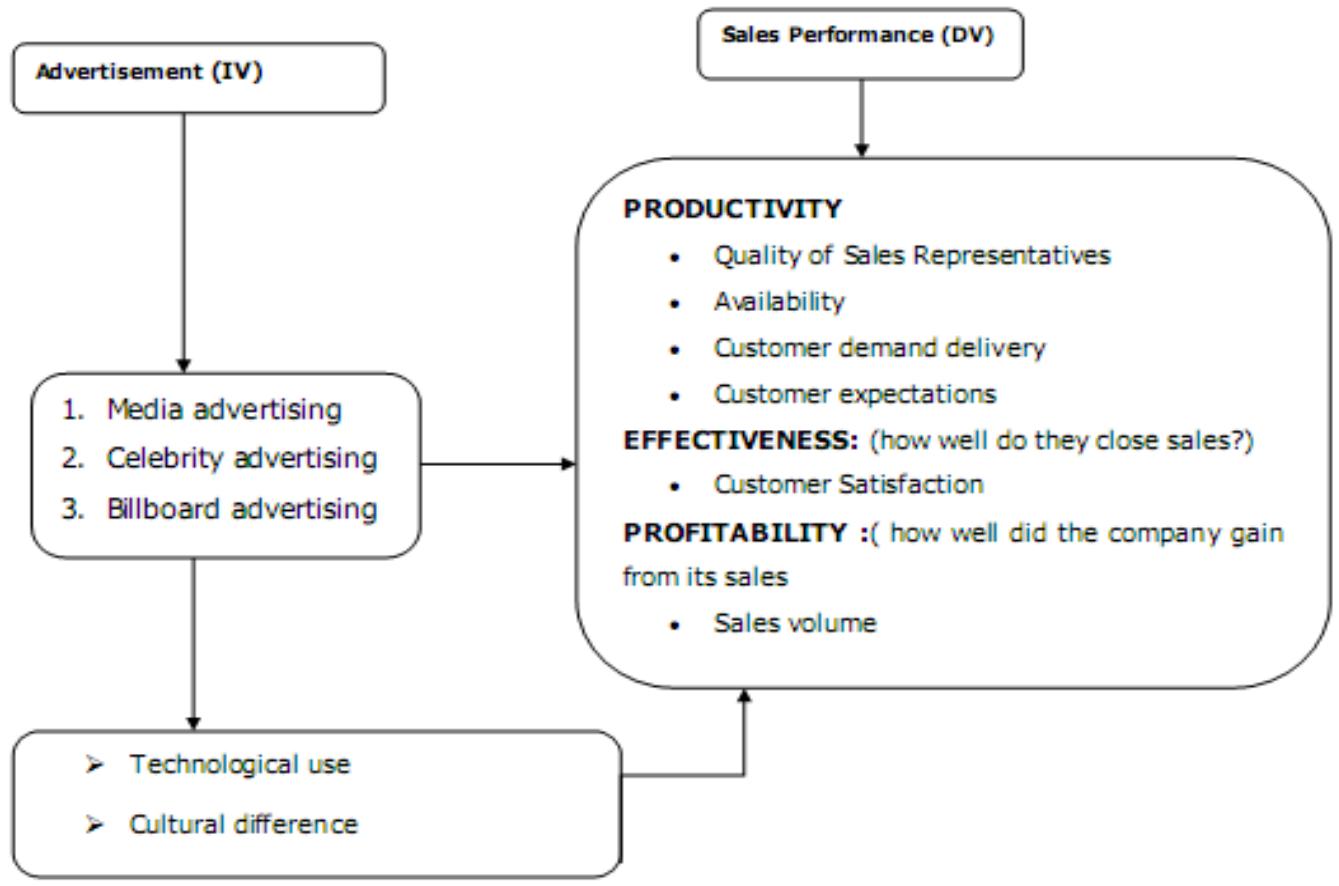
Source: Researcher (2014)
### CHAPTER TWO
#### LITERATURE REVIEW
### a) Introduction
This chapter looks at advertising as the independent variable, sales performance as the dependent variable and the relationship between the two variables.
### b) Concept of Advertising
Advertising is any paid form of non personal presentation and promotion of ideas and goods, or services by an identified sponsor (Kotler and Arm strong 2010). Although advertising is used mostly by commercial firms, it is also used by a wide range of nonprofit organizations, professionals and social agencies that advertise their causes to various target publics. According to Adekoya (2011) advertising is any paid form of non-personal communication about an organization or its product to a specific target audience through a given medium by an identified sponsor. Adekoya (2011) observes that for any promotional activity to be called advertisement it must be paid for. In its real sense, advertising is it is the method used by companies for creating awareness of their products, as well as making new products known to the new and potential consumers.
In terms of marketing, advertising is a promotional tool which tends to remind, reassure and influence the decisions of the consumers because an advertisement itself enlightens, educates, and persuades consumers on their acceptability of the product offering (Sundar & Kim, 2005). Advertisements in such a media as print (newspaper, magazines, billboards, flyers) or broadcast (radio, television) typically consist of pictures, headlines, information about the product and occasionally a response coupon. Broadcast advertisement on the other hand consists of an audio or video narrative that can vary in range (Busari, 2002).
Many advertisements can also be seen on the seats of grocery carts, on the wall of airport walkways, on the sides of buses, airplane and train, an indication that advertising is a common phenomenon in the daily life of man. Advertisements are usually placed anywhere an audience can easily and/or frequently a access visual and/or video (Busari, 2002). So many people have tried to define the concept of advertising and as such various definitions have risen. However, there is what is common in the different definitions; all writers use the words like a communication, a promotion tool, a message delivery, attracting customers, persuading customers, calling customers to buy a product or a service and this information delivery is paid for and goes through a particular medium (Arens, 1986).
### c) Forms and Types of Advertising
There are different forms and types of advertising based on nature of the message, medium through which the message is delivered and so on. According to Kotler & Armstrong (1999), there are three forms of advertising that is informative, persuasive and reminder advertising. Informative advertising is used to inform the customers about a new product or features and to build the image of the company. Persuasive advertising is one used to build selective demand for a brand by persuading consumers that it offers the best quality for their money. It persuades a customer to accept sales calls and to purchase now (some persuasive advertising has become comparison advertising, in which a company directly or indirectly compares its brand with one or more other brands. While reminder advertising is one used to keep consumers thinking about the product or service.it is important for mature products or services. It reminds customers that the products may be needed in their near future, where to buy the product and maintaining top of mind product awareness.
Others categorize advertising inform of media, being commercial and none commercial media. Commercial advertising media can include many different advertising media, including the traditional ones and modern means. With advancement in modern technologies, it is expected that more and more means of advertising will continue to surface. Wikipedia (http://en.wikipedia.org/wiki/Advertising) outlines a number of commercial media including wall paintings, billboards, street furniture components, printed flyers and rack cards, radio, cinema and television adverts, web banners, mobile telephone screens, shopping carts, web pickups, skywriting, bus stop benches, human billboards and forehead advertising, magazines, newspapers, town criers, sides of buses, banners attached to or sides of airplanes, in-flight advertisements on seatback tray tables or overhead storage bins, taxicab doors, roof mounts and passenger screens, musical stage shows, subway platforms and trains, elastic bands on disposable diapers, doors of bathroom stalls, stickers on apples in supermarkets, the opening section of audio and video, posters, and the backs of event tickets and supermarket receipts. While there are so many forms of commercial advertising, this study conceptualized in details and empirically examined only three forms, which include media advertising, celebrity advertising and billboard advertising, for reasons that there are very few researches on them in almost no study was found in the context of Mogadishu Somalia.
### d) Theoretical Framework
It is generally known that advertising plays a role in increasing the sales volume of any company's product at any point in time but this role cannot be overemphasized. In several cases, advertising has helped many companies in various industries to growth. This is due to its role in placing a positive image about the companies' products in the mind of potential consumers.
Since advertising means different things to different people, there was a need for the researcher to conceptualize this concept in line with this study, based on some conceptualizations of previous researchers and experts in this field. Longman (2000) says that advertising involves the act of telling people publicly about a product or service in order to persuade them to buy it. Alonge (2001) contends that advertising is any paid form of non-personal communication which is directed to the consumers or target audiences through various media in order to prevent and promote product, services and idea. This means that advertising as a branch of commerce is used to create awareness for a particular product and it must be paid for. It is a service or an aids-trade in commerce used to inform, educate, guide and persuade people to buy the advertised goods or services. Gillian (1982) looks at advertising as "a means of drawing someone's attention to something or notifying or informing somebody of something".
1. Non Personal: First what is non-personal"? There are two ways to sell anything, personal or non-personally. Personal selling requires the seller and buyer to get together while non personal selling involves the use of various media to reach the consumer/buyer. The advertising is directed to group of people with no particular person in mind and it thus non-personal in nature.
2. Communication: This means not only in speech or picture but any way one person can pas information, ideas or feeling to another. Thus, communication uses all these senses, smell, touch, taste, sound and sight. And of all the five only two are really useful in advertising.
3. Information: Information is described as knowledge, fact or news. However you should bear in mind that one person's information is another's scam, particularly when an advertiser talk about their
products. Information comes in many forms it can be complete, it can be blare or deceptive.
4. Paid Form: "Paid form" is a pretty straight forward meaning. It is advert created and placed on the media, the costs of creation and time or space in the media must be paid for. This is a major area in which advertising different from public relations. However, some advertisements are not paid for by their sponsors. Free advertisements are exclusively for public service campaigns.
5. Identified Sponsor: Identified sponsor means whosoever is putting out the advertising, must tell audience who they are. Legally, a sponsor must identify herself as sponsor of an advertisement. This equally establishes the truthfulness of the message unlike propaganda which is another promotion with anonymous or hidden sponsors. A company sponsors advertising in order to convince and influence people to buy its products. All these can be shown in model:
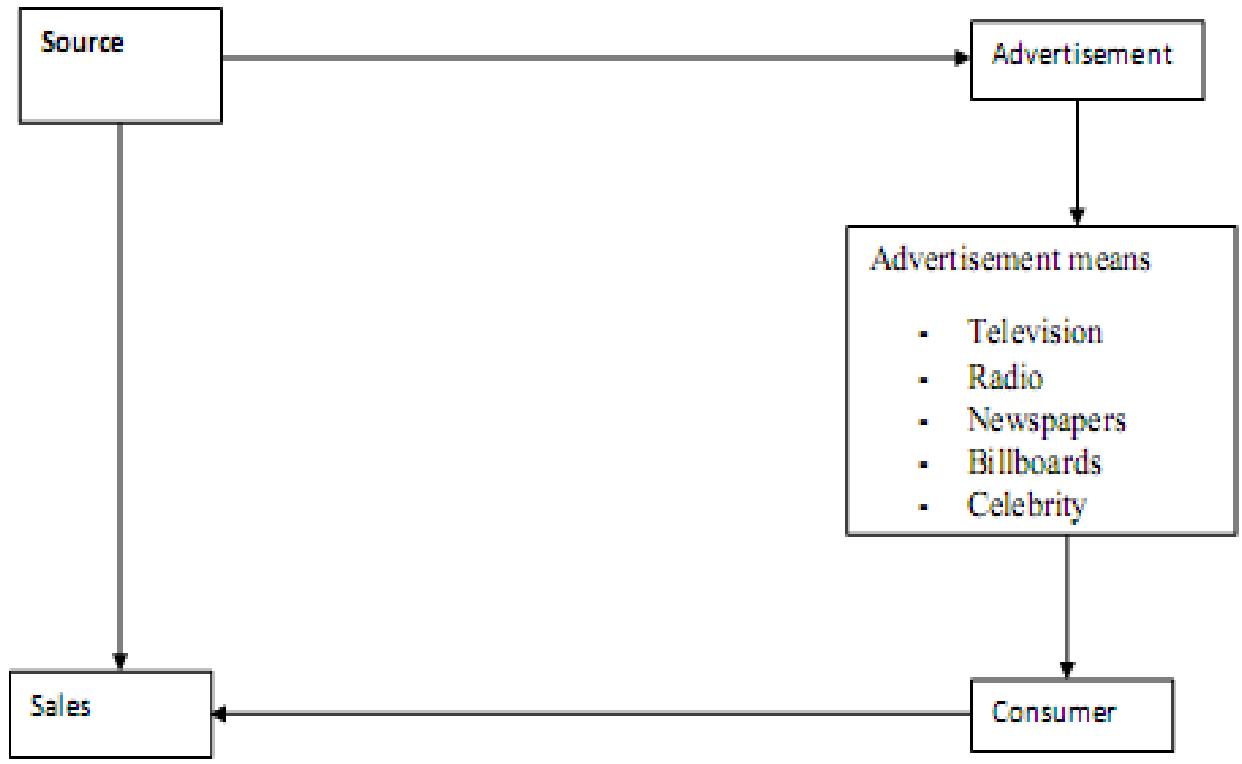 Figure 1: Model of Advertising (Osuagwu Linus, 1997, 185)
The ultimate function of advertisement is to help produce sales. This is the feedback expected from the consumer. Though advertisement may not lay absolute claim to sales, since it is equally the goal of other promotional tools, such as sales promotion, personal selling, etc, its contribution cannot be over-emphasized. The advert message is put into a symbolic form such as pictures, written words or spoken words. The message is then transmitted to the consumer via means of advertisement like television, radio, newspaper and so on. But, advertisement cannot produce immediate sales; sales may come in the long run, since consumers normally do not switch from uninterested individuals to convinced consumers in one instant move or day (Richard, 1996).
### e) Empirical Review
## i. Media Advertising and Sales Performance
### 1. Media Advertising
Media advertising is the use of several advertising media to promote goods and services of a given company. Wikipedia (http://en.wikipedia.org/wiki/ Advertising) indicates that in the 1960s, campaigns featuring heavy spending in different mass media channels became more prominent, giving an example of the Esso gasoline company which spent hundreds of millions of dollars on a brand awareness campaigns, building around the simple theme Put a Tiger in Your Tank.
#### 2. Steps in Choosing an Advertising Media
Armstrong specifies four major steps taken into consideration when choosing an advertising media, these are deciding on reach, frequency and impact of the medium selected. Reach is the percentage of people in the target market who are exposed to the ad campaign. Frequency is the measure of how many times the average person in the target market is exposed to the message.
Media impact is the qualitative value of message exposure through a given medium for example for products that need to be demonstrated, messages on television may have a great impact than those on radio since television has both sound and sight. In choosing the type of media, the reach, frequency and impact of the major media types include newspapers, televisions, direct mail, radios and magazines. Media choice is affected by the media habits of target consumers that is, media that reaches target consumer effectively. Nature of products that is some of products and services are best advertised on televisions and color magazines.
Types of messages that is a major sale may require radio or television while a technical sale requires magazines, and direct mailing or on line. Cost is another major factor in media choice. This looks at the total cost of using a medium and the cost per advert exposure Selecting specific media vehicles with in each general media type such as specific magazines, televisions, television shows or radio programmes, a company must consider or complete the cost over thousand persons reached by a vehicle, cost of producing adverts for different media and also balance media cost measures against several media impact factors. Deciding media timing is last step in choosing an advertising media. The company must decide how to schedule the advertising over the course of a year.
Continuity or pulsing patterns may be chosen. Continuity means scheduling the adverts evenly within the given period while pulsing means scheduling adverts unevenly over a period of time.
### f) Advertising Campaigns have three Main Characteristics
1. Meaningful: They should point out benefits that make the product more meaningful to the customers.
2. Believable: Customers must believe that the product or service will deliver the promised targets.
3. Distinctive: Ability to tell that the product is better than competing brands. Pride & Fewel (2006) suggest five significant decisions to be considered when drawing advertising programmed; these include what media should be involved? What message should be conveyed? What should be the company's overall advertising budget? How does the firm know that the advertising is achieving its objectives? The only reason for advertising is to sell something that is product, service or even an idea (William et al, 1998).
Scheme and smith 1980 insists that it is not enough to produce a good product, and you do not make it, advertising only makes it accessible to customers and stimulates consumption and purchase. Advertisement also facilitates the introduction of a new product, expands the industry sales and the company, supports personal selling, reaches people inaccessible by sales force, builds good will of the firm hence improving its reputation and consequently sales are improved. However advertising is costly and may not be as persuasive as a company's sales person.
Many companies used straight forward method in determining advertising applications like percentage of sales, standard expenditure per unit, the task method /market share relations between advertising and sales revenue since there are mainly other factors that determine the sales revenue of a company like price, perception towards the product (Kotler & Armstrong).
The study showed that businesses making major increases in media advertising expenditures during the recessionary period gained an average of 1:5 points of sales performance share. This level of aggressiveness was displayed by only $25\%$ of the businesses. Thus, by being aggressive, these businesses outperformed the average business, which, as we saw earlier, gained only 0.63 points of share during market recession (Nyren, 2005).
During market expansion periods, over $80\%$ of the businesses increased media advertising expenditures. The problem, however, is that no particular share gain was achieved, on average, because most firms take the same action. Thus, the consistency of ROI levels between normal and expansion periods is maintained.
We do see the danger of falling behind in media advertising. Those businesses that reduced their media advertising during the expansion lost one point of share. We cannot say, without additional information, whether the pulling back of media advertising caused a loss of share or whether it was caused by the lack of production capacity to serve the growing market. However, any program of increased media advertising should be a part of your marketing and business strategies.
### g) Celebrity Advertising and Sales Performance
## i. Celebrity Concept
Celebrities are people who enjoy public recognition by a large share of a certain group of people. According to Friedman & Friedman (1979), the term celebrity refers to an individual who is known to the public (actor, sports figure, entertainer, etc.) for his or her achievements in areas other than that of the product class endorsed (Johansson & Sparredal, 2002).
Celebrities act as spokespeople in advertising to promote products and services, which is referred to celebrity endorsement. McCracken (1989) defines celebrity endorser as "any individual who enjoys public recognition and who uses this recognition on behalf of a consumer good by appearing with it in an advertisement" (Ericsson & Hakansson, 2005).
Celebrities could be classified according to their work/performance area: entertainers (pop-stars, musicians, showmen, actors, models, etc.), sports figures, businesspersons or politicians. They could also be classified according to the level of their familiarity (local, national or international/global), and their demographics.
Advertisers often use celebrities in advertising because of their famous attributes (beauty, talent,athleticism,power,etc.) that often represents the attractions desired for the brands they endorse. According to Ericsson & Hakansson (2005), the repeated association of a brand with a celebrity might ultimately lead consumers to think the brand possesses the attractive qualities that are similar to the celebrity's. Furthermore, consumers may like the brand because they like the celebrity who endorses it.
### h) Reasons for using Celebrity Endorsers
Scientific literature is abundant in discussions about the reasons for using celebrities in advertising. Belch & Belch (2001) state that the reasons why companies spend huge amounts of money to have celebrities appear in their ads and endorse their products is that celebrities have stopping power. They draw attention to advertising messages and enhance message recall. Celebrities help in recognition of brand names, create positive attitudes toward the brand and create a personality for the endorsed brand. Moreover, it is believed that celebrities could favourably influence consumers' feelings, attitudes and purchase behaviour.
The use of celebrities in advertising has been a popular practice for a number of years already and it remains (Banyte et al., 2011). There are researches indicating that advertisements featuring a celebrity constitute a proportion of about 20-25 percent of all ads (Brown, 2006; Shimp, 2007). According to Silvera and Austad (2004), the popularity of such kind of advertisement is determined by the opinion, that celebrity endorsement can result in more favourable advertisement ratings and product evaluations (Dean and Biswas, 2001) and can have a substantial positive impact on financial returns for the companies that use them (Erdogan, 1999). Among the most common reasons why companies use celebrities to endorse their products are those: increase attention, image polishing, and brand introduction, brand repositioning, etc. (Erdogan, 1999; Ericsson and Hakansson, 2005). One more solid reason for using the celebrities in advertising is the possibility to eliminate or reduce the effects of cultural interferences for companies performing in international, global markets.
The selection of appropriate celebrity for advertisement is a complicated issue that attracted interest of many researchers at both academic and practical levels. The number of authors analysed reasons for using the celebrity endorsers in advertising (Johansson and Sparredal, 2002; Ericsson and Hakansson, 2005; Kulkarni and Gaulkar, 2005 the criteria and the models for selection of celebrities endorsement (Silvera & Austad, 2004; Shimp, 2007), and the risk of using the celebrity in advertising (Tandon and Mehrotra, 2005; Duncan, 2008.). Analysis of existing studies reveals a lack of clear conceptualization especially on the important aspects of selecting and using celebrity endorsers in advertising. With that in mind, studies that examine the complete multistage process of selecting celebrities in advertising are especially valuable (Banyte et al., 2011).
Analysis of literature on celebrity endorsement allows managers and researchers to study the process of celebrity endorser selection from the company's point of view. It makes sense knowing that it is a company who intends to get advantage and benefits from such a marketing technique. But the perception of target audience is also of critical importance. Only opinion of customers can provide the evidence, if the endeavours of the company allow reaching the expected results. We believe that findings of the empirical research, provided in this article, would serve as at least exploratory but useful insight into the perception of consumers about celebrity endorsement. Celebrity advertising is the use of a public figure's likeness for the purpose of selling a product or service. Celebrity advertising can be accomplished through celebrity endorsements, whereby the celebrity consents for his or her likeness to be used in advertisements for a certain brand (Miciak & Shanklin, 1994).
Celebrity advertising without the celebrity's consent results in products that are referred to as "bootleg" merchandise or "knock-offs," which feature the celebrity's photo or likeness on a product Walker et al. (1992). Celebrity endorsements imply that the celebrity uses the product or service that he or she is endorsing, and prefers it above others of its kind. For this reason, brands will often target celebrities who appear to reflect whichever effects the advertisement is promising. For example, celebrities who are already fit are often approached to represent fitness and weight loss products, and stars that are known for their hair are approached to endorse certain brands of shampoo.
In some cases, the celebrity might not even use the product or service at all. Celebrities who knowingly mislead the public in exchange for profit in this regard are often criticized for "selling out." Because of this, many North American celebrities have opted to endorse products for advertisements that are only shown overseas, particularly in Japan (Kaikati, 1987). One of the most iconic examples of celebrity advertising is the George Foreman Grill. At one time best known for his championship boxing, George Foreman is perhaps better-known today for endorsing his eponymous grill, which claims to reduce fat in cooking. Like many products endorsed by celebrities, the George Foreman Grill was brought to the public's attention through a series of repetitive TV commercials. In some cases, celebrity endorsements on TV exceed the length of a standard commercial; these ad spots are known as "infomercials" or "paid programming." Some celebrities who have appeared in infomercials include: Victoria Principal for the Principal Secret, Daisy Fuentes for Winsor Pilates, and Chuck Norris for the Total Gym.
Celebrity advertising via bootleg merchandise usually consists of the celebrity's likeness, whether through an actual photo of the celebrity or a facsimile that reflects certain iconic aspects of the celebrity's image (Miciak & Shanklin, 1994). For example, a product that is not endorsed by Elvis Presley's estate but still bears an image of the singer's signature hairstyle, pose, etc. would be considered bootleg merchandise. Restrictions prohibit bootleg merchandise from being sold in most major retail outlets; however, flea markets and discount stores have been known to carry such items.
Despite well-publicized celebrity miscues such as O. J. Simpson's arraignment on murder charges, Mike Tyson's rape conviction, and Michael Jordan's gambling debt, the use of celebrity endorsers continues unabated. Indeed, approximately 20 percent of all commercials use some type of celebrity endorsement (Radley, 1996) Recent highly visible examples include Candice Bergen for Sprint, Jerry Seinfeld for American Express, Michael Jordan for Nike, Cindy Crawford for Pepsi, and Grant Hill for Fila, Christie Brinkley for the Milk Council, and Ken Griffey, Jr for Nintendo (Bradley, 1996).
Although endorsers can be used for a variety of purposes such as getting attention (Kaikati, 1987) and penetrating commercial clutter (Miciak & Shanklin, 1994), the high cost of endorsements suggests that marketers expect to get far more value from the endorsement than simply the use of a clever execution device designed to attract consumer attention.
Despite the popularity of celebrity pitchmen (and women), many commercials using celebrity endorsers do not live up to advertisers' expectations (Miciak & Shanklin, 1994). However, used appropriately, celebrity endorsers can serve a valuable role in developing brand equity and enhancing a brand's competitive position. The purpose of this article is to identify how basic associative learning principles can be invoked to improve the use of celebrity endorsers.
### i) Billboard Advertising and Sales Performance
Advertisers are indeed exploring many new avenues. Billboard advertising is being used in innovative ways: "Out-of-home advertising, long considered a backwater on Madison Ave., is getting tougher to ignore as it branches out beyond the old-fashioned billboard. New technologies are transforming out-of-home ads, a sector which includes roadside billboards, ads on buses and trains and now even coasters in bars. As advertisers find it harder to reach consumers through television and radio, the increasing array of out-of-home ads is looking more attractive (The Wall Street Journal, July 21, 2005).
## i. Billboard
A billboard (archaically a "hoarding" in the UK) is a large outdoor advertising structure (a billing board), typically found in high traffic areas such as alongside busy roads. Billboards present large advertisements to passing pedestrians and drivers. Typically showing large, ostensibly witty slogans, and distinctive visuals, billboards are highly visible in the top designated market areas (Cavaliere, & Tassinari, 2001).
Bulletin are the largest, most impactful standard-size billboards. Located primarily on major highways, expressways or principal arterials, they command high-density consumer exposure (mostly to vehicular traffic). Bulletins afford greatest visibility due not only to their size, but because they allow creative "customizing" through extensions and embellishments (Assmus, Farley & Lehmann, 1984).
Posters are the other common form of billboard advertising, located chiefly in commercial and industrial areas on primary and secondary arterial roads. Posters are a smaller format than bulletins and are viewed principally by residents and commuter traffic, with some pedestrian exposure (Cavaliere, & Tassinari, 2001).
## ii. Painted billboards
Grabowski, (2000) almost all these billboards were painted in large studios. The image was projected on the series of panels that made up the billboard, then "pounced" on the board, marking the outlines of the figures or objects. Then, using oil paints, the artists would actually use large brushes to paint the image. Once the panels were installed using large hydraulic booms on trucks, the artists would go up on the installed billboard and touch up the edges between the panels. These large, painted billboards were especially popular in Los Angeles where historic firms such as Foster & Kleiser and Pacific Outdoor Advertising dominated the industry. Eventually, these painted billboards gave way to graphic reproduction, but hand-painted billboards are still in use in some areas where only a single board or two is required. The "Sunset Strip" in Los Angeles is one area where hand-painted billboards can still be found, usually to advertise upcoming films or albums in the heart of the entertainment industry.
## iii. Advertising Style
Billboard advertisements are designed to catch a person's attention and create a memorable impression very quickly, leaving the reader thinking about the advertisement after they have driven past it (Kelton & Kelton, 1982). They have to be readable in a very short time because they are usually read while being passed at high speeds. Thus there are usually only a few words, in large print, and a humorous or arresting image in brilliant color (Kelton & Kelton (1982)).
Some billboard designs spill outside the actual space given to them by the billboard, with parts of figures hanging off the billboard edges or jutting out of the billboard in three dimensions. An example in the United States around the turn of the 21st century were the Chick fil-A billboards (a chicken sandwich fast food chain), which had three-dimensional cow figures in the act of painting the billboards with misspelled anti-beef slogans such as "friends do not let friends eat beef (Kelton & Kelton, 1982).
The first "scented billboard" an outdoor sign emitting the odors of black pepper and charcoal to suggest a grilled steak, was erected on NC 150 near
Mooresville, North Carolina by the Bloom grocery chain. The sign depicted a giant cube of beef being pierced by a large fork that extended to the ground. The scents will be emitted between 7-10 a.m. and 4- to 7 p.m. from May 28, 2010 through June 18, 2010.
## iv. Billboards can Capture Attention Easily
Newspaper ads require a person to sift through the pages in order to find that advertisement. Billboards however, can simply attract attention by being there. One billboard placed strategically is as effective as hundreds of newspaper and television ads running. The best thing is, anyone can see them. Drivers, employees, students; these people can see your billboard when you start placing them on top of buildings and on the sides of the highway. They can't ignore them as well; whether they like it or not, the billboards are there to stay. Well designed billboards can easily capture a person's fancy as well. It all depends on your creative team to come up with that.
## v. They are Available around the Clock
Unlike TV ads that depend on the number of minutes paid and newspaper ads that depend on the amount of space the ad occupies, billboards are available around the clock. Anyone can see billboards anytime of the day. They are not taken down after a certain hour as passed, nor are they restricted to certain time limits. They are like advertisers that work 24 hours a day, with no stops and no pauses. You can't even turn billboards down as well. They are just there, speaking their message in silence. You don't have to talk to them; all you have to do is just look at them and see what they have to say to you through the designs placed on the billboard.
Billboard advertising has become one of the most solid methods of promoting your business. Should you wish to utilize outdoor advertising, make sure that you depend only with Advertisement (Nelson, 2001).
### j) Sales Performance
Sales in business terms are the actual sales in money values, a company receives after necessary collections are made from different sales channels of the original total production put on the market (Mc Cathy et al, 1994). It is sales that stimulate production in a company and consequently profits which are affected by various factors some of which are controllable like quality and others are uncontrollable like competition and general price changes.
Sales performance is an integrated frame work that enables organizations to plan and model sales strategies and ensure timely execution of sales initiatives while ensuring both front line sales people and decisions-markers have visibility into performance. Sales performance represents the next generation of best practices for sales (Michael, 2006).
Sales performance also refers to the total amount of firm's output sold to the market especially on monthly or annually basis.this is affected by many factors including customer relationship, marketing management of the firm and sales force skills and motivation and even the pricing of the goods and services (Amanda, 2002).
Sales revenue is the total amount of money that the firm gets from the sale of all its goods and services in a given period of time. This is usually six months or a year if a firm produced only one product or service, the sales revenue will be the price of the product multiplied by the number of products sold. In the case of more than one product or service the revenue from each needs to be added together (wood, 1996).
The figure for sales revenue in profit and loss account does not necessarily mean that the firm has received all the money because although they may have sold that quantity of the product, they may still be owed some of the money as debtors (Baker 2001). Sales performance refers to consistent and satisfactory turnover of goods and services produced and put on the market by an organization or company. It is the sole economic goal of companies to have as much goods sold on the market. This facilitates the rate of goods turn over and consequently revenue and increased production.
## i. Sales
According to stein (2006) it is believed that the right sales approach consists of sales training that supports a company's sales methodology and related processes. Designing or adopting sales methodology is critical, without this methodology in place, training is a tactical attempt to a larger problem. The selling methodology must be developed based on the company's unique situation in their market, their customers, how the customers buy, the complexity and price levels of the products and services the company offers, competitive pressures, reporting requirement s the participation partners and the skill level of their current sales people (stein, 2006).
In the past years some organizations have found that their sales process are becoming more challenging while the performance of some of their sales professional who were past stars are deteriorated. Selling complex products and services, versus selling commodities has always been more difficult and sales professionals must have different skill sets (stein, 2006).
Most companies recognize that the world and their buyers buying processes probably have changed forever. But some companies have not recognized the need to make change in their sales force (stein 2006).
In dealing with falling or declining sales, it is advisable to invest in some short term training to upgrade the skills of sales and customer service staff. If you cannot afford to fire experience, train the staff you can afford. This is an investment you cannot afford to miss. Find training that produces results tailored to get to your situation. It can be seminars or distance learning that does not require time away from the property or the job (verret, 2004).
According to Hardesty (2006), sales training programs encompass a variety of necessary components, things like company policies, sales paper work, customer relationship management, sales force automation orientation, sales processes, company services, sales skill training and product features and benefits. stein 2006 further urges that, even when companies do decide that sales training is a step in the right direction, they do not always proceed forward for the right reasons in the right order, or in a way that results in them, driving more sales revenue companies have learned how to employ sales training as a strategic tool.
Those that are leaders in the industry, offering their stake holders maximum return on their input are able to quickly adapt to changing market conditions, are respected by their customers, and provide rock solid, consistent sale performance. the sales people that work for those companies are motivated, stay at their jobs longer and are proud to help in recruiting their friends who have been successful selling for other companies. This therefore leads to improved sales performance.
## ii. Sales Process
A sales process is a systematic approach involving a series of steps that enables a sales force to close more deals, increase margins and make more sales through referrals. Actively using and desire to become willing to implement a sales process could lead to more sales. Normally a sales process involves the following key steps; prospecting qualifying, proposal presentation, handling objections, closing sale and follow-up for repeat business –referrals (Dvora, 2008).
## iii. Effective Sales Process
An effective sales process has elasticity to accommodate extraordinary situations. Is your company prepared to meet a certain spike in demand for their products or services? Effective sales processes stand the rigors of changing times and market conditions and produce the best possible results in most circumstances. Companies have to be flexible and change with the changing environment and different consumer needs so as to be able to offer consumers what they need, when they need it. An effective sales process produces sales results with unerring precision as a manufacturing unit produces finished products, it should therefore be evaluated to gauge performance of both the staff and organization. Thus considers constant monitoring and supervision of organizational activities. A sales process can be viewed as an integrated method where man power refers to the sales force, the product or service is the raw material, strategy refers to sales plans and methods, and technology refers to the latest communication and sales technologies.
## iv. Outcomes of Sales Processes
The outcome of a sales process can be explained by a series of steps that are systematic and not haphazard. Random acts produce random and uncertain results. In sales, random acts can be used occasionally, but systematic and well defined best practices can assure predictable results (vakratsas and Ambler). The steps include; predictable out comes, repeatable activities, and tangible results. Predictable outcomes are desired and predictable through a series of action that could lead to more sales and higher margins. Respectable activities are the ones that have to be done over again by any sales person within the organization. Tangible results are the outcomes that can be measured and compared. Relevancy for others that is a good sales process may be cloned to suit other organizations and they may emulate a successful sales process model. A group of companies may apply a particularly productive sales process to all or some of its divisions.
## v. The Outcome of the Selling Process
Identifying and qualifying; leads to take in to account only those prospects that truly have the potential to buy according to their importance, to assign the right resources to each of them. Successful sales people spend more time with their top revenue producing accounts. This implies that the customer with the uniqueness of the product or service and your company, talk about the need of the customer and develop customized value proportions to solve their business use, convince the customer that your company is the one that can take care of the need and non can do it better than you. Assessing the purchasing power of each potential customer, large percentage off profit sales and forge strong bonds between the company and customers through the sales staff, Griffith (2001) states that profitability of a business is the justification of good performance. He further says that, profits of a business are the end results of operations and an indicator of good performance. Therefore, profit is a basic yardstick with which the success of the business can be measured. It is a reward for enterprise innovation and taking risks.
The sole reason for setting up a business is creation of customer, not profit. profit is as a result of coincidence during business operations. (Hampton, 2001) contends that business do not carry on their activities solely with an eye of achieving the highest possible profits but business have placed a high value on the growth of sales and willing to accept lower profits in order to gain the stability provided by large sales.
### k) Relationship between Advertising and Sales Performance
The essence of advertising is to increase sales revenue hence improving sales performance (David et al, 1988). Advertising combines with a host of other influences to determine what contribution advertising makes to the buyer's purchase decision. The retailer John Wanamaker is said to have remarked that he knew that only half of his advertising was effective but he was unable to know which half it was. It is through advertising or other forms of promotion that brands in different market segments can effectively tell people in the market that a product is intended specially for them (Engel 1991, mc Gann and Russell, 1998).
The significance of advertising is to let customers know that an established brand is still around and it has certain characteristics, uses and benefits (Pride et al, 1989). Effective advertising can increase sales of advertisers products, and by so doing increase their profits. Advertising provides consumers and other prospects with information about different products that are available to them. This enables consumers to compare and choose between the products and encourages competition. Competition encourages companies to be more price and quality conscious so as to retain customers and clients (Cambridge international college training manual, 2000). The decision to advertise implies a decision to compete in a new and aggressive way with in the market. This means the provider will no longer rely too solely upon personal sales man ship to gain distribution. Instead he implies his readiness to and intention of speaking directly to consumers in abroad countries.
The decision to advertise also helps the marketer to expand his share in the market. Advertisement helps in development and expansion of the market and the consumer acceptance of the product. Dunn (1968) points out that the market needs and conditions are changing; therefore there is need for creativity in selling. This will show the company what to produce so as to satisfy the needs of the users. When companies produce such a commodity and they advertise, there is an automatic high response in consumption. Thus, showing the relationship between advertising and sales performance (Penchman, 1992) found out that advertising has a greater potential of building awareness of people hence obtaining a high preference in the market share because a big percentage of the population has one or more of the mass medium such as radios and television. This fact introduces the advertised company to many people. If the advertising is satisfying the customer it will lead to increase in volume of sales.
Pride F et al (1989) observes that advertising often stimulates demand thus stimulating sales. For advertising to have a direct relationship with sales revenue, the entire market mix must be viewed by the customer as the right one (Engel et al 1991, mc Cathy and perveault, 1988). Gordon (1993) states that companies advertise in order to compete in a new and aggressive way with in the marker, to increase their market share through increased customer, utilize the low cost way of teaching customers to create marketing approaches. David et al (1988) recognizes that many scholars have heard different views on the effect of advertising on sales performance.however most of them agree that effective advertising will eventually increase revenue. Jefikins (1990) has stated that in a competitive society there is not only competition between rival advertisers but choice between their rival products and services. Also people forget very easily and therefore the biggest advertiser in the world will get bankrupt very easily if he stopped advertising. Companies advertise to create familiarity with or of a product, which helps to create confidence in it. If a product is simply made available, it is important to inform people of its existence.
#### CHAPTER THREE
#### METHODOLOGY
### a) Introduction
This chapter presents the research design, research population, research instrument, and data gathering procedures, data analysis, ethical considerations and limitations of the study.
## i. Research Design
This study employed a descriptive correlational and a cross sectional survey design. Therefore, the descriptive design enabled the researcher to determine the picture or document current conditions or attitudes to describe the effect of advertisement and sales performance of the selected companies in Mogadishu Somalia. It was descriptive correlation because the study intended to describe and establish the relationship between extent of advertising of and the sales performance of the companies. The use of cross-sectional design was justified because data was collected at once across the selected respondents.
### b) Study Area and Population
The researcher targeted 160 employees of the selected companies. For reasons of accuracy and the reliability of the data provided, the researcher carefully selected directors, managerial staff, sales and marketing personal, and) customer relationship management from each company. This mathematically accumulated to 160 employees which was the target population of this study.
Table 3.1: Target Populations
<table><tr><td>No</td><td>Transfers</td><td>Directors</td><td>Managerial staff</td><td>Sales & marketing personal</td><td>CRM</td><td>Total</td></tr><tr><td>1.</td><td>DAHABSHIIL</td><td>2</td><td>10</td><td>10</td><td>10</td><td>32</td></tr><tr><td>2.</td><td>HORMUUD</td><td>2</td><td>10</td><td>10</td><td>10</td><td>32</td></tr><tr><td>3.</td><td>OLYMPIC</td><td>2</td><td>10</td><td>10</td><td>10</td><td>32</td></tr><tr><td>4.</td><td>SCOMPANY</td><td>2</td><td>10</td><td>10</td><td>10</td><td>32</td></tr><tr><td>5.</td><td>AMAANA</td><td>2</td><td>10</td><td>10</td><td>10</td><td>32</td></tr><tr><td></td><td colspan="5"></td><td>160</td></tr></table>
### c) Sample Size
The entire number of the target population of selected companies was 10 directors, 32 managerial staff, 32 sales and marketing personal and 32 customer relation management departments of each company. The researcher used Slovene's formula to determine the sample size, with maximum acceptable error of $5\%$. The sample size consisted of (114) respondents from the target population. The sample size was determined from the population of the study using Sloven's formula which is stated as follows;
$\mathsf{n} = \frac{\mathsf{N}}{\mathsf{1} + \mathsf{N}(\mathsf{e}^{\mathsf{2}})}$, Where; n = the required sample size; N = the known population size; and e = the level of significance, which is $= 0.05$
### d) Sampling Procedures
The data was collected from the employees of selected companies using purposive sampling to select the respondents based on their experience and knowledge in motivation. From the list of qualified respondents chosen based on the inclusion criteria and finally the selected respondents with the consideration to the computed minimum sample size.
### e) Research Instrument
The researcher employed questionnaires as the main tools for data collection. This instrument was chosen by the researcher because it is the most effective data collection tool and perhaps less costly. Furthermore, the questionnaires helped the researcher to engage a large number of respondents within a short period of time. The questionnaire consisted of three sections; the first section helped the researcher to collect data on the demographic characteristics of respondents; the second section was used by the researcher to collect data on the independent variable (adversing) and this section was divided into three subsections, which included five questions on media advertising, five questions on celebrity advertising and five questions on billboard advertising. All questions in this section were Likert scaled using five points, where $1 = \text{Strongly Disagree}$ (SD), $2 = \text{Disagree}$ (D), $3 = \text{Undecided}$ (U), $4 = \text{Agree}$ (A) and $5 = \text{Strongly Agree}$ (SA); the last section involved questions on the dependent variable (sales performance) and was also broken into three subsections, with five questions on company productivity, five on effectiveness and five on company profitability. All questions in this section were also Likert scaled using five points, where $1 = \text{Strongly Disagree}$ (SD), $2 = \text{Disagree}$ (D), $3 = \text{Undecided}$ (U), $4 = \text{Agree}$ (A) and $5 = \text{Strongly Agree}$ (SA). The items which were used to formulate questions were derived from literature review sources and so the questionnaire was own made.
### f) Validity and Reliability
To know the validity of the questionnaire, the questions were given to experts in contents subject of the study, subjects such as professors and lecturers to judge the relevancy of the questionnaires. Then a content validity index was computed using the formula of content validity index (CVI). And if the CVI was greater than or equal 0.75, then the questionnaire was declared valid.
Content Validity Index $(\mathrm{CVI}) =$ No. of items declared valid
Total No: of items.
Using test re-test method, the reliability and consistency of the instruments was tested. The questionnaire first was given to a few respondents and then after three weeks was given to the same people of respondents. Results of the two tests were compares using a t-test, which showed a high degree of reliability.
### g) Data Gathering Procedures
## i. Before the Administration of the Questionnaires
An introduction letter was obtained from the Graduate School and Research Office for the researcher to ask for approval to conduct the study from the respective managers of humanitarian organizations.
respective managers of humanitarian organizations.
2. When approved, the researcher secured a list of the qualified respondents from the humanitarian organizations directors and select through systematic random sampling from this list to arrive at the minimum sample size.
3. The respondents were explained about the study and were requested to sign the Informed Consent Form (Appendix 3).
4. Select research assistants who would assist in the data collection; brief and orient them in order to be consistent in administering the questionnaires.
## ii. During the Administration of the Questionnaires
1. Sufficient questionnaires were distributed and the respondents were requested to answer completely and not to leave any part of the questionnaires unanswered.
2. The researcher and assistants emphasized retrieval of the questionnaires within five days from the date of distribution.
3. On retrieval, all returned questionnaires were checked if all are answered.
## iii. After the Administration of the Questionnaires
After receiving the questionnaire back, the researcher encoded the data into the computer and statistically treated using the Statistical Package for Social Sciences (SPSS).
### h) Data Analysis
The data was analyzed using qualitative analysis and was presented using tables and charts computed using the Statistical Package for Social Science (SPSS) version 17. The researcher used descriptive data analysis techniques to summarize the data using frequency counts, means and standard deviations. The Pearson's Linear Correlation Coefficient and Multiple Linear Regression were used to test for the effect of advertising on sales performance.
### i) Ethical Consideration
The researchers made sure that the views of respondents are unidentified in order to protect their confidentiality. In doing so, the researchers used code numbers on the questionnaire in order to provide secrecy of the respondents. The researcher mentioned all authors whose ideas were used in order not to steal someone's knowledge. The respondents were given freedom of weather to fill the questionnaire or not. The researcher treated all the respondents equally.
### j) Limitations of the Study
Limitations the study may face include the following ones:
- The researcher face that some of the respondents will not answer the questionnaire properly or correctly because they think if they response fully
they may under value their organization. This challenge will solve by making an interviews.
- Since top management and staff with busy schedules are part of the respondents, the researcher will not get as much time from them as anticipating. This challenge will solve by seeking appointments with them at their convenient places and time.
#### CHAPTER FOUR
DATA PRESENTATION, ANALYSIS AND INTERPRETATION OF RESULTS 4.0
### a) Introduction
In this chapter, the researcher presents, analyzes and interprets the results. It is divided into five sections. In the first section, the researcher presents, analyzes and interprets the results about the background information of respondents. In the second section, the researcher presents, analyzes and interprets the results about the independent (advertisement) and dependent (sales performance) variables. In the third section, the researcher presents, analyzes and interprets the results about the effect of media advertising on sales performance in some selected companies in Mogadishu-Somalia. In the fourth section, the researcher presents, analyzes and interprets the results on how celebrity advertising affects sales performance in some selected companies in Mogadishu-Somalia. In the fifth section, the researcher presents, analyzes and interprets the results on how billboard advertising affects sales performance in some selected companies in Mogadishu-Somalia.
### b) Background Information
Respondents were asked about their age, gender, highest level of education and work experience. Findings are presented in tables 1 to 5 followed with an analysis and interpretation of the results.
Table 4.1: Gender of Respondents
<table><tr><td>Categories of gender</td><td>Frequency</td><td>Percent</td></tr><tr><td>Male</td><td>53</td><td>46.5</td></tr><tr><td>Female</td><td>61</td><td>53.5</td></tr><tr><td>Total</td><td>114</td><td>100.0</td></tr></table>
The findings in Table 4.1 show that most respondents (53.5%) were female compared to the male respondents (46.5%). This implies that there are more female staff members at companies studied compared to the male staff members. Table 4.2 shows distribution of respondents by age groups.
Table 4.2: Age of Respondents
<table><tr><td>Age groups</td><td>Frequency</td><td>Percent</td></tr><tr><td>Below 20 years</td><td>14</td><td>12.3</td></tr><tr><td>20 - 30 years</td><td>46</td><td>40.4</td></tr><tr><td>31- 40 years</td><td>30</td><td>26.3</td></tr><tr><td>41 - 50 years</td><td>17</td><td>14.9</td></tr><tr><td>More than 50 years</td><td>7</td><td>6.1</td></tr><tr><td>Total</td><td>114</td><td>100.0</td></tr></table>
The findings in Table 4.2 show that a large proportion of respondents (40.0%) were in the age range of 20-30 years compared to the respondents in the age range of 31-40 years (26.3%), 41-50 years (14.9%), those below 20 years (12.3) and those above 50 years (6.1%) respectively. This implies that there is large proportion of staff members at the studied companies who are in the age range of 20-30 years and that most staff there, are early adulthood age bracket. Table 4.3 shows how respondents were distributed by marital status.
Table 4.3: Marital Status of Respondents
<table><tr><td>Marital status</td><td>Frequency</td><td>Percent</td></tr><tr><td>Married</td><td>41</td><td>36.0</td></tr><tr><td>Unmarried</td><td>38</td><td>33.3</td></tr><tr><td>Widow/Widower</td><td>13</td><td>11.4</td></tr><tr><td>Divorced</td><td>22</td><td>19.3</td></tr><tr><td>Total</td><td>114</td><td>100.0</td></tr></table>
The findings in Table 4.3 showed that a large proportion of respondents (36.0%) were married (32%) followed by unmarried respondents (33.3%), divorced (19.3%) and those who were widowed (11.4) respectively. This implies that there is large proportion of staff members at the studied companies who are singles, with relatively few people who are currently married.
Table 4.4 shows how respondents were distributed by education level.
Table 4.4: Level of Education of Respondents
<table><tr><td>Highest Education Level</td><td>Frequency</td><td>Percent</td></tr><tr><td>Secondary</td><td>11</td><td>9.6</td></tr><tr><td>Diploma</td><td>20</td><td>17.5</td></tr><tr><td>Bachelor</td><td>38</td><td>33.3</td></tr><tr><td>Master</td><td>45</td><td>39.5</td></tr><tr><td>Total</td><td>114</td><td>100.0</td></tr></table>
The findings in Table 4.4 show that a large proportion of respondents (39.5%) had have a Masters degree as their highest level of education, followed by the respondents with a $1^{\text{st}}$ degree level of education (33.3%), then those with a Diploma (17.5) and lastly those with a secondary level of education (9.6%). This implies that most staff members at the studied companies are well educated. Table 4.5 shows work experience of respondents.
Table 4.5: Work Experience of Respondents
<table><tr><td>Years worked</td><td>Frequency</td><td>Percent</td></tr><tr><td>1⁄2 year</td><td>12</td><td>10.5</td></tr><tr><td>1 year</td><td>27</td><td>23.7</td></tr><tr><td>3 years</td><td>28</td><td>24.6</td></tr><tr><td>4 years</td><td>20</td><td>17.5</td></tr><tr><td>More than 4 years</td><td>27</td><td>23.7</td></tr><tr><td>Total</td><td>114</td><td>100.0</td></tr></table>
The findings in Table 4.5 show that a large proportion of respondents (24.6%) had served at their current work station for a period of 3 years followed by those respondents who had served for a period of one year and more than 4 years, all at $23.7\%$, while those who had worked for less than one year (10.5%). This implies that there is large proportion of staff members with a work experience of 3 years and above (over $65\%$ ). This indicates that employees at these companies are relatively highly experienced.
### c) Description of the Independent and Dependent Variables
## i. Description of the independent variable
The independent variable in this study was advertising, which was broken into three elements, which include media advertising, celebrity advertising and billboard advertising. To investigate about the extent of advertising in some selected companies in Mogadishu-Somalia, 15 statement questions (five questions on each of the three elements) were presented to respondents who were the staff at selected companies in Mogadishu-Somalia.
These respondents were requested to respond to each statement using a five point Likert scale by indicating the extent to which they agree or disagree with each, where $1 = \text{Strongly Disagree (SD)}$, $2 = \text{Disagree (D)}$, $3 = \text{Undecided (U)}$, $4 = \text{Agree (A)}$ and $5 = \text{Strongly Agree (SA)}$. Their responses were analysed using descriptive statistics showing frequency counts, percentage distributions and means as indicate
Table 4.6: Descriptive Statistics on Extent of Advertising in Selected Companies in Mogadishu-Somalia
<table><tr><td>Questions on Advertising</td><td>SD</td><td>D</td><td>U</td><td>A</td><td>SA</td><td>Total</td><td>Mean</td></tr><tr><td>Media Advertising</td><td></td><td></td><td></td><td></td><td></td><td></td><td></td></tr><tr><td>Most media used to advertise products of this company are accessible by the target market</td><td></td><td>44 (38.6)
63 (55.3)</td><td>2 (1.8)</td><td>2 (1.8)</td><td>3 (2.6)</td><td>114 (100)</td><td>4.00</td></tr><tr><td>This company frequently use television ads</td><td></td><td>39 (34.2)
47 (41.2)</td><td>11 (9.6)</td><td>15 (13.2)</td><td>2 (1.8)</td><td>114 (100)</td><td>3.60</td></tr><tr><td>This company frequently use newspapers, magazines & posters as forms of advertising</td><td></td><td></td><td>24 (21.1) 41
(36.0) 22
(19.3) 22
(19.3)</td><td></td><td>5 (4.4)</td><td>114 (100)</td><td>3.27</td></tr><tr><td>This company frequently uses outdoor form of advertising.</td><td></td><td></td><td>15 (13.2) 30
(26.3) 22
(19.3) 33
(28.9) 14
(12.3)</td><td></td><td></td><td>114 (100)</td><td>3.05</td></tr><tr><td>This company frequently uses radio stations to advertise its products.</td><td></td><td>40 (35.1)26 (22.8)</td><td>8 (7.0)</td><td></td><td>17 (14.9) 23(20.2)</td><td colspan="2">114 (100) 3.31</td></tr><tr><td colspan="8">Average Mean 3.61</td></tr><tr><td>Celebrity Advertising</td><td>SD</td><td>D</td><td>U</td><td>A</td><td>SA</td><td>Total</td><td>Mean</td></tr><tr><td>Your company always agrees with celebrities to promote its products.</td><td>49(43.0)</td><td>39 (34.2)</td><td>10 (8.8)</td><td>10 (8.8)</td><td>6 (5.3)</td><td>114 (100)</td><td>4.01</td></tr><tr><td>Your company products are promoted by an experienced and trustworthy celebrity.</td><td>35(30.7)</td><td>55 (48.2)</td><td>16 (14.0)</td><td>6 (5.3)</td><td>2(1.8)</td><td>114 (100)</td><td>4.01</td></tr><tr><td>You have an attractive, familiar & highly liked celebrity to promote your company products</td><td>26(22.8)</td><td>43 (37.7)</td><td></td><td>12 (10.5) 27(23.7)</td><td>6(5.3)</td><td>114 (100)</td><td>3.49</td></tr><tr><td>Your company products are promoted by a relevant and highly respected celebrity.</td><td>22(19.3)</td><td>50 (43.9)</td><td>26 (22.8)</td><td>12(10.5)</td><td>4 (3.5)</td><td>114 (100)</td><td>3.65</td></tr><tr><td>Your products are currently promoted by a celebrity who has experience, expertise and whose services are related to your products</td><td>12(10.5)</td><td>13(11.4)</td><td>55(48.2)</td><td>18(15.8)</td><td>16(14.0)</td><td>114 (100)</td><td>2.89</td></tr><tr><td colspan="8">Average Mean 3.61</td></tr><tr><td>Billboard Advertising</td><td>SD</td><td>D</td><td>U</td><td>A</td><td>SA</td><td>Total</td><td>Mean</td></tr><tr><td colspan="8"></td></tr><tr><td>Your company is currently advertising on billboards</td><td>39(34.2)</td><td>49 (43.0)</td><td>17(14.9)</td><td>5(4.4)</td><td>4 (3.5)</td><td>114(100)</td><td>4.25</td></tr><tr><td>Your company products are currently advertised on billboards placed in busy towns</td><td>33(28.9)</td><td>37(32.5)</td><td></td><td>16 (14.0)21(18.4)</td><td>7 (6.1)</td><td>114(100)</td><td>3.93</td></tr><tr><td>Your company has billboards on tall buildings</td><td>17(14.9)</td><td>42 (36.8)</td><td></td><td>19 (16.7)27(23.7)</td><td>9 (7.9)</td><td>114(100)</td><td>3.50</td></tr><tr><td>Your company billboards are attractive and easy to read in a short time.</td><td>29(25.4)</td><td>21(18.4)</td><td></td><td>15 (13.2) 25(21.9) 24(21.1)</td><td></td><td colspan="2">114 (100) 2.99</td></tr><tr><td>Your company uses printed, mobile and digital billboards</td><td>19(16.7)</td><td>53 (46.5)</td><td>5 (4.4)</td><td>18 (15.8)</td><td>19 (16.7)</td><td>114 (100)</td><td>3.38</td></tr><tr><td colspan="7">Average Mean</td><td>3.45</td></tr></table>
The findings in Table 4.6 indicate that regarding media advertising, accessibility of the advertising media was rated best (mean=4.00) and this is confirmed by most respondents (55.3% and 38.6%) who respectively agreed and strongly agreed with the statement that most media used to advertise products of the company are accessible by the target market. This implies that over 93% of the respondents confirmed that their companies use accessible media of advertising. The most common of these advertising media according to the findings is television with a mean of 3.60 and with over 75% confirming to the statement that their company frequently uses television advertisements. This was followed by the use of radios (mean=3.31), print media (mean=3.27), while the use of outdoor advertising lagged behind, with a mean of 3.05.
Concerning celebrity advertising, the findings indicated that the companies involved in the study usually use this form of advertising. Majority of the respondents agreed to the statement that their companies usually agree with celebrities to promote their products, with a mean of 4.01 and confirmed by $77\%$ of the respondents. The findings also revealed that over $78\%$ of the respondents confirmed to the statement that their company products are promoted by an experienced and trustworthy celebrity (mean=4.01), which implies effectiveness, since a trusted celebrity has a higher capacity to convince more customers. Most respondents $(63\%)$ also confirmed the statement that their company products are promoted by a relevant and highly respected celebrity (mean=3.65). This is an indication that most of the companies surveyed take time to screen the quality of the celebrities they use in promoting their products. This is further confirmed by the finding that the celebrities used are not only relevant, but they are also attractive, familiar and highly liked in public. This attracted satisfaction of over $60.5\%$ of the respondents, who strongly agreed and agreed with the statement, with a statement mean score of 3.49. It is however indicated that experience, expertise and services of a celebrity being related to company products is not much a concern to most companies, as the statement recorded a lower score of agreement (mean=2.89), where majority (about $64\%$ ) disagreed with the statement and only $21\%$ agreed with it. On the overall however, celebrity form of advertising was found to be popular among the companies studied, with the overall mean of 3.61.
Finally, concerning the use of billboards as a form of advertising, it was found to be less popular as compared to the above two forms, although it also fairly scored. For example, over $77\%$ of the respondents confirmed to the statement that their company was currently advertising on billboards (mean=4.25), an indication that the use of billboards to advertise goods was not neglected by the surveyed companies. Another indicator that companies were currently using billboards to advertise goods was that most respondents $(61\%)$ agreed on the question that company products are currently advertised on billboards placed in busy towns (mean= 3.93) and another one on whether their company has billboards on tall buildings (mean= 3.50) to which over $51\%$ confirmed. The overall mean of 3.45 showed that on average, the use of billboards to advertise goods was found to be fair among these companies.
## ii. Description of the Dependent Variable
The dependent variable in this study was sales performance, which was broken into three elements, which include productivity, effectiveness and profitability. To investigate about the level of sales performance in some selected companies in Mogadishu-Somalia, 15 questions in form of statements (five questions on each of the three elements) were asked to respondents who were the staff in the selected companies in Mogadishu-Somalia. These respondents were requested to respond to each statement using a five point Likert scale by indicating the extent to which they agree or disagree with each, where $1 = \text{Strongly Disagree (SD)}$, $2 = \text{Disagree (D)}$, $3 = \text{Undecided (U)}$, $4 = \text{Agree (A)}$ and $5 = \text{Strongly Agree (SA)}$. Their responses were analysed using descriptive statistics showing frequency counts, percentage distributions and means as indicated in table 4.
Table 4.7: Descriptive Statistics on Level of Sales Performance in Selected Companies in Mogadishu-Somalia
<table><tr><td>Questions on advertising</td><td>SD</td><td>D</td><td>U</td><td>A</td><td>SA</td><td>Total</td><td>Mean</td></tr><tr><td>Productivity</td><td></td><td></td><td></td><td></td><td></td><td></td><td></td></tr><tr><td>This company offers a variety of products to customers</td><td>3 (2.6)</td><td>6 (5.3)</td><td>6 (5.3)</td><td></td><td>51(44.7) 48 (42.1)</td><td>114 (100)</td><td>4.18</td></tr><tr><td>In this company all sales staff worker as a team</td><td>2 (1.8)</td><td></td><td>23 (20.2) 11(9.6) 54 (47.4) 24 (21.1)</td><td></td><td></td><td>114 (100)</td><td>3.66</td></tr><tr><td>The total monthly amount of output sold to the market are as expected</td><td>5 (4.4)</td><td></td><td>22 (19.3) 14 (12.3) 25 (21.9) 48 (42.1)</td><td></td><td></td><td>114 (100)</td><td>3.78</td></tr><tr><td>Of recent, there is an increase in the sales of this company</td><td>8 (7.0)</td><td></td><td>29 (25.4) 23 (20.2) 39(34.2) 14 (12.3)</td><td></td><td></td><td>1114 (100)</td><td>3.46</td></tr><tr><td>This company controls a significant share of the market</td><td>7(6.1)</td><td>9 (7.9)</td><td></td><td>10 (8.8) 33 (28.9) 55 (48.2)</td><td></td><td>1114 (100)</td><td>4.05</td></tr><tr><td colspan="7">Average mean</td><td>3.83</td></tr><tr><td colspan="7">Effectiveness</td><td></td></tr><tr><td>The quality of goods sold by this company meets expectations of the customers</td><td>9 (7.9)</td><td></td><td>18 (15.8) 15 (13.2) 37(32.5) 35 (30.7)</td><td></td><td></td><td>114 (100)</td><td>3.62</td></tr><tr><td>There is increased speed in the serving of customers</td><td>10 (8.8) 24(21.1) 10 (8.8) 31(27.2)</td><td></td><td></td><td></td><td></td><td>114 (100)</td><td>3.57</td></tr></table>
<table><tr><td>Questions on Advertising</td><td>SD</td><td>D</td><td>U</td><td>A</td><td>SA</td><td>Total</td><td>Mean</td></tr><tr><td>Productivity</td><td></td><td></td><td></td><td></td><td></td><td></td><td></td></tr><tr><td>This company offers a variety of products to customers</td><td>3(2.6)</td><td>6(5.3)</td><td>6 (5.3)</td><td></td><td>51(44.7) 48 (42.1)</td><td>114 (100)</td><td>4.18</td></tr><tr><td>In this company all sales staff worker as a team</td><td>2(1.8)</td><td></td><td>23 (20.2) 11(9.6) 54 (47.4) 24 (21.1)</td><td></td><td></td><td>114 (100)</td><td>3.66</td></tr><tr><td>The total monthly amount of output sold to the market are as expected</td><td>5(4.4)</td><td></td><td>22 (19.3) 14(12.3) 25 (21.9) 48 (42.1)</td><td></td><td></td><td>114 (100)</td><td>3.78</td></tr><tr><td>The goods sold make customers happier and meet customer preferences</td><td>8(7.0)</td><td></td><td>17 (14.9) 20 (17.5) 44 (38.6) 25 (21.9)</td><td></td><td></td><td>114 (100)</td><td>3.54</td></tr><tr><td>This company sales enough goods and satisfy demands of its customers better than competitors</td><td></td><td></td><td>14 (12.3) 17(14.9) 11(9.6) 37(32.5) 35 (30.7)</td><td></td><td></td><td>114 (100)</td><td>3.54</td></tr><tr><td colspan="7">Average mean</td><td>3.58</td></tr><tr><td colspan="7">Profitability</td><td></td></tr><tr><td>The profits of this company are generally high and will continue to increase</td><td>1 (.9)</td><td>11(9.6)</td><td>7(6.1)</td><td></td><td>39(34.2) 56(49.1)</td><td>114(100)</td><td>4.21</td></tr><tr><td>The level of profits in this company meet the expectations of its owners</td><td>8(7.0)</td><td></td><td>37(32.5) 18(15.8) 34(29.8) 17(14.9)</td><td></td><td></td><td>114 (100)</td><td>3.13</td></tr><tr><td>The profit realized by this company are higher than the competitors</td><td></td><td></td><td>28 (24.6) 15 (13.2) 15 (13.2) 44 (38.6) 12 (10.5)</td><td></td><td></td><td>114 (100)</td><td>2.97</td></tr></table>
<table><tr><td>Questions on Advertising</td><td>SD</td><td>D</td><td>U</td><td>A</td><td>SA</td><td>Total</td><td>Mean</td></tr><tr><td>Productivity</td><td></td><td></td><td></td><td></td><td></td><td></td><td></td></tr><tr><td>This company offers a variety of products to customers</td><td>3(2.6)</td><td>6(5.3)</td><td>6(5.3)</td><td></td><td>51(44.7)
48(42.1)</td><td>114
(100)</td><td>4.18</td></tr><tr><td>In this company all sales staff worker as a team</td><td>2(1.8)</td><td></td><td>23(20.2) 11(9.6)
54(47.4) 24(21.1)</td><td></td><td></td><td>114
(100)</td><td>3.66</td></tr><tr><td>The total monthly amount of output sold to the market are as expected</td><td>5(4.4)</td><td></td><td>22(19.3) 14(12.3)
25(21.9) 48(42.1)</td><td></td><td></td><td>114
(100)</td><td>3.78</td></tr><tr><td>The rate of increase in revenue reaches the expected levels</td><td>4(3.5)</td><td></td><td>28(24.6) 14(12.3)
47(41.2) 21(18.4)</td><td></td><td></td><td>114
(100)</td><td>3.46</td></tr></table>
The findings in Table 4.7 indicate that sales performance in terms of productivity was rated highest among the three indicators, with an average mean of 3.83. This was followed by effectiveness with an average mean of 3.58, while profitability lagged behind with an average mean of 3.38.
Regarding productivity, company performance rated highest on offering a variety of products to customers, with a mean of 4.18 and an overwhelming majority of the respondents (over $86\%$ ) agreeing to the statement that the company offers a variety of products to customers. On the statement that all sales staff worker as a team, over $68\%$ agreed, giving a mean score of 3.66, an indication that there is productivity if the staff are serving as a team. Another question was on whether the total monthly amount of output sold to the market are as expected, to which majority of the respondents $(64\%)$ confirmed, with a mean response of 3.78. The company's market share was rated second highest with a mean of 4.05, with majority of the respondents $(77\%)$ confirming it.
As regards effectiveness of the company, respondents rated their companies most effective on flexibility of the customer terms of sale offered by their companies (mean=3.63) and this was confirmed by a big majority of the respondents (over $68\%$ ) who agreed to the statement in the questionnaire. This was followed by the quality of goods sold meeting expectations of the customers (mean=3.62) and with over $63\%$ of the respondents who agreed to the statement. The findings also revealed that over $61\%$ of the respondents confirmed the statement that there was increased speed in the serving of customers (mean=3.57), an indication that the organisations surveyed were perceived to be relatively performing well in terms of effectiveness. On whether the goods sold make customers happier and meet customer preferences (mean=3.54), majority of the respondents (over $60\%$ ) affirmed the statement and on whether the company sales enough goods and satisfy demands of its customers better than competitors (mean = 3.54), still majority of the respondents (over $63\%$ ) affirmed the statement, something that shows that the companies were rated to be performing well and this is indicated by the average mean score of 3.58.
Finally, concerning profitability, the companies were rated as fairly profitable (average mean $= 3.38$ ), although majority of the respondents $(83\%)$ showed that the profits of this company are generally high and will continue to increase (mean $= 4.21$ ). However on whether the level of profits in this company meet the expectations of its owners (mean $= 3.13$ ), most respondents (over $44\%$ ) agreed, although qiet a big number (almost $40\%$ ) disagreed. This implies that the expectations of owners in terms of profitability were hardly met by the surveyed companies. It also implied that the sales made by these companies were not enough to realize the profits to the expectations of the owners or that the sales are made at lower prices, all of which reduce the effectiveness of a company. On whether the profit realized by this company are higher than the competitors (mean $= 2.97$ ) less than half of the respondents $(49\%)$ agreed, meaning that more than half $(51\%)$ did not agree with this statement, so they were not sure of the same. Finally, the consistency of the company profitability was also rated low with a mean of 3.11 and only $49\%$ agreeing to the statement, while $40\%$ disagreed.
### d) Relationship between Media Advertising and Sales Performance in Some Selected Companies in Mogadishu-Somalia
This study's first objective was to investigate the relationship between media advertising and sales performance in some selected companies in Mogadishu-Somalia. This objective was achieved by collecting data on media advertising and sales performance from the selected companies in Mogadishu-Somalia. Results from these two (media advertising and sales performance) have already been presented in Tables 4.6 and 4.7 respectively. In order to find out whether there is a relationship between the two (media advertising and sales performance), the researcher correlated the results in Table 4.6 (media advertising) with those in Table 4.7 (sales performance) using Pearson's Linear Correlation Coefficient and these results are shown in Table 4.8.
Table 4.8: Pearson's Correlations for the Relationship between Media Advertising and Sales Performance from the Selected Companies in Mogadishu-Somalia
<table><tr><td>Variables Correlated</td><td>r-value</td><td>Sig.</td><td>Interpretation</td><td>Decision on H0</td></tr><tr><td>Media Ad Vs Productivity</td><td>0.277**</td><td>.003</td><td>Significant correlation</td><td>Rejected</td></tr><tr><td>Media Ad Vs Effectiveness</td><td>0.214**</td><td>.022</td><td>Significant correlation</td><td>Rejected</td></tr><tr><td>Media Ad Vs Profitability</td><td>0.108</td><td>0.254</td><td>Insignificant correlation</td><td>Accepted</td></tr><tr><td>Media Ad Vs Overall Sales Performance</td><td>0.340**</td><td>0.000</td><td>Significant correlation</td><td>Rejected</td></tr></table>
Looking at the results in Table 4.8, we derive three important findings; one is that there is a positive relationship between media advertising and all the three elements of sales performance, as indicated by the positive r-values (Pearson coefficients) corresponding with all the three. This first finding implies that media advertising has a positive relationship with sales performance of the selected companies in Mogadishu Somalia.
The second finding from the results of Table 4.8 is that there is a strong relationship between media advertising and two out of the three elements of sales performance. That is, media advertising has a positive strong correlation with company productivity (sig. = 0.003) and company effectiveness (sig. = 0.022). This is indicated by the fact that the corresponding significance values are less than 0.05. This implies that improving or increasing media advertisements may significantly increase company productivity and effectiveness. Another finding related to this is that there is a weak relationship between media advertising and the third element of sales performance, which is company profitability. That is, media advertising has a positive weak correlation with company profitability. This is indicated by the fact that the corresponding significance value (sig. = 0.254) is greater than 0.05. This implies that improving or increasing media advertisements may not significantly increase company profitability.
Lastly, the third major finding in Table 4.8 is that there is a positive significant relationship between media advertising and overall sales performance of the selected companies in Mogadishu Somalia. This is indicated by the fact that the r-value (r=0.340) is positive and the sig. value (0.000) attached to these results is less than 0.05. This implies that the relationship between media advertising and overall sales performance of the selected companies in Mogadishu Somalia is statistically significant at 0.05 level. This means that the first study null hypothesis is rejected and a conclusion is taken in favour of the alternative hypothesis.
### e) Relationship between Celebrity Advertising and Sales Performance in some Selected Companies in Mogadishu-Somalia
The second objective of this study was to establish the relationship between celebrity advertising and sales performance in some selected companies in Mogadishu-Somalia. This objective was achieved by collecting data on celebrity advertising and sales performance from the selected companies in Mogadishu-Somalia. Results from these two (celebrity advertising and sales performance) have already been presented in Tables 4.6 and 4.7 respectively. The researcher tested a null hypothesis that; there is no significant relationship between celebrity advertising and sales performance in the selected companies in Mogadishu-Somalia. In order to test this null hypothesis, the researcher correlated the results in Table 4.6 (celebrity advertising) with those in Table 4.7 (sales performance) using Pearson's Linear Correlation Coefficient and these results are shown in Table 4.9.
Table 4.9: Pearson's Correlations for the Relationship between Celebrity Advertising and Sales Performance from the Selected Companies in Mogadishu-Somalia
<table><tr><td>Variables Correlated</td><td>r-value</td><td>Sig.</td><td>Interpretation</td><td>Decision on H0</td></tr><tr><td>Celebrity Advertising Vs Productivity 0.489</td><td>**</td><td>0.000</td><td>Significant Correlation</td><td>Rejected</td></tr><tr><td>Celebrity Advertising Vs Effectiveness</td><td>0.347**</td><td>0.000</td><td>Significant Correlation</td><td>Rejected</td></tr><tr><td>Celebrity Advertising Vs Profitability</td><td>0.040</td><td>0.671</td><td>Insignificant Correlation</td><td>Accepted</td></tr><tr><td>Celebrity Advertising Vs Overall Sales Performance</td><td>0.517**</td><td>0.000</td><td>Significant Correlation</td><td>Rejected</td></tr></table>
The results in Table 4.9, show three important findings; one is that there is a positive relationship between celebrity advertising and all the three elements of sales performance, as indicated by the positive r-values (Pearson coefficients) corresponding with all the three. This first finding implies that celebrity advertising is positively correlated with sales performance of the selected companies in Mogadishu Somalia.
Another finding from the results of Table 4.9 is that there is a strong relationship between celebrity advertising and two of the three elements of sales performance. That is, celebrity advertising has a positive strong correlation with company productivity (sig. = 0.000) and company effectiveness (sig. = 0.000). This is indicated by the fact that the corresponding significance values are less than 0.05, which is the most common level of significance used in social science researches. This implies that improving or increasing celebrity advertisements may significantly increase company productivity and effectiveness. Similarly, the finding related that there is a weak positive
relationship between celebrity advertising and company profitability. This is indicated by the fact that the corresponding significance value (sig. = 0.671) is greater than 0.05. This implies that improving or increasing celebrity advertisements may not significantly increase company profitability.
Finally, the last finding from Table 4.9 is that there is a positive significant relationship between celebrity advertising and overall sales performance of the selected companies in Mogadishu Somalia. This is indicated by the fact that the r-value $(r = 0.517)$ is positive and its corresponding sig. value (0.000) is far less than 0.05. This implies that the relationship between celebrity advertising and overall sales performance of the selected companies in Mogadishu Somalia is statistically significant at 0.05 level. This means that the second null hypothesis was rejected and a conclusion is taken that increasing celebrity advertisements is likely to increase a company's sales performance and vice versa.
### f) Relationship between Billboard Advertising and Sales Performance in some Selected companies in Mogadishu-Somalia
The last objective in this study was to establish the relationship between billboard advertising and sales performance in selected companies in Mogadishu-Somalia. To achieve this objective, the researcher collected data on billboard advertising and sales performance from the selected companies in Mogadishu-Somalia. Results from these two (billboard advertising and sales performance) have already been presented in Tables 4.6 and 4.7 respectively. The researcher tested a null hypothesis that; the two variables (billboard advertising and sales performance) are not significantly correlated. To test this null hypothesis, the mean scores from the two variables (billboard advertising; Table 4.6 and sales performance Table 4.7) were correlated using Pearson's Linear Correlation Coefficient results of which are shown in Table 4.1
Table 4.10: Pearson's Correlations for the Relationship between Billboard Advertising and Sales Performance from the Selected Companies in Mogadishu-Somalia
<table><tr><td>Variables Correlated</td><td>r-value</td><td>Sig.</td><td>Interpretation</td><td>Decision on H0</td></tr><tr><td>Billboard Advertising Vs Productivity</td><td>0.059</td><td>0.534</td><td>Significant correlation</td><td>Rejected</td></tr><tr><td>Billboard Advertising Vs Effectiveness</td><td>0.367**</td><td>0.000</td><td>Significant correlation</td><td>Rejected</td></tr><tr><td>Billboard Advertising Vs Profitability</td><td>-0.009</td><td>0.928</td><td>Insignificant correlation</td><td>Accepted</td></tr><tr><td>Billboard Advertising Vs Overall Sales Performance</td><td>0.208*</td><td>0.026</td><td>Significant correlation</td><td>Rejected</td></tr></table>
The findings in Table 4.10, present three important findings; the first one is that billboard advertising is positively correlated only two out of the three elements of sales performance, which are company productivity $(r = 0.059)$ and company effectiveness $(r = 0.367)$. This positive correlation is indicated by positive r-values (Pearson coefficients) corresponding with the two stated elements. However, billboard advertising is negatively correlated with one element of sales performance and that is company profitability $(r = -0.009)$. This first finding implies that while billboard advertising is likely to positively affect company productivity and effectiveness, it is likely to negatively affect company profitability in Mogadishu Somalia.
Another finding from the results of Table 4.10 is that billboard advertising has a strong relationship with only one element of sales performance and that is company effectiveness. This implies that billboard advertising has a positive strong correlation with company effectiveness (sig. = 0.000) while it has a positive weak correlation with company productivity (sig. = 0.534) and a negative weak correlation with company profitability (sig. = 0.928). The implication for this particular finding is that improving or increasing billboard advertisements may significantly help to increase company effectiveness only but not company productivity. Similarly, the finding suggests that there is a weak negative relationship between billboard advertising and company profitability. This is implies that increasing billboard advertising may decrease company profitability, although the effect is not serious.
Finally, the findings from Table 4.10 suggest that there is a positive significant relationship between billboard advertising and overall sales performance of the selected companies in Mogadishu Somalia. This is indicated by the fact that the r-value $(r = 0.208)$ is positive and its corresponding sig. value (0.026) is less than 0.05. This implies that the relationship between billboard advertising and overall sales performance of the selected companies in Mogadishu Somalia is positive and statistically significant at 0.05 level. This made the researcher to reject last null hypothesis and make a conclusion that increasing billboard advertisements may increase a company's overall sales performance and vice versa.
Whereas the Pearson's correlation coefficient results have indicated positive and negative correlations as well as strong and weak relationships between the various elements of advertising and those of sales performance, such analysis did not indicate which of the three forms of advertising is likely to affect a company's level of sales more than the other. To solve this, multiple Linear Regression Analysis was run, results of which are presented in table 4.11;
Table 4.11: Regression Analysis between the Advertising and Sales Performance
<table><tr><td>Variables regressed</td><td>Adjusted r2</td><td>F-value</td><td>Sig.</td><td>Interpretation</td><td>Decision on Ho</td></tr><tr><td>Advertising VS Sales performance</td><td>.325</td><td>19.105</td><td>.000</td><td>Significant effect</td><td>Rejected</td></tr><tr><td>Coefficients</td><td>Beta</td><td>t-value</td><td>Sig</td><td></td><td></td></tr><tr><td>(Constant)</td><td>1.706</td><td>6.345</td><td>.000</td><td>Significant effect</td><td>Rejected</td></tr><tr><td>Media Advertising</td><td>.229</td><td>2.857</td><td>.005</td><td>Significant effect</td><td>Rejected</td></tr><tr><td>Celebrity Advertising</td><td>.464</td><td>5.887</td><td>.000</td><td>Significant effect</td><td>Rejected</td></tr><tr><td>Billboard Advertising</td><td>.120</td><td>1.511</td><td>.134</td><td>Insignificant effect</td><td>Accepted</td></tr></table>
Regression analysis results in table 4.11 revealed that advertising taken together accounted for $32.5\%$ towards variations in sales performance and this is indicated by adjusted r squared of 0.325. Looking at the F-value (19.105) and its corresponding sig. value (0.000), the stated general null hypothesis is rejected leading to a conclusion that advertising significantly affects sales performance. The coefficients section, it is revealed that all forms of advertising, celebrity advertising accounted for the biggest influence on sales performance of selected companies in Somalia $(\beta = 0.464, \mathrm{Sig} = 0.000)$, followed by media advertising $(\beta = 0.229, \mathrm{Sig} = 0.005)$, while billboard advertising $(\beta = 0.120, \mathrm{Sig} = 0.134)$ had an insignificant effect on company sales performance.
#### CHAPTER FIVE
#### DISCUSSIONS, CONLUSIONS AND RECOMMENDATIONS
### a) Introduction
This chapter focuses on the discussion of findings, conclusions and recommendations based on the conclusions of this study. The suggested areas that need further research are also included here.
### b) Discussion of Findings
This study was set to find out the relationship between advertising and sales performance in selected companies of Mogadishu Somalia. Three specific objectives guided this study and these were i) establishing the effect of type of media advertising on sales performance; ii) to find out the effect of celebrity advertising on sales performance and (iii) the effect of billboard advertising on sales performance. The findings are discussed below following the three study objectives;
The findings of this study revealed that media and celebrity advertising were popularly used among the selected companies (average mean $= 3.61$ ) while billboard advertising was the least used (average mean $= 3.45$ ). It is common that small companies use media advertising mainly such as radios, news papers, magazines and some other less costly outdoor advertising media. These forms of advertising are easy and cheaper compared to others. In addition, they are quickly reached by many people. However, some advertising media like television and news papers are sometime expensive, although this depends on the type and length of the advert. For example, if a television advert involves pictures and narration of stories, it may be a little bit expensive and not easy affordable. But if it is in form of a running written message on the television screen, it may be less costly. Likewise, newspapers adverts may be more expensive if they are to cover full page, half a page or quarter a page. But if the size is lower than quarter a page, it may be quiet affordable for many companies to put their adverts and indeed many advertise in news papers and so the findings in this study may not be surprising. For example, Banyte et al. (2011) indicated that the use of celebrity advertising is a popular practice in many business environments, a similar case that was found in this study. The findings of this study revealed a significant relationship between media advertising and overall sales performance of a company. These findings are line with Siong (2010) who also found that media advertising significantly improved firms' performance in Malaysian consumer products sector. Siong
(2010) indicates that media advertising plays an important role in marketing communications and it is an effective way of promoting a product. In the real business life, consumers are bombarded with arrays of media such as television, newspapers, magazines, radio, internet, direct mail and other mass media, simply because marketing managers or firm managers believe that advertising improves a company's performance in many aspects, such as increasing sales, increasing profits, building a reputable brand and so on (Clow & Baack, 2006). Clow & Baack (2006) add that for a company to register all these forms of successes, its marketing objectives have to be clear and therefore, its marketing message has to be convincing. Hackley (2005) also found a significant relationship between media advertising and sales performance, adding that media advertising helps to build presence for a well known brand around the world. The findings of ZenithOptimedia (2009) had however indicated that of all the advertising media, internet has the biggest advantage in making substantial increases in company sales and marketshare. This study however did not show the extent of internet as a media of advertising by the companies under study. The findings of this study further agree with those of the World Association on Newspaper (2008) which showed that the use of media advertising (especially newspapers, radio, magazines and television) is the most common among Malaysian firms.
## ii. Relationship between Celebrity Advertising and Sales performance
The findings of this study revealed that celebrity advertising was generally common among the companies in Mogadishu Somalia, with an overall mean score of 3.61. It was revealed that most of the companies had an agreement with a celebrity to promote their products and that for most of the companies, there was a trusted and experienced celebrity currently promoting their products. The study found a significant relationship between celebrity endorsement and overall sales performance of the companies under study (r=0.517, sig. = 0.000). The findings are in line with those of Banytè et al. (2011) who found out that celebrity endorsement is a common advertising technique worldwide. As found out in this study, Banytè et al. (2011) point out that selecting a trusted and an experienced celebrity is a big factor in making this form of advertising a success. They indicated that it is possible for this kind of advertising to have a negative impact on company sales, if there is no much care taken to select the right celebrity. This study found out that most of the companies under study were using proper channels and approaches to utilize this kind of advertising. Banytè et al. (2011) concluded in their three phase conceptual modulation that, to effectively and successfully apply celebrity advertising, a company should investigate properly the appropriateness of a celebrity endorser from the consumers' point of view.
Tandon & Mehrotra (2005) presented findings in opposite to the findings of the current study, when they found negative relationship between celebrity endorsement and financial performance of firms. They however explained that the reasons for the negative effect was due to the high demand for famous entertainment and sports celebrities for advertising and yet these individuals are sometimes very expensive to use as endorsers. That is why celebrities have to be used with much care, if the company is to gain positive results from their services. As Tandon & Mehrotra (2005) indicate, it is important for a company to consider if the celebrity endorser is worth the company financial investment, otherwise, it will have a negative effect on its sales. Katyal (2009) also indicated negative results with celebrity advertising, which he attributed to poor processes in selection of a celebrity endorser.
Other researchers researchers like Silvera & Austad (2004), had similar findings and conclusions, that the popularity of this kind of advertisement is determined by the opinion, that celebrity endorsement can result in more favourable advertisement ratings and product choices and sales. Dean & Biswas (2001) also indicated that celebrity endorsement can have a substantial positive impact on financial returns for the companies that use them. All these imply that, while this study found a significant positive relationship between celebrity endorsement and sales performance, the results can be otherwise and negative if the factors in selecting a celebrity with good attributes are not put into consideration.
The findings of this study revealed that billboard advertising was fairly used among the selected companies in Mogadishu Somalia, with an overall mean score of 3.45. Over $77\%$ of the companies were currently using billboards to promote their products and that for most of the companies, there was a raised billboard in a busy town (for over $60\%$ of the companies). The study found a significant relationship between billboard advertising and overall sales performance of the companies under study $(r = 0.208, \text{sig.} = 0.026)$. However the correlation was weaker compared to the other two forms of advertising. It was indicated that billboard advertising was negatively correlated with profitability and only significantly correlated with company effectiveness. Regression results indicated that billboard advertising had no significant effect on sales performance.
These results indicated that, while companies tried to advertise using billboard, their sales were less increased as compare to when they used other forms of advertising. This prompt someone to say that billboard advertising is less important. However, according to Shefali (2010) billboard advertising is important because people spend more time out of home than in-home, because of mainly two key factors: increasing mobility of consumers as they spend more time on the road while commuting to and from places of work and relaxation, in spite of the increasing cost of fuel and increasing number of working individuals per family, itself influenced by an increasing cost of living and lifestyle.
Furthermore, Shefali (2010) indicates that consumers are increasingly exerting control of their purchase and consumption habits, demanding the advertisement content that they want to see when they want to see it. It has been argued that the increasing clutter of home-based advertising from a number of TV and radio channels, and a widening option of print media from magazines to newspapers, has made it difficult to make purchase decisions at home (Farbry et al., 2001). As a result, most consumers are now making such decisions out-of-home, at that moment in time immediately before the point of purchase. This calls for more outdoor adverts such as billboards.
The findings are in line with those of lyer et al. (2005) who found out that billboard advertisements are a common advertising technique worldwide. Bbosa (2011) also found that billboard adverts are common among Ugandan business enterprises. Pride (2005) observed that billboard advertising often stimulates revenue. For billboard advertising to have a direct relationship with the sales performance, the entire marketing mix must be viewed by the consumer as the right one. This study found that some elements of billboard advertising are not handled well and this may explain the weak relationship between billboard advertising and sales performance, found out in this study.
The findings of this study deviated from many previous studies, such as those of Tsao & Sibling (2004), who found out that customers have more positive attitudes towards billboards adverts, direct mail, TV and radio. This finding could be explained by the fact that billboard advertising has similar functionalities in terms of entertainment value and as an information source. Billboard adverts also offer rich visual or auditory cues similar to the TV and internet. Tsao & Sibling (2004) also found a positive linked between billboards and online advertising that could be explained by the fact that billboards may be perceived similar to banner ads (Russell & Lane, 2002).
### c) Conclusions
From the findings of the study, the researcher generated the following conclusions based on the objectives of the study;
It was concluded that different companies use different media of advertising. The selection of advertising depends on different factors considered by the different companies and the costs as well as the extent to which the selected medium can be able to reach the targeted audience. The effectiveness of advertising depends on how it has been planned by the company and the quality or organisation of the message in it. Most of the companies investigated upon rated fairly on advertising effectiveness. It was therefore concluded based on the findings of the current study as well as findings of previous researchers that media advertising will always positively affect the sales of a company. However this is on the condition that its management is good and it has been planned well, not just to invest money in it without proper analysis. There is a possibility that media advertising may affect a company negatively if its message is not designed and worded very well.
## ii. Relationship between Celebrity Advertising and Sales Performance
Companies in Mogadishu commonly use celebrity advertising as a way of promoting their goods. There are however fewer culturally based celebrity endorsers in Somalia. The use of foreign endorsers is common and this in one way or another affect their effectiveness. Companies in Mogadishu mind less on the experience, expertise and the relationship between the services of the celebrity endorser and the company products which they are promoting, meaning that there is an important factor in selecting a celebrity which is not given much attention by the companies in Mogadishu.
We also conclude that celebrity endorsement, if handled properly can significantly increase company sales. This conclusion is however on condition that the selection of a celebrity is done carefully with all important factors considered. Such factors include, the experience of a celebrity, trustworthiness of a celebrity, attractiveness of a celebrity and the popularity and reputation of that celebrity, otherwise if a celebrity is not liked by the community, his/her adverts may have a negative impact on the volume of company sales.
Companies in Mogadishu fairly use billboards to advertise their goods. There are many companies with raised billboards in busy towns. Few companies have yet adopted billboards on tall buildings. The attractiveness of billboards in Mogadishu is generally poor and readability is not good. The use of printed mobile and digital billboards is slowly growing in Mogadishu. There is generally a weak correlation between billboard advertising and sales performance and there is evidence that indicates that billboard advertising does not significantly increase company sales. The researcher however has a belief that if the quality of billboards is improved, their impact on company sales may positively change.
### d) Recommendations
From the findings of this study, the researcher recommends that if the companies in Mogadishu are to successfully increase their sales volume, the following should be done;
1. Companies should try to offer a variety of products to customers and increase on training of their sales staff. This means that the management of these companies should always be in market to see what others are doing and what the customers want. After establishing needs, they should train their sales staff on how to address these needs and how to convince customers.
2. Companies should also ensure that their quality meets the expectations of their customers. This also means that management should always conduct customer satisfaction surveys so that they get the quality issues and address them accordingly. They need to increase speed in serving customers and make their terms of sale flexible.
3. Companies in Mogadishu or their management should ensure that they increase on the use of outdoor advertising media such as posters, billboards and so on. This is in line with the current nature of customers, who are always out on the move to or from their jobs, making in-house adverts less effective in delivering the required information the intended customers.
4. Also companies in Mogadishu need to put up clear processes and procedures for selection of celebrity endorsers, if they are to remain effective in their advertising campaigns. They need to do this by putting into consideration the following factors while selecting a celebrity endorser; the experience and trustworthiness of a celebrity; the attractiveness of a celebrity; the familiarity of a celebrity; the popularity and extent to which he/she is liked by the people in the community; relevancy of a celebrity and the respect people give him/her and the experience of the celebrity in that product a company is promoting.
5. Finally, regarding billboards, companies in Mogadishu Somalia or their management have got to be a bit careful with their billboards expenditure; making sure that their expenditure is worth of it. This can be done by improving the quality of their billboard adverts. They should make sure that apart from placing their billboards in busy towns, the message on them should be not only clear and easy to read, but readable in a short time.
### e) Recommendations for Further Research
Further researches in the field of advertising and sales performance in Mogadishu Somalia, need to be done in the following areas;
1. The effectiveness of the various advertising media
2. Company expenditures on the various advertising media and the extent to which they affect the sales volume
3. Advertising expenditure and company profitability in Mogadishu
4. Advertising expenditure and company reputation in Mogadishu
5. Comparative analysis of the advertising expenditure on the various advertising media and their effect on company performance variables.
#### ACKNOWLEDGEMENTS
1. I appreciate and thanks to Allah, the most gracious, the Most Merciful, for what He has done for me: giving me wisdom, strength to always be courageous in accomplishing this research report. I highly appreciate the authors upon whose shoulders I leant and drew inspiration to do this work.
2. My sincerest gratitude to my supervisor for his valuable comments and suggestions, impressive encouragement and precious time spent on my thesis. He is not only taught me how to solve the academic problems and also how to deal with difficulty in my life, which impressed me more and would benefits my future path in life and career. Meanwhile, credits should be given to those questionnaires respondents, family and friends. Your support has been instrument.
3. I also owe a debt to my best brother Mr. Mohamed Osman Aden and best friend Mr. Abu-bakar Abdi buulle for their moral and financial help they have rendered towards my academic struggles and advice on certain issues and also their kind help in editing this work.
4. I particularly wish to acknowledge my superior supervisor Dr. Dezi for the time, advice, fatherly guidance and supervisory role he offered to me during the course of this study. Special thanks go to Dr. kibuuke for his help during the designing of the instruments, providing tips on how to deal with different areas in this book and the collegial atmosphere he provided to me during my study period. I wish to enlist heartfelt gratitude towards all lecturers who taught me on the masters" program".
#### APPENDICES
#### APPENDIX 1
### a) Questionnaire
I am ABDIHAKIN ABDULLAHI JAMA a student at Kampala International University studying Master of Business Administration in Marketing; I am carrying out research on the contribution of advertising on sales performance of some selected companies in Mogadishu Somalia.
This study is purely academic, and you have been selected to provide reliable. I kindly request you to answer the flowing questions honestly.
Part I
Circle the Appropriate Response
#### 1. Gender Male
Female
Age $< 20$
<table><tr><td></td><td>31-40</td><td></td></tr><tr><td></td><td>41-50</td><td></td></tr><tr><td></td><td>>51</td><td></td></tr><tr><td>2. Marital status</td><td>Married</td><td></td></tr><tr><td></td><td>Unmarried</td><td></td></tr><tr><td></td><td>Widow/widower</td><td></td></tr><tr><td></td><td>Divorced</td><td></td></tr><tr><td>3. What qualifications have you attained?</td><td>Secondary</td><td></td></tr><tr><td></td><td>Diploma</td><td></td></tr><tr><td></td><td>Bachelor</td><td></td></tr><tr><td></td><td>Master</td><td></td></tr><tr><td></td><td>Other specify</td><td></td></tr><tr><td>4. Experience 6 months</td><td>1years</td><td></td></tr><tr><td></td><td>2 years</td><td></td></tr><tr><td></td><td>3 years</td><td></td></tr><tr><td></td><td>4 years and above</td><td></td></tr><tr><td></td><td>60</td><td></td></tr></table>
You are requested to please put a tick mark (√) under the appropriate column.
<table><tr><td>STATEMENT</td><td></td><td></td><td></td><td></td><td></td></tr><tr><td>MEDIA ADVERTISING</td><td>Strongly Agree</td><td>Agree</td><td>Undecided</td><td>Disagree</td><td>Strongly Disagree</td></tr><tr><td>Most media used to advertise products of this company are accessible by the target market</td><td></td><td></td><td></td><td></td><td></td></tr><tr><td>This company frequently use television ads</td><td></td><td></td><td></td><td></td><td></td></tr><tr><td>This company frequently use newspapers, magazines & posters as forms of advertising</td><td></td><td></td><td></td><td></td><td></td></tr><tr><td>This company frequently uses outdoor form of advertising.</td><td></td><td></td><td></td><td></td><td></td></tr><tr><td>This company frequently uses radio stations to advertise its products.</td><td></td><td></td><td></td><td></td><td></td></tr><tr><td>CELEBRITY ADVERTISING</td><td></td><td></td><td></td><td></td><td></td></tr><tr><td>Your company always agrees with celebrities to promote its products.</td><td></td><td></td><td></td><td></td><td></td></tr><tr><td>Your company products are promoted by an experienced and trustworthy celebrity.</td><td></td><td></td><td></td><td></td><td></td></tr><tr><td>You have an attractive, familiar & highly liked celebrity to promote your company products</td><td></td><td></td><td></td><td></td><td></td></tr><tr><td>Your company products are promoted by a relevant and highly respected celebrity.</td><td></td><td></td><td></td><td></td><td></td></tr><tr><td>Your products are currently promoted by a celebrity who has experience, expertise and whose services are related to your products</td><td></td><td></td><td></td><td></td><td></td></tr></table>
<table><tr><td>BILLBOARD ADVERTISING</td><td></td><td></td><td></td><td></td><td></td></tr><tr><td>Your company is currently advertising on billboards</td><td></td><td></td><td></td><td></td><td></td></tr><tr><td>Your company products are currently advertised on billboards placed in busy towns</td><td></td><td></td><td></td><td></td><td></td></tr><tr><td>Your company has billboards on tall buildings</td><td></td><td></td><td></td><td></td><td></td></tr><tr><td>Your company billboards are attractive and easy to read in a short time.</td><td></td><td></td><td></td><td></td><td></td></tr><tr><td>Your company uses printed, mobile and digital billboards</td><td></td><td></td><td></td><td></td><td></td></tr></table>
<table><tr><td>PRODUCTIVITY</td><td></td><td></td><td></td><td></td><td></td></tr><tr><td>This company offers a variety of products to customers</td><td></td><td></td><td></td><td></td><td></td></tr><tr><td>In this company all sales staff worker as a team</td><td></td><td></td><td></td><td></td><td></td></tr><tr><td>The total monthly amount of output sold to the market are as expected</td><td></td><td></td><td></td><td></td><td></td></tr><tr><td>Of recent, there is an increase in the sales of this company</td><td></td><td></td><td></td><td></td><td></td></tr><tr><td>This company controls a significant share of the market</td><td></td><td></td><td></td><td></td><td></td></tr></table>
<table><tr><td>EFFECTIVENESS</td><td></td><td></td><td></td><td></td><td></td></tr><tr><td>The quality of goods sold by this company meets expectations of the customers</td><td></td><td></td><td></td><td></td><td></td></tr><tr><td>There is increased speed in the serving of customers</td><td></td><td></td><td></td><td></td><td></td></tr><tr><td>There is flexibility of the customer terms of sale offered by this company</td><td></td><td></td><td></td><td></td><td></td></tr><tr><td>The goods sold make customers happier and meet customer preferences</td><td></td><td></td><td></td><td></td><td></td></tr><tr><td>This company sales enough goods and satisfy demands of its customers better than competitors</td><td></td><td></td><td></td><td></td><td></td></tr></table>
<table><tr><td>PROFITABILITY</td><td></td><td></td><td></td><td></td><td></td></tr><tr><td>The profits of this company are generally high and will continue to increase</td><td></td><td></td><td></td><td></td><td></td></tr><tr><td>The level of profits in this company meet the expectations of its owners</td><td></td><td></td><td></td><td></td><td></td></tr><tr><td>The profit realized by this company are higher than the competitors</td><td></td><td></td><td></td><td></td><td></td></tr><tr><td>The rate of increase in revenue reaches the expected levels</td><td></td><td></td><td></td><td></td><td></td></tr><tr><td>The profitability of this company is consistent</td><td></td><td></td><td></td><td></td><td></td></tr></table>

#### APPENDIX II
### a) Informed Consent
I am giving my consent to be part of the research study of Abdhakin Abdullahi Jama that will focus on Advertising and Sales Performance Selected Companies in Mogadishu, Somalia. I shall be assured of privacy, anonymity and confidentiality and that I will be given the option to refuse participation and right to withdraw my participation anytime.
I have been informed that the research is voluntary and that the results will be given to me if I ask for it.
Initials:
Date:
Sign:
#### APPENDIX III
### a) Transmitional Letter
Dear Sir/Madam,
I am a candidate for Master of Business Administration Management at Kampala International University and currently pursuing a dissertation entitled, Advertising and Sales Performance Selected Companies in Mogadishu, Somalia. In view of this empirical investigation, may I request you to be part of this study by answering the questionnaires? Rest assured that the information you provide shall be kept with utmost confidentiality and will be used for academic purposes only.
As you answer the questionnaire, please be reminded to respond to all of the items in the questionnaires thus not leaving any item unanswered. Further, may I retrieve the filled out questionnaires after 5 days from the date of distribution?
Thank you very much in advance.
Yours Faithfully,
Abdihakin Abdullahi Jama
APPENDIX IV: WORK PLAN
<table><tr><td>Activity</td><td>September 2013</td><td>October -2013</td><td>November 2013</td><td>December 2013</td><td>January 2014</td><td>February - March - 2014</td><td>April 2014</td><td>November - 2014</td></tr><tr><td>Topic selection</td><td></td><td></td><td></td><td></td><td></td><td></td><td></td><td></td></tr><tr><td>Literature & search review</td><td></td><td></td><td></td><td></td><td></td><td></td><td></td><td></td></tr><tr><td>Proposal writing</td><td></td><td></td><td></td><td></td><td></td><td></td><td></td><td></td></tr><tr><td>Finalizing of the proposal & submitting</td><td></td><td></td><td></td><td></td><td></td><td></td><td></td><td></td></tr><tr><td>Data collection</td><td></td><td></td><td></td><td></td><td></td><td></td><td></td><td></td></tr><tr><td>Data analysis</td><td></td><td></td><td></td><td></td><td></td><td></td><td></td><td></td></tr><tr><td>Report Writing and submission of the report</td><td></td><td></td><td></td><td></td><td></td><td></td><td></td><td></td></tr><tr><td>Oral dissertation</td><td></td><td></td><td></td><td></td><td></td><td></td><td></td><td></td></tr></table>
APPENDIX V: BUDGET ESTIMATED
<table><tr><td>Particulars</td><td>Quantity</td><td>Amount</td></tr><tr><td>Development of the proposal</td><td></td><td>500,000/=</td></tr><tr><td>Stationary</td><td></td><td>350,000/=</td></tr><tr><td>Research Assistants</td><td>3 *100,000</td><td>300,000/=</td></tr><tr><td>Transport costs and Data collection</td><td></td><td>1,000,000/=</td></tr><tr><td>Data Analysis</td><td></td><td>400,000/=</td></tr><tr><td>Upkeep</td><td></td><td>300,000/=</td></tr><tr><td>Miscellaneous</td><td></td><td>200,000/=</td></tr><tr><td></td><td>GRAND TOTAL</td><td>3,050,000</td></tr></table>
Generating HTML Viewer...
References
50 Cites in Article
O Adekoya (2011). The Impact of Advertising on Sales Volume of a Product, a case study of Starcomms Plc, Nigeria.
Alonge (2001). Essentials of Commerce for Secondary School, Advertising.
G Assmus,J Farley,D Lehmann (1984). How Advertising Affects Sales.
J Banytė,E Stonkienė,P Žaneta (2011). Sport Celebrities.
Douglas Candia,Claire Ashaba,James Mukoki,Peter Jehopio,Brenda Kyasiimire (2011). NON-SCHOOL FACTORS ASSOCIATED WITH SCHOOL DROPOUTS IN UGANDA.
G Belch,M Belch (2001). Advertising and Promotion -An Integrated Marketing Communications Perspective.
M Brown (2006). Celebrity power: can less be more? Available at.
O Busari,P Olannye,C Taiwo (2002). Essentials of Marketing, 1st Edition, Wadtson Dusme Limited.
Giuseppe Cavaliere,Giorgio Tassinari (2000). Advertising effect on primary demand: a cointegration approach.
Kenneth Clow,Donald Baack,Chris Fogliasso (2004). Reducing perceived risk through advertising service quality cues.
Giuseppe Cavaliere,Giorgio Tassinari (2001). Advertising effect on primary demand: a cointegration approach.
Comparison.
D Dean,A Biswas (2001). Third-party organization endorsement of products: an advertising cue affecting consumer prepurchase evaluation of goods and services.
A Adam,M Katsimi,T Moutos (2011). Inequality and the import demand function.
David Dunbar,Jules Backman (1968). The Politics of the Economics of Advertising.
B Erdogan (1999). Celebrity Endorsement: A Literature Review.
Wenjun Luo,Ping Zhang,Charlie Li,Yang Zou,Zongze Li (2005). PRELIMINARY NUMERICAL EVALUATION OF RE-USING OIL STORAGE CAVERNS FOR HYDROGEN STORAGE BY USING LINED ROCK CAVERN TECHNOLOGY.
J Farbry,K Wochinger,T Shafer,N Owens,A Nedzesky (2001). Research Review of Potential Safety Effects of Electronic Billboards on Driver Attention and Distraction.
Frank Jefkins (1990). Introduction to marketing, advertising and public relations.
H Grabowski (2000). The Effects of Advertising on Intraindustry Shifts in Hackley. C.
Christina Kelton,W Kelton (1982). Advertising and Intraindustry Brand Shift in the U.S. Brewing Industry.
G Iyer,D Sobermann,M Villas-Boas (2005). The Targeting of Advertising.
Wenjun Luo,Ping Zhang,Charlie Li,Yang Zou,Zongze Li (2002). PRELIMINARY NUMERICAL EVALUATION OF RE-USING OIL STORAGE CAVERNS FOR HYDROGEN STORAGE BY USING LINED ROCK CAVERN TECHNOLOGY.
J Kaikati (1987). Celebrity advertising: a review and synthesis.
S Katyal (2009). Impact of celebrity endorsement on a brand.
Christina Kelton,W Kelton (1982). Advertising and Intraindustry Brand Shift in the U.S. Brewing Industry.
P Kotler,K Keller (2005). Marketing Management.
S Kulkarni,S Gaulkar (2005). Impact of celebrity endorsement on overall brand.
Hairong Li,Steven Edwards,Joo-Hyun Lee (2002). Measuring the Intrusiveness of Advertisements: Scale Development and Validation.
Grant Mccracken (1989). Who is the Celebrity Endorser? Cultural Foundations of the Endorsement Process.
S Mchugh,W Nickels,J Mchugh (2000). Understanding Business, International Edition, 5th Edition.
A Miciak,W Shanklin (1994). Choosing celebrity endorsers.
Philip Kotler,& Garry,Armstrong (2010). Principle of marketing.
F Pride (1989). Marketing concept and strategies.
S Radley (1996). Marketers are always looking for good pitchers.
S Rinta-Kanto (2012). The effect of traditional advertising campaigns on online affiliate channel performance -a case of a leading international hotel booking website.
J Russell,W Lane (2002). Principles of advertising.
W Shefali (2010). Comparative study of effectiveness of various Mediums of Advertising.
T Shimp (2007). Selecting message appeals and picking endorsers.
David Silvera,Benedikte Austad (2004). Factors predicting the effectiveness of celebrity endorsement advertisements.
Chia Hwong,Siong Sim,Lip Kho,Yit Teh,Luke Harrold,Kian Chua,Nahrul Zainal (2010). EFFECTS OF BIOCHAR FROM OIL PALM BIOMASS ON SOIL PROPERTIES AND GROWTH PERFORMANCE OF OIL PALM SEEDLINGS.
S Sundar,Jinhee Kim (2005). Interactivity and Persuasion.
M Tandon,S Mehrotra (2005). Impact of celebrity endorsements on overall brand: searching for the right match.
M Tandon,S Mehrotra (2005). Impact of celebrity endorsements on overall brand: searching for the right match.
James Tsao,Stanley Sibley (2004). Displacement and Reinforcement Effects of the Internet and Other Media as Sources of Advertising Information.
No ethics committee approval was required for this article type.
Data Availability
Not applicable for this article.
How to Cite This Article
Abdihakin Abdullahi Jama. 2026. \u201cAdvertising and Sales Performance of Selected Companies in Mogadishu- Somalia\u201d. Global Journal of Management and Business Research - E: Marketing GJMBR-E Volume 23 (GJMBR Volume 23 Issue E3).
Explore published articles in an immersive Augmented Reality environment. Our platform converts research papers into interactive 3D books, allowing readers to view and interact with content using AR and VR compatible devices.
Your published article is automatically converted into a realistic 3D book. Flip through pages and read research papers in a more engaging and interactive format.
Our website is actively being updated, and changes may occur frequently. Please clear your browser cache if needed. For feedback or error reporting, please email [email protected]
Thank you for connecting with us. We will respond to you shortly.