
I. INTRODUCTION
Globalization has facilitated the rapid increase in informal employment and has been associated with the "generation of employment that is flexible, precarious and insecure" (Lund and Nicholson, 2003). A large number of workers worldwide work informally, yet the discipline and practice of OSH covers largely only formal workers in the formal workplaces (Lund, Alfers and Santana, 2016). It has been pointed out that the cost in human terms of the existence of the informal sector and ways in which it is sustained is tragic. Workers in the informal sector activities often toil for low wages, under poor and inhumane conditions and unhealthy environments. Enforcement and compliance with safety and health standards are unknown (Karanja, Muchiri and Muruka, 2003).
Many informal jobs are not only "flexible, precarious and insecure but are also hazardous and take place in unhealthy and unsafe environments (Burton, 2010). Informal sector workers operate in inhumane conditions and makeshift places without sanitary facilities. Examples of such environments include road reserves, informal market places, wetlands/ marginal lands and poorly serviced homes, all of which can expose workers to environmental hazards, disease, traffic accidents, fire hazards, crime, assault as well as weather related discomfort and musculoskeletal injuries. Despite the risks involved, due to unconventional nature and location, informal workers in most African countries are not protected by institutions mandated to protect them. Conventional OSH institutions have been designed to protect formal workers in the formal sector environments (Alfers, Draft, Joronen, Oluranti, Surienty, Sains and Tse, 2012). Informal workers operate in typically non-standard workplaces excluded by definition from OSH protection measures. The study will provide data in Uganda; unregulated informal sector for redress by providing data to policymakers and duty bearers to increase adoption levels within the sector. The purpose of the study was to assess the compliance of OSH measures in the informal manufacturing sector and identify interventions for mitigation in Kampala City.
II. LITERATURE REVIEW
Promoting safety begins with having a published company safety policy. The policy should make it clear that safe work practices are expected of all employees at all times. It serves as a foundation on which other promotional efforts are hinged. One of the keys to safety promotion at work is to involve the employees. They usually know better than anyone else where the hazards exist. In addition, they are the ones who must follow and implement safety rules. Safety training is one of the best ways to promote safety in workplaces. Initial safety training should be part of the orientation process for new employees, which should be aimed at developing new, specific in-depth knowledge and at reviewing or updating existing knowledge. Another way to promote safety at workplaces is through the use of safety committees. These provide a formal structure through which employees and management can channel concerns and suggestions about safety and health issues. Uganda's Occupational Safety and Health Act (OSH Act, 2006). requires firms with five and above employees in a workplace to set up safety committees and only requires a safety policy when the firm or company has a staff of more than 20 workers, yet most of the enterprises in the informal sector have less than five at the workplace.
There are three main approaches that have emerged to manage hazards at workplaces and these include; safe person, safe place and safe systems. Safe person strategies involve techniques that focus on equipping the person with knowledge and skills to avoid creating dangerous scenarios in the first instance or with the ability to deal with unsafe situations should they arise; communicating awareness of situations that have the potential to cause harm or with the recovery of the person after an illness or injury experience whether it being physical or psychological. Due to the complexity of issues associated with the human factor, a wide range of treatment options can be listed like; pre-employment screening, training needs analysis for competency, awareness and refresher training, continuous education, networking, awareness of fatigue, employee assistance programs, health promotion and vaccination, use of PPE and application of behavioural based safety (Makin and Wenders, 2008).
Safe place strategies are underpinned by risk assessment process and the application of the hierarchy of controls up to the point where alterations are made to the existing physical environment. They include arrangements for abnormal emergency situations, monitoring and supervision. Safety system strategies refer to situations of leadership and direction in putting up safety systems in place that may include setting OSH policy, safe procurement criteria, incident investigation as well as having preventive and reactive mechanisms in place (McSween, 1995). Safety system strategies may require regular feedback and open communication(Makin and Wnders, 2008). Setting work place policies and carrying out incident investigations as well as feedbacks and open communication may not be feasible in the informal sector.
A country needs to develop a national OSH policy. Such a policy should aim at promoting and advancing at all levels the rights of workers to a safe and healthy environment; assessing and combating occupational risks and hazards at source and developing a national preventative safety and health culture. This can be followed by a national OSH system which comprises of all the infrastructure, mechanisms and specialized human resources required to translate the principles and goals defined in the national OSH policy. Lastly, the country should develop and implement a national OSH program. The national OSHprogram is the strategic program with predetermined time frame, which focuses on specific national priorities for OSH, identified through the analysis of the National OSH System and upto date national profile. The aim of this programme is to promote, develop and maintain a preventative OSH culture and bring about continuous improvements to the weak or ineffective elements of national OSH system(Makin and Wnders, 2008).
Practice of safety and health measures is affected by the barriers to good standards of OSH which include complexity- a situation where employees usually become unhappy with the amount of information available on safety and health. This may not be tailored to them including the red tape procedures to perform simple jobs. Regulation requirements can become overwhelmingly difficult to understand when poorly communicated. Competing demands to meet production targets or keep within budgets may compromise safety and health of workers while behavioural issues particularly changing workers' attitudes and behaviour to work safely is one of the biggest challenges in safety and health at work. Therefore, to achieve high levels of safety and health requires a safety and health culture. These can be through proper and competence recruitment, training, supervision, monitoring and evaluation of workers supplemented by a system of accountability and enforcement where institutional failures at workplaces are addressed (Hughes and Ferrett, 2011).
III. MATERIALS AND METHODS
a) Study design and setting
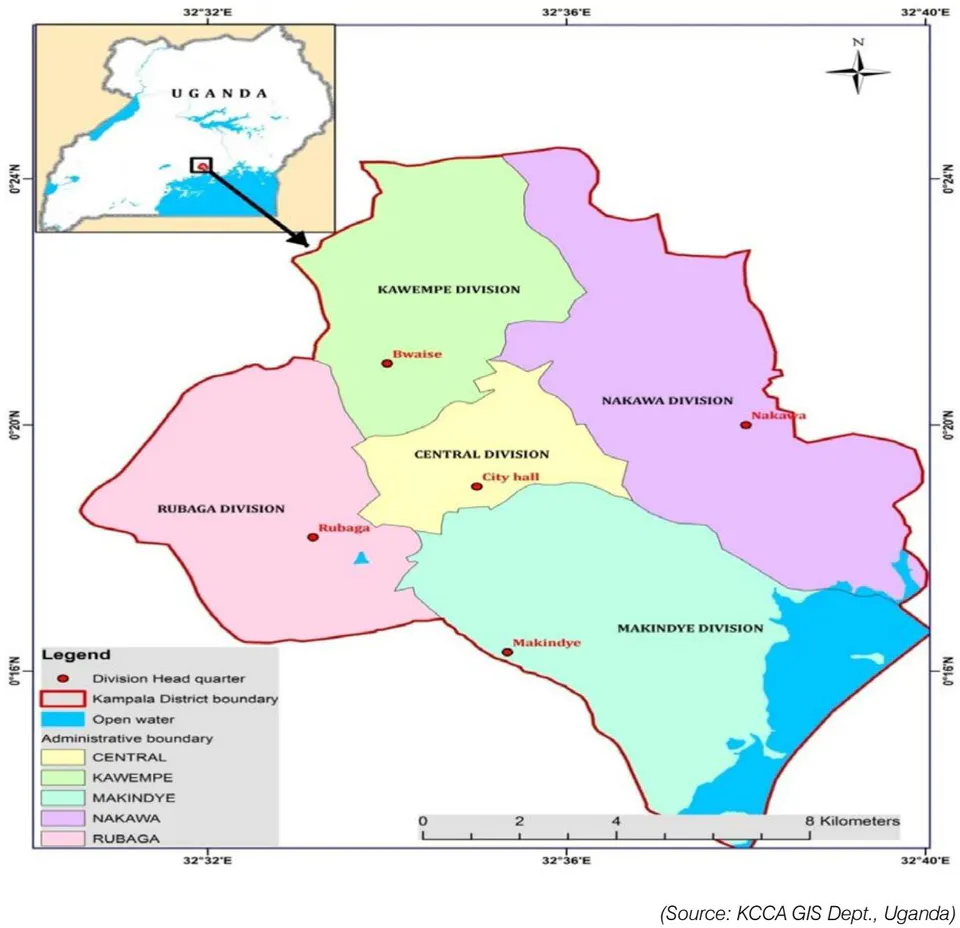
The study employed a cross-sectional survey designin Kampala City. Kampala City lies on Latitudes North of the Equator and Longitudes East of Greenwich. It is bordered by Wakiso district in the south, west and north, Kira Municipal Council in the east and Lake Victoria in the South. Administratively
Kampala is divided into 5 Municipalities which include; Kampala Central, Nakawa, Kawempe, Rubaga and Makindye, It covers a total surface area of of which 169 island and 19 water (Kampala
Capital City Authority, 2016). Figure 1) below shows the study area boundaries comprising all the divisions of Kampala City. Inset is the map of Uganda.
b) Sampling
The study population comprised of 8,652 enterprises in the key sectors (clusters) based on the Census of Business Establishments (COBE) for Uganda Uganda Bureau of Statistics (UBOS, 2014). Cluster sampling technique was used to select the enterprises among the clusters on which simple random sampling was done to get the study enterprises. These included; the manufacture of metal products, textile and clothing, bricks and concrete products, repair of equipment and machinery, recycling of paper and paper products and other manufacturing. The actual enterprises were selected proportional to size at the enterprise level.(those which are many gave more respondents).
The sample size of the study was determined using the formula that yielded a representative sample meant for large populations(Singh, and Masuku, (2014).
Where is the sample size
is the abscissa of the normal curve that cuts off an area at the tails (1- equals the desired confidence level is (1.96) e is the desired level of precision (0.05)
is the estimated portion of an attribute that is present in the population equal to 0.5 and is the 1- p
Therefore the sample size n enterprises.
Inclusion criteria consisted of those enterprises with less than 5 employees and willing to participate in the survey. The owner of the enterprise was the target for interview. Where both the owner and employee was available then one employee was selected using simple random sampling and interviewed by the research assistants using the questionnaires The study excluded workplaces that were not involved in some sort of manufacturing products from raw materials. People who were not employed in the sector like students and apprentices, who had worked for less than one month and those who declined to participate in the study. all participants signed a consent form.
c) Data collection
Relevant information for the study was obtained from primary and secondary sources. Secondary data were obtained from relevant literature such as Scholarly articles, OSH Conventions, Annual reports, Acts of Parliament and textbooks. The primary data was obtained through the field survey using the interviewer-administered piloted questionnaires due to the ability to generate reliable and valid data from a population within a short period at minimum cost. A walk-through survey using the ILO adapted checklist was applied on the sampled firms to identify types of hazards and control measures at work places as well as environmental hygiene conditions (Kogi, 2012). Checklists are practical instruments for investigating and improving policy for workplace safety and health as well as ideal for rapid risk assessment when inspecting important areas of a workplace for purposes of determining planned measures. Compliance of OSH measures was measured on Likert scale. Never, Rarely, Sometimes, Often, and Always. Answers 1-3 were summed up to indicate no or unsatisfactory compliance while 4-5 indicated yes or satisfactory compliance of OSH measures at work Obstacles to OSH were assessed using 5 questions. On a scale of 1-5 ( Not a problem, Minor problem, Moderate barrier, Serious barrier and Very serious barrier) for the severity of the obstacles. The respondents were asked to suggest the possible solutions to improve OSH at work. The variables were; use PPE, always comply with safety practices at work, always comply with hazard control measures, ask for OSH information, comply with reporting of incidents and unsafe practices, and comply with audit exercises. Additional information was got from key informants in the Ministry of Gender, Labour and Social Development, Kampala Capital City Authority (KCCA), National Organization Trade Unions (NOTU) and Federation of Uganda Employers (FUE). Field checking of questionnaires was done after the field interviews, errors were immediately verified and corrected daily.The study duration was 4 months from May to August 2018 and comprised of a sample size of 388 enterprises.
d) Statistical Analysis
IV. RESULTS
a) Socio-demographic characteristics of the respondents
Table 1 below, shows the demographic characteristics of respondents in the study area. It shows the, gender, age, marital status, education of respondents, number of employees, the period of work, the working hours per day and working hours per week. A total of 228 businesses owners and 160 employees were interviewed with a response rate of , majority of the respondents were male compared to their female counterparts . A considerable proportion of the respondents were reported married followed by singles .
Results also showed that of the respondents were aged 30 years and below while slightly less than a quarter were aged 31-40 years. The average age was 31 years old. In terms of education, a half of respondents had attained at least some level of education equivalent to secondary level. About had acquired primary level whereas those who possessed higher education (tertiary/vocational) were . The largest segment was youth 30 years and below.
| Variable | Variable category | Number of enterprises (n=388) | |
| Frequency | Percent (%) | ||
| Gender | Male | 263 | 67.8% |
| Female | 125 | 32.2% | |
| Age category | 30 Years & Below | 158 | 40.7% |
| 31-40 Years | 80 | 20.6% | |
| 41-50 Years | 79 | 20.4% | |
| 51 years & Above | 71 | 18.3% | |
| Mean age | 71 | 30 ± 2.16 | |
| Marital Status | Single | 101 | 26.0% |
| Married | 275 | 70.9% | |
| Divorced | 08 | 2.1% | |
| Widowed | 04 | 1.0% | |
| Education | None | 14 | 3.6% |
| Primary | 103 | 26.5% | |
| Secondary | 196 | 50.5% | |
| Tertiary/Vocational | 55 | 14.2% | |
| Degree level | 20 | 5.2% | |
| Period working in informal sector | 1-5 Years | 133 | 34.3% |
| 6-10 Years | 123 | 31.7% | |
| 10 Years & Above | 132 | 34.0% | |
| No. of employees of work | 0 Self/owner | 228 | 58.8% |
| 1-3 Employees | 82 | 21.1% | |
| 4 or 5 Employees | 78 | 20.1% | |
| Work hours per day | 1-8 Hours | 61 | 15.7% |
| 9 Hours & Above | 327 | 84.3% | |
| Work days per week | 1-5 Days | 45 | 11.6% |
| 6 Days & Above | 343 | 88.4% | |
- More than a quarter of respondents (34.3%) had spent 1-5 and (31.7%) had 5-10 years working in the informal sector, while a related proportion of 34.0% had spent above 10 years of work in informal sector. Furthermore, most employers engaged themselves in their businesses thereby not employing workers (self employed) (58.8%) whereas employers who employed 1-3 employees were only (21.1%). Most of them (84.3%) worked for 9 hours per day. The average number of hours worked being hours per day averaging 40 hours per week and 6 days (88.4%) per week with a mean working rate of days per week.
b) Environmental and industrial hygiene in the sampled premises
About of the workplaces were in the open operating in hot sun (no roof, no walls/ no structure housing the workers), closed (enclosed in a structure with both roof and walls), partially enclosed (only roof but no walls). About operational/working space (floors) surrounding the work stations were littered with rubbish and full of waste materials, did not regularly empty their waste containers while of the working environment around the workplace was not swept. A situation that exposes workers to physical and biological hazards. Only had appropriate roofs, had appropriate walls and had emergency exits free from obstruction.
In terms of welfare, only had sanitary facilities, had resting facilities and running water. Fire precautions were almost non-existent with only having fire provisions.
c) Occupational safety and health hazards identified in the study area
Table 2, below analyses the with types of the premises agnaist physical hazards. The specific physical hazards include the extreme heat, extreme weather, extreme noise, excessive optical radiation, unsuitable lighting, inadequate ventilation body vibration and slippery floors in the informal manufacturing sector in Kampala City.
| Type of premises | Physical hazards | |||||||
| Extreme heat% (n) | Extreme weather% (n) | Extreme noise% (n) | Excessive optical radiation | Unsuitable lighting% (n) | Inadequate ventilation% (n) | Body vibration% (n) | Slippery floors% (n) | |
| Metal fabrication and welding | 34.3% (71) | 37.4% (88) | 27.9% (79) | 44% (55) | 39.3% (48) | 50.4% (66) | 5.5% (15) | 12.6% (36) |
| Manufacture of Furniture | 27.1% (56) | 18.7% (44) | 21.6% (61) | 32.8% (41) | 15.6% (19) | 39.7% (52) | 9.1% (25) | 4.9% (14) |
| Textiles and clothing | 15% (31) | 11.5% (27) | 14.1% (40) | 18.4% (23) | 18% (22) | 7.6%(10) | 7.3% (20) | 11.9% (34) |
| Concrete and brick making | 18.4% (38) | 8.1% (19) | 25.4% (72) | 37.6% (47) | 0% | 0% | 6.9% (19) | 5.6% (16) |
| Paper making and recycling | 5.3% (11) | 9.8%(23) | 21.6% (61) | 24% (30) | 33.6% (41) | 18.3% (24) | 12% (33) | 7% (20) |
| Repair of machinery and equipment | 0% | 6.9% (19) | 0% | 0% | 0% | 0.0% | 0% | 0% |
| Other manufacturing | 14% (29) | 8.1% (19) | 11.7% (33) | 8.8% (11) | 17.2% (21) | 10.7% (14) | 2.9% (08) | 12.9% (37) |
The most hazardous subsector was manufacture of metal products with inadequate ventilation and excessive optical radiation (50.4% and 44.0) of the sampled premises. Other rampant physical hazards were; extreme weather (37.4%) of the metal production and inadequate ventilation (39.7%) in the manufacture of furniture.
Table 3, below gives an analysis of the major forms of chemical hazards in the types of premises. these include the metal fumes, solvents used, chemical paints and gase generated. in the sampled premises in the informal manufacturing sector in Kampala City.
| Types of premises | Metal fumes% (n) | Solvents used% (n) | Chemical hazards Chemicals /paints used% (n) | Gases generated% (n) |
| Manufacture of Metal products and welding | 13.8% (41) | 8.6% (27) | 15% (51) | 26.7% (91) |
| Manufacture of Furniture Textiles and clothing | 16.2% (48) | 16.9% (53) | 19.5% (66) | 21.1% (72) |
| 4.7% (14) | 2.9% (09) | 3.8% (13) | 11.7% (40) | |
| Manufacture of Concrete and brick Products | 8.8% (26) | 4.8% (15) | 5% (17) | 23.5% (80) |
| Paper making and recycling | 0% | 10.5% (33) | 14.5% (49) | 7.9% (27) |
| Repair of machinery and equipment | 5% (17) | 0.0% | 0.0% | 2.6%(10) |
| Other manufacturing | 13.8% (41) | 5.4% (17) | 7.7% (26) | 6.5% (22) |
Chemical hazards included hazards mainly in the furniture industry comprised of chemicals/paints (19.5%) in maunfacture of furniture and fumes 23.5% in brick making. Chemical hazards prevalent in the manufacture and fabrication of metal products, gases generated from welding were 26.7%, while concrete and brick making was 23.5% of the sampled enterprises.
Tables 4, below addresses the types of premises against the mechanical hazards prevalent in the informal sector. These comprised majorly of mechanical sharps or mechanical edges and high powered force
| Types of premises | Mechanical hazards | |
| Mechanical sharps/ edges% (n) | High powered force% (n) | |
| Metal fabrication and welding | 18.5% (67) | 25% (86) |
| Manufacture of Furniture | 21.3% (77) | 19.2% (66) |
| Textiles and clothing | 6.6% (24) | 13.1% (45) |
| Concrete and brick making | 13.8% (50) | 4.4% (15) |
| Paper making and recycling | 5.8% (21) | 10.2% (35) |
| Repair of machinery and equip | 15.0% | 0.0 |
| Other manufacturing | 5.2% (17) | 5.5% (20) |
Mechanical hazards were prevalent in metal fabrication and welding sector with high powered force (25%) and mechanical sharps /edges (18.5%) of the sampled premises.
d) Compliance of occupational safety and health practices in the study area
Figure 2, below looked at the levels of compliance with occupational safety and health measures at work in the sampled premises in the informal manufacturing sector in Kampala City. Cpmliance was assessed on the use of PP, application of safety measures, asking for OSH information and carrying out of audit exercises in the informal manufacturing sector in Kampala City.
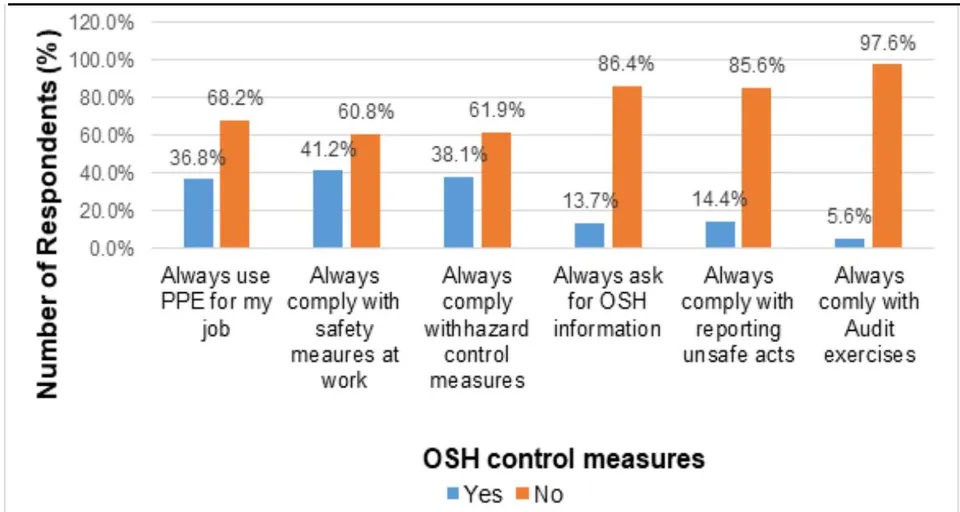
Compliance of occupational safety and health measures was generally poor with below . A high proportion of respondents did not comply with safe work practices, and did not comply with reporting of incidents and unsafe acts.
e) Suggestions on possible solutions to improve occupational safety and health at workplaces in the study area
Figure 3, below summarises the possible solutions to improve occupational safety and health in the sampled premises in the informal manufacturing sector in Kampala City. Using a scale of 1-5, (1 = Not a priority, 2 = Low priority, 3 = Medium priority, 4 = High priority and 5 = Essential), employers listed the possible solutions to improve the glaring occupational safety and health situation being marred by the obstacles aforementioned. The response on solutions to occupational safety and health included; training, provision of PPE, collaboration with government, upgrading of equipment and technology and vocation training.
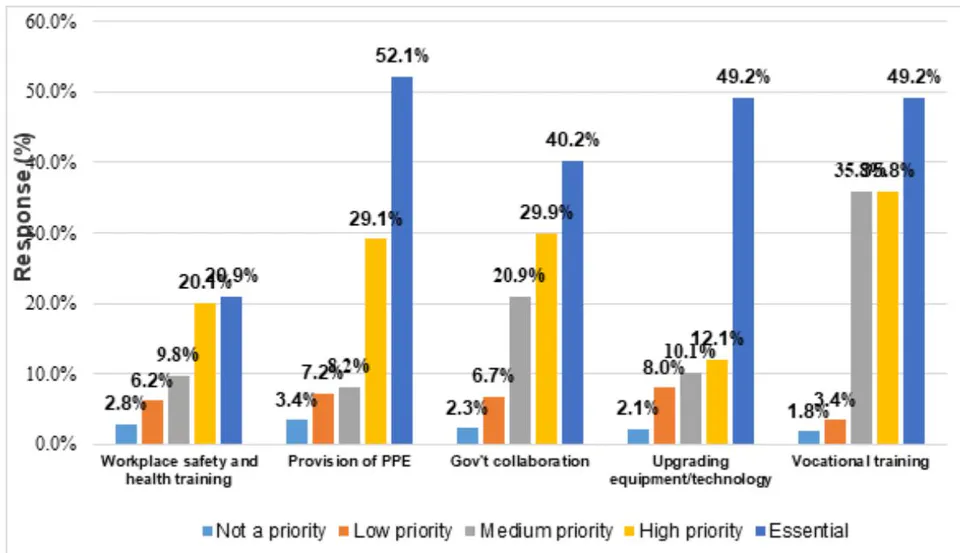
Respondents revealed that provision and use of more PPE (52.1%) was essential in the control of hazards of occupational safety and health at workplaces in the informal manufacturing sector in Kampala City. They also agreed that upgrading equipment/technology and vocational training and government collaraboration respectively.
V. DISCUSSION
The socio demographic results compare with similar study where a number of males being higher than females is consistent with a Lagos study in Nigeria where the majority of respondents (90%) were male and 10% were females (Adebola, 2014). a disparity that could primarily be a reflection of the economic gender disparity in the developing countries with the fact that informal sector manufacturing is risk averse and male dominated. Women are more likely to be outworkers, unpaid contributing family workers and less likely to be employers. Females are more likely to work at homes or on streets rather than workshops or factories (Chen, 2016). Working hours were found to be 40 hours per week which was similar to the formal sector. This was however lower than those found in that operated at 55hours per week in Kenya. In a similar study in Kamukunj, Kenya, (Keitany, 2014) found the same age for the workers below 35 years in a small scale metal industry. The high number of respondents aged below 30 years is expected as it is the point of career life (youth stage) that most workers start entering the job market. These are mainly the unemployed youth who comprise the biggest segment of the population, cannot find jobs in the formal sector due to lack of prerequisite skills and vocational training.
The findings concur with the Auditor General's Report in Uganda, where an audit of the Department of Occupational Safety and Health (DOSH) in 50 sampled enterprises in Uganda found out that of the enterprises were non-compliant with written OSH policy, were without clear fire exits, had no fire alarms in place, did not carry out fire drills to their staff and without First Aid boxes on the premises. The general situation was that only of the enterprise having adequate occupational safety and health services in Uganda (Government of Uganda, 2016). This is attributed poor adopted on inadequate staffing, inadequate awareness and sensitization, limited logistics, absence of national OSH policy and lack of OSH Laboratory to analyze exposure measurements and test PPE equipment. The results on occupational hazards in the informal sector are also consistent with a similar study by the National Institute of Labour Protection in Vietnam. (Nguyen, 2010).
[17]that showed of production workshops being unsafe and dirty. This is however, in contrast with a study in Nairobi that found adequate drinking water at the workplace, food cafeteria available and resting space inadequate at workplaces. While toilets were also adequate but waste disposal was inadequate (only ) and drainage (Keitany, 2014). The situation in Nairobi was in a regulated formal setup with enforcement and supervision of OSH services as compared to the unregulated informal sector in Uganda.
It was evident that most of the enterprises operate in the open and do not have the necessary OSH services and facilities. In most developing countries the informal sector is found in marginal lands usually not regulated and without municipal services, this exposes workers to unhealthy and unsafe environments. Lack of regulations mean that the informal sector operates in the dark without OSH monitoring and supervision. The sector is poor and cannot access funding from government and other agencies making them to have poor or no facilities which in turn affect OSH. A study in Accra and Takoradi, Nigeria by Alfers (2009), found out that market fires, poor sanitation, lack of sufficient storage facilities, physical and psychological effects were among the major hazards affecting the informal economy.
On compliance with OSH measures, the results are in contrast to a study in Lagos, Nigeria (Adebola, 2014), found high compliance with safe practices among respondents , while complied with the use of personal protective equipment. The contrast is attributed to informal sector in Uganda being unregulated with no enforcement to encourage high adoption of OSH measures compared to the formal sector. A study in Oyo State Nigeria revealed that knowledge, attitude and compliance with preventive measures were good among those who were more recently employed in the industry. This was however contrary to findings in the same study which showed of those who had spent more than 6 years having good adopted with OSH measures (Onajole, Odeyemi, Ogunowo, Onwetuelo and Oridota, 2004).
Compliance with safety and health measures is affected by the barriers to good standards of OSH which include complexity- a situation where employees usually become unhappy with the amount of information available on safety and health which may not be tailored to them and the red tape procedures to perform simple jobs. Regulation requirements can become overwhelmingly difficult to understand and poorly communicated. Competing demands to meet production targets or keep within the budgets may compromise safety and health of workers, while behavioural issues particularly changing workers' attitudes and behaviour to work safely is one of the biggest challenges in the safety and health at work. Therefore, to achieve high levels of safety and health requires a safety and health culture and enforcement. These can be through proper and competence recruitment, training, supervision, monitoring and evaluation of workers supplemented by a system of accountability and enforcement where institutional failures at the workplaces are addressed [9]. This compares with a similar study in the United Arab Emirates that revealed that despite the workers knowledge of occupational hazards, the use of personal protective equipment was very low [13]. In the textiles and clothing manufacture, workers engaged in garment manufacturing sectors had high knowledge of health problems related to their occupation, had good knowledge on the importance and use of personal protective equipment and their benefits but very few workers complied to such measures (Parimalam, Kamalamma and Ganguli, 2007).
OSH legislation sets out specific standards on government policies regarding practices in work places and determines the extent of the punishment meted out against offenders. The author concludes that government laws and regulations have a strong influence on the extent to which firms implement OSH programmes (Ndegwa, Guyo, Orwa, Ng'an'ga, and Murigi, 2014). However in contrast in other studies it has been urged that legalizing health and safety standards in the informal workplace has little relevance because most workers in this sector are either self-employed or work within small bands with little additional resources to meet legislative demands. They suggest that policy frameworks should instead focus on raising awareness, providing technical expertise in hazard management, providing resources for control measures and providing medical expertise for medical surveillance, diseases diagnosis and management (Naidoo, Kessy, Mlingi, Peterson, and Mirembo, 2009).
Small businesses do not consider OSH a priority. This means that safe practices do not depend on knowledge and attitude alone but related to availability of appropriate personal protective clothing and equipment, being constantly informed about safety precautions coupled with effective supervision for their use. The lack of supervision and auditing, non-seeking of information makes implementation to be latent and a time bomb since there is lack of enforcement both on the employer and the regulatory agency.
The informal sector adoption results concur with a survey carried out in small enterprises in Canada comprising of 103 manufacturing metal products and 120 in the garment sector, of the employers considered the cost to be an obstacle while thought that lack of training, prioritizing of production than safety and lack of time to be barriers to safety(Champux, and Brun, 2003). Investing in the safety and health of workers will try to minimize its internal production costs as the provision of safety gadgets and decent work environment involves costs that must be paid by the firm with expectations of receiving benefits of such investments in form of higher productivity (Ogunrinola, Fadayomi, Amoo and Sodipe, 2012). The equilibrium level of safety is the point where the rising marginal cost of job safety intersects the downward sloping marginal benefits from job safety(McConnell, Brue and Macpherson, 2010). However, evidence in most countries has shown that the level of safety attained is affected by the low level of investment in safe working environment by private firms and hence has motivated the public to intervene to reverse the trend. This is the actual situation in the informal manufacturing sector which has low investments and cannot easily invest in OSH and hence requires public intervention.
Cost of OSH preventive measures for instance in terms of buying Fire extinguishers, training, First aid, welfare facilities, decent work environments is the most important obstacle affecting the implementation of OSH measures at work in Kampala due to the fact that the informal sector does not have access to external funding in government and financial institutions. Lack of information and lack of government intervention and guidance are the major may affect the sector. Government needs to intervene by regulation of the sector, providing information and training to the informal sector.
The essential measures listed in the informal sector to improve OSH are internal to the organization and can easily be achieved by creation of awareness in the informal sector. Management should demonstrate in words and actions, through policies, procedures and financial incentives, that it is committed to workers' safety and health, then supervisors and workers will respond by ensuring that work is performed safely throughout the enterprise. Total commitment on the part of management to making safety and health a priority is essential to successful OSH program(Alli, 2009). However, the situation is different in small enterprise where management is not clear, policies and procedures are non-existent and no regulation is done by government.
Similarly, it is has been urged that OSH administration requires that employers protect their workplace depending on the dangers or work place settings. It recommends the use of manufacturing or work practice control to handle or reduce risks to the minimum level possible. Personal protective equipment is usually required to be worn to minimize exposure to a variety of hazards. Although this can be feasibly enforced in formal enterprises, it is a myth in the informal sector in developing countries (Amir, Hashim, Qandee, Ishtiaq and Anam, 2017).
A number of OSH management strategies were fronted during the study to improve the situation in the informal manufacturing sector. These suggestions among other included workplace safety and health training, provision and use of personal protective equipment as well as vocational training of the workers in the informal sector. Other suggestions were upgrading the technology in the informal sector.
VI. CONCLUSION
Most workplaces were in the open operating in hot sun (no roof, no walls/ structure housing the workers), The state of openness exposes workers to weather extremes. Working space surrounding the work stations were littered with rubbish and full of waste materials. Welfare facilities were almost non existant. The informal manufacturing sector is affected with physical, chemical, and mechanical hazards with various risk magnitudes. Various types of hazards identified were; inadequate ventilation, optical radiation, extreme weather, extreme heat, extreme noise in manufacture of metal products. Noxious gases and paints in furniture and metal products while sharps were in manufacture of metal products. Compliance of OSH measures were very low due to lack of regulation in the sector, although use of PPE was rated high as a control measure for hazards in the workplace, the type and appropriateness was in question. However PPE alone can not guarantee good OSH in the workplace it must be supported by other measures like safe work practices, safe person and safety culture. The challenges to adoption of OSH by workers included; lack of government guidance and support, lack of information and lack of adequate funding to invest in safety programmes and equipment.
Possible solutions put forward to control the occupational hazards were; provision of PPE, upgrading equipment, technology for example getting new and latest machinery, vocational and technical training to acquire more skills in OSH and collaboration with government and partners. There is need to initiate an intensive mass media campaign by government and partners for creation of awareness, advocacy and sensitization on OSH hazards and control measures in the informal manufacturing sector targeting employers and employees, registration of all informal manufacturing enterprises for OSH monitoring and inspection, and development of relevant OSH regulations by government. Kampala City should regulate the secotrand all companies to be registered and inspected regularly. Workplace policies and appropriate PPE to all employees at work should be provided.
VII. ETHICAL CONSIDERATIONS
Ehtical approval of the study protocol was done by the Makerere University School of social Sciences Research and Entics Committee and the National Council of Science and Technology. Permission was sought from the Ministry of Gender, Labour and Social Development and KampalaCapital City Authority in Kampala, Uganda.
Competing interest
All the authors declare that they have no competing interests.
Disclaimer
The was no sponsor's role in the design, implementation and writing of this paper and choice of journal to publish this research paper.
Funding
The funding to the studies and research was done by the author, Kampala, Uganda.
Availability of Data and Materials
Acknowledgment
Not Applicable
Authors' Contributions.
All the authors read and approved the final manuscript.