The investigation had objective to reproduce on tubetes the species Sporobolus virginicus, as plantation material for dune ecosystems benefitted with sand dumpings. The variables evaluated were: sprouting percentage, height, number of leaves and number of sprouts. Three substrates (sand, sand+humus and worm humus) was evaluated. In the substrate with more sprouting percentage was evaluated the position of the rhizome segment (horizontal, vertical and in angle of 45°), the angle formed in the cut (90° and 45°), the viability at 24 o’clock, 48, 72 and 96 hours from its prospecting and the survival post-transplant. The rhizomes planted in humus did not sprout. The biggest sprouting percentage with 37% was obtained in the compound by the mixture of sand and humus. The horizontal position of the segments of rhizomes in the tubetes reached the biggest values for the evaluated variables and the number of final sprouts duplicated the vegetable established material initially. The position forming angle of 45° showed increment in the number of sprouts until the 64 days.
## I. INTRODUCCION
El papel de las dunas litorales adquiere mayor importancia, ante los desafíos que imponen los efectos del cambio climático entre los que se destacan el incremento del nivel medio del mar y la mayor Frequencia de los eventos meteorólogicos extremos. En Cuba el plan de estado para el enfeintimiento al cambio climático (Tarea Vida) incluye entre sus tareas conservar,mantener y recuperar integralmente las playas arenosas del archipiélago cubano,priorizando las urbanizadas de uso turístico Para el cumplimiento de estas actiones es importante la reproduccion de plantas del complejo de vegetacion de costa arenosa y la optimizacion de sus protocolos de reproduccion. Estas espécies actuan como barrera ante la'action del viento y mareas,al conservarse, retardan los cambios en la dinamica de la costa, brindando asi proteccion a las constructions en caso de tormentas tropicales y huracanes; alismo tiempo fijan la duna y permiten la acumulacion de materia organica y, por ende,la formacion de suelo (Espejel, 1992; Duran-Garcia et al., 2010).
En este sentido, Sporobolus virginicus es tolerante a la sequía y a la sal, por lo que se convierte en una espécie útil en la estabilación de las Costas. Como Otherwise, posee semillas con baja viabilidad por lo que la reproducción asexual es la via más practica de propaganda (Dvauchelle, 2007). En laactualidad no existen problemas que aborden la influencia del substrato humus de lombriz en combinación con la technología sobre tubetes para espécies del complejo de vegetación de costa arenosa. Situación que implica la búsqueada de procedimientos que permitan obtener el mayor número de plántulas a un bajo costo, en el menor tiempo possible y de estaforma lograr una exitosa propaganda vegetativa.
## II. MATERIALS Y METHODOs
### a) Ubicación del área de estudio
- El estudio se descarró a partir del 12 de marzo de 2020, en un area de vivero experimental sobre tubetes en el Centro de Ingeniería Ambiental y Biodiversidad (CIBA), ubicado en la carretera a la localidad de Patria km $1\frac{1}{2}$ ( $22^{\circ}05'59''N$ y $78^{\circ}36'55''W$ ), municipio Morón, Ciego de Ávila.
b) Material vegetalutilizzato
- Se utilizes rizomas estoloníferos colectados en Playa Larga, los que se fracciónaron a 3,5 cm de longitud y fueon colocados en agua libre de cloro hasta el momento de la plantación en el tubete.
c) Envases, substrato y riego
Se utilizeson tubetes tipo: ALMTB 08145 RPE de facturabrasileña con capacité: $111~\mathrm{cm}^3$ (8 estrías y diametro interno de $3.5~\mathrm{cm}$ ). Estos contenedores se agruparon en bandejas plácicas con capacité de alojamento para 56 tubetes. Elllenado se realizó de forma manual con arena, humus de lombriz y la mezcla deodosustratos. Se colocaron algas (obtenidas en la limpieza de la arena en la playa) en el fondo del tubete para evaporar la perdida del substrato.
El riego se realizó de forma manual directamente al substrato; la Frequencia delo en correspondencia con el estudio de descrollo de las plantas, sido más freciente e intenso durante los primeros 30 días (etapa de establishimiento). Posteriormente, se redujo de forma gradual la Frequencia para contribuir a disminuir el estrés hidrico posterior al trasplante.
Para determinar el efecto del sustrato sobre la brotación de los segmentos de Sporobolus virginicus se conformaron los siguientes tratimientos:
Tratimiento 1: arena
Tratimiento 2: $50\%$ arena + $50\%$ humus de lombriz
Tratimiento 3: humus de lombriz
El sustrato sobre las plantas en el tubete y se evaluaron tres formas de colocar en el tubete el segmento de rizoma: (horizontal, vertical y en ángulo de $45^{\circ}$ ). Para la evaluación de la influencia del ángulo en el corte del segmento se evaluaron dos ángulos $90^{\circ}$ y $45^{\circ}$. Los cortes se realizaron con una tijera de poda de una mano. La viabilidad de los segmentos se determinó a las 24, 48, 72 y 96 horas a partir de su colecta como material de planta.
Las variables evaluadas fueron las siguientes:
Porcentaje de segmentos brotados (%): del total de segmentos evaluados cuando emitierto yemas foliares.
Altura total de la planta (cm.): se midio con una regla graduada, desde la superficie del sustrato hasta el apice.
Número de hojas por planta: se determinó mediante conteo visual.
Número de brotes por segmento:ULDaidad de brotes existentes en cada segmento.
Segmentos viables: segmentos que permanecieren vivos y fueron capaces de brotar una vez plantados en los sutratos.
Brotación acumulada: número de brotes en correspondencia con los días de realizada la plantaupon hasta los 64 días desde la plantaupon.
Supervivencia post trasplante: macollas que sobrevivieron a los 30 días de realizado el trasplante.
Cada evaluación constituya un experimento independiente.
La temperatura y la humedad relativa se determinó diariamente en horarios de las 10:00 AM y 3:00 PM. Para esta evaluación se utilizó un medidor meteorológico Kestrel 3000. Para la confeción de losográicos se realizó la media entre las dos lecturas para ambas variables. Estas variables fueron registradas solo para la evaluación de la influencia de los sustratos en el desarrollo de la espécie.
Cada experimento tuvo un Diseño Completely aleatorcido. Para la evaluación de lasdietresvariables seutilizaron 10 plantas por cada repeticion,paraun totalde30plantaspor tratamente (tres repeticiones).Las evaluaciones se realizaron cada 7 días hasta elmomento del trasplante (65 días).
### d) Análisis estadístico
Los datos se registrararon en el tabulador electrónico EXCEL y se procesaron mediante el programa estadístico IBM SPSS Statistic ver.
22. Se realizó un análisis de homogeneidad de varianza (Levenne) y un test de normalidad por Kolmogorov Smirnov. Se utilizó el procedimiento ANOVA de un factor para determinar diferencias significativas entre los tratimientos. En los casos en que el ANOVA fue significativo, la discriminación de medias se realizó mediante la prueba de Tukey. Para el análisis del ángulo en el corte de los segmentos se realizó una Prueba T para muevas independentes.
## III. RESULTADOS Y DISCUSSION
Al analizar el percentaje de brotacion de los segmentos estoloniferos segun el tipo de sustrato realizado (Figura 3.), ellos comenzaron a emerger a partir de los 12 días de ser plantados y alcanzaron un percentaje similar. Los segmentos plantados en humus de lombriz no brotaron.
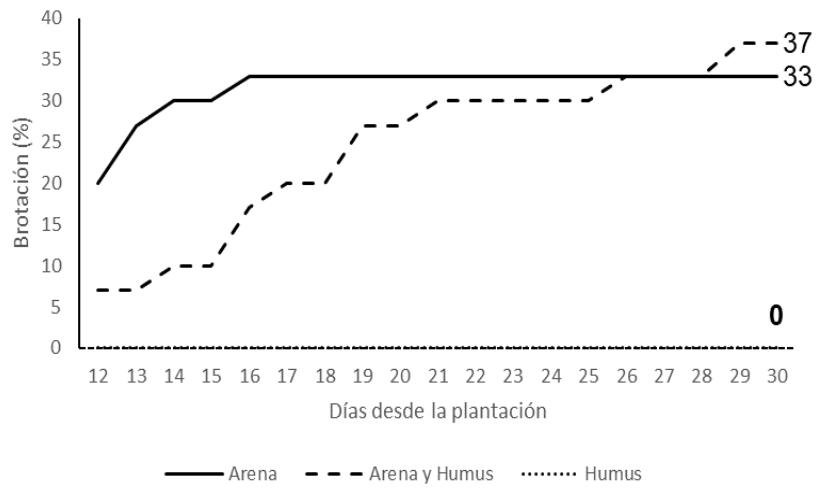 Figura 3: Porcentaje de brotacion segun substratos en el desarrollo de S. virginicus
Según Avedano et al., 2018 las conditiones del substrato peuvent determinar Cambios en el desarrollo de Sporobolus virginicus. Asimismo, Reyes et al. (2015) refieren que el humus de lombriz facilita el desarrollo radical de las plantas, el crecimiento del tallo y hojas. Estos fenómenos que provocan, dan como resultados plantas más saludables y vigorosas que AUGmente la producción y el rendimiento por area de%.
Por su parte Sequeira et al., (2004) al evaluar differsentes percentajes de humus de lombriz y suejo, como sustrato en la produccion de posturas de Capsicum anumm L en bandejas para transplante, obtuvieron resultados similares y alegan que este efecto pueda deberse a que el substrato se compactaba demasiado, lo que impide el crecimiento del sistemas radical y al mesmo tiempo a la movilidad - disponibiliad de los nutrientes para las plantas. Dominguez et al., 2010 mentionan que los efectos del humus de lombriz podrian no reducirse a los meramente fisicos - quimicos yignalan la possible existencia de mecanismos biologicos de stimulacion de crecimiento vegetal.
Al comparar las variables alta, número de hojas y brotación (Tabla 2) los resultados se alcanzaron para la mezcla de sustratos de arena y humus.
Table 2: Influencia de los substratos en la alta, número de hojas y protación de S. virginicus
<table><tr><td>Tratimientos</td><td>Altura</td><td>Hojas</td><td>Número de Brotes</td></tr><tr><td>T1</td><td>4.583b</td><td>3.57a</td><td>0.73b</td></tr><tr><td>T2</td><td>6.897a</td><td>3.57a</td><td>2.60a</td></tr><tr><td>T3</td><td>0 c</td><td>0 b</td><td>0 b</td></tr><tr><td>Desviación típica</td><td>7.2666</td><td>4.286</td><td>2.429</td></tr><tr><td>Error típico</td><td>.7660</td><td>.452</td><td>.256</td></tr></table>
Lo anterior pudiera estar atribuido a que cuando se utilizes el humus de lombriz como sustrato, se apportan colonias microbiales que participan en la transformación de todos los nutrientes minerales necessarios para la nutrición de la planta (Medina y Quezada, 2004).
Estos resultados son similares a los obtenidos por Liriano-González et al., 2017 al utilizing el humus de lombriz en la produccion de plantulas de Lycopersicon esculentum Mill. y Obtener para esta espécie incrementos de alta y número de hojas, lo que se attribuyen a la gran riqueza y calidad biológica de este abono organico, que influye sobre propiedades biológicas tales como: mejora en los procesos energéticos y modificación de la activités enzimática, favorece la sintesis de acidos nucleicos y sirve de amortiguidor al regular la disponibiliidad de los nutrientes según las necessities de las plantas. Si bien S. virginicus se adapta a sueños de bajo fertilidad thesest resultados coinciden con lo planteado por Leithead, Yarlett & Shiflett, 1976 quienes alegan que enmiendas con nutrientes son beneficiosas para el=rápido establecimiento de esta espécie.
El humus de lombriz roja californiana (Eisenia foetida) presenta un contenido de minerales muy alto, entre los que se enquiryra el nitrogeno, fósforo y potasio, que libera lentamente, incrementando la disponibiliad de los elementos ya existentes en el suejo para ser absorbidos por la planta (Canellas & Rocha, 2004). Por su parte Sotelo & Téllez, 2007 obtuvieron resultados similares a los nuestros cuando los values para las variables alta y número de hojas se vieron afectados al utilizing substratos con $100\%$ de humus de lombriz para el cultivo del café.
Aligar como influyó la posición del segmento en el sustrato para la variable brotación, el mejorthis especie se alcanzó en los segmentos que fueron colocados de forma horizontal (Figura 4).
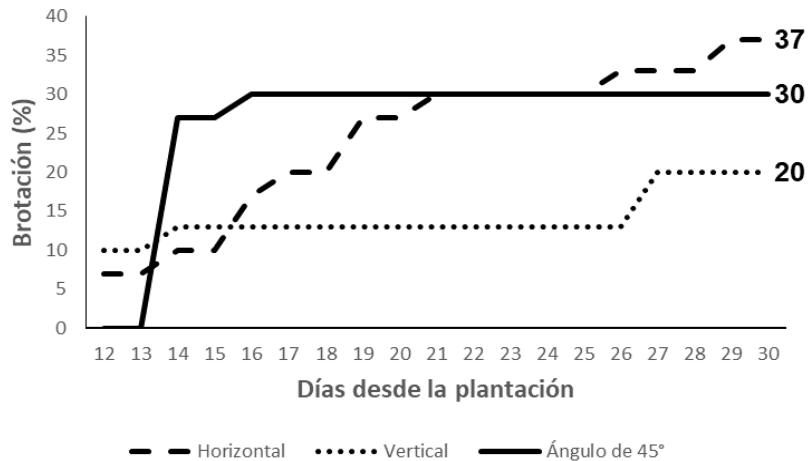 Figura 4: Porcentaje de brotacion de S. virginicus segun posicjion del segmento en el sustrato conformado por arena y humus
Estos resultados diferirieron de los obtenidos por López et al., 1995, quienes al evaluar la posición de estacas para todas espécies como Manihot esculenta Crantz no obtuvieron diferencia entre la posición vertical, inclinada y horizontal. Sin embargo, autores refieren que efectos están determinados por la humedad y que cuando en los primeros 30 días existe un periodo seco para el cultivo, las estacas inclinadas o verticales manifestaron una mayor protación.
Tabla 3: Posición del segmento en mezcla de arena + humus y su influencia en la alta, número de hojas y protación de plántulas de S. virginicus en tubetes
<table><tr><td>Tratimientos/Posión del segmento</td><td>Altura</td><td>Hojas</td><td>Número de Brotes</td></tr><tr><td>T1 (horizontal)</td><td>6.90a</td><td>3.37a</td><td>2.6a</td></tr><tr><td>T2 (vertical)</td><td>4.07c</td><td>2.23c</td><td>1.4c</td></tr><tr><td>T3 (ángulo 45°)</td><td>4.97b</td><td>2.73b</td><td>2.33b</td></tr><tr><td>Desviación típica</td><td>8.4114</td><td>4.424</td><td>3.330</td></tr><tr><td>Error típico</td><td>.8866</td><td>.466</td><td>.351</td></tr></table>
Letras distinguas en los values indican diferencias significativas entre tratamientos (Tukey, $p \leq 0.05$ ).
El comportimiento de las variables morfológicas alta, número de hojas y brotes estuve relacionado con la forma de colocar el segmento de Sporobolus en el tubete (Tabla 3). Sin embargo, los brotes colocados de forma horizontal en su evaluación a partir de los 57 días incrementaron muy poco el número de brotes, cuando que los colocados de forma vertical y formando ángulo de 45 grados nostraron incremento en el número de brotes hasta los 64 días (Figura 5).
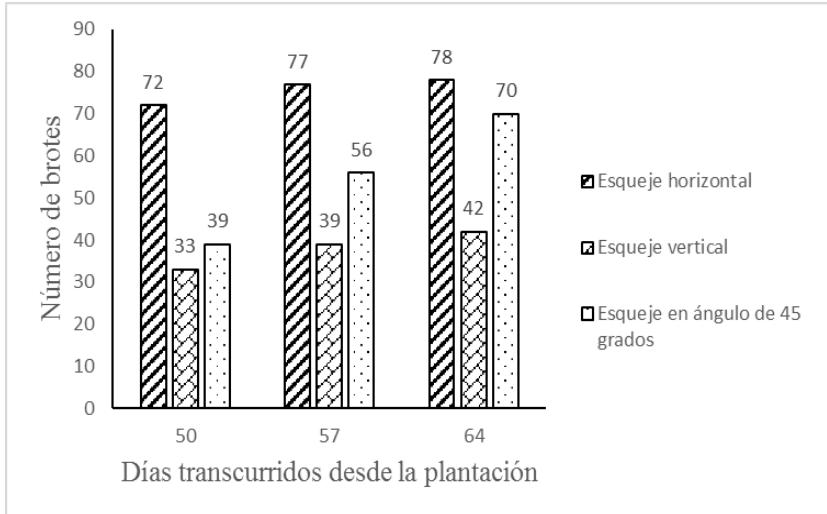 Figura 5: Número de brotes de S. virginicus según posición del segmento en mezcla de arena y humus
Sporobolus presentó en su descrollo sobre tubetes un bajo percentaje de brotación. Sin embargo, esta situación se revierte al alcancar un $260\%$ de brotes finales con disrespect a la� de segmento existecidos inicialmente (30). Cuando se colocaron en posición horizontal se incrementaron al doble el número de brotes finales. Este efecto se produjo también en los segmentos colocados formando ángulo de $45^{\circ}$.
Además, cabe resaltar que la espécie es autoctona y juega un importante papel en la conservación, por ser un componente esencial en la rehabilitación y recuperación de los ecosistemas primarios de Cuba. Illo se debe a queCTLa otheres espécies, forma parte de la protección natural, al establecer una barrera que se opone a las invasions (Ricardo y Herrera, 2017).
El ángulo formado al realizar el corte en el extremo del segmento del estolón no influyó en el comportimiento de la brotación (Figura 6). En este sentido Ponce et al., 2014 alegan que una las conditiones que garantiza el exito de la propaganda por estasas es la realización del corte transversal para que haya mayor area de producción de raíces. Por su parte Gómez, 2016 para el cultivo de caña de azúcar VARIODAD CG98-10, propone que el corte de los tallos debe realizarse de forma vertical de manière que quede redondo.
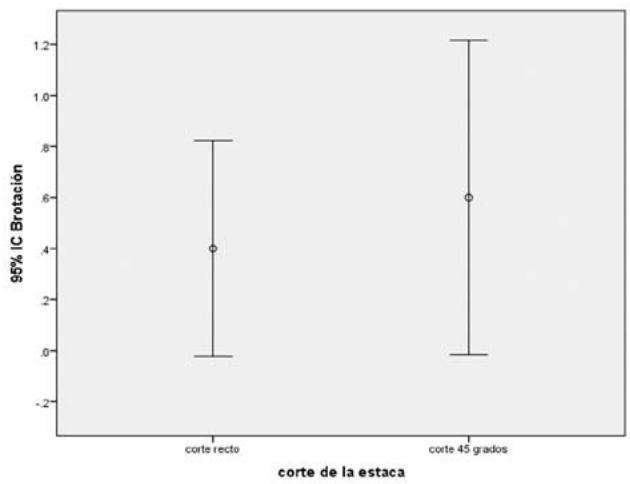 Figura 6: Correlación según el ángulo formado al realizar el corte del segmento de S. virginicus
Al analizar el comportimiento de la brotación se apprecia que cuando la plantación se realiza a partir de las 48 horas de colectado el material vegetal ocurre una disminución considerable en esta variable (Figura 7).
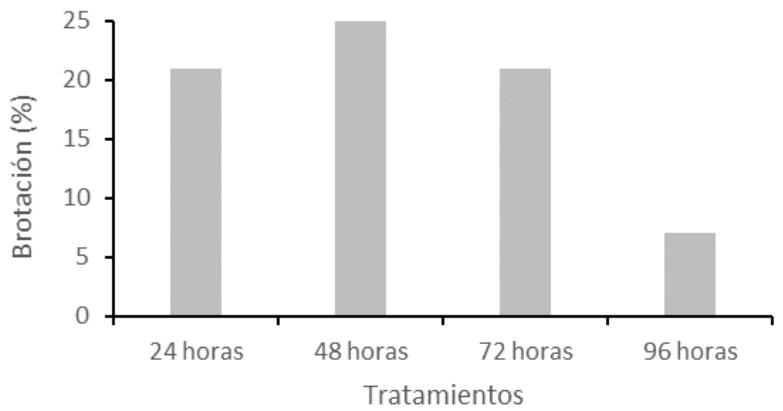 Figura 7: Porcentaje de brotacion de segmentos en tubetes con arena y humus a las 24, 48, 72 y 96 h desde la proseccion
Elmanter los segmentos de Sporobolus hidrataidos hasta el momento de su plantacion, permitió prolongar su conservacion en caso de no ser possible su plantacion de forma inmediata. Sin embargo, pasadas 48 horas el efecto beneficioso de la hidratacion se modifico pudiendo estar atribuido este suceso a la ocurrencia del desorden fisiologico conocido como hiperhidricidad.
Según Haapala (2005), inmersiones constantes de las raíces en SOLUTIONES, puede tener problemas los cuales danan seriamente los tejidos. Resultados similares también fueeron observados por
Ramírez et al., 2013 en ensayos utilizing segmentos de tallo lateral de Solanum phureja sobre hubo una mortalidad de segmentos superior al $50\%$ durante este procedimiento.
Las medicaciones de temperatura (Figura 8) y humedad relativa (Figura 9) realizadas in situ en el vivo arrojaron valores de 30 a $35^{\circ}C$ y de 58 a $69\%$ respectfully durante los 58 días del muestreo. Según el situo http://es.climate-data.org/america-del-norte/cuba/ciego-de-avila/cayo-coco-57554/ en Cayo Coco para el mes de agosto se registraron valores de temperatura minima de $27.1^{\circ}C$ y para la maxima valores de $29.3^{\circ}\mathrm{C}$, registrandose una temperatura media de $28.2^{\circ}\mathrm{C}$. Para el mes de septiembre la temperatura minima fue de $26.7^{\circ}\mathrm{C}$ y la maxima de $29^{\circ}\mathrm{C}$ para una media de 27.8. Estos values differen de los obtenidos en el microvivero, contradicciónatabuida a la distancia existente entre el situ de propaganda y el situ de establishimiento (más de 62 km) y al equipo de medicaciónutilrado.
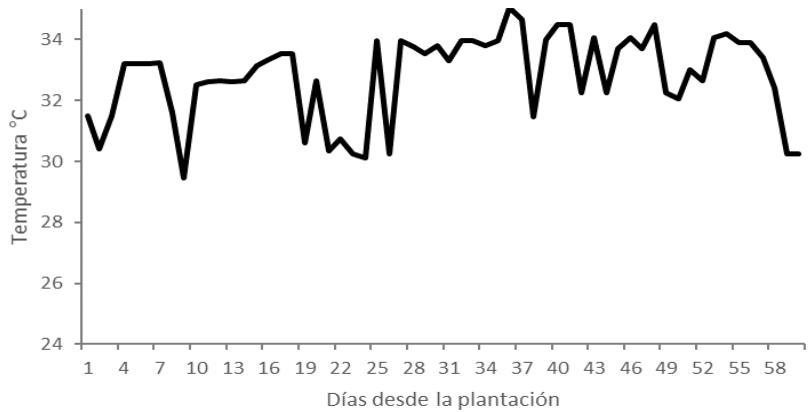
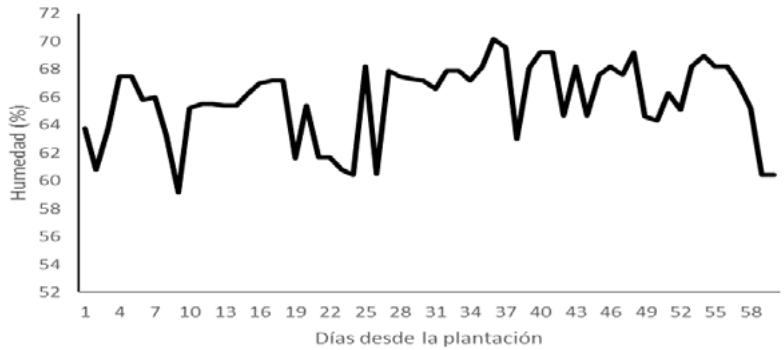 Figura 8: Temperatura durante el desarrollo de Sporobolus virginicus sobre tubetes Figura 9: Humedad relativa durante el desarrollo de Sporobolus virginicus sobre tubetes
Muñoz et al., 2004 determinaron tres conditiones de temperatura para estudios de germinación: $25^{\circ}\mathrm{C}$, $25 - 30^{\circ}\mathrm{C}$ y $25 - 35^{\circ}\mathrm{C}$ los cuales coinciden con los referidos en el estudio. Estos valores se ensayaron para similar las conditiones de temperatas a que se pudieran ver somedayas los propángulos de U. paniculata en su habitat natural. Estos autores confirmaron que la dormancia está impuesta por la temperatura y la mejor respuesta germinativa fue alcanzada al termoperiodo de $25 - 30^{\circ}\mathrm{C}$. Estos resultados demuestran la importancia de la evaluacion de esta variable en la propaganda de gramineas. Lo que coincide con lo planteado por Villalobos et al., 2009 quien alega que las temperatas tienen efecto sobre la germinacion, la velocidad de crecimiento, transpiracion, respiracion, fotosintesis, y absorccion de agua y nutrientes.
El percentaje de supervivencia de las plantas trasplantadas a la duna fue del $100\%$ (Figura 10). Este resultado está relacionado con su amplia capacité de distribución en disímiles ambientes costeros como playas, dunas arenosas, herbazales halófilos, praderas costeras o pantanos costeros (Medina et al., 2008).
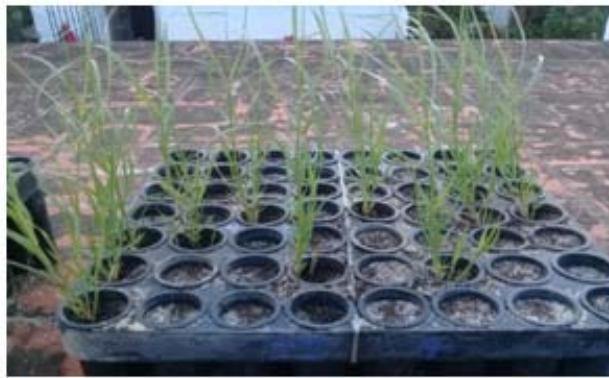
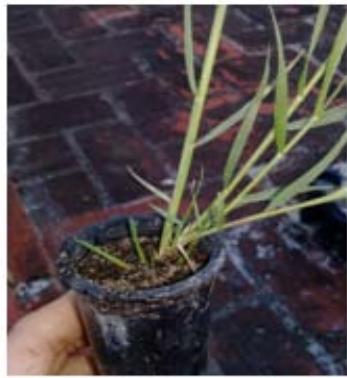
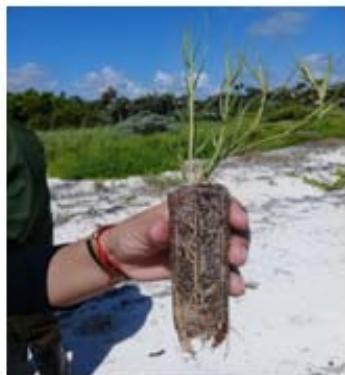
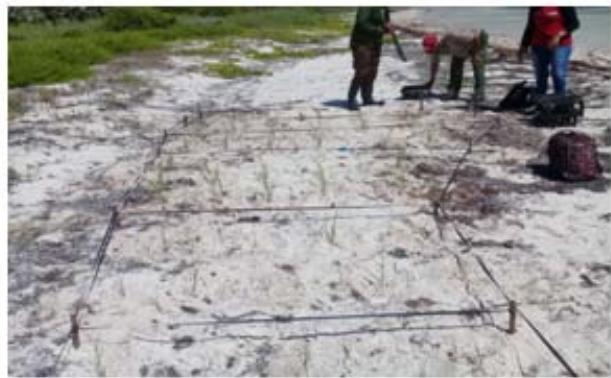 Figura 10: Establishacion de Sporobolus virginicus en la zona frontal de la duna costera de Playa Las Coloradas, Cuba
Igualmente, esteattribuido a las adaptations de la espécie las cuales responden a las constantes fluctuaciones de los factores ambientales (Mitsch y Gosselink, 2007), especiallyla salinidad (Sharpe y Baldwin, 2009; Lonard et al., 2011) la cui se ve estimulada en los ambientes antes citados. Esto pudiera eliminar el excesso de sal a trovés de glándulasubicadas en las hojas de las plantas y evaporar laaccumulación toxica de sodio (Lonard et al., 2013). Una de las respuestos adaptativas de las plantas ante lavariabilitad ambiental de los ecosistemas es laplasticidad fenotipica, que permitte la tolerancia avariaciones ambientales, incluidas aquellas asociadas con Cambios climáticos (Gratani, 2014).
## IV. CONCLUSIONES
Es posible la propagación en tubetes de S. virginicus para su establecimiento en ecosistemas dunares.
Para la propaganda en vivo ro de esta espécie el humus de lombriz en la mezcla del substrato propicia un incremento considerable en la emisión de brotes, reponiendo el bajo percentaje de brazione inicial.
La hidrataction de los segmentos estoloniferos previo a la colocacion en los tubetes incrementa la brotacion.
La plantación de los segmentos debe realizarse ante de las 72 horas de realizada la prospeccion del material vegetal.
Generating HTML Viewer...
References
18 Cites in Article
O Gómez-Nix (2016). Evaluación de la edad óptima de corte de semilla de caña de azúcar variedad CG98-10.
(2024). 8 de marzo. Publicación conmemorativa del Día Internacional de la Mujer.
Loretta Gratani (2014). Plant Phenotypic Plasticity in Response to Environmental Factors.
R Lonard,F Judd,R Stalter (2011). The Biological Flora of Coastal Dunes and Wetlands: Batis maritima C. Linnaeus.
R Lonard,F Judd,R Stalter (2013). The Biological Flora of Coastal Dunes and Wetlands: Sporobolus virginicus (C. Linnaeus) K. Kunth.
M López-Zada,E Vázquez -Becalli,R López-Fleites (1995). Raíces y tubérculos.
R Luna,J Reyes,R López,M Reyes,G Murillo,C Samaniego (2015). Abonos orgánicos y su efecto en el crecimiento y desarrollo del cultivo del tomate (Solanum lycopersicum L.).
E Medina,A Francisco,R Wingfield,O Casañas (2008). Halofitismo en Plantas de la costa Caribe de Venezuela: Halófitas y Halotolerantes.
Juan Anchordoquy (2004). Efecto del manganeso durante la maduración de los ovocitos de bovino: daño en el ADN y estrés oxidativo.
W Mitsch,J Gosselink (2007). Wetlands.
O Ponce-Alfonso,Alicia Rodríguez-Fuentes,Elisa Hernández-Padilla,Lourdes Pérez-Montesino,Leiva-Sánchez,T Ángela (2014). Manual de Técnicas de Cultivo de Plantas Ornamentales.
Liliana Ramírez,Catalina Zuluaga,Elena Gonzalez,Mauricio Marín,Juan Gonzalo Morales,Carlos Ñústez,José Cotes (2013). Uso de esquejes de tallo lateral para evaluar la resistencia de genotipos de Solanum phureja a Spongospora subterranea f. sp. subterranea.
Ricardo Zamponi (2017). Producción de etileno en Lycopersicon esculentum Mill c.v. Platense.
N Ricardo,P Herrera (2017). Especies vegetales exóticas y nativas que invaden ecosistemas vulnerables en Cuba. Centro Nacional de Áreas Protegidas (CNAP).
R Sequeira,M Valle,J (2004). Evaluación de diferentes porcentajes de lombrihumus y suelo, como sustrato en la producción de posturas de chiltoma (Capsicum anumm L) en bandejas para transplante.
Peter Sharpe,Andrew Baldwin (2009). Patterns of wetland plant species richness across estuarine gradients of Chesapeake Bay.
Reyes Sotelo,G; Téllez,J Páramo (2007). Efecto de distintos porcentajes de humus de lombriz, compost y suelo, como sustrato en la producción de plántulas de café (Coffea arabica L) variedad caturra.
F Villalobos Martín,L Mateos-Iñiguez,F Orgaz-Rosua,E Fereres-Castiel (2009). Fitotecnia, bases y tecnologías de la producción agrícola. 2da Edición.
No ethics committee approval was required for this article type.
Data Availability
Not applicable for this article.
How to Cite This Article
Danay Rodríguez Ramos. 2026. \u201cSustract Effect in the Development on Tubetes of Sporobolus Virginicus (L.) Kunth\u201d. Global Journal of Science Frontier Research - C: Biological Science GJSFR-C Volume 23 (GJSFR Volume 23 Issue C1).
Explore published articles in an immersive Augmented Reality environment. Our platform converts research papers into interactive 3D books, allowing readers to view and interact with content using AR and VR compatible devices.
Your published article is automatically converted into a realistic 3D book. Flip through pages and read research papers in a more engaging and interactive format.
Our website is actively being updated, and changes may occur frequently. Please clear your browser cache if needed. For feedback or error reporting, please email [email protected]
Thank you for connecting with us. We will respond to you shortly.