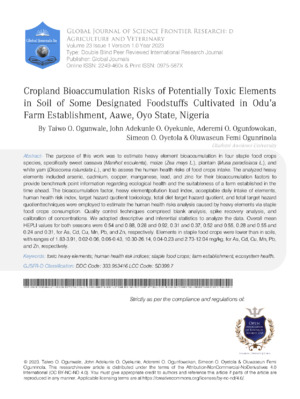
Cropland Bioaccumulation Risks of Potentially Toxic Elements in Soil of some Designated Foodstuffs Cultivated in Odu’a Farm Establishment, Aawe, Oyo State, Nigeria

Article ID

LM4Y2

Bioaccumulation of hazardous elements in soil.

Cropland Bioaccumulation Risks of Potentially Toxic Elements in Soil of some Designated Foodstuffs Cultivated in Odu’a Farm Establishment, Aawe, Oyo State, Nigeria

Taiwo O. Ogunwale
Taiwo O. Ogunwale Awolowo University
John Adekunle O. Oyekunle
Simeon O. Oyetola
Simeon O. Oyetola
Oluwaseun Femi Ogunrinola
Simeon Oyesoji
Simeon Oyesoji
Salami
Salami
Kaseem Dele
Kaseem Dele
DOI

Abstract

The purpose of this work was to estimate heavy element bioaccumulation in four staple food crops species, specifically sweet cassava (Manihot esculenta), maize (Zea mays L.), plantain (Musa paradisiaca L.), and white yam (Dioscorea rotundata L.), and to assess the human health risks of food crops intake. The analyzed heavy elements included arsenic, cadmium, copper, manganese, lead, and zinc for their bioaccumulation factors to provide benchmark point information regarding ecological health and the suitableness of a farm established in the time ahead. The bioaccumulation factor, heavy elementpollution load index, acceptable daily intake of elements, human health risk index, target hazard quotient toxicology, total diet target hazard quotient, and total target hazard quotienttechniques were employed to estimate the human health risks analysis caused by heavy elements via staple food crops consumption. Quality control techniques comprised blank analysis, spike recovery analysis, and calibration of concentrations. We adopted descriptive and inferential statistics to analyze the data. Overall mean HEPLI values for both seasons were 0.54 and 0.88, 0.28 and 0.92, 0.31 and 0.37, 0.52 and 0.55, 0.28 and 0.55 and 0.24 and 0.31, for As, Cd, Cu, Mn, Pb, and Zn, respectively. Elements in staple food crops were lower than in soils, with ranges of 1.83- 3.91, 0.02-0.06, 0.06-0.43, 10.30-26.14, 0.04-0.23 and 2.73- 12.04 mg/kg, for As, Cd, Cu, Mn, Pb, and Zn, respectively. The levels of heavy elements in consumable parts of the diverse staple food crops diminished in this order as plantain > maize > yam > cassava. Arsenic in the study staple food crops exceeded Food and Agriculture Organization/World Health Organization guideline values. Analysis of DAEs, HHRI, THQ, TDTHQ and TTHQ for the four staple food crops indicated that local populations were unsafe and were at threat of potentially prolonged health effects from nutritional As.

Cropland Bioaccumulation Risks of Potentially Toxic Elements in Soil of some Designated Foodstuffs Cultivated in Odu’a Farm Establishment, Aawe, Oyo State, Nigeria

The purpose of this work was to estimate heavy element bioaccumulation in four staple food crops species, specifically sweet cassava (Manihot esculenta), maize (Zea mays L.), plantain (Musa paradisiaca L.), and white yam (Dioscorea rotundata L.), and to assess the human health risks of food crops intake. The analyzed heavy elements included arsenic, cadmium, copper, manganese, lead, and zinc for their bioaccumulation factors to provide benchmark point information regarding ecological health and the suitableness of a farm established in the time ahead. The bioaccumulation factor, heavy elementpollution load index, acceptable daily intake of elements, human health risk index, target hazard quotient toxicology, total diet target hazard quotient, and total target hazard quotienttechniques were employed to estimate the human health risks analysis caused by heavy elements via staple food crops consumption. Quality control techniques comprised blank analysis, spike recovery analysis, and calibration of concentrations. We adopted descriptive and inferential statistics to analyze the data. Overall mean HEPLI values for both seasons were 0.54 and 0.88, 0.28 and 0.92, 0.31 and 0.37, 0.52 and 0.55, 0.28 and 0.55 and 0.24 and 0.31, for As, Cd, Cu, Mn, Pb, and Zn, respectively. Elements in staple food crops were lower than in soils, with ranges of 1.83- 3.91, 0.02-0.06, 0.06-0.43, 10.30-26.14, 0.04-0.23 and 2.73- 12.04 mg/kg, for As, Cd, Cu, Mn, Pb, and Zn, respectively. The levels of heavy elements in consumable parts of the diverse staple food crops diminished in this order as plantain > maize > yam > cassava. Arsenic in the study staple food crops exceeded Food and Agriculture Organization/World Health Organization guideline values. Analysis of DAEs, HHRI, THQ, TDTHQ and TTHQ for the four staple food crops indicated that local populations were unsafe and were at threat of potentially prolonged health effects from nutritional As.

Taiwo O. Ogunwale
Taiwo O. Ogunwale Awolowo University
John Adekunle O. Oyekunle
Simeon O. Oyetola
Simeon O. Oyetola
Oluwaseun Femi Ogunrinola
Simeon Oyesoji
Simeon Oyesoji
Salami
Salami
Kaseem Dele
Kaseem Dele

No Figures found in article.

Taiwo O. Ogunwale. 2026. “. Global Journal of Science Frontier Research – D: Agriculture & Veterinary GJSFR-D Volume 23 (GJSFR Volume 23 Issue D1): .

Download Citation

Journal Specifications

Crossref Journal DOI 10.17406/GJSFR

Print ISSN 0975-5896

e-ISSN 2249-4626

Classification
GJSFR-H Classification: DDC Code: 333.953416 LCC Code: SD399.7
Keywords
Article Matrices
Total Views: 1229
Total Downloads: 23
2026 Trends
Research Identity (RIN)
Related Research
Our website is actively being updated, and changes may occur frequently. Please clear your browser cache if needed. For feedback or error reporting, please email [email protected]

Request Access

Please fill out the form below to request access to this research paper. Your request will be reviewed by the editorial or author team.
X

Quote and Order Details

Contact Person

Invoice Address

Notes or Comments

This is the heading

Lorem ipsum dolor sit amet, consectetur adipiscing elit. Ut elit tellus, luctus nec ullamcorper mattis, pulvinar dapibus leo.

High-quality academic research articles on global topics and journals.

Cropland Bioaccumulation Risks of Potentially Toxic Elements in Soil of some Designated Foodstuffs Cultivated in Odu’a Farm Establishment, Aawe, Oyo State, Nigeria

Taiwo O. Ogunwale

Taiwo O. Ogunwale Awolowo University
John Adekunle O. Oyekunle
Simeon O. Oyetola
Simeon O. Oyetola
Oluwaseun Femi Ogunrinola
Simeon Oyesoji
Simeon Oyesoji
Salami
Salami
Kaseem Dele
Kaseem Dele

Research Journals