I. INTRODUCTION
virtual reality refers to experiencing computer-generated content that doesn't exist in the real world. While it may seem like a simple concept, it involves creating a believable and interactive 3D world that allows users to feel as though they are there, both mentally and physically. To be considered true VR, it must have certain attributes, including Believable, interactivity, Computer-Generated, Explorable, and
Immersive. While books, movies, paintings, and music can be immersive and transportive, they do not meet the criteria of true virtual reality.
Believable: You need to feel like you're in your virtual world (on Mars, or wherever) and to keep believing that, or the illusion of virtual reality will disappear.
Interactive: As you move around, the VR world needs to move with you. You can watch a 3D movie and be transported up to the Moon or down to the seabed—but it's not interactive in any sense.
Computer-Generated: Why is that important? Because only powerful machines, with realistic 3D computer graphics, are fast enough to make believable, interactive, alternative worlds that change in real time as we move around them.
Explorable: A VR world needs to be big and detailed enough for you to explore. However realistic a painting is, it shows only one scene, from one perspective. A book can describe a vast and complex "virtual world," but you can only really explore it linearly, exactly as the author describes it.
Immersive: To be both believable and interactive, VR needs to engage both your body and your mind. Paintings by war artists can give us glimpses of conflict, but they can never fully convey the sight, sound, smell, taste, and feel of battle. You can play a flight simulator game on your home PC and be lost in a very realistic, interactive experience for hours (the landscape will constantly change as your plane flies through it), but it's not like using a real flight simulator (where you sit in a hydraulically operated mock-up of a real cockpit and feel actual forces as it tips and tilts), and even less like flying a plane.
VR is quite different. It makes you think you are actually living inside a completely believable virtual world (one in which, to use the technical jargon, you are partly or fully immersed). It is two-way interactive: as you respond to what you see, what you see responds to you: if you turn your head around, what you see or hear in VR changes to match your new perspective. Page Layout
An easy way to comply with the conference paper formatting requirements is to use this document as a template and simply type your text into it.
II. HISTORY OF VR TECHNOLOGY AND LITERATURE SURVEY
Although the concept of virtual reality was first introduced in the 1970s, it was not until the 1920s that Edwin Link developed the first flight simulator, which provided pilot training. The first form of interactive theatre experience, called the Sensorma, was developed by Morton Heiling in 1957, and in the late 1960s, the use of User-Mounted Displays (UMD) and Head-Mounted Displays (HMD) began to gain attention in the world of virtual reality. In 1970, researchers at MIT developed Aspen and Colorado, which allowed users to walk through the city of Aspen. The 1980s saw virtual reality being used by NASA and in Human-Computer Interaction (HCI). However, it was not until the 1990s that virtual reality technology really took off, but the hype surrounding this technology also had negative effects. Jaron Lanier helped raise awareness of these issues. Today, researchers are aware of both the advantages and challenges associated with virtual reality and continued understanding and exploration of this technology is ongoing.
In this context, it has been introduced a synchronization scheme to achieve a high-level consistency in peer to peer based virtual environment for shared hepcatics with large time delays(Cheong et al., 2005). In another context has been introduced the CVE (Collaborative Virtual Environment) has been. They added the CVE's possibility to the health sciences after that created the Virtual Environment for training to assist the surgical team(Paiva et al., 2013).In 1997, their research team introduced the Driving Simulation. This work has benefited greatly from the experience of developing components for a full-scale operational VE system like IDS. Many other proposed VE technologies would similarly benefit from such real-world testing(Cremer et al., 1996). In (De Moraes & Machado, 2013) have been given the idea to compare the evolutions of Technology for Medical Science. Later on, this idea was used in the neural network. In (Kashiwagi et al., 2012) has been developed a tool by which people can interact with each other by swinging their whole bodies like a rocking chair. This study is purely based on VR Technology. All the above studies reflect the advantages of VR Technology. A book notes by (Burdea, 2002) based on the topic of Virtual Rehabilitation is showing the provision of therapeutic interventions locally or at a distance, using Virtual Reality hardware and simulations. Such therapy has been applied to various patient populations. Also, this book note is discussed the many challenges in integrating this new technology into the medical care system.
In one study discussed (Schultheis & Rizzo, 2001), the potential applications of VR in rehabilitation services were explored, including important considerations for implementing this technology.
Another study discussed the concept of Virtual Reality and disabilities, which was initially raised in the 1990s when VR technology was still in its early stages. (Rizzo et al., 2005) compared the challenges and emergence of VR rehabilitation and proposed a method for addressing these issues. These are just a few examples of the research being conducted in the field of VR, with many others exploring the advantages and applications of this technology in various fields. Currently, numerous conferences are being held to discuss the latest advancements in Virtual Reality.
Here we discussed only selected research on VR. Many others have provided advantages in some other fields, while some of them discussed the applications of VR. Currently, many conferences are being held on Virtual Reality.
III. FRAMEWORK OF V.R. TECHNOLOGY
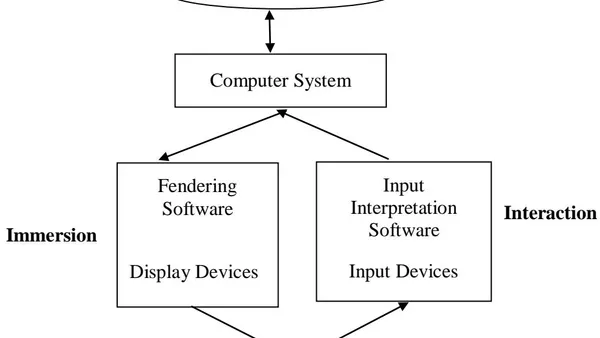
Many reports described the framework of VR Technology based on the concepts, features, and attributes while three tasks are common for each 3D VR Technology system such as Imagery, Interaction, and Behavior (Marsh et al., 1998)(Wann & Mon-Williams, 1996). In (Wann & Mon-Williams, 1996) has been given this idea of the shared framework of VR Technology. The imagination is the virtual and wholly part of the 3D graphics. While the user can manipulate or interact with 3-dimensional computer-generated objects in the 3D (or real-world) environment, and observe these objects and environment from various angles or viewpoints. In (Marsh et al., 1998) described the framework of augmented reality based on the component of VR Technology and virtual reality. They proposed a framework consisting of reusable distributed services for key sub-problems of AR, the middleware to combine them, and extensible software architecture. This framework is to use implemented services for tracking, modeling real and virtual objects, modeling structured navigation or maintenance instructions, and multimodal user interfaces. Here we are showing some different frameworks of Virtual Reality which is very useful for future development. In(Bauer et al., 2001) the authors gave the framework (Figure 1) according to the army training needs. This framework has the following components:
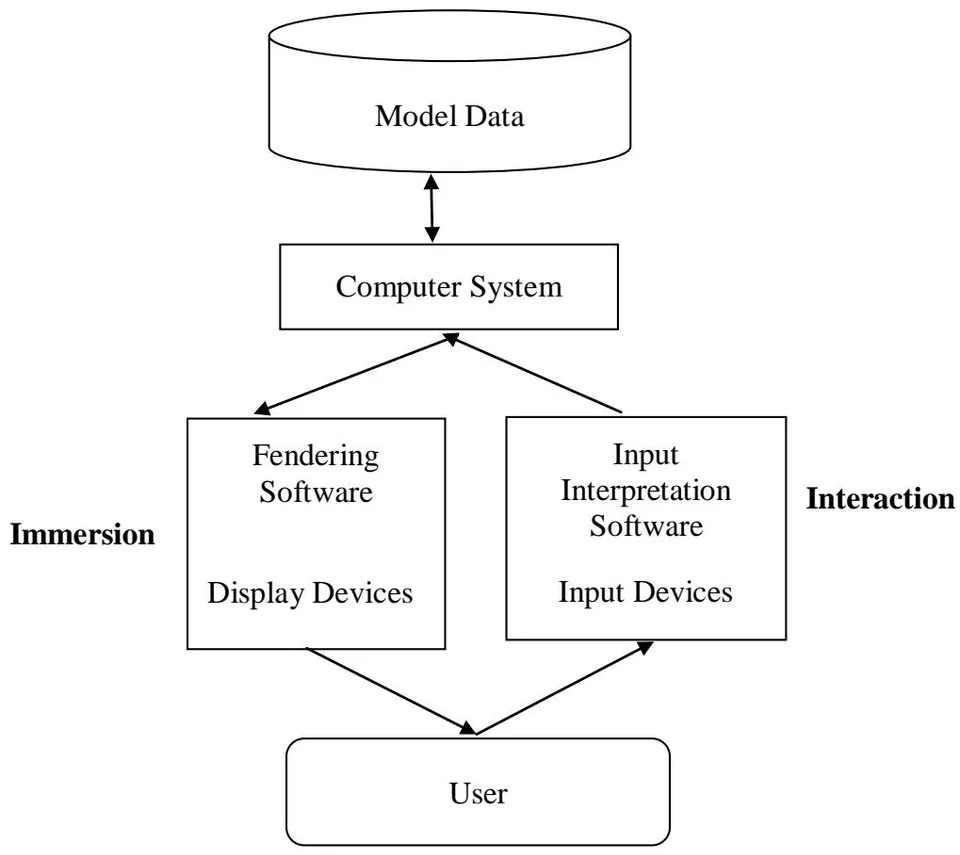
Immersion refers to the objective level of sensory fidelity a VR system provides. • Presence refers to a user's subjective psychological response to a VR system. A VR system's level of immersion depends only on the system's rendering software and display technology (including all types of sensory displays). Immersion is objective and measurable—one system can have another. Then immersion of level higher hand is an individual and other on the presence to the related response user context-dependent experience of "being there." Different users can experience the same VR with the presence of different levels Differences might be the experienced user and a single system, different levels of presence with the same system in history, recent mind of state on depending times, and other factors(De Moraes & Machado, 2013).
All the frameworks are based on the flowchart and based on immersion and interaction. These frameworks are helpful for the development of VR Technology.
IV. APPLICATIONS OF VR TECHNOLOGY. These days, VR Technology is growing very rapidly. We are watching new types of games, movies, or play station devices, different types of medical equipment, wearable devices, fashion technology, Military Operations, education, etc. Everywhere VR Technology plays a big role in making it efficient. We are describing
Here some of the important places where VR Technology filled a big gap to enhance that technology. Those places are as follows: Commented [HP1]: Not clear; rewrite Virtual Reality in the Medical Science: In medical sciences, VR helps to develop the best medicine and helps to diagnose the problem of the patient. For many health care professionals, VR is the very first technology since 1986 when used the term for the first time, VR has been usually described as a collection of technological devices: a computer capable of interactive 3D visualization, a head-mounted display, and data gloves equipped with one or more position trackers. These trackers track the position of the user and report that information to the display screen (Riva, 2003). VR has been used in both the medical and dentistry field. This is used for visualization purposes when formulating a diagnosis. Reaching a diagnosis means conducting a series of tests that produce complex sets of data. But virtual reality can be used to create a visual explanation of this data which is easier to read, understand and interpret. On the other hand, virtual reality is used in surgery, especially in the field of robotic surgery where it has proven to be very successful. Robotic surgery is a recent innovation in which surgery is performed using a robotic device, e.g. robotic arm which is controlled by a human surgeon.
This means fewer risks of complications during surgery and a faster procedure. The robotic device is accurate, meaning smaller incisions, reduced blood loss, and faster recovery. VR has shown its importance in the field of nursing, second life, medicine, dentistry, and other health care issues. They do this by using 3D virtual humans or avatars which act as their alter egos. Virtual Reality in Military: Virtual reality has been adopted by the military – this includes all three services (army, navy, and air force) – where it is used for training purposes. This is useful for training soldiers for war situations or other dangerous settings where they have to learn how to react appropriately. A virtual reality simulation enables them to do so but without the risk of death or serious injury. They can re-enact a particular scenario, for example, engagement with an enemy in an environment in which they experience this but without the real-world risks. This has proven to be safer and less costly than traditional training methods.
These include:
- Flight simulation
- Battlefield simulation
- Medical training (battlefield)
- Vehicle simulation
- Virtual boot camp
Virtual reality is also used to treat post-traumatic stress disorder. Soldiers suffering from battlefield trauma and other psychological conditions can learn how to deal with their symptoms in a 'safe' environment. The idea is for them to be exposed to the triggers for their condition which they gradually adjust to. This has the effect of decreasing their symptoms and enabling them to cope with new or unexpected situations. Some of the VR equipment uses in the military are Flight Simulator and Snipper Attack: Which uses in war and combat situations. HMD (Head Mounted Display): Uses in Army operations, to save money and time. Virtual Naval Ship: Uses in the Navy Operations. Virtual Reality in Entertainment: The entertainment industry is one of the most enthusiastic advocates of virtual reality, most noticeably in games and virtual worlds.
But other equally popular areas include:
- Virtual Museums, e.g., interactive exhibitions
- Galleries
- Theatre, e.g., interactive performances
- Virtual theme parks
- Discovery centers Many of these areas fall into the category 'edutainment' in which the aim is to educate as well as entertain.
a) Virtual Reality in Education
Education is another area that has adopted virtual reality for teaching and learning situations. The advantage of this is that it enables large groups of students to interact with each other as well as within a three-dimensional environment. It can present complex data in an accessible way to students which is both fun and easy to learn and these students can interact with the objects in that environment to discover more about them.
b) Virtual Reality Astronomy
Astronomy students can learn about the solar system and how it works by physical engagement with the objects within. They can move planets, see around stars and track the progress of a comet. This also enables them to see how abstract concepts work in a three-dimensional environment which makes them easier to understand and retain. This is useful for students who have a particular learning style, e.g., creative, or those who find it easier to learn using symbols, colors, and textures.
One Ideal Learning Scenario Is Medicine: Virtual reality can be used to develop surgery simulations or three-dimensional images of the human body which the students can explore. This has been used in medical schools both in the KSA and abroad. Virtual Reality and Tech-Savvy Children This is the fact that children today are familiar with all forms of technology and use these at school as well as at home. They have grown up with technology from a very early age and unlike adults, do not have any fear or hesitation in using it.
IV. OPEN RESEARCH TOPICS IN V.R. TECHNOLOGY
A billion-dollar question is always raised in our mind what is the future of V.R. technology, How the peoples can accept this technology without knowing much more about this? This looks exciting for certain with new developments in virtual reality gear and game consoles that play VR games. We are describing here the future scope of VR in some different fields.
a) Future of VR Technology in Medical Science
When people experience virtual reality for the first time, a common reaction is to start imagining all the different uses the technology might hold. Even within one industry, healthcare, the potential is open-ended. The good thing is that scientists and medical professionals have been at the drawing board for years now, developing and implementing virtual reality in ways that can help them train, diagnose, and treat myriad situations.
Exposure Therapy the VR experiences provide a controlled environment in which patients can face their fears and even practice coping strategies, as well as break patterns of avoidance — all while in a setting that's private, safe, and easily stopped or repeated, depending on the circumstances.
Treatment for PTSD VR technology can be used to cure PTSD (Post Traumatic Stress Disorder). This will be helpful to treat these diseases. Post Traumatic Stress Disorder is reported to be caused by traumatic events that are outside the range of
usual human experiences including (but not limited to) military combat, violent personal assault, being kidnapped or taken hostage, and terrorist attacks. Virtual Reality (VR) exposure treatment has been used in previous treatments of PTSD patients with reports of positive outcomes(Rizzo et al., 2005)
Treatment for Pain For burn victims, pain is an ongoing issue. Doctors are hoping distraction therapy via virtual reality could help them get a handle on that pain. A VR video game from the University of Washington called Snow World, which involves throwing snowballs at penguins and listening to Paul Simon, could alleviate pain during tasks that can be excruciating, like wound care or physical therapy, by overwhelming the senses and pain pathways in the brain7.
Treatment for Brain Damage Assessment and Rehabilitation. In (Rose et al., 2005) Published a roundup of virtual reality experiences in use for not only assessing impairments but also recreating them. Besides these important fields, VR technology can be useful for other types of patients, as it can help the disabled, social cognition, meditation, etc. According to one hypothesis till 2020 VR Technology will take place to cure many lives heartened diseases, like cancer, TB, BP, and heart diseases.
b) Future of VR Technology in Military
As we all know that Military is the strongest element of the defense system of any country. VR technology is playing a big role to enhance the defense system. At present this is working in the combat situation, threats, goal management, decision-making, etc. In the future, the role of games is very important for the progression of the military field. In the future more COTS games are probably being adapted to become military simulators. The realism of these simulators should likewise increase further. Probably there is a shift from real war situations to operations other than war. This means that humanitarian missions and peacekeeping become more important and that developments in the field of virtual reality tend to focus more on these types of situations. In the past simulation was primarily based on controlling the craft. Nowadays and probably in the future interaction is becoming more important. The last section showed that the current developments are based on interactions like communication, leadership, awareness, and emotions [UNK04]. Facial animation shall become more important to be aware of a person's emotional status [DEA04]. It is also in line with expectations that healthcare and virtual reality, like the treatment of PTSD veterans, make further development. Furthermore, it is hard to tell what the future of virtual reality in the military field brings (Haar, 2005).
c) Future of VR Technology in Entertainment
Virtual reality has been predicted as the next big thing in entertainment for some time, but only within the last two or three years has it started to emerge as a real possibility. This is playing a big role in gaming, 3D movies, playing stations, sports, etc.
Gaming options also mean that there is more chance for other types of gaming and game play to become a virtual reality. The regular use of hand-held technology for gaming including Solitaire can be enhanced by the use of virtual reality. It would allow more opportunities for conversations and real-time action, and can also add to the thrill of competitions such as Poker or online Bingo. Some websites in this field are already expressing an interest in this option.
d) Future of VR Technology in Communication
In the field of communication, wearable devices overtake mobile phones in the future. VR technology is helping to enhance wearable devices for making them better. The teams of experts are not thinking only, beyond gaming, they are trying to make such future devices that will be more helpful in the way of information technology and communication. At this time, different types of communication rings, and watches are available; In the future, these devices can probably be enhanced. So, we discuss some open issues on which future work is dependent. Besides these topics, some more challenges are available on which future researchers can give their idea.
V. CHALLENGES OF V.R. TECHNOLOGY
Despite VR technology's recent renaissance, this technology still has some problems which need to be improved. So many researchers have pointed out these challenges which we are briefing here. One problem which every author has mentioned is what we see and what we feel, this is a security issue that is still unsolved. What we don't know about VR today can hurt tomorrow.
In the games, there is still a need to enhance the system and this is the chance for future researchers to modify this system. The problem is in this field "Try enough demos, though, and as with any emerging technology, the cracks will start to show. And the biggest crack right now is in user input — the buttons, pads, or sensors that make VR as interactive as traditional video games. The unique challenge of VR technology which is still unsolved is fidelity. The meaning of fidelity is to change the pixels in the pixellated images. The first complaint with the new wave of VR was: "we could see the pixels!" We started at (640 x 800 per eye) with the VR device, then went up to with the DK2, and now with the Pixellated images are less of a problem already, and even when they are noticeable, the brain learns after a short time to ignore them and we're left immersed in the virtual world. In the gaming issue, VR is a big option but there are also some the problems like Virtual reality only being a fad is that people worried about. They don't want to invest in an expensive device that will only be relevant for two, maybe three years. Here's where a lot of industry professionals are divided. While some think that VR will be a new and longstanding platform, others think people will just return to traditional games eventually. Besides this, the games or devices of VR technology are too expensive which is beyond people's budget so if anyone wants to make this technology familiar so it should be at a nominal price.
VI. CONCLUSION
In this study, we discussed the applications and some open research topics related to the safety and security of VR technology. This study is just giving direction to future researchers about virtual reality. Our work is helpful for those people who are new in this field and want more information about Virtual Reality. Where VR Technology has been opened so many opportunities, some of the problems are also there which need to solve. Table 1 lists the advantages and challenges.
| Challenges | Advantages | VR Technology Fields |
| • Expensive equipment • Clinic and clinical acceptance • Technical expertise | • Engaging/motivating • Economy of scale • Online data gathering • Fine time resolution • Impairment/Function • Malingering detection • Wearable Devices helps to cure problem easily | Medical |
| • Difference between what we see and what we feel. • Expensive systems • Technical expertise • Hacking problems still their • Fidelity problems | • Development of Many Army devices • Helpful in the Combat situations • Support in the decision making • Helps to detecting the terrorists activities | Military |
| • Expensive devices • Memory management • Wrong use can harmful for the child's brain • Fidelity problems for the pixelated images. | • Sports are using this technology for live telecast. • 3D movies. • 3D games • Many games are based on the VR. | Entertainment |
| • Cannot trace the student's problem. • Work only machine based • Expensive tools • Beyond the limit of poor peoples | • A good tool for the online education • Added cognitive variables in education and training • Helpful to trained the military and army. • Interaction makes this technology more better for the education • Psychologically confirmation. • Some online training wearable tools like • Google watches | Education |
| • Low data transfer rate • Expensive devices • Security issues • Low bandwidth • Problems of Virtual display | • NTT can be replacing the mobile phones • All the work of internet can be done by the wearable devices which are based on • VR Technology • Very interactive devices • Portable systems, easy to carry | Communication |
| • Available in developed cities • Peoples are not technically sound for using this system • Sometimes wrong information can do a big blast • Language problem | • Help to control the traffic • Working to detect the criminal activities • Helping to control the air traffic • like radar | Traffic Control |