I. INTRODUCTION
This paper reviews the legal and regulatory regime for decommissioning oil and gas platforms on the United Kingdom Continental Shelf (UKCS) and in the North Sea and the process followed by UK regulatory authorities in approving an exception (derogation) to the requirement to fully remove all structures by allowing the footings of large steel jacketed platforms to remain in-situ.
To be granted an exception, the owners of the platforms are required to prepare a Comparative Assessment of decommissioning options demonstrating partial removal is the best overall (optimum) decommissioning option based on an assessment of technical, safety, environmental, societal, and economic (cost) factors. The requirements for Comparative Assessments are specified in Guidance Notes issued by UK regulatory authorities. To date, the jackets of five large platforms have been approved to be partially removed by UK regulatory authorities with their footings remaining in-situ. This paper summarizes the results of a Comparative Assessment prepared for Platform Ninian North (Ninian) that supported the decision by UK regulatory authorities to allow the jacket footings to remain in-situ. The paper notes there are eight California oil and gas platforms having jackets that would qualify for derogation consideration based on the criteria established for North Sea oil and gas installations. Based on the UK practice, the authors believe a strong case can be made for leaving the lower jacket structure (footings) of large California platforms in-situ by preparing Comparative Assessments of decommissioning options. The Comparative Assessments would likely show that partial removal of the large jackets is the optimum decommissioning option. It would also provide Federal and state regulatory agencies with project related technical, safety and cost information on decommissioning options that is not typically included in environmental impact assessment documents prepared to satisfy National Environmental Policy Act (NEPA) requirements but is critical to informed decision-making.
a) UK Legal and Regulatory Regime
The decommissioning of offshore oil and gas infrastructure on the UKCS is primarily governed by the Petroleum Act of 1998, as amended by the Energy Act of 2016. The Petroleum Act sets out the requirements for a formal Decommissioning Program which must be approved by the UK Offshore Petroleum Regulator for Environment and Decommissioning (OPRED) before the owners of an offshore installation or pipeline may proceed with decommissioning. OPRED is a regulatory body within the Department for Business, Energy, and Industrial Strategy (BEIS).
The OPRED has issued Guidance Notes (UKBEIS, 2018) describing the regulatory requirements set out in the Petroleum Act and Energy Act, and the UK's obligations under international treaties, namely the United Nations Convention on the Law of the Sea 1982, which prohibits the disposal (dumping) of platforms and other man-made structures at sea without the express prior approval of the relevant coastal state. The International Maritime Organization (IMO) has issued guidelines and standards requiring signatory coastal states to ensure that unused oil and gas installations are removed in whole or in part where there is no reasonable justification for allowing the installation to remain on the sea floor.
The UK, along with 14 other European government bodies (contracting parties), is also a signatory to the Convention for the Protection of the Marine Environment of the North-East Atlantic 1992, more commonly known as the OSPAR Convention. Under OSPAR Decision 98/3, the topsides of all oil and gas installations and the jackets of platforms weighing less than 11,023 short tons (10,000 metric tons)1 must be returned to shore for recycling and disposal (OSPAR, 1998). In addition, all installations put in place after February 9, 1999 (when OSPAR 98/3 came into force) must be completely removed. However, OSPAR 98/3 also provides exceptions (derogations) on a case-by-case basis for removing certain installations that may be difficult to entirely remove due to technical and/or safety factors .
To obtain OPRED approval for a derogation, the owners of the installation must conduct consultations with stakeholders and prepare a detailed Comparative Assessment of decommissioning options to identify the optimum or best option. The OPRED also requires owners/operators to prepare an Environmental Impact Assessment (EIA) to analyze environmental impacts of decommissioning activities and potential mitigation measures which would be implemented to minimize those impacts. The installations that qualify for potential derogation consideration are:
- Steel constructions (excluding topsides) weighing more than 11,023 short tons installed before February 9, 1999, where the footing may remain in place.
- Gravity based concrete installations, floating concrete installations, and any concrete anchorbase installed before February 9, 1999.
- Other unused offshore installations when it is possible to demonstrate exceptional and unforeseen circumstances resulting from structural damage, deterioration, or similar difficulties.
To comply with OSPAR requirements, UK oil and gas regulations also require partially removed installations be removed to a minimum depth of 180 feet (55 m) below the ocean surface (Mean Low Water/MLW) to ensure navigation safety. We note that the US Coast Guard similar safe navigation reference depth is 85 feet.
Prior to granting a derogation, and as part of the consultation process, BEIS must provide notification to the OSPAR Executive and other contacting parties who may provide comments and issue an opinion on the proposed derogation. There is no requirement for an owner of an installation to prepare a Comparative Assessment nor for BEIS to consult with the OSPAR Executive and contracting parties for cases where full removal is the chosen option. Under sections 29 and 34 of the 1998 Petroleum Act, owners of facilities are perpetually liable for partially removed structures (UKBEIS, 2018). Owners are also required to develop a monitoring plan for structures like jacket footings approved to remain in-situ on the seabed.
b) UK Comparative Assessment Guidelines
The UK BEIS Guidance Notes for Decommissioning of Offshore Oil and Gas Installations and Pipelines include an annex with guidelines for conducting and preparing Comparative Assessments documentation (UKBEIS, 2018). The BEIS guidelines follow the requirements specified for comparative assessments set out in Annex 2 of the OSPAR Decision 98/3. The guidelines provide information on assessment criteria (safety, technical, environmental, societal, economic), topics to be considered, and decommissioning options. Listed below are some of the key provisions of the guidelines. Additional details on the provisions can be found in Annex 2 of the BEIS Guidance Notes.
i. General
- Operators must assess the impact of each option using established methodologies.
- The preferred option should be selected by focusing on the matters where the impacts of the options are significantly different.
- Options where the safety risks are intolerable or involve major unacceptable environmental impacts may be ruled out without further consideration.
- Balancing the safety and environmental impacts of the options, including the impact on climate change, will clearly be important.
- Proportionality must also be considered but it is unlikely that cost will be accepted as the main driver unless all other matters show no significant difference.
- The engagement of interested stakeholders in balancing the impacts of the options is strongly recommended.
- The studies and the assessment process that supports the chosen decommissioning option should be reviewed by independent experts.
ii. Safety
In assessing and comparing the safety risks of different options the general principles of risk management used within the industry should be applied.
The use of quantitative risk assessment (QRA) techniques should be employed [e.g., Potential Loss of Life (PLL)].
A comparison should be made with the risk levels generally supported by the Health & Safety Executive (HSE); HSE defines the maximum tolerable level of individual risk of fatality as 1 in 1,000 man-years.
iii. Environmental
- The assessment and comparison of the environmental impacts of different options should be based on an Environmental Appraisal carried out in accordance with the widely recognized techniques and standard methodologies for such evaluations.
- An assessment of the impact of all activities at the offshore location and at the onshore dismantling and disposal site should be carried out.
iv. Technical Feasibility
- Recognized Quantitative Risk Assessment techniques, engineering and operational analysis should be used in combination to provide comprehensive, robust, quantitative, and qualitative assessments of the options.
- A comparison should be made with accepted industry risk assessment criteria for marine operations.
- The assessment of the technical feasibility of different decommissioning options should be based on existing industry experience and available equipment.
v. Societal
The engagement of interested stakeholders will be important to assess and take account of the views of different interest groups.
The impacts on fisheries and fishing activity both historical and future potential will be of paramount importance.
Employment and regional development opportunities should be considered.
vi. Economic
- In assessing alternative decommissioning options proportionality should be considered and costs should be balanced against the other assessment criteria.
c) UK Platforms Approved for Partial Removal
To date, a total of five steel-jacketed oil and gas platforms have been approved by OPRED to be removed with the footings of the jackets remaining in situ. The jacket footings and drill mugs and cuttings found at the base and surrounding the perimeter of the jacket were approved to remain in-situ based on the results of Comparative Assessments of decommissioning options conducted by the platform owners. The first large platform approved to be removed with the jacket footings remaining in-situ was Platform North West Hutton in 2009. This was followed by Platform Murchison in 2017, Miller in 2018, Brent Alpha in 2020, and Ninian in 2022. Table 1 provides information on the water depths of the platforms and the total combined and individual weights of the topside and jacket. Also shown are the estimated weights of the jacket footings approved to remain in-situ, the percentage of the total jacket weight remaining in-situ, and the height the remaining jacket footings rise above the original mudline of the seabed. As can be seen in the data, there is a wide variation in the percentage of total jacket weight (35-70 percent) remaining in-situ and the heights the remaining footings rise above the seabed. The variation is due to the different structural designs of the jackets and pilings securing the jackets to the seabed.
| Platform | Year Removed | Water Depth (ft) | Total Weight1,2 (tons) | Jacket Weight3 (tons) | Jacket Weight Removed (tons) | Weight of Footings In-situ (tons) | Percent of Jacket Weight Remaining In-situ | Height of Footings4 (ft) |
| NW Hutton | 2009 | 472 | 41,480 | 19,257 | 10,141 | 9,116 | 47% | 130 |
| Murchison | 2017 | 512 | 57,575 | 30,476 | 9,210 | 21,266 | 70% | 144 |
| Miller | 2018 | 338 | 52,157. | 20,485 | 13,363 | 7,122 | 35% | 66 |
| Brent Alpha | 2020 | 460 | 50,310 | 31,657 | 9,382 | 22,274 | 70% | 183 |
| Ninian | 2022 | 463 | 33,214 | 19,487 | 10,471 | 9,016 | 46% | 254-290 |
As noted above, the OSPAR guidelines allow an exception (derogation) to the requirement to fully remove the footings of large steel jackets weighing more than 11,023 tons (excluding topsides). "Footings" are defined by OSPAR as those parts of a steel installation which are below the highest point of the piles which connect the installation to the seabed or, in the case of an installation constructed without piling, form the foundation of the installation, and contain amounts of cement grouting like those found in piled installations. The definition also includes those parts of a steel installation which are so closely connected to the footings as to present major engineering problems in severing them (OSPAR, 1998). The footings of large platforms are massive and can account for 35-70 percent of the total jacket weight (see Table 1).
II. NINIAN PLATFORM
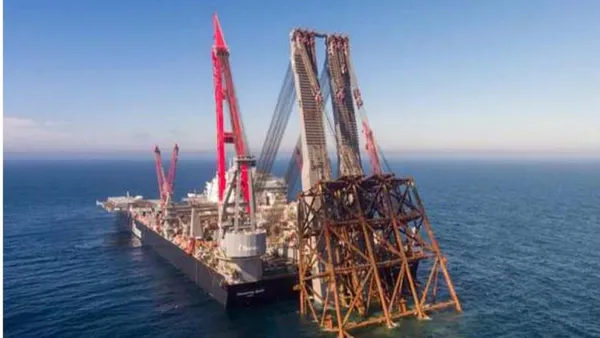
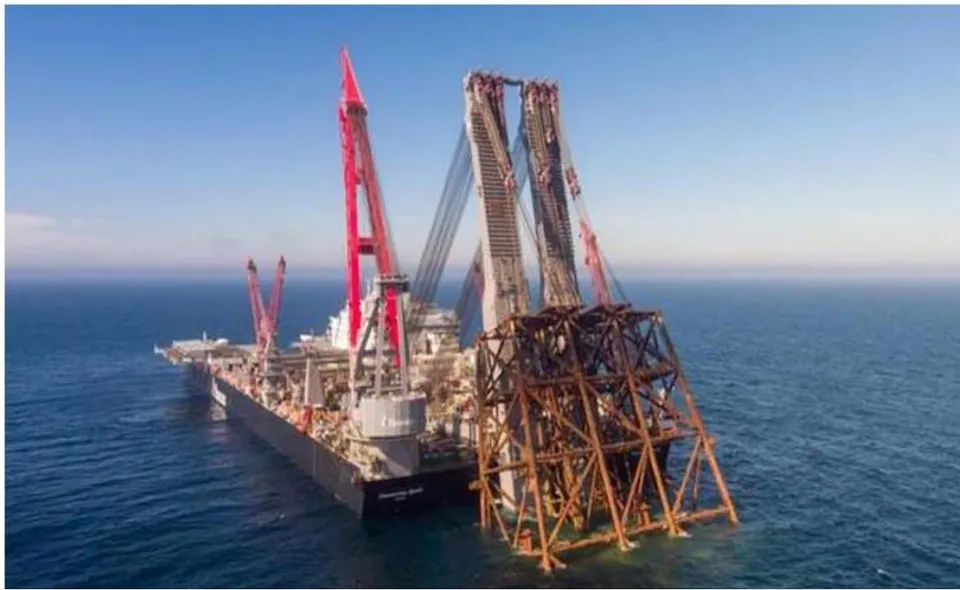
Ninian was a drilling and production platform situated approximately 100 miles northeast of the Shetland Islands; the platform stood in 463 feet of water and the combined weight of the topside (13,727 tons) and the jacket (19,487 tons) was reported to be 33,214 tons (CNR, 2019). The topside of the platform was fully removed and transported to shore for recycling and disposal. The footings of the jacket (Figure 1) were approved to remain in-situ by OPRED based on the results of Comparative Assessment of decommissioning options conducted by the owners of the platform (CNR, 2017).
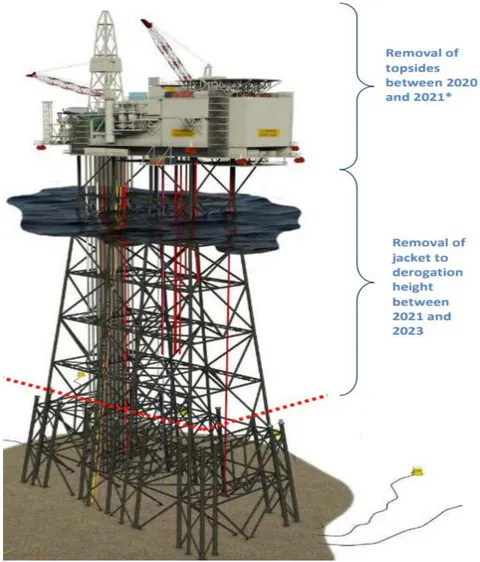
Topside Removal: The Ninian topside (15,653 tons) was removed in 2020 by the Pioneer Spirit in a single lift and transported by the Pioneer Spirit to an inshore location near the Peterson-Veolia yard in Dales Voe, Shetland, where it was transferred to the Iron Lady, a large cargo barge owned by Allseas measuring 656 feet in length and 164 feet in width (Allseas, 2022; Offshore Engineer, 2020). The topside was subsequently transported by the Iron Lady to the quay at the Peterson-Veolia yard where it was dismantled and recycled.
Jacket Removal: The Ninian jacket was secured to the seabed by 26 structural piles, 8 leg piles (46 in. diameter) and 18 skirt piles (60 in. diameter). The upper portion of the jacket (Figure 2) was removed in a single-lift (8,929 tons) during a 7-day campaign by the Pioneer Spirit in April 2022 (Offshore Engineer, 2022). Like the topside, the Ninian jacket was directly transported by the Pioneer Spirit to an inshore location where the jacket was transferred to the Iron Lady. The Iron Lady was then towed by tugboats to the quay of the Peterson-Veolia yard where the Pioneering Spirit assisted in offloading the jacket. Approximately 46 percent (9,016 tons) of the total jacket weight (19,487 tons) remains in-situ. The remaining footings rise to a height of 254-290 feet above the seabed (CNR, 2019).
a) Platform Ninian Comparative Assessment
This section summarizes the results of the Comparative Assessment prepared by Canadian Natural Resources International (CNR) to assess the decommissioning options for the Platform Ninian jacket and the drill cuttings pile that had formed at and surrounding the base of the jacket (CNR, 2017). A derogation case for the jacket and drill cuttings pile was submitted to OSPAR for review and subsequently approved by BEIS. The jacket decommissioning options included full and partial removal, the latter option of which also involved leaving the footings of the jacket in-situ. A total of five drill cuttings options were assessed:
Recover to the surface, treat, and release liquids offshore, transport solids to shore.
Recover to surface, slurry to shore.
Recover to surface, reinject in offshore disposal well.
Disperse drill cuttings on the seabed.
Leave in-situ.
The Comparative Assessment recommended the Ninian jacket be partially removed to the top of the footings (between 254-290 feet below sea level) using multiple lifts, with the footings remaining in-situ (CNR,
2017). This option resulted in a significant reduction in risks to project personnel, environmental impacts, and total costs compared to the full removal option. The assessment also recommended the drill cuttings remain in-situ to degrade naturally over time. This option was considered superior to recovering or dispersing the drill cuttings on the seabed based on the lack of proven technology for recovering the drill cuttings, the adverse environmental impacts resulting from dispersal of the drill cuttings, and cost considerations. Each decommissioning option was assessed against the safety, technical, environmental, societal, and total cost criteria established by OSPAR and BEIS to identify the best overall (optimum) decommissioning option. Both quantitative and qualitative data were used to support the assessment. The results of the Comparative Assessment for the Ninian jacket are summarized in Table 2 and described in more detail below. The Environmental Statement prepared by CNR for decommissioning the Ninian platform determined there would be no significant adverse effects on the environment from leaving the jacket footings and drill cuttings pile in-situ (CNR, 2017a).
| Criteria/Metric | Full Removal | Partial Removal | Summary of Key Results |
| Safety | |||
| ·Risk to personnel Potential loss of life (PLL) | 2.5 x 10⁻² | 1.0 x 10⁻² | Full jacket removal increases PLL by 150 percent compared to the partial removal option. For full removal, the PLL is 2.5 x 10⁻²per annum, or 1 in 40 years; the PLL for partial removal is 1.0 x 10⁻²per annum or 1 in 100 years. |
| ·Risk to other users of the sea | 0 | 2.3 x 10⁻⁵ | Full removal eliminates the risk to other users. Partial removal creates a long-term hazard to fishermen from the potential snagging of fishing gear on the remaining footings. The PLL for fishermen is extremely small, 2.3 x 10⁻⁵per annum or 1 in 43,103 years. |
| Technical | |||
| ·Technical feasibility | 25% | 100% | Full removal is much more technically challenging than partial removal. |
| ·Use of proven technology and equipment | 33% | 100% | The techniques and equipment required to remove the footings do not have a proven track record. This increases the probability of a forced deviation (excursion) from planned operations. |
| ·Ease of recovery from excursion | 75% | 100% | Full removal is more likely to result in an excursion which can cause a delay or extension of removal operations and an increase in costs compared to partial removal. |
| Environment | |||
| ·Environmental impacts | 66% | 100% | Full removal results in greater offshore and onshore environmental impacts than partial removal due to the larger volume of steel removed and processed. |
| ·Energy consumption (Gigajoules) | 297,654 | 530,148 | Energy usage is higher for partial removal due the energy required to manufacture new metals equivalent to the weight of the footings remaining in-situ. |
| ·Air Emissions CO2 equivalent (metric tons) | 24,277 | 31,064 | There is no significant difference in emissions to the atmosphere between full and partial removal. |
| Societal | |||
| ·Commercial impact on fisheries | 100% | 94% | There is no significant difference on fish catch between full and partial removal; the obstruction caused by the footings has a footprint of less than 2.5 acres and is situated in an area where the level of fishing activity is low to moderate. |
| ·Socioeconomic impact on amenities | 100% | 100% | The socioeconomic impact of full and partial removal on amenities are equivalent. |
| ·Socioeconomic impact on communities | 100% | 100% | The socioeconomic impacts of full and partial removal are equivalent. |
| Economic | |||
| ·Total project cost | 53% | 100% | Full removal increases removal costs by 46% compared to the partial removal option. |
i. Safety
The safety assessment determined full removal of the jacket would result in a 150 percent increase in risk to project personnel compared to the partial removal option. For full removal, the Potential Loss of Life (PLL) was calculated to be per year (1 in 40 years); the PLL for partial removal was per year (1 in 100 years). The PLL for full removal was much higher than the maximum tolerable PLL limit of per year (1 in 1,000 years) established by the UK Health and Safety Executive (HSE) and violated the UK regulatory principle that risks should be reduced to as low as reasonably possible (ALARP). The increase in risk for full removal was due in-part to the larger number of lifts required to fully remove the jacket compared to the partial removal option. This increased the overall length of time to complete the removal work thereby increasing the exposure risk to personnel participating in decommissioning activities. The Comparative Assessment acknowledged partial removal of the jacket
would create a long-term hazard to fishermen from the potential snagging of fishing gear on the remaining footings. The PLL for fishermen was calculated to be extremely small, or 1 in 43,103 years.
ii. Technical
The technical assessment determined full removal of the Ninian jacket would be much more complex and technically challenging than partial removal; it also determined the techniques and equipment required to remove the large Ninian footings did not have a proven track record. The use of novel or unproven techniques increases the probability the removal techniques could fail, necessitating an excursion (deviation) in planned operations resulting in a delay or postponement of operations and an increase in costs. Among the technical challenges were:
Jacket stability: Progressive cutting of the jacket renders the remnant jacket less rigid and potentially unstable, increasing the potential for collapse of the structure.
Cutting tool deployment: Below the derogation height (top of the pilings) there were numerous diagonal cross members within the complex steel lattice framework of the jacket that would be difficult to access, cut and remove using remotely operated vehicle (ROV) deployed mechanical and abrasive cutting tools. This increased the potential that inherently risky diver intervention services would be required to assist in positioning or retrieving cutting equipment.
Failed cuts: Diamond wire and abrasive water jet cutting techniques are prone to operational difficulties that can lead to incomplete cuts. Failure to make the complete cuts required to free each jacket section for lifting could result in the crane and other equipment on the heavy lift vessel (HLV) being exposed to a severe risk of damage due to the loss of stability and structural integrity of the section being removed.
*Pile severing: The Ninian jacket was secured to the seabed by 26 piles (8 leg piles and 18 skirt piles) many of which were grouted with cement (CNR, 2017). Failure to obtain internal access to the piles would require excavation of large pits around the piles to provide access for divers to deploy mechanical or abrasive cutting tools to externally sever the piles, thereby exposing divers to significant risks from collapse of the pit walls.
Dropped objects: Cutting the footings into sections would result in unstable loads that when lifted by the HLV crane and loaded onto vessels or cargo barges would increase the potential for dropped objects and risk of injuries and fatalities to project personnel.
iii. Environmental
The environmental assessment noted the full removal option resulted in greater environmental impacts than partial removal. The primary factors differentiating the two options were the scale of operations and the physical presence of jacket footings left in-situ. The full removal option involved removing nearly 20,000 tons of steel, nearly double the tonnage removed in the partial removal option. The full removal option therefore required a larger vessel spread and resulted in more vessel traffic and anchoring activity than the partial removal option. Full removal also required the footings to be removed to a depth of nine feet (UK regulatory requirement) below the seabed resulting in disturbance of the drill cuttings pile and the potential release of hydrocarbon contaminants in the marine environment. The drill cuttings pile would not be disturbed under the partial removal option. Full removal also resulted in more onshore impacts (increased noise, traffic, emissions, landfills). The assessment also acknowledged the potential environmental impacts associated with the release of contaminants from the jacket and shell mounds as they degrade naturally in the marine environment. The impacts were determined to be insignificant.
iv. Societal
The results of the assessment showed there was no significant difference on impacts on commercial fisheries between the full and partial removal options. The assessment noted the obstruction caused by the footings had a footprint of less than 2.5 acres and was situated in an area where the level of fishing activity is low to moderate. The assessment also showed the socioeconomic impact on amenities (i.e., employment, public services) to be equivalent for full and partial removal options.
v. Economic
The economic assessment determined full remove would increase total project costs by 46 percent compared to the partial removal option. The significant increase in costs for the full removal option was driven by the larger tonnage of steel required to be removed, and the longer duration and complexity of operations compared to partial removal.
b) California Decommissioning Overview
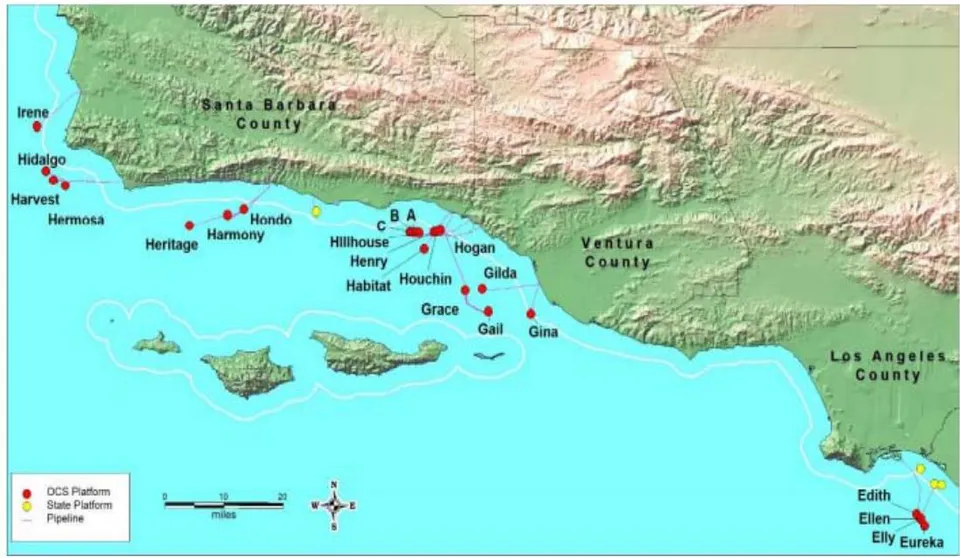
There are a total of 27 oil and gas platforms located off the coast of California, 23 on the federal Outer Continental Shelf (OCS) which are located beyond three nautical miles offshore, and four in state waters (Figure 3). The OCS platforms are in water depths ranging from 95 to 1,198 feet, and range in size from small structures like Gina having a total weight of 1,400 tons, to ultra-large structures like Heritage and Harmony having estimated removal weights ranging from 69,000 to 87,000 tons (TSB Offshore, Inc., 2016). At the close of
2022 eight (Gail, Grace, Harvest, Hermosa, Hidalgo, Habitat, Hogan, Houchin) of the 23 OCS platforms were on terminated leases and in the early stages of being decommissioned (Tab.3) The full removal of Platforms Gail (739 ft. wd.), Harvest (675 ft. wd.), and Hermosa (603 ft. wd.) would each establish a world water depth record (approximately 500 ft. wd.) for fully removing conventional oil and gas platform jackets from the seafloor (Chevron, 2022).
In contrast to the North Sea and the Gulf of Mexico (GOM), where numerous oil and gas platforms have been decommissioned, there is little or no infrastructure available in California to support large oil and gas platform decommissioning operations. There are currently no heavy lift vessels (HLVs) stationed on the U.S. west coast that have capability to remove the large OCS platforms efficiently and safely. The HLVs would need to mobilize from the North Sea, GOM, or other distant locations at great expense (Smith and Byrd, 2023). There are also no port-based facilities in California that have the capability to offload and process the topside components and jackets of the large OCS platforms. Absent the construction of new or expanded materials disposal facilities, the dismantled topside and jacket sections are likely to be loaded onto cargo barges and towed to materials disposal yards in the GOM or overseas locations.
(Source, MRS Environment, Inc.)
| Platform | Year Installed and Age in Years | Operating Status 2ndQtr. 2023 | Water Depth (feet) | Estimated Removal Weight (short tons) | Wells Drilled | OCS Operator1 | |
| San Pedro Bay – Los Angeles County | |||||||
| Eureka | 1984 | 38 | Producing | 700 | 33,377 | 50 | BOC |
| Elly2 | 1980 | 42 | Producing | 255 | 9,400 | 0 | BOC |
| Ellen | 1980 | 42 | Producing | 265 | 11,655 | 63 | BOC |
| Edith | 1983 | 39 | Producing | 161 | 8,556 | 18 | DCOR |
| Eastern Santa Barbara Channel – Ventura and Santa Barbara County | |||||||
| Hogan | 1967 | 55 | Leases terminated | 154 | 5,098 | 39 | BWEG3 |
| Houchin | 1968 | 54 | Leases terminated | 163 | 5,615 | 35 | BWEG3 |
| A | 1968 | 54 | Producing | 188 | 4,896 | 52 | DCOR |
| B | 1968 | 54 | Producing | 190 | 4,959 | 57 | DCOR |
| C | 1977 | 45 | Producing | 192 | 5,718 | 38 | DCOR |
| Henry | 1979 | 43 | Producing | 173 | 4,006 | 23 | DCOR |
| Hillhouse | 1969 | 53 | Producing | 190 | 5,834 | 47 | DCOR |
| Gina | 1980 | 42 | Producing | 95 | 1,380 | 12 | DCOR |
| Gilda | 1981 | 41 | Producing | 205 | 11,293 | 63 | DCOR |
| Habitat | 1981 | 41 | Leases terminated | 290 | 9,611 | 20 | DCOR |
| Gail | 1987 | 35 | Leases terminated | 739 | 37,057 | 28 | BWEG4 |
| Grace | 1979 | 43 | Leases terminated | 318 | 13,074 | 28 | BWEG4 |
| Western Santa Barbara Channel – Santa Barbara County | |||||||
| Hondo | 1976 | 46 | Shut-in | 842 | 29,478 | 28 | XOM |
| Harmony | 1989 | 33 | Shut-in | 1,198 | 86,513 | 34 | XOM |
| Heritage | 1989 | 33 | Shut-in | 1,075 | 69,192 | 48 | XOM |
| Santa Maria Basin – Santa Barbara County | |||||||
| Harvest | 1985 | 37 | Leases terminated | 675 | 35,150 | 19 | FMC |
| Hermosa | 1985 | 37 | Leases terminated | 603 | 30,868 | 13 | FMC |
| Hidalgo | 1986 | 36 | Leases terminated | 430 | 23,384 | 14 | FMC |
| Irene | 1985 | 37 | Shut-in | 242 | 8,762 | 26 | FMC |
c) Federal and State Decommissioning Regulations
The U.S. Department of the Interior's Bureau of Safety and Environmental Enforcement (BSEE) and Bureau of Ocean Energy Management (BOEM) regulate OCS oil and gas leasing, development, and decommissioning activities under the authority granted by the OCS Lands Act and its implementing regulations found in Title 30, U.S. Code of Federal Regulations. Under the OCS regulations (30 CFR §250.1700-1754; BSEE,2020), when a platform is no longer useful for operations, operators are required to:
Permanently plug all wells.
Remove all platforms and other facilities to a depth of 15 feet below the mudline.
Decommission all pipelines.
Clear the seafloor of all obstructions on the lease or pipeline right-of-way.
The OCS regulations (30 CFR §250.1728) require platforms and other facilities (including templates and pilings) to be removed to a depth of at least 15 feet below the mud line. The regulations also allow BSEE to approve an alternate removal depth if any one of the following conditions is met:
The remaining structure would not become an obstruction to other users of the seafloor or area, and geotechnical and other information demonstrates that erosional processes capable of exposing the obstructions are not expected.
The company responsible for decommissioning determines, and BSEE concurs, the use of divers is required, and seafloor sediment stability poses safety concerns.
The water depth is greater than 2,624 feet (not relevant offshore California where water depths of platforms are less than 1,198 feet).
The regulations also allow BSEE to grant a departure from the requirement to remove a platform if the structure is converted to an artificial reef. To grant a departure from removing an OCS platform, the following conditions must be met:
The structure becomes part of a State artificial reef program.
The responsible State agency acquires a permit from the U.S. Army Corps of Engineers and accepts title and liability for the structure.
U.S. Coast Guard navigational safety requirements for the structure are satisfied.
d) Partial Removal Benefits
In the North Sea oil and gas platform jackets installed before 1999 weighing more than 11,023 tons can be approved by regulatory authorities to remain in situ if Comparative Assessments of decommissioning options conducted by the owners of the facilities demonstrate partial removal is the best overall (optimum) option taking into consideration safety, technical, environmental, societal, and economic criteria. There are a total of eight OCS platforms (Eureka, Gail, Harvest, Hermosa, Hidalgo, Harmony, Heritage, and Hondo) located offshore California that would qualify for derogation consideration based on their jacket/pile weight ( tons) and date of installation (prior to 1999) if they were in the North Sea (Table4). The OCS platforms are in water depths ranging from 430 to 1,198 feet and have estimated jacket/pile removal weights ranging from 12,950 to 55,250 tons.
| Platform | Year Installed | Water Depth (ft) | Topside Removal Weight (tons) | Jacket/Pile Removal Weight (tons) | Total Removal Weight1 (tons) | Number of Piles | |
| Main | Skirt | ||||||
| Eureka | 1984 | 700 | 8,000 | 21,000 | 33,377 | 24 | 0 |
| Gail | 1987 | 739 | 7,693 | 22,300 | 37,057 | 8 | 12 |
| Harvest | 1985 | 675 | 9,024 | 20,016 | 35,150 | 8 | 20 |
| Hermosa | 1985 | 603 | 7,830 | 19,500 | 30,868 | 8 | 20 |
| Hidalgo | 1986 | 430 | 8,100 | 12,950 | 23,384 | 8 | 8 |
| Harmony | 1989 | 1,198 | 9,839 | 55,250 | 86,513 | 8 | 20 |
| Heritage | 1989 | 1,075 | 9,826 | 46,370 | 69,192 | 8 | 26 |
| Hondo | 1976 | 842 | 8,450 | 15,100 | 29,478 | 8 | 12 |
Decommissioning plans for four of the platforms (Gail, Harvest, Hermosa, Hidalgo) are expected to be submitted to BSEE for review and approval in the near term (BSEE, 2022). The platforms are in water depths ranging from 430 to 739 feet and have estimated jacket/pile removal weights ranging from 12,950 to 22,300 tons. Platform Ninian, in comparison, was in 403 feet of water and had an estimated jacket/pile removal weight of 19,487 tons. The full removal of jackets of Gail (739 ft. wd.), Hermosa (603 ft. wd.), Harvest (675 ft. wd.) and Hidalgo (430 ft. wd.) and the other deep-water platforms will be technically challenging due to the massive size of the jacket footings, the structural complexity of the jackets, and the numerous piles (16 to 28 per platform) securing the jackets to the seabed. To date, there have been no projects where jacket footings of this size and water depth have been removed from the seabed.
The safety, technical, environmental, and economic benefits resulting from partial rather than full removal of the Platform Ninian jacket were documented in the Comparative Assessment of decommissioning options prepared for the removal of the structure (see Table 2). Similar benefits are likely to be achieved if the jacket footings and drill cuttings of large California platforms are approved to remain in-situ rather than being fully removed. Highlighted below are some of the likely benefits that could be achieved by partially removing the jackets of large California platforms.
i. Worker Safety
- Partial removal significantly reduces the potential risks of deaths and injury to project personnel.
ii. Technical
- Partial removal is much less complex, requires less time, uses proven technology, and is much less likely to be impacted by adverse weather/ oceanographic conditions and technical issues resulting in postponement, delay, or extension of removal operations.
iii. Environmental
- Partial removal results in a significant reduction in environmental impacts, both offshore and onshore.
- Partial removal obviates the need to use explosives, which may be required if the legs and piles of the jacket cannot be completely severed internally using mechanical and abrasive cutting tools.
- Partial removal results in a large reduction in construction related emissions. A study of a large California platform (Harvest) estimated partial removal (reefing the jacket in-situ) would result in up to a 10-fold reduction in emissions (Smith and Byrd, 2021).
- Partial removal retains established marine habitats having high ecological value. Scientific studies show California platforms are among the most productive marine habitats globally (Claisse et al., 2014); the studies also show approximately 90 percent of the fish biomass and secondary fish production would be retained if the upper portion of the jacket was removed to a depth of 85 feet below the ocean surface and the remaining structure is left standing in-situ (Claisse, et. al., 2015).
iv. Economic
- Partial removal results in a significant reduction in total project cost.
- Studies in the UK show removal costs would be reduced 37-75 percent (CNR, 2019; CNR, 2014; BP, 2011).
- Studies show the cost savings could range from 160 million or more if a large California platform was converted to an artificial reef (Smith and Byrd, 2020).
- Under the California Marine Resources Legacy Act (AB 2503) 80 percent of the cost savings would go to the State to fund ocean conservation if a partially removed jacket is converted to an artificial reef.
III. SUMMARY AND CONCLUSIONS
There are 27 steel-jacketed oil and gas platforms located offshore California, eight of which have jackets that would qualify to be considered for partial removal (derogation) under OSPAR if they were in the North Sea. To date, five large platforms have been approved to be partially removed on the UKCS with their jacket footings and drill muds and cuttings remaining in situ. The derogated jackets were approved to remain in situ by UK regulatory authorities based on the results of Comparative Assessments of decommissioning options conducted by the owners of the facilities demonstrating partial removal of the jackets was the best overall (optimum) decommissioning option taking into consideration technical, safety, environmental, societal, and economic criteria. Of the eight California platforms that would qualify for partial removal consideration in the North Sea, four (Gail, Harvest, Hermosa, Hidalgo) are expected to be removed by the end of the decade. The full removal of platform jackets will be technically challenging and establish new world water depth records for conventional steel-jacketed structures. To date, there have been no projects where jacket footings of this size and weight have been removed from the seabed.
Based on the practice followed in the UK, the authors of this paper believe a strong case can be made for allowing the jacket footings of the platforms to remain in-situ at or below a safe navigation depth acceptable to the U.S. Coast Guard, likely 85 feet, irrespective of whether the jacket is converted to an artificial reef. To obtain permit approvals from federal and state regulatory agencies to leave the footings of the jackets and drill cuttings in-situ, the owners of the platforms will need to clearly demonstrate that partially removing the jackets is the optimum decommissioning option. This can be demonstrated by adopting the practices that have been followed in the UK and North Sea under OSPAR for preparing Comparative Assessments of decommissioning options. The authors recommend the operators of large OCS platforms offshore California and in the Gulf of Mexico who propose to partially remove platform jackets prepare Comparative Assessments to support their decommissioning applications. The Comparative Assessments can also be prepared to support the case for allowing partial removal of smaller platform jackets and allowing pipelines and drill muds and cuttings to remain in-situ.
Footnotes
All weights cited in this paper are reported as short tons (2000 pounds) except HLV lift capacities which are in metric tons (1000 kg or 2200 pounds). (p.2) ↩