Based on a large scale synthesis of data, Mars can be understood to be a planet with a flourishing, Gaia-type, biosphere in the past, where life modified its environment from an early epoch so that it became the home of a massive Earth-like biosphere, before an anomalous mass extinction event, reduced it to its present state with only a weak, residual biosphere. Such a possibility is strongly suggested by circumstantial evidence gathered form a variety of sources. The Mars crate ring rate, is shown to be much higher than Lunar leading to the average surface age in the Northern Hemisphere to be approximately 1/2 billion years or less. This is proven by the average age of younger Mars meteorites, the Nakhlites and Shergottites, of less than 1 Billion years. The young surface ages make signs of liquid water on Mars more recent and indicate that the liquid water epoch on Mars lasted for most of Mars geologic history. This requires a high pressure CO 2 greenhouse in the presence of large amounts of ferrous silicates, requiring, in turn, a high oxygen level atmosphere to provide geochemical stability. This results in a red Mars due to large amounts of Hematite in the soil and few carbonates. This oxygenated atmosphere, in turn, requires massive photosynthesis, as occurs on Earth, since UV photolysis of water is self-limiting whereas photosynthesis is self-amplifying by formation of an ozone layer to protect plant life. Mars thus became very Earthlike in environment, with a mixed CO 2 and CH 4 greenhouse produced by a high pressure oxygen rich atmosphere, until some cataclysm ended all but a present residual biosphere.
## I. INTRODUCTION: INDUCTIVE REASONING
AND THE ROLE OF BIOLOGY IN
UNDERSTANDING MARS PAST AND
PRESENT To form or test hypothesis by some precise measurement is the favored mode of modern science, and is deductive reasoning, however, to recognize a pattern formed by large numbers of measurements is to form a synthesis, which is inductive reasoning. These are two modes of thought recognized since Aristotle.. To form a synthesis is to recognize a galaxy and its associated dynamics, as opposed to studying the individual stars of the galaxy. Both processes of thought are essential to science, one
process provides precise data and the other uses that data to understand the larger relationships of that data.
A modern example of inductive reasoning was the recognition of the Gaia Principle by Lovelock and Margulis, (1974). The recognition of the relationship of life as part of a biosphere that helped shape the geochemical evolution of the Earth so that it was more hospitable to life, was a grand synthesis using data drawn from many disciplines within chemistry, biology, ecology, and geology. It can be said that the Gaia Principle is the inference from a vast body of data on Earth that the laws of physics favor biology on a massive scale. But what of other planets? Would not the laws of physics be cosmic in their application, and therefore create Gaias beyond the Earth?
The planet Mars, with its surface displaying a range of terrains, some heavily cratered and others only lightly cratered, and evidence of massive, global, water induced erosion, including a Paleo-Ocean bed on its most lightly cratered portion, Brandenburg (1986) Clifford and Parker (1999), and highly oxidized surface, with only scarce carbonates, betrays a past much different than its present state. That extensive past may now be understood as an epoch of an Earth-like Gaia regime, where a massive and persistent biosphere modified the Mars environment to favor life bearing conditions. The end of those same conditions meant also the end of the massive biosphere, explaining Mars present state. Massive biology can be understood to have stabilized the Mars environment, Brandenburg (2015), over most of geologic time, as it did on Earth. Mars past can be understood as a pattern of interlocking puzzles, however, as will be shown, the solution of one puzzle leads to the solution of another.
It will be shown that the proximity of Mars to the asteroid belt, and hence suffering a high cratering rate, Brandenburg (1994), Treiman A. (1995) and Nyquist et al. (1998), leads to an understanding of Mars as a dynamic Earth-like planet for most of its history. Further, the persistence and abundance of signs of liquid water, Tanaka (1996), even on its most lightly cratered regions (see Figure 1), including a lightly cratered Paleo-Ocean bed Brandenburg (1986), requires Earth-like atmospheric pressures and a powerful greenhouse effect to have operated until recent geologic times.
This persistent greenhouse, it will be shown, requires a highly oxygenated atmosphere to achieve geochemical stability, which only biology can supply. Thus, Mars past cannot be understood without massive biology being present. Sadly, the fragility of life, seen in evidence of mass extinctions on Earth, explains also the present environment of Mars, where only a residual biosphere appears to be present. To solve this problem of Mars past requires a broad New Mars Synthesis, Brandenburg, (2015), drawing on a vast trove of data from Mars, the Moon, and even the Earth. This data ranges from meteorites collected in Antarctica, and sediments found in the bottom of the Grand Canyon on Earth, to Moon rocks collected by astronauts, and finally to a vast array of data collected by robotic probes from Mars orbit, meteorites from Mars collected in Antarctica, and lander/rovers on its surface. Once again, the key to understanding Mars past environment appears to be abundant life. But first we must understand our models of Mars Geochronology and their problems. In particular, we want to know the answer to the question: what was the length of the Mars "Liquid Water Epoch" in geologic time?
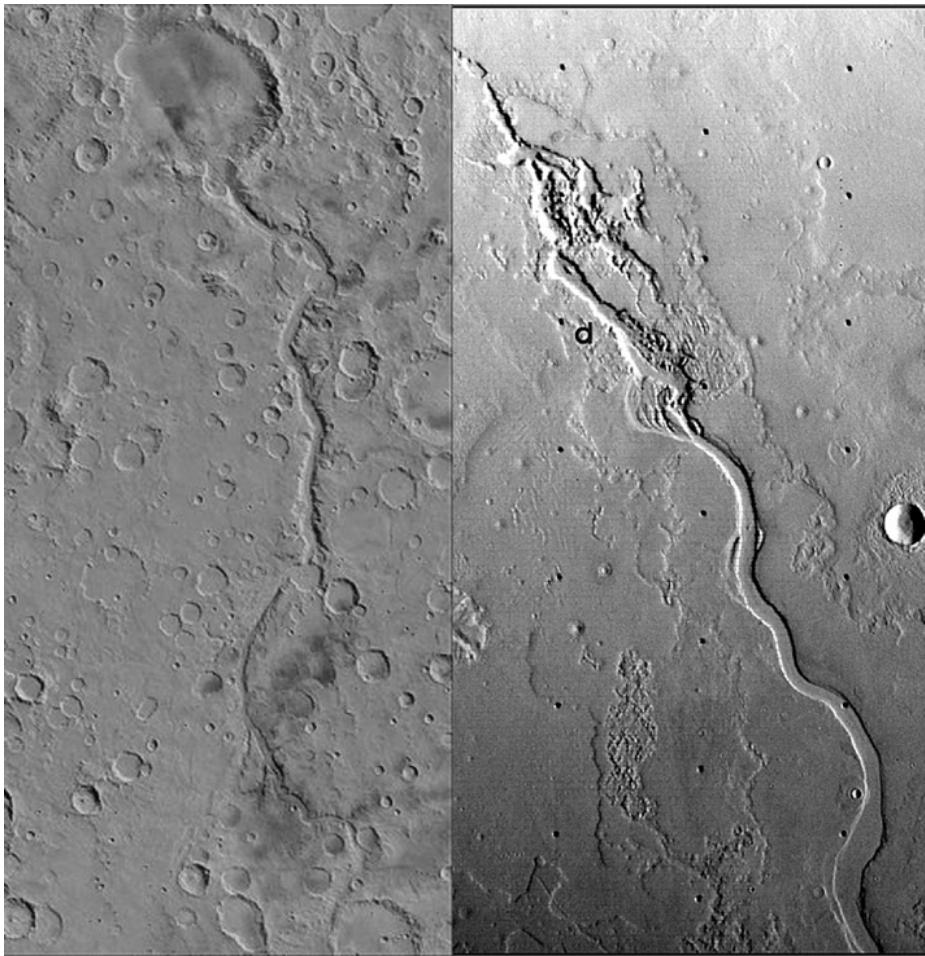 Figure 1: MaadimVallis (L) on old terrain draining into Gusev Crater. Hradd Vallis on young terrain, draining into the Paleo-Ocean bed. Both channels are approximately $800\mathrm{km}$ long
## II. THE MARS AGE PARADOX AND ITS RESOLUTION
Cratering densities are used on both the Moon and Mars as an indicator of the age of a surface, and the water channels on those surfaces, since its last resurfacing event, such as lava flow or water erosion. More craters correlate with greater surface age, being the straightforward interpretation, calibrated for Lunar surfaces, by Apollo rock samples and imagery. With this large body of Lunar data, it made sense to apply the Apollo derived models to Mars. However, Mars defines the inner edge of the asteroid belt, the source of most meteoritic impacts on Earth. That Mars cratering rate should be much higher than Earth's, appears obvious, and is consistent with the much larger amount of MM (Mars Meteorite) materials being recovered on Earth, versus those originating from the Moon. Despite this, application of LCG (Lunar Cratering-Geochronology) models to Mars persists, leading to the seeming paradox of the average age of MMs being much less than the estimated average surface age of Mars, as given by LCG models Brandenburg (1994), Treiman A. (1995) and Nyquist et al.(1998).
Mars, like the Moon, has a glaring dichotomy of surface ages: the Southern Highlands on Mars displaying primordial cratering patterns and densities similar to those found on the Lunar Highlands versus the lightly cratered Northern lowlands of Mars, similar to the younger Lunar Maria. On Mars this is reflected, to a degree, in the dichotomy of MM crystallization ages, either of very old or very young geologic ages, though the young MMs, statistically, much outweigh the older ones. While this statistical problem may be resolved by the discovery of more older MMs in the meteorite collections, such as possibly the Cl carbonaceous chondrites Brandenburg (1996), we can concentrate on the younger MMs as a group and assume they came from the younger Northern Martian Lowlands. However, even when this is done the Mars age paradox remains.
The solution to the Mars Age Paradox is fairly simple: the Mars cratering in recent geologic time, the unknown free parameter in these LCG models applied to Mars, must be allowed to be much larger, approximately 4xLunar. When this adjustment of the Mars cratering rate is done, the paradox largely disappears. The mean surface age of the Northern Lowlands of Mars becomes approximately $\frac{1}{2}$ billion years, matching the mean age of the young MMs. However, this creates a new problem for the Mars community, it transforms the Red Planet from being a simple place that died geologically in its early days, to a lively, complex, dynamic place, that appears to have been Earthlike until recent geologic times. The Mars age paradox is thus solved, but in its place is a host of more profound puzzles emerging. These puzzles center around the new, younger ages of liquid water erosion landforms, spanning almost the whole geologic age of Mars, that, given our new younger ages for Mars surfaces, must now be recognized as being formed right up until recent geologic times. (see Fig. 2)
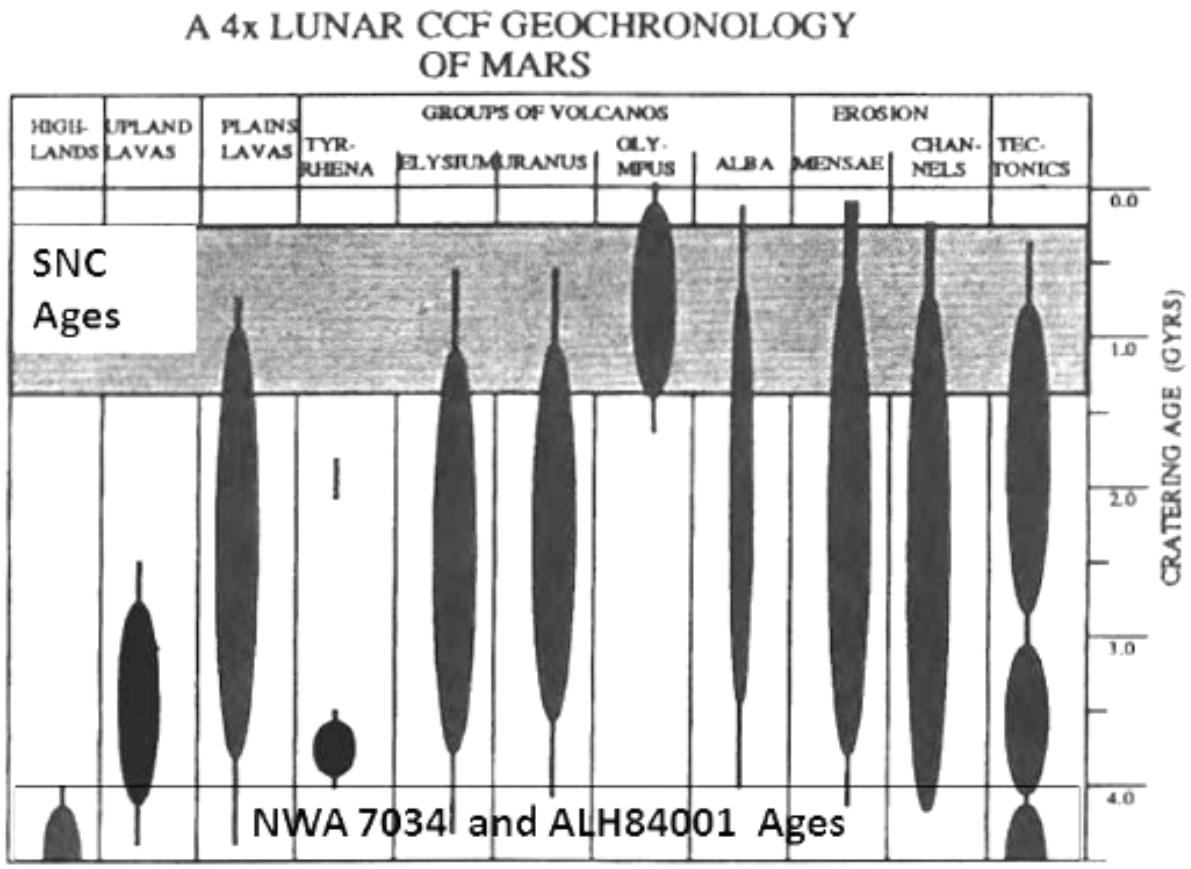 Figure 2: Taken from Brandenburg (2005) reference 3 SNC (Shergottites Nakalites and Chassignites) are the group of young MM s.
## III. THE LIQUID WATER EPOCH ON MARS
Liquid water channels or lake/sea beds, (see Figure 2) are found on terrains of Mars spanning the geologic ages from the ancient, heavily cratered
Southern Highlands to the apparent Paleo-Ocean bed in the lightly cratered Northern Lowlands (Figure 3) Brandenburg (1985). This indicates that conditions of atmospheric pressure and temperature were Earthlike for most of Mars geologic history. This requires a greenhouse of near Earthly atmospheric pressure, however, studies of such greenhouses, basically with $\mathrm{CO}_{2}$ and water vapor, as the main greenhouse gases, perhaps assisted by a small methane component, while plausible, are geochemically unstable. This is due to the formation of carbonic acid and its reaction with iron rich phyllosilicate lavas to form ferrous-carbonates and magnesium carbonate along with quartz. This geochemical instability means that the greenhouse could not last long on Mars, but would instead collapse to form massive carbonate deposits. However, the greenhouse regime on Mars was obviously of long duration and only trace amounts of carbonate minerals have been found in Martian atmospheric dust, Bandfield et al. (2003). However, this geochemical instability can be solved by adding a strong free oxygen component to the greenhouse atmosphere either photolytically Fairen et al (2004), or photosynthetically, Brandenburg (2015) Molecular oxygen is presently the $4^{\text{th}}$ most abundant gas in the Mars atmosphere, following argon in abundance and being twice as abundant as carbon monoxide. Oxygen is very reactive, and breaks down ferrous carbonates into $\mathrm{CO}_{2}$ and bright red ferric oxide, hematite. The $\mathrm{CO}_{2}$ is thus displaced by oxygen and recycled back into the atmosphere to maintain the greenhouse. Therefore, for iron rich soils, as found on Mars, McGlynn et al. (2012), (see Figure 4) a $\mathrm{CO}_{2}$ greenhouse system can be stabilized by a strong oxygen component. Free oxygen in the presence of vulcanism also leads to the formation of sulfuric acid, Fairen (2004) which further reacts with carbonates to release $\mathrm{CO}_{2}$ and form sulphates. Therefore, a strong and persistent $\mathrm{CO}_{2}$ greenhouse, leading to long lived liquid water conditions, is possible on Mars, provided a strong molecular oxygen component is also present. The result would be a Mars with abundant, bright red, sedimentary beds formed by standing water, as seen in Fig. 5 at Gale crater. Also sulphates but few carbonates would be seen in the case of an oxygen stabilized $\mathrm{CO}_{2}$ greenhouse on Mars. The question then becomes, what would be the source of the molecular oxygen that would stabilize this persistent greenhouse? The answer is biology.
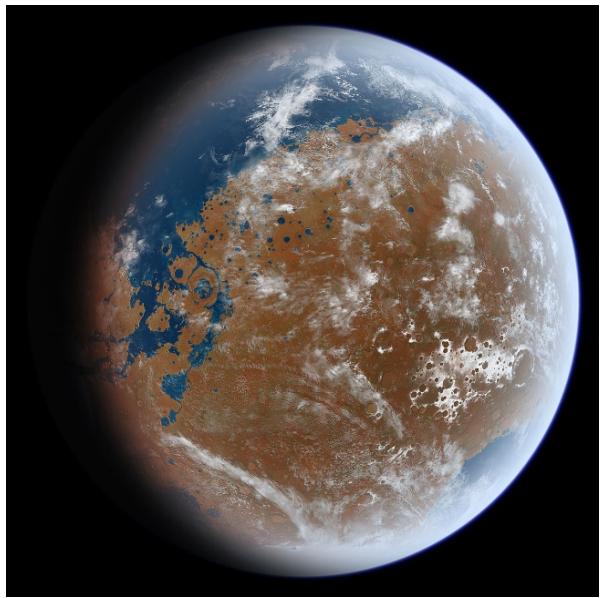 Figure 3: Mars with a Paleo-Ocean
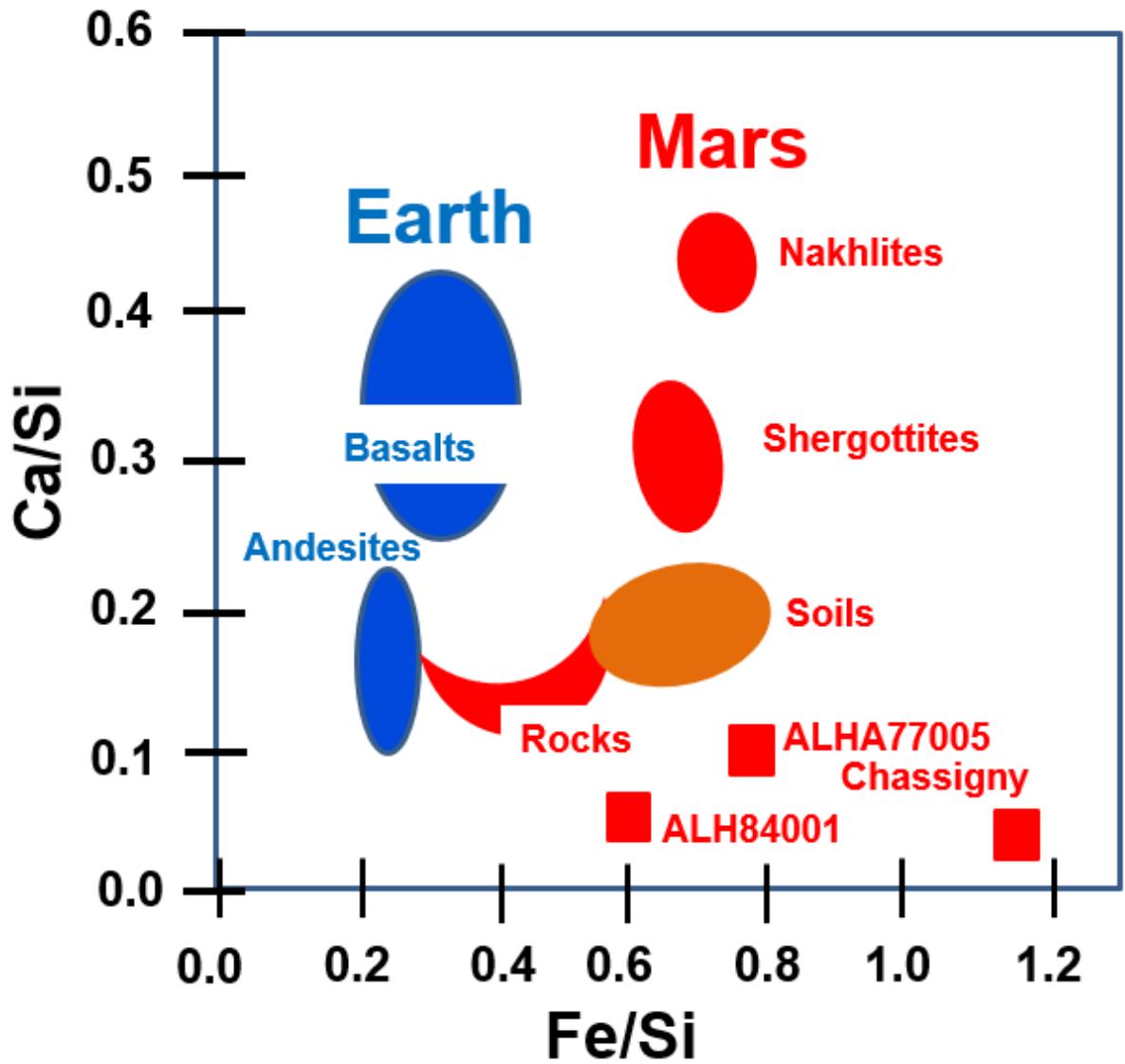
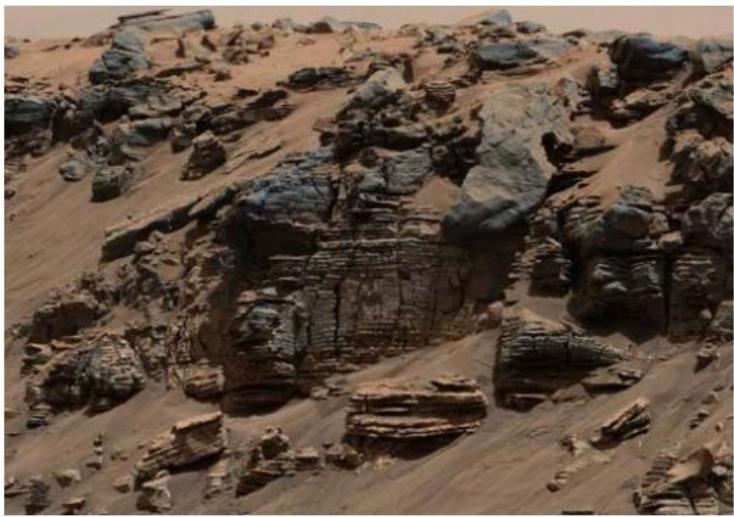 Figure 4: Mars soil composition compared to Earth, showing a significantly higher iron content( $230\%$ ) on the Red Planet. Graph adapted from McGlynn et al. (2012) Figure 5: Hematite rich sedimentary beds exposed in Gale Crater
## IV. THE EARLY EMERGENCE OF LIFE ON EARTH
Evidence of photosynthetic cyanobacteria colonies, in form of stromatolites, has now been found in the EOarchean geologic formations of Greenland dating from 3.7 Ga, Nutman et al. (2016), Similar structures have been found in the Paleoarchean 3.5Ga formations of Strelley Pool in the Pilbara Craton, in Australia, Clarke and Stoker (2013). This early appearance of evidence of biology suggests that the laws of physics favor the emergence of photosynthetic life on Earthlike planets even soon after their formation. In particular warm temperature and abundant liquid water appear most favorable for the appearance of life.
On Earth, mechanisms for producing oxygen were obviously overwhelmed by various environmental sinks, Kasting et al. (1979), and remained low in the early Earthly record until the GOE (Great Oxygen Event) at approximately at 2.3 Gya. This would include various UV driven photolysis processes, Holland (2006). In the GOE it appears photosynthetic life reached some sort of "critical mass" and oxygen levels grew exponentially. Apparently, after approximately 1.5 billion years of very low oxygen levels Earth experienced then an explosive increase to nearly present levels in roughly 10 million years Luo, G. M. et al. (2016). Therefore, we have seen on Earth that warm, wet conditions appear to foster biology even on young rocky planets, and that once photosynthetic biology becomes established it is capable of explosive growth.
## V. THE MARTIAN GAIA
The conditions of warm temperatures and abundant liquid water evident on Early Mars, empirically, would have led to biology as they did on Early Earth. The strong oxygen component in the atmosphere that would have to be present on Mars to stabilize its $\mathrm{CO}_{2}$ greenhouse, would have been generated photosynthetically, that is, by biology. Photosynthesis, relying primarily on visible wavelengths to which water and oxygen are transparent can become a self-feeding process, uninhibited by its "waste gas" oxygen.
Alternatively, models for formation of a photolytically sourced oxygen component, based on the UV breakdown of $\mathrm{CO}_{2}$ and water, are self-limiting due to the fact that the ultra-violet wavelength bands that power them, are blocked by the same oxygen they generate. Wavelengths shorter than $185\mathrm{nm}$, are seen in experiments to cause photolysis of water, Bar-Nun, and Hartman (1978) and UV bands shorter than $167\mathrm{nm}$ are seen to cause photolysis of $\mathrm{CO}_{2}$, Schmidt et al. (2013), that can lead to free oxygen. However, these same UV bands are then blocked by the strong UV absorption of the same $\mathrm{O}_{2}$ they create. These UV photolytic wavelengths are absorbed by free oxygen absorption in the Schuman-Runge bands, Thomas, and Stamnes, (1999.), (see Figure 6) which begin at wavelengths shorter than $242\mathrm{nm}$, which marks the onset of ozone production. Therefore, UV Photolysis as a method of creating free oxygen is self-limiting. Also, by breaking down water and methane, such hard UV would destroy the two most efficient greenhouse gases in the atmosphere, leading to rapid greenhouse collapse on Mars as it lost its efficiency.
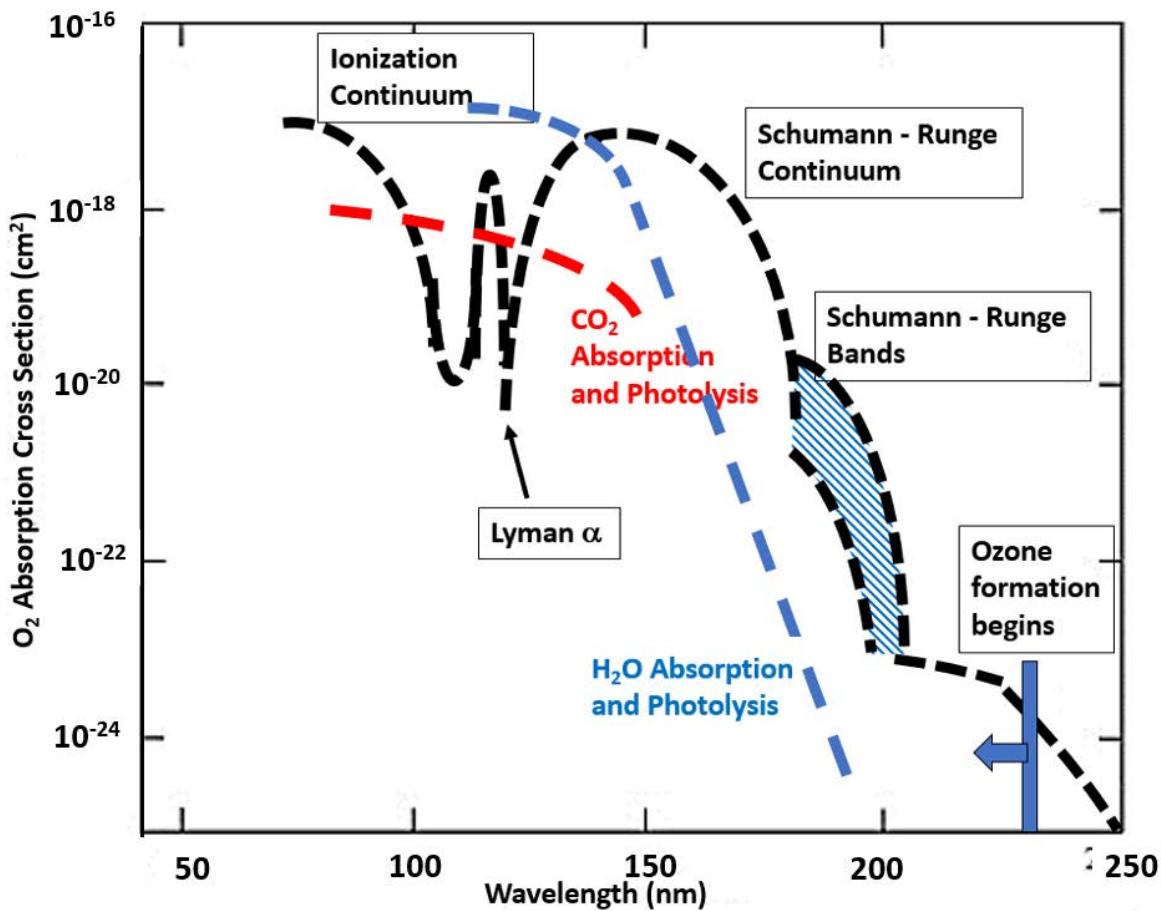 Figure 6: The UV absorption cross section of oxygen with the approximate ranges of UV causing photolysis of water vapor and $\mathrm{CO}_{2}$ processes thought to create free molecular oxygen abiotically. Graph adapted from with additional data from Thomas, and Stamnes, (1999), with $\mathrm{CO}_{2}$ and $\mathrm{H}_{2} \mathrm{O}$ data from Venot, O. et al. (2018) and Warren, S. G., and R. E. Brandt (2008), respectively. As can be seen, absorption of UV by $\mathrm{O}_{2}$ created by photolysis blocks the same UV bands that could create more of it from $\mathrm{CO}_{2}$ and $\mathrm{H}_{2} \mathrm{O}$ photolysis, choking off the process.
In contrasts, photosynthesis by wavelengths in the visible range is self-promoting, since it functions in the wavelengths, to which water and oxygen are transparent, rather than the UV which absorbed by free oxygen. Photosynthesis also and creates an ozone layer by its oxygen, which then blocks UV that is harmful to plants, allowing plant life to spread from the water to the land. Photosynthesis, then done by biology would overwhelm abiotic photolysis on Mars, as it obviously did on Earth. That life would create an environment that would be conducive to yet more life, is in keeping with the Gaia principle, Lovelock and Margulis (1974, which is seen operating on Earth. Thus, a Martian Gaia would promote oxygen and by this stabilize the same atmospheric greenhouse which allow more oxygen to be produced. Accordingly, the existence and duration of the liquid water epoch on Mars can be ascribed to biology as part of a Martian Gaia.
Earth has experienced several major mass extinction events, some of them from known causes, like the Chixulube impact, and others like the great Permian extinction, which was much more severe and also much more mysterious. Some massive mass extinction event afflicted Mars in recent geologic time, and this apparently destroyed that planet's ability to sustain a large biosphere. However, life is also tenacious and adaptable, and consistent with the Mars Gaia hypothesis, there exists evidence from Mars rover measurements that a residual biosphere, producing both oxygen and methane in the spring and summer on northern Mars, is still operating, Trainer, et al. (2019). (see Figure 7).
## VI. THE FALL OF MARS
Sadly, life is not only very effective in creating conditions favorable to more life, but it is also fragile.
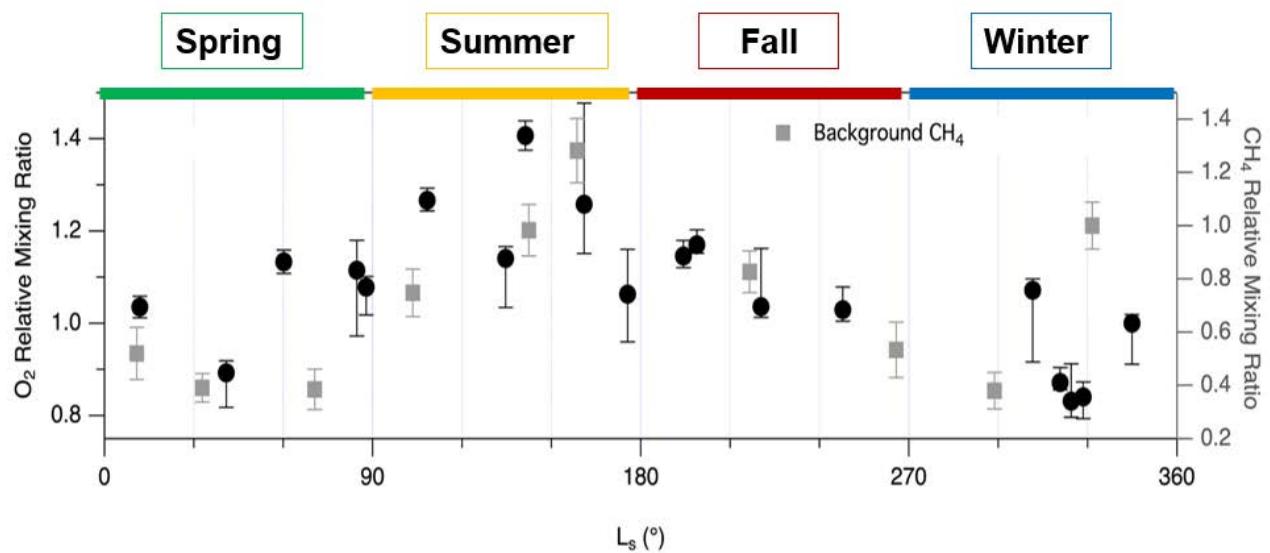 Figure 7: Seasonal Variations in Molecular Oxygen and Methane on Mars consistent with a residual biosphere. Figure adapted from Trainor et al. (2019)
## VII. SUMMARY AND DICCUSSION
In summary: the revised geochronology on Mars, making many terrains, and the water channels on them, date from recent geologic time, requires a persistent $\mathrm{CO}_{2}$ greenhouse on Mars. In order to have persistent greenhouse without formation of massive carbonate deposits, one requires massive amounts of persistent free oxygen. The source for this oxygen must be biology, due to the fact that free oxygen blocks the UV required for photolysis, thus making abiotic oxygen production self limiting. Photosynthesis, from biology that would thrive in a warm-wet greenhouse environment on Mars, is self-feeding and thus would thus overwhelm any abiotic photolytic mechanism for generating oxygen. Accordingly, biology explains what is found on Mars, a highly oxidized surface, dominated by hematite, with liquid water channels on terrains of all ages, and a paleo-ocean bed, on the recently resurfaced northern plains. This is The New Mars Synthesis, drawn from the vast store of Mars. Lunar and Terrestrial data now available from a variety of sources. Mars was apparently the home of a Gaia, as Earth has been.
Sadly, the fragility of life, due to dramatic changes in environment induced by outside events, also explains the present state of Mars, as a site of a mass extinction event, like those seen on Earth, but far more severe. The evidence for a residual biosphere still producing small amounts methane and free oxygen is consistent with this scenario. Therefore, the main features of Mars past and present can be explained by a past Gaia scenario.
The key to understanding Mars climatic evolution is therefore biology, possibly leading, ironically, to paralysis in the scientific investigation of that planet.
If NASA, is in fact, "biophobic", in unspoken policies even while giving public lip-service to the search for life, then suggestions of past biosphere on Mars become "forbidden" in a "conspiracy of silence" in the Mars community. Suspicion of an unspoken policy against finding evidence of life is reinforced by the reluctance of NASA to repeat, with improved technologies, Stoker (2023), the life experiments of Viking, in 1976, even after a half-century, and despite many opportunities. However, that is the past, let us look to the future.
We can understand Mars past by understanding that was alive. This conclusion can be tested by more data from Mars, conducted by scientists not afraid to find evidence of life and publish it. That this understanding may mean a deeper mystery in the universe as a whole is something we must, as a people, face boldly.
If a past Gaia on the Red Planet is confirmed, this answers deep questions on Mars, but it raises profound questions about the cosmos and our place in it, chief of which is Fermi's Paradox. If our Solar System hosted two vigorous biospheres then this indicates biology is a common phenomena in the universe. Such a lively cosmos would be expected to betray itself by leading to noisy intelligent species such as ourselves in nearby stellar systems. However, the nearby universe is as quiet as a ghost town. However, we must press ahead boldly. In particular, the reason for a Mars mass extinction, destroying the Gaia that existed there, should be urgently investigated, in order to ensure it does not happen here.
### ACKNOWLEDGEMENTS
The author wishes to thank Brent Nelson, Jason Dvorkin, Michael Smith, and the Late Paul Murad of Kepler Aerospace LTD for their support and encouragement of this research.
Generating HTML Viewer...
References
26 Cites in Article
; Bandfield (2003). Spectroscopic Identification of Carbonate Minerals in the Martian Dust.
Akiva Bar-Nun,Hyman Hartman (1978). Synthesis of organic compounds from carbon monoxide and water by UV photolysis.
Allan Treiman (1986). Post-Shield Mantle Plume Lavas From Mars: The Nakhlites.
J Brandenburg (1994). Constraints on the Martian cratering record based on the SNC meteorites and implications for the Mars climatic history.
John Brandenburg (1996). Mars as the parent body of the CI carbonaceous chondrites.
J Brandenburg (2015). The NMS (New Mars Synthesis), Recent Data from Gale Crater and NWA 7034: Evidencefor a Persistent Biologically Stabilized Greenhouse on Mars.
Yao Chang,Yong Yu,Feng An,Zijie Luo,Donghui Quan,Xia Zhang,Xixi Hu,Qinming Li,Jiayue Yang,Zhichao Chen,Li Che,Weiqing Zhang,Guorong Wu,Daiqian Xie,Michael Ashfold,Kaijun Yuan,Xueming Yang (2021). Three body photodissociation of the water molecule and its implications for prebiotic oxygen production.
Jonathan Clarke,Carol Stoker (2013). Searching for stromatolites: The 3.4Ga Strelley Pool Formation (Pilbara region, Western Australia) as a Mars analogue.
S Clifford,T Parker (2001). The Evolution of the Martian Hydrosphere: Implications for the Fate of a Primordial Ocean and the Current State of the Northern Plains.
Alberto Fairén,David Fernández-Remolar,James Dohm,Victor Baker,Ricardo Amils (2004). Inhibition of carbonate synthesis in acidic oceans on early Mars.
Heinrich Holland (2006). The oxygenation of the atmosphere and oceans.
J Kasting,S Liu,T Donahue (1979). Oxygen levels in the prebiological atmosphere.
James Lovelock,Lynn Margulis (1974). Atmospheric homeostasis by and for the biosphere: the gaia hypothesis.
Zhou Lu,Yih Chang,Qing-Zhu Yin,C Ng,William Jackson (2014). Evidence for direct molecular oxygen production in CO <sub>2</sub> photodissociation.
Genming Luo,Shuhei Ono,Nicolas Beukes,David Wang,Shucheng Xie,Roger Summons (2016). Rapid oxygenation of Earth’s atmosphere 2.33 billion years ago.
I Mcglynn,M Christopher,Fedo,H Mcsween (2012). Soil mineralogy at the Mars Exploration Rover landing sites: An assessment of the competing roles of physical sorting ,and chemical weathering.
Allen Nutman,Vickie Bennett,Clark Friend,Martin Van Kranendonk,Allan Chivas (2016). Rapid emergence of life shown by discovery of 3,700-million-year-old microbial structures.
L Nyquist (1998). The Shergottite age paradox and the relative probabilities for Martian meteorites of differing ages.
Johan Schmidt,Matthew Johnson,Reinhard Schinke (2013). Carbon dioxide photolysis from 150 to 210 nm: Singlet and triplet channel dynamics, UV-spectrum, and isotope effects.
Carol Stoker (2023). Life on Mars, can we detect it?.
K Tanaka (1986). The Straitigraphy of Mars.
G Thomas,K Stamnes (1999). Radiative Transfer in the Atmosphere and Ocean.
M Trainer (2019). Seasonal Variations in Atmospheric Composition as Measured in Gale Crater, Mars.
Allan Treiman (1995). S ≠ NC: Multiple source areas for Martian meteorites.
O Venot,Y Bénilan,N Fray,M-C Gazeau,F Lefèvre,E Es-Sebbar,E Hébrard,M Schwell,C Bahrini,F Montmessin,M Lefèvre,I Waldmann (2018). VUV-absorption cross section of carbon dioxide from 150 to 800 K and applications to warm exoplanetary atmospheres.
Stephen Warren,Richard Brandt (2008). Optical constants of ice from the ultraviolet to the microwave: A revised compilation.
No ethics committee approval was required for this article type.
Data Availability
Not applicable for this article.
How to Cite This Article
John E Brandenburg. 2026. \u201cThe New Mars Synthesis : Circumstantial Evidence of a Past Persistent Gaia on the Red Planet\u201d. Global Journal of Science Frontier Research - A: Physics & Space Science GJSFR-A Volume 23 (GJSFR Volume 23 Issue A5).
Explore published articles in an immersive Augmented Reality environment. Our platform converts research papers into interactive 3D books, allowing readers to view and interact with content using AR and VR compatible devices.
Your published article is automatically converted into a realistic 3D book. Flip through pages and read research papers in a more engaging and interactive format.
Our website is actively being updated, and changes may occur frequently. Please clear your browser cache if needed. For feedback or error reporting, please email [email protected]
Thank you for connecting with us. We will respond to you shortly.