Why do photons exist? Classical physics gives a derivation, but can not explain the essence and strange properties of photons. Quantum theory suggests that photons are nonlocal particle and differ significantly from ordinary microscopic particles. However, no theory can provide a concrete image of the photon, which causes difficulties in the definition of a single photon. Photons can be obtained from light pulses, the number of which follows the Poisson distribution, and can also be defined from the light power, the photons is actually a kind of weakest light source.
## I. INTRODUCTION
Since the birth of natural science in Europe hundreds of years ago, the question of "what is light" (what is, the nature of light) has attracted the attention and thought of scientists. In 1672 I. Newton described his experiment in which he obtained a spectrum of seven colours by dividing sunlight into light at different angles of refraction using a triangular glass prism. Around the same time Newton explained the corpuscular theory of light to explain the reflection of light at the interface. In 1690, C. Hugens proposed the theory that light is a wave, which includes the concepts of "wavelet" and "wave front". In 1802, T. Young did the experiment of two-slit interference of light, which provided the experimental proof of "light fluctuation". In 1818, A. Fresnel calculated the diffraction pattern caused by obstacles such as slit, round hole and round plate, which was consistent with the experiment; Fresnel is credited with developing Huygens' principle. Until now, most physicists believed in the wave theory of light. In 1865, J. Maxwell proposed that light was an "electromagnetic disturbance propagating through a field according to electromagnetic laws", i.e., an electromagnetic wave; In 1887, H. Hertz discovered electromagnetic waves through experiments. The development of the wave theory of light has come to an end, and the whole process took about two hundred years.
Then the salient event was the discovery of photons. The photoelectric effect was discovered by P. Lenard et al. in the late 19th century; However, Maxwell's electromagnetic theory could not explain it. So in 1905 A. Einstein postulated that the energy of light was quantized, that is, made up of "quanta". With the photon quantum hypothesis, A. Einstein explained the photoelectric effect and derived the photoelectric equation. In short, Einstein said that "waves have particle-like properties" according to light, and the energy and momentum of a particles can be the determined by the parameters of the wave (frequency and wavelength), namely $\mathbf{E} = hf$, $p = h / \lambda$. From 1905 to 1914, R. Millikan proved the correctness of the photoelectric equation with long-term experiments. Einstein and Millikan were awarded the Nobel Prize in Physics in 1921 and 1923, respectively. In 1924, A. Compton measured the lengthening of the wavelengths of X-rays scattered by graphite. The momentum of the photon was taken into account in the interpretation, and the change in the wavelength of the secondary X-ray generated when the X-ray was scattered could be calculated. When the photon collides with the electron, and the calculation was consistent with the actual measurement. At this point, the photon hypothesis was further proved, and Compton was awarded the 1927 Nobel Prize in Physics.
By 1924, the theory of "light fluctuations" had not been refuted by anyone, and at the same time it was established that "light consists of many photons". Thus, a complicated situation arises.
Photons are very strange particles. So far we have only been able to describe photons in terms of abstract physical parameters (frequency, power, dynamic mass, polarization, etc.), but we have not been able to visualize them. What does a photon look like (round, square)? We can't tell. Does a photon have a volume (i.e., geometric size)? We don't know. The erratic nature of photons, which normally exist for a short time, makes them harder to grasp. The current approach to understanding photons indirectly, by looking at pulses of light, is also problematic.
## II. EINSTEIN'S THEORY OF PHOTONS[1]
In 1905, before quantum mechanics (QM) existed, Einstein's light quantum hypothesis was, of course, based on classical physics. Einstein argued that the wave theory of light, which operates in terms of continuous spatial functions, had proved so superior in describing purely optical phenomena that it seems difficult to replace it with any other theory. But optical observations are all about time averages, not instantaneous values. Although the theories of diffraction, reflection, refraction, dispersion, etc., are fully verified by experiments, it is conceivable that the theory of light, operated by continuous spatial functions, will lead to a contradiction with experience when applied to the phenomena of the production and transformation of light. So Einstein hypothesized that the energy of a beam of light emitted from a point source is not continuously distributed over an increasing amount of space in its propagation, but consists of a finite number of quanta confined to each point in space, which can move, but can no longer be divided, but can only be absorbed or produced in their entirety.
Einstein's theory of photons differs from Planck's theory of quantum energy. In 1900 M. Planck's work had only quantized the vibrational energy of the oscillators that make up the wall of the black body, or his quanta had been a computational tool used to derive the radiation formula for radiation. Einstein regards light quanta as a physical reality, and believes that quantization was the basis of electromagnetic radiation and light. Einstein's starting point was the difficulties faced by the theory of blackbody radiation, and the determination of the fundamental quanta by Planck. Starting with Wien's law of Blackbody radiation:
$$
\rho = \alpha f ^ {3} e ^ {- \beta f / T}
$$
Where $f$ is the frequency and $T$ is absolute temperature; The above formula is fully effective when $hf_{\gg}kT$. From the above formula
$$
\frac {1}{T} = - \frac {1}{\beta f} \ln \frac {\rho}{\alpha f ^ {3}}
$$
Assuming that a radiation of energy $E$ has a frequency between $\mathbf{f}$ to $(\mathbf{f} + \mathbf{df})$ and occupies a volume $\mathbf{V}$, the entropy of the radiation with volume can be derived if the energy is constant:
$$
S - S _ {0} = - \frac {1}{\beta f} \ln \frac {V}{V _ {0}}
$$
$S, S_{0}$ are the entropy when the radiation occupancy volume are $V, V_{0}$. Therefore, the entropy of monochromatic radiation varies with volume. The above formula can also be written as
$$
S - S _ {0} = - \frac {R}{N} \ln \left[ \left(\frac {V}{V _ {0}}\right) ^ {N E / R \beta f} \right]
$$
$R$ is the gas constant, which $N$ is the number of molecules in 1 mole; Citing Boltzmann's principle (which states that the entropy of a system is a probability function of its state):
$$
S - S _ {0} = - \frac {R}{N} \ln p
$$
We have
$$
p = \left(\frac{V}{V_{0}}\right)^{NE/R\beta f}
$$
It is concluded that the monochromatic radiation image with low energy density is composed of a number of unrelated energy quantums of size $R\beta f / N$. So Einstein said, "Not only the incident light, but also the generated light is composed of the magnitude $R\beta f / N$ of the energy quanta."
With these ideas, Einstein successfully explained the photoelectric effect, photoluminescence, and the effect of ultraviolet light on the ionization of gases. The energy of Einstein's quantum of light is
$$
E = \frac{R\beta}{N} f \tag{1}
$$
Compared to the energy quantum proposed by Planck when he formulated the radiation formula in 1900:
$$
E = h f \tag {2}
$$
If the two theories fit together, there is
$$
h f = \frac {R \beta}{N} \tag {3}
$$
In formula $\beta = 4.866 \times 10^{-11}$; $N$ is the Avogadro number, which is now customary writing $N_{A}$, while the contemporary exact value (standard value) is $N_{A} = 6.02214199 \times 10^{23}$. The derivation is based on the theory of the motion of gas molecules, where $R / N$ is a universal constant.
It can be seen from Einstein's derivation that light radiation is a large number of photons composed by energy $hf$. This not only explains the photoelectric effect, but also advances our understanding of how light interacts with matter. This is reflected in the concepts of stimulated and spontaneous radiation that he introduced when he derivation the Planck formula for blackbody radiation. Einstein is thus largely responsible for the early development of quantum theory. But after the birth of quantum mechanics (QM) in 1925-1926, Einstein continued to oppose it. as we'll see later. Einstein didn't talk about the mass and size of photons and so on. But because of the mass-energy relation $\mathbf{E} = mc^2$, it can be obtained in conjunction with equation (2), we obtain
$$
m = \frac {h f}{c ^ {2}} \tag {4}
$$
Therefore, Einstein theory holds that the dynamic mass of a photon depends only on its frequency $f$; And in the direction of propagation, the momentum of the photon is
$$
p = mc = \frac{hf}{c}
$$
This mass and momentum derivation makes the photon image particle. Because $c$ is very large, it is small unless $f$ is very large. As for the photon energy, it is calculated using the following formula:
$$
E = h f = \frac {h c}{\lambda} \tag {2a}
$$
Where and $f$ and $\lambda$ are the corresponding wave frequency and wavelength of the photon respectively. Therefore, we can calculate the wavelength, dynamic mass and energy of the photon. In a wide range of wavelengths, from radio waves to X-rays, the photon has a lower mass than the electron (electron rest mass $m_0 = 9.109534 \times 10^{-28} \mathrm{~g}$ ). photon energy can be used as a unit of electron volt (eV), and $1 \mathrm{eV} = 1.60217733 \times 10^{-19} \mathrm{~J}$. Therefore, at the midpoint of the visible light spectrum $(\lambda = 5 \times 10^{-5} \mathrm{~cm})$, $E = 2.48 \mathrm{eV}$ can be calculated. The energy of the single photon is very small.
In Einstein's theory, the rest mass $m_0$ of a photon is zero. So does a photon have a volume? In special relativity (SR) there's something called the length shortening formula:
$$
l = l_{0} \sqrt{1 - \left(\frac{v}{c}\right)^{2}}
$$
$l_{0}$ Is the length of the moving body when it is at rest; When the velocity $v = c$, $l = 0$, so the Einstein photon has no volume (the ruler shrinks to zero and becomes a point). The idea that a photon, as a particle with mass, and momentum, and energy, but has no volume. This is controversial.
## III. THE PHOTONS IS NOT A CLASSICAL THING
Einstein won the 1921 Nobel Prize in Physics for his theory of photons, which perfectly explained the photoelectric effect. But in 1951, at the age of 72, he wrote to his old friend Besso[2]: "Fifty years of conscious reflection have brought me no closer to the answer to the question 'What are photons of light?' It is true that every scoundrel now believes that he knows it, but he is deceiving himself." In a 2004 article, historian of science M.Chown[3] said that not many people today know about Einstein's visit to Brazil. The trip left Hamburg on March 5, 1925, for a three-month tour of South America. Brazilian scientists had gathered in Rio de Janeiro to hear Einstein speak about his theory of relativity. But Einstein himself had other ideas; For Einstein, relativity was just an extension of the classical physics of the nineteenth century, but the revolutionary thing in his life was the idea of photons, and that's what he was going to talk about. But waves are spread out across space, and particles are discrete entities. How do you unify the two? Einstein didn't find the answer. Because Einstein used classical physics, it was impossible....A month after Einstein's lecture in Brazil, W. Heisenberg in Germany invented a new kind of physics, quantum mechanics (QM). The point Einstein couldn't see was that photons were not a classical thing. The night of his presentation to the Brazilian Academy of Sciences on May 7, 1925, marked the end of Einstein's career as a leading scientist. Until his death, Einstein refused to accept quantum mechanics, which replaces certainty with uncertainty. Einstein's speech in Rio de Janeiro said he still desperately hoped that the "monster" (photon) he released in 1905 could still be tamed by old classical physics.
Several decades have passed since Einstein said in 1951 that "we have no idea what a photon"; Do we now have a clear idea of what a photon is? The fact that the "wave-particle duality", is still being debated suggests that the problem remains unresolved. In fact, the particle nature of photons is a difficult subject. It is acknowledged that it is incorrect to regard photons as point particles. On the other hand, according to special relativity (SR), photons have no rest mass ( $m_0 = 0$ ), so classical mechanics is difficult to apply to such "massless particles". Relativistic mechanics is also difficult to apply. For photons,
$$
m = \frac{m_0}{\sqrt{1 - (v/c)^2}} = \frac{m_0}{0} = \frac{0}{0} \tag{7}
$$
$m$ becoming any size is not acceptable; If $m_0 \neq 0$, $m = \infty$, this is also unacceptable. Relativistic mechanics is incapable of dealing with objects such as photons.
A. Compton's 1923 paper on scattering caused by X-rays incident on an element suggested that the incident photons were scattered by collisions with electrons in the element, and the electrons recoaxed in the other direction. Let the static mass $m_0'$ of the electron be, the static energy $m_0' c^2$ be, and then form the energy conserved, we obtain
$$
m_{0}^\prime c^{2} + h f_{i} = \frac{m_{0}^\prime c^{2}}{\sqrt{1 - (v^\prime / c)^{2}}} + h f
$$
The left end of the equal sign above is the incident case and $f_{i}$ is the incident photon frequency; The right end of the equals sign is the case after collision, $\nu^{\prime}$ is the recoil electron velocity, $f_{i}$ is the photon frequency after scattering by electrons; And by adding conservation of momentum, we can combine these equations
$$
\lambda - \lambda_{i} = 2 \lambda_{c} \cdot \sin^{2} \frac{\theta}{2}
$$
Where $\lambda = c / f$, $\lambda_{i} = c / f_{i}$, $\lambda_{c} = h / m_{0}^{\prime}c$ (Compton wavelength); The above formula indicates that the wavelength of the photon increases after scattering (the frequency becomes smaller). The above formula was confirmed by Compton experiment, indicating that the photon does participate in the collision process as a particle, and the momentum formula $(p = hf / c)$ can indeed be applied to the photon. However, the SR theory can only be applied to massive particles (electrons), and there is no evidence that SR is applicable to photons. This process has echoes of classical mechanics, since momentum is a Newton concept for the motion of macroscopic matter.
As a result, there are only two ways to understand photons -- through experiment; Or by quantum mechanics(QM) and quantum electrodynamics (QED). Since there is limited information available from the measurement of photons (only frequency, energy, polarization, and survival time), it is most important to rely on quantum theory to understand photons. Although the Compton experiment proved that photons, like electrons, are physical entities with positive real dynamic mass, it also proved that momentum and energy are conserved in a single collision event of microscopic particles. But the photon is not a billiard ball and cannot be dealt with primarily by classical physics. For example, if we hope to "measure the diameter of the photon", we will probably never get results.
From the point of view of the experimental technology of generating and applying single photon, the condition of generating single photon is that the incident light power is extremely weak (such as less than $10^{-16}\mathrm{W}$ ), and the acquisition of single photon depends on the optical pulse signal (or even the electronic pulse signal transformed from the light pulse). We have never seen such reports that scientists have obtained single photon in the form of particles in the experiment. It has been pointed out that the energy of a single photon is
(1.6~3)eV, which is calculated according to the frequency of visible light. If considered in terms of 2eV, there is
$$
2\mathrm{eV}=3.2\times10^{-19}\mathrm{J}=3.2\times10^{-12}\mathrm{erg}
$$
Biophysicists say[4] that the number of photons that enter the pupil and cause vision is 54 to 148. Assuming 100 photons, the energy is equivalent to $3.2 \times 10^{-10}$ erg. This is the sensitivity of the entire eye; Taking into account some complex reflection and absorption processes, it can be calculated that the number of photons absorbed by the sensor in the absolute threshold time is only 5 to 14, indicating that the human eye is highly constructed and surprisingly sensitive. In fact, only a single photon can activate a cylindrical cell, but in $5 \sim 14$ cylindrical cells are activated at the same time to cause light perception. But these discussions are all at the energy level; So there is no point in putting too much weight on the number of photons in this discussion.
The fact that a photon has mass (moving mass), but its shape and size cannot be taken into account, is difficult for many people to accept, and probably one of the reasons why Einstein lamented that "I don't know what a photon is." So what can QM tell us? Look at Schrödinger's equation:
$$
j\hbar\frac{\partial}{\partial t}\Psi(\mathbf{r},t)=-\frac{\hbar^{2}}{2m}\nabla^{2}\Psi(\mathbf{r},t)+U(\mathbf{r},t)\Psi(\mathbf{r},t)\tag{10}
$$
Where mass $m$ is the parameter of particle and wave function $\Psi(\mathbf{r}, t)$ is the parameter of wave; Therefore, the equation combines the description of the wave state with the description of the particle motion state. However, we must note two points: 1 Schrödinger equation has non-relativistic properties; 2 The equation was proposed for electrons, but later a series of evidences show that it applies to photons. As for 1, according to a 2007 study, Schrödinger equation was found to have the least error when accurately measuring the two-photon transition of a hydrogen atom, followed by Dirac's equation, and the worstKlein-Gordon equation. With respect to 2, although the Schrödinger equation was originally proposed for the motion of electrons in hydrogen atoms, there is evidence that the Schrödinger equation applies to photons -- first, the one-dimensional Schrödinger equation analysis of microscopic particles incident towards the barrier (which proves that the barrier is a evanescent state), Where "microscopic particles" include photons; And the effect can be seen in the SKC experiment of 1993[5]. Secondly, the WKB method in the analysis of slow-varying index fiber is calculated by using Schrödinger equation, and the motion of photons is the basic process in the fiber. Therefore, the Schrödinger equation has accurately described the behavior of electrons and photons, and the quantum language of wave function has replaced the classical language of particle orbits.
The non-classical nature of photons can also be seen from the principle of indistinguishable identical particles in QM. The homogeneity principle causes the wave function to remain unchanged after the exchange of two particles of the same class. The particles with this symmetry are Bosons, such as photons and mesons, which have integer spin values and do not have to satisfy the Pauli exclusion principle. These are questions that classical physics does not consider. In short, the so-called wave and particle properties actually come from classical physics, but now we can't use classical physics.
## IV. THE ESSENCE OF PHOTONS
Now let's try to do something that is not easy-- give the essence of the photon. Why do photons exist? Classical physics gives derivation, but cannot explain the essence and strange properties of photons. Quantum theory suggests that photons are non-local particle and differ significantly from ordinary microscopic particles. However, no theory can provide a concrete image of the photon, which causes difficulties in the definition of a single photon. Photons can be obtained from light pulses, the number of which follows the Poisson distribution, and can also be defined from the light power, the photon is actually a kind of weakest light source.
Photon is the energy quantum, with material properties, but physics can not give the size and volume of the photon; Special relativity actually gives photons the image of point particles. In addition, quantum mechanics (e.g. Schr"odinger's equation) describes electrons in terms of the wave function $\Psi (\mathbf{r},t)$, which is spatially located as a probability distribution, which $|\Psi |^2$ is the probability density; However, it is not possible to define a self-consistent wave function for photons, nor to write the corresponding wave equation. And it is well known that the classical Maxwell wave equations do not describe photons satisfactorily.
Rapid advances in quantum informatics technology have forced scientists to consider the behavior of a small number of photons (say, 10,000 or fewer). The success of momentum of light has made it possible to experimentally determine the number of photons contained in a laser beam. Quantum secure communication requires ideal single photon sources (PSPS), in which each light pulse contains only one photon. However, no such sources have been made so far, and the only ones used are approximate PSPS, so the communication is not completely secure. Due to light interference during the day, satellite quantum communication and quantum radar are difficult to work well, such as the microwave frequency band will have a good effect, but the microwave single photon energy is very small, it is very difficult to achieve.
The use of special relativity (SR) to explain photons has failed miserably. The treatment of SR makes the photon a point particle; This is not a good theory by any means. The history of physics offers a lesson in treating electrons as point particles. As we all know, quantum field theory (QFT) and quantum electrodynamics (QED) are considered highly accomplished disciplines; However, the shortcoming of QFT and QED is the famous divergence problem, which is rooted in the fact that it is a point particle field theory. As early as 1940 R. Feynman noted that the "infinite energy of the electron" posed a significant problem for the theory of the electromagnetic field, because the model describing the electron was a point particle. This means that the self-action of a point charge has difficulty diverging. If the electron is regarded as a point without structure, the electromagnetic mass caused by the action of the field on itself is infinite.... In his lecture on in 1964, P. Dirac $^{[6]}$, talking about renormalization, he first discussed this problem of electron quality. The mass of the electron is not infinite, of course, but the mass of the electron interacting with the field will change; Dirac points out that it is impossible to assign any meaning to "infinite mass". When people continue to calculate "without the infinitely large term", the results (such as Lamb shift and the anomalous magnetic moment) agree with observations; So say "QED is a good theory" and don't worry about it. Dirac resents this, because a "good theory" is obtained by ignoring some infinity -- which is both arbitrary and unreasonable. Sound mathematics, says Dirac, allows you to ignore small quantities, but not the infinite (just because you don't want it). Overall, Dirac believes QFT's success has been "extremely limited."
In fact, the electron is not a point particle, the famous experimental physicist Zhaozhong Ding has long been concerned about the size of the electron measurement problem, not long ago he gave the data is still the electron radius $r \leq 10^{-17}$ cm....A photon is different from an electron in that the latter has a definite rest mass while the former does not (according to the prevailing view of physics);In addition, electrons have an electric charge and photons have no charge. Still, specifying that photons are point particles can be problematic.
So, what exactly is a photon? Here's our take:
1) A photon is a special microscopic particle with no electric charge.
2) A Photon is a Boson, which has an unlimited number of particles in each quantum state; The spin is $\hbar$.
3) There is no experimental data about the volume and size of the photon.
4) The upper limit of photon static mass $m_0 \approx 10^{-52}\mathrm{g}$; The new theory thinks that may $m_0 \neq 0$.
5) It is generally believed that the corresponding wave of photon is electromagnetic wave; However, if the photon is identified as a kind of microscopic particle, it should have the probability wave properties, but there is no photon wave equation at present. In connection with this, it is difficult to define a wave functions for a photon.
6) There is a view that the wave function of the free photon is the electromagnetic plane wave function; Correspondingly, Maxwell electromagnetic equation is the wave equation of the free-state photon. However, this is only a simplistic view and does not provide a dynamic representation of the physical image of photons. The problem of photon wave equation still needs to be studied.
7) It is not clear from SE alone that photon is a microscopic particle similar to electron.
A further discussion is now necessary. We begin by pointing out that photons are much more different from electrons than they are similar. Now, write the classical Maxwell wave equation:
$$
\left(\nabla^{2} - \varepsilon\mu\frac{\partial^{2}}{\partial t^{2}}\right)\Psi(\mathbf{r},t) = 0 \tag{11}
$$
Where the wave function $\Psi$ is electric field intensity $\mathbf{E}(\mathbf{r},t)$ or magnetic field intensity $\mathbf{H}(\mathbf{r},t)$ is a vector function; Respectively $\varepsilon$, $\mu$ are the dielectric constant and magnetic permeability of the medium through which the electromagnetic wave passes; This is the wave equation derived in 1865, which we call MWE. Now write the quantum Schrödinger wave equation again:
$$
\left(\frac {\hbar^ {2}}{2 \mathrm {m}} \nabla^ {2} + \mathrm {j} \hbar \frac {\partial}{\partial t} - \mathrm {U}\right) \Psi (\mathbf {r}, t) = 0
$$
Where $\Psi$ is the wave function of probability wave, $m$ is the particle mass, $U$ is the potential energy function, This is the wave equation derived in 1926, which we call SE. Finally, write the Dirac quantum wave equation:
$$
\left(j\hbar\frac{\partial}{\partial t} + j\hbar c\alpha\cdot\nabla - \beta m_{0}c^{2}\right)\Psi\left(\mathbf{r},t\right) = 0
$$
This is the wave equation derived in 1928, which we call DE.
Quantum scientist, Prof. Yongde Zhang believes that DE, as a single electron wave function equation, only takes into account the external electromagnetic field action, does not consider the electromagnetic action of the electron itself, so it is still an approximate equation. Secondly, it cannot be generalized to photons, because Dirac assumes that the particle position is an observable quantities. For photons, this assumption is not valid, and the photon problem cannot be described. Photons have no real representation of coordinates; Although a quasi-wave function description containing mechanical variables is sometimes imposed on the photons, it does not have a normal physical interpretation of the wave function (the modulus square is the probability density). A photon can, however, have a momentum representation, which is sufficient for practical purposes.... It is not virtually possible to define a self-consistent wave function for photons, and there is no probability wave equation for photons, which there is for electrons.
The corresponding wave of the electron is the probability wave, so the wave equation of the electron is SE; The wave function of the electron is the $\Psi (\mathbf{r},t)$ in SE, which is a probability wave function. Thus, SE fully represents and explains the properties of the electrons. But for photons things are not so simple; One idea is that the Maxwell wave equation is the wave equation of a free-state photon, because the corresponding wave of a photon can only be an electromagnetic wave. However, it is wrong to say that the two are "completely the same", because it is precisely because Maxwell electromagnetic wave theory can not explain the photoelectric effect, Einstein proposed the light quantum theory and explained the photoelectric effect perfectly. Although the photon's scalar nature and the photon flow's statistical essenceboth make it a probabilistic wave. However, there is no special probability wave equation for photons, so it is difficult to define the wave function for photons. So M.Lanzagorta[7] says:"the photon cannot be localized also implies that we cannot define a consistent wave function for the photon".
Lanzagorta also states: "the photon is a non-localizable particle"; Also, "the photon cannot be localized"; The meaning of these words is consistent with that stated by Prof. Yongde Zhang. Further, Lanzagorta pointed out the difference between photons and ordinary microscopic particles, such as electrons. "it is a mathematically impossible to build a continuity equation using localization probability distributions that satisfy
Einstein's special relativity ";it is impossible to write down a wave equation for the photon. It is impossible to write down a wave equation for the photon. It can be seen that studying photons is more difficult than studying electrons.
## V. PHOTON NUMBER EQUATION AND PHOTON NUMBER MEASUREMENT
Classical optics also recognizes photons and mentions such particles in the discourse, but never considers the number of photons. This is because the number of photons contained in a beam of light (natural light or laser light) is so large that talking about 10,000 photons is like talking about a drop of water in the ocean. Quantum optics, on the other hand, think down to the behavior of one or two photons. Recent developments in quantum informatics (QIT) have made it even more important to consider the one-photon, two-photon problem. For example, the concepts of "one-photon Quantum Radar" and "two-photon Quantum Radar" using entangled states appear in QR theory. Although they have not yet been realized in practice, the novelty and boldness of their imagination are quite surprising. For example, quantum communication technology uses a single photon string (single photon series), and also uses entangled states, which is said to have been successful; This also gives people a sense of disbelief.
In QM there is so-called many-body theory, which involves, for example, writing rigorous quantum field equations when you consider many electrons, and then trying to solve them. The multi-photon problem is also a multi-body theory problem. In short, the multiparticle quantum theory is more complex and rigorous than the single-particle quantum theory. But that doesn't mean it's easy to master when it comes to single particles. In fact, functional devices with large numbers of particles (such as classical radar, which emits electromagnetic waves) are easier to implement; And devices that work with only one (or two) particles, such as single-photon quantum radars, are extremely difficult or impossible to succeed with.
So how many photons are there in a beam (microwave beam or laser beam)? So far, no one has measured them. This may be calculated or estimated; For example, there is a claim of $10^{18}$ photons, but we don't know on what. Now this paper deduces the equation related to the number of photons $(n)$; The momentum of a single photon is given above
$$
p = \frac {h f}{c}
$$
The electromagnetic wave quanta can write
$$
p _ {\mathit {\Pi} = h k}
$$
The vector from is written as
$$
\boldsymbol{p} = h \boldsymbol{k}
$$
Where $\pmb{p}$ is the photon momentum vector; $\pmb{k}$ is the wave vector.
If the number $n$ of photons of a beam is, then the photon momentum equation should be written
$$
\boldsymbol {p} = n h \boldsymbol {k} \tag {14}
$$
This gives the photon number equation:
$$
n = \frac {p}{h k} \tag {14a}
$$
When the frequency is known, the magnitude of $k$ is determined; However, it is no longer the momentum $p$ of a single photon, but the momentum of the beam. Recently, there are reports abroad that Canadian scientists have proposed a new technique for measuring the momentum of light, referred to as the macroscopic momentum of light beams, which is very helpful to our topic.
Now, says scientists at the University of British Columbia in Canada: "We have not been able to determine how this momentum is transformed or moved. Since light carries so little momentum, the sensitivity of the equipment we have has not been sufficient to solve this problem." However, a new technique could finally help solve this 150-year-old conundrum, they say: "We cannot directly measure the momentum of a photon, so our approach is to detect its effect on the mirror by 'listening' to the elastic wave passing through it. We were able to trace the momentum of the light pulse itself from the signature of these waves, which opens the door to finally defining and simulating how light momentum exists inside a material."
I believes that the new result is actually the design of a new device designed to measure the weak interaction between photons. This provides a new approach to way to measure the number of photons in a beam of light, which we are considering. And it doesn't make sense to say that each photon is massless but that a large number of photons in a beam have momentum. Although the macroscopic momentum of a beam should be caused by the photon's dynamic mass, this scientific result should urge us to consider whether the photon's static mass is a problem.
## VI. PHOTON STATIC MASS AND PROCA WAVE EQUATION
Photons and neutrinos are two types of particles that still excite mystery. Whether they have a small, nonzero resting mass has been the subject of much debate. Traditional physical theories such as Maxwell's electromagnetic Theory and Special relativity (SR) suggest that photons have no resting mass, i.e., $m_0 = 0$; For this reason, photons are called "massless particles" to distinguish them from "massless particles" like electrons; The latter are also called matter particles.
Although efforts to measure the rest mass of photons have never stopped, and theories like quantum electrodynamics(OED) assume that the rest mass of photons is not zero; People still assume that photons are massless particles. Now it seems that this may not only be a barrier to understanding photons, but also one of the reasons for the lack of self-consistency in basic physical theories.
Particle physics usually assumes that the Lorentz-Einstein formula for mass velocity is true:
$$
m = \frac{m _ {0}}{\sqrt{1 - \frac{v ^ {2}}{c ^ {2}}}} \tag{15}
$$
Where $\pmb{\nu}$ is the particle velocity, $c$ is the speed of light, $m_0$ is the rest mass at $\nu = 0$. Physics textbooks never say that the above formula doesn't apply to photons, so let's give it a try; If you take $m_0 = 0$, $\nu = c$, you get $m = 0/0$; Become any size, is not acceptable. The problem can only be caused by the following three aspects: (1) the formula of mass-velocity is wrong; (2) The photon's static mass is not zero; (3) The speed of the photon is not $c$. Obviously, any of these three things are inconsistent with special relativity; In fact, Einstein's theory could not explain his discovery of photons.
Another embarrassment in fundamental physics is that Schrödinger's quantum wave equation (SE) and Dirac's quantum wave equation(DE), both of which are important components of quantum mechanics, have particle mass $m$, whereas Maxwell's wave equation has no mass. Of course, in Maxwell's day (1865) there was no concept of wave-particle duality; But we do now, so what? SE and DE are very successful wave equations that describe the motion of electrons; Contrast this with the following: electrons are microscopic particles with rest mass; SE and DE have mass parameters $m$ in the equation; These two points have internal logical consistency and are also excellent interpretations of wave-particle duality.... But there is no mass parameter in ME. Does this mean that Maxwell equations are not accurate enough and need to be corrected?... In addition, since the introduction of optical fiber in 1970, SE has been successfully illustrated; This suggests that SE can be used to analyze the participation of photons in physical processes, but there is a question: what $m$ is in SE?... Finally, the volatility of a microscopic particle depends on its statistics, and what the wave function represents is only a wave of probability. This principle holds true for electrons; It's a paradox for photons -- although photons are the result of quantization of electromagnetic fields and waves, electromagnetic waves are not probability waves. Thus, the phrase "wave function modulus squared is probability density" does not apply to photons; Are photons still microscopic particles?
It must be noted that if a photon is a particle with a resting mass, all of these paradoxes are countable and the system is far more consistent than it otherwise would be. There are many physicists who do not believe that photon $m_{0} = 0$, such as R.Lakes[8], a professor at the University of Wisconsin who has been working on measuring the rest mass of photons, once said firmly: "the photon is massive!"
In 1936, A. Proca $^{[9]}$ proposed a new set of electromagnetic field equations, Proca assumed that the rest mass of photons $m_0 \neq 0$. This section deals with this problem. And we will derive the wave equation specific to photons.
The process of deriving the classical Maxwell electromagnetic wave equation(ME) is as follows: starting from the curl equation and incorporating the action of other equations into the derivation, the classical electromagnetic wave equation expressed by the intensity of the electric field can be derived from $\nabla \times \boldsymbol{E} = -\frac{\partial \boldsymbol{B}}{\partial t}$, we obtain:
$$
\nabla^{2} \boldsymbol{E} - \varepsilon \mu \frac{\partial^{2} \boldsymbol{E}}{\partial t^{2}} = \nabla \left(\frac{\rho}{\varepsilon}\right) + \mu \frac{\partial}{\partial t} (\rho v) \tag{16}
$$
On the other hand, from the beginning, the classical electromagnetic wave equation expressed by the strength of the electromagnetic field can be derived form: $\nabla \times \boldsymbol{H} = \boldsymbol{J} + \frac{\partial \boldsymbol{D}}{\partial t}$, we obtain:
$$
\nabla^{2} \boldsymbol{H} - \varepsilon \mu \frac{\partial^{2} \boldsymbol{H}}{\partial t^{2}} = - \nabla \times (\rho \boldsymbol{v}) \tag{17}
$$
It can be seen that these two equations do not have asymmetric form. Only when the space is passive $(\rho = 0)$, the two equations have formal symmetry, so that the wave function $\Psi (\mathbf{r},t)$ can be used to express the sum uniformly, and a simplified formula $\left(\nabla^{2} - \varepsilon \mu \frac{\partial^{2}}{\partial t^{2}}\right)\Psi (\mathbf{r},t) = 0$ can be obtained.
In a similar way, it can be derived from two curl equations of Proca equations. Now we write the Proca field equations:
$$
\nabla \cdot \boldsymbol {D} = \rho - \kappa^ {2} \varepsilon \Phi \tag {18}
$$
$$
\nabla \cdot \boldsymbol{B} = 0
$$
$$
\nabla \times \boldsymbol{H} = \boldsymbol{J} + \frac{\partial \vec{D}}{\partial t} - \frac{\kappa^{2}}{\mu} \boldsymbol{A} \tag{20}
$$
$$
\nabla \times \boldsymbol{E} = -\frac{\partial \boldsymbol{B}}{\partial t} \tag{21}
$$
Where $\mathbf{A}$ is the magnetic vector potential, $\Phi$ is the electrical marker potential, and the coefficient is $\kappa$:
$$
\kappa = \frac{\mathrm{c}}{\hbar} \mathrm{m}_0 \tag{22}
$$
So, relative to ME, two of the 4 equations have changed, and are related to $m_0$. Now, ME becomes a special case of the Proca system of equations (PE) at $m_0 = 0$. Since mass is introduced into the basic field equation, the derived wave equation will also be relevant, so that some irrational phenomena in the physical theory can be solved. In a similar way, Zhi-Xun Huang[10] derived the Proca wave equation expressed by the electric field intensity $E$:
$$
\nabla^ {2} \boldsymbol {E} - \varepsilon \mu \frac {\partial^ {2} \boldsymbol {E}}{\partial t ^ {2}} = \nabla \left(\frac {\rho}{\varepsilon}\right) + \mu \frac {\partial \rho}{\partial t} - \kappa^ {2} \frac {\partial \boldsymbol {A}}{\partial t} \tag {23}
$$
Where $\mathbf{A}$ is the magnetic vector potential, satisfied; $\pmb {B} = \nabla \times \pmb{A}$. For free space $(\rho = 0)$, it can be proved that:
$$
\nabla^ {2} \boldsymbol {E} - \varepsilon \mu \frac {\partial^ {2} \boldsymbol {E}}{\partial t ^ {2}} - \kappa^ {2} \boldsymbol {E} = 0 \tag {24}
$$
Similarly, we can prove
$$
\nabla^ {2} \boldsymbol{H} - \varepsilon \mu \frac{\partial^ {2} \boldsymbol{H}}{\partial t ^ {2}} - \kappa^ {2} \boldsymbol{H} = 0 \tag{25}
$$
The above two expressions are symmetric, they are Proca wave equation(PWE); If $\kappa = 0$, it is converted to the electromagnetic wave equation for photons without rest mass.
In short, Proca theory is useful for the study of photons and expands the idea. Although photons and electrons are very different; But if photons also have particles of rest mass (even very small), they have probability probabilistic properties like electrons. We can see this in the words of the Nobel Prize Laureate in Physics in 1933, who said, "With the introduction of light quantum, quantum mechanics must abandon the requirement of causality."... The laws of physics represent the odds of an event occurring — our senses and instruments are imperfect, we can only sense the average, so our laws of physics deal with the odds."... Even so, it is not wrong to find the "photon probability wave equation", but such an equation did not exist in the past. If we accept that photon wave are statistical, then they are indeed different from classical waves (such as mechanical waves and sound waves), and they donot seem to be the same as electromagnetic waves.
Since Proca himself did not deduce the wave equation, I make up for this gap and give PWE; But how to apply PWE in practice remains to be studied. As for other effects after adopting the Proca theory, it is only emphasized here that the phase velocity $(\nu_{p})$ and group velocity $(\nu_{g})$ of Proca wave are related to the angular frequency, showing the dispersion effect of electromagnetic waves in vacuum:
$$
v_{p} = \frac{c}{\sqrt{1 - \left(\frac{\omega_{c}}{\omega}\right)^{2}}}
$$
$$
v_{g} = c \sqrt{1 - \left(\frac{\omega_{c}}{\omega}\right)^{2}}
$$
Where $c$ is the speed of light in vacuum, and is the characteristic angular frequency:
$$
\omega_ {c} = \kappa c = \frac {m _ {0} c ^ {2}}{\hbar} \tag {28}
$$
Obviously, when $\omega = \omega_{c},\nu_{p} = \infty,\nu_{g} = 0;$ When $\omega >\omega_{c}$, for a finite value greater than the speed of light, and for a finite value less than the speed of light. So, in the Proca context, the wave speed is not the speed of light even in free space conditions, and the size of the difference depends on the frequency. Of course, the difference is small, because the actual value is large. When $\frac{\omega}{\omega_{\mathrm{c}}} = 10, \nu_{p} = 1.005^{\circ}, \nu_{g} = 0.995^{\circ}$, the difference between phase velocity and group velocity is only $0.5\%$. In fact $\frac{\omega}{\omega_{\mathrm{c}}} \gg 10(\mathrm{e.g.} 10^{6} \sim 10^{10})$, so the difference between the phase velocity, group velocity, and the speed of light is very small. Nevertheless, this is fundamentally different from the conventional theory ( $\nu_{p} = \nu_{g} = c$, in free space).
To establish a quantitative concept of rest mass for microscopic particles, here are some data- electron rest mass $\mathbf{m}_{\mathrm{e}} = 9.10938188 \times 10^{-28} \mathrm{~g}$, which is the international recommended value in 1998; However, one value of the upper limit of the photon rest mass is $2 \times 10^{-50} \mathrm{~g}$ [19], and the other is $1.2 \times 10^{-51} \mathrm{~g}$. It can be seen that the photon's rest mass, if not zero, is much smaller than that of the electron.
## VII. THE CONCEPT OF WAVE-PARTICLE DUALITY OF LIGHT MAY BE PROBLEMATIC
The basic concept in physics is that matter is made up of particles. In this way, separateness seems to "override" the continuity embodied by fields and waves. But you can't get rid of waves; It is true, for example, that light is made up of clusters of photons. But light is also a wave, and the properties of light waves are characterized by continuity parameters such as frequency, wavelength, phase and amplitude. Lose the "light wave" and there is no light. For example, "quantum" (energy quantum, light quantum) is a discrete concept, but the energy $hf$ of each quantum, and the frequency $f$ is a continuous concept, can be measured very accurately.... It is clear, therefore, that since all particles are quanta of corresponding fields, the most fundamental forms of matter can be considered to be fields, with their related and corresponding waves. In this way, continuity again seems to "overwhelm" the separateness. Therefore, any theory based on the "one overriding the other" is not a good theory.
The theory of photons proposed by Einstein in 1905 not only successfully explained the photoelectric effect, but also made people realize that radiation of any frequency (wavelength) is particular, and the energy and momentum of particles are
$$
\mathbf{E} = h f \tag{29}
$$
$$
p = h / \lambda
$$
Where $\mathbf{h}$ is Planck constant $(= 6.62606876 \times 10^{-34} \mathrm{~J} \cdot \mathrm{S})$. In 1924, Louis de Broglie proposed that wave-particle duality is not limited to light radiation, and is equally unavoidable when describing the behavior of matter particles such as electrons. He pointed out that if a particle (energy, momentum) is incident, it must carry a wave (first called phase wave, later called matter wave), its frequency and wavelength are respectively $Ep$
$$
\mathbf{f} = \mathbf{E} / \mathbf{h}
$$
$$
\lambda = \mathrm{h} / p
$$
On the surface, formula (29a) and formula (30a) are the same as (29) and (30), but in fact they are different concepts. Einstein is based on the theory that waves have particle-like properties, which has been supported by experimental phenomena. de Broglie's theory that particles have waviness was based on electrons took several years to prove experimentally (the electron diffraction experiment of C. Davisson and I. H. Germer in 1928).
After the birth of quantum mechanics, it was suggested that its two systems (Heisenberg's matrix mechanics and Schrödinger's wave mechanics) represented exactly different directions for particles and waves, exacerbating the contradiction between the two images. Schrödinger later argued that the fundamental thing is a wave, and that the wave packet formed by superposition of the eigen solutions of the wave equation is a particle. NBohr pointed out that the particles were stable, but the wave packet gradually spread out (fat) as it propagated, so Schrödinger's statement was incorrect.
In May 1927, W. Heisenberg said that Bohr had made him realize that "uncertainty in experimental observations is related to wave-particle duality" and does not arise only from discontinuous particles or continuous waves. In September, N. Bohr gave a lecture on his idea of complementarity -- that waves and particles have contradictory images while complementing each other. Bohr argued that what appears as a particle in one context appears as a wave in another. However, some physicists (such as de Broglie) believe in "wave-particle association", that is, being both a wave and a particle at the same time.
The fifth Solvy Conference was held in October 1927, with the central topic being "electrons and photons" and the development of quantum mechanics. At the meeting, de Broglie proposed the "waveguide theory" (also known as the double solution theory), which believes that the wave equation of quantum mechanics has two solutions, one is the continuous wave function $\psi$, representing the monochromatic plane wave; The other is a singular solution, where the singularity represents the particle. The idea that the wave guides the particles, as if the particles were straddling the wave, was not supported. In 1955, de
Broglie published his final formula for the theory of double solutions:
$$
u = F e^{js/\hbar}
$$
And think that the above formula represents the particle structure, and the exponential term represents the wave. During this period, de Broglie was concerned with nonlinear equations, with the study of solitons and solitons at the time, and argued that "particles are localized peaks in waves".
N.Bohr had proposed a principle 90 years earlier. It has to do with subatoms such as electrons and photons, which seem to behave like particles in some experiments and waves in others. According to Bohr, these particle and wave properties are complementary, and no experiment can show both properties at the same time. According to Bohr, the photon concept implies an unexpected dilemma: the particle picture cannot be reconciled with the effect of interference, which can only be explained by fluctuations. Moreover, the dilemma is exacerbated by the fact that interference is the only means of providing the idea of frequency and wavelength. The situation was not yet clarified, and Broglie pointed out that wave-particle duality was also unavoidable in explaining the behavior of matter particles. Bohr points out that there are opposites in the dilemma, each of which relates to an essential aspect of experience. So what is to be done? Bohr argues that what is encountered is the opposition revealed by observations of microscopic objects made by different experimental devices, a situation that has no precedent in classical physics and can be called "complementarity" or "complementarity". In theory, quantum mechanics makes it possible to describe complementarity by writing the commutation relation of a pair of conjugate variable operators $(\mathbf{p}, \mathbf{q})$ after replacing the physical variables with operators:
$$
\mathrm{q p} - \mathrm{p q} = \mathrm{j} \frac{\mathrm{h}}{2\pi}
$$
Here $j = \sqrt{-1}$. At the same time, specify the limits of causal analysis with the uncertainty relation:
$$
\nabla\mathbf{q}\cdot\nabla\mathbf{p}=\frac{\mathrm{h}}{4\pi}\tag{32}
$$
Bohr argues that the complementarity view is appropriate both to encompass the individuality of quantum phenomena and to illuminate other unique aspects of experience. Whereas classical physics does not consider interference with object by means of observation in scientific experiments, this kind of neglect is not allowed in the study of quantum physics -- for example, when electrons are observed under a gamma microscope, gamma photons interfere with the electrons, meaning that the object is associated with the instrument and loses its independent reality. NBohr had long argued that the two major requirements of classical physics (natural phenomena subject to strict causality and the description of object phenomena according to the laws of space-time) could not be met at the same time. Since no clear distinction can be drawn between phenomena and instruments, it is not surprising that the methods of quantum mechanics are limited to statements of statistical regularities; Bohr thinks that complementary descriptions can be used to cope with this situation.
In Bohr's view, since the simultaneous measurement of position and momentum for a microscopic particle is mutually exclusive, one can only gain knowledge of the object in a complementary sense. That is, position and momentum are a complementary pair of observable quantities in quantum mechanics. In fact "complementarity" can be generally expressed as follows: for every dynamical degree of freedom there is a pair of complementary observables.
All of the above theories seem profound on the surface, but they are in fact problematic, as I pointed out earlier. In 2013, Huang Zhixun[11] proposed that for the wave and radiation with very low frequency (wavelength is very long), the concept of particle property is difficult to establish. For example, if you take $\mathbf{f} = 100\mathrm{Hz}$, then $\lambda = c / \mathbf{f} = 3\times 10^{6}\mathrm{m}$; And suppose that in microwave $\mathbf{f} = 10\mathrm{GHz} = 10^{10}\mathrm{Hz}$, then $\lambda = 3\times 10^{-2}\mathrm{m} = 3\mathrm{cm}$. In both cases, the wavelength of the former is extremely long, and it is impossible to imagine that such waves can correspond to "particles." The wavelength of the latter is in the order of centimeters, and it is still difficult to imagine the corresponding "particles", but perhaps it is possible to start thinking about particles. Obviously, the wave-particle duality requires certain conditions, and this condition is that the wavelength is small enough; But the current theory does not give a boundary for wavelength (or frequencies). In other words, complete self-consistency in theory is not achieved. This alone shows that there is nothing wrong with the fundamental concepts of physics.
My criticism, though simple, points directly to the fundamental flaw in the concept of wave-particle duality. Unfortunately, my ideas has so far escaped the attention of the mainstream physics community.
## VIII. PROFESSOR ZHIYUANLI'S OUTSTANDING CONTRIBUTION TO THE STUDY OF WAVE- PARTICLE DUALITY[12-16]
In recent years, Chinese physicist Zhiyuan Li has persisted in studying the problem of wave-particle duality. His theoretical analysis is both serious and profound, and his experimental design is unique. Now, it is Professor Li who takes a clear stand against the wave-particle duality theory. He has been studying the problem of wave-particle duality for 20 years. He points out that in the past it was widely believed that wave-particle duality was governed by the Heisenberg uncertainty relation. In the 1980s and 1990s, a number of scholars proposed atomic interferometer designs based on quantum optics and atomic physics methods, in which the detection of particle paths and interference fringes is not bound by the uncertainty relationship, but the quantum entanglement between the two still ensures that the microscopic particles obey the wave-particle duality principle. The application and extension of the concept of quantum entanglement in atomic interferometers has also led to the emergence of physical concepts such as "delayed selection" and "quantum erase" that go against people's intuitions.
This paper briefly introduces Li's research methods and uses two figures (Figure 1 and Figure 2) as an auxiliary illustration.
Li's research method is to admit that the time-tested and unambiguous system of quantum mechanics operating norms is also applicable to photon and atom interferometers, and then rigorously solve the Schrödinger equation to obtain the exact solution of the wave function evolution, and then further analyze the particle information and wave information of microscopic particles. Quantitatively calculate the values of path discernability $D$ and interference fringe visibility $V$, and finally see whether the interferometer's operating results follow or violate the standard wave-particle duality principle.
Professor Li realized that the evolution of the wave function was the only thing that could be predicted based on SE, according to the standard operating rules of quantum mechanics. Photons and other microscopic particles follow SE as they move through the Mach-Zehnder interferometer shown in Figure 1:
$$
\mathrm{j}\hbar\frac{\partial}{\partial\mathrm{t}}\Psi(\mathrm{r},t)=H(\mathrm{r},t)\Psi(\mathrm{r},t)\tag{33}
$$
The mainstream view today is that when BS2 in an interferometer system is a quantum beam splitter, the Hamiltonian of the system can be simply written as $H(\mathbf{r}) = a_{w}H_{in}(\mathbf{r}) + a_{p}H_{out}(\mathbf{r})$, then the wave function of the system is $\psi = a_{w}\psi_{w} + a_{p}\psi_{p}$. The measurement results of the detector X and Y are show as the linear superposition of two abstract quantum states: particle property and wave property. At this time, the microscopic particles are in the quantum superposition state of partial particle state and a partial wave dynamics. This is exactly the conclusion obtained by several international teams carrying out "quantum delayed selection experiment". In contrast, the early view of quantum physics was that microscopic particles were either in full particle states $\psi_{\rho}$ or in full wave dynamics $\psi_{w}$, one or the other.
However, this analysis in the face of everyday experience. It is hard to imagine in actual experiments splitter BS2 the macroscopic objects in "in the mood" $[H(\mathbf{r},t) = H_{\mathrm{in}}(\mathbf{r})]$ and the "state" $[H(\mathbf{r},t) = H_{\mathrm{out}}(\mathbf{r})]$ of quantum superposition. For this reason, Li proposed a more natural physical explanation in mid-2016: the time-modulated Hamiltonian model. In this model, BS2 is in a time-modulated state of "entering state" and "coming out state", meaning that one moment is in "entering state" and the other is in "coming out state", and the two cannot co-exist in time coordinates. Math in such a state can be expressed as $H(\mathbf{r}, t) = H_{\mathrm{in}}(\mathbf{r})$ and $H(\mathbf{r}, t) = H_{\mathrm{out}}(\mathbf{r})H(\mathbf{r}, t) = H_{\mathrm{mod}}(\mathbf{r}, t) = a(t)H_{\mathrm{in}}(\mathbf{r}) + b(t)H_{\mathrm{out}}(\mathbf{r})$, and the corresponding wave function for the two kinds of particles and volatility of abstract quantum state time modulation state. $\psi = \psi_{\mathrm{m}}(t) = a(t)\psi_{\mathrm{w}} + b(t)\psi_{\mathrm{p}}$. The physical starting point of the above two models is not the same, and the physical image and physical meaning are also very different.
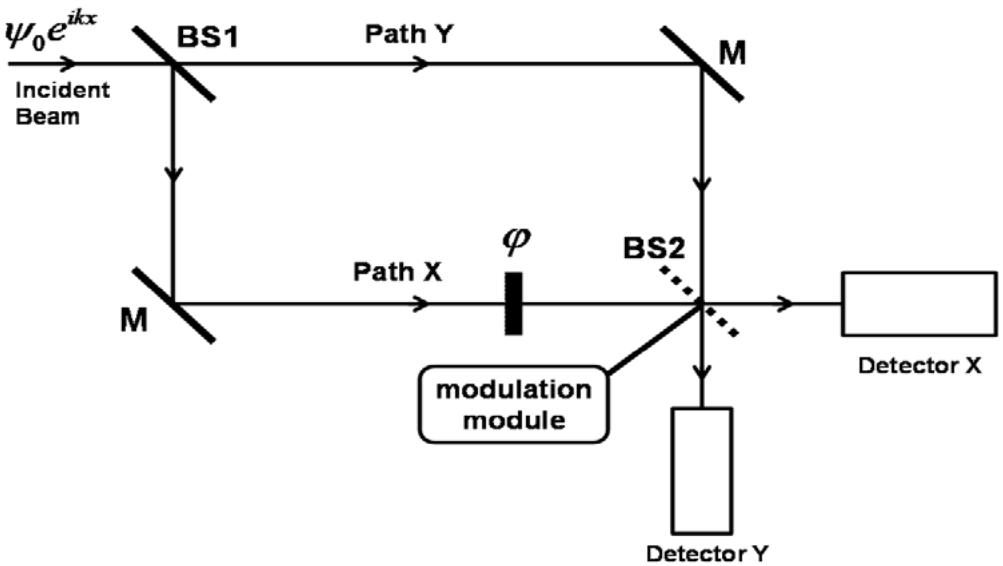 Fig. 1: Delay selection experiment based on Mach-Zehnder dual-arm interferometer
Importantly, the theoretical results clearly show that it is impossible to observe both the wave and particle properties of microscopic particles based on such an interferometer delay selection experiment scheme, because the path discernability and the visibility of interference fringes meet the condition $V^2 + D^2 \leq 1$. Is it possible, then, to break through the limitations of the wave-particle duality principle so that $1 \ll V^2 + D^2 \leq 2$?
Professor Li further analyzed the propagation and evolution of the wave function in the interferometer, and found that at the spatial intersection of the two particle beams, the wave functions will overlap, which should in principle produce interference fringes. But this simple physical picture was completely ignored in the past few years. herefore, he proposed a new type of weak measurement interferometer, replacing BS2 with another interference fringe weak measurement device (such as using weak scattering and weak absorption techniques), while obtaining high-contrast interference fringes, the microscopic particles can continue to propagate in the original direction (99% efficiency), which is detected and recorded by the particle detectors X and Y. This new interferometer uses two sets of measuring instruments acting simultaneously, without interfering with each other, and in principle can observe the wave $(V = 1)$ and particle properties $(D = 0.99)$ of the microscopic particles at the same time, $V^2 + D^{2\gg}1 \rightarrow 2$. This simple device can be applied to photons, electrons, atoms, molecules, and quasticles in condensed matter, etc. The key is to design and manufacture a weak measurement detector that can record interference fringes without changing the information of particle motion path. This analysis also shows that the delay-selection experiment belongs to the strong measurement interferometer in principle, and the functional device BS2 to detect particle properties has a huge destructive interference to the wave function. The two sets of instruments repel each other, so it is impossible to detect particle properties and wave properties at the same time.
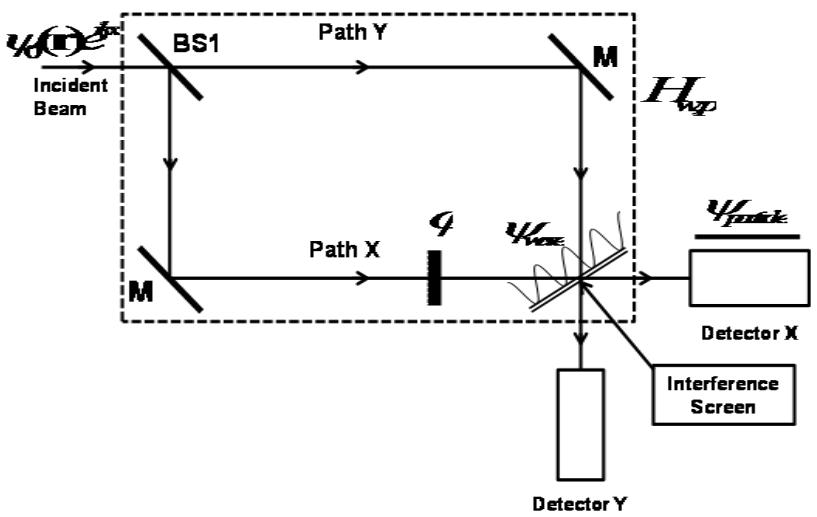 Fig. 2: Scheme of Mach-Zehnder photon interferometer for weak measurement.
Now a complete quantum mechanical modeling, calculation and analysis is needed. In 2019, Professor Li started from SE, wave function and other basic elements to establish a reasonable physical model and conduct quantum mechanical solutions. First of all, it is determined that the atom interferometer is a quantum scattering or propagation problem, rather than a quantum eigenstate problem. Therefore, the whole process of space-time evolution of the atomic wave function must be calculated and solved, starting from the incident wave function, tracking its changes through all atomic optical devices such as beam splitter, phase shifter, path detector, and finally arriving at the interference fringe detector. Secondly, the atom is a complex system, containing the atomic centroid and the outer electrons, so the evolution of the atomic centroid wave function and the internal electronic state must be considered at the same time. Third, to evaluate the wave-particle duality of an atom, it is necessary to aim at the atom's centroid rather than its inner electrons.
Therefore, it is necessary to analyze, calculate and measure the path information and interference fringes of the atomic center of mass, but not the path information and interference fringes of the internal electrons.
In his 2019 paper, he distinguished between strong measurement path detectors, which worked for early atomic interferometers, and weak measurement path detectors, which act directly on an atom's centroid to obtain precise information about its position. Introducing the interaction the total Hamiltonian is $H(R) = H_{\mathrm{free}}(R) + H_{\mathrm{int}}(R)$ Hamiltonian, it is simply. To solve the propagation and evolution of the atomic wave $\delta \varphi$ function, it is found that the influence of the path detector on the centroid wave function of the incident atomic beam can be described simply and reasonably by introducing random phase offset. The wave functions of the two propagation paths are finally overlapped on the interference fringe observation screen and the total wave function is written as
$$
\psi(\mathbf{r}) = a(\mathbf{r}) \psi_{1,tran}(\mathbf{r}) + b(\mathbf{r}) \psi_{2,tran}(\mathbf{r}) = \psi_{0} e^{jkl} \left[ a_{1} a(\mathbf{r}) e^{j\varphi_{1}} e^{j\delta\varphi_{1}} + \left[ a_{2} b(\mathbf{r}) e^{j\varphi_{2}} e^{j\delta\varphi_{2}} \right] \right]
$$
$$
I (\mathbf{r}) = \overline{A |\psi(\mathbf{r})|^2} = A [a^2 + b^2 + 2ab \overline{a_1 a_2 \cos(\varphi_1 - \varphi_2 + \delta\varphi_1 - \delta\varphi_2)}] = A [a^2 + b^2]
$$
This shows that when the path detector acts directly on the atom's center of mass, the over strong interaction leads to a large random phase shift, which destroys the quantum coherent superposition of the two path propagation wave functions, making the interference fringe completely disappear.
Another class of path detectors are weak measurement detectors, including microwave microcavity path detectors and Bragg grating path detectors, which obtain deterministic path information through direct strong measurement interactions with the internal electronic states of atoms (indirect interactions for atomic centroids, $H_{\mathrm{int}}^{\mathrm{iqs}}(\mathsf{R},\mathsf{r})$ described by the Hamiltonian). In order to obtain the effect of $H_{\mathrm{int}}^{\mathrm{iqs}}(\mathsf{R},\mathsf{r})$, it is necessary to conduct fully quantum-mechanical modeling, analysis and calculation of the atom-electron-detector interaction system. For the microwave microcavity weak measurement path detector, the Hamiltonian of the system is $H_{\mathrm{S}} = H_{\mathrm{acm}} + H_{\mathrm{photon}} +$
$\pmb{H}_{\mathrm{electron}} + \pmb{H}_{\mathrm{int}}^{\mathrm{p.e.}} + \pmb{H}_{\mathrm{int}}^{\mathrm{a.e.}} + \pmb{H}_{\mathrm{int}}^{\mathrm{a.p.}}$. It is generally believed in quantum physics circles that the interference fringes disappear due to the quantum entanglement between the path detector and the atomic path information, thus maintaining the wave-particle duality principle. However, in practice, the information of the interference fringe detector and the path detector are artificially associated by coincidence counting operation. Then the obtained measurement results of interference fringes already contain the path information of atoms, that is, the interference fringes are modulated by the electronic state transition information or the evolution information of the particle path detector. Therefore, non-physical quantum entanglement and quantum erasure phenomena are artificially generated.
Zhiyuan Li believes that the quantum entanglement effect claimed by some people in the past is to observe the wave-particle duality of the internal electronic states of atoms, and the test of the truly concerned atomic wave-particle duality does not work. In other words, the electrons inside the atom satisfy the wave-particle duality principle, while the atomic center of mass violates the wave-particle duality principle. The theoretical analysis results show that the wave and particle properties of atoms can be observed at the same time on this weakly measured atomic interferometer device, as long as the correct physical model and analysis method are adopted.
In 2020, Professor Xuewen Chen and his doctoral team designed and built the weak measurement photon interferometer on the basis of Professor Li's theoretical research, and tested the wave-particle duality[20] of single photons. They demonstrated the simultaneous observation of the wave and particle properties of single photons with conclusive evidence, and its comprehensive index broke through the limitations of the wave-particle duality principle of classical quantum mechanics. The experimentally observed interference fringes show not only the fluctuations of those photons that are scattered, but also the fluctuations of the photons that enter the interferometer from the single photon source (the object of wave-particle duality detection). Therefore, the Chinese scientists' experimental results show that the wave and particle properties of photons can be observed simultaneously.
## IX. DISCUSSION
Professor Li's rigorous thinking and profound theoretical analysis are excellent works. We noticed that he started from the original thinking methods and operating tools of quantum mechanics, that is to say, he did these studies not to oppose QM, but to find a new quantum mechanics.
Now we can make a comparison. QM holds that all microscopic particles (whether they have mass or not) have wave-particle duality, sometimes appearing as particles (which have definite orbits) and sometimes as waves (which can produce interference fringes); This depends on the experimental method of the observer. But it is not possible to observe both at the same time, in fact, the root point is a quantum relationship that is both mutually exclusive and complementary, and any experiment will lead to uncertainty about their conjugate variables; Therefore, the complementarity principle is consistent with the uncertainty relation.... But Einstein, the inventor of the theory of photons, has long recognized the paradox that light is both a wave and a particle. But by rejecting the uncertainty principle, he could not accept Bohr's complementarity theory, which saw uncertainty relations as an example and consequence of the complementarity principle.
In the author's opinion, Professor Li's theory and experiment only prove that it is possible to observe the particle properties and the volatility of photons at the same time, but not that these two properties must exist in the object at the same time in the microscopic world. To prove that the latter is a universal law of the objective world seems to be far away. Therefore, his work does not represent a repudiation of the principle of complementarity, quantum non-locality, quantum entanglement, the uncertainty principle, quantum statistical interpretation, etc. That is to say, a scientist who admits in advance the basic principles and modes of operation of QM will not conclude at the end of his research work that "quantum mechanics is wrong".
For the sake of caution, I put a few questions to Prof.Li: "(1) It is said that in 2007 and 2011, A. Stlinberg directed the publication of two papers opposing[17,18] the 'principle of complementarity'. If this is true, then you are not the first to oppose the complementarity principle? (2) If the complementarity principle is dead, what next? What is your opinion? The complementarity principle is linked to the Heisenberg uncertainty principle, so is it a threat to quantum mechanics? (3) de Broglie argues that "particles ride on waves". what do you think?(4) Your thoughts and activities have always been within the framework of the QM, not bent on destroying it, as Einstein did. This is evident from your clever use of quantum weak measurements. (5) I have a personal suggestion for using nonlinear SE to help understand this problem."
Zhiyuan Li gave the following reply: "There are many people in history who have opposed the Copenhagen orthodox interpretation of quantum mechanics. I am just only a Chinese scholar who has thought about this. However, all of them have failed to shake the foundation of quantum mechanics....I'm not a big fan of the principle of complementarity, especially when combined with two-particle quantum physics, which naturally gives rise to bizarre, counterintuitive physical explanations of two-electron, two-photon quantum entanglement and so on. I am a committed materialist and firmly opposed to any physical theory that leads to idealism."
Before that, however, Professor Li had spoken of his thoughts, which I recorded: "How do microscopic particles move? Newton mechanics and Schrödinger equation (SE). Is quantum mechanics a complete statistical description of microscopic particles (massless photons and massless electrons, protons, atoms, molecules)? Is there a deeper, unknown law behind it that describes the behavior of individual particles?...In today's highly developed technology of quantum physics, quantum optics, atomic physics and quantum regulation, these are not only philosophical questions, but also scientific questions that can be tested."
On the surface, Professor Li seems inclined to revert to the EPR paper and to J.Bell's earlier ideas. But I don't think so. His point is to re-examine many of the fundamental questions with modern technology. Moreover, he could not have been unaware of two things, one is that Schrödinger's equation(SE) was derived from Newton mechanics, not from relativistic mechanics. Second, J. Bell proposed the Bell inequality from the original intention of the EPR paper, but after Aspect's precise experiments in supporting of QM were published, Bell completely switched sides and sided with QM.
Now I suggests that further analysis should begin with the introduction of nonlinearities to the Schrödinger equation (SE), which we earlier studied in 2016[19].LSE can be written as:
$$
\mathrm {j} \hbar \frac {\partial \boldsymbol {\Psi}}{\partial t} = \hat {\mathbf {H}} \boldsymbol {\Psi}
$$
Where $\hat{\mathbf{H}}$ is the linear operator, the Hamiltonian of the system. If a nonlinear term is added to it, the nonlinear Schrödinger equation (NLSE) can be obtained; take
$$
\hat{\boldsymbol{H}} = \frac{\hbar^ {2}}{2 \mathrm{m}} \nabla^ {2} + \mathbf{U} \quad (\text{LSE}) \tag{36}
$$
$$
\hat{\boldsymbol{H}} = \frac{\hbar^ {2}}{2 \mathrm{m}} \nabla^ {2} + \mathbf{U} - \beta | \boldsymbol{\Psi} | ^ {2} \quad (\text{NLSE}) \tag{37}
$$
Where $\beta$ is the nonlinear coefficient; Take $U = 0$, the NLSE is:
$$
\mathrm {j} \hbar \frac {\partial \boldsymbol {\Psi}}{\partial t} + \alpha \nabla^ {2} \boldsymbol {\Psi} + \beta | \boldsymbol {\Psi} | ^ {2} \boldsymbol {\Psi} = 0 \tag {38}
$$
In formula $\alpha = -\hbar^2 / 2\mathbf{m}$; It can be proved that NLSE can have solitary wave solutions, indicating that SE can strengthen its particle image by introducing nonlinearity.
We know that in SE, the kinetic energy operator $\left[-\frac{\hbar^2}{2m}\nabla^2\right]$ is already the embodiment of the particle property, in which $m$ represents the particle mass. Therefore, SE is not only the basic equation of quantum wave mechanics, but also the equation that has reflected the duality of wave and particle. Now, the nonlinear term is introduced, and the isolated wave solution is obtained under the action of the dispersion effect. This not only overcomes the problem of SE's wave packet divergence, but also better presents particle properties in the wave equation....Perhaps what we have said above can explain the results of recent experiments?
## X. CONCLUSION
A physicist once asked, while giving an academic talk, "What is a photon? What does it look like? What is the size? How does it move? How to interact with matter? What are the space-time details?"
Here, we try to answer. It is well known that an electron has a rest mass and that it has a size (radius $r \leq 10^{-17}$ cm), not a point particle. Mainstream physicists—to the photon has no rest mass, then it will not inch, become a point particle. However, any theory in physics that is based on point particles is not a good theory.
This paper argues that the hypothesis of "photon has no rest mass" causes the lack of self-consistency of the theory. For mass photons, the Proca equations proposed in 1936 can be used to replace the Maxwell equations. We derive a new wave equations for electromagnetic waves and photons, called Proca wave equation (PWE). In PWE there are terms containing particle mass parameter, which is consistent with Schrödinger wave equation and Dirac wave equation. This improved the theoretical relationship and draws a clear line between massive photons and point particles.
In short, some strange phenomena of photons (such as photon self-interference, homomorphic photon interference, single photon passing through double slit at the same time, quantum post-selection, quantum entanglement, etc.) can not be explained by traditional classical and deterministic methods. As R. Feynman said, we do not know why nature is the way it is, but we must accept it as it is; The important thing is that theory and experiment must agree.
The author believes that when strange phenomena appear in the microcosmic world, if they have been proved to exist by experiments, or even have been applied in practice, then we should acknowledge and accept them. Feynman is absolutely right that the only thing scientists can do is to be loyal to nature.
It must be admitted that there are still many contradictions and confusion regarding the photon and the wave-particle duality of light, and further study is undoubtedly right. But for things in the microcosmic world, perhaps some ambiguity that needs to be dealt with without undue attention to this. Photons belong to the quantum world, where the distinction between a particle and wave becomes blurred, and the notion of "size" becomes vague and meaningless. We can describe the behavior of photons mathematically, but we can't visualize them as regular images....Now the particles of the wave are both present in separate states and may be observed simultaneously. This is the wonder of nature, the wonder that fascinates us!
Generating HTML Viewer...
References
19 Cites in Article
Supleec (1999). Physics in 20th Century.
P Speziali (1903). Albert Einstein-Michel Besso Correspondance.
Marcus Chown (2004). About time: You are now leaving the present.
R Stacy (1955). Essentials of biological and medical physics.
A Steinberg (1993). Unknown Title.
P Dirac (1964). Coulomb scattering of dirac particles.
M Lanzagorta,Radar (2012). Unknown Title.
Roderic Lakes (1998). Experimental Limits on the Photon Mass and Cosmic Magnetic Vector Potential.
A Proca (1936). Sur la théorie ondulatoire des électrons positifs et négatifs.
Bo Huang,Man Huang,Yongbin Gao,Yuxin Yu,Xiaoyan Jiang,Juan Zhang (2019). 3D Object Detection Incorporating Instance Segmentation and Image Restoration.
Z Huang (2013). Unknown Title.
Lizy,Chin (2014). Unknown Title.
Liz Chin (2016). Unknown Title.
Lizy (2017). Unknown Title.
Zhi-Yuan Li,Chin (2019). Atom interferometers with weak-measurement path detectors and their quantum mechanical analysis*.
Fenghua Qi,Zhiyuan Wang,Weiwang Xu,Xue-Wen Chen,Zhi-Yuan Li (2020). Towards simultaneous observation of path and interference of a single photon in a modified Mach–Zehnder interferometer.
Sacha Kocsis,Boris Braverman,Sylvain Ravets,Martin Stevens,Richard Mirin,L Shalm,Aephraim Steinberg (2011). Observing the Average Trajectories of Single Photons in a Two-Slit Interferometer.
No ethics committee approval was required for this article type.
Data Availability
Not applicable for this article.
How to Cite This Article
Zhi-Xun Huang. 2026. \u201cStudy on the Essence of Photons and the Wave-Particle Duality of Light\u201d. Global Journal of Science Frontier Research - A: Physics & Space Science GJSFR-A Volume 23 (GJSFR Volume 23 Issue A10).
Explore published articles in an immersive Augmented Reality environment. Our platform converts research papers into interactive 3D books, allowing readers to view and interact with content using AR and VR compatible devices.
Your published article is automatically converted into a realistic 3D book. Flip through pages and read research papers in a more engaging and interactive format.
Our website is actively being updated, and changes may occur frequently. Please clear your browser cache if needed. For feedback or error reporting, please email [email protected]
Thank you for connecting with us. We will respond to you shortly.