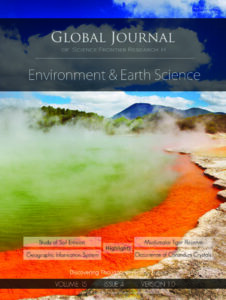
This study was aimed to evaluate the spatial and temporal patterns of forest fire between 1999 and 2014 using remote sensing and GIS in Mudumalai Tiger Reserve, Western Ghats. Remote Sensing and GIS are very effective tools in detecting active fire, mapping burned area, analyzing fire risk and preparing improved management plans. We used Landsat TM, ETM+, OLI-TIRS and Fire location data for this study. In our study, we found that the annual rate of fire was 3141.46 hectare year -1 (9.78%) with an average number of 22 fire incidences per annum. Maximum area was burned in 2004 (10451 hectares) whereas in 2013, we did not record any fire incidence through Lands at images. Fire occurred between January and May and utmost incidences in February and March (93.64%). However, 58.86 % of detected fire incidences were in February alone.
References
28 Cites in Article
Jennifer Balch,Daniel Nepstad,Paulo Brando,Lisa Curran,Osvaldo Portela,Oswaldo De Carvalho,Paul Lefebvre (2008). Negative fire feedback in a transitional forest of southeastern Amazonia.
G Certini (2005). Effects of fire on properties of forest soils: a review.
M Chandran (1997). On the ecological history of the Western Ghats.
R Cincotta,J Wisnewski,R Engelman (2000). Human population in the biodiversity hotspots.
Mark Cochrane (2003). Fire science for rainforests.
S Cumming (2001). Forest type and wildfire in the Alberta boreal mixedwood: what do fires burn?.
Donghyun Kim (2012). Characteristics of Korean Forest Fires and Forest Fire Policies in the Joseon Dynasty Period (1392–1910) Derived From Historical Records.
M Gadgil,M Chandran (1988). On the history of Uttara Kannada forest.
F Gerard,S Plummer,R Wadsworth,A Sanfeliu,L Iliffe,H Balzter,B Wyatt (2003). Forest fire scar detection in the boreal forest with multitemporal SPOT-VEGETATION data.
A Gill (1975). Fire and the Australian flora: a review.
R Jaiswal,S Mukherjee,K Raju,R Saxena (2002). Forest fire risk zone mapping from satellite imagery and GIS.
A Johnsingh (1986). Impact of fire on wildlife ecology in two dry deciduous forests in south India.
M Kellman,R Tackaberry,J Meave (1996). The consequences of prolonged fragmentation: Lessons from tropical gallery forest.
Narendran Kodandapani,Mark Cochrane,R Sukumar (2004). Conservation Threat of Increasing Fire Frequencies in the Western Ghats, India.
Narendran Kodandapani,Mark Cochrane,R Sukumar (2009). Forest fire regimes and their ecological effects in seasonally dry tropical ecosystems in the Western Ghats, India.
L Lentile,Z Holden,A Smith,M Falkowski,A Hudak,P Morgan,N Benson (2006). Remote sensing techniques to assess active fire characteristics and post-fire effects.
Mazuelas Benito,P,Fernández Torralbo,A (2012). Landsat and MODIS Images for Burned Areas Mapping in Galicia.
N Mondal,R Sukumar (2014). Characterising weather patterns associated with fire in a seasonally dry tropical forest in southern India.
G Narayanaraj,M Wimberly (2012). Influences of forest roads on the spatial patterns of human-and lightning-caused wildfire ignitions.
K Puri,G Areendran,K Raj,S Mazumdar,P Joshi (2011). Forest fire risk assessment in parts of Northeast India using geospatial tools.
Q Renard,R Pélissier,B Ramesh,N Kodandapani (2012). Environmental susceptibility model for predicting forest fire occurrence in the Western Ghats of India.
S Saha (2002). Anthropogenic fire regime in a deciduous forest of central India.
K Saranya,C Reddy,P Rao,C Jha (2014). Decadal time-scale monitoring of forest fires in Similipal Biosphere Reserve, India using remote sensing and GIS.
S Srivastava,S Saran,R De By,V Dadhwal (2014). A geo-information system approach for forest fire likelihood based on causative and anti-causative factors.
S Verma,S Jayakumar (2012). Impact of forest fire on physical, chemical and biological properties of soil: A Review.
S Verma,S Jayakumar (2015). Post-fire regeneration dynamics of tree species in a tropical dry deciduous forest, Western Ghats, India.
H Xaud,F Martins,J Santos (2013). Tropical forest degradation by mega-fires in the northern Brazilian Amazon.
N Kodandapani,M Cochrane,R Sukumar (2008). A comparative analysis of spatial, temporal, and ecological characteristics of forest fires in seasonally dry tropical ecosystems in the Western Ghats, India.
No ethics committee approval was required for this article type.
Data Availability
Not applicable for this article.
How to Cite This Article
Shanmuganathan Jayakumar. 2015. \u201cMonitoring changes in Forest Fire Pattern in Mudumalai Tiger Reserve, Western Ghats India, using Remote Sensing and GIS\u201d. Global Journal of Science Frontier Research - H: Environment & Environmental geology GJSFR-H Volume 15 (GJSFR Volume 15 Issue H4).
Explore published articles in an immersive Augmented Reality environment. Our platform converts research papers into interactive 3D books, allowing readers to view and interact with content using AR and VR compatible devices.
Your published article is automatically converted into a realistic 3D book. Flip through pages and read research papers in a more engaging and interactive format.
Our website is actively being updated, and changes may occur frequently. Please clear your browser cache if needed. For feedback or error reporting, please email [email protected]
Thank you for connecting with us. We will respond to you shortly.