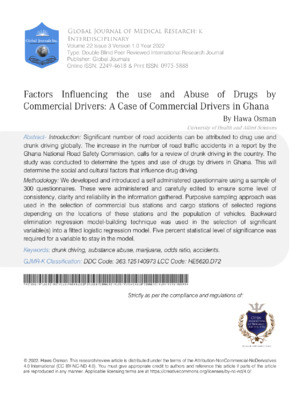
Factors Influencing the Use and Abuse of Drugs by Commercial Drivers: A Case of Commercial Drivers in Ghana

Article ID

5SN86

Factors Influencing Drug Abuse and Commercial Drivers in Ghana.

Factors Influencing the Use and Abuse of Drugs by Commercial Drivers: A Case of Commercial Drivers in Ghana

Hawa Osman
Hawa Osman
DOI

Abstract

Introduction: Significant number of road accidents can be attributed to drug use and drunk driving globally. The increase in the number of road traffic accidents in a report by the Ghana National Road Safety Commission, calls for a review of drunk driving in the country. The study was conducted to determine the types and use of drugs by drivers in Ghana. This will determine the social and cultural factors that influence drug driving. Methodology: We developed and introduced a self administered questionnaire using a sample of 300 questionnaires. These were administered and carefully edited to ensure some level of consistency, clarity and reliability in the information gathered. Purposive sampling approach was used in the selection of commercial bus stations and cargo stations of selected regions depending on the locations of these stations and the population of vehicles. Backward elimination regression model-building technique was used in the selection of significant variable(s) into a fitted logistic regression model. Five percent statistical level of significance was required for a variable to stay in the model.

Factors Influencing the Use and Abuse of Drugs by Commercial Drivers: A Case of Commercial Drivers in Ghana

Introduction: Significant number of road accidents can be attributed to drug use and drunk driving globally. The increase in the number of road traffic accidents in a report by the Ghana National Road Safety Commission, calls for a review of drunk driving in the country. The study was conducted to determine the types and use of drugs by drivers in Ghana. This will determine the social and cultural factors that influence drug driving. Methodology: We developed and introduced a self administered questionnaire using a sample of 300 questionnaires. These were administered and carefully edited to ensure some level of consistency, clarity and reliability in the information gathered. Purposive sampling approach was used in the selection of commercial bus stations and cargo stations of selected regions depending on the locations of these stations and the population of vehicles. Backward elimination regression model-building technique was used in the selection of significant variable(s) into a fitted logistic regression model. Five percent statistical level of significance was required for a variable to stay in the model.

Hawa Osman
Hawa Osman

No Figures found in article.

Hawa Osman. 2026. “. Global Journal of Medical Research – K: Interdisciplinary GJMR-K Volume 22 (GJMR Volume 22 Issue K3): .

Download Citation

Journal Specifications

Crossref Journal DOI 10.17406/gjmra

Print ISSN 0975-5888

e-ISSN 2249-4618

Classification
GJMR-K Classification: DDC Code: 363.125140973 LCC Code: HE5620.D72
Keywords
Article Matrices
Total Views: 1615
Total Downloads: 24
2026 Trends
Research Identity (RIN)
Related Research
Our website is actively being updated, and changes may occur frequently. Please clear your browser cache if needed. For feedback or error reporting, please email [email protected]

Request Access

Please fill out the form below to request access to this research paper. Your request will be reviewed by the editorial or author team.
X

Quote and Order Details

Contact Person

Invoice Address

Notes or Comments

This is the heading

Lorem ipsum dolor sit amet, consectetur adipiscing elit. Ut elit tellus, luctus nec ullamcorper mattis, pulvinar dapibus leo.

High-quality academic research articles on global topics and journals.

Factors Influencing the Use and Abuse of Drugs by Commercial Drivers: A Case of Commercial Drivers in Ghana

Hawa Osman
Hawa Osman

Research Journals