Development of a Model for Prediction of Composition and the Atomic Weights of the Elements

Article ID

NX8XB

Analyzing atomic weights and element composition for accurate scientific predictions and research development.

Development of a Model for Prediction of Composition and the Atomic Weights of the Elements

Elcio Fabio Soares Pereira
DOI

Abstract

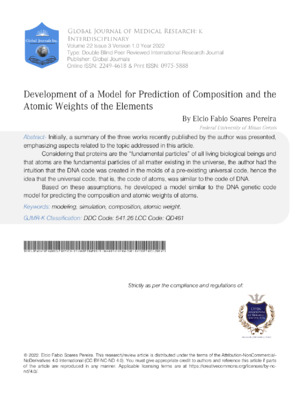
Initially, a summary of the three works recently published by the author was presented, emphasizing aspects related to the topic addressed in this article. Considering that proteins are the “fundamental particles” of all living biological beings and that atoms are the fundamental particles of all matter existing in the universe, the author had the intuition that the DNA code was created in the molds of a pre-existing universal code, hence the idea that the universal code, that is, the code of atoms, was similar to the code of DNA. Based on these assumptions, he developed a model similar to the DNA genetic code model for predicting the composition and atomic weights of atoms. Simulations made considering the elements of the Periodic Table seem to confirm the model developed by the author. The atoms generated by the model, called “genetic atoms”, generated from the active genetic groups, allow the prediction of the subatomic composition of the various elements of the Periodic Table, the possibility of the existence of numerous unmarked isotopes and provides a possible explanation for so many subatomic particles. If the model is confirmed, new questions are raised, some of which are cited by the author.

Development of a Model for Prediction of Composition and the Atomic Weights of the Elements

Initially, a summary of the three works recently published by the author was presented, emphasizing aspects related to the topic addressed in this article. Considering that proteins are the “fundamental particles” of all living biological beings and that atoms are the fundamental particles of all matter existing in the universe, the author had the intuition that the DNA code was created in the molds of a pre-existing universal code, hence the idea that the universal code, that is, the code of atoms, was similar to the code of DNA. Based on these assumptions, he developed a model similar to the DNA genetic code model for predicting the composition and atomic weights of atoms. Simulations made considering the elements of the Periodic Table seem to confirm the model developed by the author. The atoms generated by the model, called “genetic atoms”, generated from the active genetic groups, allow the prediction of the subatomic composition of the various elements of the Periodic Table, the possibility of the existence of numerous unmarked isotopes and provides a possible explanation for so many subatomic particles. If the model is confirmed, new questions are raised, some of which are cited by the author.

Elcio Fabio Soares Pereira

No Figures found in article.

Elcio Fabio Soares Pereira. 2026. “. Global Journal of Medical Research – K: Interdisciplinary GJMR-K Volume 22 (GJMR Volume 22 Issue K3): .

Download Citation

Journal Specifications

Crossref Journal DOI 10.17406/gjmra

Print ISSN 0975-5888

e-ISSN 2249-4618

Classification
GJMR-K Classification: DDC Code: 541.26 LCC Code: QD461
Keywords
Article Matrices
Total Views: 1452
Total Downloads: 22
2026 Trends
Research Identity (RIN)
Related Research
Our website is actively being updated, and changes may occur frequently. Please clear your browser cache if needed. For feedback or error reporting, please email [email protected]

Request Access

Please fill out the form below to request access to this research paper. Your request will be reviewed by the editorial or author team.


X

Quote and Order Details

Contact Person

Invoice Address

Notes or Comments

This is the heading

Lorem ipsum dolor sit amet, consectetur adipiscing elit. Ut elit tellus, luctus nec ullamcorper mattis, pulvinar dapibus leo.

High-quality academic research articles on global topics and journals.

Development of a Model for Prediction of Composition and the Atomic Weights of the Elements

Elcio Fabio Soares Pereira

Research Journals