## I. INTRODUCTION
The so-called "Anti-Vaccine Movement" gained strength from a fraudulent study published in The Lancet in 1998. In that article, physician Andrew Wakefield described that, after vaccination with the Triple Virus, an intestinal inflammatory condition would occur that would make the individual susceptible to mercurial toxins, which would lead to autism. The fraud was exposed sometime later by the General Medical Council, but the theory had already gained supporters worldwide. $^{1}$
Anti-vaccine movements are not recent and, as already mentioned, had their greatest demonstration over a century ago in Brazil, with similar episodes in different parts of the world such as England and the United States. Recently, worldwide cases of eradicated diseases have started to be reported. Like tetanus in children described in 2017 in Italy and the United States, generating in the latter an approximate cost of one million dollars spent on treatment, which could have been avoided with adequate vaccination, whose price revolves around thirty dollars.[2]
Failure to vaccinate has disastrous consequences[^1] and is directly related to the concepts of vaccine hesitancy, vaccine refusal and the anti-vaccination movement itself,[^3] which has resulted in a reduction in vaccine coverage in Brazil. For example, from 2015 to 2020, there was a reduction of $41.72\%$, and in 2018, seven of the eight mandatory vaccines for children did not reach their coverage target, with the exception of BCG (Bacillus Calmette-Guérin).[^1]
According to Dubé et al (2014),[^3] vaccine hesitancy consists of a heterogeneous group of individuals who demonstrate doubts about vaccination and therefore may delay, be reluctant, but still accept or refuse some or all vaccines. On the other hand, vaccine refusal, a term closely linked to the context, is related to the traditions, health and religion of a given population, and in low- and middle-income countries, it can be used to obtain other social services interventions that meet the needs of the community. The anti-vaccination movement, on the other hand, opposes any and all types of vaccination, including individuals who allocate part of their time and resources to express, mainly through digital media, their position with regard to vaccines since this movement also has the aim to attract new fans. Still according to the authors, the participants call themselves defenders of freedom of choice in relation to getting vaccinated and the transparency of public information with an anti-vaccination rhetoric, addressing controversial issues to legitimize their decisions. With the assumption that if the subject is in high proportion in the media, there is greater generation of fear in the population, resulting in the decline of immunizations.
In the present scoping review, based on the assumption presented, our intention was to analyze the production on the anti-vaccination movement and its implications for vaccination coverage of the Brazilian population in the indexed scientific literature.
## II. METHODS
### a) Search Strategy and Selection Criteria
The present systematic review was carried out in accordance with the guidelines of the Preferred Reporting Items for Systematic reviews and Meta-Analyses extension for Scoping Reviews (PRISMA-ScR).[^4] References included dates from March 2001 to March 2022 and were extracted from the electronic databases PubMed, Scopus, Web of Science, Embase, Lilacs/BVS and SciELO.
To guide the question and objective of the research, we used the acronym PCC (Population, Concept and Context), in which "Population" referred to publications that addressed the theme of the "Anti-Vaccine Movement," "Concept" to the dynamics of the "Anti-vaccine Movement" and the vaccination coverage in the population and "Context" indicates the geographic delimitation in the subject of the retrieved records (Brazil). Based on the definition of the PCC, the following guiding question was established: Do the publications mention the implications of the anti-vaccination movement in the vaccination coverage of the Brazilian population?
The following keywords (a combination of MeSH and non-MeSH terms) were used: PubMed - (Anti-Vaccination Movement[Mesh] OR Anti-Vaccination Movement\* [tiab] OR Anti-Vaccination Movement\* [tiab] OR Anti-Vaccine Movement\* [tiab] OR Vaccination Refusal[mesh] OR Vaccination Refusal\*[tiab] OR Vaccination Hesitancy[tiab] OR Vaccine hesitancy[tiab]) AND (Public Health[Mesh] OR Public Health[tiab]); Embase - exp ('anti-vaccination movement'/exp OR 'vaccination refusal'/exp OR 'anti-vaccination movement' OR 'vaccination refusal' OR 'vaccine refusal' OR 'vaccination hesitancy' OR 'vaccine hesitancy': ab,ti) AND ('public health'/exp OR 'public health': ab,ti); LILACS - (Tw:"Vaccination Movement" OR "Vaccination Refusal" OR "Anti-Vaccination Movement" OR "Vaccination Refusal" OR "Vaccine Hesitancy" OR "Anti-Vaccine Movements") AND (tw:"Single Health System" OR "public health" OR "Public health" OR "Unified Health System" OR "SUS" OR "international health" OR "national health" OR "collective health");SCIELO - (Tw:"Movement against Vaccination" OR "Refusal of Vaccination" OR "Anti-Vaccination Movement" OR "Vaccination Refusal" OR "Vaccine Hesitancy" OR "Anti-Vaccine Movements") AND (tw:"Single Health System" OR "public health" OR "Public health" OR "Unified Health System" OR "SUS" OR "International health" OR "national health" OR "collective health");SCOPUS - TITLE-ABS-KEY("Public Health" OR "Unified Health System") AND ("Anti-Vaccination Movement" OR "Anti-Vaccination Movements" OR "Antivaccination Movement" OR "Antivaccination Movements" OR "Vaccination Refusal" OR "Vaccination Refusals" OR "Vaccine Refusal" OR "Vaccination Hesitancy" OR "Vaccine hesitancy" OR "refusal of vaccination"); Web of Science - TS=("Anti-Vaccination Movement" OR "Anti-Vaccination Movements" OR "Antivaccination Movement" OR "Anti-Vaccination Movement" OR "Anti-Vaccination Movements" OR "Anti-Vaccination Movements" OR "Vaccination Refusal" OR "Vaccination Refusals" OR "Vaccine Refusal" OR "Vaccination Hesitancy" OR "Vaccine hesitancy" OR "refusal of vaccination") AND TS=("Public Health" OR "Unified Health System").
As for the eligibility criteria, only scientific articles from primary studies were considered eligible to compose our sample. Searches were not carried out in gray literature sources - OpenGray, Catalog of annals of events - CIN/CNEN, theses and dissertations - BDTD and general sources such as Google Scholar, as well as possible non-indexed works. Studies in English, Spanish and Portuguese were accepted, and there was no time frame in the present study.
### b) Data Extraction and Analysis
Using the eligibility criteria, titles, abstracts and full-text articles were screened by the following researchers: MDS; ADS; RFG; CTW. Training exercises were performed with the four evaluators for each screening level. Subsequently, they selected citations and full articles for inclusion, in pairs of independent work and blindly. Discrepancies between the four evaluators were resolved by consensus meeting and validation for the final insertions were performed by the fifth evaluator and SMD specialist. The Rayyan $^6$ software was also used as a tool, which consists of a web application developed by QCRI (Qatar Computing Research Institute), which was responsible for the process of screening articles and removing duplicates.
We entered all selected articles into a spreadsheet and extracted the following data: title of publication, name of authors, title of journal, country of journal, original language of publication, year of publication, relation of publication to the theme of the anti-vaccine movement and vaccination coverage and, finally, whether the publication mentioned implications of the anti-vaccination movement on vaccination coverage of the Brazilian population and/or the general population. At the same time, we also built an excel spreadsheet with the summaries and conclusions from the studies selected as sources of evidence. Next, for data analysis, we categorized the publications included in the study according to the relationship with the theme (1- the publication has no direct relationship with the theme; 2- the publication has a partial relationship with the theme; 3- the publication presents direct relationship with the theme).
We also categorized the implications mentioned by the publications (1- the publication mentions implications in the vaccination coverage of the Brazilian population; 2- the publication mentions implications in the vaccination coverage of the general population; 3- the publication does not mention implications in the vaccination coverage of the Brazilian population and/or in general).
And finally, the file with the summaries and conclusions of the included studies were imported into the Iramuteq software, $^{7}$ through which the textual corpus analysis was carried out, specifically the similarity analysis, which is anchored in graph theory. Similarity analysis is defined mathematically as a probabilistic network represented by a graphic structure composed of relationships between words and their precepts. Each "node" in the graph represents a word, and the links between the nodes are the edges, which represent the probabilistic dependencies between the words (which, from a mathematical point of view are understood as variables). $^{8}$ Thus, it is possible to demonstrate the relational structures in the form of acyclic and directed graphs (DAG's), as well as their probabilistic dependencies between the words in the nodes, $^{9}$ from the co-occurrence (frequency of occurrence and co-occurrence), between the words. $^{10}$ The significance level was established at $5\%$ in this analysis.
## III. RESULTS
Among the analyzed articles, 37 were included as sources of evidence (Figure 1).<sup>3,11-46</sup>
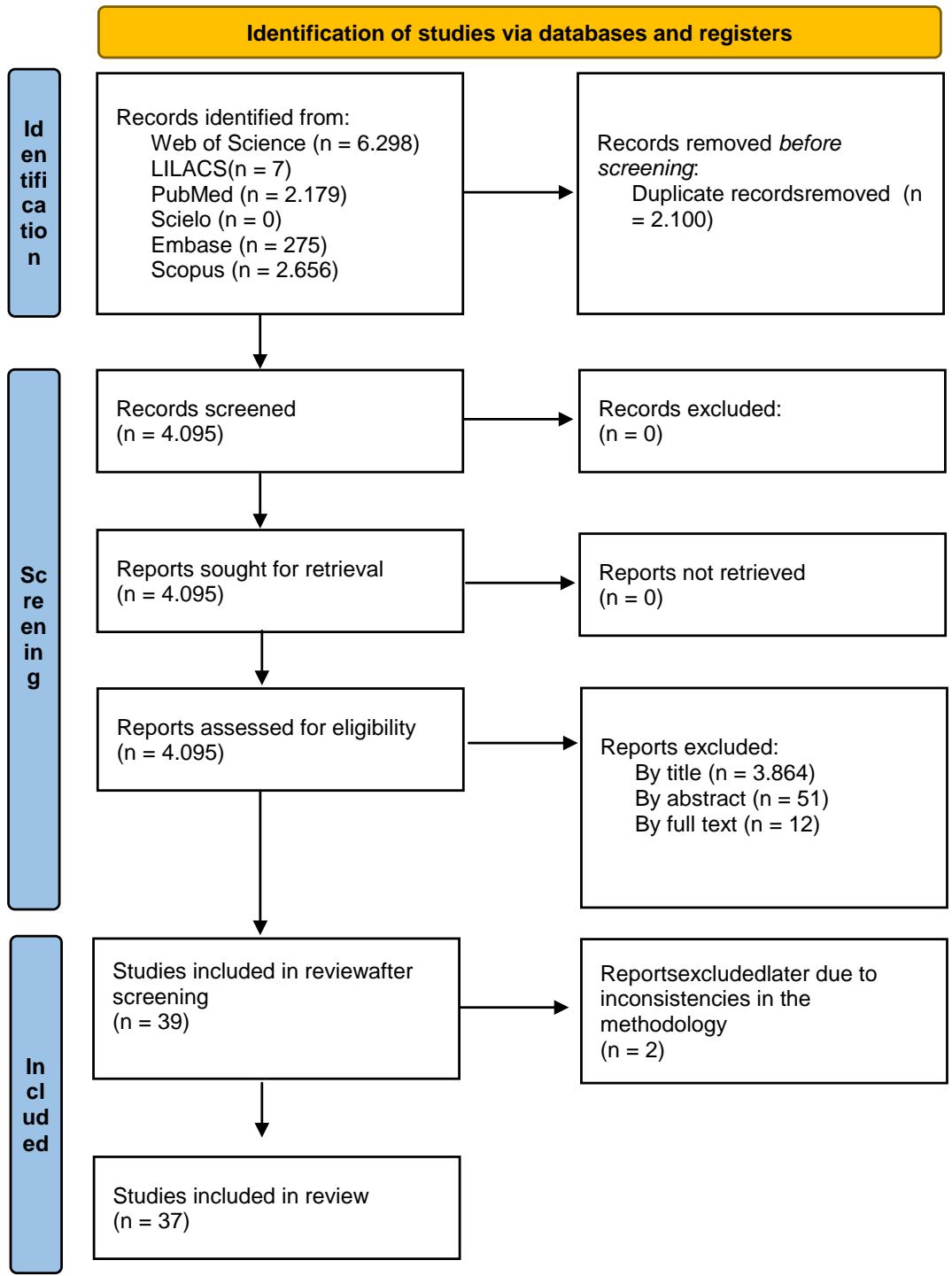 Figure 1: Flowchart demonstrating a selection process according to PRISMA-ScR guidelines.
We characterized the 37 publications regarding the following information: publication title; authors' names; journal title; journal country; original language of publication; and year of publication (Table 1).
Table 1: Synthesis of publications selected as sources of evidence in the PubMed, Scopus, Web of Science, Embase, Lilacs/BVS and SciELO electronic databases.
<table><tr><td>Publication Title</td><td>Authors Name</td><td>Journal Title</td><td>Country of the Journal</td><td>Original Language of Publication</td><td>Year of Publication</td></tr><tr><td>Understanding those who do not understand: a brief review of the anti-vaccine movement</td><td>Poland GA, Jacobson RM</td><td>Vaccine</td><td>USA</td><td>English</td><td>2001</td></tr><tr><td>Anti-vaccinationists past and present</td><td>Wolfe RM, Sharp LK</td><td>The BMJ</td><td>USA</td><td>English</td><td>2002</td></tr><tr><td>Anti-vaccine activists, Web 2.0, and the postmodern paradigm--an overview of tactics and tropes used online by the anti-vaccination movement</td><td>Kata A</td><td>Vaccine</td><td>Canada</td><td>English</td><td>2012</td></tr><tr><td>Parents' Refusal to Vaccinate Their Children: An Increasing Social Phenomenon Which Threatens Public Health</td><td>Barbacariu CL</td><td>Procedia - Social and Behavioral Sciences</td><td>Romania</td><td>English</td><td>2014</td></tr><tr><td>Vaccine hesitancy, vaccine refusal and the anti-vaccine movement: influence, impact and implications</td><td>Dubé E, Vivion M, MacDonaldNE</td><td>Expert review of vaccines</td><td>Canada</td><td>English</td><td>2015</td></tr><tr><td>Vaccine hesitancy: understanding better to address better</td><td>Kumar D, Chandra R, Mathur M, Samdariya S, Kapoor N</td><td>Israel Journal of Health Policy Research</td><td>India</td><td>English</td><td>2016</td></tr><tr><td>Mapping the anti-vaccination movement on Facebook</td><td>Smith N, Graham T</td><td>Information, Communication and Society</td><td>Australia</td><td>English</td><td>2017</td></tr><tr><td>What do popular YouTube videos say about vaccines?</td><td>Basch CH, Zybert P, Reeves R, Basch CE</td><td>Child: Care, Health and Development</td><td>USA</td><td>English</td><td>2017</td></tr><tr><td>The psychological roots of anti-vaccination attitudes: A 24-nation investigation</td><td>Hornsey MJ, Harris EA, Fielding KS</td><td>American Psychological Association (APA)</td><td>Australia</td><td>English</td><td>2018</td></tr><tr><td>The Anti-vaccination Movement: A Regression in Modern Medicine</td><td>Hussain A, Ali S, Ahmed M, Hussain S</td><td>Cureus</td><td>Aruba</td><td>English</td><td>2018</td></tr><tr><td>Polarization of the vaccination debate on Facebook</td><td>Schmidt AL, Zollo F, Scala A, Betsch C, Quattrocicocchi W</td><td>Vaccine</td><td>Italy</td><td>English</td><td>2018</td></tr><tr><td>What is the importance of vaccine hesitancy in the drop of vaccination coverage in Brazil?</td><td>Sato APS</td><td>Revista de Saude Publica</td><td>Brazil</td><td>English</td><td>2018</td></tr><tr><td>The Influence of Antivaccination Movements on the Re-emergence of Measles</td><td>Patricia CRN, Zulay JPY, Carlos RLJ, Alejandra CM, Cristina JSR, Josefina RV</td><td>J. Pure Appl. Microbiol.</td><td>Mexico</td><td>English</td><td>2019</td></tr><tr><td>The anti-vaccination debate and the microbiome: How paradigm shifts in the life sciences create new challenges for the vaccination debate</td><td>Guttinger S</td><td>EMBO Rep.</td><td>UK</td><td>English</td><td>2019</td></tr><tr><td>Temporal trends in anti-vaccinatediscourse on Twitter</td><td>Gunaratne K, Comoes EA, Haghbayan H</td><td>Vaccine</td><td>Canada</td><td>English</td><td>2019</td></tr><tr><td>An analysis of pro-vaccine and anti-vaccine information on social networks and the internet: Visual and emotional patterns</td><td>Cuesta-Cambra U, Martínez-Martínez L, Niño-González JI</td><td>El profesofal de la información</td><td>Spain</td><td>Spanish</td><td>2019</td></tr><tr><td>Analysis of the Anti-Vaccine Movement in Social Networks: A Systematic Review</td><td>Ortiz-Sánchez E, Velando-Soriano A,Pradas-Hernández L, Vargas-Román K, Gómez-Urquiza JL,Cañadas-De la Fuente GA e Albendín-García L</td><td>International Journal of Environmental Research and Public Health</td><td>Spain</td><td>English</td><td>2020</td></tr><tr><td>#Antivaccination on Instagram: A Computational Analysis of Hashtag Activism through Photos and Public Responses</td><td>Kim Y, Song D, Lee YJ</td><td>International Journal of Environmental Research and Public Health</td><td>Korea</td><td>English</td><td>2020</td></tr><tr><td>Parental autonomy in health and anti-vaccine movement conformation in the post-truth scenario</td><td>Borges GS, Cervi TD, Piaia TC</td><td>Revista Juridica</td><td>Brazil</td><td>Portuguese</td><td>2020</td></tr><tr><td>'Should I vaccinate my child?' comparing the displayed stances of vaccine information retrieved from Google, Facebook and YouTube</td><td>ElkinLE, PullonSRH, Stubbe MH</td><td>Vaccine</td><td>New Zealand</td><td>English</td><td>2020</td></tr><tr><td>Fact vs Fallacy: The Anti-Vaccine Discussion Reloaded</td><td>Stolle LB, Nalamasu R, Pergolizzi Jr JV, Varrassi G, Magnusson P, LeQuang J, Breve F, The NEMA Research Group</td><td>Advances in therapy</td><td>USA</td><td>English</td><td>2020</td></tr><tr><td>Anti-vaccine movements - a form of social activity for health care, ignorance or diversion aimed at destabilizing the health situation? Part 1. Epidemiological safety. Vaccinations - pros and cons</td><td>Kołątaj WP, Kołątaj B, Panasiuk L, Sobieszczanski J, Karwat ID</td><td>Annals of Agricultural and Environmental Health</td><td>Poland</td><td>English</td><td>2020</td></tr><tr><td>Anti-vaccine movements - health care, ignorance or a diversion aimed at destabilizing the health situation? Part 2. Contemporary conditions for the functioning and development of anti-vaccination movements</td><td>Kołątaj BM, Kołątaj WP, Karwat ID, Sobieszczanski J, Panasiuk L</td><td>Annals of Agricultural and Environmental Health</td><td>Poland</td><td>English</td><td>2020</td></tr><tr><td>Characteristics of Antivaccine Messages on Social Media: Systematic Review</td><td>Wawrzuta D, Jaworski M, Gotlib J, Panczyk M</td><td>Journal of Medical Internet Research</td><td>Poland</td><td>English</td><td>2021</td></tr><tr><td>Covid-19, the anti-vaccine movement and immunization challenges in Brazil: a review</td><td>Bivar GCC, Aguiar MESC, Santos RVC, Cardoso PRG</td><td>Scientia Medica</td><td>Brazil</td><td>English</td><td>2021</td></tr><tr><td>Understanding Anti-Vaccination Attitudes in Social Media</td><td>Mitra T, Counts S, Pennebaker JW</td><td>Proceedings of the Tenth International AAAI Conference on Web and Social Media (ICWSM 2016)</td><td>Georgia</td><td>English</td><td>2021</td></tr><tr><td>Vaccine fake news: an analysis under the World Health Organization's 3Cs model</td><td>Frugoli AG, Prado RS, da Silva TMR, Matozinhos FP, Trapé CA, Lachtim SAF</td><td>Journal of School of Nursing – University of São Paulo</td><td>Brazil</td><td>English</td><td>2021</td></tr></table>
<table><tr><td>Vaccine Hesitancy, Acceptance, and Anti-Vaccination: Trends and Future Prospects for Public Health</td><td>Dubé É, Ward JK, Verger P, MacDonald NE</td><td>Annual Review of Public Health</td><td>Canada</td><td>English</td><td>2021</td></tr><tr><td>Vaccine hesitancy and anti-vaccination in the time of COVID-19: A Google Trends analysis</td><td>Pullan S, Dey M.</td><td>Vaccine</td><td>UK</td><td>English</td><td>2021</td></tr><tr><td>Identifying Vaccine Hesitant Communities on Twitter and their Geolocations: A Network Approach</td><td>Ruiz JB, Featherstone JD, Barnett GA</td><td>Proceedings of the 54th Hawaii International Conference on System Sciences | 2021</td><td>USA</td><td>English</td><td>2021</td></tr><tr><td>Ecological model of health behavior as a methodology for reducing anti-vaccination trends</td><td>Braverman A</td><td>Wien Klin Wochenschr</td><td>USA</td><td>English</td><td>2021</td></tr><tr><td>"Brazil is still na huge hospital": Hygienist and Anti-vaccine Movements in Brazil - from the incipient Republic to the contemporary</td><td>Wermuth MAD, Nielsson JG, Tertuliano GC</td><td>Revista Academica Da Faculdade De Direito Do Recife</td><td>Brazil</td><td>English</td><td>2021</td></tr><tr><td>The Model of "Informed Refusal" for Vaccination: How to Fight against Anti-Vaccinationist Misinformation without Disregarding the Principle of Self-Determination</td><td>D'Errico S, Turillazzi E, Zanon M, Viola RV, Frati P, Fineschi V</td><td>Vaccines</td><td>Italy</td><td>English</td><td>2021</td></tr><tr><td>Pro-Vaxxers Get Out: Anti-Vaccination Advocates Influence Undecided First-Time, Pregnant, and New Mothers on Facebook</td><td>Bradshaw AS, Shelton SS, Wollney E, Treise D, Auguste K</td><td>Health communication</td><td>USA</td><td>English</td><td>2021</td></tr><tr><td>Multi-perspectives systematic review on the applications of sentiment analysis for vaccine hesitancy</td><td>Alamoodi AH, Zaidan BB, Al-Masawa M, Taresh SM, Noman S, Ahmaro IYY, Garfan S, Chen J, Ahmed MA, Zaidan AA, Albahi OS, Aickelin U, Thamir NN, Fadhil JA, Salahaldin A</td><td>Computers in Biology and Medicine</td><td>Malaysia</td><td>English</td><td>2021</td></tr><tr><td>Information, misinformation, disinformation, and Anti-vaccine movements: materiality of enunciationsin information regimes</td><td>Vignoli RG, Rabello R, de Almeida CC</td><td>Revista eletrónica de Bibliotecaconomia e Ciência Da informação</td><td>Brazil</td><td>Portuguese</td><td>2022</td></tr><tr><td>Faster than warp speed: early attention to COVID-19 by anti-vaccine groups on Facebook</td><td>Kalichman SC, Eaton LA, Earnshaw VA, Brousseau N.</td><td>Journal of Public Health</td><td>UK and US</td><td>English</td><td>2022</td></tr></table>
It was evident that the journals that published these articles have different scopes, such as vaccines, microbiology, medical sciences, social and behavioral sciences, law, health policies, environment and health, as well as health information and communication. Among the 37 publications, the journals come from the American, European and Asian continents, most of them located in the United States, Brazil and Canada. Additionally, the original language of the publications is mostly English (34 articles), with only 2 articles in Portuguese and 1 article in Spanish.
It is interesting to note that the publications ranged from 2001 to 2022, with only 2 articles in the period between 2000 and 2010, 21 articles in the period 2011 and 2020 and 14 articles in the period between 2021 and 2023.
As for the similarity analysis from the abstracts of the publications selected as sources of evidence (Figure 2), it was verified that there is a formation of a central nucleus that comprises the term "vaccine," and the division into four "branches of interest" that stand out in the graph which are identified with the terms: "vaccination," "public health," "information" and "antivaccination," the latter being divided into two branches with the terms "anti-vaccination movement" and "social." In the similarity analysis of the conclusions of these articles selected for the study (Figure 3), again the term "vaccine" appears as a central term and there are four branches of interest with strong connectors with the terms: "vaccination", "public health," "social" and "information."
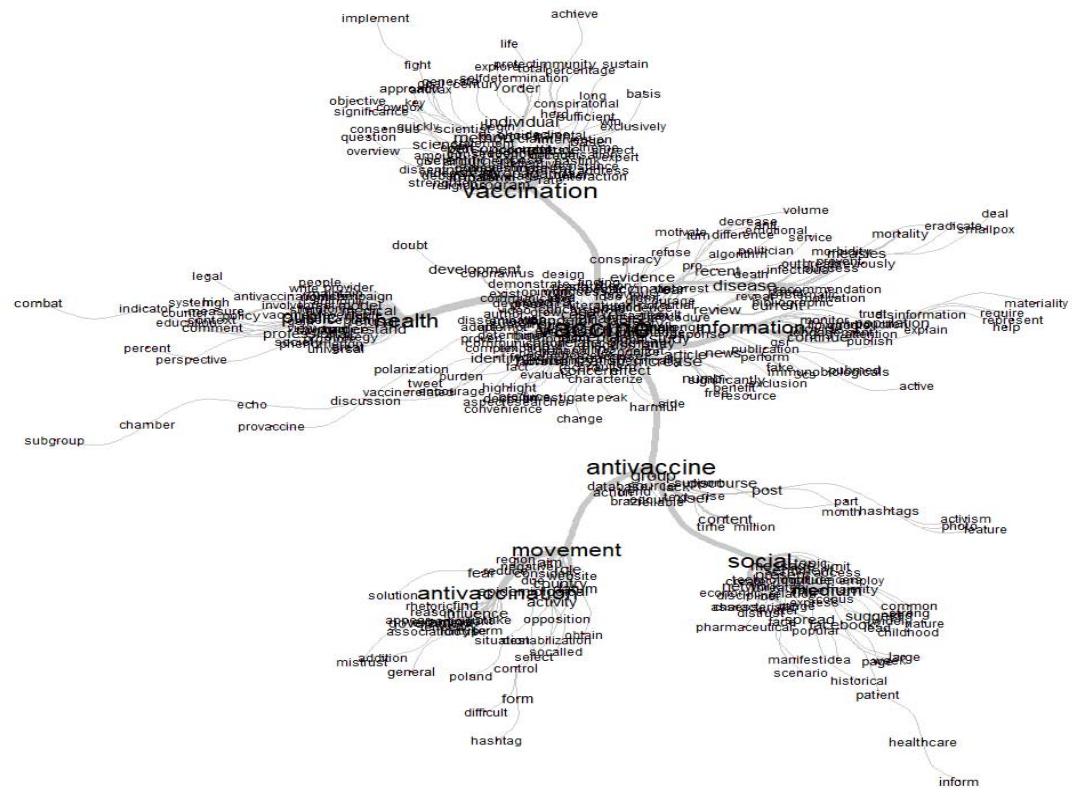 Figure 2
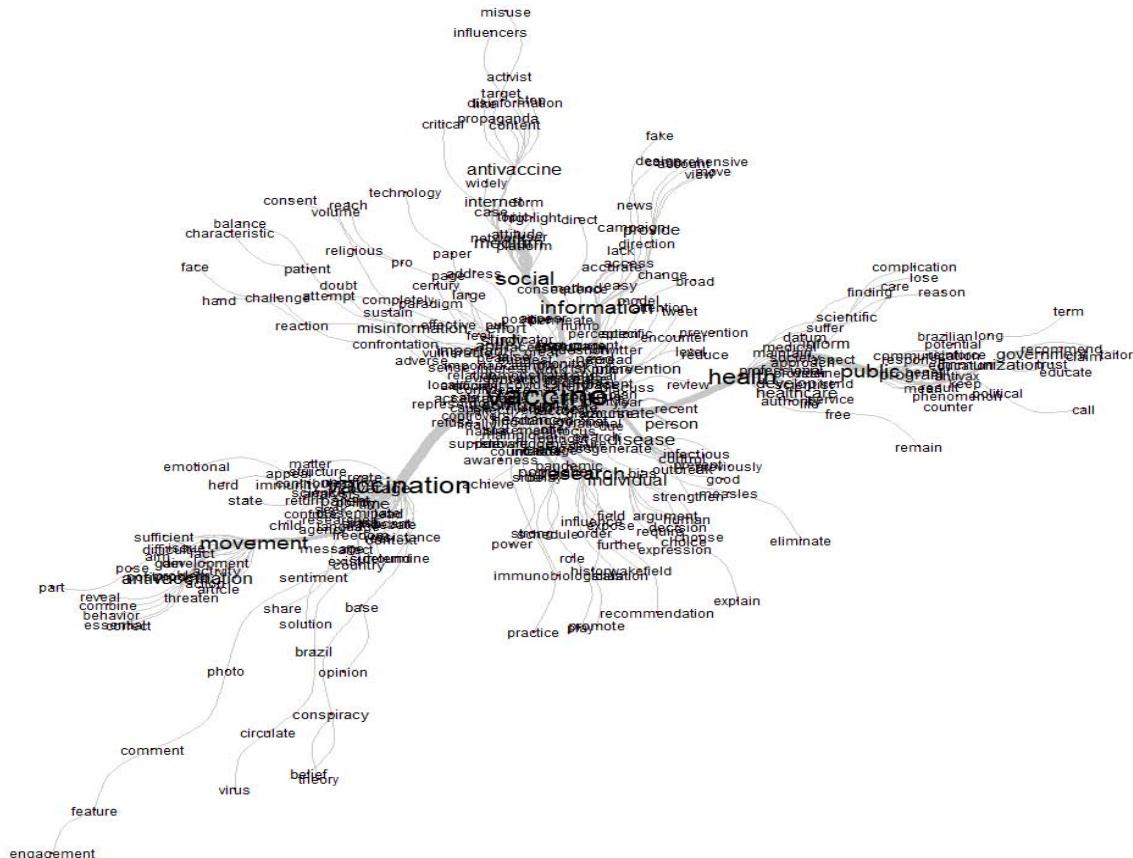 Figure 3
When we analyzed the relationship between the central theme of the 37 publications and the "Anti-Vaccine Movement" (Figure 4A), it was possible to observe that 28 (75.7%) had no direct relationship, 2 (5.4%) had a partial relationship with the theme and only 7 (18.9%) have a direct relationship.
And when we analyzed the mentions of the 37 publications regarding the implications of the "Anti-vaccine Movement" in the vaccination coverage of the Brazilian population and/or in general (Figure 4B), it was possible to observe that only 5 (13.5%) mentioned implications in the vaccination coverage of the Brazilian population, 6 (16.2%) mentioned implications in the vaccination coverage of the general population and 26 (70.3%) did not mention implications in the vaccination coverage of the Brazilian population and/or in general.
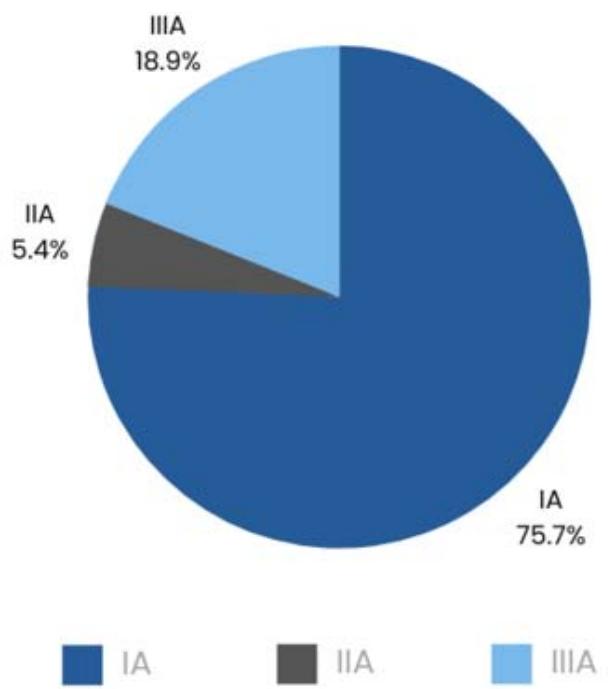 Panel label: A. Panel label: B.
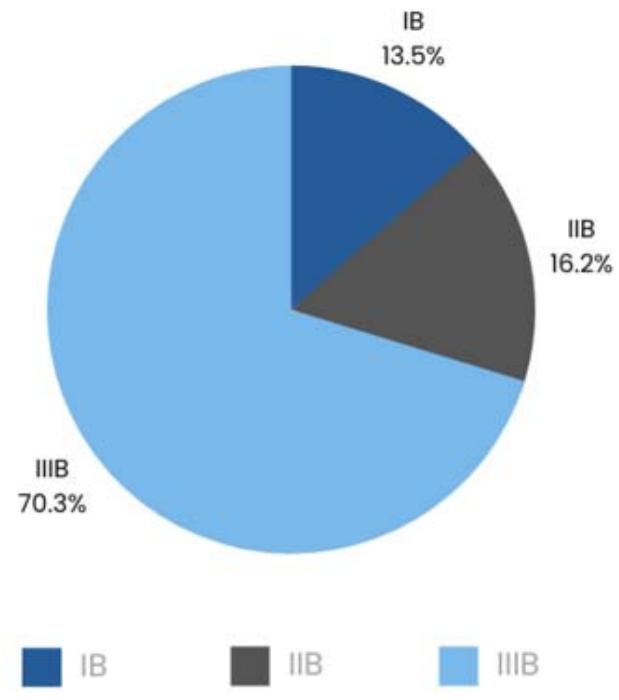 Figure 4: Graph with the number of publications and their relationship with the theme, in addition to mentions or not of implications for vaccination coverage in the Brazilian population and/or in general.
I-A: The publication is not directly related to the theme. II-A: The publication is partially related to the theme. III-A: The publication is directly related to the theme. I-B: The publication mentions implications for vaccination coverage in the Brazilian population. II-B: The publication mentions implications for vaccination coverage in the general population. III-B: The publication does not mention implications for vaccination coverage in the Brazilian population and/or in general.
## IV. DISCUSSION
The present scoping review sought to analyze the production on the anti-vaccination movement and its implications for vaccination coverage of the Brazilian population in the indexed scientific literature.
The 37 articles selected as sources of evidence made it possible to identify that, in the last two decades, there has been a significant increase in publications that address the theme of the "Anti-Vaccine Movement," going from 2 publications identified in the period from 2000 to 2010, increasing to 21 publications between 2011 and 2020 (ten times more), and between 2021 and 2023, already a number of 14 publications, which points to an increasing trend on the subject in the coming years.
From the similarity analysis carried out in the present study, it was possible to identify that the theme "vaccine" is a central theme in the publications, which is corroborated by the presence of the term in the center of the graphs of the abstracts and conclusions of the selected articles. The theme of the "anti-vaccination movement," despite the articles having become increasingly present and gaining greater attention,[31] is shown peripherally in our similarity graphs. This peripheral location of the "anti-vaccination movement" theme, as well as the absence of a direct relationship with the theme in most of the publications in our scoping review (28, 75.7%), indicates how this subject has been presented in the indexed scientific literature.
The publications selected as sources of evidence allowed us to perceive that there is a prevalence of use of the concepts of vaccine hesitation, vaccine refusal, with little mention of the term "Anti-Vaccine Movement" and the implications for vaccination coverage of the Brazilian population and/or in general.
The term "anti-vaccination movement" seems to be gaining more visibility in scientific research with the advent of social networks and, mainly, "fake news," which since 2016 have contributed greatly to the reduction of vaccination coverage in the population. Fake news is considered false information disseminated irresponsibly and at high speed, mainly in digital media. For the elaboration of such news, there is a complete absence of scientific information with respectable levels of evidence, being based on denialism that becomes more evident every moment.[47]
Such denial of science constitutes a major risk to Public Health, as demonstrated in the pandemic caused by Sars-CoV-2, in which empirical methods of prevention and treatment were passed on inconsequentially from individual to individual, evidencing the lack of respect and credibility to specialists and authorities in the area. Fake news circulates on the main social networks such as Facebook, Instagram, Twitter and Youtube, addressing a dangerous anti-vaccination discourse guided, by many, as the restriction of individual freedom being one of the consequences of vaccination.[48]
Digital media, as well as mass media, are important tools for disseminating news and information. Shapers of beliefs and popular opinions, they should be used as means by health and government authorities, aiming at carrying out health education with awareness plans accessible to the population. It is necessary to note that in the midst of the "information society" there is so much disinformation shared and taken as truth.[49]
## V. LIMITATIONS
Systematic scoping reviews have some limitations, such as the possibility of bias in the selection of studies, since not all studies can be included. In addition, the quality and availability of studies can affect the results. It is also important to consider that scoping reviews may not provide a complete summary of the results, since they do not carry out statistical analysis of the data. Additionally, a limitation of great relevance related to our work is the fact that for the study of this theme we are more in the field of ideas and associated with social networks.
## VI. CONCLUSION
The number of scientific publications on the anti-vaccination movement and its implications for vaccination coverage of the Brazilian population, from March 2001 to March 2022, is scarce and figures peripherally compared to the publications selected as sources of evidence in the present scoping review.
It is of great importance that new studies be carried out directly addressing this issue, clearly explaining the implications for the vaccination coverage of this population.
Generating HTML Viewer...
References
50 Cites in Article
Renata Beltrão,Alba Mouta,Nickolas Silva,Jocerone Oliveira,Ilvanete Beltrão,Camila Beltrão,Sâmara Fontenele,Augusto Da Silva (2020). Perigo do movimento antivacina: análise epidemio-literária do movimento antivacinação no Brasil.
Renata Beltrão,Alba Mouta,Nickolas Silva,Jocerone Oliveira,Ilvanete Beltrão,Camila Beltrão,Sâmara Fontenele,Augusto Da Silva (2020). Perigo do movimento antivacina: análise epidemio-literária do movimento antivacinação no Brasil.
E Dubé,M Vivion,Macdonald,Ne (2015). Vaccine hesitancy, vaccine refusal and the anti-vaccine movement: influence, impact and implications.
Mourad Ouzzani,Hossam Hammady,Zbys Fedorowicz,Ahmed Elmagarmid (2016). Rayyan—a web and mobile app for systematic reviews.
M Salviati (2017). Manual do Aplicativo Iramuteq -versão 0.7 Alpha 2 e R Versão 3.2.3.
I Ben-Gal,F Bayesian Networks ; Ruggeri,F Faltin,R Kenett (2007). Encyclopedia of Statistics in Quality and Reliability.
Sven Knüppel,Andreas Stang (2010). DAG Program:.
L Lebart,A Salem (1994). Statistique textuelle.
G Poland,M Jacobson (2001). Understanding those who do not understand: a brief review of the anti-vaccine movement.
Robert Wolfe,Lisa Sharp (2002). Anti-vaccinationists past and present.
Kata (2012). Anti-vaccine activists, Web 2.0, and the postmodern paradigm -An overview of tactics and tropes used online by the anti-vaccination movement.
Carmen Barbacariu (2014). Parents’ Refusal to Vaccinate their Children: An Increasing Social Phenomenon Which Threatens Public Health.
Naomi Smith,Tim Graham (2017). Mapping the anti-vaccination movement on Facebook.
C Basch,P Zybert,R Reeves,C Basch (2017). What do popular YouTube<sup>TM</sup> videos say about vaccines?.
Matthew Hornsey,Emily Harris,Kelly Fielding (2018). The psychological roots of anti-vaccination attitudes: A 24-nation investigation..
Azhar Hussain,Syed Ali,Madiha Ahmed,Sheharyar Hussain (2018). The Anti-vaccination Movement: A Regression in Modern Medicine.
Ana Schmidt,Fabiana Zollo,Antonio Scala,Cornelia Betsch,Walter Quattrociocchi (2018). Polarization of the vaccination debate on Facebook.
Aps Sato (2018). What is the importance of vaccine hesitancy in the drop of vaccination coverage in Brazil?.
Rnp Calderón,Jerez Pacheco,Y,Ruvalcaba Ledezma,J Chavarría,M,Jiménez Sánchez,R,Reynoso Vázquez,J (2019). The Influence of Antivaccination Movements on the Re-emergence of Measles.
Stephan Guttinger (2019). The anti‐vaccination debate and the microbiome.
Keith Gunaratne,Eric Coomes,Hourmazd Haghbayan (2019). Temporal trends in anti-vaccine discourse on Twitter.
Ubaldo Cuesta-Cambra,Luz Martínez-Martínez,José-Ignacio Niño-González (2019). An analysis of pro-vaccine and anti-vaccine information on social networks and the internet: Visual and emotional patterns.
Elvira Ortiz-Sánchez,Almudena Velando-Soriano,Laura Pradas-Hernández,Keyla Vargas-Román,Jose Gómez-Urquiza,Guillermo Cañadas-De La Fuente,Luis Albendín-García (2020). Analysis of the Anti-Vaccine Movement in Social Networks: A Systematic Review.
Yunhwan Kim,Donghwi Song,Yeon Lee (2020). #Antivaccination on Instagram: A Computational Analysis of Hashtag Activism through Photos and Public Responses.
G Borges,T Cervi,T Piaia (2020). Parental autonomy in health and anti-vaccine movement conformation in the post-truth scenario.
Lucy Elkin,Susan Pullon,Maria Stubbe (2020). ‘Should I vaccinate my child?’ comparing the displayed stances of vaccine information retrieved from Google, Facebook and YouTube.
Lucas Stolle,Rohit Nalamasu,Joseph Pergolizzi,Giustino Varrassi,Peter Magnusson,Joann Lequang,Frank Breve (2020). Fact vs Fallacy: The Anti-Vaccine Discussion Reloaded.
Witold Kołłątaj,Barbara Kołłątaj,Lech Panasiuk,Jarosław Sobieszczański,Irena Karwat (2020). Anti-vaccine movements – a form of social activity for health care, ignorance or diversion aimed at destabilizing the health situation? Part 1. Epidemiological safety. Vaccinations – pros and cons.
Kołł Bm,Wp,I Karwat,J Sobieszczański,L Panasiuk (2020). Anti-vaccine movements -health care, ignorance or a diversion aimed at destabilizing the health situation? Part 2. Contemporary conditions for the functioning and development of anti-vaccination movements.
Dominik Wawrzuta,Mariusz Jaworski,Joanna Gotlib,Mariusz Panczyk (2021). Characteristics of Antivaccine Messages on Social Media: Systematic Review.
Gcc Bivar,Mesc Aguiar,Rvc Santos,Prg Cardoso (2021). Covid-19, the anti-vaccine movement and immunization challenges in Brazil: a review.
Tanushree Mitra,Scott Counts,James Pennebaker (2021). Understanding Anti-Vaccination Attitudes in Social Media.
Alice Frugoli,Raquel Prado,Tercia Silva,Fernanda Matozinhos,Carla Trapé,Sheila Lachtim (2021). Fake news sobre vacinas: uma análise sob o modelo dos 3Cs da Organização Mundial da Saúde.
Ève Dubé,Jeremy Ward,Pierre Verger,Noni Macdonald (2021). Vaccine Hesitancy, Acceptance, and Anti-Vaccination: Trends and Future Prospects for Public Health.
Samuel Pullan,Mrinalini Dey (2021). Vaccine hesitancy and anti-vaccination in the time of COVID-19: A Google Trends analysis.
Jeanette Ruiz,Jade Featherstone,George Barnett (2021). Identifying Vaccine Hesitant Communities on Twitter and their Geolocations: A Network Approach.
Ariel Braverman (2021). Ecological model of health behavior as a methodology for reducing antivaccination trends.
Maiquel Wermuth,Joice Nielsson,Gisele Tertuliano (2021). “O BRASIL AINDA É UM IMENSO HOSPITAL” : MOVIMENTOS HIGIENISTAS E ANTIVACINA NO BRASIL – DA INCIPIENTE REPÚBLICA À CONTEMPORANEIDADE.
E Turillazzi,M Zanon,R Viola,P Frati,V Fineschi (2021). The Model of "Informed Refusal" for Vaccination: How to Fight against Anti-Vaccinationist Misinformation without Disregarding the Principle of Self-Determination.
Shelton Bradshawas,Ss,E Wollney,D Treise,Auguste (2021). Pro-Vaxxers Get Out: Anti-Vaccination Advocates Influence Undecided First-Time, Pregnant, and New Mothers on Facebook.
A Alamoodi,B Zaidan,M Al-Masawa,S Taresh,S Noman,Iyy Ahmaro (2021). Multi-perspectives systematic review on the applications of sentiment analysis for vaccine hesitancy.
Richele Vignoli,Rodrigo Rabello,Carlos Almeida (2021). Informação, Misinformação, Desinformação e movimentos antivacina: materialidade de enunciados em regimes de informação.
Seth Kalichman,Lisa Eaton,Valerie Earnshaw,Natalie Brousseau (2022). Faster than warp speed: early attention to COVD-19 by anti-vaccine groups on Facebook.
Ljc Saraiva,De Faria,J (2019). ACiência e a Mídia: A propagação de Fake News e sua relação com o movimento anti-vacina no Brasil.
Camargo Jr,K (2020). Lá vamos nós outra vez: a reemergência do ativismo antivacina na Internet.
Marieli Ferreira,Alexander Quadros,Amanda Dellanhese,Morgana Fernandes (2020). MOVIMENTO ANTIVACINAÇÃO NO FACEBOOK®:UMA ANÁLISE CRÍTICA DA DISSEMINAÇÃO DE NOTÍCIAS FALSAS / ANTI-VACCINATION MOVEMENT ON FACEBOOK®: A CRITICAL ANALYSIS OF THE DISSEMINATION OF FALSE NEWS.
No ethics committee approval was required for this article type.
Data Availability
Not applicable for this article.
How to Cite This Article
Amanda Dagnon da Silva. 2026. \u201cAnti-Vaccine Movement and its Implications for Vaccination Coverage of the Brazilian Population: A Scoping Review\u201d. Global Journal of Medical Research - K: Interdisciplinary GJMR-K Volume 23 (GJMR Volume 23 Issue K6).
Explore published articles in an immersive Augmented Reality environment. Our platform converts research papers into interactive 3D books, allowing readers to view and interact with content using AR and VR compatible devices.
Your published article is automatically converted into a realistic 3D book. Flip through pages and read research papers in a more engaging and interactive format.
Our website is actively being updated, and changes may occur frequently. Please clear your browser cache if needed. For feedback or error reporting, please email [email protected]
Thank you for connecting with us. We will respond to you shortly.