
I. INTRODUCTION
The elderly undergo biopsychosocial and functional changes that reduce their ability to adapt to the environment. In addition, pathological processes occur that make the elderly more susceptible to frailty. This frailty is based on three pillars, which include alterations such as loss of muscle mass (sarcopenia), neuroendocrine dysregulation, and immune dysfunction. Elderly people with these characteristics are more likely to suffer from muscle mass loss and develop a chronic inflammatory state. It is therefore clear that frailty is closely related to the quality of life of the elderly, since the more frail they become, the lower their general wellbeing.
Frailty in the elderly is a complex condition that can significantly compromise their quality of life. As we age, several factors such as decreased muscle mass, bone loss and changes in the immune system can contribute to frailty.2 This physical and functional vulnerability makes older people more susceptible to falls, illnesses and disabilities, which, in turn, negatively impacts their autonomy and independence. In addition to the physical aspects, fragility can also have emotional repercussions, leading to feelings of isolation and discouragement. Therefore, it is crucial to adopt integrated approaches to care, including regular physical activity, a balanced diet and psychosocial support, to preserve the health and promote the wellbeing of older people, minimizing the adverse effects of frailty on their aging journey.3
Frailty in the context of aging represents not just a physical condition, but a multifaceted challenge that can drastically reshape the life experience of older people. The real impact of this fragility transcends the evident limitations of mobility and resistance, directly influencing autonomy and the ability to actively participate in society.5 Physical vulnerability can translate into frequent falls and health complications, generating not only significant financial costs, but also triggering a cycle of functional decline. Coping with frailty requires a holistic approach that considers not only clinical aspects, but also social and emotional elements, aiming to restore and maintain the quality of life of the elderly in the face of these challenges.4
II. METHODOLOGY
The methodology used for this analysis was based on a literature review, in which the sources were obtained from the SciELO, Google Scholar, and PubMed data platforms. The search was conducted in August 2023, and inclusion criteria were applied, which involved the selection of works written in Portuguese and English, with online availability and full access to the content.
III. DISCUSSION
Ageing raises concerns about the impact on the quality of life of these individuals (Lenardt et al., 2016). According to Who (1995), quality of life is an individual's perception of their position in life according to the context in which they live and their relationship with expectations, goals, and concerns. In this sense, it can be seen that quality of life suffers from internal and external influences (Jesus et al., 2018).
The elderly undergo biopsychosocial and functional changes, which lead to a reduction in the ability to adapt to the environment, as well as pathological processes taking place, which makes the elderly more vulnerable and predisposes them to fragility (Siqueira et al., 2021). Mariana et. al. (2023) report that frailty is a syndrome characterized by a decrease in the body's physiological capacity since there is a disharmony in body homeostasis, making the elderly more vulnerable to falls, hospitalizations, and functional incapacity (Siqueira et. al., 2021).
Fried et al. (2001) define frailty as being based on a trip, since it presents alterations such as sarcopenia, neuroendocrine dysregulation, and immune dysfunction. Elderly people with these characteristics are prone to a loss of muscle mass and a chronic inflammatory state (Ferrioli et al., xxx).
Frailty in Elderly
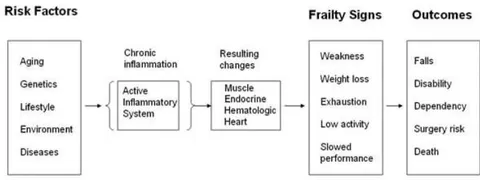
Modified from: Chen et al Clinical Interventions in Aging 9,436, 2014
Thus, frailty is related to the comorbidities and functional incapacity that the individual may have, since it includes reduced mobility, increased risk of falls and hospitalizations, as well as greater morbidity and mortality (Fried et al., 2001). All these factors will have a negative impact on quality of life in ageing (Siqueira et al. 2021).
It is therefore known that frailty is closely linked to quality of life in the elderly, since the greater the frailty, the lower the individual's well-being (Lenardt et al., 2016). In this sense, in order to improve quality of life during ageing, it is essential to look for resistance exercises, in addition to a multidisciplinary assessment, which should involve physical, psychological and social aspects.
IV. FINAL COMMENTS
The aging process has a significant impact on individuals' quality of life. Quality of life, as defined by the World Health Organization, is intrinsically linked to the individual's perception of their position in life. Ageing brings with it a series of biopsychosocial and functional changes that reduce the ability to adapt to the environment, making the elderly more vulnerable to pathological processes and frailty. Frailty, in turn, is characterized by a decrease in the body's physiological capacity and an imbalance in body homeostasis, with components such as sarcopenia, neuroendocrine dysregulation and immune dysfunction. This frailty is associated with comorbidities, functional incapacity, reduced mobility, an increased risk of falls, hospitalizations and greater morbidity and mortality, resulting in a reduced quality of life for the elderly. The greater the frailty, the lower the individual's well-being. In order to improve quality of life in the elderly, it is crucial to adopt strategies that include resistance exercise and a multidisciplinary approach, considering not only physical aspects, but also psychological and social ones. By understanding the factors that contribute to frailty and recognizing their negative influence on the quality of life of the elderly, we can seek solutions that promote healthier and more satisfactory ageing, with a view to the lasting well-being of these individuals.