
I. INTRODUCTION
Safe and affordable shelters are the basic needs for sustainability of any place. Achieving safe and resilient habitat is one of the main goal among Sustainable Development Goals post 2015 proposed by UN (2014). Settlements can be categorized as rural and urban in broad sense. Environmental impact often influences the individual choice of house types (UN Habitat, 2010) and this impact is significant on rural settlements. India is primarily rural in character where nearly of the Indian population lives in rural areas (Census, 2001). NSSO (2010) round report estimated that nearly and of the rural and urban households lived in pucca structures, around and of the rural and urban households lived in semi-pucca structures and approximately and of the rural and urban households lived in kachcha structures. According to Ministry of Rural Development, Govt. of India and National Family Health survey by International Institute for Population Sciences (IIPS) (2007) house types have been classified as Kachcha (both wall and roof made of natural material), Semipucca (either wall or roof made of finished or rudimentary materials), and Pucca (both wall and roof made of finished material) (Table 1). Indian rural settlements show a typical pattern with mud wall carrying the roof load with a support of two bamboo post in corner (World Housing Encyclopedia Report, 2002). The total number of census- houses have increased from 24.9 crore (2001) to 33.1 crore (2011) which is around higher than 2001 housing stock (Census, India). Empirical evidences show that better rural housing always has a positive correlation with creation of wealth and raises productivity in the rural sector in particular and hence augments social welfare too. In West Bengal about rural and urban households live in kachcha houses. rural and urban households live in semi- pucca and rural and urban households live in pucca houses (IIPS, 2010). Structures of house are directly associated with the household income as nearly of the rural households in the bottom quintile class based on monthly per capita expenditure mainly live in kachcha houses (NSSO, 2010) in India.
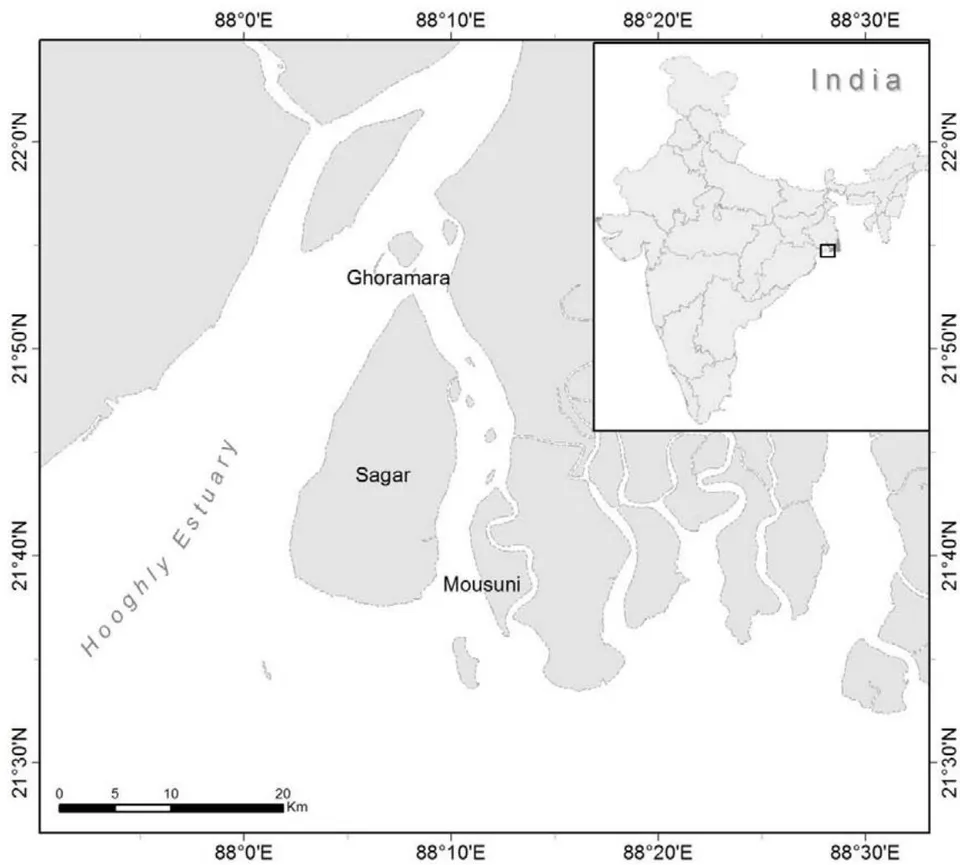
Climatic changes and extreme weather events have negative impact on settlements. Indian Sundarbans is very much prone to natural disasters like tidal surge and cyclones. But all the blocks in Sundarban except in Joynagar-1, less than households live in pucca or partially pucca houses with no security of living during disaster (HDR, S 24 Parganas, 2009) which requires urgent attention because it is associated with security of human life and property. The present study aims to assess the associations between natural hazards and housing pattern in (ISD) mainly focussing on Sagar, Ghoramara and Mousani islands (Figure 1). The area is a low, flat, alluvial plain intersected by a large number of tidal rivers, estuaries, and creeks with dynamic flow patterns of tidal water, along with the erosion accretion of land, have built up a complex geomorphology (Das, 2006). Climate change, induced sea-level rise, changing rainfall patterns, and changes in the frequency and intensity of extreme weather events have had significant impacts on the islanders of ISD (Danda, 2010). Half of the households of the islands of ISD experiences extreme events like cyclone, inundation and surges, land erosion among which almost of households reported loss from these hazards (Hajra et al., 2017). Cyclonic storm surges can damage embankments followed by saline water intrusion and flooding and lead to damages of property including mud wall of houses, cracks in structures; salinization and crop failure (Hajra and Ghosh, 2018; Hajra et al., 2017). Although earlier studies investigated the impacts of natural hazards on society in these islands (Hajra et al., 2017; Hazra et al., 2014), there is limited research examining the connections between vulnerability to natural hazards and change in housing pattern to combat extreme consequences. This study aims to fill this gap by examining on the housing structure and impact of each natural hazard on house types at a household level in the ISD and offer a number of concrete policy recommendations to reduce vulnerability to natural hazards.
| Category | Building materials | ||
| Natural | Rudimentary | Finished | |
| Wall | polythene/cane/palm/trunks/ bamboo/mud/grass/reeds/thatch | bamboo with mud/stone with mud/plywood/cardboard/un burnt brick/raw wood/reused wood | cement/concrete stone with lime/cement burnt bricks cement blocks wood planks/shingles gi/metal/asbestos sheets |
| Roof | thatch/palm leaf/reed/grass mud/sod/mud and grass mixture plastic/polythene sheeting | rustic mat palm/bamboo raw wood planks/timber unburnt brick/loosely packed stone | metal/gi wood calamine/cement fiber asbestos sheets rcc/ rbc/ cement/concrete roofing shingles tiles slate burnt brick |
| Floor | mud/clay/earth sand dung | raw wood planks palm/bamboo brick /stone. | parquet or polished wood vinyl or asphalt ceramic tiles cement carpet /polished stone/ marble/ granite |
II. DATA AND METHODS
Data have been collected for this study through direct interviews with households within the study area of ISD. In order to assess the impact of natural hazards on the different yard stick of housing structure of the study area a two-stage sample survey was conducted in three islands of Sundarban -Sagar, Ghoramara and Mousani during March 2012 to October 2013. In the first stage, using Tippett's random number tables mouzas were selected from all three islands; in the second stage, a systematic sampling procedure is applied where a first house was selected randomly using random number table in each mouza and remaining were chosen maintaining a prescheduled constant gap of the houses. Sagar Island has 42 villages under 9 Gram Panchayat of Sagar Block. Ghoramara is a single mouza under Sagar Block and Mousani has 4 villages. The survey was carried out through direct interviews in of the inhabited mouzas of Sagar Block, including Ghoramara (23 mouzas out of 42) and of the inhabited mouzas (4 mouzas) of Mousani Gram Panchayat of Namkhana Block (Figure 1). In our survey of mouzas were selected with members of 783 households from 27 villages of the study area. The margin of random error (Fox et al., 2009) was obtained close to at confidence interval for the selected number of sample.
Respondents were asked if they felt the impact of climate change i.e. some questions covered whether they affected by the different natural hazards or not. Questions were also asked to get the type of the housing structure of the inhabitants to cope with natural hazards. The main aim of this study has been to assess the linkages between some key explanatory variables related to natural hazards of interest such as surge (S), Inundation (I), cyclone (C) and erosion (E) with housing variables through statistical models. Housing variables for our study are the main materials used for the construction of walls (W), floors (F) and roofs (R) among the surveyed households. Each housing material is divided into categories of natural, rudimentary, and finished. This study has also considered the height of the floor (H) from the land. In our analysis, the hazards variables were assigned as 1 or 0 accordingly the response of the inhabitants was yes or no, respectively. Study also consider different place or land (L) as a control variable. The numbers 1, 2, and 3 were assigned if Sagar, Ghoramara and Mousani were considered. Similarly, the response variables wall, roof and floor materials are categorical and 1, 2, and 3 accordingly have been assigned if made by natural, rudimentary, or finished material. Height of the floor is also assigned 1, 2, and 3 if the height is less than 1 ft, between 1 ft to 2 ft and more than 2 ft respectively. Study uses 4 different models to analyse the result. In model 1, wall material was taken as dependent and surge, inundation, erosion, and cyclone were considered independent variables, controlling the control variable land. The independent variables are same for all other models. The housing variables Roof type, Floor type and Height of floor are the dependent variable for the respective models 2, 3 and 4. In all the models dependent and independent variables were used to identify the associations as stated in the aims of this study. The response variables, i.e., the housing variables being categorical in nature and these dependent variables are of different layers, so multinomial logistic regression has been performed to test the effects. This analysis has been done in SPSS software.
In general, If the dependent variable is categorical and takes values, are the explanatory (independent) variables and Probability with , then the log model is:
and hence,
Here are the coefficients of the regressors corresponding to i-value of y and let outcomelis chosen as pivot. The Maximum Likelihood Method is used to obtain these estimates.
Thus, for models 1, 2, 3 and 4 y represents respectively house material, roof type, floor type and height of floor.
p-values were measured to test the impact of the hazards on the different parameters of the housing structure. If p-values (0, 0.001, 0.01, 0.05, 0.1), then the explanatory variables have a significant effect at the level . Generally, up to , here consider higher significant effect. However, if then one can also say the corresponding factor has a small significant effect.
data have been used in this study from Sagar, Ghoramara and Mousani islands of ISD. Result of descriptive analysis (Table 2) shows that inhabitants of Sagar and Mousani are suffered more from the inundation and tidal surge whereas the people of Ghoramara suffered maximum from erosion. It is also observed that among households and in Sagar, and in Ghoramara, and in Mousani have been suffered from two and three types of hazards respectively. Only a rare section of the inhabitants are never been affected from any natural hazards. This confirms the pivotal role of natural extreme events on these islands in line with previous literatures (Hajra et al., 2017; Hazra et al., 2002; Gopinath, 2010). Study observes that most of the inhabitants either lose land or house or both land and house. Estimation of losses (Table 2) shows that the people of Ghoramara are suffered more from losses than other two islands as of households lost land, of households lost both land and house while these figures are lower in Sagar and lowest in Mousani. This suggests the importance of studying hazard parameter that related to the day to day life of the inhabitants. However, this study restricted to analysing the influence of natural hazards on housing pattern and the changes made on housing structure to prevent these extreme natural events.
III. RESULTS
In order to examine the association between housing structure and natural hazards, household level
| Descriptive statistics (% of households) | ||||
| Natural hazards | Sagar | Ghoramara | Mousani | |
| Categories of natural hazards | Surge | 59 | 46 | 49 |
| Inundation | 60 | 58 | 87 | |
| Cyclone | 43 | 21 | 43 | |
| Erosion | 17 | 75 | 21 | |
| Number of categories faced by households | One | 16 | 18 | 33 |
| Two | 49 | 42 | 37 | |
| Three | 11 | 33 | 7 | |
| Four | 5 | 0 | 15 | |
| Types of Losses | Land | 11 | 50 | 4 |
| House | 6 | 2 | 4 | |
| Land and house | 13 | 22 | 10 | |
| Housing structure | ||||
| Wall material | Natural | 80 | 92 | 70 |
| Rudimentary | 06 | 04 | 20 | |
| Finished | 14 | 04 | 10 | |
| Roof material | Natural | 31 | 25 | 34 |
| Rudimentary | 06 | 00 | 00 | |
| Finished | 63 | 75 | 66 | |
| Floor material | Natural | 60 | 91 | 90 |
| Rudimentary | 04 | 00 | 00 | |
| Finished | 36 | 09 | 10 | |
| Floor height | <1ft | 24 | 29 | 39 |
| 1-2 ft | 48 | 67 | 52 | |
| >2ft | 28 | 04 | 09 | |
| Number of rooms | 1 | 63 | 50 | 75 |
| 2 | 30 | 42 | 23 | |
| More than 2 | 09 | 08 | 02 | |
This study finds that , and households live in semi-pucca houses and , and households live in kachcha houses in Sagar, Ghoramara and Mousani respectively whereas only houses in Sagar and Mousani and houses in Ghoramara are of pucca structures. Descriptive analysis on housing structure shows that in all three islands natural materials are most preferred for wall and floor construction. , and households used natural material for wall and , , households used natural material for floor in Sagar, Ghoramara and Mousani respectively. Being riverine islands, mud is easy available from river, creeks and ponds and used as wall and roof material (Ugbomeh, 2016). Finished materials are preferable for roof among the inhabitants including in Sagar, in Ghoramara and in Mousani Island. This can be explained as these islands are prone to cyclonic hazards, peoples try to stabilize the roof by finished materials like asbestos, tiles to protect form cyclonic storm (Ugbomeh, 2016; Das et al., 2012; Paul and Routray, 2011; Pinelli et al., 2004). , , and households of Sagar, Ghoramara and Mousani Island have houses with floor height between 1 ft to 2 ft to avoid the storm surges and tidal water inundation and destruction of housing structure. Sagar Island being affected more from inundation has houses having floor height more than 2 ft. The inhabitants of these islands are mostly poor, so having only one room among majority households (Table 2). The impact of natural hazards are more on the poor community (Hajra et al., 2017), hence they tried to maintain discussed housing pattern to minimise losses from natural hazards. In the next section of analytical part multinomial logistic regressions are considered to identify the associations between the natural hazard and different characteristic of housing structure. Four separate tables (Tables 3-6) show the results of four separate models that tested our hypotheses.
| Wall material | Variable | Estimates | Standard Error | p-value |
| 1.00 | Intercept | 1.928 | 0.577 | 0.071 |
| [Surge=0] | -0.333 | 0.377 | 0.057 | |
| [Inundation=0] | 0.250 | 0.410 | 0.031 | |
| [Cyclone=0] | 0.069 | 0.378 | 0.085 | |
| [Erosion=0] | 0.369 | 0.408 | 0.036 | |
| [Island=Sagar] | 0.027 | 0.484 | 0.096 | |
| [Island=Ghoramara] | 1.134 | 1.161 | 0.082 | |
| 2.00 | Intercept | 0.252 | 0.702 | 0.719 |
| [Surge=0] | -0.333 | 0.450 | 0.075 | |
| [Inundation=0] | 0.653 | 0.473 | 0.016 | |
| [Cyclone=0] | 0.040 | 0.451 | 0.092 | |
| [Erosion=0] | 0.765 | 0.518 | 0.014 | |
| [Island=Sagar] | -0.361 | 0.559 | 0.098 | |
| [Island=Ghoramara] | 1.02 | 0.99. | 0.072 |
In order to examine the relationship between the wall material with inundation, erosion, cyclone, controlling for other variables included in the model, regression analysis was performed (Model 1 - Table 3). The p-values of the coefficients corresponding to the key variables including inundation, erosion, and cyclone shows that all the hazards have a more or less significant effect on different structure of the wall. The place also has a small significance effect. Among the hazards erosion along with inundation have the higher significant affect for wall material. Here the Goodman and Kruskal's coefficients has calculated between wall type and erosion, inundation and the place and they are -0.71, -0.57 and -0.29 respectively.
| Roof material | Variable | Estimates | Standard Error | p-value |
| 1.00 | Intercept | -0.426 | 0.380 | 0.263 |
| [Surge=0] | -0.207 | 0.256 | 0.420 | |
| [Inundation=0] | 0.356 | 0.267 | 0.182 | |
| [Cyclone=0] | -0.315 | 0.260 | 0.022 | |
| [Erosion=0] | 0.014 | 0.304 | 0.593 | |
| [Island=Sagar] | -0.960 | 0.305 | 0.512 | |
| [Island=Ghoramara] | -0.273 | 0.563 | 0.628 | |
| 2.00 | Intercept | -40.401 | 1.616 | 0.428 |
| [Surge=0] | 1.251 | 1.050 | 0.634 | |
| [Inundation=0] | .287 | 1.076 | 0.279 | |
| [Cyclone=0] | 18.699 | .000 | 0.039 | |
| [Erosion=0] | -0.057 | 1.189 | 0.096 | |
| [Island=Sagar] | 1.646 | 0.467 | 0.667 | |
| [Island=Ghoramara] | -0.667 | 0.500 | 0.942 |
In Table 4 - Model 2 multinomial logistic regression of roof type on inundation, erosion, cyclone, and the place has been done. Table 3 also shows that only cyclone influences different type of roofs. This is why to cope with impact of cyclone most of the inhabitants use finished product for their roof in ISD. Here the coefficient between roof type and cyclone is 0.34.
| Floor material | Variable | Estimates | Standard Error | p-value |
| 1.00 | Intercept | 61.100 | 3288.180 | 0.985 |
| [Surge=0] | 14.694 | 1749.781 | 0.099 | |
| [Inundation=0] | 12.855 | 2084.671 | 0.099 | |
| [Cyclone=0] | -14.602 | 1863.908 | 0.994 | |
| [Erosion=0] | 13.252 | 2067.913 | 0.009 | |
| [Island=Sagar] | -14.531 | 0.481 | 0.375 | |
| [Island=Ghoramara] | -12.442 | 4890.915 | 0.824 | |
| 2.00 | Intercept | 42.050 | 4348.924 | 0.992 |
| [Surge=0] | -14.813 | 1749.782 | 0.096 | |
| [Inundation=0] | 13.458 | 2084.671 | 0.075 | |
| [Cyclone=0] | -14.845 | 1863.909 | 0.994 | |
| [Erosion=0] | -14.621 | 2067.914 | 0.034 | |
| [Island=Sagar] | 0.252 | 2846.227 | 0.560 | |
| [Island=Ghoramara] | -13.357 | 7614.820 | 0.999 |
Table 5- Model 3 illustrates regression analysis considering floor type, inundation, erosion, cyclone, land. The p-value indicates that erosion has most influential for floor material. Surge and erosion have also some impact on the material of floor. Here coefficients between floor type and inundation, surge and erosion are respectively -0.27, -0.14 and -0.61.
| Height of floor | Variable | Estimates | Standard Error | p-value |
| 1.00 | Intercept | 1.405 | 0.640 | 0.028 |
| [Surge=0] | 0.748 | 0.377 | 0.047 | |
| [Inundation=0] | 0.633 | 0.393 | 0.011 | |
| [Cyclone=0] | -0.898 | 0.408 | 0.328 | |
| [Erosion=0] | -0.221 | 0.445 | 0.022 | |
| [Island=Sagar] | -0.479 | 0.502 | 0.074 | |
| [Island=Ghoramara] | 0.510 | 1.217 | 0.097 | |
| 2.00 | Intercept | 2.017 | 0.615 | 0.001 |
| [Surge=0] | -0.130 | 0.356 | 0.071 | |
| [Inundation=0] | -0.002 | 0.375 | 0.049 | |
| [Cyclone=0] | -0.604 | 0.398 | 0.129 | |
| [Erosion=0] | -0.171 | 0.429 | 0.049 | |
| [Island=Sagar] | -0.081 | 0.488 | 0.067 | |
| [Island=Ghoramara] | 1.304 | 1.172 | 0.095 |
In Table 6- Model 4, an attempt has been made to find out the associations between height of the floor and inundation, erosion, cyclone, and land. This table reflects that among the hazards erosion and inundation have highly significant effect on the height of the floor. The island also has an effect on planning on height of the floor. Sagar has the more proportion of the houses having above 2 ft height of the floor than other islands which can be explained by the diurnal flooding from tidal spill (Hajra and Ghosh, 2018). Here the coefficients between floor height and inundation, erosion and land are respectively 0.42 and 0.53 and -0.18.
IV. DISCUSSION AND POLICY IMPLICATIONS
Islands of ISD are highly vulnerable from natural hazards. In addition, large proportions of the households in the study area are poor and thus have limited access to resources and facilities (Ghosh, 2012). In this context, the main objective of this paper is to examine the association between natural hazards and housing pattern to combat extreme consequences in these islands of ISD. The results of the study confirmed that there is significant association between natural hazards and housing structure. In line with previous literature (Hajra et al., 2017; Hazra et al., 2002) this study also finds that most of the households are suffered from more than one type of natural hazards. Results of multinomial logistic regression show that erosion and inundation has significant impact on the wall and floor material similar with findings of previous literature (Chand et al., 2012; Paul and Routray, 2011; Hutton and Haque, 2003). Again in line with other literature (Ugbomeh, 2016; Das et al., 2012; Paul and Routray, 2011; Pinelli et al., 2004) this study suggests that finished materials are preferable for roof among the inhabitants to stabilize and protect the roof form cyclonic storm. Height of the floor is also maintained above 1 ft to 2 ft. This can be explained by the fact that the households try to protect the houses from storm and tidal surge and inundation (Hajra et al., 2017; Hazra et al., 2002; Ghosh et al., 2001).
Based on the findings of this study few policy recommendations are provided for improving the residential structures including wall, floor and roof material. Planned housing structure is needed especially in coastal mouzas. For this to effectively occur, programs must become more responsive in promoting constituency-building and lobbying among the poorest and most vulnerable. The implication of the 'Indira Awas Yojona' and other Government schemes under the supervision of the local Panchayat should be taken with utmost priority to the vulnerable mouzas mainly Ghoramara, Sapkhali, Baliara etc. Along with the proper maintenance of housing structure natural hazards management planning is also necessary to prevent further losses. Development of community infrastructure can increase societal resilience, and reduce the intensity of natural hazard impacts on households. Establishment of flood shelters, maintenance of embankment, development of wireless networks, and improvement of warning system could enhance the societal resilience.