
I. INTRODUCTION
Waste management remains a significant concern for most countries around the world. Furthermore, the quality of life and the sustainable socio-economic development of populations in urban and peri-urban areas are understood by greenhouse gas emissions, the eutrophication of environments due to untreated solid and, or liquid discharges, the lost soil fertility, groundwater pollution (Lakiotia et al., 2017; World Bank, 2010, p. 33). It represents one of the most complex environmental problems to solve because of its transversal and multifactorial nature. Indeed, the difficulties in implementing climate change mitigation measures stem from the poor management of most waste produced in low-income countries (Kaza et al., 2018; McAllister, 2015). In these countries, the increase in this waste is due mainly to galloping urbanization, accelerated population growth, and new consumption patterns in urban areas. In India, for example, the mode of transport and time of dumping of abused waste, coupled with the issues of the rapid urbanization process and its environmental degradation impacts, constitute the most pressing issue which is causing the health hazards in outlying areas of cities (Narain et al., 2014, pp. 11, 18). The anarchic management of household waste has a significant environmental impact. In the informal neighborhoods of African cities, the poor management of sanitation systems is considered a factor in the deterioration of the health status of communities. Malaria and diarrheal diseases, whose prevalence (47.1% and 19.2%, respectfully) increase during the rainy seasons are among the most worrying non-communicable diseases in these poor areas in Abidjan (Dongo et al., 2010, p. 34; Naibbi & Umar, 2017, pp. 31-32). Thus, the degradation and insalubrity linked to the poor management of household waste are the cause of approximately 2.2 million deaths per year in the African region. This number compared to the global burden of disease (12.6 million deaths) represents a mortality rate of 17.46% in 2012 (OMS, 2016).
In Africa, the management of household solid waste has become an essential concern in urban areas, given that they concentrate on different categories of populations and economic activities. The daily production of household waste from about 2500 tons in 2002 increased to 3500 tons in 2010 (Nallari et al., 2012). However, management is limited to landfilling, and therefore, household waste is not subject to any treatment or control process. Thus, this method of waste management strongly contributes to the degradation of the environment due to the proliferation of illegal dumping. These sources of nuisance expose local residents to health and environmental risks. Indeed, mosquitoes, flies, mice and bacteria are factors in the spread of diseases. These are malaria, typhoid fever, cholera, yellow fever, pulmonary infections and acute respiratory illness (World Bank, 2010; Athanase, 2016, p. 60).
This is the case in the city of Abidjan, where most of the population in households is exposed to the effects of pollutants (62.1%) and shows signs of intoxication (51.1%) as well as respiratory, cardiac, and cutaneous diseases such as cough (37.1%), asthenia (33.1%), pruritus (29.9%) and nausea (29.1%) (Dongo et al., 2012). In addition, this situation leading to ecological risks justified the implementation of the project to close the Akouédo landfill on December 15, 2018, according to the Ministry in charge of sanitation. Indeed, this landfill opened in 1965 and has saturated in recent years. It made it possible to collect 3,000 tons of waste composed of 49% food per day (Soumaho et al., 2021; Japan International Cooperation Agency, 2018).
The public authorities have made the management of urban solid waste one of the challenges to be met, in accordance with the vision of emergence in Côte d'lvoire by 2020. In 2016, a budget of 30 billion FCFA was allocated for the collection and disposal of waste (RCI, 2011, 2015). In practice, the solid waste management process, through the involvement of both formal actors and private sectors, generates beneficial impacts on the monthly amount that households are willing to pay for the improvement of the collection, sorting and recycling service. Indeed, local informal or private operators (including NGOs) interact with the formal sector represented by government agencies at every stage of solid waste management (Suchada et al., 2003, pp. 8-9; Oteng-Ababio, 2012, p. 417; Briand & Kone, 2020, pp. 16-18). But waste management remains a concern because the efforts are far from favoring the achievement of the expected results.
In the District of Abidjan, the Yopougon Services Platform (PFS-Yop) has made it possible to involve households in the waste recovery activity. With the support of an intermediary in the village, Group Bio, an Economic Interest Grouping (EIG) created to ensure the execution of the project, carried out sensitizations to explain the benefits of this project and how it was going to happen. Thus, he distributed garbage bags to collect only organic waste. Households, for their part, had the role of sorting their waste and putting in the bags, only organic waste such as banana skins, cassava, food scraps, etc.
However, this development project is encountering difficulties in its development in Abidjan and particularly in the Adiopodoume village, located in the commune of Yopougon. Indeed in the field, we found that the structural-organizational problems enameled the management of household waste in the municipality. But on analysis, some facts and observations lead one to believe that these project difficulties are linked to the demotivation of the actors that are the Group Bio, the intermediary of the village and the households.
The general objective of this study is therefore to understand the factors that explain the demotivation of the actors in the solid waste recovery activity (households, Group Bio, and village intermediary). As specific objectives, it is a question of describing the strategies of management of the valorization of the organic waste, identifying the representations of the actors, and analyzing the stakes related to this activity in Adiopodoumé.
II. THEORETICAL FRAMEWORK
The problem of waste management is a complex societal challenge in contemporary societies. It is a social object constructed by the social representations of individuals and communities. Among these populations, awareness of environmental responsibility could be a determining factor in ecological behavior (Kaiser et al., 1999, p. 66). This ecological awareness reflects the level of commitment of the populations in their community space. Each actor therefore has a role to play in the effective management of waste, within its social structure (Suchada et al., 2003). Thus, the theory of structural-functionalism chosen made it possible to explain the phenomenon better. According to this theory, the actions of individuals fulfill functions in the social structure (Parsons, 1937). The structural-functionalist view is drawn from the work of several classical and neoclassical sociologists in Europa (Weber, Pareto, Alfred Marshall, and Emile Durkheim) and translates a standard systematic theory of action based on a voluntarist or alternative principle.
For Parsons, individuals are social actors who seek to satisfy needs; to do this, they set themselves objectives and develop the most effective strategies to achieve these objectives. The author also notes that the satisfaction of these needs is achieved under material and, above all, symbolic constraints that individuals must consider.
Parsons suggests analyzing society, which he calls the social system, as a set of exchanges regulated by a cybernetic principle; through its means of communication. Because the system is a complex object composed of interdependent elements, which allows the integration of individuals. This social system must satisfy four needs in order to maintain itself and subsist. Those are:
Adaptation, meaning that society must balance its resources to ensure its survival;
The maintenance of relations with its environment to take what it needs. For this, the system must mobilize its resources to achieve its goals;
The pursuit of objectives involving the coordination and integration of the different interests of all parts of the system;
The maintenance of models and standards and the management of tensions. This implies that the system must ensure the cohesion of its social structures and maintain the motivation and commitments of the actors.
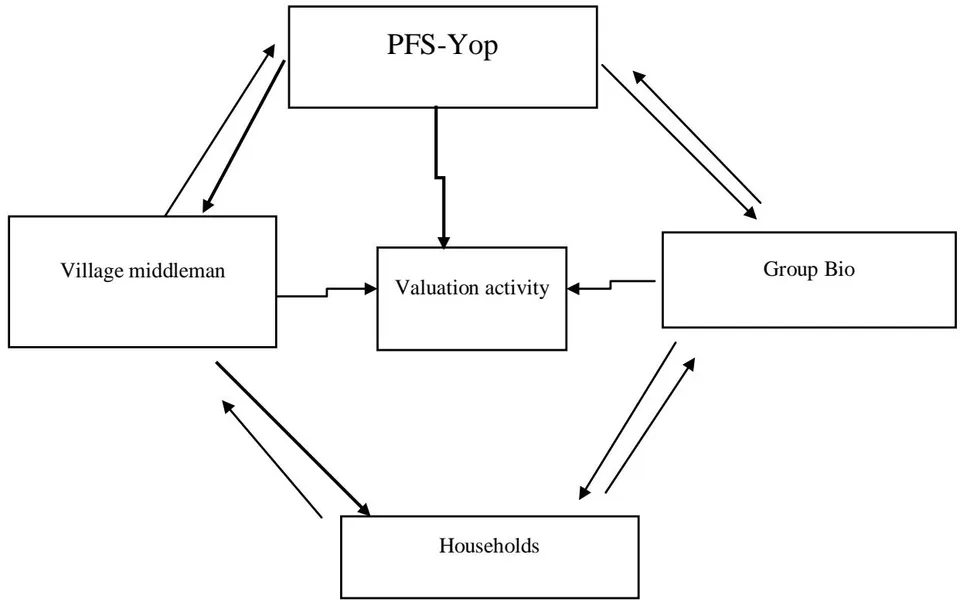
The Yopougon Services Platform (PFS-Yop) is a system created in September 2011. Its objective is to promote the sustainable integration of young people through economic activity. The platform has set up an organic waste recovery center in Adiopodoume for training, the promotion of sustainable peri-urban agriculture and the entrepreneurship development. The official launch of this project was made on February 27, 2015. The goal is to improve the management of 180,000 tons of waste in the municipality. The Yopougon Services Platform ensured the management and control of the recovery activity.
For the execution of the recovery project, the PFS-Yop has made available to Group Bio, a newly created Economic Interest Grouping (EIG), financial, material, and human resources. Group Bio has worked with PFS-Yop to help clean up the living environment of communities by collecting around 7.5 tons of waste per day and producing about 100 tons of compost to improve local market gardening.
This group was responsible for carrying out the organic waste recovery activity by involving members of the village community of Adiopodoume in a particular task. In this context, the village intermediary played the role of guide for Group Bio, which he supported during the sensitization of households. Thus, he oriented him on the behavior to adopt in the village. As for families, they have been made aware of sorting their waste, by putting only organic waste such as banana skins, cassava skins, food scraps, etc., in the garbage bags distributed by Group Bio.
This whole organization forms a system in the organic waste recovery activity in Adiopodoumé.
Figure 1 describes the relationship between the actors involved in the integrated process of managing the recovery of household solid waste in Adiopodoumé.
III. METHODOLOGY
a) Field of study
The definition of the geographical field makes it possible to circumscribe the space in which our study is carried out. The research is conducted in the village of Adiopodoumé.
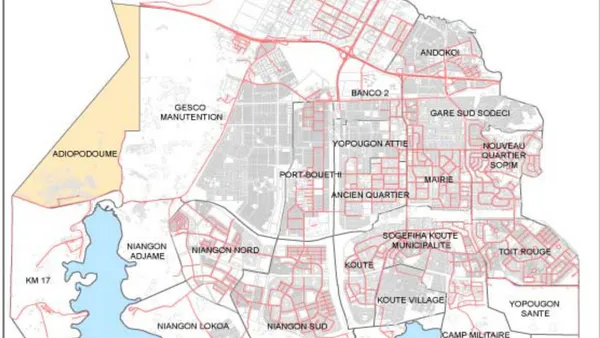
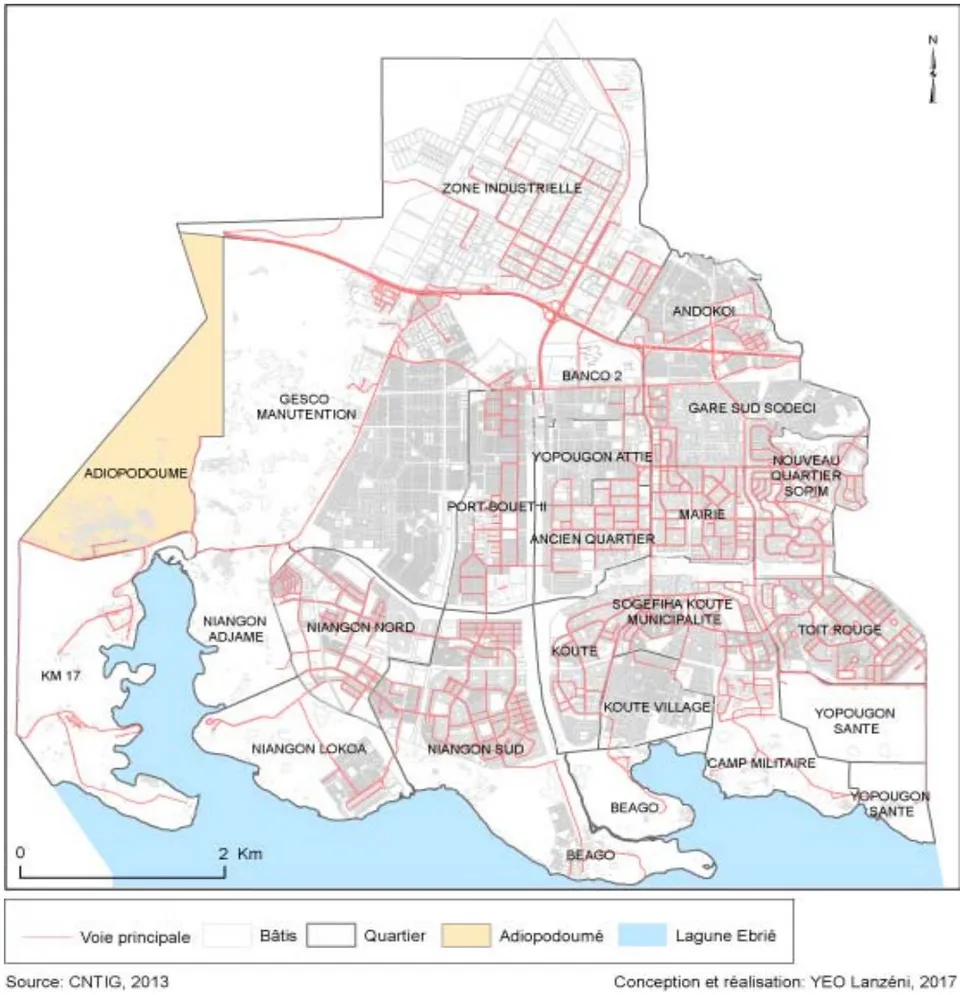
The village of Adiopodoumé is located southwest of the commune of Yopougon in the District of Abidjan. It is in a sedimentary basin, and the soils are clay sediment type. Adiopodoumé is crossed by a river and to the south by the Ebrié lagoon. Its location on the coast's edge gives it a humid equatorial climate. Precipitation subdivides the annual cycle into four essential seasons.
Temperatures vary between and (Koffi, 2007).
The choice of Adiopodoumé is justified because this village, which is in a peri-urban area, is confronted with the problem of managing household waste, the majority of which is of organic origin.
In addition, Adiopodoumé is an area with high vegetable production. The recovery of this waste can bring many immediate environmental, health and agricultural benefits. However, the demotivation of the actors does not favor this condition in Adiopodoumé. This reality led to the choice of this peripheral village as a field of investigation. Figure 2 below shows the location of Adiopodoumé.
As for the social field, its determination consists in defining the object of study and in determining the target population, that is to say the individuals or groups of sociologically representative individuals. The purpose is to reach the numbers of these at the time of the field survey (Kawulich, 2005; Smit & Onwuegbuzie, 2018).
The objective of the study led to identify:
The head of the PFS-Yop;
The technical manager of the town hall;
Members of Group Bio;
The intermediary of the village;
The customary authorities of Adiopodoumé
Households that hold the raw material for the recovery activity.
In addition, the study on the problem of the recovery of solid organic household waste falls within environmental sociology.
b) Data collection and analysis techniques
The documentary research was beneficial for the elaboration of our research question. It led us to consult the works that had a link with our research topic. These include specific and methodological works, reports and dissertations, related to our research topic. To this end, we visited libraries, in particular, the CSRS and the CIRES. We also consulted press articles, investigation reports, conferences, theses, books, etc.
The internet also allowed us to complete the information collected. These helped us to draft the theoretical and methodological framework.
Observation is the set of operations by which the analytical model is subjected to the test of facts. It consists of apprehending behaviors or events over a given period and recording them (Kawulich, 2005).
It made it possible to get closer to the target population to access the information requested (Reinharz, 2011). It also facilitated the collection of certain preliminary report concerning the degree of involvement of each actor in the waste recovery activity.
First, we walked through the village to soak up the level of sanitation in the village. We observed that the main activity of women is the marketing of attiéké and identified several wild dumps. This accentuates bad smells, flies and mosquitoes in the town.
We also did the pre-collection with the young people of Group Bio. Thus, we obtained results on women demands and pre-collectors difficulties.
To establish a relationship of trust and belong to the community, we participated in fraternal meals. This approach made it possible to have information on the village and to know the attitude of the population concerning sanitation.
For the interview with specific players in the waste recovery activity, we have drawn up an interview guide. This guide focused on the organization of the different entities and their representation and the challenges of the recovery activity. Table 1 shows the people we interviewed.
| Type of people | Number |
| Members of the Group Bio | 04 |
| village middleman | 01 |
| Customary authorities | 03 |
| Head of the PFS-Yop | 01 |
| Technical manager of the town hall | 01 |
| Household members | 78 |
| Total | 88 |
About the processing, we carried out a manual analysis of the data through transcription. For the analysis of these data, the transversal synthesis of the interviews is obtained by the content method following a process of thematic analysis (Braun & Clarke, 2006; Flick, 2006).
IV. RESULTS
a) The sanitary and hygienic challenges of the recovery activity
Sanitary and hygienic reasons are perceived as a significant problem for participation in the waste recovery project. Indeed, this activity allows a considerable reduction of household waste. Households are aware of the problems associated with waste and see this project as a way to have a healthy living environment. But behind this reason hides a material interest, which is reflected in the promises made by Group Bio.
In addition, the analysis highlights the risks of injury and contamination to which those involved in composting are exposed:
"Equipment such as the shredder could cut us. We weren't fully protected. Often households do not sort well, so there may be syringes, bottles, and sharp objects that can hurt us."
Admittedly, the latter benefited from vaccines before the start of the project and received boxes of milk after their activity and even medication when they felt unwell. One of the actors mentions that they did not carry out medical visits during the activity. He says it in these terms:
"Since the project started until today, we have never gone to the hospital for medical follow-up."
The analysis at the sanitary level highlights the importance of the clean and hygienic aspects in executing the recovery activity. The results obtained show that this is one of the main reasons, according to membership, even if on the ground, the observation is different.
The health risks related to the execution of the recovery activity are among other difficulties for the project's sustainability. Indeed, the lack of shelter on the composting site was also a difficulty during the interviews. We observed during the field visit that the area which received the organic waste was not covered. Rotting waste in windows is exposed to weather and animals. One respondent stated that this situation did not make repositories more accessible:
"We also don't have shelter for the composting site. This prolongs the maturity of the compost, and in periods of heavy rain, there is no quality compost. There is a release of stinky odors, a lot of leachates; which affects the compost quality."
b) Valuation put to the test by demotivation and the reluctance of the actors
The survey revealed that most households are not informed of the recovery activity and that they do not know what becomes of their waste, once collected. Indeed, many of them are unaware of the recovery activity, which shows a lack of awareness or the absence of communication on the action. This is what a notable means in these terms:
"We don't have feedback on what they do with our waste; the results are not disseminated."
Households agreed to donate their waste, because it enabled them to get rid of their garbage and have free labor. Another respondent emphasizes the advantage of collecting and recovering household waste:
"It made it easier for us. Instead of going to pay, we give it to them and they help us keep our houses clean."
But at the same time, they complain about the lack of communication on the recovery activity, because behind this activity, households see the material and financial gains that they can draw from it.
"I want them to communicate what they do with the waste. On the results, they must clearly state the expectations and the benefits for the population."
These remarks show that the households see the improvement project as a means of making a profit, apart from the sanitation of the village.
In addition, the survey revealed that during the first 06 months, the development activity was reimbursed monthly, thanks to the financing of external donors of the PFS-Yop. After this period, the self-financing, from the sale of the compost and its market garden products, which should perpetuate the functioning of the recovery activity, was not subsequently perceived. Consequently, the young people were no longer paid; this situation was the reason for the departure of the members of this group. The words of this interlocutor confirm this:
"At the start, we were about ten people. But at the end of the project, with the lack of remuneration, there was no longer any motivation among the participants. In the end, we stayed with four people. Many left the group because there was no more remuneration. After all we paid for the transport ourselves, to get to the site. With the lack of salary and the distance to travel to get to the site, our comrades were discouraged."
Thus, households have begun to express reluctance to donate their organic waste because of breaches of trust. The pre-collectors experienced more and more difficulties in the field in the accomplishing their task, faced with the various demands of the households. This situation contributed further to the demotivation of the members of Group Bio and the suspension of the recovery activity:
"We had to stop because of the lack of manpower and the reluctance of households. We were also faced with the non-respect of our commitments".
V. DISCUSSION
The study results revealed the household waste management methods initiated by the Services Platform of Yopougon (PFS-Yop) in Adiopodoumé. The analysis highlights the shortcomings in the waste management system, despite the health and hygiene issues. These failures are perceived from the angle of material, financial, and communication management relating to the system.
The findings showed that the mode of management of household waste resulting in recycling is likely to promote the proliferation of pathologies in the peri-urban environment of Adiopodoumé. They thus reinforce others showing that composting can contribute to reducing the facial components and pathogens generally present in household deposits to ensure the quality of the living environment of households and waste workers (Gutberlet & Uddin, 2017, pp. 303-306; Siles-Castellano et al., 2021, pp. 7-10). This is also why the literature suggests reconciling the recovery of organic waste with health, environmental and agricultural challenges. However, weaknesses in the strategies used to taint the implementation of initiatives by recovery actors due to economic, legal, and technical constraints related to the governance and organization of the waste system, particularly in African regions (Kulczycka et al., 2011; Godfrey et al., 2019, pp. 7-8). The inefficiency of these strategies led to the demotivation of the actors. This weakened the operating system of the recovery project.
The choice for households to throw their garbage in one place or another is not neutral. It stems from the traditional rejection system. The waste management method or the sanitation methods are not meaningless. They depend on the framework of socialization and are based, for the most part, on historical, social, and cultural conceptions. The results of this study stipulate that the waste "results from symbolic and identity values that are appropriated and reproduced by the social group concerned, whatever the price to be paid" (Djè, 2012, p. 204). But, this attitude could be explained by the lack of equipment such as dumpsters, garbage cans, and other materials that remains an obstacle to the pre-collection of garbage (Athanase, 2016; van Niekerk & Weghmann, 2018, p. 6). For other researchers, the dysfunction of waste management services results from the weakness of capital development, sometimes resulting in the lack of health training for individuals in popular neighborhoods (Kulczycka et al., 2011, p. 83).
The fact of attributing the waste the dirty character, influences their mode of management. Although aware of the ills related to waste, households continue to throw their garbage behind their house, on the road, in holes and gutters. The vast majority of them refuse to pay any personal collection tax for dirt to have a healthy living environment. This result aligns with studies dealing with household behaviors, attitudes, and practices. Indeed, apart from the lack of resources of municipalities and African NGOs, the complexity of waste management is mainly due to the lack of education, ignorance, incivility and indiscipline of the populations (Athanase, 2016, p. 68; GIZ & ANGed, 2014, p. 41; Wang et al., 2022, pp. 7-10). However, the collaboration between actors remains a factor to consider to solve the difficulties and concerns of waste management (Kulczycka et al., 2011).
In addition, the unkept promises during the sensitization phase led to discouragement, according to the speeches of the respondents. To this end, the study questions the means used by the actors of the precollection and composting during the awareness which led the population to accept the project. Because the commitments not kept have created a crisis of confidence between the actors. This harmed recovery activity. Indeed, the normative reasons evoked by the actors for their adhesion to the valorization project come up against the way of building social relations within the framework of an economic opportunity. This economic perception of waste management explains the demotivation among actors due to the weakening of social ties presented as a factor in reducing a performance (Gutberlet et al., 2017; Abegaz et al., 2021, p. 9).
VI. CONCLUSION
Ultimately, we note that a device integrating the stakeholders has been put in place for the efficient management of the activity of recovery of solid household waste in Adiopodoumé. However, this initiative managed by the Services Platform of Yopougon (PFS-Yop), globally remained in the pilot phase, taking into account the limiting factors of material, financial and communication order.
The study aims to demonstrate the dysfunctions between the management strategies, the social representations of the actors, and the issues related to the activity of recovery of organic waste. It has contributed to an understanding of the problems associated with the rescue of organic waste in Abidjan and particularly in the municipality of Yopougon.
In any event, the success of the organic waste recovery system in the village of Adiopodoumé is based on an interaction between management strategies, social representations, and issues. However, it implies increased awareness of local elected officials and other state institutions. In this sense, organic waste recovery projects must be implemented through concrete actions and results adapted to socio-economic, health, and environmental realities.
Declaration of Interests
We have no conflict of interest.