Teaching of Physics in secondary schools has not yielded desired results in the Kenya Certificate of Secondary Education examinations generally in Kenya and especially in Matayos Subcounty, Busia County. The purpose of this study was to investigate the effect of physics practicals on students’ performance in Matayos sub-county Busia County. Existing studies indicated that increasing effectiveness in teaching and learning positively influence performance not only in Physics but other subjects also. The objectives of this study were; to determine the effects of physics practical on performance; to find out the nature of physics practical and to determine how frequency of physics practical influence performance. A descriptive correlation study was carried out in selected secondary schools in Matayos Sub-County, Busia County. The target populations for this study included 15 physics teachers and 180 students totalling to 195 respondents. 65 of the population will be sampled using random sampling technique. Questionnaire was used to collect data. Data collected quantitatively and quantitatively were analyzed using descriptive statistics such as means, mode, median, frequency and percentages. The findings will be presented in tables, graphs, charts.
## I. INTRODUCTION
### a) Background of the study
Education around the world has developed from a teacher-centered learning transforming into a student- centered learning that teaches students how to take responsibility for their own learning and become more independent. Many teachers still follow traditional practices such as direct lecturing, strict use of textbook as the only reference, and rarely extend their teaching to make it relevant to real-life scenarios. As stated by Yore (2018), this does not place any importance on the development of critical thinking skills and whole concepts that are important to science literacy. On the other hand, Cobb, McClain, de Silva Lamberg and Dean (2018) state that: "Design experiments have both a pragmatic bent and a theoretical orientation developing domain-specific theories by systematically studying those forms of learning and the means of supporting them.
Physics education is in crisis. Enrolment in Physics courses at all levels is low. Reasons for this range from inadequate learner preparation, weak mathematics background, inadequate teacher qualifications as well as possession of below standard pedagogical and content knowledge on the part of the teacher (Semela, 2017). Many students regard Physics as difficult, and they therefore find the subject boring and non-enjoyable (Hirschfeld, 2018). Enrolment in Physics is decreasing, learning motivation is declining, and the examination results are getting worse (Garwin et al., 2020). In many school settings, little time is allocated to the discipline as compared to the time allocated to the languages and mathematics, which are the other important and core subjects. Worse still, this subject is made an elective at Form Three level which makes its attractiveness less to the learners many of whom opt out as early as at Form Two level. Training in conducting school type science experiments to a large extent is completely ignored in many universities' teacher-training curricula. Many, if not all, Kenyan university-trained Bachelor of Education (Science) graduates lack the skills of handling high school type practical work. There are no school-type laboratories set aside for this exercise in the various universities that train teachers (Masingila & Gathumbi, 2020). Being a science subject, effectiveness of teaching Physics should be judged by the kind of practical activities that teachers and students engage in (Oyoo, 2018). The consequence is that Physics teachers lack the skills for effectively guiding learners in conducting laboratory work; and therefore, the attendant advantages of performing practical work are lost on the learners. The goals of practical work are to improve students' understanding, develop their skills in solving problems and understanding the nature of science, by replicating the actions of scientists. Sotiriou, Bybee and Bogner (2017) state that: While solving a scientific problem, students should act like a scientist and follow scientific processes. According to Hodson (2019), practical work can motivate students, stimulate their interest in teaching and learning, enhance the learning of scientific knowledge, give them experience in using scientific knowledge and widen their way of thinking.
Science practicals are a vital part of science education. They help students to develop their understanding of science, appreciate that science is based on evidence and acquire hands-on skills that are essential if students are to improve in science performance and progress in science. Knowledge of how teaching methods affect students "learning may help educators to select methods that improve the teaching and learning quality and effectiveness (Babikian, 2020). An appraisal of the role of physics practicals as an approach or method in the learning and teaching of physics is necessary. This can be done by conducting related classroom-based relevant research on central issues like the effectiveness of the method, which can shape and improve chemistry learning consequently improving performance. Hence, the study intended to find out the effects of physics practicals on learners' performance in physics in Kenyan secondary schools.
### b) Statement of the problem
In the Kenyan system of education, students may choose to pursue Physics in their last two years of secondary education or opt out of it (Wambugu & Changeywo, 2018). In, however, very few students study Physics in Form Three as compared to those choosing to study either Physics or CRE; Physics or (Biology or Chemistry) although these too, are optional science subjects. In addition to the low enrolment, the performance of those students who do Physics is found to be poor at the National Examination level; very few quality grades are recorded. Thus, the results of Physics in the County are usually skewed positively from the normal. Examination results analysis (Kenya National Examination Council 2016, 2017 of 2018, 2019 and 2020 for Busia County reveal that the best student in Physics scored a mean grade of A- (MoE, 2020). According to the Physics grading system, a candidate cannot raise a mean grade of B- unless he/she scores at least a grade of D+ in Physics practical paper This, however, indicates that majority of students in the said County could be performing dismally in the practical paper; an issue that must be addressed to possibly improve performance and enhance enrolment in the subject. It was in this respect that the researcher wished to find out the effect of physics practical on performance in National Examination and improve student enrolment in Physics.
### c) Purpose of the study
The purpose of this study was to investigate the effect of Physics practicals on performance in Physics among secondary school students.
### d) Objectives of the study
i) To find out the nature of Physics practical carried out in public sub-county secondary schools in Matayos Sub-county, Kenya.
ii) To determine the influence of Physics practical on academic performance in public sub-county secondary schools in Matayos Sub-county, Kenya.
## II. LITERATURE REVIEW
### a) Effective nature of physics practical
The branch of science concerned with the nature and properties of matter and energy is physics. The subject matter of this subject includes: mechanics, magnetism, heat, light, radiation, sound, electricity, magnetism and the structure of atoms (dictionary). Experimental physics or practical physics is a category of discipline and sub disciplines in the field of physics that are concerned with the observation of physical phenomena and experiments. Physics is a practical science, practical activities are not just motivational and fun they can also sharpen student's powers of observation, stimulate questions and help develop new understanding and vocabulary. Good quality appropriate physics experiments and investigations are the key to enhanced learning and clarification and consolidation of theory (Hadady, 2016).
The main purpose of laboratory work in science education is to provide students with knowledge to help them learn scientific concepts, and through scientific methods, to understand the nature of science. Laboratory work also gives the students the opportunity to experience science by using scientific research procedures. In order to achieve meaningful learning, scientific theories and their application methods should be experienced by students. Moreover, laboratory work should encourage the development of analytical and critical thinking skills and encourage interest in science (Korma, 2021). Several studies suggest that practical activities, whose central aim is to assist students develop their knowledge and understanding of the natural world, vary significantly in learning demand. If the purpose is for students to examine an object, or material, or event that they have not seen before, or not looked at directly before – and to remember what they see – then the learning demand is comparatively low. Many students will remember it for some time; the more astonishing or remarkable the observation is, the longer they are likely to commit to memory (Kyle, 2019). But if the objective is to help students develop their understanding of descriptive ideas, concepts, models or theories, then the learning demand is much greater. To a large extent practical work is somewhat ineffective because teachers underrate the challenge the students face in making sense of what they see. The thought that explanations 'emerge' from observations has been called 'the fallacy of induction' (Lunetta, 2017). We might anticipate that activities of high learning demand would be planned or presented in class in ways that reflected this; a recent study, however, found little difference in the way activities of higher and lower learning demand were designed or presented (Millar, 2018).
Traditional laboratory classes normally involve students carrying out teacher-structured laboratory exercises or/and experiments, where each step of a procedure is vigilantly prescribed and students are expected to follow and adhere to the procedures precisely. This kind of laboratory activity is in which little student involvement with the content is required. For such kind of activities, Johnstone, add that students can be successful in their laboratory class even with little understanding of what they are actually doing. Physics practical should be conducted in such a way that they interact with ideas, as much as the phenomena themselves. It is necessary for teaching to focus upon scientific ways of talking and thinking about phenomena, rather than the phenomena themselves (Niaz, 2015). Teachers can employ a wide variety of teaching strategies to engage students "minds in learning. Reports emphasize that teaching science with the help of chemistry practical makes chemistry to be more enjoyable and stimulating to students than teaching the same subject matter only through lecture. Students have a lot to benefit from Physics practical which may include increasing students" interest and abilities in the subject as well as their achievement in Physics.
### b) Frequency of physics practical
Teachers usually control the frequency and, to some extent, the quality of Physics practical in schools. The volume and variety of physics practical in schools has lessened over time. In many situations, the cause of this is the focus on "teaching for examination", which has squeezed out some types of Physics practical. Many teachers complain that, with pressure to get through the syllabus, they cannot find room for many Physics practical. Teachers are being required to achieve better examination results and one response to this has been to focus more on, book learning which is more easily managed than physics practical. Teachers had to teach didactically to get through the content according to the examining body specifications (Zitoon, 2016).
Practical in physics are expensive, particularly the costs of replenishing apparatus and chemicals. When combined with insufficient budgets to provide enough technical support, materials and equipment and lack of time to prepare the chemistry practical, the frequency of performing practical definitely suffers. Apart from being expensive on resources and time, student laboratory experiments are more difficult to plan or organize and supervise National Endowment for Science, Technology and the Arts (2015) survey of science teachers on factors affecting teachers "use of Physics practical found that $64\%$ lacked time for experiments while many teachers said that safety rules had put them off. $87\%$ of respondents said learning which allowed more experiments and scientific enquiry would have a more significant impact on performance (Tamer, 2021). Science teachers are not alone in reporting lack of time as a barrier to doing more chemistry practical. For example, a study Busia, found that science teachers generally find enquiry-based laboratory work very difficult to manage. The high costs and constraints of chemistry practical limit the number of lessons planned involving chemistry practical and hence the frequency of Physics practical goes down.
The practice-based teaching and learning approach is far more understood as a suitable approach to impart in learners long-lasting knowledge and skills (Bonnell et al., 2011). The widespread of technological tools coupled with vibrant discoveries and rapidly changing living styles due to high societal demand has concurrently pushed science educators to direct their teachings towards practical work, thus, allowing beneficiaries of knowledge and skills to gain practical skills that of course could be easily applied in a real-life situation. For instance, practical work in teaching and learning physics is accompanied by several advantages as it has been pointed out in many studies (Musasia, Abacha, and Biyoyo, 2018); Scanlon, Morris, Di Paolo, and Cooper (2020). Advantages of practical work include but are not limited to;
- Imparting in learners long-lasting life skills.
- Encourages self-learning.
- Promotes experiential learning.
- Discovering reality unrevealed in theories.
- Facilitating the implementation of concepts based on personal experience
## III. METHODOLOGY
### a) Research design
The study was conducted using descriptive survey design to investigate the effects of physiocs practical on the performance of students. Kumar (2015) defines a research design as a plan, structure, and strategy of investigation to obtain answers to research questions or problems, while Kothari (2004) defines it as the blueprint for collection, measurement and analysis of data. The design was used to assess the variables i.e practicals, nature of practical, frequency of physics practical and importance of physics practical. This enabled in obtaining the opinion about the effects of physics practical on performance. Kerlinger (2016) recommended survey design as the best method to be used for collecting systematic factual data for decision making and efficient method of descriptive information regarding characteristics of population and the current practice and conditions
### b) Target population
Target population or universe of a study is all the members or objects involved in the study (Kothari,
2016). Mugenda and Mugenda (2016), defines target population as that population to which the researcher wants to generalize the result of the study. The target population in this research study was public secondary schools. According to the principal, the selected school had 195 students taking physics. Physics teachers were targeted as they were the major agents of curriculum implementation in the schools.
### c) Sampling design
Sampling is a process of selecting a part of population on which research will be conducted, in order to ensure that conclusions form the study may be generalized to the entire population. Simple random sampling procedure will be used in selecting the required sample for this study.
A sample is a smaller group obtained from the accessible population from which data is collected. The study focused on a third percentage of the target population which gives $33.33\%$. According to Mugenda and Mugenda (2015), $20 - 50\%$ percent sample size of the target population is enough for descriptive survey.
### d) Research instruments
Questionnaires of both open and closed ended questions were used in this study. Some questions will have Yes or No or True or False alternatives. Teacher's and student's questionnaire will be designed. Questionnaire is a technique of data collection in which the respondent completes it at his/her convenience. The questionnaires targeted 65 students and teacher which is $33\%$ of the target population comprising of 60 students and 5 teachers.
## i. Questionnaire for teachers
The purpose of this questionnaire was to establish the how frequent the teachers carries out practical and how he conducts the practical. This enabled to find out the view of the importance of practical by the physics teacher on performance.
## ii. Questionnaire for students
The purpose of this questionnaire was to establish the how frequent the student attend physics practical and how the practical is conducted. This enabled to find out the view on the importance of practical by the physics students on performance.
### e) Validity
Validity of the research instrument is the ability of an instrument to measure what it is designed to measure. According to Kumar (2015), the judgement that an instrument is measuring what it is supposed to is primarily based upon the logical link between the questions and the objectives of the study. To ensure validity the instruments were reviewed under the guidance of peers in the faculty. Orodho (2015) recommends that questionnaires be piloted established whether the questions are clear or whether the questions are ambiguous and whether the questions provoke response.
### f) Reliability
Reliability of a research instrument is the degree of accuracy or precision in the measurements made by the research instrument (Kumar, 2015). Therefore, a measuring instrument is reliable if it provides consistent results (Kothari, 2016). The results from piloting were used to determine the level of the reliability of the instruments. All the items in the instruments were related to the research topic. The reliability of the instruments was reflected on the items that were structured in simple English language, which the respondents found easy to understand and internalize.
### g) Data collection procedure
Questionnaires are appropriate for gathering the views of ma large number of people about a particular phenomenon (Cochran, 2017). Questionnaires of both open and closed ended questions were used in this study. Some structured questions will have either Yes or No or True or False alternatives. All the questions in the questionnaires will relate to the objective and the research question of the study. Questionnaires were administered to the sample population of teachers and students. The data collected from the population formed the basis of this research report.
### h) Method of data analysis
The will study utilized descriptive analysis techniques such as frequency distribution, mean, median. Quantitative data were collected using the Microsoft excel while qualitative data were sorted, summarized and interpreted in line with the research questions and objectives. Data analysis results were presented both quantitatively in form of percentages, tables and figures, while qualitatively as descriptive text.
## IV. DATA ANALYSIS, PRESENTATION AND
### INTERPRETATION
### a) Research instrument's return rate
The respondent included 4 teachers' questionnaire and 50 questionnaires from the students. This represented $80\%$ and $83.3\%$ respond rate respectively. This was considered adequate for analysis. According to Peil (2015), questionnaires return rate below $50\%$ is considered not good for a study.
### b) Demographic data
The demographic data considered in this study for the respondents included practicals, nature of practical and frequency of physics.
## i. Teacher
Table 3
<table><tr><td></td><td>Number of teachers</td></tr><tr><td>Conduct practical</td><td>3</td></tr><tr><td>Do not conduct practical</td><td>1</td></tr><tr><td>Total</td><td>4</td></tr></table>
The table above show the distribution of respondents among teachers. Out of 4 teacher, three teacher do conduct the practical while 1 teacher does not.
This data was presented in a pie chart of percentage as shown below
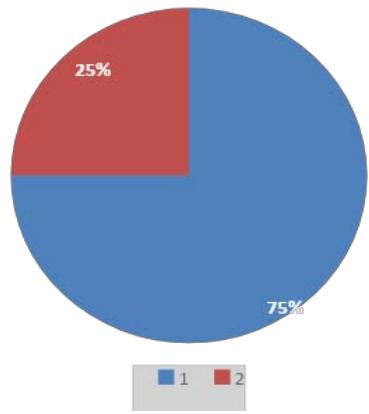
Percentage of coducting practical Figure 3
- 1: Those who conduct practical
- 2: Those who do not conduct practical
The three-teacher represented $75\%$ while one teacher represented $1\%$
Table 4: Student
<table><tr><td></td><td>Number of students</td></tr><tr><td>Attend practical practical</td><td>48</td></tr><tr><td>Do not conduct practical</td><td>2</td></tr><tr><td>Total</td><td>50</td></tr></table>
The table above shows the distribution of 50 students, 48 students attend practical while 2 do respondents among students who attend practical. Out not attend physics practical.
This data was presented in a pie chart of percentage as shown below
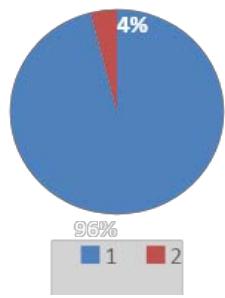
percentage of attending practical Figure 4
- 1: Those who attend practical
- 2: Those who do not attend practical
The pie chart showed that $96\%$ of the respond do attend practical while the $4\%$ do not attend practical.
Table 5: Frequent physics practical.
<table><tr><td>Frequency</td><td>(Teacher)</td><td>Student</td></tr><tr><td>Once a week</td><td>3</td><td>20</td></tr><tr><td>Twice a week</td><td></td><td>14</td></tr><tr><td>Once every two weeks</td><td>1</td><td>1</td></tr><tr><td>Only during term exam</td><td></td><td>8</td></tr><tr><td>Once a year</td><td></td><td></td></tr><tr><td>Not at all</td><td></td><td>12</td></tr><tr><td>None of the above</td><td></td><td></td></tr><tr><td>TOTAL</td><td>4</td><td>50</td></tr></table>
From the table above, 3 teacher respondents to be teaching practical once a weak while one teacher; respondent, once every week. There is need to increase the frequent of physics practical since from 1 represented a $25\%$ respond. There was a distribution in the response among student on the frequent of practical. 12 student respondents as not at which; meaning that from their respond, they were not satisfied with the frequent methods. The data from the, table above was presented below in a combined bar graph.
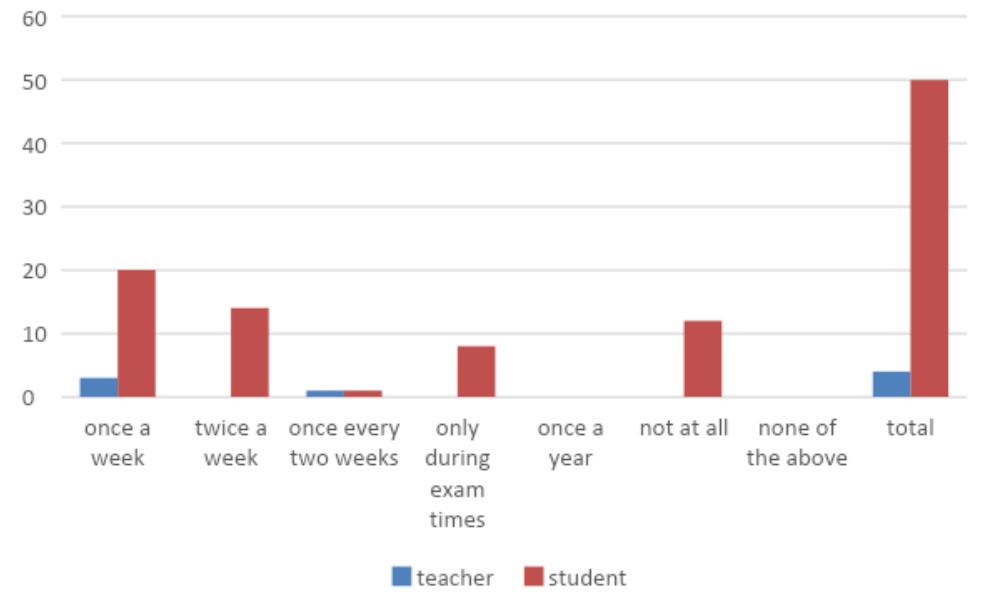
Frequency of physics practical Figure 5
Table 6: Methods of conducting Practical
<table><tr><td>Practical method</td><td>Teacher</td><td>Student</td></tr><tr><td>Theory</td><td>1</td><td>46</td></tr><tr><td>Demonstration</td><td>3</td><td>3</td></tr><tr><td>Picture method</td><td></td><td>1</td></tr><tr><td>TOTAL</td><td>4</td><td>50</td></tr></table>
From table above, 3 teachers mostly use demonstration method of teaching practical which involve conducting of practical either in laboratory set-up or classroom. One of the teachers employ the theory method of teaching practical. 46 students responded of using theory method of practical which represented a $85\%$ of the total student. 3 students responded of using demonstration while 1 student reply of using a picture method. The data was presented in the bar chart below.
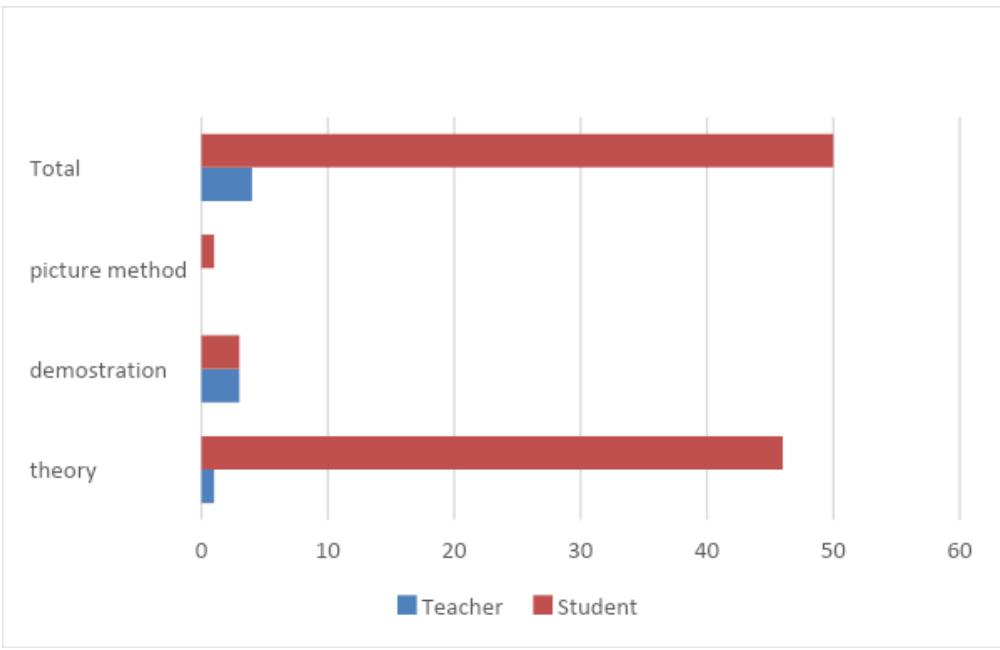 Figure 6
Table 7: Place of conducting practical
<table><tr><td>Place of conducting practical</td><td>Frequency (Teacher)</td><td>Student</td></tr><tr><td>Laboratory</td><td>2</td><td>40</td></tr><tr><td>classroom</td><td>2</td><td>8</td></tr><tr><td>field</td><td>4</td><td>48</td></tr></table>
From the table above, 2 teachers responded of using laboratory for practical while the other 2 of using classroom for practical. 40 of the students responded of using laboratory while 8 students of using classroom.
Two of the students did not give a respond. The data from the table above was represented in the table below.
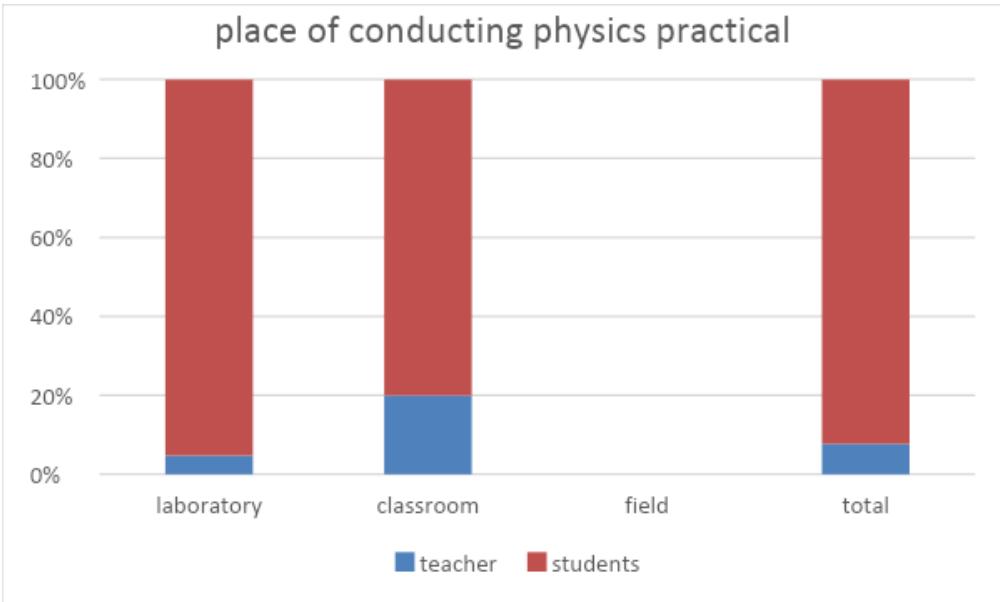 Figure 7
The data from laboratory, classroom, field and teacher's and student's cumulative respond was taken total was analyzed separately of which the sum of out of $100\%$.
Table 8: Importance of physics practical.
<table><tr><td>Importance of physics practical</td><td>Frequency (Teacher)</td><td>Student</td></tr><tr><td>Yes</td><td>4</td><td>49</td></tr><tr><td>NO</td><td></td><td>1</td></tr><tr><td>Not sure</td><td></td><td></td></tr><tr><td>Total</td><td>4</td><td>50</td></tr></table>
From the table above, all teacher responded that physics practical are important to student which represented a $100\%$ agreement. One of the students admitted that physics practical is not important. There is a further need to investigate why physics practical is not important. The data was presented in the graph below.
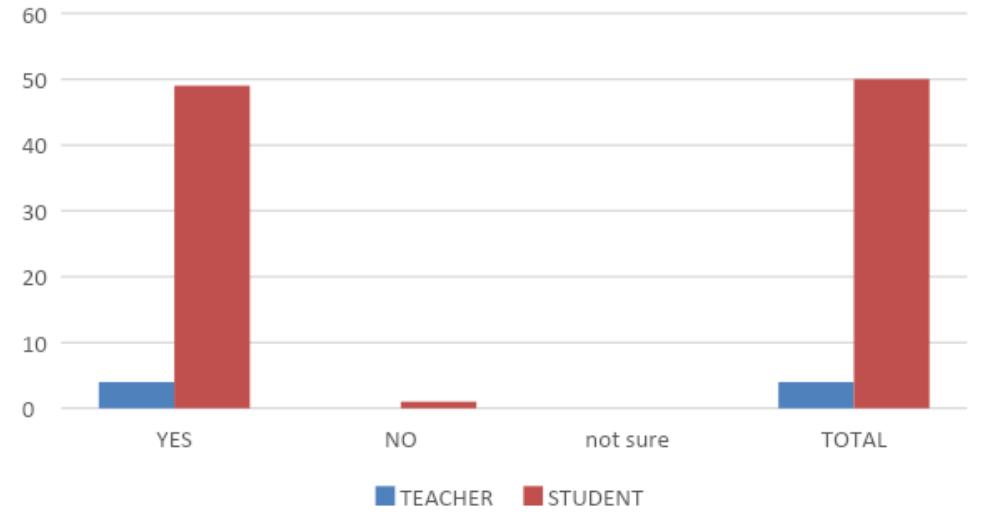
importance of physics practical Figure 8
The data was analyzed in comparison of teacher and student separately on the variable; yes, no, not-sure and the total respond which acted as a reference figure for teacher and student.
## V. SUMMARY OF FINDINGS, DISCUSSIONS AND RECOMMENDATIONS
### a) Summary of findings
The objectives of this study were to find out the nature of Physics practical and to determine how frequency of Physics practical influence performance in a selected school in Matayos Sub- County. The study involved getting information through questionnaire from physics teachers and students in a selected secondary school. The study involved two specific objectives. In summary, the study found out the nature of physics practical and frequency of physics practical are very important in the performance of physics.
## i. The nature of Physics practical
The study found out that three teachers use demonstration method of teaching practical which represented $75\%$. $25\%$ from the others teacher is till a large number taking that one assumption of the study was that; the data collected was a representation of the other schools in the county. So, there is need to put more input in demonstration aspect of practical. The issue of theory method could be maybe due to unavailability of equipment's or material in conducting the practical. The respond between teacher and student varies where 46 students responded of using theory method which represented $86\%$. There is further need to investigate the variation of the respond.
A respond of the place of conducting practical between classroom and laboratory showed that there might be less physics equipment or laboratory or laboratory technician. There is further need to investigate
## ii. Frequency of Physics practical
The study found out that practical most practicals are carried out between one and twice a week. Due to less performance in physics; there is further need to emphasize on a more frequent physics practical. There is need to further investigate why 12 student which represent $24\%$ response from student admit of 'not at all' frequency.
### b) Discussions of the findings
As highlighted in the background of the study, the government of Kenya has focused on improvement of education for the relevance of the nation. Further it was noted that secondary education and training is one of the key factors for increased economic growth. Despite the school being equipped in terms of biology laboratory, apparatus and reagents, the performance of physics subject by students in public secondary schools is far below average. There is further need to encourage student to work hard in physics and appreciate the subject.
From the study majority of Chemistry teachers and student's response varied like methods of conducting practical and frequent of physics practical.
In this study it was also observed that the most common teaching learning methodology in physics was theory method from students' response and demonstration method among teachers.
### c) Conclusion of the study
From the findings of the study, it can be concluded that factors that influence Performance of physics are frequent of physics practical and method of conducting physics practical. Majority of the students seems to be very positive toward physics, though there performance is far below average. Majority of students seem s to score low grade in physics. After considering this aspect it was concluded that there may be other factors which have major influence on students' physics performance is physics practical.
A $98\%$ response from student on the importance of physics practical showed that $2\%$ of students do not appreciate practical.
### d) Recommendation
From research findings and conclusion made, the following recommendations were made
1. There is need to have a more frequent physics practical.
2. There is need to use laboratory for conducting physics practical.
3. There is need for using of demonstration rather than theory and picture method.
4. There is also need to encourage student to appreciate the importance of physics practical as a method of teaching physics.
5. Other factors such as attitude were found to be also factor that promote to poor performance in biology.
Generating HTML Viewer...
References
18 Cites in Article
Y Babikian (2020). An empirical investigation to determine the relative effectiveness of discovery, laboratory, and expository methods of teaching science concepts.
B Fraser,G Giddings,C Mcrobbie (2015). Evaluation and validation of a personal form of an instrument for assessing science laboratory classroom environments.
Marlene Fuhrman,Vincent Lunetta,Shimshon Novick (2016). Do secondary school laboratory texts reflect the goals of the "new" science curricula?.
K Hadady (2016). Are they sloppy? A comparative analysis of performance in the laboratory.
Harold Harty,Nasser Al‐faleh (2019). Saudi arabian students' chemistry achievement and science attitudes stemming from lecture‐demonstration and small group teaching methods.
H Keulen,Van,T Mulder,J Goedhart,A Verdonk (2021). Teaching and learning Physics laboratory courses.
Robert Kozma (2021). Instructional design in a chemistry laboratory course: The impact of structure and aptitudes on performance and attitudes.
William Kyle,John Penick,James Shymansky (2019). Assessing and analyzing the performance of students in college science laboratories.
Frances Lawrenz,Theodore Munch (2018). The effect of grouping of laboratory students on selected educational outcomes.
V Lunetta,A Hofstein,G Giddings (2017). Evaluating science laboratory skills, The Science Teacher.
(2021). Educational Statistics 2020-2016.
Mansoor Niaz (2015). Relationship between student performance on conceptual and computational problems of chemical equilibrium.
O Odubunmi,T Balogun (2019). The effect of laboratory and lecture teaching methods on cognitive achievement in integrated science.
Morris Scanlon,Di Paolo,Cooper (2020). West Bank and Gaza Strip.
Pinchas Tamir,Vincent Lunetta (2021). Inquiry‐Related Tasks in High School Science Laboratory Handbooks.
G Thijs,G Bosch (2015). Cognitive effect of experiments focusing on students' preconceptions of force: a comparison of demonstrations and small-group practical.
A Zitoon (2016). The effect of using laboratory on developing science thinking skills of 11th grade students in Jordan.
No ethics committee approval was required for this article type.
Data Availability
Not applicable for this article.
How to Cite This Article
Hezekiah Adwar Othoo. 2026. \u201cEffect of Physics Practicals on Students’ Academic Performance in Public Secondary Schools in Matayos Sub-county, Busia county, Kenya\u201d. Global Journal of Human-Social Science - G: Linguistics & Education GJHSS-G Volume 22 (GJHSS Volume 22 Issue G4).
Explore published articles in an immersive Augmented Reality environment. Our platform converts research papers into interactive 3D books, allowing readers to view and interact with content using AR and VR compatible devices.
Your published article is automatically converted into a realistic 3D book. Flip through pages and read research papers in a more engaging and interactive format.
Our website is actively being updated, and changes may occur frequently. Please clear your browser cache if needed. For feedback or error reporting, please email [email protected]
Thank you for connecting with us. We will respond to you shortly.