
I. INTRODUCTION
Gayford(2003)in one of his research reveals that this approaches have been used to enable teachers to establish their practice needs in relation to education for sustainability (EfS) and also maintain the integrity of their subject disciplines.
participatory learning environment It is a shift from a belief that learners are empty plate who are supposed to be imparted with knowledge (teach concept) to a belief that learners can construct knowledge and learn on their own if properly guided (learn concept) (Kafyulilo). Participatory teaching approach is a form of a reflective teaching approach which stresses the subjectivity of learners assisting in the self construction of knowledge. According to McLoughlin and Lee (2007) in participatory learning "learners are active participants or co-producers rather than passive consumers of content, and so learning is a participatory, social process supporting personal life goals and needs." From Shen et al. (2004) participatory learning approach engages "students as active participants in the full life cycle of homework, projects, and examination." From the two definitions, it could be seen that students are basically active learners in participatory learning environment (Kucharcikova and Tokarcikova, 2016; Ciobanu, 2018). This is partly because students have opportunity to negotiate for the objectives, knowledge, skills, attitudes, or the teaching and learning methods of a lesson and that every student in a class has a peculiar learning style where teaching should be organised in such a way to engage him or her actively in the teaching and learning process (UNESCO, 2001).
Participatory is an approach that involves an active learning style and the integration of learning programs according to the pupil's own learning rhythm. The student here are accountable for the progress they made in terms their own education. Among the teaching-learning methods are those through which students work productively with each other, develop collaborative skills and mutual help. Here, Teachers students communicate with each other and listen to the opinions of others. As it is well known fact that interactivity is an important component of the teaching and learning process, and it assumes learning through communication, collaboration, generating a rain of ideas, opinions and arguments with a high degree of activity and personal involvement. They are designed only for smaller groups of participants, to encourage better retention of what they have learned. This implies not only to engage students' interest in theoretical lessons, encouraging group discussions and critical reflections, but also to involve them in more practical activities, to connect academic achievement with real-life issues and to understand the impact of the individual actions on the community. In order to develop critical thinking in pupils, a teacher must use the above approach which includes some active-participative strategies and creativity.
II. PARTICIPATORY APPROACH A NEW WAY FORWARD FOR SUSTAINABLE EDUCATIONAL GOALS
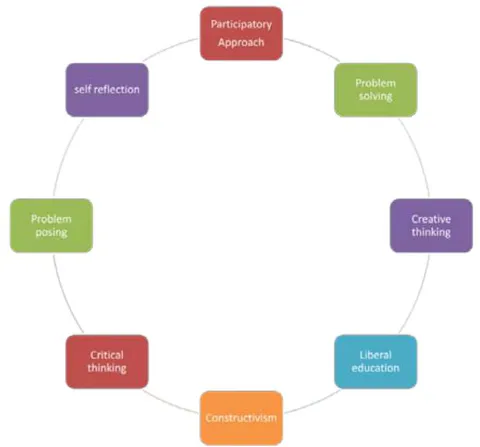
Today's generations are learning in 21st century. And their needs are not stick to the watertight compartments curriculum syllabus and also most importantly pedagogical approach. This is the need of an hour and reform is absolutely. Using old traditional method may be proving to be absurd. Teachers at this point need to be vigilant in their teaching aspects. So, the participatory approach is the modern and latest approach teaching methods and need strengthened. In participatory teaching methods learners create meaning of what they learn through active participation in the teaching and learning process (Emsheimer & Mtana, 2004). This thinking is based on the constructivist learning theories developed by Piaget (1970), Vygotsky (1978) and Bruner (1996). Since constructivism implies that knowledge is constructed by the individual, it has prompted the development of teaching/learning situations which stress and encourage participation of learners in the teaching and learning process. In Participatory approach, students are encouraged to work together with fellow student either in pairs, small groups, or in whole groups for collective participation. Participatory such as role play, rhyming together, expressiveness of words or sentences, singing together, fantasy release and other functional exponent using.
The primary requirement of progressive education, as Jean Piaget says, is to ensure a diversified methodology based on combining independent learning and work with cooperative, group and interdependent work. At the same time, didactic methods are action plans with a (self) regulating function (a set of operations that are carried out in order to achieve a goal) and ways of acting (action strategies through which the student reveals the essence of phenomena, processes, events). To achieve higher efficiency of education is necessary to use a combination of several methods. They should also include participative methods. Participative methods assume a high degree of student activities. Their advantage is that they support better remember learned. Lecture prefer the content of learning, participative methods prefer the procedural aspect. Students can be activated using a combination of various participative methods such as group work, brainstorming, case studies, role playing, management games, and so on.
An important part of this method of teaching is to provide feedback and evaluation of activities. In participatory approach, the role of a facilitator is one of importance; and to make the approach collaborative enough, the role of a facilitator should be rotated. However, the facilitator's role should be moderated in such way that the facilitator will not dominate group meetings when he/she is of some expertise in the area being discussed. The elements of creativity must always be present. Disputes are important aspect of participatory teaching and learning processes. Shen et al. (2004) therefore emphasized that teachers should carefully review students' solutions presented to the class ahead of scoring to avoid disputes. The opportunities given to students such as disputing solutions and reading or observing colleagues solutions in a participatory lesson provide them with opportunities to view subjects or course from more than one perspective of importance (Shen et al., 2004). Participatory learning is not like seeking an expert view but it is an evolving process that makes use of more than one instructional approach (Landcare Research, 2002). There are many different views about the nature and purpose of education for sustainability and many of the issues that threaten sustainability are controversial (see, for example, Jickling & Spork, 1998). As Payne (1999) explains, the implications of post-modern thinking for the sort of debate that surrounds the controversies of sustainability are important for formal education. The methodology described here provides a realistic alternative to universalist world-views and helps to relate to pluralist ideas where knowledge and the solution of problems is considered to be influenced by culture and context, arguing against the notion that every genuine question has only one true answer (see, for example, Berlin, 1969).
III. EDUCATIONAL IMPLICATION OF PARTICIPATORY APPROACH
Gaining Knowledge by doing: Su et al. (2010) stated that the participatory approach to learning considers knowledge by doing which is typical for active practice, experience and direction to the learning of "learning by doing". They are thus based on the fact that people will learn more if you try to do something, than if they just read or listen to the new information, such as a lecture.
Peer exchange: Shön (1995) considers that the isolated position of individual teachers within the classroom is a problem that works against the reflective process and that peer exchanges can help to overcome the difficulty.
Encourages Sharing of Experiences: Land care Research (2002) found that since individual as well as group experiences the world in different ways, it is important to involve people on a subject or topic in order to share their respective experiences, activities, and understanding on the subject or topic (Liu et al., 2013). Liu et al. (2013) stated that many educators are calling for the teaching and learning students to share their respective experiences with other students (UNESCO, 2001). This Value the real life experiences on the experience of participants as practitioners. Participatory instruction takes advantage of the students' existing experiences (Omollo et al., 2017) and encourages students to share their respective experiences with other students (UNESCO, 2001).
Ensures better implementation of knowledge, skills and abilities: This, students in another study perceived, places huge burden on their shoulders (Gal et al., 2018). By active-participatory methods, we can ensure better implementation of knowledge, skills and abilities. This enables the students to understand all the situations in which they are placed and who take them out of the subject of the object of training and turn them into active subjects, co-participants in their own training, not only the active methods themselves. Participative teaching includes a set of didactic strategies and techniques that aim to promote a more active role of students in the learning process (acquiring skills and abilities) to develop knowledge and action that can be shown to be directly useful and reflective (Fals-Borda, 1988).
Promote cooperative/Collaborative learning among children: Participatory approach is collaborative in learning as students create and solve problems as well as evaluate and settle disputes with respect to colleagues' solutions (Shen et al., 2004). This makes the participatory approach characteristically collaborative (Foster et al., 2008; Su et al., 2010; Trauth-Nare and Buck, 2011; Ciobanu, 2018) considering the views of all participants and is collaborative and not leaving at the door steps of only the developers to plan and develop the instruction (Foster et al., 2008).
Empowered and Encouraged group discussion: Of this type encouraged to learn from each other and to continue the process by understanding that thinking to move on to establishing an approach to practice. UNESCO (2001) explained that group discussion is a useful participatory instructional tool as through group discussion students learn to agree, disagree, and have mutual respect for the views of other students in a more relax manner (Ciobanu, 2018). To work collaboratively with colleagues make them feel empowered by the process.
Provide Opportunities: Participatory oriented offers students more opportunities than just consuming knowledge given by teachers or textbooks such as the opportunity to design questions or projects, execute them, and then assess and grade their peers. In the participatory approach everybody within the group should be given the opportunity to make contributions (Pain et al., 2011) and there is the need for a continuous follow-up to ensure that the participants are well informed for effective participatory approach. In that, students are given the opportunity to read their colleagues solutions to problems and therefore could argue on the correctness of some solutions.
IV. DRAWBACKS OF THE PARTICIPATORY APPROACH
Though it has been found that students need to be interactive, learn collaboratively. Making teaching learning student-centered and not teacher-centered applying participatory approach seems to be a democratic, non-linguistic, honest strategy from the point of view of education for all. Still there are objective factors that impede education by focusing on the students need. Every time Participatory methods are not so functional. Sometimes this approach leads to more tiring for the learners, unlike the classical ones that are more passive and relaxing. That is why the teacher needs to have several alternatives to approach the lesson. The discontinuous nature of the type of invasion arises because the type of participative learning at school is different from the home one, which is individual and reflexive. One of the research studies found that, in participatory approach translating content into games and interactive approaches can emphasize information that is not very important, but information may be lost because of the inability to integrate into the lesson. Another reason for impede is that, the teachers' time of thinking when working in teams is 3-4 minutes for each task, which will never be respected by students and will almost always result in incomplete or superficial task. Therefore, active-participatory methods imply prudence in use. But methods should not be ignored because it enhances the teaching-learning process and motivates students. It is good for a teacher to know and apply as many teaching methods as possible to avoid devaluing the method by repetition.
V. CONCLUSION
In Participatory approach, participant reactions in the participatory environment create avenues for personal learning; and apart from the possibility of creating personal learning avenues, new ideas evolve for improvement of instruction. The numbers of approaches used in participatory approach have always resulted in an increased level of satisfaction. Shen et al. (2004) concluded their work by saying the student-centered nature of participatory approach enables students to appreciate and develop interest (Gal et al., 2018) in topical issues in class. Chuenet al. (2008) added that success is collaborative which is achieved through the contribution of each student from the groups in a collaborative lesson. UNESCO (2001) emphasized that students achieve more and become more satisfied when they are actively involved in the teaching and learning process; and that students' active participation in lessons is an effective part of their learning of concepts (McLoughlin and Lee, 2007; Liu et al., 2013). Participation is an essential part of the empowerment of any group, including teachers. It recognizes and allows there to be a variety of ways in which approaches to education for sustainability can be developed amongst practitioners.