## I. INTRODUCTION
The transformations of teaching and training have evolved due to the Covid-19 pandemic, with it Information and Communication Technology (ICT), adding to these, virtual platforms to improve educational processes. Currently, the instruction of the English language has gone from being a luxury into something necessary for citizens to easily understand the global perception that is increasing more worldwide. Understanding the importance of the English language as an instrument of international communication is paramount in the life of communities. Also, educational institutions have been implementing ICTs to complement traditional education by consolidating language skills.
The study of a foreign language such as English has become a challenge in this 21st century, due to the various complications that it presents, in addition to worrying Latin American nations, since it manifests levels below in terms of its domain. Which is used worldwide. The European continent is where this language is most mastered and in any part of this region you can establish conversations with other people without presenting difficulties due to the level of preparation they have. The existing reality in the classrooms of educational centers for their training is the lack of preparation or the inefficient strategies implemented that affect the little progress of English.
The Dominican educational system has shown enormous interest in guaranteeing universal development and training among nations, from childhood to higher education, incorporating English training and instruction. This art would not be a passive process where the student receives what the teacher instructs, but an active way in which he interacts in said development.
## II. CURRENT STATUS OF ENGLISH AS A FOREIGN LANGUAGE
Mejia & Russi (2019) believe that the reality that countries live around the teaching and learning of English as a second language, as a result of the needs that seek the advancement of nations with international demands, caused by technological advances, tourism and social, becoming one of the causes that governments have been implementing through pedagogical strategies (p.26).
For the strengthening of strategic positions against globalization, defined by free trade agreements, universalization of cultural industries and the increase of the knowledge society, in which the State has the responsibility to establish the conditions for development mastery of a second language. In the Dominican Republic, students who graduate from secondary education must handle basic English, written and spoken. That is, show understanding of the texts they read as well as those they listen to in the foreign language, have the ability to prepare oral and written speeches and be able to converse with other people (Mejía & Russi, 2019:26).
Miranda, Gil, Otalora, Marín, González, Isaza (2021) comment that the incorporation of ICT as an instrument in the English processes, the training of teachers and students that means a position for a competitive universality that values the promotion in learning permanent, having a strong impact on improving the quality of life, making various users access the different means to improve themselves. With the advances, improvements and contributions that virtual platforms have had in learning and teaching for those who wish to acquire the necessary knowledge in all fields of study. These have become technological means that facilitate the interaction of people with the tools, facilitating their activities. For the teaching of English as foreign languages, various instruments have been created, thus improving their learning. They have countless options to facilitate these processes (p.204-205).
Virtual platforms teachers and students intervene in the teaching and learning processes through their use effectively, with which they can communicate, share, create knowledge, among others that lead to learning. With these adaptations, didactic environments are created. Currently, the aim is to standardize the English language within institutions so that all professionals at a global level can interact and understand each other, facilitating cultural exchange between nations. The English language is a necessity and due to its relevance it is globalized with which the most important operations in the world are carried out (Mejía et al, 2021:205-206).
## III. ENGLISH AS A FOREIGN LANGUAGE
Andrade (2019) comments that Information and Communication Technologies (ICT) integrate the mediating tools of the knowledge built by the students and of the teaching and learning processes. Therefore, ICTs are instruments used to think, learn, know, represent and transmit to others and future generations the understandings and training acquired. These transfers are implemented from the elaboration of cave paintings in the Paleolithic, to those that favor capturing and transmitting images and messages through a smartphone or the Internet through distance for the reproduction of certain data and their dissemination (p. 32).
The importance of studying a foreign language for strengthening the economic, social and cultural development of a country. Therefore, English has established itself as a mandatory language in educational training proposals. This is due to the fact that it is a foreign language that is not spoken in the local environment, because the daily conditions of society are not permanently required for communication. They can be learned in the classroom, where the student would be exposed during controlled periods of time. It is only used in academies or educational centers, students can acquire efficient performance to communicate when required. When conversing in English, it refers to a language that is not used in everyday life and is different from the mother tongue of the country where it is applied. The English language has become a language for business, work, entertainment and cultural exchange. Therefore, in Spanish-speaking countries they promote their training at an early age, because it has been shown that it has a greater incidence when the teaching of another language begins at a young age (Andrade, 2019: 38-40).
Belda (2020) argues that learning a second language should be done at an early age, because the efforts made to communicate in another language in adulthood are to a certain extent useless and insignificant. On the other hand, the academic exercise with digital tools is associated with the generations born in the digital age, putting older people aside. Likewise, society shows mistrust and indifference to the abilities that adults have to learn and communicate in a non-mother tongue, with the necessary fluency and the use of digital instruments effectively and efficiently (p.2-3).
Conventionally, the ideal age for learning a language was considered to be before reaching puberty. Logically, learning a foreign language at an early age is essential, but at the time of learning it does not depend on physiological issues, but also on other factors, such as motivation, frequency of use, type of learning, among others. That is, motivation changes with age, with educational and employment arguments being more important in youth compared to social and cultural reasons that are present in maturity (Belda, 2020:3).
Nicolas (2020) considers that understanding a foreign language is one of the basic elements in the training of students. The obligation to learn a second language makes it possible to participate in the fields of education, culture, science, technology and at work. You can count on the possibility of knowing, learning and using it, since English is currently a universal and commercial language, offering the opportunity to have a level of equality with people from other nations (p.5).
All those who have faced the teaching of a foreign language have ascertained that it is a subject that requires constant renewal in its technique, where the implementation of ICTs becomes relevant. Conventionally, the teaching of English was made up of the teaching of vocabularies and grammatical structures. As the communicative points of view gained importance in the learning processes, the increase in skills was focused on Listening, Reading, Speaking, and Writing. These in recent years have become relevant in changes in language learning thanks to the development and consolidation of multicultural education (Nicolás, 2020:5).
## IV. MOTIVATION IN LEARNING A FOREIGN LANGUAGE
Rodríguez (2020) comments that learning the English language has become a unique and complex phase, due to the multifaceted nature and the relationships of languages with each other. This can be at the same time: a communicative coding system that can form as a school subject; and they are a general part of the identity of the people are involved in all their cognitive activities; channel of importance in social institutions inserted in the associations that use it.
Valero (2021) states that learning a second language is one of the most complex issues in most English language students and teachers, since maintaining motivation to learn is a constant challenge that must be assumed, but with the emergence of the Covid-19 pandemic presented inconveniences in terms of the management of ICTs by the educational community in general. Although educational institutions have technological resources, they have been affected, because English classes were immersed in the development of educational materials and posted as evidence on platforms, without giving importance to learning. The approach would be to practice the language until you become an expert (p.7) With the support of ICT, online activities are made possible with the various resources for strengthening grammar, vocabulary, reading, writing and complying with the study plans planned in the curriculum using educational materials. Through these techniques, problems are dealt with through action. In other words, work with the problem, present it and discuss it. The nature of the functioning of the roles consists of the commitment of the participants and observers in a real situation and the will to understand and solve what generates said commitment (Valero, 2021:9).
## V. THE USE OF ICT AS MOTIVATION IN LEARNING ENGLISH
Rodriguez (2020) comments that information and communications technology (ICT) have become necessary tools for daily life, due to the use of computers, tablets, smartphones for various purposes, from professional to personal.. For the formation of a second language, it is possible to resort to ICT through video games, vocabulary applications, among others. Also, there are the computer, digital whiteboards, televisions, multimedia systems, internet educational services, among others. On the other hand, it allows several applications for teaching in different contexts, providing interaction, making classes more striking, colourful, favoring teamwork, encouraging interest so that new technologies are the mediators of training and construction of knowledge.
ICTs encourage the learning of the English language, because it allows access to materials, information, contact with entities and cultural values of the speakers of the language they are learning, enhances the action of learning, inquire about the information necessary to solve problems or proposed assignments, group work, which allows them to interact in the search for solutions, and at the same time, prepares them in socializations for future work situations.
Motivating through ICT allows better growth in the combination of skills for teaching the English language, strengthens the acquisition of vocabulary and grammatical combinations with participatory instructions (Rodríguez, 2020).
Muñoz (2022) comments that it is essential for teachers to innovate, because they are in charge of training future citizens, putting into practice the potential in learning a second language and managing technology among their students. It must be carried out in a real communication scenario, which will favor motivation and the acquisition of communication skills. These can be made through virtual learning communities, that is, with virtual platforms. On the other hand, learning more than one language has become a matter of survival, since it is essential to obtain a job. Also, it happens with reading, movies, music, travel, among others, since the more languages you master, the wider the possibilities that may arise.
Globalization has brought with it a new social, cultural and political scenario, where ICT together with the transformations of the knowledge-based economy, requiring the active participation of the entire community that makes up the educational system. For these reasons, learning communities are created, where people learn in a common way, using the same instruments within the same habitat. To be carried out, it must have the following conditions: open participation, development of collaborative work, promoting equal conditions and opportunities, placing people at the center of the teaching and learning process, implementation of tools that favor modernity and flexibility (Muñoz, 2020).
## VI. ICT AND ENGLISH
Social networks are other types of tools that can be used, which are not advisable for primary and secondary schools, but are suitable for young people and adults who can take advantage of them as a learning mechanism if they cannot attend a classroom. On the other hand, podcasts, blogs, collaborative instruments, are of some use to teachers and students, since they can interact in real time and receive feedback from the teacher through contributions or true recordings. The use of these tools is to stimulate the work in a truthful way, the self-sufficiency of the students, the collaboration of the work in flexible recreation. Finally, personal scenarios are presented so that each person can learn, thus reinforcing comprehension and written production skills (Rico, 2017: 20)
Lizasoain, Ortiz, Becchi (2018) are of the opinion that digital and English literacy go hand in hand, since both are considered essential for the growth and mobility of society. Although ICTs are presented as one of the effective means for education, the implementation of initiatives is deficient to be used in the teaching and learning of English.
Escobar & Ibanez (2018) are of the opinion that learning English as a foreign language is essential in the tourism industry, driving changes in the methodologies of educational programs. For such purposes, an academic curriculum should be implemented that takes into account the obligations of presenting quality materials, using ICTs, in order to apply distance learning using all available technology, Tablet, mobile devices, among others (39-40).
ICTs have changed educational processes in all educational entities (universities, colleges, schools, institutes, among others) adding suitable didactic tools to collaborate with the learning process, requiring certain standards, among which are self-assessment, practice teaching and communication. The teaching of the English language has an approach based on action, of a communicative type, because it accepts key conceptualizations for the new methodologies that are to be implemented in the classroom, such as the concept of tasks and projects that collaborate with the approach based on the action. With this, the teacher does not perform the role of connoisseur and transmitter of knowledge, but rather acts as a guide to exploit the abilities of students working by competencies for their independence, to communicate, have initiatives and use technology responsibly (Escobar & Ibañez, 2018:40).
Álvarez & Marrero (2018) talk about the possibilities offered by ICTs in the formation of a foreign language such as English, due to its wide and varied commercial, educational, cultural implications, among others, thanks to the universality with which it is used, transmit information between different nations worldwide. Technology favors virtual work from any place or part of the world, optimizing and improving resources in the various learning activities proposed throughout the course of the English subject. Creative and interactive methodologies are demonstrated where the interpreters are the students, who develop their abilities in the inquiries, selection, analysis and evaluation of information. Also, the teacher acts as a guide in the process of teaching and learning the English language. Through technology in the classroom, it contributes to facilitating learning, motivating and stimulating students in collaboration and cooperation with other classmates in increasing the various communication skills, turning classes into interactive sessions that would encourage students in promoting expression, oral and written comprehension (p. 2783-2784).
For the organization and development of the teaching process, teachers put into practice a certain methodology that is characterized by the introduction of a series of strategies that encourage the participation and cooperation of students in the classroom, making it possible to increase skills and communicative skills in the English language. The integration of new technologies is important in teaching innovation, also, in reducing the disadvantages that may arise with teaching in large groups, where the teacher would have to include these resources in their pedagogical policies to improve the teaching and learning processes.. These have made this process more flexible, an environment in which classes become more interactive, participatory and motivating for students. (Álvarez & Marrero, 2018: 2784-2785).
Gómez, Ramírez, Martínez & Chuc (2019) are of the opinion that the various causes that intervene in the incorporation and use of ICTs are divided into two types of barriers: first and second order. The first covers external circumstances or circumstances that are unrelated to the teacher, such as lack of access to computer equipment, programs, lack of time to develop activities that involve the use of technologies, poor or no technical support from administrators. The second includes factors intrinsic to teachers, such as personal characteristics, beliefs about teaching and computer use, teaching practices, and attitudes toward change (p.78-79).
Various factors have been identified that serve as barriers to the integration and effective use of ICT by teachers, listing the following:
<table><tr><td>Barriers at the school level</td><td>Barriers at the teaching level</td></tr><tr><td>Lack of time</td><td>Lack of time</td></tr><tr><td>Lack of access to resources</td><td>Lack of trust</td></tr><tr><td>Lack of training</td><td>Resistance to change and negative attitudes</td></tr><tr><td>Technical problems</td><td>No perception of benefits</td></tr><tr><td></td><td>Lack of personal access</td></tr></table>
Del Pezo (2020) comments that technological tools are methodological options that can be used to manage student learning, since in the current century, these types of media can be accessed. In other words, it is in the teachers who are willing to apply these innovative instruments in their subjects to obtain the desired results, taking into account that the way of teaching has changed over the years and the advancement of technology. These offer the opportunity to improve the quality of students, of education and can be the main character in each of the virtual activities (p.3).
In educational institutions, teachers have a limited command of the English language, thus maintaining a traditional way, since they use texts to transmit their knowledge, making it a routine learning, resulting in lack of interest in learning that language, since they do not there is motivation for such learning (Del Pezo, 2020:3).
The use of ICTs in educational tasks demands that teachers have a positive attitude in the activities, be trained for their application in the teaching and learning of English. Also, they show multiple benefits in the classroom, stimulating students' free learning, collaborating with the storage and joint memorization of information, making efficient use of time in the subjects of a second language. Therefore, methodological strategies and the use of technologies for teaching the English language are a series of procedures created by teachers to collaborate in the quality of educational processes (Del Pezo, 2020:6).
Mendo (2021) highlights that the teaching and learning of English through the use of technology is defined as "an activity that involves great determination, motivation and continuous practice of language skills, such as speaking, listening, reading and write in English" (p.19). On the other hand, the reality shown is that most students have few possibilities to interact using the foreign language, being limited to what is transmitted to them in the classroom, to the contents in the texts and to the planning of the teachers.
ICTs are very useful tools for improving the learning of the English language and it is what motivates research teachers to use different strategies, through the use of tools that are adapted to the needs and different realities in which they are taught. Students develop. There are various free tools that can be used in educational work to streamline the instruction process, because they are very useful for learning in the area of English as in other subjects (Mendo, 2021:19).
## VII. PERCEPTION OF STUDENTS REGARDING THE USE OF ICT AND LEARNING THE ENGLISH LANGUAGE
Carranza, Islas & Maciel (2018) state that the integration of ICT in the educational environment is due to the need to know to what extent, circumstances and conditions its incorporation into the teaching and learning processes vary the educational practices in the classroom. Class and find out if it has a positive impact on learning. The educational institutions show efforts in learning English, because the failures in the teaching of the English language reveal certain deficiencies in the educational system in the implementation of educational policies, showing a change in the paradigms of teaching and learning of this language (p.51-52).
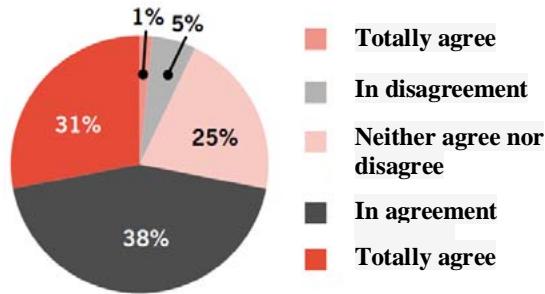 Students' perception regarding the use of ICT and learning English
One of the challenges presented by educational institutions in the teaching of a second language is the innovation and application of new procedures and instruments that help with the formation of the English language, together with technologies, which are an element that favors the educational process when it is available to teachers and students. In other words, English learning can be encouraged, allowing changes from the personal, attitudes, thinking, didactic-pedagogical elements, and the contents of work in the full sense of the teacher's practice. These optimizations cause educational environments that have repercussions on teaching and learning strategies and on didactic models.
The relationship between ICT and the teaching of a second language is produced by the changes that these can cause in student learning, which means going beyond instructing with technology, since it should stimulate a transformation in mentality, because the important thing is not the excess of information, but the ability to process it. As part of the globalization and internationalization of education, the use of a second language has been identified as one of the most urgent obligations in teaching at all educational levels. International business has increased and those who speak more than one language are highly sought after. (Carranza, Islas & Maciel, 2018: 52).
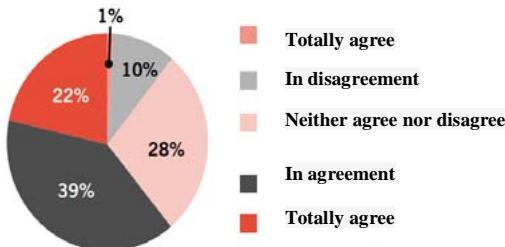 Perception of the students about whether the technological resources offered by their teacher reinforce the learning of the English language
Araya, Erna & Cid (2020) point out that the curricular bases implemented by the Ministries of Education in Latin America and the Caribbean, ICT are of great help for the process of teaching and learning a foreign language, in the study carried out, English. These allow to encourage and increase the productive and receptive abilities of the students. The curricular bases propose teachers to accompany their students in the learning process through technology to increase their ability to critically review materials and texts, identify reliable sources and be responsible in the subsequent use of said materials (p 35- 37).
In the course of teaching the English language, it would be possible to use ICT, enriching and favoring the points of view of the instruction of this language, because technology is something natural for students, because they use it in various places and in their lives every day. Currently they have been included in their academic training, so they must be properly integrated for the development of their cognitive skills. They have some relevance, because students can read texts online with a variety of learning aids such as translators, audio dictionaries, as well as voice interactions and auditions. These have evolved to have formats that stimulate the teacher's behavior in a certain way, offering freedom in the student's way of learning and even receiving automatic corrections. On the other hand, they are not a substitute for the teacher, but an ally in teaching and learning, in addition, there is no agreement on which tools facilitate effective learning (Araya, Erna & Cid (2020: 39-40).
## VIII. THE USE OF ICTS IN THE FOREIGN LANGUAGE CLASS
Nicolas (2020) highlights that ICTs offer the possibility of real-time communication anywhere in the world with simple and immediate access to endless amounts of information that increases over time. Knowing a foreign language enables interaction between speakers, creating real and functional communicative contexts. On the other hand, its implementation in the classroom for the foreign language is a procedure that encourages students, since it stimulates them to be attracted by them and to be used in different ways (p. 30).
ICTs in the classroom have the following advantages: interest, motivation, interaction, development of initiatives, learning from mistakes, greater communication between teachers and students, cooperative learning, high degree of interdisciplinary, digital and audiovisual literacy, skills development search and selection of information, easy access to all types of data, visualization of simulations, among others.
Among the disadvantages and inconveniences are: dispersion, loss of time, superficial learning, unreliable information, very rigid dialogues, partial vision of reality, among others.
The use of the technology of a foreign language in the classroom entails a job for teachers who have to be constantly updating and receiving training to use these resources when instructing students. On the other hand, methodologies are constantly changing and in current times, the use of technology is mandatory in the teaching of any subject (Nicolas, 2020: 31-32).
Generating HTML Viewer...
References
9 Cites in Article
C Gómez,J Ramírez,O Martínez,I Chuc (2019). El uso de las TIC en la Enseñanza del Inglés en las Primarias Públicas.
A Lizasoain,A Ortiz,C Becchi (2018). Utilización de una herramienta TIC para la enseñanza del inglés en un contexto rural.
Genny Gómez Bustamante (2019). El desarrollo de habilidades en la competencia oral en la enseñanza del inglés como lengua extranjera a través de la implementación de herramientas web en grado noveno de cinco colegios públicos de Colombia.
A Mendo (2021). Uso de las TIC para el Aprendizaje del idioma Inglés en estudiantes de educación básica.
K Miranda,J Gil,L Otalora,E Marín,H González,G Isaza (2021). Proceso de aprendizaje de inglés como idioma extranjero: integración de la Plataforma Virtual FREERICE.
S Muñoz (2022). El aprendizaje de las lenguas a través de las TIC.
S Nicolás (2020). El uso de las TICs como herramientas potenciadoras en la clase de Lengua Extranjera (Ingles).
A Rodríguez (2020). Motivación y TICS para la enseñanza aprendizaje del inglés en la universidad.
M Valero (2021). Estrategias comunicativas para el aprendizaje del inglés y el desarrollo de la autonomía a través de las TICS en los estudiantes de grado cuarto del colegio COMFACA de Florencia.
No ethics committee approval was required for this article type.
Data Availability
Not applicable for this article.
How to Cite This Article
Santa Cabrera. 2026. \u201cICT in the Teaching and Learning of English as a Foreign Language: A Systematic Review of the Literature in the Dominican Republic\u201d. Global Journal of Human-Social Science - G: Linguistics & Education GJHSS-G Volume 22 (GJHSS Volume 22 Issue G8).
Explore published articles in an immersive Augmented Reality environment. Our platform converts research papers into interactive 3D books, allowing readers to view and interact with content using AR and VR compatible devices.
Your published article is automatically converted into a realistic 3D book. Flip through pages and read research papers in a more engaging and interactive format.
Our website is actively being updated, and changes may occur frequently. Please clear your browser cache if needed. For feedback or error reporting, please email [email protected]
Thank you for connecting with us. We will respond to you shortly.