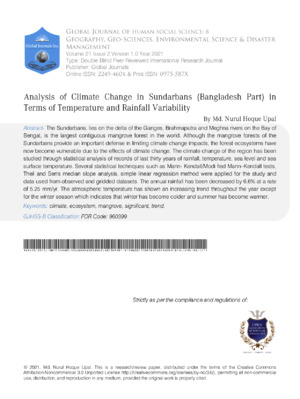
Analysis of Climate Change in Sundarbans (Bangladesh Part) in Terms of Temperature and Rainfall Variability

Article ID

O7938

Analysis of climate change impacts on Sundarbans, rainfall variability, and seasonal effects in Bangladesh.

Analysis of Climate Change in Sundarbans (Bangladesh Part) in Terms of Temperature and Rainfall Variability

Md. Nurul Hoque Upal
DOI

Abstract

The Sundarbans, lies on the delta of the Ganges, Brahmaputra and Meghna rivers on the Bay of Bengal, is the largest contiguous mangrove forest in the world. Although the mangrove forests of the Sundarbans provide an important defense in limiting climate change impacts, the forest ecosystems have now become vulnerable due to the effects of climate change. The climate change of the region has been studied through statistical analysis of records of last thirty years of rainfall, temperature, sea level and sea surface temperature. Several statistical techniques such as Mann- Kendall/Modi fied Mann–Kendall tests, Theil and Sen’s median slope analysis, simple linear regression method were applied for the study and data used from observed and gridded datasets. The annual rainfall has been decreased by 6.6% at a rate of 5.25 mm/yr. The atmospheric temperature has shown an increasing trend throughout the year except for the winter season which indicates that winter has become colder and summer has become warmer.

Analysis of Climate Change in Sundarbans (Bangladesh Part) in Terms of Temperature and Rainfall Variability

The Sundarbans, lies on the delta of the Ganges, Brahmaputra and Meghna rivers on the Bay of Bengal, is the largest contiguous mangrove forest in the world. Although the mangrove forests of the Sundarbans provide an important defense in limiting climate change impacts, the forest ecosystems have now become vulnerable due to the effects of climate change. The climate change of the region has been studied through statistical analysis of records of last thirty years of rainfall, temperature, sea level and sea surface temperature. Several statistical techniques such as Mann- Kendall/Modi fied Mann–Kendall tests, Theil and Sen’s median slope analysis, simple linear regression method were applied for the study and data used from observed and gridded datasets. The annual rainfall has been decreased by 6.6% at a rate of 5.25 mm/yr. The atmospheric temperature has shown an increasing trend throughout the year except for the winter season which indicates that winter has become colder and summer has become warmer.

Md. Nurul Hoque Upal

No Figures found in article.

Md. Nurul Hoque Upal. 2021. “. Global Journal of Human-Social Science – B: Geography, Environmental Science & Disaster Management GJHSS-B Volume 21 (GJHSS Volume 21 Issue B2): .

Download Citation

Journal Specifications

Crossref Journal DOI 10.17406/GJHSS

Print ISSN 0975-587X

e-ISSN 2249-460X

Issue Cover
GJHSS Volume 21 Issue B2
Pg. 21- 32
Classification
GJHSS-B Classification: FOR Code: 960399
Keywords
Article Matrices
Total Views: 2028
Total Downloads: 926
2026 Trends
Research Identity (RIN)
Related Research
Our website is actively being updated, and changes may occur frequently. Please clear your browser cache if needed. For feedback or error reporting, please email [email protected]

Request Access

Please fill out the form below to request access to this research paper. Your request will be reviewed by the editorial or author team.
X

Quote and Order Details

Contact Person

Invoice Address

Notes or Comments

This is the heading

Lorem ipsum dolor sit amet, consectetur adipiscing elit. Ut elit tellus, luctus nec ullamcorper mattis, pulvinar dapibus leo.

High-quality academic research articles on global topics and journals.

Analysis of Climate Change in Sundarbans (Bangladesh Part) in Terms of Temperature and Rainfall Variability

Md. Nurul Hoque Upal

Research Journals