Transforming Financialization and Inequality in a Post-Covid World

Article ID

DJ31Q

TransformFinanceInEquality.

Transforming Financialization and Inequality in a Post-Covid World

John M. Balder
John M. Balder
DOI

Abstract

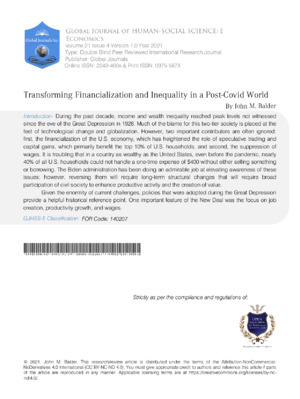
During the past decade, income and wealth inequality reached peak levels not witnessed since the eve of the Great Depression in 1928. Much of the blame for this two-tier society is placed at the feet of technological change and globalization. However, two important contributors are often ignored: first, the financialization of the U.S. economy, which has heightened the role of speculative trading and capital gains, which primarily benefit the top 10% of U.S. households, and second, the suppression of wages. It is troubling that in a country as wealthy as the United States, even before the pandemic, nearly 40% of all U.S. households could not handle a one-time expense of $400 without either selling something or borrowing. The Biden administration has been doing an admirable job at elevating awareness of these issues; however, reversing them will require long-term structural changes that will require broad participation of civil society to enhance productive activity and the creation of value. Given the enormity of current challenges, policies that were adopted during the Great Depression provide a helpful historical reference point. One important feature of the New Deal was the focus on job creation, productivity growth, and wages.

Transforming Financialization and Inequality in a Post-Covid World

During the past decade, income and wealth inequality reached peak levels not witnessed since the eve of the Great Depression in 1928. Much of the blame for this two-tier society is placed at the feet of technological change and globalization. However, two important contributors are often ignored: first, the financialization of the U.S. economy, which has heightened the role of speculative trading and capital gains, which primarily benefit the top 10% of U.S. households, and second, the suppression of wages. It is troubling that in a country as wealthy as the United States, even before the pandemic, nearly 40% of all U.S. households could not handle a one-time expense of $400 without either selling something or borrowing. The Biden administration has been doing an admirable job at elevating awareness of these issues; however, reversing them will require long-term structural changes that will require broad participation of civil society to enhance productive activity and the creation of value. Given the enormity of current challenges, policies that were adopted during the Great Depression provide a helpful historical reference point. One important feature of the New Deal was the focus on job creation, productivity growth, and wages.

John M. Balder
John M. Balder

No Figures found in article.

John M. Balder. 2021. “. Global Journal of Human-Social Science – E: Economics GJHSS-E Volume 21 (GJHSS Volume 21 Issue E4): .

Download Citation

Journal Specifications

Crossref Journal DOI 10.17406/GJHSS

Print ISSN 0975-587X

e-ISSN 2249-460X

Classification
GJHSS-E Classification: FOR Code: 140207
Keywords
Article Matrices
Total Views: 1841
Total Downloads: 854
2026 Trends
Research Identity (RIN)
Related Research
Our website is actively being updated, and changes may occur frequently. Please clear your browser cache if needed. For feedback or error reporting, please email [email protected]

Request Access

Please fill out the form below to request access to this research paper. Your request will be reviewed by the editorial or author team.
X

Quote and Order Details

Contact Person

Invoice Address

Notes or Comments

This is the heading

Lorem ipsum dolor sit amet, consectetur adipiscing elit. Ut elit tellus, luctus nec ullamcorper mattis, pulvinar dapibus leo.

High-quality academic research articles on global topics and journals.

Transforming Financialization and Inequality in a Post-Covid World

John M. Balder
John M. Balder

Research Journals