A Critical Criminological Analysis of the Series “When they See us” and Some Considerations about the Institutional Racism

Patrícia Silva
Patrícia Silva

Send Message

To: Author

A Critical Criminological Analysis of the Series “When they See us” and Some Considerations about the Institutional Racism

Article Fingerprint

ReserarchID

567MX

A Critical Criminological Analysis of the Series “When they See us” and Some Considerations about the Institutional Racism Banner

AI TAKEAWAY

Connecting with the Eternal Ground
  • English
  • Afrikaans
  • Albanian
  • Amharic
  • Arabic
  • Armenian
  • Azerbaijani
  • Basque
  • Belarusian
  • Bengali
  • Bosnian
  • Bulgarian
  • Catalan
  • Cebuano
  • Chichewa
  • Chinese (Simplified)
  • Chinese (Traditional)
  • Corsican
  • Croatian
  • Czech
  • Danish
  • Dutch
  • Esperanto
  • Estonian
  • Filipino
  • Finnish
  • French
  • Frisian
  • Galician
  • Georgian
  • German
  • Greek
  • Gujarati
  • Haitian Creole
  • Hausa
  • Hawaiian
  • Hebrew
  • Hindi
  • Hmong
  • Hungarian
  • Icelandic
  • Igbo
  • Indonesian
  • Irish
  • Italian
  • Japanese
  • Javanese
  • Kannada
  • Kazakh
  • Khmer
  • Korean
  • Kurdish (Kurmanji)
  • Kyrgyz
  • Lao
  • Latin
  • Latvian
  • Lithuanian
  • Luxembourgish
  • Macedonian
  • Malagasy
  • Malay
  • Malayalam
  • Maltese
  • Maori
  • Marathi
  • Mongolian
  • Myanmar (Burmese)
  • Nepali
  • Norwegian
  • Pashto
  • Persian
  • Polish
  • Portuguese
  • Punjabi
  • Romanian
  • Russian
  • Samoan
  • Scots Gaelic
  • Serbian
  • Sesotho
  • Shona
  • Sindhi
  • Sinhala
  • Slovak
  • Slovenian
  • Somali
  • Spanish
  • Sundanese
  • Swahili
  • Swedish
  • Tajik
  • Tamil
  • Telugu
  • Thai
  • Turkish
  • Ukrainian
  • Urdu
  • Uzbek
  • Vietnamese
  • Welsh
  • Xhosa
  • Yiddish
  • Yoruba
  • Zulu
Font Type
Font Size
Font Size
Bedground

Abstract

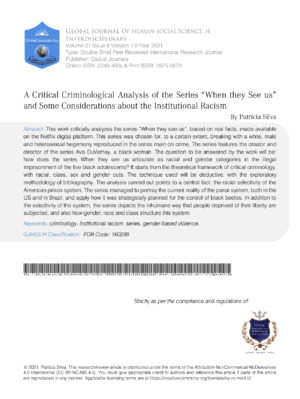
This work critically analyzes the series “When they see us”, based on real facts, made available on the Netflix digital platform. This series was chosen for, to a certain extent, breaking with a white, male and heterosexual hegemony reproduced in the series main on crime. The series features the creator and director of the series Ava DuVernay, a black woman. The question to be answered by the work will be: how does the series When they see us articulate as racial and gender categories in the illegal imprisonment of the five black adolescents? It starts from the theoretical framework of critical criminology, with racial, class, sex and gender cuts. The technique used will be deductive, with the exploratory methodology of bibliography. The analysis carried out points to a central fact: the racist selectivity of the American prison system. The series managed to portray the current reality of the penal system, both in the US and in Brazil, and apply how it was strategically planned for the control of black bodies. In addition to the selectivity of the system, the series depicts the inhumane way that people deprived of their liberty are subjected, and also how gender, race and class structure this system.

References

25 Cites in Article
  1. Silvio Almeida,De (2019). Racismo estrutural.
  2. Vera Andrade,Regina Pereira,De (2015). A ilusão de segurança jurídica: do controle da violência à violência do controle.
  3. Juliana Borges (2018). O que é encarceramento em massa? Belo Horizonte.
  4. Carmen Campos,Hein De (2015). Feminicídio no Brasil: Uma análise crítico-feminista.
  5. Salo Carvalho,; De,Evandro Duarte,Piza (2017). Criminologia do preconceito: racismo e homofobia nas Ciências Criminais.
  6. Mary Curtin,Ann (2000). Black Prisoners and eir World, Alabama, 1865-1900.
  7. Angela Davis,Mulheres (2016). Raça e classe.
  8. Angela Davis (2018). A liberdade é uma luta constante.
  9. Angela Davis (2018). Estarão as prisões obsoletas? Sâo Paulo.
  10. Jeremi Duru (2004). The central park five, the scottsboro boys, and the myth of the bestial black man.
  11. Frantz Fanon (2008). Pele negra, máscaras brancas.
  12. Ana Flauzina,Pinheiro (2016). O feminicídio e os embates das trincheiras feministas. Discursos sediciosos: crime, direito, sociedade.
  13. Eduarda Gindri,; Toscani,Marília Budó,. A Função Simbólica Do Direito Penal E Sua Apropriação Pelo Movimento Feminista No Discurso De Combate À Violência Contra A De Nardin,Mulher (2016). Unknown Title.
  14. Ana Gomes,Paula Pereira,Coletivo Negro -Individual (2007). Self, Raça e Identidade: Algumas questões sobre o tornar-se negro e a auto-rejeição.
  15. Charles Hamilton,Ture Kwane (1967). Black Power: Politics of Liberation in America.
  16. Bell Hooks (1981). Não sou eu uma mulher.
  17. Lagarde Y De Los Ríos,Marcela (2007). Por los derechos humanos de las mujeres: la Ley General de Acceso de las Mujeres a una Vida Libre de Violencia.
  18. Shana Maier (2008). Rape Victim Advocates' Perception of the Influence of Race and Ethnicity on Victims' Responses to Rape.
  19. Soraia Mendes,Rosa Da (2014). Criminologia Feminista no Brasil: diálogos com Soraia Mendes.
  20. Silva Silveira Da,; Patrícia,Marília Budó,; De Nardin,Felipe Dias,Da Veiga (2019). A medida socioeducativa de internação e a audiência de revisão de medida: um estudo a partir da observação não participante.
  21. Neusa Sousa,Santos (1983). Tornar-se Negro: as vicissitudes da identidade do negro brasileiro em ascensão social.
  22. Luanna Souza,Thula Pires (2019). É POSSÍVEL COMPATIBILIZAR ABOLICIONISMOS E FEMINISMOS NO ENFRENTAMENTO ÀS VIOLÊNCIAS COMETIDAS CONTRA AS MULHERES?.
  23. Rolf Souza,De (2009). As representações do homem negro e suas consequências.
  24. Sojourner Truth (2020). E não sou uma mulher? Geledes -Instituto da mulher negra.
  25. Eugenio Zaffaroni,Raúl (1991). Em busca das penas perdidas: a perda de legitimidade do sistema penal.

Funding

No external funding was declared for this work.

Conflict of Interest

The authors declare no conflict of interest.

Ethical Approval

No ethics committee approval was required for this article type.

Data Availability

Not applicable for this article.

How to Cite This Article

Patrícia Silva. 2021. \u201cA Critical Criminological Analysis of the Series “When they See us” and Some Considerations about the Institutional Racism\u201d. Global Journal of Human-Social Science - H: Interdisciplinary GJHSS-H Volume 21 (GJHSS Volume 21 Issue H8).

Download Citation

An in-depth analysis of institutional racism and gender bias in academic research.
Journal Specifications

Crossref Journal DOI 10.17406/GJHSS

Print ISSN 0975-587X

e-ISSN 2249-460X

Keywords
Classification
GJHSS-H Classification FOR Code: 160299
Version of record

v1.2

Issue date
November 19, 2021

Language
pt
Experiance in AR

Explore published articles in an immersive Augmented Reality environment. Our platform converts research papers into interactive 3D books, allowing readers to view and interact with content using AR and VR compatible devices.

Read in 3D

Your published article is automatically converted into a realistic 3D book. Flip through pages and read research papers in a more engaging and interactive format.

Article Matrices
Total Views: 1895
Total Downloads: 835
2026 Trends
Related Research
Our website is actively being updated, and changes may occur frequently. Please clear your browser cache if needed. For feedback or error reporting, please email [email protected]

Request Access

Please fill out the form below to request access to this research paper. Your request will be reviewed by the editorial or author team.
X

Quote and Order Details

Contact Person

Invoice Address

Notes or Comments

This is the heading

Lorem ipsum dolor sit amet, consectetur adipiscing elit. Ut elit tellus, luctus nec ullamcorper mattis, pulvinar dapibus leo.

High-quality academic research articles on global topics and journals.

A Critical Criminological Analysis of the Series “When they See us” and Some Considerations about the Institutional Racism

Patrícia Silva
Patrícia Silva

Research Journals