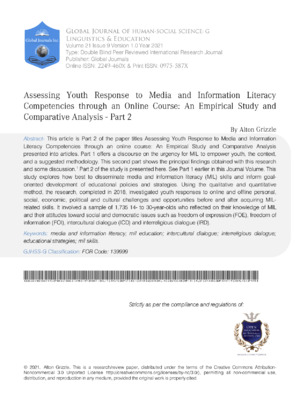
Assessing Youth Response to Media and Information Literacy Competencies through an Online Course: An Empirical Study and Comparative Analysis – Part 2

Article ID

0AV32

Young people's media literacy skills and their impact on media consumption.

Assessing Youth Response to Media and Information Literacy Competencies through an Online Course: An Empirical Study and Comparative Analysis – Part 2

Alton Grizzle
Alton Grizzle
DOI

Abstract

This article is Part 2 of the paper titles Assessing Youth Response to Media and Information Literacy Competencies through an online course: An Empirical Study and Comparative Analysis presented into articles. Part 1 offers a discourse on the urgency for MIL to empower youth, the context, and a suggested methodology. This second part shows the principal findings obtained with this research and some discussion.1 Part 2 of the study is presented here. See Part 1 earlier in this Journal Volume. This study explores how best to disseminate media and information literacy (MIL) skills and inform goal-oriented development of educational policies and strategies. Using the qualitative and quantitative method, the research, completed in 2018, investigated youth responses to online and offline personal, social, economic, political and cultural challenges and opportunities before and after acquiring MIL-related skills. It involved a sample of 1,735 14- to 30-year-olds who reflected on their knowledge of MIL and their attitudes toward social and democratic issues such as freedom of expression (FOE), freedom of information (FOI), intercultural dialogue (ICD) and interreligious dialogue (IRD).


Assessing Youth Response to Media and Information Literacy Competencies through an Online Course: An Empirical Study and Comparative Analysis – Part 2

This article is Part 2 of the paper titles Assessing Youth Response to Media and Information Literacy Competencies through an online course: An Empirical Study and Comparative Analysis presented into articles. Part 1 offers a discourse on the urgency for MIL to empower youth, the context, and a suggested methodology. This second part shows the principal findings obtained with this research and some discussion.1 Part 2 of the study is presented here. See Part 1 earlier in this Journal Volume. This study explores how best to disseminate media and information literacy (MIL) skills and inform goal-oriented development of educational policies and strategies. Using the qualitative and quantitative method, the research, completed in 2018, investigated youth responses to online and offline personal, social, economic, political and cultural challenges and opportunities before and after acquiring MIL-related skills. It involved a sample of 1,735 14- to 30-year-olds who reflected on their knowledge of MIL and their attitudes toward social and democratic issues such as freedom of expression (FOE), freedom of information (FOI), intercultural dialogue (ICD) and interreligious dialogue (IRD).

Alton Grizzle
Alton Grizzle

No Figures found in article.

Alton Grizzle. 2021. “. Global Journal of Human-Social Science – G: Linguistics & Education GJHSS-G Volume 21 (GJHSS Volume 21 Issue G9): .

Download Citation

Journal Specifications

Crossref Journal DOI 10.17406/GJHSS

Print ISSN 0975-587X

e-ISSN 2249-460X

Issue Cover
GJHSS Volume 21 Issue G9
Pg. 53- 60
Classification
GJHSS-G Classification: FOR Code: 139999
Keywords
Article Matrices
Total Views: 1966
Total Downloads: 1000
2026 Trends
Research Identity (RIN)
Related Research
Our website is actively being updated, and changes may occur frequently. Please clear your browser cache if needed. For feedback or error reporting, please email [email protected]

Request Access

Please fill out the form below to request access to this research paper. Your request will be reviewed by the editorial or author team.
X

Quote and Order Details

Contact Person

Invoice Address

Notes or Comments

This is the heading

Lorem ipsum dolor sit amet, consectetur adipiscing elit. Ut elit tellus, luctus nec ullamcorper mattis, pulvinar dapibus leo.

High-quality academic research articles on global topics and journals.

Assessing Youth Response to Media and Information Literacy Competencies through an Online Course: An Empirical Study and Comparative Analysis – Part 2

Alton Grizzle
Alton Grizzle

Research Journals