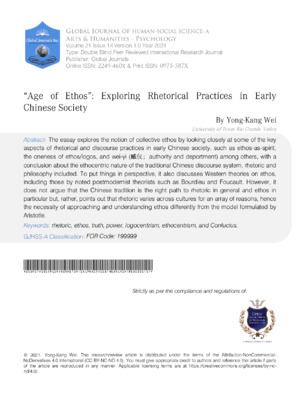
“Age of Ethos”: Exploring Rhetorical Practices in Early Chinese Society

Article ID

724O0

Exploring Rhetorical Practices in Youth Chocide.

“Age of Ethos”: Exploring Rhetorical Practices in Early Chinese Society

Yong-Kang Wei
Yong-Kang Wei University of Texas Rio Grande Valley
DOI

Abstract

The essay explores the notion of collective ethos by looking closely at some of the key aspects of rhetorical and discourse practices in early Chinese society, such as ethos-as-spirit, the oneness of ethos/logos, and wei-yi (威仪; authority and deportment) among others, with a conclusion about the ethocentric nature of the traditional Chinese discourse system, rhetoric and philosophy included. To put things in perspective, it also discusses Western theories on ethos, including those by noted postmodernist theorists such as Bourdieu and Foucault. However, it does not argue that the Chinese tradition is the right path to rhetoric in general and ethos in particular but, rather, points out that rhetoric varies across cultures for an array of reasons, hence the necessity of approaching and understanding ethos differently from the model formulated by Aristotle.

“Age of Ethos”: Exploring Rhetorical Practices in Early Chinese Society

The essay explores the notion of collective ethos by looking closely at some of the key aspects of rhetorical and discourse practices in early Chinese society, such as ethos-as-spirit, the oneness of ethos/logos, and wei-yi (威仪; authority and deportment) among others, with a conclusion about the ethocentric nature of the traditional Chinese discourse system, rhetoric and philosophy included. To put things in perspective, it also discusses Western theories on ethos, including those by noted postmodernist theorists such as Bourdieu and Foucault. However, it does not argue that the Chinese tradition is the right path to rhetoric in general and ethos in particular but, rather, points out that rhetoric varies across cultures for an array of reasons, hence the necessity of approaching and understanding ethos differently from the model formulated by Aristotle.

Yong-Kang Wei
Yong-Kang Wei University of Texas Rio Grande Valley

No Figures found in article.

Yong-Kang Wei. 2021. “. Global Journal of Human-Social Science – A: Arts & Humanities GJHSS-A Volume 21 (GJHSS Volume 21 Issue A14): .

Download Citation

Journal Specifications

Crossref Journal DOI 10.17406/GJHSS

Print ISSN 0975-587X

e-ISSN 2249-460X

Issue Cover
GJHSS Volume 21 Issue A14
Pg. 1- 26
Classification
GJHSS-A Classification: FOR Code: 199999
Keywords
Article Matrices
Total Views: 1933
Total Downloads: 871
2026 Trends
Research Identity (RIN)
Related Research
Our website is actively being updated, and changes may occur frequently. Please clear your browser cache if needed. For feedback or error reporting, please email [email protected]

Request Access

Please fill out the form below to request access to this research paper. Your request will be reviewed by the editorial or author team.
X

Quote and Order Details

Contact Person

Invoice Address

Notes or Comments

This is the heading

Lorem ipsum dolor sit amet, consectetur adipiscing elit. Ut elit tellus, luctus nec ullamcorper mattis, pulvinar dapibus leo.

High-quality academic research articles on global topics and journals.

“Age of Ethos”: Exploring Rhetorical Practices in Early Chinese Society

Yong-Kang Wei
Yong-Kang Wei University of Texas Rio Grande Valley

Research Journals