Bangladesh has seen a significant rise in the number of young people who run businesses on social media sites. In the last few years, this pattern has become apparent. Social-media-based businesses significantly contribute to the nation’s economy since young people constitute a significant proportion of the total population. The study aims to determine how social media assists young people in starting their enterprises and in educating the younger generation about the difficulties and opportunities that can help improve Bangladesh’s economy. In addition, a questionnaire-based survey was conducted to determine whether a low initial investment cost, a high-profit ratio, simple and direct payment methods, and sufficient networking opportunities make businesses more attractive to young entrepreneurs. This paper shows that young entrepreneurs are becoming more interested in social-media-based enterprises because they can make money and work for themselves.
## I. INTRODUCTION
Social networking is an online engagement service that builds and connects individuals with similar interests. Numerous individuals are drawn to social media, and Websites such as Facebook, Twitter, and YouTube are social networking platforms. These sites have been integrated into their everyday life. Some social media sites attempt to recruit a broad audience, while others can only afford to attract users who share a similar language or national identity. They are creating their blog on the Internet.
These sites are gaining popularity since they continue to draw many visitors, particularly teenagers and the younger generation, whose interests are catered to by these sites. Numerous students devote endless daily hours to social media platforms such as Facebook, Instagram, Twitter, and YouTube. Initially, this may seem a waste of time, but it helps students develop essential information and social skills. (Hoglund, W& Leadbeater, B. 2004) For young people, the Internet has opened up a new universe of social networking. Ten years ago, the internet world was drastically different. Due to the introduction of social media, young men and women today share thoughts, emotions, personal information,
## II. THE CONCEPT OF SOCIAL-MEDIA
Social media is the network of interactions between individuals. It may be described in several ways:
Social media are computer-mediated technologies that allow people, corporations, and other organizations to produce, share, or exchange information, professional interests, ideas, and images/videos within virtual communities and networks.
Users can build up and share information or participate in social networking through websites and apps.
Social media is a collection of online communication channels dedicated to community-based involvement, engagement, content exchange, and collaboration. There are several types of social media, such as forums, microblogging, social networking, bookmarking, social curation, and wikis. Some popular social media are given below,
Facebook: Facebook is a well-known, free social networking website that allows registered users to create profiles, upload photos and videos, send messages, and keep in touch with friends, family, and colleagues.
Twitter: Twitter is a free microblogging platform that enables registered users to broadcast "tweets," brief blog entries. Twitter users can share their tweets and read other user's tweets on several devices.
Google+: (pronounced Google plus) The objective of Google's social networking endeavor was to replicate offline interactions more accurately than current social networking platforms. "Real-world sharing recreated for the Internet" is the project's slogan.
YouTube: YouTube is a video-sharing website headquartered in San Bruno, California. Users can publish, read reviews, share, add to favorites, report, comment on, and subscribe to other users' channels on this website.
Wikipedia: Wikipedia is a free online encyclopedia open to the public and produced by the Wikipedia community. Anyone registered on the site may publish an article; registration is not required to change an existing theme. January 2001 saw the birth of Wikipedia.
Social media is becoming an increasingly effective instrument for youth empowerment in the current day. Young entrepreneurs in poor communities can access modern communication and information tools. Empowering youth requires a lot of training, analysis, planning, making, executing, monitoring, evaluating, and thinking about how it will affect their lives and situations.
## III. REVIEW OF LITERATURE
A new class of Bangladeshi youngsters has arisen in the online business. Though some research has been completed on social media-based enterprise and how it helps people to become self-employed in Bangladesh, no recent substantial research has been conducted on how social media influence young people to start their businesses and become self-employed and decreases the youth unemployment[^2] rate in our nation.
Kurniawan's article, "Driving Performance of Youth Creative Firms Based on Online Markets Using Social Media," aims to determine what factors affect the success of businesses run by creative young people who take advantage of the technological revolution. Descriptive analytic methods were used in this study to provide a synopsis of the data analyzed. This study uncovered the keys to startup success among millennials, including using social media as a branding and marketing tool. Thus, the success of an age-neutral business will depend on the factors that make up its infrastructure. Create successful companies out of their unique ideas for using the internet. This study's findings suggest that many social media channels may be used as branding channels for online marketplaces. A company owner could benefit from social media product photo personalization. (Kurniawan, 2019)
Detailed research by Tanbirul about online business found that many aspects of running a company are influenced by the unsettling speed with which digital technology is advancing. The use of social media for commercial purposes, for instance, has become commonplace. Significantly, less developed countries like Bangladesh have benefited from technological progress along with more developed ones. There has been a proliferation of small enterprises in Bangladesh, many of which rely on online marketplaces for their success. Many of these companies successes might be attributed to importing items from the United States, where the market could be more competitive. One exciting thing about this marketplace is that the prices are much lower than at traditional stores. (Tanbirul, 2020)
Khondoker did this study to discover the advantages and disadvantages of e-commerce. And highlighted what factors are obstructing or producing issues in the development of the e-commerce business in Bangladesh, as well as what might be done to overcome these obstacles, as well as examining the industry's prospects for assuring the growth of the e-commerce industry in Bangladesh. This quantitative and qualitative research was inspired by the current online frauds perpetrated by several e-commerce including Ealy, Eorange, Dhamaka, Qoom, Dalal, Sirajganj Shop, Aladiner Prodip, Boom Pradip, Adian Mart, etc. (Khondoker, 2020)
Business operations in Bangladesh are reportedly being modernized with the use of various e-commerce technologies, as reported by Ahammad et al. (2007). Customers in Bangladesh can now use verified internet connections to buy and sell multiple products on a micro-scale, beginning with orders placed with chosen vendor partners. The potential for e-commerce and related businesses in Bangladesh is substantial. For companies thinking about incorporating e-commerce solutions into their operations, this paper outlined the potential and future of e-commerce. Overall, it provided a picture of e-commerce in Bangladesh. (Ahmed et al. 2007)
The e-commerce sector in Bangladesh is still in its infancy. Karim, Thohidul, and Xi Xi (2018) offered details about the history and current state of Bangladesh's e-commerce sector. They have brought out a few issues with the existing e-commerce industry. Both the availability of internet shopping options and the number of people doing their shopping in this way in Bangladesh are on the rise. Customers in Bangladesh were found to have a generally favorable impression of online purchasing but to be wary of its potential security risks. Therefore, it is incumbent upon e-commerce merchants to make an effort to cultivate a long-term connection with customers and win their trust by facilitating open communication, encouraging the formation of communities, soliciting feedback, and putting customers' suggestions to good use. They need to boost their marketing efforts to expand their customer base and create a plan that centers on the end user's needs. (Karim, 2018)
Hossain observed that women's empowerment, in terms of social standing, economic security, self-actualization, etc., is an inextricable aspect of the development of any given society. Succeeding in long-term development is next to impossible without including women in conventional programs. Without women's full and equal participation in the nation's growth, the goal of this progress would remain just that: a dream. According to Hossain's research, women company owners in Bangladesh find e-business the most practical and straightforward way to operate their companies. (Hossa in, 2018)
Modern Bangladesh has focused on young entrepreneurship to provide employment opportunities, strengthen economic competitiveness, and promote regional development. According to Dash and Kaur (2012), two fundamental characteristics draw the attention of young entrepreneurs in underdeveloped countries such as Bangladesh. The first is the rising number of jobless young people compared to the rest of the population. The second is the need for better competitiveness, and the attendant demands for skill development and entrepreneurship to counterbalance the consequences of globalization and liberalization. (Das h and Kaur, 2012) To avoid misrepresentation and safeguard client rights, e-commerce businesses pay careful attention to the specifics of the online items, such as the product's quality and return policy. E-commerce enterprises will also be required to establish contracts with things, suppliers, delivery networks, and payment gateways to guarantee that consumers' rights are adequately safeguarded to gain customer confidence (Srinivasan, 2004).
Malhotra and Schuler's in-depth study using Kabeer's idea of empowerment employs a range of indicators to assess women's empowerment. According to them, women's empowerment must occur in six diverse areas: the economic, social, familial/ interpersonal, legal, and political spheres, as well as the psychological realm. Each of these may be evaluated at several levels, from the household to the community to the national, regional, and global levels. In the economic dimension, empowerment indicators may include women's control over family income, access to labor, credit, and markets, representation in high-paying professions, and participation in macroeconomic policy. (Malhotra et al., 2005)
## IV. METHODOLOGY
a) Sampling techniques, Target groups, Data collection, Data analysis techniques
This research contains both primary and secondary sources. To gather primary data, an online poll was done to determine how social media assists adolescents in becoming self-sufficient and increasing the employment rate in our nation. Young people involved in online business who live in Dhaka or near the city were selected as the study's target population. The sample size for this population is calculated using a non-probabilistic sampling technique. The sample size is 30. Participants in the survey vary in age from 18 to 30 years old. Secondary data are from websites, publications, organizations, papers, and e-commerce specialists. Microsoft Excel is used to analyze the survey data. The simple average or percentage approach generates quantitative statistics from semi-structured questionnaire data.
## V. FINDINGS AND DISCUSSION
This survey has a sample size of 30 people. The survey included open-ended and more narrowly focused questions and those with multiple-choice and yes/no options. The results and interpretation of this study's questionnaire are shown below.
Table 1: Demographic Profile
<table><tr><td>Gender</td><td>Percentage</td><td>Frequency</td></tr><tr><td>female</td><td>77%</td><td>23</td></tr><tr><td>male</td><td>23%</td><td>7</td></tr><tr><td>total</td><td>100%</td><td>30</td></tr></table>
Based on gender, there are $77\%$ female and $23\%$ male respondents. The majority of the respondents are female.
Table 2
<table><tr><td>Age Range</td><td>Frequency</td><td>Percentage</td></tr><tr><td>≤18</td><td>2</td><td>7</td></tr><tr><td>19-24</td><td>19</td><td>63</td></tr><tr><td>25≤</td><td>8</td><td>30</td></tr><tr><td>total</td><td>30</td><td>100</td></tr></table>
In the table (2), the survey samples reveal that $7\%$ of respondents are below or equal to the age of 18 and they initially started their university life, while $63\%$ fall within the age range of 18-24 years, $30\%$ are above or equal the age of 25. The survey reveals that most respondents began their businesses via social media between 19 and 24. As they mature, they become aware of the risk linked with business.
Table 3
<table><tr><td>Educational Qualification</td><td>Frequency</td><td>Percentage</td></tr><tr><td>undergraduate</td><td>25</td><td>83</td></tr><tr><td>graduate</td><td>4</td><td>13</td></tr><tr><td>Higher Secondary</td><td>1</td><td>3</td></tr><tr><td>Others</td><td>0</td><td>0</td></tr><tr><td>total</td><td>30</td><td>100</td></tr></table>
The educational analysis shown in table-(3) represents that $83\%$ of the respondents are undergraduates, $13\%$ are graduates, and $3\%$ of them are at the higher secondary level. As we can see, $83\%$ of the respondents are undergraduates, which means they are university students. For this reason, respondents have a good knowledge of the facilities provided by social media.
It has been noted that most university students aspire to engage in income-generating activities during or shortly after their graduate education. Young generations with higher levels of education find that a business based on social media requires less movement and capital. It is one of the reasons why there is a more significant proportion of educated younger generations in companies based on social media.
## VI. BUSINESS CHARACTERISTICS
### a) Product variety
Table 4
<table><tr><td>Selling Product Name</td><td>Percentage</td><td>Frequency</td></tr><tr><td>Stitched and Unstitched Clothing</td><td>40%</td><td>12</td></tr><tr><td>Jewelry & Cosmetics</td><td>20%</td><td>6</td></tr><tr><td>Art and crafts</td><td>23.30%</td><td>7</td></tr><tr><td>Food items & Catering Service</td><td>13.30%</td><td>4</td></tr><tr><td>Meat Products</td><td>3.30%</td><td>1</td></tr><tr><td>jamdani</td><td>3.30%</td><td>1</td></tr><tr><td>Electronic gadgets</td><td>3.30%</td><td>1</td></tr><tr><td>Digital product/service</td><td>3.30%</td><td>1</td></tr></table>
From table (4), we can see that $40\%$ of the respondents sell unstitched and stitched clothing and $20\%$ sell jewelry and cosmetics, and $6.6\%$ sell both. On the other hand, $23.3\%$ of the respondents are doing art and craft bussiness. $13.30\%$ of the sellers are doing the food business. $3.3\%$ are doing both (arts and crafts and food business). Again $3.3\%$ are selling meat through social media, and $3.3\%$ are selling traditional jamdani. Additionally, $3.3\%$ are selling electronic products, and $3.3\%$ are giving digital services. Clothing, art and crafts, food supply, and jewelry businesses are now popular on social media.
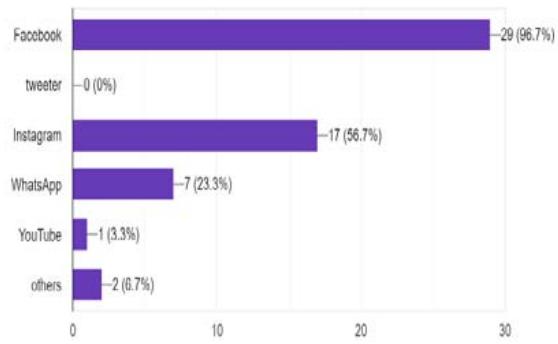 Which social media do you use for your business? 30 responses Figure 1
Figure (1) shows that $96.7\%$ of young entrepreneurs run their businesses on Facebook. This platform motivated many young people to become social media entrepreneurs and helped them acquire the customer connection skills necessary to run a profitable Facebook business. Everyone chooses Facebook for too many reasons, including the fact that Facebook is an inexpensive method of advertising, that it can be used to distribute both general company information and specific product/service-related content, that it can be used to connect with current and potential customers and offer support, To attract clients' attention, the majority of entrepreneurs give their page a unique name.
On the other hand, $23.3\%$ of business owners use WhatsApp, and $56.7\%$ use Instagram to run their businesses. Moreover, only $3.3\%$ use YouTube and $6.7\%$ use another website. Personal branding and self-promotion on social media have grown in importance today. To start a business, one must first establish oneself as a brand. Numerous young individuals operate their businesses online, yet they need to gain awareness of and understand personal branding on social media.
### b) Business Profile
How much is your monthly income?
Table 5
<table><tr><td>How Much Is Your Monthly Income</td><td>Percentage</td><td>Frequency</td></tr><tr><td>less than 10K</td><td>53%</td><td>16</td></tr><tr><td>10k to 25K</td><td>33%</td><td>10</td></tr><tr><td>25k to 45k</td><td>7%</td><td>2</td></tr><tr><td>More than 45k</td><td>7%</td><td>2</td></tr><tr><td>total</td><td>100</td><td>30</td></tr></table>
Table (5) reveals that $53\%$ of the respondents earn less than 10k in a month.this can be happened because of a lack of knowledge about the business or because of small business. Again $33\%$ of the respondent earn 10k to 25k; moreover, only $7\%$ earn 25k to 45k. On the other hand, $7\%$ of business owners make more than 45k.
Profit ratio
Table 6
<table><tr><td>Profit Ratio</td><td>Percentage</td><td>Frequency</td></tr><tr><td>less than 20%</td><td>20%</td><td>6</td></tr><tr><td>20% to 30%</td><td>30%</td><td>9</td></tr><tr><td>30% to 40%</td><td>23%</td><td>7</td></tr><tr><td>more than 50%</td><td>27%</td><td>8</td></tr><tr><td>total</td><td>100</td><td>30</td></tr></table>
Only $27\%$ of respondents have a more than $50\%$ profit ratio. $30\%$ of the owners are in the $20\%$ to $30\%$ profit ratio category. Again, $23\%$ of those polled are between $30\%$ and $40\%$. $20\%$ of the respondents are in the type of less than $20\%$ profit ratio. Here, the profit ratio could be more noteworthy. Possibly due to a need for more management experience and marketing strategy expertise.
Initial investment
Table 9
<table><tr><td>Initial Investment</td><td>Percentage</td><td>Frequency</td></tr><tr><td>less than 25k</td><td>40%</td><td>12</td></tr><tr><td>25k to 50k</td><td>30%</td><td>9</td></tr><tr><td>50k to 1lac</td><td>23%</td><td>7</td></tr><tr><td>more than 1 lac</td><td>7%</td><td>2</td></tr><tr><td>total</td><td>100</td><td>30</td></tr></table>
Among the respondents in table-7, $40\%$ started their business with an initial investment of below 25k, $30\%$ of the respondents have an initial capital within 25k-50k, $23\%$ started with 50k-1lac, and only $7\%$ had an initial money above 1lac taka. Due to financial constraints or risk issues, it is evident that entrepreneurs have little desire to launch their businesses with large amounts of capital.
Engagement
Table 8
<table><tr><td colspan="3">How strong is your engagement with your customers?</td></tr><tr><td>Level</td><td>Percentage</td><td>Frequency</td></tr><tr><td>High</td><td>27%</td><td>8</td></tr><tr><td>low</td><td>7%</td><td>2</td></tr><tr><td>moderate</td><td>67%</td><td>20</td></tr><tr><td>total</td><td>100%</td><td>30</td></tr></table>
Entrepreneurs must establish a strong network with their online clients to achieve a healthy profit. With the assistance of family, friends, and colleagues, many business owners enjoy an extensive network of connections. In the table(8), $27\%$ of respondents have an excellent network with their clients. 67 percent have a moderate network with their clients, whereas 7 percent cannot maintain a good network.
Spending time
Table 9
<table><tr><td colspan="3">How much time do you spend on your business?</td></tr><tr><td>Type</td><td>Percentage</td><td>Frequency</td></tr><tr><td>less than 2 hours</td><td>20%</td><td>6</td></tr><tr><td>3 to 5 hours</td><td>50%</td><td>16</td></tr><tr><td>5 to 7 hours</td><td>17%</td><td>5</td></tr><tr><td>more than 7 hours</td><td>13%</td><td>4</td></tr><tr><td>total</td><td>100%</td><td>30</td></tr></table>
Table 9 demonstrates that almost $50\%$ of owners devote 3 to 5 hours daily to their business, while $20\%$ devote less than 2 hours to social media. Over $17\%$ of owners spend between 5 and 7 hours on social media, while only $13\%$ spend more than 7 hours on social media. Generally, physical business owners must pay daily to engage with clients, while online merchants only need to devote their entire day and night to customer service.
Furthermore, the majority of business owners in this survey are students. Therefore, they must spend their time efficiently between school and business. Therefore, online business platforms aid in time management. Young entrepreneurs effectively manage their time via social media sites.
Experience in online business
Table 10
<table><tr><td colspan="2">Experience in online business</td><td></td></tr><tr><td>Experience</td><td>Percentage</td><td>Frequency</td></tr><tr><td>less than 1</td><td>43.30%</td><td>13</td></tr><tr><td>2 to 3 years</td><td>43.30%</td><td>13</td></tr><tr><td>3 to 4 years</td><td>3.30%</td><td>1</td></tr><tr><td>more than 4 years</td><td>10%</td><td>3</td></tr><tr><td>total</td><td>100%</td><td>30</td></tr></table>
The research indicates that $43.3\%$ of owners have less than one year of experience. In contrast, $43.0\%$ of the owners had two to three years of online business experience. Only $3.3\%$ of the owners have 3 to 4 years of expertise on this platform, while the remaining $10\%$ have more than 4 years of experience.
As a social media platform, it is mainly used for marketing businesses and enhancing connections with clients. Therefore, it presents a chance for young entrepreneurs to continue their businesses online. The combination of a robust business strategy, high-quality goods, the existence of corporate integrity, and a suitable market drive can improve the quality of online business.
## VII. LIKERT SCALE RESULT ANALYSIS
A questionnaire has been created to find out why social media platforms are the best way for young people to start making money on their own. Five options have been used for this. "Strongly disagree," "disagree," "neutral," "agree," and "strongly agree."
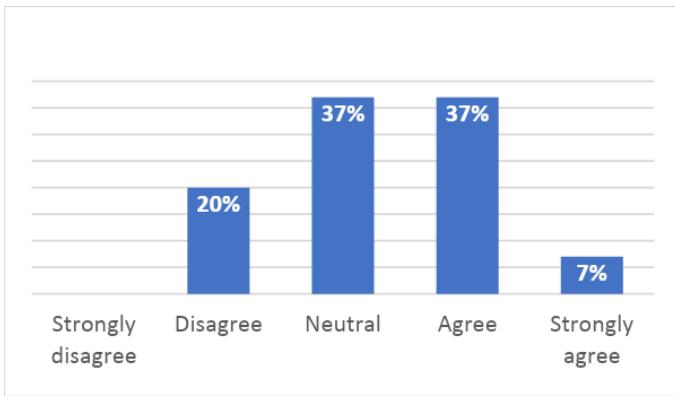 Initial investment Figure 2
New businesses require an initial investment to launch. However, it is onerous for most young entrepreneurs to acquire adequate funding. In this industry, e-commerce helps young companies. Entrepreneurs can launch their businesses by creating a Facebook profile and investing a small amount of money. Figure 2 reveals that $20\%$ of respondents strongly agree and $60\%$ are agreed that a minimum initial expenditure is required to launch a new social media-based business. In contrast, $10\%$ of respondents disagree with the statement.
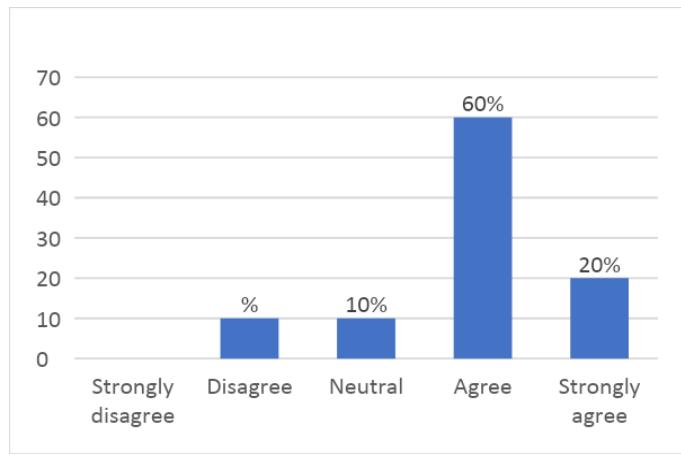 Profit ratio Figure 3 In terms of profit, Table 3 reveals that $7\%$ of respondents strongly agree, and $37\%$ agree that using social media for business helps generate a healthy profit within the first year of firm operation. $20\%$ of entrepreneurs disagree with the statement and believe that earning a good profit within one year of business start-up is very difficult. Entrepreneurs think that the profit ratio varies depending on their product categories. Again, $37\%$ of the respondents are neutral about this statement.
Running an online business is less expensive.
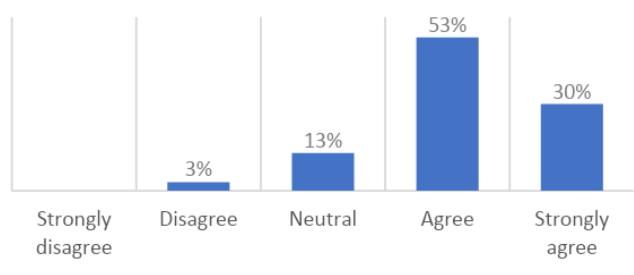 Running on-line business is relatively less expensive than traditional one (with showroom). percentage(%) Figure 4
30% of respondents strongly agreed, and 53% agreed that e-commerce is less expensive than traditional companies since there are no showroom costs, personnel salaries, or power bills. While 13% were neutral, and 3% disagreed.
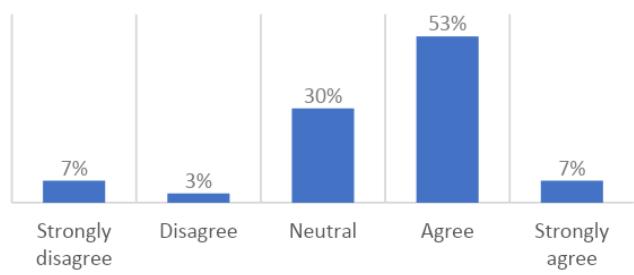 Saves time Attending customers on-line saves time. percentage(%) Figure 5
Business owners feel that clients increasingly depend on online purchasing since city traffic and poorly designed roads make it difficult for them to go shopping. They prefer online shopping with the option of home delivery.
On the other hand, entrepreneurs save time with e-commerce because interacting with individual clients is time-consuming. According to the survey, $7\%$ of respondents strongly agreed, and $53\%$ agreed that a traditional business is more time-consuming than an online business.
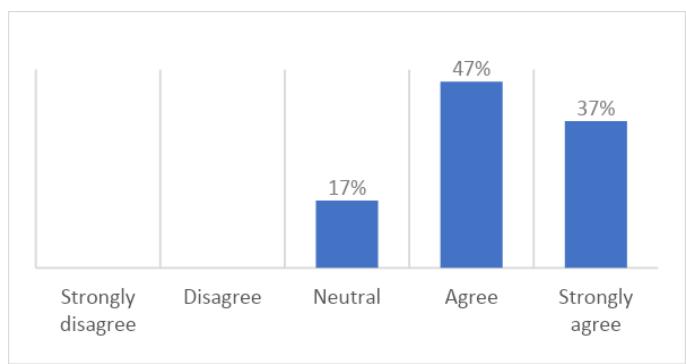 Soft loans by the government Figure 6
47% agreed, 37% strongly agreed that government should provide soft loans, and 17% were neutral about this statement. The government must create policies, legislation, and incentives to foster trust and confidence among young entrepreneurs and establish a national framework. The government can issue soft loans to encourage young people to launch businesses on social media platforms.
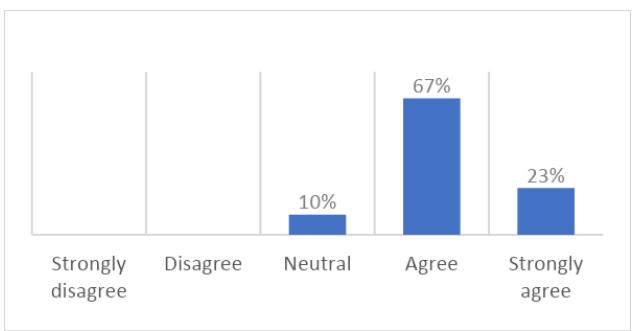 Self-reliance Figure 7
Social media is a big online market. It is a business that requires minimal investment. There is no requirement for a private showroom. It is simple to establish and manage a personal and professional profile. The social media platform provides an accessible networking facility with customers and a cost-effective marketing facility.
Moreover, Through social media, young business owners are gaining respect from others. They can provide financial help to their family. Thus, the online business creates economic independence and assists young entrepreneurs in achieving high social status. The graph demonstrates that $67\%$ of the owners thought social media promotes independence. In contrast, $23\%$ of respondents strongly agreed. None of the owners dispute the claim. $10\%$ of owners are neutral on this matter
 Low marketing cost Figure 8
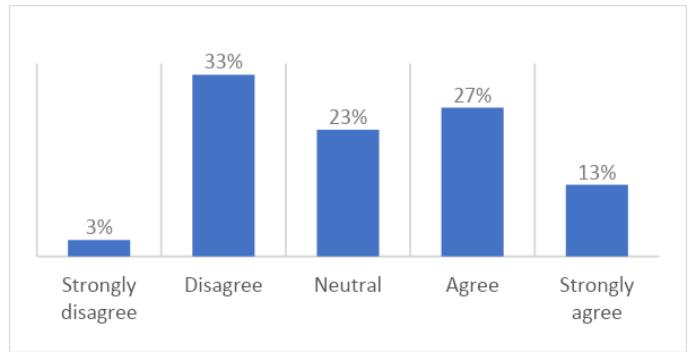
27% of respondents agreed that social media offers minimal marketing costs, and 13% strongly agreed. Social media provides small companies with a cost-effective and efficient digital marketing approach for boosting brand recognition and communicating with their target audience. To successfully promote on social media, one must discover which platforms the target population uses, create accounts, and interact with the target audience to increase brand exposure and sales. In contrast, 33% of respondents disagreed with this assertion, 23% were ambivalent, and just 3% strongly disagreed that social media marketing costs are cheap. Social media marketing is often seen as a low-cost kind of advertising. However, depending on how aggressively it is used, it might take a significant amount of the entire marketing budget, mainly if sponsored social is used. During social media marketing for small businesses, entrepreneurs must consider future expenditures and compare them to their return on investment.
 High competition Figure 9
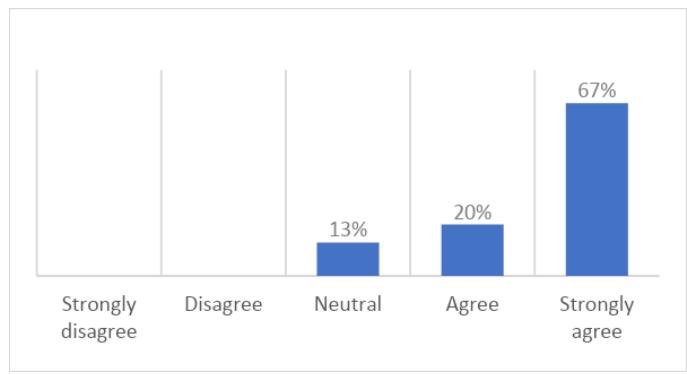
20% and 60% of respondents agreed and strongly agreed that online business competition is extremely high. No one disagreed with the assertion, and just 13 percent of respondents were indifferent. Online business is a highly competitive center. There are hundreds of thousands of businesses that serve the same clients. The present level of digitization has enabled clients to have infinite options. For them, switching to a rival is as simple as clicking a new link.
Government should impose a tax
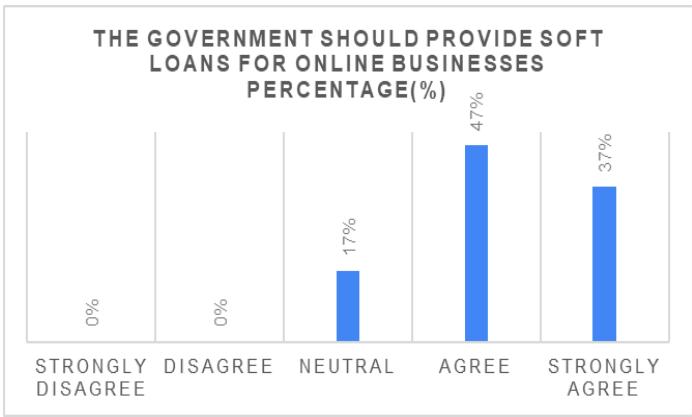 Figure 10
17% of respondents agreed with the assertion that the government should impose a tax on internet businesses. 3% of respondents strongly agreed with this statement. 40% of respondents disagreed, and 10% strongly disagreed with this statement. 27% were indifferent to this statement.
According to daily star, in response to the increasing popularity of online shopping, a $7.5\%$ VAT has been implemented to assist the government in meeting its income goals. When the state government gets a new source of revenue, public service cutbacks are reduced.
But many small company owners have concerns about this tax issue. Companies that can sustain a sales tax price increase have an unfair edge over smaller enterprises that cannot. Due to this tax regime, new entrepreneurs would lose motivation.
Analysis of the Relationship between youth employment and social media based online business
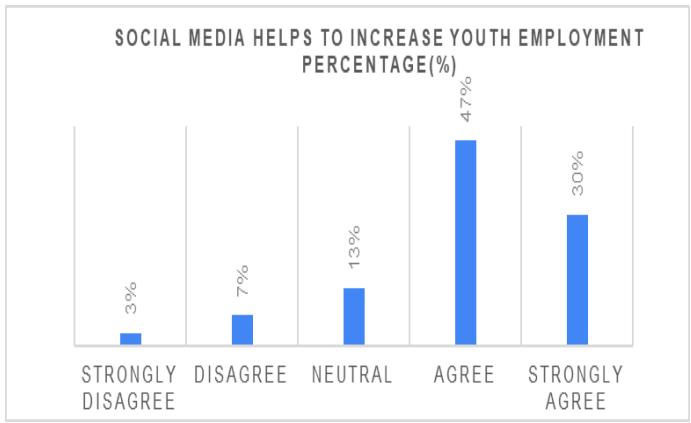 Figure 11
 shows the relationship between youth employment and social media-based online business. Respondents were asked whether they believe social media helps to increase youth employment. The table shows that most respondents (30%) strongly agreed, and $47\%$ agreed that social media helps increase youth employment.
After Evaluating the Results of the Analysis and Findings Section, the Research Concluded that Social Media is the Most Convenient Method for Young Entrepreneurs in Bangladesh to do Business. The Primary Benefits of doing Business through Social Media are:
Huge web-based market: Entrepreneurs use Facebook, Twitter, WhatsApp, and Instagram to do business. These mediums encourage young people to do business online since they are affordable advertising methods. Communication with clients and customers is quite simple. Entrepreneurs use many mediums to interact with as many customers as possible. Facebook is the most popular business medium.
Saves valuable time: At a physical business, the proprietor must spend the whole day and night in the store serving customers. However, individuals who do business online devote a maximum of three to five hours daily to it. Given that the majority of company owners in our poll are students, it is apparent that they must divide their time between school and business effectively. Online business platforms thus assist in time management. Through social media, young entrepreneurs efficiently manage their time.
Business requires minimal capital: It is challenging for young entrepreneurs to get money, but social media has made it simple for them to do so. They may begin their enterprises by establishing a profile on social media with an attention-getting name. This involves a little expense.
There is no need for a private showroom: We need ample space for a business's showroom. However, social media makes it easy to develop and maintain a company without a physical location. They need to offer a broad description of their product and attract consumers specifically interested in it. This contributes to the maintenance of a personal and professional profile.
Simple networking capability with clients: In online business, business people interact with their customers through their website or online page. Customers rely more on internet shopping since metropolitan traffic and poorly planned roads make it impossible for them to purchase in person. They prefer internet shopping with home delivery options. Entrepreneurs must build a solid network with their online customers to generate a healthy return.
Inexpensive advertising facility: Social media is a cheap and effective way for small businesses to use digital marketing to increase brand awareness and communicate with their target audience. To increase brand exposure and sales, one must find out which platforms the target audience uses, make accounts, and talk to the target audience.
Economic independence: Young entrepreneurs are aided in attaining high social standing through internet business, which promotes financial autonomy. Thus, they can support their family financially.
Again, Whenever any information is updated, it will be shown on the walls of all the individuals who have been added as friends. Entrepreneurs may tag posts or images on the walls of their frequent consumers without sending out invites individually. In addition, regular customers and friends bring in more consumers via word-of-mouth marketing and by inviting their friends to join the business's Facebook page. After a certain amount of time, these clients will become loyal.
However, businesses still need help with various obstacles while doing business online. That is given below,
Limited access to information in the IT industry: Most young individuals in the internet business need more technological competence. Consequently, maintaining a company is a significant obstacle for young individuals.
Lack of Internet connectivity facility: Most places in Bangladesh need more Internet access. Therefore, any new entrepreneurs who want to launch a company using social media are discouraged. A weak internet connection might threaten businesses that rely on social media.
Lack of Training Program Accessibility: Young entrepreneurs who want to continue their firms online must possess a strong business plan, high-quality products, and corporate ethics. However, their inability to conduct business effectively results from their ignorance of business strategy. In Bangladesh, no training program provides information on internet business strategy. Thus, young individuals acquire knowledge via experience, but this comes with a substantial danger.
Absence of management experience: Entrepreneurs often start businesses relatively early. It is typical for them to need more management experience. As a result, they face loss in the first stage.
Need for an adequate marketing capability: People often think of social media as a cheap advertising method. However, this all depends on how information is used for commercial purposes. Marketing budget allocation is very critical. Most new entrepreneurs in our nation need help to manage their marketing plans.
Strenuous competition: There are millions of firms that service the same customers. The current degree of digitalization has allowed customers to have limitless possibilities. They may easily switch to a competitor by clicking a new link.
Effect of social-media based business on youth employment
Social media-based businesses in a developing nation such as Bangladesh are relatively new. In Bangladesh, $27.82\%^{1}$ of the population comprises youth, while the unemployment rate among young people is $14.7\%^{2}$. Thus, businesses based on social media have provided a new chance for the younger generation. The moment is now for young people to work and generate since the breadth of commerce and marketing is expanding due to information and communication technologies. Utilizing the internet to advertise and sell their goods, businesses can expand the scope of trade and marketing. It is more productive and efficient since the buyer does not have to spend money traveling to the shop. Therefore, the seller is also advantageous since they save money because they do not need to invest additional funds to rent and locate an ideal site. They are decreasing the cost of doing extra work. They need to post the product's description and image on social media. Nonetheless, in the current day, young people also sell their items using a website they created themselves. The fact that social media makes buying and selling things easier shows how valuable it is.
## VIII. RECOMMENDATION
- > Students and young entrepreneurs struggle to acquire the financing needed to launch a new firm. In this case, many financial institutions, banks, and even the government may be able to help the person by giving them small personal loans.
- If young entrepreneurs can build a solid network, it will be straightforward to produce a healthy profit within the first year of operation. It would help their reputation if they put more effort into building networks, kept their Facebook page up-to-date, and posted interesting product videos.
- > Young entrepreneurs may start their businesses with relative ease by creating a Facebook profile. However, most clients want a showroom to examine the items in more detail. In this case, e-commerce will help customers learn more about the business and serve as a draw.
- > Providing accurate information, prompt delivery, and maintaining client loyalty are essential to gaining consumer confidence.
- > Academic institutions may provide career counseling services to help young entrepreneurs and networking opportunities.
- $\succ$ According to the study, young people in Bangladesh are more interested in starting their businesses. Therefore, regulations and policy formulation should encourage development.
- > Payment mechanisms on Bangladeshi e-commerce websites should provide a higher degree of security. Bangladesh's ICT legislation governing e-commerce must be modernized. International norms must perform it.
- > Businesses operating online in Bangladesh should improve customer service and address areas of concern. Entrepreneurs should prioritize timely delivery.
## IX. CONCLUSION
In Bangladesh, social media is rapidly benefiting the economy and business. It significantly adds to the nation's GDP and overall growth. Currently, the nation's largest firms are also starting to deliver all services via social media. The rapid growth of social media was due to the favorable attitude of the country's population toward it. Young adults (18-24 years old) are particularly drawn to it (Islam, 2019). However, except in a few major cities, not everyone in the nation has been able to reap the advantages of social media. The whole country will reap the rewards if this sector is enhanced further. The E-Marketplace is a data source that acts as an information agent, supplying buyers and sellers with product information. Everyone must know its specifics to make this sector more lucrative and extensive. This paper has examined various social media-based business issues, including its operations, development, expansion in Bangladesh, etc.
Additionally, some of their operations and regulations have been proposed so that this industry might expand throughout the nation. In addition, this paper has discovered that consumers and businesspeople need to gain awareness of the whole system. Suppose everyone is aware of the present status and complete specifics of the social media industry in Bangladesh. In that case, many individuals, entrepreneurs, and international investors will be interested in participating in this dynamic area. Business based on social media and online business has become the new way for young people to work for themselves.
## X. LIMITATIONS OF THE STUDY
The Research is conducted with a small number of participants due to time and financial constraints. The sample is gathered only in the city of Dhaka. This study is based on an analysis of existing literature and primary data obtained via questionnaires and in-person interviews with young entrepreneurs.
[^1]: https://en.prothomalo.com/bangladesh/o9i009reql#:~:text=One%20fourth%20of%20the%20country's, Bureau%20of%20Statistics%20(BBS). _(p.9)_
[^2]: https://www.macrotrends.net/countries/BGD/bangladesh/youth-unemployment-rate _(p.9)_
Generating HTML Viewer...
References
20 Cites in Article
Shaikh Ahammad,Mostak (2007). PROSPECTS OF E-COMMERCE IN BANGLADESH.
Youcef Baghdadi (2013). From E-commerce to Social Commerce: A Framework to Guide Enabling Cloud Computing.
R Bajaj (2017). DO SOCIAL NETWORKING SITES PRIVACY POLICIES DIFFER? A LINGUISTIC ANALYSIS OF THE TEN MOST POPULAR SOCIAL NETWORKING SITES.
V Barker (2009). Older adolescents" motivations for social network site use: The influence of gender, group identity, and collective self-esteem.
M Dash,K Kaur (2012). Youth entrepreneurship as a way of boosting Indian economic competitiveness: a study of Orissa.
(2017). Green Energy for Green Economy: The Case Study of Kurdistan Region of Iraq (KRI).
A Ghoneim,S Ghoneim,S Kamel (2014). The Role of the Government in eCommerce in Egypt.
Donna Hoffman,Thomas Novak,Marcos Peralta (1999). Building consumer trust online.
Wendy Hoglund,Bonnie Leadbeater (2004). The Effects of Family, School, and Classroom Ecologies on Changes in Children's Social Competence and Emotional and Behavioral Problems in First Grade..
Tanjela Hossain (2018). Empowering Women through E-Business: A Study on Women Entrepreneurs in Dhaka City | Asian Business Review.
M Islam (2019). existing-home-sales-reach-six-year-high.
J Johnson (2021). Figure 8.30. Daily Internet connection among smartphone users in selected countries, spring 2012.
M Johnson,S Whang (2003). E-Business and Supply Chain Management: An Overview and Framework.
Md Karim,Xu Qi (2018). E-commerce Development in Bangladesh.
K Karl,J Peluchette (2008). Social networking profiles: An examination of student attitudes regarding use and appropriateness of content.
M Khondoker (2022). "Problems & Prospects Of Bangladesh Shipping Industry: A Comparative Overview ".
A Malhotra,S Schuler (2005). Measuring Empowerment.
N Nie,D Hillygus (2002). The impact of internet use on sociability: Time-diary findings IT & Society, 1(1).
J Rayport,B Jaworski,B Jaworski Introduction to E-Commerce, 2/E, with E-Commerce Powerweb.
S Srinivasan (2004). Role of trust in e‐business success.
Explore published articles in an immersive Augmented Reality environment. Our platform converts research papers into interactive 3D books, allowing readers to view and interact with content using AR and VR compatible devices.
Your published article is automatically converted into a realistic 3D book. Flip through pages and read research papers in a more engaging and interactive format.
Our website is actively being updated, and changes may occur frequently. Please clear your browser cache if needed. For feedback or error reporting, please email [email protected]
Thank you for connecting with us. We will respond to you shortly.