Bronze Age sites of the Southern Trans-Urals (Sintashta, Petrovka and Alakul’ archaeological cultures) associated with the migrations of early Indo-European communities on the territory of Central Eurasia. Since the 2000, an archaeological expedition of Chelyabinsk State University has been conducting research on Bronze Age sites near the modern village Stepnoye in the Chelyabinsk Region (Russia). The article presents the characteristics of the burial rite of the Bronze Age communities from the steppe region, based on the analysis of 146 burials and sacrificial complexes. The burial rituals of the studied sites demonstrate analogies to Indo-European mythological plots known from written sources, and testify to the complex social processes that took place during this period. The Sintashta and Petrovka series of burials shows the occurrence of elite groups of the population in society, the Alakul’ series shows a return to the simplified stratification of the buried.
## I. INTRODUCTION
The sites of Sintashta, Petrovka and Alakul' archaeological cultures of the Bronze Age of the Southern Trans-Urals (Russia) are traditionally included in the circle of chariot cultures of early Indo-European communities. The interest of researchers for this Bronze Age period of the Southern Trans-Urals increased significantly after the discovery at the end of the XX century of a series of fortified settlements equipped with a composite defensive system, indicating that these communities had a complex social organization. The archaeologists from Russian, USA, Great Britain and Germany universities took part in the study of these sites (Hanks et al, 2014; Krause, Koryakova, 2013; Pitman et al, 2013; etc.).
For more than 20 years, the archaeological expedition of the Chelyabinsk State University has been carrying out complex research of the Bronze Age sites (Sintashta, Petrovka and Alakul' archeological cultures) in the South Trans-Urals near the modern village Stepnoye (Chelyabinsk region, Russia). Over these years, in collaboration with colleagues from the Universities of Pittsburgh (USA) and Sheffield (UK), the fortified settlement of the Sintashta culture Stepnoye, as well as Stepnoye-1 and Stepnoye VII cemeteries (two necropolis near the settlement) were partially investigated (Hanks et al, 2014; Hanks et al, 2016; Kupriyanova, 2016; Kupriyanova, Zdanovich, 2015; Pitman et al, 2013).
The study of ancient burial complexes give a possibility to reconstruct the social structure, elements of funeral rites and mythological system, religious ideas of societies that did not have written and pictorial sources. The aim of the study is to generalize the characteristics of the burial rite of two cemeteries located in the limited district near the modern village Stepnoye. These archaeological sites are part of a large cultural community of the Bronze Age of the Southern Trans-Urals, consisting of genetically related cultures - Sintashta, Petrovka, Alakul. Dozens of scientific papers were devoted to the study of their burial rites (Hanks et al, 2016; Kupriyanova, 2016; Kupriyanova, Epimakhov, Berseneva, Bersenev, 2017; Kupriyanova, Zdanovich, 2015; etc.). The article presents new archaeological materials and study of the social structure, rituals and elements of Indo-European mythology, which reflected in these sites.
## II. MATERIALS AND METHODS
In the Stepnoye-1 cemetery, there were 7 kurgans excavated, including 52 burials and sacrificial pits of the Sintashta and Petrovka cultures (Kupriyanova, 2016), while in the Stepnoye VII cemetery 8 burial complexes including 94 burials and sacrificial pits of the Petrovka and Alakul cultures underwent diggings (Kupriyanova, Zdanovich, 2015). During the excavations, several hundred ceramic vessels and hundreds of other artifacts were obtained, including tools, weapons, woman ornaments etc. Comprehensive researches of the artefacts included various types of natural science analyses. In this article devoted to social reconstructions, generalized data of anthropological definitions of the sex and age of the buried individuals, zoological definitions of animal bone remains from sacrifices, radiocarbon dating of objects, DNA analysis data were used. The proposed conclusions represent a generalized characteristic of the burial rite of the Indo-European communities of the Bronze Age of Southern Trans-Urals, obtained during the comprehension of statistical data, typology and semantic analysis of the rite elements presented in the archaeological remains.
## III. RESEARCH RESULTS
### a) Dating and cultural affiliation of archaeological sites
Twenty-seven AMS dates were obtained from the studied objects at five laboratories - University of Arizona; University of California, Irvine; Oxford Radiocarbon Accelerator Unit; Klaus-Tschira-Labor, Curt-Engelhorn-Zentrum Archaeometrie; Collaborative Center "Radiocarbon Dating and Electron Microscopy Laboratory" of the Institute of Geography, Russian Academy of Sciences. The analysis of these data allows us to determine the following time intervals of the existence of ancient populations for this area: Sintashta culture - about 1950-1850 BC; Petrovka culture - about 2133-1631 BC; Alakul' culture - about 1882-1566 BC (Epimahov, Kupriyanova, Hommel, Hanks, 2021). Most likely, the Sintashta and Petrovka cultures partially coexisted in the Stepnoye archaeological area, but their objects were never recorded together within the same mound or burial site. The Alakul' culture has later dates, but its objects are usually incorporated into the structure of Petrovka complexes. There have been noted cases of multiple reuses of Petrovka sacrificial complexes and burials by the Alakul' population. The similarities between the burial rites and the complex of artifacts suggest a genetic link between all three cultures. Three DNA samples obtained from the burials of the Stepnoye VII cemetery, which participated in a large-scale study of ancient DNA (Narasimhan et al, 2019), confirm that the Bronze Age populations of the Southern Trans-Uralis are directly related to the Eurasian migrations of early Indo-European tribes.
### b) Structure of burial complexes
Basing on the classification by M. Gimbutas, K. Jones-Bley distinguishes 8 positions characterizing the burial rites of ancient Indo-Europeans: 1) individual burials; 2) kurgans; 3) funerary structures in the form of dwellings; 4) division of burials into classes according to the presence/absence of grave goods and architectural complexity; 5) central male burials and subordinate position of women and children burials; 6) human and animal sacrifices, including the traditions of sati; 7) placing the dead on the floors of burial pits in a crouched position; 8) animal burials in separate graves (Gimbutas, 1974; Jones-Bley, 2002). All these features are noted in varying degrees by K. Jones-Bley on the burial complexes of the Sintashta culture.
The burial rites in the investigated cemeteries near the village Stepnoye present new data and correspond to the proposed characteristics, but show variation in the Sintashta, Petrovka and Alakul' complexes. In the Stepnoye-1 cemetery, there were recorded 65 chaotically arranged kurgans, sometimes forming chains. In the Stepnoye VII cemetery, all the complexes are lined up. Burial complexes comprise structured sites with large pits with individual or collective burials in the center. On the periphery around the central pits there are smaller, most often children's and women's burials, and sacrificial pits. In most cases, the complexes are surrounded by a circular ditch, which may also contain burials and sacrifices. The central burials were covered by domed structures, which, when destroyed, created the impression of a mound. In kurgans with one central pit, there were individual male or female burials in the center. In kurgans with two or three central burials, these pits contained collective graves which included adult individuals of both sexes as well as children and adolescents.
### c) Age and social classes
The age structure of the buried of the Petrovka population is similar in percentage distribution to that of the Sintashta population: the buried between 10 and 25 years of age account for $45\%$ of all age groups, while the number of infant burials - $35.5\%$ - is relatively small. In the Alakul' series, the vast majority of the buried are children of under 1 year of age $(83.2\%)$. The number of the buried of other ages is not large. Buried children between 1 and 4 years of age are almost completely absent in all cultural groups.
Basing on the analysis of paleoanthropological definitions, it can be stated that the age composition of the buried is very similar in the Sintashta and Petrovka populations and far from the natural mortality structure due to the predominance of adolescents and individuals of young age, a small number of infants and a near absence of adults and the elderly. The Alakul' age diagram of the buried is generally close to the usual mortality profile in ancient societies with extremely high infant mortality. From these data, it follows that in the Sintashta and Petrovka societies there was a selection for burial in kurgans. It is possible that this type of rite was practiced for the elite population group, while there were alternative kinds of rituals for the common people. Similar processes can be observed in other ancient societies. For instance, it is noted that in the Aegean Bronze Age necropolis, infant burials disappear from common cemeteries as the social complexity increases and stratification emerges (Dickinson, 1994). The Sintashta society is referred to by researchers as the so-called "complex society" at the stage of formation of chiefdom (Drenan, Hanks, Peterson, 2011). The age structure analysis of the buried in the necropolis near the Stepnoye fortified settlement allows to draw the same conclusion for the Petrovka population.
### d) Burial rite
Large graves had two burial chambers located one over the other. The lower chamber contained bodies of the buried in a crouched position on a side, accompanied by grave goods (Fig. 1). The predominant posture of the buried is on the left side, with knees bent and hands joined at the face. There are also a few recorded secondary burials, where the body of the deceased was originally in another place, and after clearing from the flesh, the bones were collected and placed in the grave (Fig. 4.2). In some cases, those bones were in a disorderly assemblage, while in others they were given an anatomically correct placement imitating a crouched position.
Numerous burials were robbed in antiquity. The study of the taphonomy of burials suggests that robberies were carried within a short period, most likely by the same population. In many cases, only the upper part of the skeleton of the buried person was disturbed, while the legs and grave goods remained in situ (Fig. 2). Most likely, grave robberies were not mercenary in nature, but part of rituals that reflected fear of death and the dead.
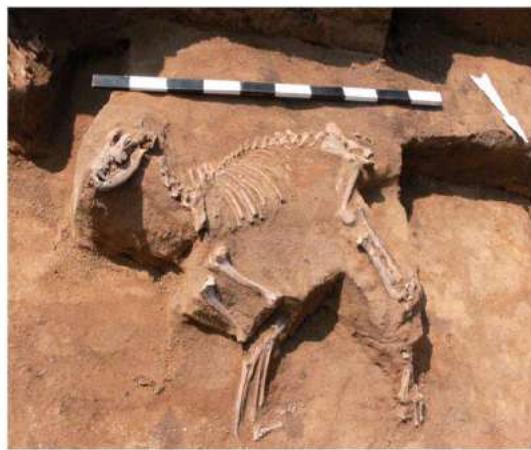
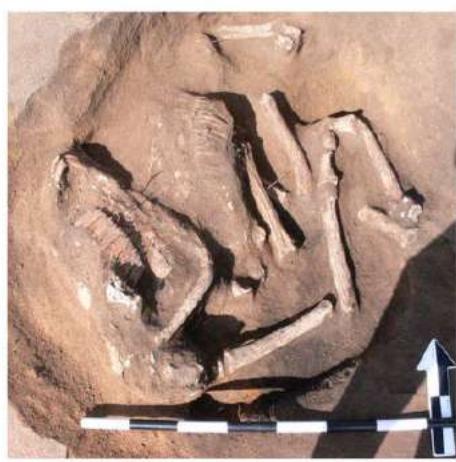
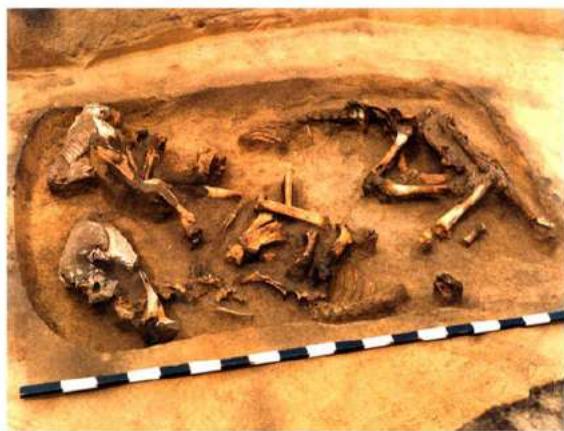
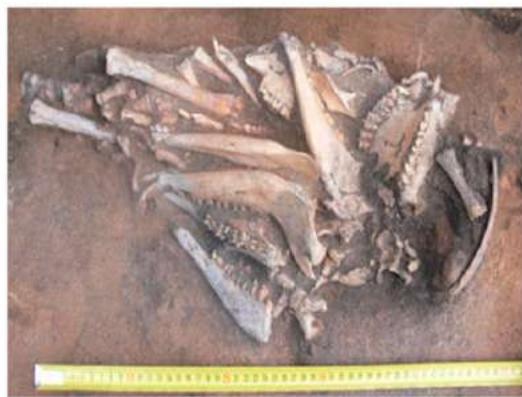
The overlay between the upper and lower burial chambers contained animal sacrifices. Those were also located in separate pits and on the platform of the mound (Fig. 3). The sacrificed animals were always domestic - horse, cow, small cattle, and dogs. In adult and collective Sintashta burials, the sacrificial altars consisted, as a rule, of several (up to 12) animal individuals, represented partially - by heads and limbs. In large Petrovka burials, sacrificial animals are most often represented by complete skeletons. Only occasional sacrifices of 1-2 individuals of small cattle were noted in children's burials.
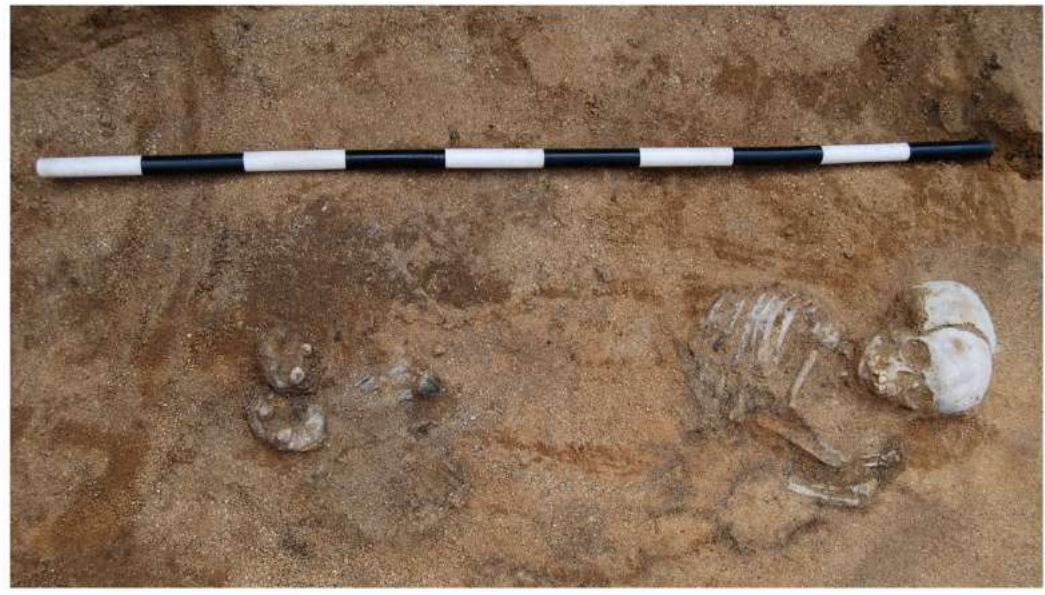
The grave goods of the necropolis are extensive and diverse. Children's individual burials of all three archaeological cultures were accompanied only by ceramic vessels, sometimes sets of dice and small decorations. However, the skeletons of children from collective burials may have been accompanied by items of a prestigious nature. For example, in burial 2 of kurgan 1 of Stepnoye-1 cemetery, a quiver of arrows and two cheek-pieces (elements of horse harness) were found with a child of 1.5-2 years old (Fig. 4.1). Such facts testify to the "elite" origin of children from collective burials.
Besides ceramic vessels with remains of burial food, adult individuals had weapons (axes, daggers, arrowheads and remains of bows) (Fig. 5. 1-8, 10), tools (pestles, needles, awls, knives, spindles, chisels, etc.), elements of horse harness (Fig. 5.9), ornaments (Fig. 6), ritual objects (bone spatulas, sets of fortune-telling bones - astragali). The metal objects are made with great skill and indicate a high level of development of metallurgy among the Bronze Age communities. Decorations on ceramic vessels are based on the core Indo-European symbolic elements - swastika and meander (Fig. 7), which brightly manifested later in the great civilizations of antiquity.
### e) Mythological themes
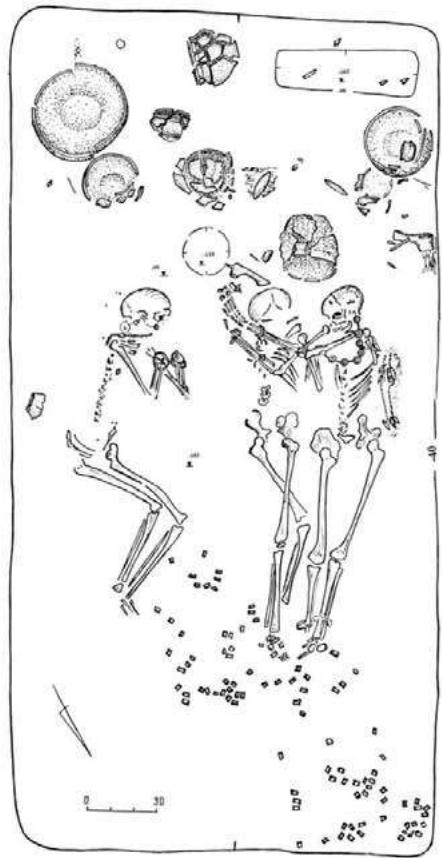
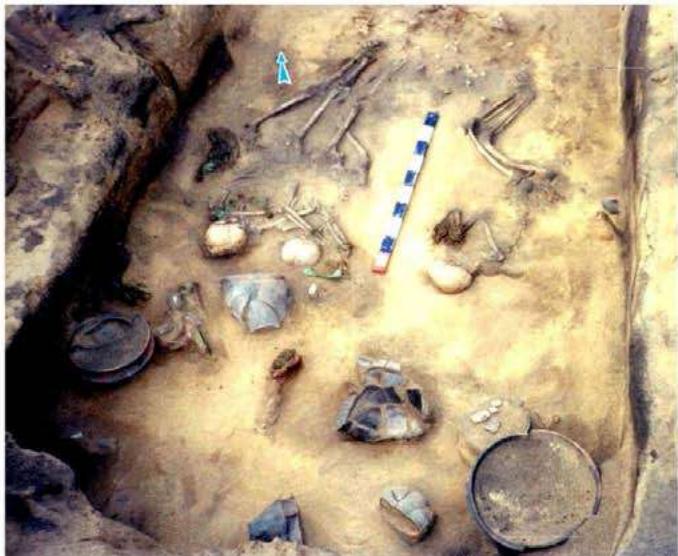
A separate issue is the two "themes" reflected in the burial rites - burials with evidence of charioteering and burials "in the position of embrace". These types of burials occupy central positions in the kurgans and have the richest grave goods. In the Stepnoye-1 and Stepnoye VII cemeteries, there were examined 4 burials "in the embrace pose" and 7 burials with elements of the chariot complex. In the "embrace position" burials, two individuals lie face to face on their left and right sides, embracing each other. Usually there is a male on the left side and a female in a richly decorated costume on the right one. However, the DNA analysis in burial 17 of the Stepnoye VII cemetery has shown that both of the buried were females. The woman aged between 15 and 17, buried on her right side, was accompanied by numerous decorations. Her arms embraced the second buried woman and held over her head from behind a ritual axe in the shape of the head of a bird of prey (Fig. 8). The second buried woman had no decorations and played the role of a "male" character. Often in such burials, a couple of people in the ritual embrace position is accompanied by other individuals of different sex and age. The sex, age and the special position of the buried leave no doubt that they were not real spouses during their lifetime, but represented in the ritual the symbolism of a "sacred marriage", being a reflection of the cults of the Great Goddess, Magna Mater.
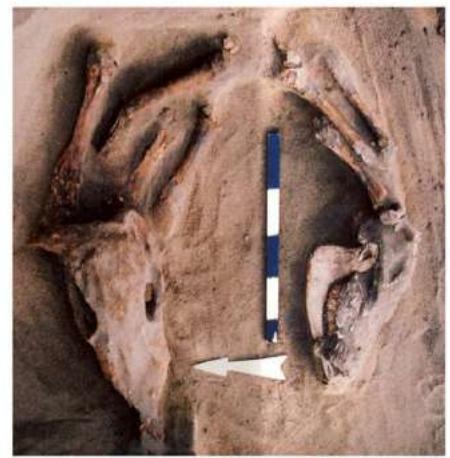
The chariot complex, which is the hallmark of the Sintashta and Petrovka cultural traditions, is very clearly manifested in the studied necropolis. The chariot complex includes burials accompanied by paired horse sacrifices (Fig. 4. 3, 4), wheel pits, or traces of a chariot placed in the grave, cheek-pieces, and weapons of distant combat. In the Sintashta burials, paired horse sacrifices were located on the slabs of large central collective graves and are represented by "partial" animals (head + legs). In such burials, sets of cheek-pieces accompany not only men but also women and children of all ages, indicating that the buried were not charioteers in reality, but played this role in the ritual. In the Petrovka complexes, the individual central burials of mature men were accompanied by whole carcasses of two horses located outside the burials, on sub-mound grounds or in separate pits. These observations show that the symbolism of charioteering in the Sintashta society extended to a particular social group, while in the Petrovka society it was an attribute of a particular individual.
Horse sacrifices in the studied sites accompany not only burials with chariot combat symbolism but also burials "in the embrace position" with clearly expressed fertility symbology. The number of horses in such complexes always equals two or multiples of two. In some cases, the horses in the sacrifices imitate an embrace position, lying on their left and right sides with their legs towards each other. The study of this element of the rite evokes direct analogies with the Indo-European Twin cults. The pairs of Divine Twins known in Indo-European mythological systems, such as Dioscuri, Molionidae, Ashvins, etc., are always closely associated with horses and charioteering. According to the conception of G. Dumezil, who divided the ancient Indo-European society functionally into three social classes - priests (sacred function), ruling elite (military function) and peasants (productive function), the Divine Twins represent the third function - production of material goods, and are related to fertility cults. S. Wikander has given separate consideration to the image of the Indian twins Ashvins. By correlating them with the heroes of the epic Mahabharata twins Nakula and Sahadeva, the scholar came to the conclusion about the original diametrical opposition of the Indian twins. In his opinion, one of them symbolizes the military function, the other - the production function (Wikander, 1957). D.Ward, developing this idea, analyzed other Indo-European twin pairs and came to the conclusion that these properties are characteristic not only for Indian, but for all Indo-European twins, although it is often not stated in the myths directly, but is established only by indirect evidence. One of them has a vicious character, and is associated with a sword and a battle horse; while the other has a mild character, being associated with a plow, a farmer's horse, etc. (Ward, 1970). The mythological connection of the Divine Twins with horses, chariots and the image of the Great Goddess is noted by C. Grottanelli and other researchers (Grottanelli, 1986; etc.). The study of the Bronze Age sites of the Southern Trans-Uralis has shown that this mythological theme is one of the earliest in Indo-European mythology and is recorded for as early as the II millennium BC.
## IV. CONCLUSION
The study of the cemeteries near the village Stepnoye in the Southern Trans-Urals has provided extensive information on the burial rites, mythological system, symbolism, and social structure of early Indo-European communities of the Bronze Age in Eurasia. From the beginning of the II millennium BC, we can observe the formation of complex societies of the Sintashta and Petrovka cultures, the emergence of elite population groups, the development of charioteering, metallurgy and cattle breeding, the reflection of classical mythological themes and symbols in the rites. Judging by the study of ancient DNA, approximately during this period the territory of the South Trans-Ural region was subjected to waves of migration of population groups to the Altai, Central Asia and India (Narasimhan et al, 2019). In the subsequent Alakul' period, closer to the middle of the second millennium, the burial sites show simplification of the social structure and rites, with the general similarity of the material culture and preservation of many traditions.
### ACKNOWLEDGEMENTS
The author expresses gratitude to Dr. Dmitry Zdanovich (Chelyabinsk state university) for joint field research on Stepnoye VII cemetery, Dr. Alexandr Khokhlov (Samara state social-pedagogical university), Dr. Egor Kitov (Institute of ethnology and anthropology of Russian Academy of Science), Dr. Alina Chirkova (Center of Paleo-ethnological research) for anthropological definitions, Dr. Leonid Gayduchenko (Chelyabinsk state university) for definitions of animal remains, Denis Semenov for help in translation of text.
1. Dickinson O. (1994). The Aegean Bronze Age. Cambridge, Cambridge University Press.
2. Drenan R., Hanks B., Peterson Ch. (2011). The comparative study of chiefly communities in the Eurasian steppe region. Social evolution and history 10 (1): 149-186.
3. Epimahov A. V., Kupriyanova E. V., Hommel P., Hanks B. K. (2021). Arheologiya i kompleksnye metody issledovaniya. Ot predstavlenij o linejnoj evolyucii k mozaike kul'turnyh tradicij (bronzovyj vek Urala v svete bol'shih serij radioulglerodnyh dat). Drevnie i tradicionnye kul'tury vo vzaimodejstvii so sredoj obitaniya: problemy istoricheskoj rekonstrukcii. Chelyabinsk, Izdatel'stvo Chelyabinskogo gosudarstvennogo universitet: 7-29.
4. Gimbutas M. (1974). An archaeologist's view of PIE in 1975. Journal of Indo-European Studies 2 (3): 289-307.
5. Grottanelli C. (1986). Yoked horses, twins, and the powerful lady: India, Greece, Ireland and elsewhere. Journal of Indo-Europeans Studies 14 (1-2): 125-152.
6. Hanks B., Doonan R, Zdanovich D., Kupriyanova E., Pitman D., Batanina N., Johnson J. (2014). Metals, Society and Economy in the Late Prehistoric Eurasian Steppe. Archaeometallurgy in Global Perspective. Early metallurgy: a global reader. New York, Springer: 755-784.
7. Hanks B., Doonan R., Pitman D., Kupriyanova E., Zdanovich D. (2016). Eventful Death – Eventful Lives? Bronze Age Mortuary Practices in the Late Prehistoric Eurasian Sterres of Central Russia (2100-1500 BC). Death Rituals, Social Order and the Archaeology of Immortality in the Ancient World. New York, Cambridge university press: 328-351.
8. Jones-Bley K. (2002). Indo-European burial, the "Rigveda", and "Avesta". Complex societies of Central Eurasia from the $3^{rd}$ to the $1^{st}$ Millenium BC: Regional specifics in light of global models (1). Washington, DC: 68-81.
9. Krause R., Koryakova L. (ed.) (2013). Multidisciplinary investigations of the Bronze Age
- settlements in the Southern Trans-Urals (Russia). Bonn, Verlag Dr. Rudolf Habelet. GmbH.
10. Kupriyanova E.V. (2016). Pogrebal'nye praktiki epohi bronze Yuzhnogo Zauralya: mogilnik Stepnoe-1 (raskopki 2008, 2010-2011, 2014 gg.). Chelyabinsk, Enciklopediya.
11. Kupriyanova E., Epimakhov A., Berseneva N., Bersenev A. (2017) Bronze Age Charioteers of the Eurasian Steppe: A Part-time Occupation for Select Men? Praehistorische Zeitschrift 92(1): 40-65.
12. Kuprijianova E.V., Zdanovich D.G. (2015). Drevnosti lesostepnogo Zauralia: mogil'nik Stepnoe VII. Cheliabinsk, Entsiklopedija.
13. Narasimhan V. M., Patterson N., Moorjani P., Rohland N., Bernardos R., Mallick S., Lazaridis I., Nakatsuka N., Olalde I., Lipson 1 M., Kim A. M., Olivieri L. M., Coppa A., Vidale M., Mallory J., Moiseyev V., Kitov E., Monge J., Adamski N., Alex N., Broomandkhoshbacht N., Candilio F., Callan K., Cheronet O., Cullenston B. J., Ferry M., Fernandes D., Freilich S., Gamarra B., Gaudio D., Hajdinjak M., Harney E., Harper T. K., Keating D., Lawson A. M., Mah M., Mandl K., Michel M., Novak M., Oppenheimer J., Rai N., Sirak K., Slon V., Stewardson K., Zalzala F., Zhang Z., Akhatov G., Bagashev A. N., Bagnera A., Baitanayev B., Bendezu-Sarmiento J., Bissembaev A. A., Bonora G. L., Charginov T. T., Chikisheva T., Dashkovskiy P. K., Derevianko A., Dobes M., Douka K., Dubova N., Duisengali M. N., Enshin D., Epimakhov A., Fribus A. V., Fuller D., Goryachev A., Gromov A., Grushin S. P., Hanks B., Judd M., Kazizov E., Khokhlov A., Krygin A. P., Kupriyanova E., Kuznetsov P., Luiselli D., Maksudov F., Mamedov A. M., Mamirov T. B., Meiklejohn Ch., Merrett D. C., Micheli R., Mochalov O., Mustafokulov S., Nayak A., Pettener D., Potts R., Razhev D., Rykun M., Sarno S., Savenkova T. M., Sikhymbaeva K., Stepchenko S. M., Soltobaev O. A., Stepanova N., Svyatko S., Tabaldiev K., Teschler-Nicola M., Tishkin A. A., Tkachev V. V., Vasilyev S., Velemínský P., Voyakin D., Yermolayeva A., Zahir M., Zubkov V. S., Zubova A, Shinde V. S., Lalueza-Fox C, Meyer M, Anthony D. Boivin N, Thangaraj K, Kennett D. J, Frachetti M, Ron Pinhasi, Reich D. (2019). The formation of human population in South and Central Asia. Science 365 (Eaat7487).
14. Pitman D., Doonan R., Hanks B., Zdanovich D., Kupriyanova E., Brempt L.V., Montgomery D. (2013). Exploring metallurgy in Stepnoye: the role of ceramic in the matte conversion process. *Historical metallurgy* society. *Accidental and Experimental Metallurgy* 7: 153-160.
15. Ward D. (1970). The separate function of the Indo-European Divine Twins. Myth and Law among the Indo-Europeans. Berkley; Los Angeles; London: 193-202.
## LIST OF ILLUSTRATIONS
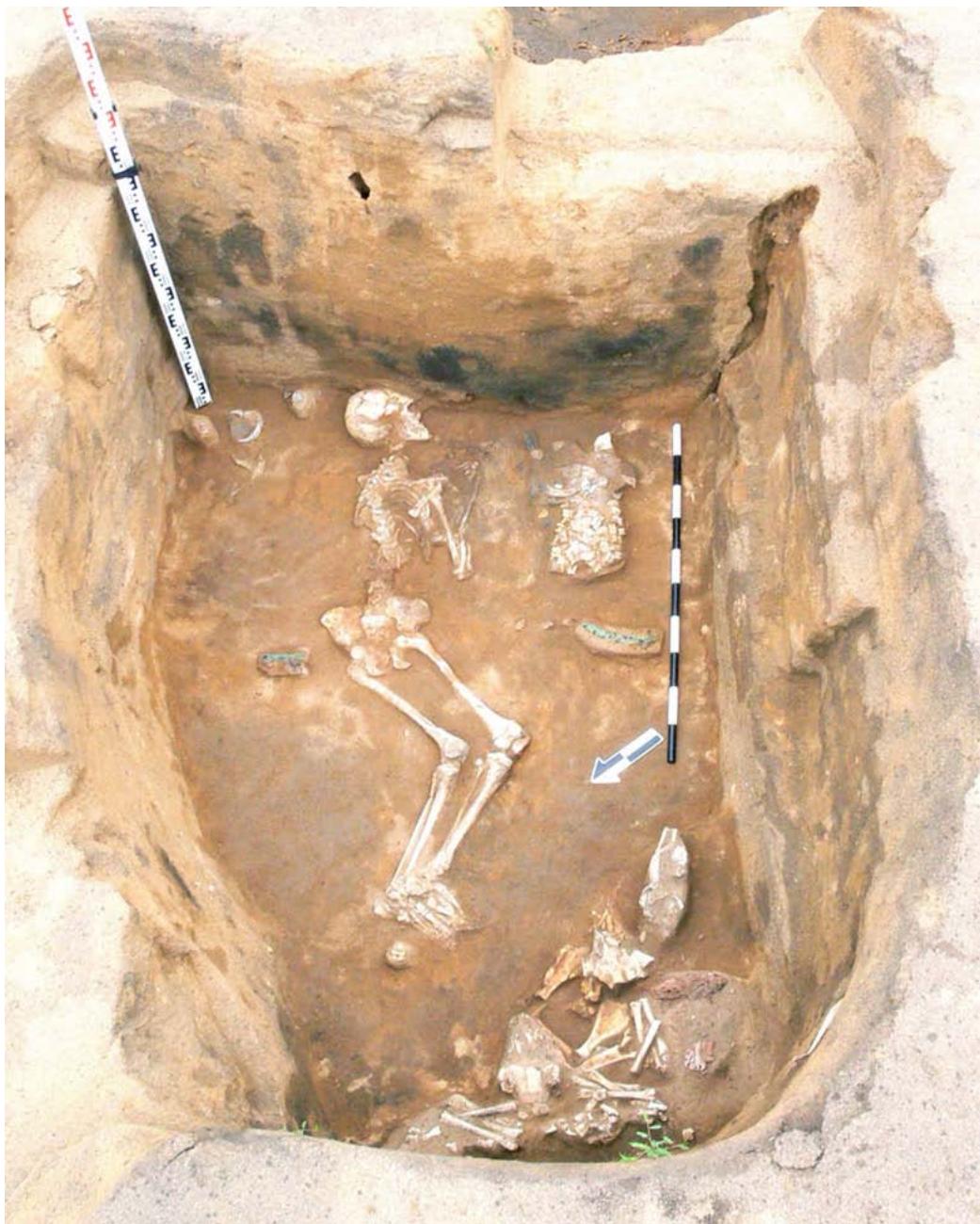
Fig. 1: Burial of Sintashta Culture (Stepnoye 1 Cemetery, Kurgan 7, Pit 2)
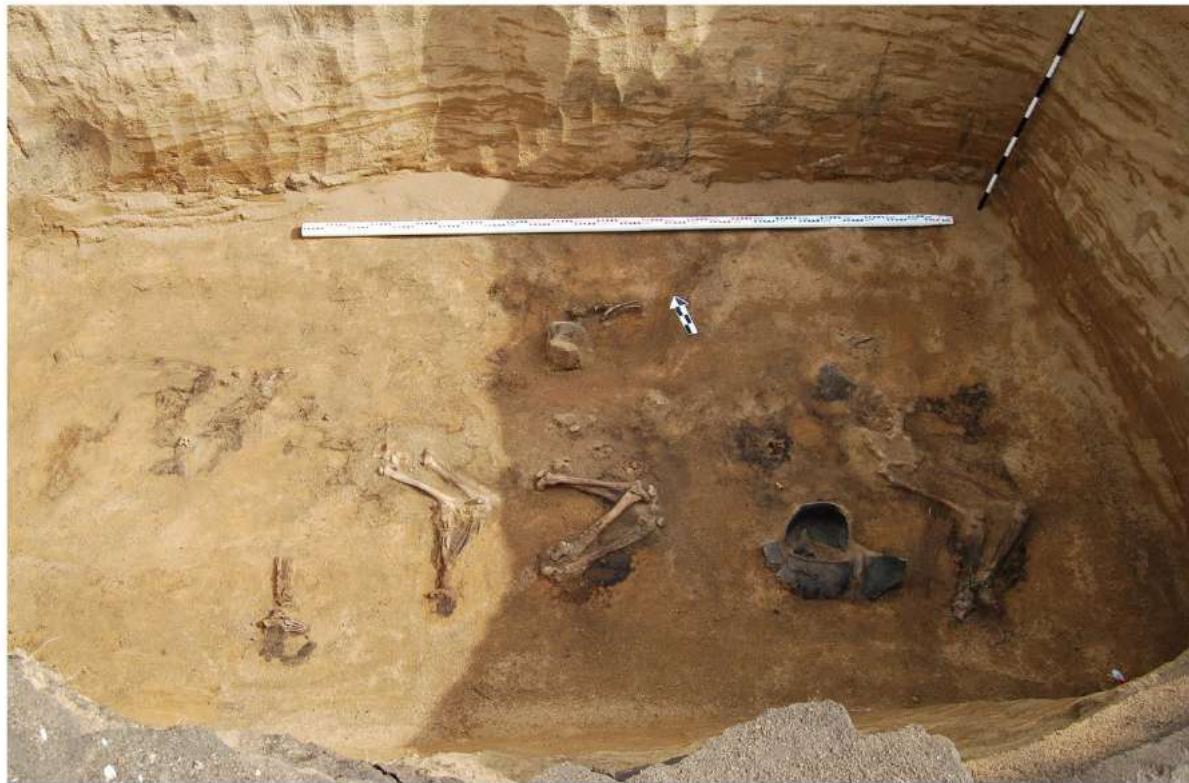
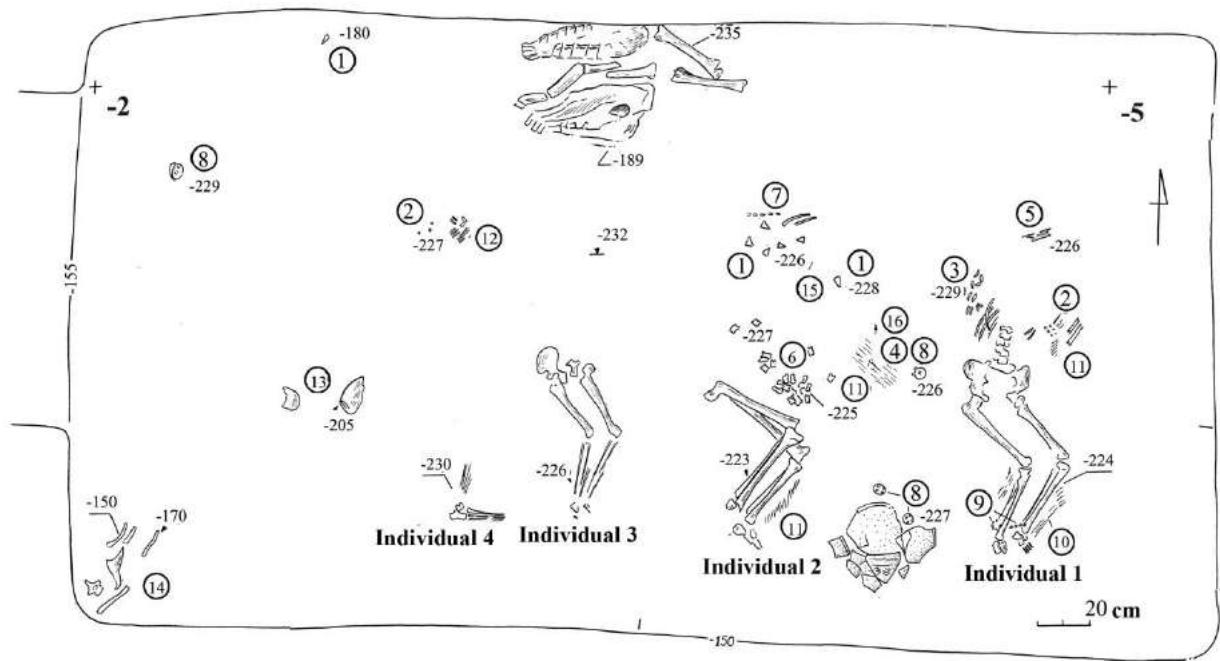
Fig. 2: Robbed burial of Sintashta culture (Stepnoye 1 cemetery, kurgan 1, pit 1): 1 – photo; 2 – plan of burial (1 – stone arrowhead; 2 – beads; 3 – women ornament; 4 – awl; 5 – piece of wood; 6 – astragals; 7 – tail vertebrae of the animal; 8 – cheek-pieces; 9 – bronze beads; 10 – fragment of felt; 11 – organic remains; 12 – hand bones of individual 4; 13 – human scull; 14 – human bones; 15 – needle; 16 – awl with wooden handle)
1
2
3
4
5
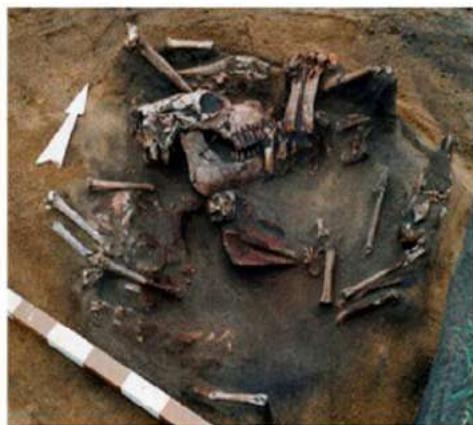
6 Fig. 3: Sacrificial complexes of Sintashta and Petrovka cultures): 1 - sacrifice of bull, cow and calf, Stepnoye VII cemetery, complex 7; 2 - dog sacrifice, Stepnoye 1 cemetery, kurgan 4; 3 - double horse sacrifice (heads and legs), Stepnoye 1 cemetery, kurgan 5; 4 - double horse sacrifice, Stepnoye VII cemetery, complex 6; 5-6 - multiple animal sacrifices, Stepnoye VII cemetery, complex 4
1
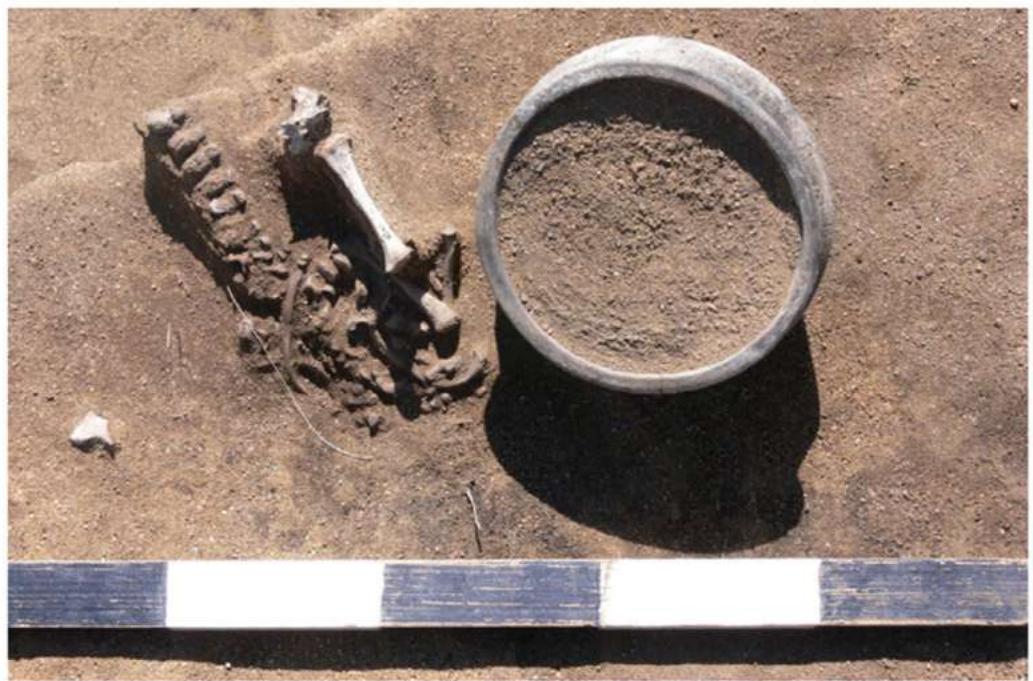
2 Fig. 4: Child burials: 1 – child of 1, 5-2 years old with cheek-pieces, Stepnoye 1 cemetery, kurgan 1; 2 – secondary child burial with vessel, Stepnoye 1 cemetery, kurgan 4
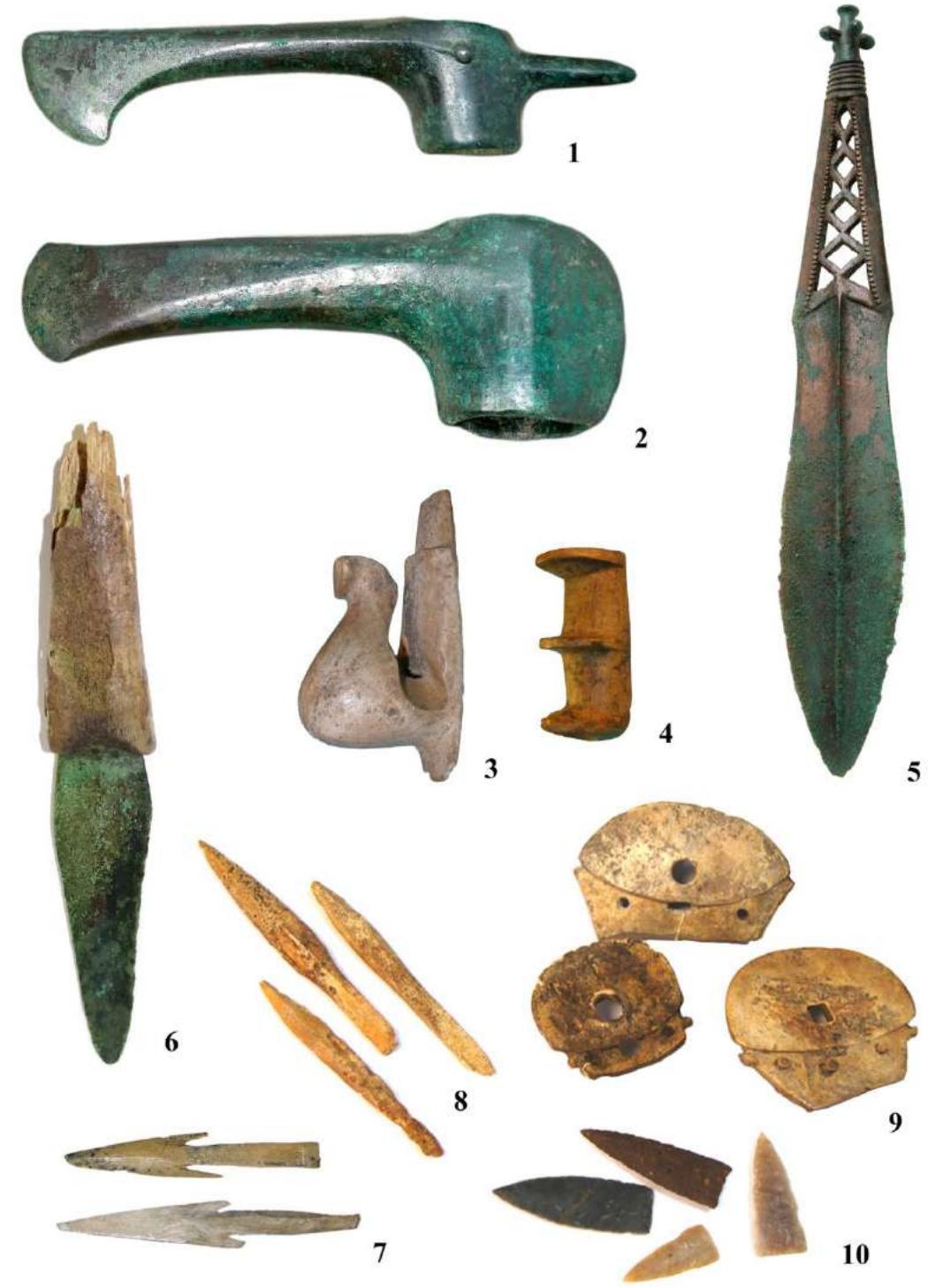
Fig. 5: Burial items: 1-2 - axes; 3-4 - parts of a complex bow; 5-6 - daggers; 7-8 - bones arrowheads; 9 - cheek-pieces; 10 - stone arrowheads (1-2, 5 - Stepnoye VII cemetery; 3-4, 6-10 - Stepnoye 1 cemetery)
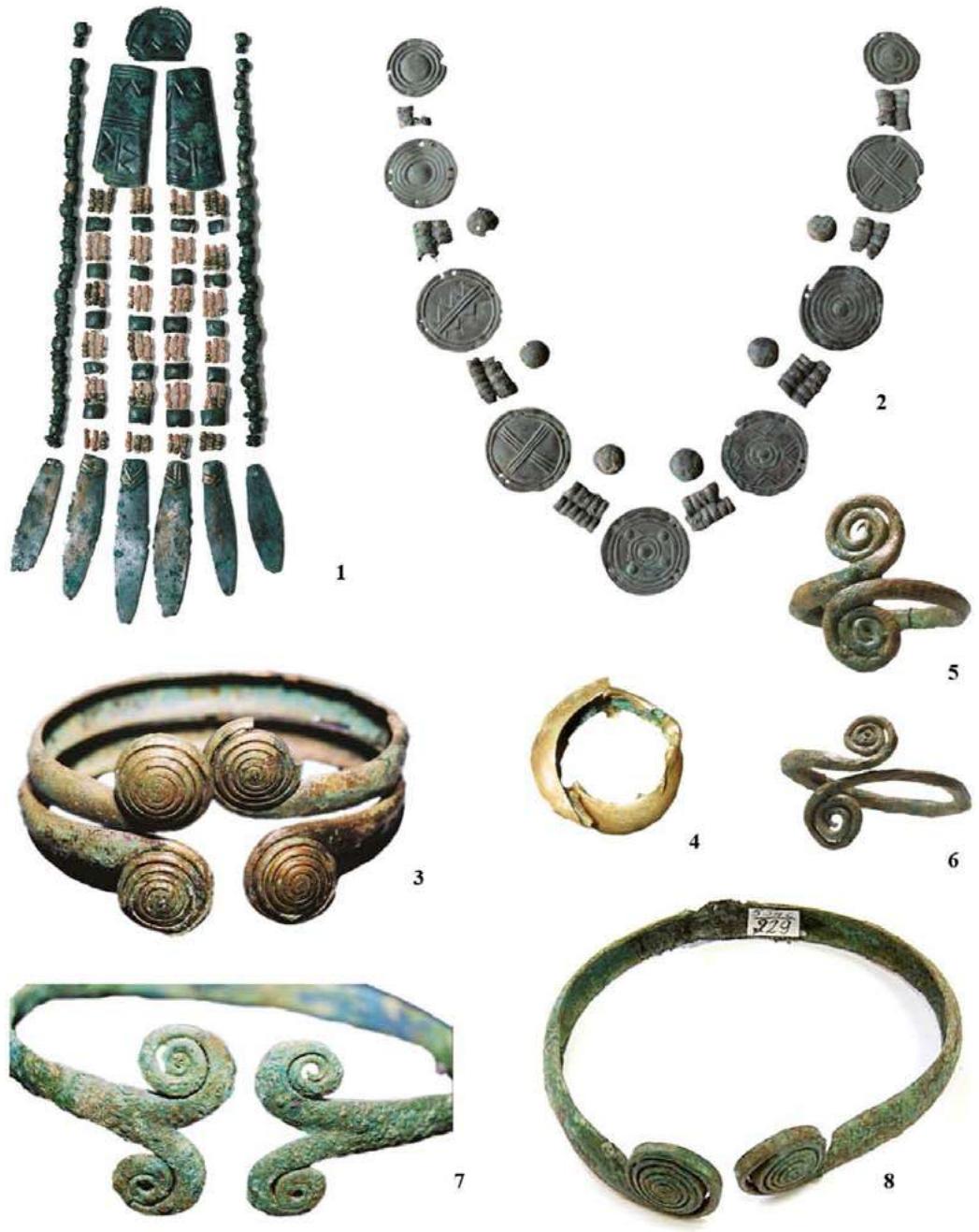
Fig. 6: Bronze Age woman ornaments, Stepnoye VII cemetery: 1 – braid ornament; 2 – face pendant; 3, 7-8 – bracelets; 4 – twisted golden pendant; 5-6 – rings
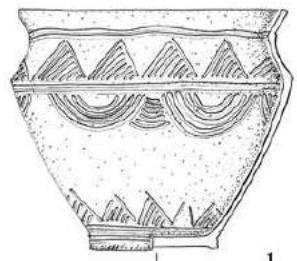
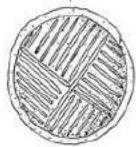
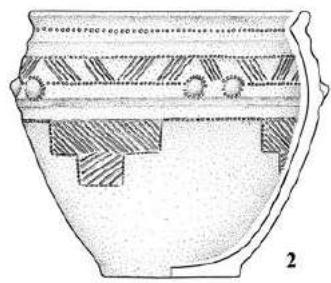
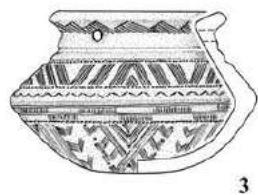
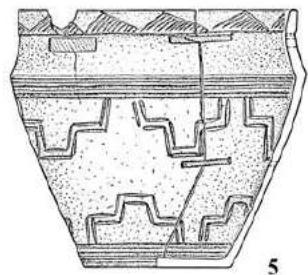
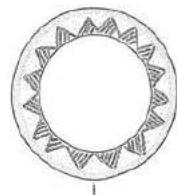
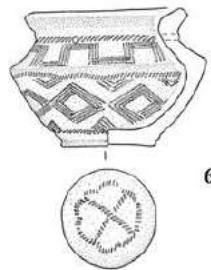
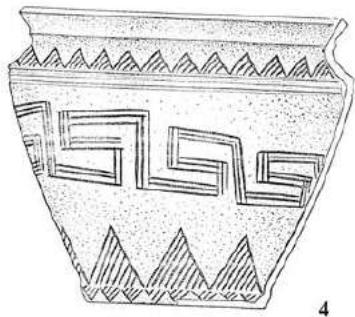
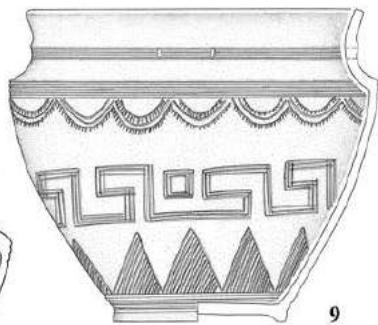
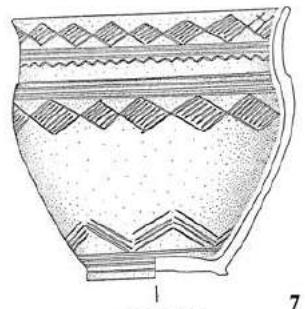
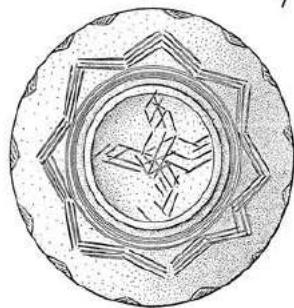
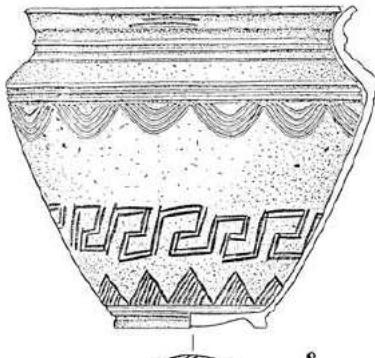

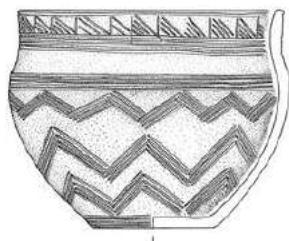
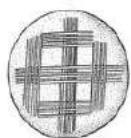
10 Fig. 7: Decorated ceramic vessels: 1-3, 6 - Sintashta culture, Stepnoye 1 cemetery; 4-5, 8-9 - Petrovka culture, Stepnoye VII cemetery; 7, 10 - Alakul' culture, Stepnoye VII cemetery
2
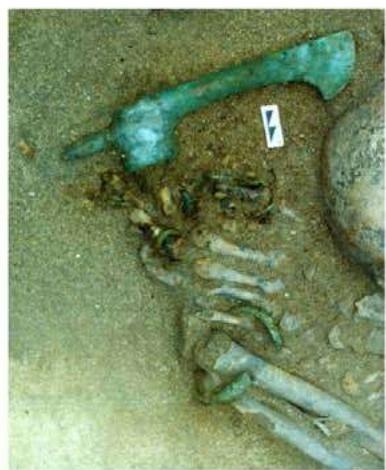
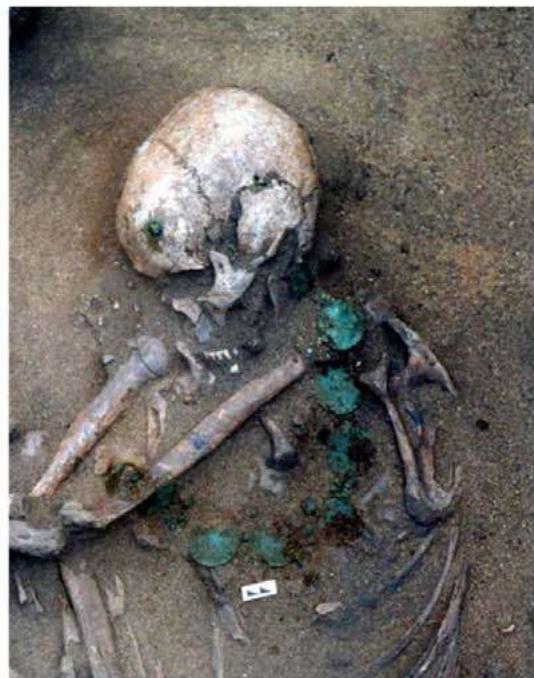
4 Fig. 8: Petrovka burial (Stepnoye VII cemetery, pit 17): 1 – plan of the burial; 2 – photo of the burial; 3-4 – details of the burial (photo)
Generating HTML Viewer...
References
16 Cites in Article
O Dickinson (1994). The Aegean Bronze Age.
R Drenan,B Hanks,Ch Peterson (2011). The comparative study of chiefly communities in the Eurasian steppe region.
A Epimahov,E Kupriyanova,P Hommel,B Hanks (2021). svete bol'shih serij radiouglerodnyh dat). Drevnie i tradicionnye kul'tury vo vzaimodejstvii so sredoj obitaniya: problemy istoricheskoj rekonstrukcii.
Marija Gimbutas (1974). The Lithuanian God Velnias.
C Grottanelli (1986). Yoked horses, twins, and the powerful lady: India, Greece, Ireland and elsewhere.
B Hanks,R Doonan,D Zdanovich,E Kupriyanova,D Pitman,N Batanina,J Johnson (2014). Metals, Society and Economy in the Late Prehistoric Eurasian Steppe. Archaeometallurgy in Global Perspective. Early metallurgy: a global reader.
B Hanks,R Doonan,D Pitman,E Kupriyanova,D Zdanovich (2016). Eventful Death -Eventful Lives? Bronze Age Mortuary Practices in the Late Prehistoric Eurasian Sterres of Central Russia (2100-1500 BC). Death Rituals, Social Order and the Archaeology of Immortality in the Ancient World.
K Jones-Bley (2002). Indo-European burial, the "Rigveda", and "Avesta.
N Shishlina,L Koryakova,O Orfinskaya (2013). Exotic Cotton Textile of the Bronze Age from the Southern Trans-Urals.
Elena Kupriyanova,Andrey Epimakhov,Natalia Berseneva,Andrey Bersenev (2017). Bronze Age Charioteers of the Eurasian Steppe: A Part-time Occupation for Select Men?.
E Kupriianova,D Zdanovich (2015). Drevnosti lesostepnogo Zaural'ia: mogil'nik Stepnoe VII.
D Pitman,R Doonan,B Hanks,D Zdanovich,E Kupriyanova,L Brempt,D Montgomery (2013). Exploring metallurgy in Stepnoye: the role of ceramic in the matte conversion process.
D Ward (1970). The separate function of the Indo-European Divine Twins. Myth and Law among the Indo-Europeans.
No ethics committee approval was required for this article type.
Data Availability
Not applicable for this article.
How to Cite This Article
Elena Kupriyanova. 2026. \u201cBurial Rite of Early Indo-European Bronze Age Communities in Southern Trans-Urals Russia: A Mirror of Religion and Society\u201d. Global Journal of Human-Social Science - D: History, Archaeology & Anthropology GJHSS-D Volume 23 (GJHSS Volume 23 Issue D2).
Explore published articles in an immersive Augmented Reality environment. Our platform converts research papers into interactive 3D books, allowing readers to view and interact with content using AR and VR compatible devices.
Your published article is automatically converted into a realistic 3D book. Flip through pages and read research papers in a more engaging and interactive format.
Our website is actively being updated, and changes may occur frequently. Please clear your browser cache if needed. For feedback or error reporting, please email [email protected]
Thank you for connecting with us. We will respond to you shortly.