I. INTRODUCTION
There is an historic bond between music and physics. Even though not every physicist played an instrument, a lot of them did. Galileo was a very good lute player. Herschel was a very well considered professional musician before becoming an astronomer and discovering Uranus. Planck, Bohr, Heisenberg used to play the piano. Einstein played the violin. Brian Cox is a keyboard player in a band and Tom Scholz (Boston) and Brian May (Queen) are remarkable guitar players. The list of physicists that also played an instrument is very long, but not always as professional musicians. As we all know, science takes a lot of time. There is also another list of scientists that were interested in music in a different way. Pythagoras, Newton, Huygens or Helmholtz wanted to know about the natural phenomena of sound and music and contributed with different aspects of acoustics and music perception.
In this article we are going to explore relationships between music and physics from a neuroscientific perspective to find out that these bonds are probably not a rare casualty between such different worlds. The main thesis of this article is that the main reasoning areas of the brain (specially the left dorsolateral prefrontal cortex) are involved in both activities and the physiological common structures are also related to a special psychological factor, which is creativity. And it will have educational implications in adolescents, such as improvement of reasoning skills, critical thinking or the appreciation of the beauty of music. It is possible to improve the adolescent executive functions and music-physics relation is a way worth exploring.
II. BRIEF PHYSIOLOGICAL NOTES
When listening to music, the mechanical waves of sound are turned into electrical signals through the cochlea up to the primary auditory cortex: the malleus, incus, and stapes transfer the vibration to a fluid (following Pascal's principle), which bends the stereocilia. The movement will mechanically open or close potassium channels, activating or deactivating the cell. In the cochlea is analyzed the frequency of the sound (tone). Superior temporal sulcus and superior temporal gyrus let us recognize the different timbres, whether it is noise or music.
Hippocampus, the memory main structure, connects with another limbic structure, the amygdala (emotions main structure) and the frontal lobe (inferior frontal cortex). Through the dorsolateral prefrontal cortex we pitch sequences and rhythms activate the lateral cerebellum and the cerebellar vermis. The signals are back to the limbic system from the frontal lobe and the auditory thalamus integrates sensory and cortical inputs for processing sounds .
All these connections are related to emotions (insula and anterior and posterior cingulate)(2), as it is also connected to the nucleus accumbens, full of dopamine (related to rewarding and motivation pathways) when we enjoy the music we are listening to. The brain works in parallel processes, interconnecting the information. And if you are a musician, you are watching and reading the sheet of your favorite song by using your Broca's and Wernicke's areas and the visual cortex in the occipital lobe, you are stubing your feet by connecting the sensory cortex(3). There is no part of the brain working hard at that moment. To play an instrument is probably one of the most activating actions for the brain.
It is clear that music provokes emotions: what I can do is transfer the essence of a feeling or an emotion, express it in music . As we can see it is much more than a homeostatic balance between human beings and their environment. Somehow, music evokes synchronicity in the brains of the audience in a concert . An example of it is to listen to Keith Jarrett's Memories of Tomorrow , a piano solo from The Koln Concert (1975): after an applause that lasts several minutes, the audience starts to applaud in a perfect synchrony.
But creating, analyzing or improvising music implies the dorsolateral prefrontal cortex, especially from the left lobe, traditionally the analytical one. Why? A musical producer or a songwriter has to make decisions: instruments, structure of the song, effects or tone, introducing familiarity and novelty at the same time. A symphonic composer needs to think about the treatment of a musical cell, using homophony or counterpoint, when to use a brass section or woods or strings or percussion, in order to balance the phrases of the score.
This is the point we want to explore. To make decisions requires the frontal lobe, especially the dorsolateral and prefrontal cortex. And it allows us to link music and science.
What about physics? Solving a physics problem implies the activation of Broca's and Wernicke's areas while reading about the situation described, the anterior cingulate cortex (if we think there is something incoherent or not intuitive for us), cerebellum, prefrontal cortex, left dorsolateral cortex, left posterior parietal cortex, hippocampus and retrosplenial cortex, involving visual motion, central executive and default mode processes . Relying on the physical kind of concepts involved, some differences are shown, especially in the intensity of the activation .
As we can see, there are common brain structures involved in playing music and solving physics problems. In terms of executive functions, it is remarkable that prefrontal cortex and dorsolateral cortex (specially in the left lobe) and both actions require running different processes in a parallel way.
It is possible that playing an instrument and solving a physics problem are reinforcing neural tracts in the same structures and producing more connections among neurons. That would be an explanation for versatility in physicists who are musicians too. This point is highly related to creativity.
III. THE CREATIVE PROCESS
It is well known Wallas described the creative process in four steps in 1926: The first in time I shall call Preparation, the stage during which the problem was 'investigated... in all directions'; the second is the stage during which he was not consciously thinking about the problem, which I shall call Incubation; the third, consisting of the appearance of the 'happy idea' together with the psychological events which immediately preceded and accompanied that appearance, I shall call Illumination. And I shall add a fourth stage, of Verification...
Even though it is not the latest model, it is simple and all newest models are based on Wallas', basically adding more stages . This model is good enough to discuss the goals of this article.
In the preparation stage, we need time to get deeply involved in the question. It could be a mathematical demonstration of a physics law, designing an experiment or the orchestral arrangement of a melody. This stage would be enhanced by motivations. If you are not just working but you are deeply involved in something. You really feel and find it as a deep personal question or activity.
The incubation stage is a magical one. You are not thinking about the problem consciously, but your brain is working hard on it, establishing relations among different ideas. Once again, the reason for this stage would be the motivations, the need for a personal answer for a specific problem or natural phenomena in physics or the need for expressing an emotional state through music. Any kind of need runs primarily the limbic system and later on the executive functions on the frontal lobe. As a necessity, the brain starts working on how to solve it even in an unconscious state. From an anthropological point of view the limbic system takes control in the first place due the risky situation for the individual or the group and a decision must be taken as soon as possible. Imagine being in front of a dangerous beast. A decision is taken in a fraction of a second, avoiding the threat or being ready to fight. If you are thirsty and water is not close, the limbic system recruits the frontal lobe and control is taken by executive functions, making a decision about where to go to drink or what to do. Currently, it is a common situation for us when we wake up in the middle of the night thinking about something, a difficulty, a son's illness, an important meeting in the morning or a concert performance, for example.
For this stage, two examples are needed, one from music and another from science. Paul McCartney explained that he woke up one day in the morning with a marvelous melody. It just was in his mind. He started to ask the rest of Beatles members if that tune was familiar for them, trying to find the composer. Somehow he came up with that music after a period of unconsciousness about it. He went into the next stage, illumination. Even though McCartney was sleeping and not conscious when the melody came up, he probably had a very deep limbic motivation, need or personal worry that would only be satisfied by music. Let's remember a quote by Beethoven: music is the mediator between the spiritual and the sensual life . By the way, the song is world wide known as Yesterday, one of the most iconic compositions in music history, with remarkable cultural impact and one of the most covered songs ever.
The scientific example is provided by chemist August Kekulé. He was trying to understand the structure of benzene, but he was not able to find the right explanation. It is said that he found out that the structure was a hexagonal ring of six tetravalent carbon atoms due to a dream in which a snake was eating its own tail. That snake was the inspiration for the right explanation , leading to the illumination stage.
Verification is the latest stage. Of course in science you have to check whether your proposal is right or wrong, if the mathematical demonstration serves its purpose, if the experiment can explain the phenomena. In music, you have to check if everything is in the right place, in the right section, in a coherent way, with a heartfelt melody, with the right rhythm, dynamics and harmony, until you get the balanced mix in the master. At this point, you really think "it works!".
Divergent thinking is a distinctive sign of creativity. And frequently interdisciplinarity enhances creativity. Flexibility and insight processes are needed in music and science, to change the way you are thinking about something or to change a melody in order to start improvising. Music and physics demand also to be focused on what you are doing, paying attention and keeping your concentration. Curiosity, sensibility, passion, logical thinking and discipline, a lot of discipline. That is why music and physics are that far and that close at the same time. Both use common psychological processes and demand similar things.
IV. MUSIC, PHYSICS AND ADOLESCENTS
The frontal lobe is not completely myelinated until the almost the end of the first two decades of life.
And it has important implications for adolescents. From a psychological point of view, they can make reckless decisions or fall into risky behaviours due to the fact that the executive functions are not completely operative. But we can help as teachers, parents, adults. And one way of helping them is not consuming a song but listening to it carefully. In the lowest stage we can lead adolescents to discover all the things behind a song, not just listening and overlooking it. We can analyze the meaning of the lyrics, the structure, the instruments involved, the counterpoint details, the harmony, the rhythms, the dynamic effects or any kind of resource in the song.
In a medium stage, we can go even further if the song has no lyrics or it is classical music. Beethoven and his seventh symphony, for example. And the highest stage would be to try to play something from the song analyzed. Maybe by using the same harmony or harmonic rhythm, for example.
Going through such activities we are promoting curiosity, keeping our attention in taking care of tiny details, as the description of reality demands through physics. They are ready to learn physics because they develop part of the scientific method inside. And they are able to enjoy music and physics, motivating them to dive deeply into physics.
V. A BRIEF EXAMPLE ON BACH
We are going to analyze the fugue (BWV 847) from Bach's Well tempered clavier (1722). It is a three part fugue in key of C minor, developed in a contrapuntal technique.
As we can see in Fig 1, the two bars main theme (subject) appears absolutely alone, with no other voicing. This theme is exposed in C minor and the response is exposed in a different pitch, G minor, a related key. This is the beginning of the exposition section.
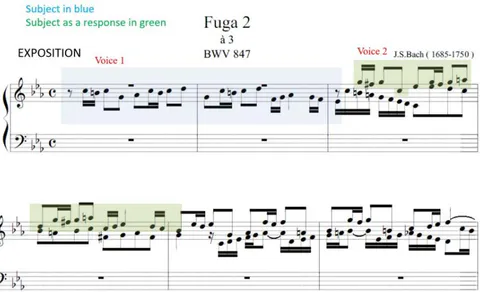
In bar 7, the theme appears played by the third voice. It is the first time this voice emerges. That is the end of the exposition. From now on, the music will develop previous material that has already been shown.
Is the beginning of the episodes. There is something new in bar 11: the theme is played in Eb major, another related key of C minor.
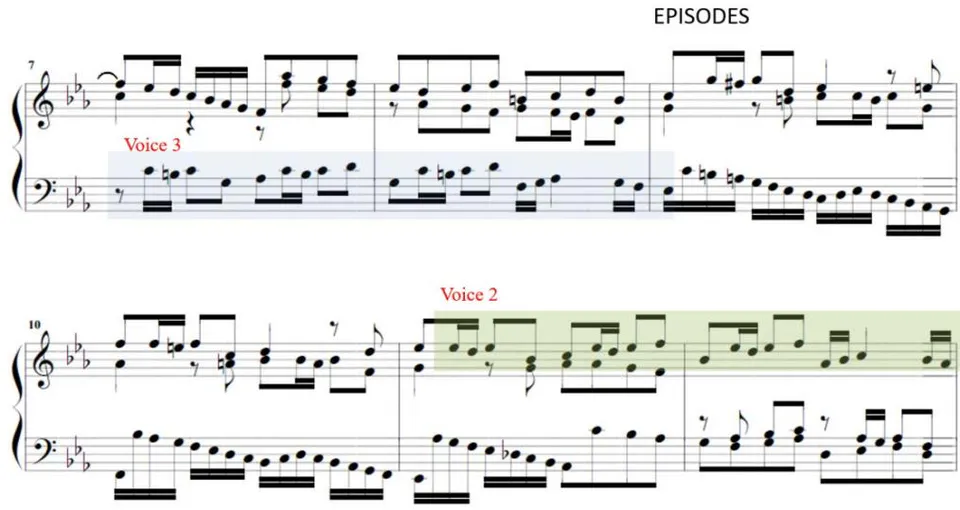
Along the whole episodes the theme is appearing and disappearing, as we can see in Fig 3.
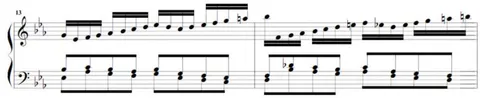
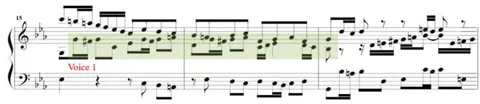
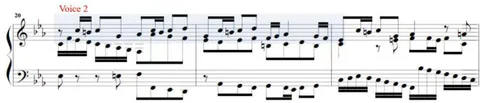
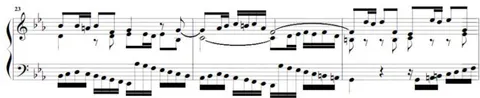
Even though the main theme appears in bar 20 in the original key, there are still some episodes going on, until bar 26, which is the last real exposition. The theme at the end of the sheet is not relevant in terms of the structure. In fact, a section that does not contribute anything new, but the end of the score. This is the coda section in Fig 4.

Voice 2

[J.S.Bach-FugaNo.2BWV847]2 CODA
This is a very brief example. Nothing has been said about the tricks Bach uses in order to build three different melodies working together or the development of the episodes (a micro-view is needed). Observe that we said very little about anything related to the sheet except how to follow the main melody. We briefly named some different sections in a fugue (macro-view). The first time you hear this wonder you probably do not know what is going on and maybe you think it is getting more and more confusing. There is a very analytical view of this score and we could keep on digging.
This is the kind of incantation that is common in the marvelous worlds of physics and music. You can discover not only the beauty of it but also the beauty of its form, the laws, the rules running behind. You can find it in an analytical way and this way of thinking in music is very close to the way of thinking in physics.
VI. CONCLUSION
In music and physics there are tiny details, beauty, order, a treatment of big and small systems in structured laws. We manage all these things through the executive functions. Playing an instrument and solving physics problems use common brain structures, specially the left dorsolateral prefrontal cortex. If both activities are reinforcing neural tracts in that area and among the frontal lobe (executive functions) and the limbic system (motivations) and producing more connections among neurons, we find a very plausible explanation for the fact that many physicists in the History of Science were good at music and science. Mixing music and physics in their lives they probably found a way to develop their reasoning skills, critical thinking, creativity and love for Science.
The educational implications must be considered as a natural way of involving students into the wonderful world of physics by analyzing the music they like and inviting them to discover the beauty of music they would not have listened to without the role of the adult. They enhance their executive functions, reasoning skills, critical thinking and creativity.