This article investigates the aesthetics of the grotesque used in images of former President Jair Bolsonaro published in Facebook groups, from the semiodiscursive/tensive approach, demonstrating the pertinence of these points of view for the expansion of comprehension of this aesthetic as a semi-social and semi-discursive practice. From the generative course of meaning and the tensive mode/style of the text, we demonstrate that the grotesque, can be considered a genre/style modalized and stylized in narrative structures and a tensive rhetoric. The texts analyzed are generated by phoric/thymic thematic and figurative paths typical of the genre, mythologically related to the fundamental semantic values life/death and nature/culture, being articulated in tensive syntactic modes and styles, and used not only as social criticism, but the establishment of a semantic program which attempts to disrupt the current one.
## I. INTRODUCTION
Throughout human history, some meaning constructions, verbal and non-verbal ones, have been created around the idea of the unusual, the bizarre, the surprising and the shocking content, with the basic intention of causing estrangement, and from it, reflection awareness and social change. While philosophy understands such contents as aesthetic and ethical phenomena, discursive semiotics, without abandoning the previous points of view, understands the grotesque as discourses constructed/textualized by a destinator/utterer, who produces an enunciation/ utterance in order to manipulate a destinataires/ enunciate/adreesse. From this understanding, the images used in our discussion will be taken as utterances organized in structuring sets, which are flexible and can be rearranged.
As images analyzed as textual/discursive units, we will discuss the representations of former President Bolsonaro, firstly understood as belonging to an aesthetic called grotesque, expanding the question and demonstrating how such aesthetics can be explored in a semio discursive way, as narrative based on fundamental semantic values[^1] and a special rhetorical type: the rhetoric of the event, related to tensive syntactic modes and styles, and erected within three discursive dimensions: the cognitive, the pragmatic and the thymic.
Bolsonaro's grotesque images can be understood as generating narratives "of their own natural worlds" and effects of veridiction, but having more or less oblique and indirect relations with what we call "reality", seen as equally permeated by narrative discourse. Thus, the same enunciator (utterer) addressee, the actant of the utterance, exists both inside and outside the text and its socio-pragmatic discursive existence. For this reason, in visual and verbal-visual texts, monolingual and syncretic, there will be social linguistic relations between the actor of the fictional natural world and the actor of the real naturalworld, and between both spaces and times, internal and external to the text.
In our analysis, it is assumed that the displayed grotesque representations are constructed by social actors who disagree with the politician and his practices and ideas, in the various social spheres. In this way, the grotesque will interest less as a punctual political gesture of a specific group, than as an example of stylistic human practice and rhetoric of meaning adopted by social groups in different historical moments, as ways of disrupting a sense of "dysphoric real". Before analyzing the images, the grotesque will be approached first as an aesthetic phenomenon, and then from a semiodiscursive point of view.
The texts of the former President of the Republic were collected in early 2021, and posted on Facebook, in groups that call themselves left-wing, or are simply opponents of the politician in various cultural and social levels.[^2] Some of the images are copyrighted and signed, belonging to artists such as Ricardo Aroeira and Jota Camelo; others, however, are anonymous, created by an audience that dominates digital visual techniques, and possibly shares the ideology of the groups against the president. The Facebook groups from which the texts were collected are ASSINEI #FORA BOLSONARIO,
FORABOLSONARO, IMPEACHMENT DE BOLSONARO JA, OS MELHORES TWEETS DA ESQUERDA, PAULO PIMENTA, SÁMIA BONFIM, SOMOS 100% PELO AFASTAMENTO DO PRESIDENTE, DEMOCRACIA, SOMOS 70 PORCENTO2.
## II. THE GROTESQUE: AESTHETIC ISSUES
The term grotesque, coined to designate a certain type of barbaric ornamentation (KAYSER [1957] 2013, p. 18), from the diachronic point of view it has accumulated several semantic layers, acquiring a broad spectrum of meaning, often antagonistic, and later used to refer to both the comic and the horrifying. Kayser ([1957] 2013, p. 20) explains that in the Renaissance the word grottesco, derived from grotto (grotto), coined to designate a certain ornamental art stimulated by antiquity, did not only connote the playful, the cheerful, the light and the fanciful, but equally the distressing and the sinister, in the face of a world in which the ordering of reality was suspended, including the clear separation between the domains of utensils, plants, animals and men, as well as aesthetics, symmetry and the natural order of magnitudes.
The Houaiss online dictionary shows these different meanings, relating the term to the misshapen, the ridiculous, the extravagant, the kitsch, the incongruous and the laughable, but also to the repulsive, the implausible aspect, to the bizarre, preposterous, caricatured, ridiculous and absurd of representations of objects, plants, animals, human beings or fantastic beings. Durrenmatt (1956/57 apud Kayser, 2013 [1957], p. 9) understands the grotesque as a sensitive paradox, the figure of a non-figure, the face of a faceless world.
According to Sodré and Paiva (2014), the grotesque is related to the catastrophic, represented as sudden mutation, unusual break in a canonical form, and unexpected deformation. Within the notion of taste, in which aesthetic, moral and sensory motivations operate, the grotesque operates in imbalance of discursive forces and their structural and expressive elements; calculations of affective reactions; values related to the balance and ethos of the discourse, which result from judgments about its quality; and aesthetic transit, that is,
ability to be operated in different forms of symbolic expression.
Kaiser conceives the grotesque as a supratemporal constant of something negative, but tragicomic, and which is repeated throughout history in different forms. In this constancy, Sodré and Paiva (2014, p. 55) understand as any other aesthetic category, the grotesque is a practice of creation, composition and effect: in terms of creation, it arises from the vision of those who dream, daydream, assimilating it as a game of masks or a caricatured representation, from which it assumes shades of the fantastic, the satirical and absurd narratives; in terms of composition, the monstrous is highlighted, existing in human, animal, vegetable or even machinic forms. The grotesque obviously seeks to manipulate the body in its two spaces: external and internal. By entering the terrain of taste and the strange, exploring it in different ways, the grotesque aesthetic mobilizes the affections, emotions and sensations of the audience, to the point of causing manifestations of discomfort and nervousness.
In art, Kayser ([1953] 2013, p. 158) finds in the grotesque characteristic motifs, or figures, related to the plant and animal kingdom, including the microscopic, and also to the cultural, in the form of dangerous human inventions, and mixtures of the mechanical and organic, such as the bodies of dolls, puppets, automatons, and faces coagulated into larvae and masks. From the discursive point of view, Sodré and Paiva (2014, p. 68-69) believe that the grotesque is generically shown as represented in scenes, and acted out in more or less spontaneous and staged ways, assuming eschatological (or coprologically characterized) expressive modalities. by reference to human waste, secretions, lower parts of the body, etc.), teratological (laughable references to monstrosities, aberrations, deformations and bestialisms), shocking (eschatological and teratological, and aimed at the superficial provocation of a perceptual shock) and criticism, which by unveiling an exaggerated and upside-down world, unmasks social conventions. The grotesque, according to Sodré and Paiva (2014, p.60), resembles another state of consciousness, another experience of lucidity that penetrates the reality of things, showing its convulsion, like a disquieting, surprising and "laughing" X-ray. of the real". Bakhtin (1987, p. 278), when analyzing the exaggerated and almost misshapen figures in Rabelais, understands that the grotesque body is cosmic and universal, and related to the four elements, in a tradition that goes back to Aristotelian knowledge.
These more aesthetic and philosophical insights are important because, from the discursive point of view, reveal the grotesque as a genre, or rhetorical style, in texts that carry out different thematic and figurative paths, revealing certain stabilities in the construction of a meaning, or deep semantic constancies within more superficial historical and cultural variations. In other to broaden the understanding of the grotesque, we discuss in what manners discursive and tensive semiotics can contribute to the question, from the semiodiscursive (utterance) point of view.
## III. THE GROTESQUE: SEMIODISCURSIVE QUESTIONS
Barros (2002) demonstrates, from the semionnarrative and discursive levels of the generative path of meaning, that it is possible to consider the enunciator and the enunciatee as thematic roles of communication and the production of meaning, constituted in two different paths of the same configuration of enunciation: that of communication, which deals with the action of men on other men, creator of the founding relationships of society; and that of production, which deals with the action of men on things, transforming or building them. Both of them socio-pragmatic. This duplicity makes it possible to consider enunciation, in verbal and non-verbal texts, or any human significant sets, as a human activity par excellence, at the same time communicative andproductive.
In the enunciation manifested by the thematic role of the communication of meaning, the destinador/manipulator, the subject and the judging sender, which are actants of the narrative level of the generative path, assume the thematic roles of enunciator and enunciatee, so that the enunciator, as discourse manipulator, becomes responsible for the values at stake and the manipulation of the enunciatee, who must carry out, by imposition or will, an interpretive-doing. After the manipulation, the enunciating role will once again assume the assigning actant, who will now judge or sanction negatively or positively theenunciatee, the manipulated subject, based on his interpretive-doing.
In the thematic role of meaning production, the addressee exists as the subject of the enunciation, a role composed of enunciator and enunciatee. Thus, the communicative dimension of every text contains a manipulator and a manipulated one, produced by a subject of enunciation, which is the combination of an enunciator and an enunciate, understood as the author and the reader, or the spectator, implicit in the text. This implies that all textual production composes, or projects, an authorial or manipulative subjectivity and a non-authorial or manipulated subjectivity.
Table 1: Thematic roles of communication and meaning production in relation to the narrative level of the generative path
<table><tr><td colspan="2">Narrative Structure</td><td>Destinator Manipulator</td><td>Destinatore Subject</td><td>Destinator Judge</td></tr><tr><td rowspan="2">Discourse
Structure</td><td>Thematic role of communication</td><td>ENUNCIATOR</td><td>ENUNCIATEE</td><td>ENUNCIATOR</td></tr><tr><td>Thematic role of production</td><td></td><td>SUBJECT of
ENUNCIATION=
(enunciator +enunciatee)</td><td></td></tr></table>
In the enunciation seen as production themes, and no longer from the thematic role that it projects, the manipulative addressee is the producer of meaning, the subject addressee is the subject of the enunciation, and the judging addressee is the receiver-interpretant. Enunciation is shown as a mediation structure between discourse and context, also understood as the natural world discriminated by language:
Table 2: Themes of production in relation to the semionarrative level of the generative path
<table><tr><td>Narrative Structures</td><td>Destinator Manipulator</td><td>Destinatore Subject</td><td>Destinator Judge</td></tr><tr><td rowspan="2">Discoursivestructure</td><td></td><td></td><td></td></tr><tr><td>PRODUCER</td><td>SUBJECT of ENUNCiation= (enunciator+enunciatee)</td><td>INTERPRETANT RECEIVER</td></tr></table>
From the aesthetic considerations discussed above, and from the notion of themes and thematic roles and themes of production, it is possible to point out some characteristics of the grotesque as a discourse that has been being practiced in human social dynamics, verbally and non-verbally. Related to a persuasions, manipulations and interpretations of a producer/ interpretant (two social actors in the dynamics of meaning production), to the sensitive, and to a particular style of seeing the world, the grotesque can
be approximated to the idea of a discursive genre that, according to Greimas and Courtés (2011, p. 228; entry: genre), points to a certain conception of the "reality" of the referent "which allows one to distinguish either different possible worlds, or narrative chains thatmore or less conform to an underlying norm". It is understood that the grotesque, as underlying norm, can become a personal characteristic, approaching the conception of an idiolectal universe, being also related to the thymic category euphoria/dysphoria (=set of attractions and repulsions).
Adopting the theme of the "strange" and the bizarre - which encompasses the fantastic, the wonderful, the surrealist, the comic, etc., the grotesque can be understood as an artifice of meaning mainly linked to thymia and dysphoria[^3]. By seeking shock and investing in thymia, the producer/enunciator of the grotesque provokes and summons the cognition of the enunciatee/interpretant to make sense of the natural world represented in phoric values. Once the grotesque seeks disruption, there are combinations of ambiguous and complex meaning production structures which are built to provoke new meaning dynamics. It is understood, from the aesthetic discussions, that both the microsystems of the fundamental semantic values life/death and nature/culture, the fundamental figurative values air, water, fire and earth[^4], considered semantic universals, as well as thefigurativization of actors, times and spaces in thematic and figurative paths are ordered according to a phoric logic, which in our case, attracts precisely because it repels.
Rhetorically, it can be concluded that the figures of speech highlighted in the grotesque, in addition to metaphor and metonymy, are the accumulation figures called hyperbole, related to excess, increasing amplification, and an increase in semantic intensity; antithesis, which accumulates meanings caused by the explanation of oppositions, in an operation of intensification of the text showing contradictions and setbacks present in the object being spoken about; and the hypotyposis, characterized as redundant emphasis, a description of past or unreal things that presents a perceptual salience that builds the impression of subjectivity of the person who describes it. The types of images used by Facebook groups, for example, indicate a conjunction with these rhetorical value-objects that characterize these subjects, discursive-ideological actors of the natural world.
In tensive terms, the notions of more and less, and event and routine, dialogue with the figures of speech seen above, and add a new point of view to the study of gender and phoria, by showing investments of meaning that create shock and surprise effects ensembled in significant sets, and composed by the rhetoric of the event. From the sensitive dimension of discourse, semiotics understands the subject acquires a tensive discursive presence field, the result of a dichotomy related to the tension of the intelligibility of the event vs. routine, so that the first points to the discourse of surprise and intensity, are related to absolute values, or impact and uniqueness; while the second points to the discourse of waiting, the exercise and the state, conform to the notion of extensity, and related to values of the universe, which are diffuse and tenuous.
These two basic semiotic modes of meaning are related to the field of presence of the discursive subject, being general regimes of meaning equivalent to two elementary enunciative styles: one of a concessive nature, the event; and the other of an implicative nature, the routine. Both will be discursive modes of joining the subject with the world, complemented by modes of efficiency and existence. Each semiotic mode has a different syntactic style:
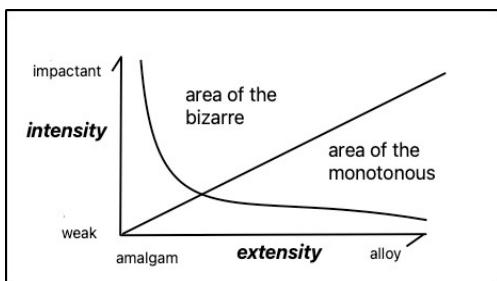 Table 4: the bizarre impactant
Source: Zilberberg (2004, p. 88) In terms of narrative program and counter-program, and from a figural point of view, we also take advantage of Zilberberg's characterization to bring the
grotesque closer to the notion of counter (counter-program), as in the figure below:
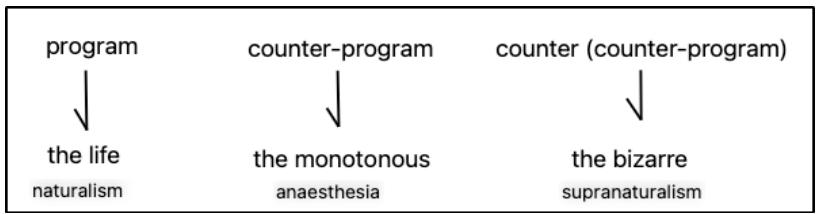 Table 5: the grotesque as conter [conter-program]
Source:Zilberberg (2004,p.88)
Having made these approximations between aesthetics, discursive semiotics and tensive semiotics, we will make a qualitative analysis of some grotesque images of the former Brazilian president Jair Messias Bolsonaro. The images are of two types: without anchoring and with anchoring in verbal language. Those are monolingual texts, texts thatuse only one language, in our case the visual ones; these are syncretic, that is, texts with different types of expression, in which, in our case the visual and the verbal are combinedto compose a meaningful content. In the case of verbal anchoring, it is still possible, according to Pietroforte (2012, p. 49), to delimit two types of operation: referential anchoring, that with subtitles and titles that explain the image; or degree-anchoring, in which words are used less to explain than to interact with the image, complement it, likein comics. As we have already defined the grotesque, we will observe how, starting from the rhetoric of the event, the generative course of meaning in the texts is motivated.
## IV. THE GROTESQUE IMAGES OF FORMER PRESIDENT BOLSONARO
As we might expect, observing the grotesque aesthetic, one of President Bolsonaro's representations involves the animal kingdom, in its most diverse characteristics. In the figures below, the president's face, mixed with birds of prey and equine quadrupeds, reveals the construction of meaning based on values disseminated in the opposite axes of being-seeming, transforming the president into a complex being, man-animal belonging to the natural/cultural realm, affirming paradoxical values. In image 1A, by Renato Aroeira (RA), Bolsonaro and his children are depicted as birds of prey perched on freshly gnawed bones, and still with remains of decomposing meat, which form the number 2021, referring to the beginning of the third year of politician's mandate. Number 1 of the year 2021, unlike previous numbers, is figured as a juicy, fatty piece of raw meat. the future, indicating that the year that begins will be devoured by the President and his vulture children. The dysphoric prediction is supported by the referential verbal anchorage at the top of the drawing, whose statement is: fresh meat around.
In image 1B (Nardo Matta), President Bolsonaro, once again, assumes the image of a dark bird man, but who now, as a zealous mother, feeds her chicks, represented as children. The food the grotesque bird dumps/regurgitates into the gaping mouths, however, is a compound formed from bones and Nazi swastikas.
In image 1C (Gilmar), the president is a dark bird of prey, and can be identified by the presidential sash. In this case, the transformation of man into nature/animal is total, but it bears the human trait, defined by the verbal text, which here works as a stage anchor, completing the meaning of the drawing. The threatening bird cries out, perched on the cross of a tombstone, in front of which a man cries, kneeling: "Vaccine, only if it is at your mother's house (text on the left of the image). No more freshness and mimimi. How long are you going to cry? (texts to the right of the image)". It is important to note that the bird's speeches, in a voice intensity represented by the red color, are not creations of the enunciator, but excerpts of opinions omitted by the president, and conveyed in different media. In this syncretic text, like the first one, and interdiscursive, the quoted speeches relate the two actors, which means that the president does not need to be represented visually.
In image 1D (RA) Bolsonaro is represented with horse hooves, and looks directly at the enunciatee, with bulging eyes and a stupid expression. His image is also anchored in a verbal text, which works as a reference to the multiple-choice test genre, and is carried out by the interlocutor himself, who speaks in the first person, and seeks to measure the reader/interlocutor's knowledge about him. On the left side of the image, at the top of the frame, the genre of the text is identified: "Multiple choice (to make it easier)"; to the right of the image, the question and the options to be ticked are displayed.
In image 1E (no author) despite the representation of the president, who is accompanied by other members of the government, and strong supporters and mentors (such as the writer and essayist Olavo de Carvalho, now deceased, and the evangelical pastor Silas Malafaia), there is no being merged with animals, as in the images above, the referential verbal anchoring identifies the people represented as petty animals ("scrotum animals") referring to the homonymous song by Brazilian group Titãs (1982). The song, according to Lopes (2020), alludes not only to beings transmitting diseases, but to the military regime. In the imperative form, the statement orders politicians/animals to return to their place of origin, the sewers, and live with their peers, that is, flies, cockroaches and rats. The visual text, which seeks objectivity and iconicity effects, in a less tonic and more moderate caricature, but no less grotesque, shows these people posing, as in a photograph, and looking at the camera. On their bodies insects crawl or perch. In the image, while the evangelical pastor sports a demonic horn, in a proposal that goes beyond the original proposal of the Titans, revealing marks of enunciation, Olavo de Carvalho, the president's intellectual guru, shows a reptilian tongue; the president, in turn, with a swollen and rotten face, wears the presidential sash with a cockroach, and caresses a rat:
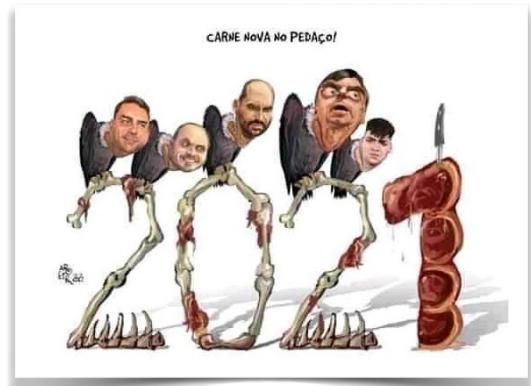
1A. Source: #Eu assinei # Fora Bolsonaro
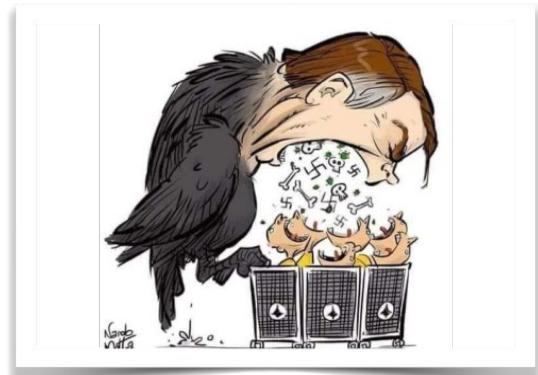
1B. Source: Impeachment de Bolsonaro Já Image 1: Bolsonaro animal
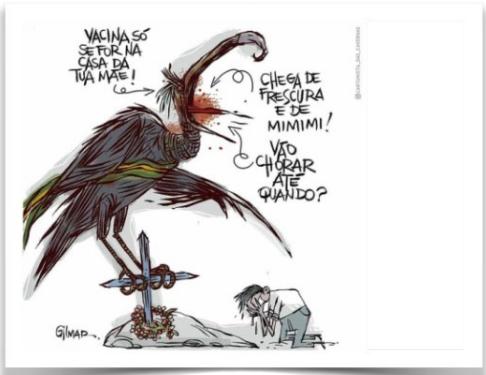
1C. Source: Samia Bonfim
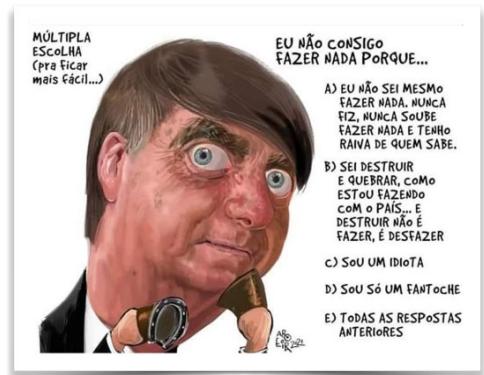
1D9. Source: Somos $100\%$ pelo afastamentejdo presidente, democracia,contra a corrupcao
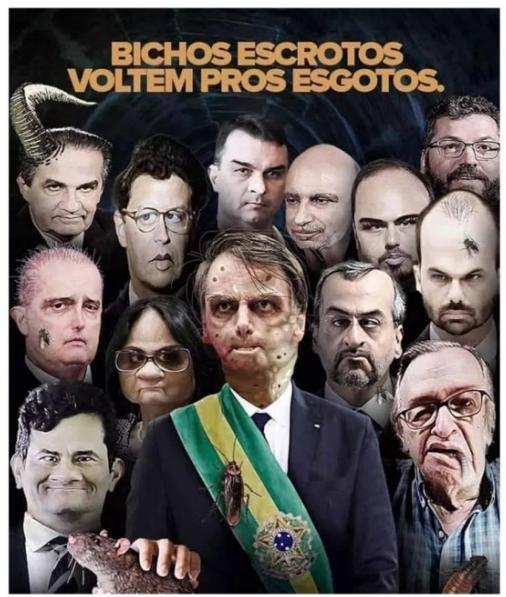
Source: Fora Bolsonaro
### 1E.
In addition to the animal or bestial appearance, and following the nature/culture semantic axis, Bolsonaro's grotesque representations also invade the field of the monstrous and thedeformed, and once again prefer the complex contrary semantic axes, typical of the grotesque. In figure 2A, (no author) sporting the presidential sash on his left shoulder andthe US flag on his right lapel, the president, represented as a monstrous being with red eyes and yellowed teeth, growls, facing the enunciatee. In this image, as well as in the one related to the Titās, the intertextuality with popular culture is evident, and one of thereferences of this visual text is the face of a character from the Star Wars film franchise, Senator Palpatine (figure 2A1) a politician dominated by the dark side of the force, and adept of imperial, authoritarian, anti-democratic and violent ideologies (in the story, he is responsible for a political coup).
In figure 2B (no author) the face of the president, who speaks into a microphone with a facial expression of hatred, presents a different, non-human skin texture, alluding to the harmful effect of exposure to a dangerous virus: the image is anchored in the following verbal text, which puts two words in capital letters, vaccine and chloroquine: "I'm going to put a curse on you; No more VACCINE and oxygen, CHLOROQUINE is left". In this case, one of the assumptions for constructing the meaning of the image, in addition to the representation of evil, is the direct relationship between the president's scaly skin and the side effects of the supposed medicine.
In image 2C (RA), the drawing presents a set of sketches that represent the US president, Donald Trump and the Brazilian president (who were compared and approximated during their mandates) with monstrous faces, referentially anchored in a verbal text that suggests a political action to remove these politicians from power, saying "Reasons for an impeachment", suggesting reasons related to the non-human and monstrous character of these characters. In Bolsonaro's last sketch, the president's threatening face is represented as a flame of fire, possibly alluding to the destruction of the country's biodiversity, attributed to the politician and his government
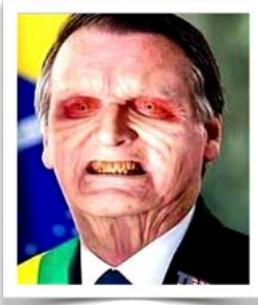
2A. Source: Fora Bolsonaro
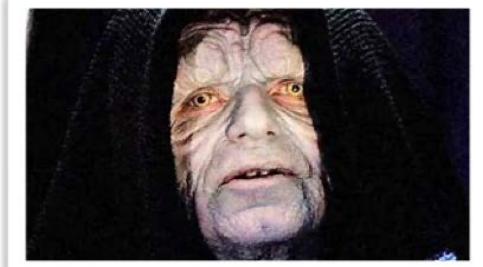
2A1 Source: Looper
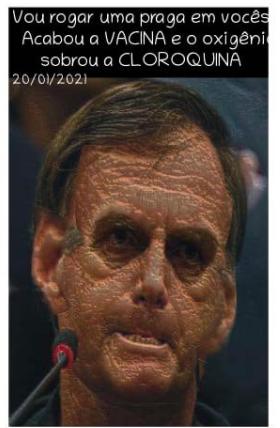
2B Source: Fora Bolsonaro
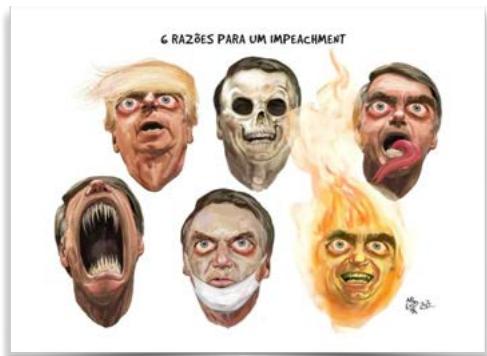
2C. Source: Fora Bolsonaro Image 2: Bolsonaro creature/monster In addition to the nature/culture semantic axis, the life/death fundamental semantic axis is also explored, revealing a president figuratively portrayed as a being of darkness, demonic, with features of a skeleton, but also as a newborn, who comes to light. in carnival spaces and unlikely orifices. In figure 3A (no author), the president smiles scornfully, wrapped in a dark veil, and within a space and time that refers to the Middle Ages. The skeleton hands of the president-monk-of-the-dark are joined in prayer and bound by a third from which hangs an inverted crucifix, symbol of cults for the devil or the dark forces of the universe. The image's thematic and figurative choices allude to a satanic ritual. Again, the grotesque president looks directly in the direction of the enunciate, as confronting or mocking him.
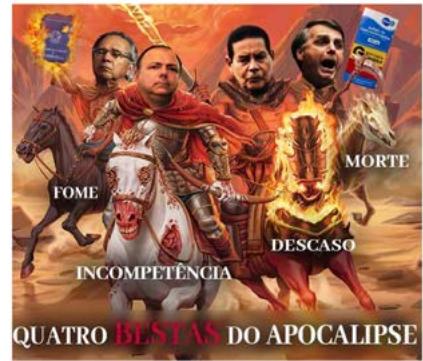
In image 3B, also anchored in the verbal text as a reference, the president, identified by the word DEATH, is one of the "four beasts of the Apocalypse", and rides, in a space that seems deserted and lifeless, alongside three members of his government: NEGLECT (represented by vice-president Hamilton Mourão, who rides a flaming steed and holds a flaming sword (whose fire fills the upper part of the frame); INCOMPETENCE, (health minister Eduardo Pazuello, responsible, in the opinion of many Brazilians, for the disastrous campaign to face COVID), and HUNGER (the minister of economy Paulo Guedes, seen as a neoliberal minister, who protects the rich, and against the rights of workers, who holds a burning work card. On the right side of the image, whose predominant color is red, and close to Bolsonaro's head, hangs a box of Chloroquine medicine that the president insisted was the best medicine against COVID, repudiating the treatment by vaccination.
In image 3C (without author), the president walks, staring at the enunciatee, represented as death itself, and holds a scythe with the words: PÁTRIA
AMADA BRASIL. Behind the death-president, a syringe, presumed to be the vaccine against the COVID virus, is inserted into his buttocks:
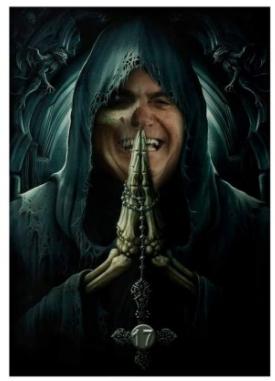
3A.
Fonte: #Eu assinei #Fora Bolsonaro
3B.
Fonte: Fora Bolsonaro
#### 3C.
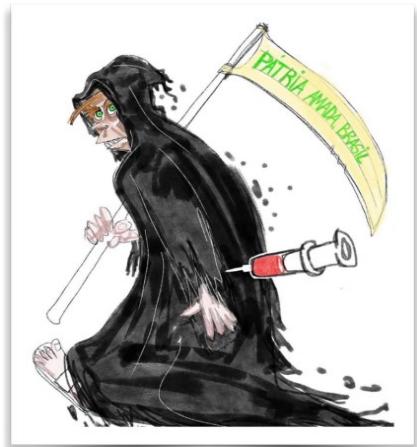
Image 3: Bolsonaro death specter
Fonte: Paulo Pimenta
The aesthetic of the grotesque is also used in another type of the former president's representation: no longer as animal, monster or linked to values of death, but leader and politician, in narratives in which the politician can be seen privately, as a newborn, or compared to other leaders considered deranged and dangerous, such as Nero and Hitler. In this case, the politician becomes an ordinary person, having traces of more human thananimal and of more culture than nature, but nonetheless a persona who occupies dysphoric spaces. As lunatic, the politician is seen as a potential threat to the social fabric and, as we have seen above, to the planet's ecosystem.
Related to Bakhtin's carnival speech, the grotesque is also noted in the bizarre photomontage (no author) that represents the birth of the president (figure 4A), who comes to light holding two American flags, emerging from the anus of a woman positioned on fours. In the image, Bolsonaro's face is added to the grotesque fetus, and the montage places the president inside a carnival space where a crowd appears to be watching the birth. The carnivalesque speech is amplified with the placement of yellow emojis that laugh with blue tears in their eyes. Anchored in the referential verbal discourse, the title clarifies the content of the event, a birth/defecation: "Exclusive moment of the birth of a bolsominions". In this euphoric/dysphoric comic and shocking narrative, as it records the birth of a human being, but denotes the release of feces, the ambiguity and irony of the grotesque discourse cause an inversion of values directly related to the inversion of orifices, and to the birth of a fetus/feces, which transforms thebiological into the bio-eschatological.
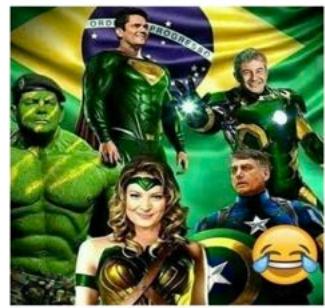
In image 4B (no author), with green and yellow tones and the Brazilian flag in the background, Bolsonaro is accompanied by members of the government, represented as a group of superheroes from Marvel Comics, united to save Brazil. The bizarre figures make reference not only to the comics, but mainly to the film franchise of the Marvel Cinematic Universe, "The Avengers". In this hyperbolic narrative that incorporates popular culture, Judge Sérgio Moro is
Superman, Vice President Ernesto Mourão is the green monster Hulk, São Paulo federal deputy Joice Hasselmann is Wonder Woman, Technology Minister Marcos Pontes is Iron Man, and the President is Captain America, holding a shield with Brazilian colors. Despite probably having been created by a supporter of the president, and being an example of the euphoric grotesque, an emoji placed in the lower right corner of the image attests to the negative sanction of the receiver-interpreter of the image, who judges the drawing to be comic and ridiculous and as co-enunciator, manipulates the enunciatee's interpretive-doing.
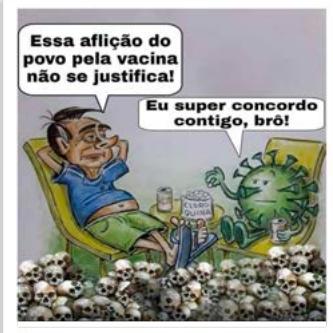
In image 4C (no author), the president occupies a private and familiar space, sitting in a chair that seems to belong in a living room. At ease, and wearing a T-shirt, shorts and flip-flops, Bolsonaro rests his legs, extended over a pile of skulls that stretches across the room. The politician talks to the COVID-19 virus, complaining about people's distress for the search for a vaccine, which he understands as exaggerated: "People's distress forthe vaccine is not justified". In front of him, the virus agrees, using informal language and slang: "I really agree bro", while dipping his hand in a pot of chloroquine pills, which in the context represented, is metaphorized as a snack, peanuts or popcorn.
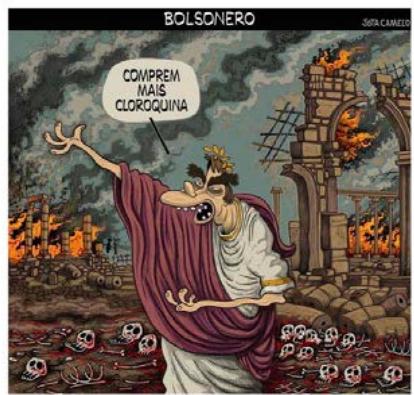
In image 4D (Jota Camelo), the title "BOLSONERO" alludes to the Roman emperor, associated with tyranny, extravagance and madness. Nero became famous by being suspicious of setting fire to part of Rome because of his whims (Suetônius, Life of
Nero 38; Dao Cassius, Roman History LJll.16 apud wikipedia). The president, encompassed in a desolate space, with burning ruins and skulls on the floor, adopts a theatrical and tragic gesture, and commands, alone: "Buy more chloroquine". In this spectacular and Shakespearean representation, the grotesque reaches tragicomic proportions, as theatricallanguage is used to ensemble a heroic context and character, who demands a medicationfor the population he represents, which has been proven not effective against the virus.
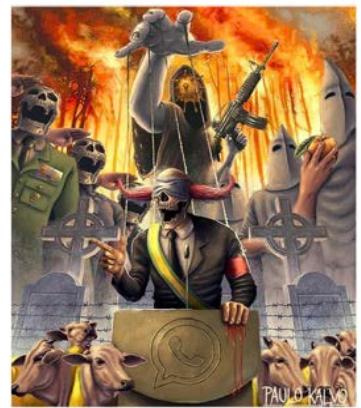
In 4E (Paulo Calvo), the thematic and figurative content is rich, and Bolsonaro, in the center of the image, is represented as a puppet with a skeleton skull and the hair of the clown Bozo (one of the politician's nicknames), a character from US Children's TV speaking at a podium with the Whapsup app icon. The puppet president, who wears a swastika on his right arm, and whose hand, full of blood, soils the bench, is manipulated by a dark being wrapped in a dark hooded suit, and bearing the face of the Covid-19 virus. At the bottom of the figure, a herd of oxen grazes around the pulpit from which the president speaks. Behind it, there is a barbed wire fence, reminiscent of Nazi concentration camps, and a cemetery. Profiled on the right and left side of the image, and surrounding the president, who is speaking, military personnel with skeleton faces and members of the extreme right-wing racist group Ku Klux Klan, surround the president. In the background of the image, a forest burns, adding red color to the upper half of the drawing.

4 A. Source: #Eu assinei #Fora Bolsonaro
4B Source:br.pinterest.com
4C Source: Somos $100\%$ pelo afastamento do presidente democracia, contra a corrupcao
4D Source: Somos 70 percento
4E Source: Os melhores Tweets de esquerda Image 4: Bolsonaro leader
## V. SUMMARY OF THE ANALYSIS
The qualitative analysis of President Bolsonaro's grotesque images demonstrated how the rhetoric of the event was used to manipulate the enunciatee's interpretative action through shock and estrangement, typical of the grotesque, in a series of discursive strategies driven by hyperbolic, antithetical and semantic investments. hypotypic linked, in our case, to dysphoric values against the politician. We noticed that the grotesque genre helps deconstruct the president, whose figurativeness oscillates on the axis of opposites being- seeming, life-death and nature-culture, creating complex social actors and affirming dysphoric values of death. Thus, Bolsonaro is figuratively portrayed as a man-animal (bird of prey, quadruped and transmitter of diseases), man-creature, servant of evil and death, man-feces and crazed leader, occupying equally dysphoric, devastated, sterile and pestilent spaces, objects and spaces related to these values, such as skeletons, crosses, sewers, devastated cities, etc., in figurativization built from the semantic universals water, fire, earth and air.
The same happens in the semi-symbolic chromatic investment of the text, which highlights colors related to blood, destruction and death, such as red and black and their shades. In this sense, the grotesque seeks the adhesion of the enunciatee from what is already known, from what is easily identifiable and characteristic in a culture, that is, from a belief-knowledge already established and programmed, and established by triggering strategies of mythological and sublogical discourses that fuse the cultural to the natural, and the physical world to the spiritual, and are used pragmatically by man: in this sense, the mythological is the pragmatic, that is, how the various Western cultures characterize death.
In Bolsonaro's images, the body and bodily manifestations follow the figurative style of the grotesque genre, and represent disfigured and caricatured bodies and faces, which regurgitate, rot and defecate. If the grotesque, as Bakhtin recalls, is linked to the lower parts of the body, the carnivalesque and the popular, it can be observed how the analyzed texts dialogue with popular and mass culture, in true intertextual and interdiscursive operations: in the composition of meanings of the texts, references to Brazilian rock, Star Wars and The Avengers film franchises, and references to historical facts, such as the burning of Rome by Nero. Within the carnivalesque dimension, which is close to the notion of an event, the use of laughing emojis was observed in many of the images, revealing the dimension of the enunciated enunciation of the text, its authorial subjectivity, which is also a striking feature of the grotesque. In a subversive act typical of the carnivalesque, an image that supports the president, representing him as a true hero, is appropriated and undergoes a semiotic intervention through an emoji that turns it into a mockery.
Regarding the stage and reference functions of the verbal anchorage in the visual text, which makes them syncretic, guiding and restricting the enunciatee's interpretive-doing, and creating effects of objectivity (such as the title and caption), and subjectivity (such as the speech and the staring at the enunciatee), both the referential-anchoring and degree- anchoring (which explain the meaning of the image or complement the meaning of the image) functions were applied. Some of the degree-anchoring type are used as words of the president, spoke in sentences in the first person, in a dynamics that transform the enunciatee of the text into an interlocutor, and establish a virtual enunciated scene, which brings the president and the subject reader/ observer closer together, erecting the time of the now and the space of the here. In some cases, the verbal text is taken from the president's own speeches, in an interdiscursive and figurative strategy of space-time that goes beyond fiction and brings the "historical-real" anchoring of the subject.
## VI. CONCLUSION
In our discussion of the grotesque, we tried to broaden this aesthetic issue by adopting a semiodiscursive/narrative point of view to investigate the question. Discourse semiotics was able to show new possibilities for the analysis of the grotesque, understood as a genre, style and type of rhetoric used in different signifying sets, verbal and non-verbal, and historical contexts. Based on the generative course of meaning, we identified an enunciator who manipulates through shock and the construction of the strange, based on complex semantic values and figurative and thematic paths guided by mainly dysphoric values, proposing an interpretive-doing to the enunciate governed by intensity. In relation to verbal semantic rhetoric, the grotesque has been compared to hyperbole, antithesis, and hypotyposis. From the point of view of tensive semiotics, it is understood that the texts analyzed were composed by a rhetoric of the event, with its semiotic modes of overcome and focus, and syntactic styles of ascendancy, sorting and concession.
The grotesque understood as counter (counter-program) of Bolsonaro's ideological affiliations and social practices, asserts itself as a disquieting, surprising and comic radiography of the real (Sodré e Paiva, p. 60), and from a mythological key, as an attempt to conjure up the demonic element of the world (Kayser, p. 161), so that this genre can be taken both as a symptom of discontent and imbalance in the relationship between culture and nature, to which the body is linked, as well as a way of, through the representation of a "supranatural", to generate reflection and social change. Sodré and Paiva (2014, p.60) explain it is important to follow the course of the manifestations of this phenomenon with regard to reflection on life, viewing it as another state of consciousness, another experience of lucidity, which penetrates the reality of things and exhibits their convulsion. But if the grotesque is built from shock, the unexpected and the intense, it is precisely in the attempt to understand and absorb it, that is, in the attempt to slow down its impact, that opposing forces are generated, linked to syntactic modes and styles. Thus, it is in the production and reception of the grotesque that the social fabric is regenerated, seeking euphoric values, modalities of outcome, apprehension and routine, and syntactic styles of descent, mixture and implication, which assume balance and rationality, and condemns the dysphoric social dynamic naturalized by Bolsonaro and his government as normal and euphoric.
- Tradução de Yara Frateschi Vieira. São Paulo: Editora Hucitec.
1987.
2. BARROS, Diana Luz de. Teoria do discusso:fundamentos semiótics. São Paulo: Humanistas. FFLCH-USP, 2002.
3. #EU ASSINEI #FORA BOLSONARO. Facebook. Disponível em: https://www.facebook.com/groups/1929458167103971/permalink/360634 0066082431. Acesso em 4 e 15 jan.; 11 fev.
2021.
4. FIORIN, J. L. Figuras de retórica. São Paulo: Contexto, 2014.
5. FORA BOLSONARO. Facebook. Disponível em: https://www.facebook.com/groups/2233028956269 61/permalink/431843754772873. Aecesso 16, 19, 20, 23 jan.; 12 fev.
2021.
6. GREIMAS, Algirdan; COURTÉS, Joseph. Diccionário de semiótica. São Paulo: Editora Contexto, 2011.
7. IMPEACHMENT DE BOLSONARO JÁ. Facebook. Disponível em https://www.facebook.com/groups/4275195544443982/. Acesso em 24 e 25 mar.
2021.
8. LOOPER. The entire Emperor Palpatine story explained. Disponível em https://www.looper.com/173072/the-entire-emperor-palpatine-story-explained/. Aecesso em 15/04/2021.
9. LOPES, Carlos Andre Martins. A revolçao dos bichos escrotos (2020). Em Pensar aeducao em pauta: um jornal para a educao brasilera. Disponivel em http://pensaraeducacao.com.br/pensaraeducacaoempatu/a-revolcao-dos-bichos-escretos. ACESSO em: 11/04/2021.
10. OS MELHORES TWEETS DA ESQUERDA. Facebook. Disponível em: https://www.facebook.com/OsMelhoresTweetsDaEsquerda/?_tn_=-UC\*F. Acesso em 24 fev.
2021.
11. PAULO PIMENTA. Facebook. Disponível em https://www.facebook.com/deputadofederal/posts/3933743216718605. Acesso em 18 jan.
2021.
12. PIETROFORTE, Antonio Vicente. Sentiţica visual: os percursos do olhar. São Paulo: Contexto, 2012.
13. SODRÉ, Muniz; PAIVA, Raquel. O imperio do grotesco. Rio de Janeiro: Mauad, 2002. Ed.
2014.
14. SAMIA BONFIM. Facebook. Disponível em: https:// www.facebook.com/samia.bombfirm.psol/posts/1015 438588863914. Aceso em 6 mar.
2021.
15. SOMOS 100% PELO AFASTAMENTO DO PRESIDENTE, DEMOCRACIA, CONTRA A CORRUPÇÃO. Facebook. Disponível em: https:// www.facebook.com/groups/2316772025282336/per malink/2564169140542622. ACESSO em 3 e 7 jan.
2021.
16. SOMOS 70 PORCENTO. Facebook. Disponível em https://www.facebook.com/groups/Somos70/perma link/2814509512098390. Acesso em8 jan.
2021.
17. TATIT, Luiz. Claude Zilberberg e a prosodização da semiótica. In: Em torno do acontecimiento: uma homenagem a Claude Zilberberb. Org: Conrado
- Moreira Mendes e Glaucia Muniz Proença Lara. Curitiba: Appris Editora, 2016.
18. ZILBERBERG, Claude. *Elementos de semióctasia*. Trad. Iva Carlos Lopes, Luiz Tatit e Waldir Beividas. São Paulo: Atelie Editorial, 2011.
19. La structure tensive: suivi de Note sur la strucuture des paradigmes et de Sur ladualite de la poétique, Press Univeritaires de Liège, 2012.
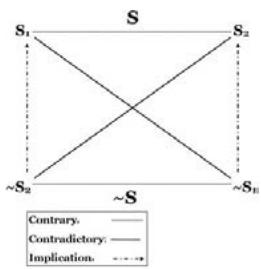
[^1]: The semiotic square, which we apply in the analysis of the texts, is a tool used in structural analysis of the relationships between semiotic signs through the opposition of basic semantic concepts, such as life- death and culture-nature. It was derived from Aristotle's logical square of opposition and developed by Algirdas J. Greimas, a Lithuanian-French linguist and semiotician, who considered it to be part of elementary structure of semantic human meaning. In the semiotic square, S1 is considered to be the assertion/positive element and S2 is the negation/negative element in the binary pair. Together, they form complex meaningselements. _(p.1)_
[^3]: But not necessarily, because the grotesque can also be related to the joyful and the pleasurable. _(p.4)_
[^4]: The Dictionary of Semiotics (entrance: universe) when defining the semantic universe explains that its relation to elementary axiological structures, which have universal qualities, allows descriptions of an individual universe, articulable according to the category life/death and the collective universe, articulated according to the category nature/culture. Both universes remain abstract at the most fundamental level of meaning, existing in abstract homologations of their fundamental categories with the elementary figurativestructure of the four elements of nature: fire, air, water and earth. In these terms Greimas, Courtes and Bakhtin dialogue when relate the grotesque to the four basic natural elements. _(p.4)_
[^2]: Jair Messias Bolsonaro was the president of Brasil from 2019 to 2023. In 2023, because of his attempts to undermine the Brazilian democratic voting system and incite a coup, he was declared ineligible for 8 years by the Brazilian Supreme Court. _(p.2)_
[^9]: Multiple choice (to make it easier...). I can't do anything because: a. I really don't know how to do anything, I never did, I never knew how to do anything, and I get angry with those who know; B. I know how to destroy and break, as I am doing with the country... and destroying is not doing, it is undoing; c. I'm an idiot; d. I'm just a puppet; d. all the previous answers _(p.7)_
Generating HTML Viewer...
References
17 Cites in Article
M Bakhtin (1987). A cultura popular na Idade Média e no Renascimento: o contexto de François Rabelais. Tradução de Yara Frateschi Vieira.
Diana Barros,De (2002). Teoria do discurso: fundamentos semióticos.
Lilian Bachi (2021). O processo de identificação da mulher com o discurso político de Jair Bolsonaro no Facebook.
J Fiorin (2014). Figuras de retórica.
Fora Bolsonaro (2021). Facebook.
Algirdan Greimas,Joseph Courtés (2011). Dicionário de semiótica.
Impeachment De,Bolsonaro Já (2021). Facebook.
Looper The entire Emperor Palpatine story explained.
Carlos Lopes,Martins (2020). Em Pensar a educação em pauta: um jornal para a educação brasileira.
Os Melhores Tweets Da Esquerda (2021). Facebook.
Paulo Pimenta (2021). FACEBOOK USERS’ PERCEPTIONS OF DEPRESSION: AN ANALYSIS BASED ON POSTS.
Antonio Pietroforte,Vicente (2012). O discurso da teoria da linguagem: Uma abordagem Semiótica.
Sodré,; Muniz,Raquel Paiva (2002). O império do grotesco.
Samia Bonfim (2021). FACEBOOK USERS’ PERCEPTIONS OF DEPRESSION: AN ANALYSIS BASED ON POSTS.
Somos 100% Pelo Afastamento Do Presidente,Democracia,Contra A Corrupção (2021). Facebook.
Porcento (2021). SOMOS 70.
Luiz Tatit,Claude Zilberberg E (2020). Claude Zilberberg e a prosodização da semiótica.
No ethics committee approval was required for this article type.
Data Availability
Not applicable for this article.
How to Cite This Article
Edison Gomes Junior. 2026. \u201cGrotesque Representations of Former President Jair Bolsonaro: Semiodiscoursive Issues\u201d. Global Journal of Human-Social Science - F: Political Science GJHSS-F Volume 23 (GJHSS Volume 23 Issue F5).
Explore published articles in an immersive Augmented Reality environment. Our platform converts research papers into interactive 3D books, allowing readers to view and interact with content using AR and VR compatible devices.
Your published article is automatically converted into a realistic 3D book. Flip through pages and read research papers in a more engaging and interactive format.
Our website is actively being updated, and changes may occur frequently. Please clear your browser cache if needed. For feedback or error reporting, please email [email protected]
Thank you for connecting with us. We will respond to you shortly.