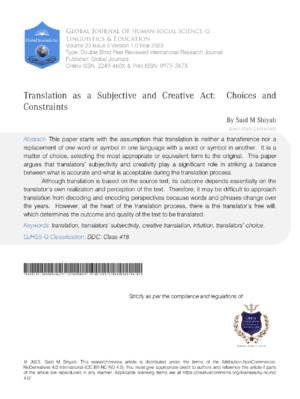
Translation as a Subjective and Creative Act: Choices and Constraints

Article ID

F5063

Analyzing translation's role in research, language choices, and cultural interpretation in scholarly publications.

Translation as a Subjective and Creative Act: Choices and Constraints

Said M Shiyab
Said M Shiyab Kent State University
DOI

Abstract

This paper starts with the assumption that translation is neither a transference nor a replacement of one word or symbol in one language with a word or symbol in another. It is a matter of choice, selecting the most appropriate or equivalent form to the original. This paper argues that translators’ subjectivity and creativity play a significant role in striking a balance between what is accurate and what is acceptable during the translation process. Although translation is based on the source text, its outcome depends essentially on the translator’s own realization and perception of the text. Therefore, it may be difficult to approach translation from decoding and encoding perspectives because words and phrases change over the years. However, at the heart of the translation process, there is the translator’s free will, which determines the outcome and quality of the text to be translated.

Translation as a Subjective and Creative Act: Choices and Constraints

This paper starts with the assumption that translation is neither a transference nor a replacement of one word or symbol in one language with a word or symbol in another. It is a matter of choice, selecting the most appropriate or equivalent form to the original. This paper argues that translators’ subjectivity and creativity play a significant role in striking a balance between what is accurate and what is acceptable during the translation process. Although translation is based on the source text, its outcome depends essentially on the translator’s own realization and perception of the text. Therefore, it may be difficult to approach translation from decoding and encoding perspectives because words and phrases change over the years. However, at the heart of the translation process, there is the translator’s free will, which determines the outcome and quality of the text to be translated.

Said M Shiyab
Said M Shiyab Kent State University

No Figures found in article.

Said M Shiyab. 2026. “. Global Journal of Human-Social Science – G: Linguistics & Education GJHSS-G Volume 23 (GJHSS Volume 23 Issue G5): .

Download Citation

Journal Specifications

Crossref Journal DOI 10.17406/GJHSS

Print ISSN 0975-587X

e-ISSN 2249-460X

Issue Cover
GJHSS Volume 23 Issue G5
Pg. 35- 40
Classification
GJHSS-G Classification: (DDC): Class 418
Keywords
Article Matrices
Total Views: 1215
Total Downloads: 18
2026 Trends
Research Identity (RIN)
Related Research
Our website is actively being updated, and changes may occur frequently. Please clear your browser cache if needed. For feedback or error reporting, please email [email protected]

Request Access

Please fill out the form below to request access to this research paper. Your request will be reviewed by the editorial or author team.

X

Quote and Order Details

Contact Person

Invoice Address

Notes or Comments

This is the heading

Lorem ipsum dolor sit amet, consectetur adipiscing elit. Ut elit tellus, luctus nec ullamcorper mattis, pulvinar dapibus leo.

High-quality academic research articles on global topics and journals.

Translation as a Subjective and Creative Act: Choices and Constraints

Said M Shiyab
Said M Shiyab Kent State University

Research Journals