Unveiling the Impact of Solid Waste Management on Health and Poverty Alleviation in Dhaka City

Article ID

5ORT7

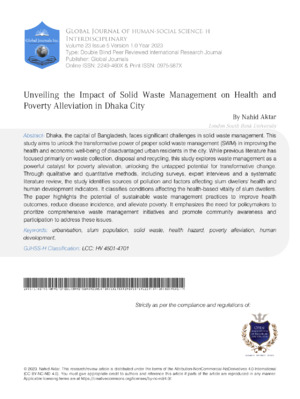
Alt text: Academic journal cover page on waste management's impact on health and poverty alleviation in Dhaka.

Unveiling the Impact of Solid Waste Management on Health and Poverty Alleviation in Dhaka City

Nahid Aktar
Nahid Aktar
DOI

Abstract

Dhaka, the capital of Bangladesh, faces significant challenges in solid waste management. This study aims to unlock the transformative power of proper solid waste management (SWM) in improving the health and economic well-being of disadvantaged urban residents in the city. While previous literature has focused primarily on waste collection, disposal and recycling, this study explores waste management as a powerful catalyst for poverty alleviation, unlocking the untapped potential for transformative change. Through qualitative and quantitative methods, including surveys, expert interviews and a systematic literature review, the study identifies sources of pollution and factors affecting slum dwellers’ health and human development indicators. It classifies conditions affecting the health-based vitality of slum dwellers. The paper highlights the potential of sustainable waste management practices to improve health outcomes, reduce disease incidence, and alleviate poverty. It emphasizes the need for policymakers to prioritize comprehensive waste management initiatives and promote community awareness and participation to address these issues.

Unveiling the Impact of Solid Waste Management on Health and Poverty Alleviation in Dhaka City

Dhaka, the capital of Bangladesh, faces significant challenges in solid waste management. This study aims to unlock the transformative power of proper solid waste management (SWM) in improving the health and economic well-being of disadvantaged urban residents in the city. While previous literature has focused primarily on waste collection, disposal and recycling, this study explores waste management as a powerful catalyst for poverty alleviation, unlocking the untapped potential for transformative change. Through qualitative and quantitative methods, including surveys, expert interviews and a systematic literature review, the study identifies sources of pollution and factors affecting slum dwellers’ health and human development indicators. It classifies conditions affecting the health-based vitality of slum dwellers. The paper highlights the potential of sustainable waste management practices to improve health outcomes, reduce disease incidence, and alleviate poverty. It emphasizes the need for policymakers to prioritize comprehensive waste management initiatives and promote community awareness and participation to address these issues.

Nahid Aktar
Nahid Aktar

No Figures found in article.

Nahid Aktar. 2026. “. Global Journal of Human-Social Science – H: Interdisciplinary GJHSS-H Volume 23 (GJHSS Volume 23 Issue H5): .

Download Citation

Journal Specifications

Crossref Journal DOI 10.17406/GJHSS

Print ISSN 0975-587X

e-ISSN 2249-460X

Issue Cover
GJHSS Volume 23 Issue H5
Pg. 27- 63
Classification
GJHSS-H Classification: LCC: HV 4501-4701
Keywords
Article Matrices
Total Views: 1172
Total Downloads: 8
2026 Trends
Research Identity (RIN)
Related Research
Our website is actively being updated, and changes may occur frequently. Please clear your browser cache if needed. For feedback or error reporting, please email [email protected]

Request Access

Please fill out the form below to request access to this research paper. Your request will be reviewed by the editorial or author team.
X

Quote and Order Details

Contact Person

Invoice Address

Notes or Comments

This is the heading

Lorem ipsum dolor sit amet, consectetur adipiscing elit. Ut elit tellus, luctus nec ullamcorper mattis, pulvinar dapibus leo.

High-quality academic research articles on global topics and journals.

Unveiling the Impact of Solid Waste Management on Health and Poverty Alleviation in Dhaka City

Nahid Aktar
Nahid Aktar

Research Journals