The history of Intangible Heritage Convention which dates back to the late 19th century, involves the intensive collection of old objects, the construction of museums, the preservation of monuments, and the foundation of National Heritage Protection Programs in order to preserve locally rooted culture at all costs. Modern museums were described as a colonial legacy in Cameroon. This has posed a problem to indigenous museums, commonly referred to as openair museum in Kedjom Keku as they remain unsung because of the innovations introduced by the European concept of museology. Indigenous museum constitutes of artisanal workshop, ecological sites, and institutional photos like family album, religious institution, traditional architecture and monuments. Today, the paradigm has shifted to mean a building in which objects of historic, scientific, artistic, or cultural interest are stored or exhibited. This paper looks at the significance of indigenous museums as veritable tools in preserving Kedjom Keku cultural heritage.
## I. INTRODUCTION
The Bamenda Grassfields fondoms are well-known for its rich material and immaterial cultural heritage which provide a platform to showcase and celebrate the people's history, traditions and arts. Most Grassfielders or local inhabitants in the Bamenda Grassfields are unaware to some of these cultural heritage values which connect the generation to the past. Among the Bamenda Grassfields Fondom, there lies unsung cultural heritage features known as indigenous museums or open-air museums or tribal museums as well as royal treasury. This museum exhibits the ancestral traditions, customs, artistic prowess and ecological features of the community. In Kedjom Keku Fondom, indigenous museums provide a captivating preview on their local history, identity and serve as living embodiments of their cultural legacy. Aithnard confirms that this museum became the custodian of the history, art, cultural treasures and values of the country intact for the people of today and for future generation.[^1] $^{1}$ Today the establishment of modern museums by the colonialist have relegated the mindfulness of this open-air museum and its treasures such as artisanal workshops, ecological sites, institutional photographs, religious institutions, traditional architectures, ceremonial objects, and monuments.
According to the Regional Delegate of Arts and Culture, North West Region in her words; Indigenous museums are institutions which preserve, exhibit and interpret the cultural heritage and artefacts of indigenous people. Besides, these museums are outdoor space where visitors can walk through freely and admire art in nature such as forests, gardens, waterfalls, hills, caves, burial sites and shrines.[2] Moreover, this museum serve as tool to reclaim practices base upon traditional (native) values; they also serves as base for conducting research whose ethics and design are relevant to indigenous community.[^10][^8][^3] Therefore, indigenous museums are traditional, research-based institution, entertainment centers where families and visitors learn about the people's way of life, local institutions and history.[^9] Historically, before the advent of the Europeans that led to the annexation of Africa and Cameroon in particular in 1884,[^4] there existed no formal or public institutions that functioned as museum. What existed in Cameroon were local institutions which governed the indigenous people. The establishment of the modern museums in Cameroon by the Colonialists benefited from the earliest collections that were preserved in the palaces by traditional rulers or family's heads. With the inception of modern museum in
Cameroon, our indigenous museums remain invaluable repositories especially in Kedjom Keku. The core question driving this research is: How can the indigenous museums become more relevant to the local people and foreign visitors? By exploring this question, the paper looks at the significance of indigenous museums as veritable tools in preserving Kedjom Keku cultural heritage.
### a) Location of Kedjom Keku
Kedjom constitutes one of the chiefdoms of the Bamenda Grassfields. It is important to indicate that the area known to be the Bamenda Grassfields was also referred to as the Western Grassfields.5 Kedjom Keku is found in Tubah-Subdivision in Mezam Division, North West Region of Cameroon.[^5] Kedjom Keku is situated along the Bambui-Fundong Highway, some 25km from Bamenda City. Today, the Kedjom Keku people are known as the Babankis. With an estimated population of about 20,000 inhabitants, she is bounded to the northwest and southeast by Bafut, to the east by Bingo (Kom) and the south by Bambui.6 The location of this indigenous museum allows visitors to have easy access to cultural artefacts, oral histories, natural sites, and traditional knowledge held by the fondom (see map 1).
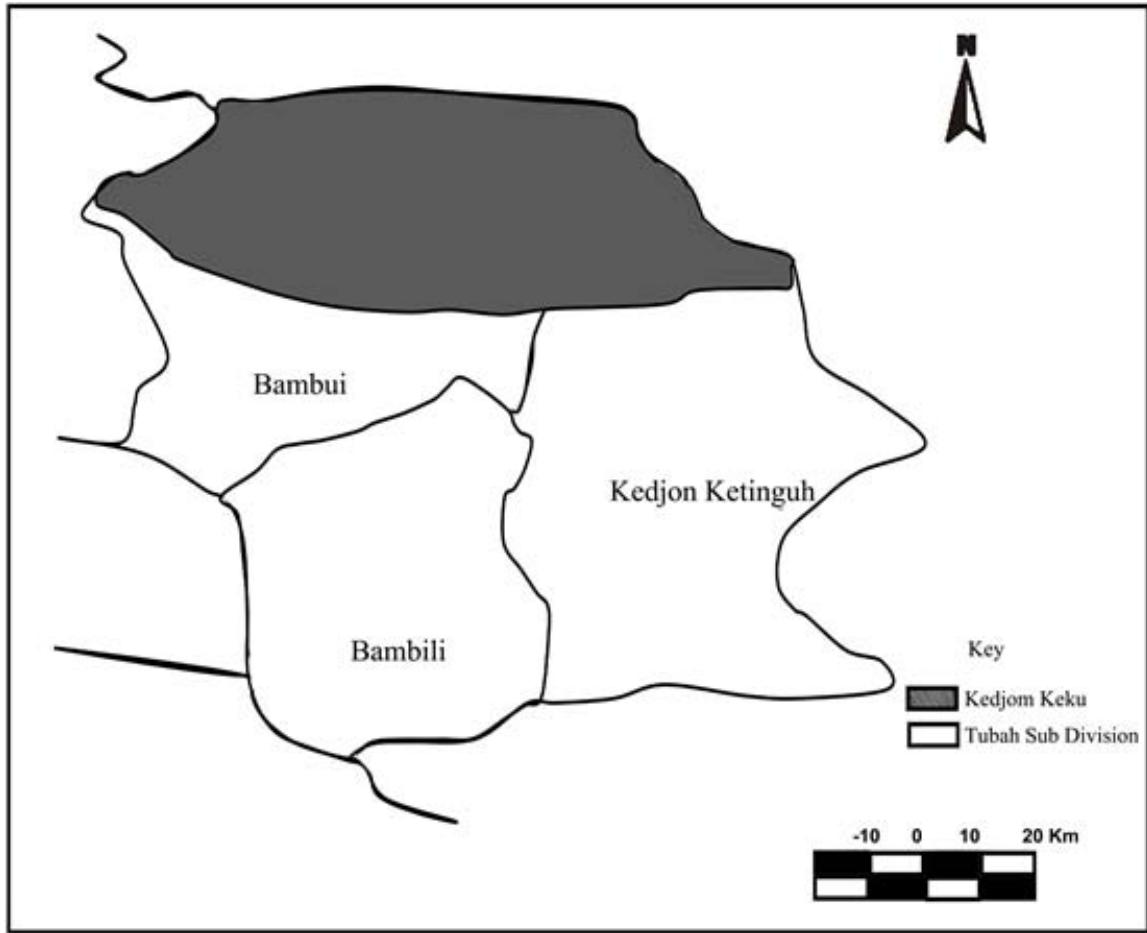 Source: Adapted from the Administrative Figure of Cameroon-MINATD-1992.
Map 1: Kedjom Keku in Tubah Sub Division.
### b) Historical Overview of Museums Background in Cameroon: From Traditional to Modern Museums
The history of museums in Cameroon can be traced back to the remote past of collections from traditional chiefdoms, sanctuaries and other cultic sites. These collections and sites were characterized by rites and accessible only to initiate persons who served as griots of traditions.[^7] Momin and Ikechukwu confirm that during pre-colonial era, various cultural materials of ritual, religious and political importance were fashioned, conserved and preserved in temples or shrines and in the palaces of kings and chiefs.8 They add that in pre-colonial era, objects were preserved of their utilitarian

and ritualistic significance or values. $^{9}$ Ngole opines that pre-colonial chiefdoms had collections and sacred treasures in Africa and Cameroon in particular long before $18^{\text{th}}$ century in the form of palace displays as well as some natural features like lakes, mountains, and forests which were considered as open-air museum within this era and was preserved according to their own traditional cosmology. $^{10}$ According to Akpomuvic;
In the pre-colonial settings, traditional museums were known to be various cultural materials of ritual, religious and political embodiments were fashioned, conserved and preserved in traditional shrines and in the palaces of kings and chiefs. Morse so, ivory, bronze and carved wooden objects (craft workshops) preserved objects in their own right as well as some natural features like caves, waterfalls, forests and mountains were maintained as monuments.[^11]
Fon Voutsiboung attests that indigenous museums remains a treasure of the past like the palace buildings where displayed objects held remarkable histories of the people's way of life, economic, political, socio-cultural and spiritual importance. He adds that some objects were used as initiation tools, weaponry items, blacksmiths objects, dancing instruments like masks, clay pots and calabashes. For example, clay pots and calabashes were used to store oil and palm wine, wooden statues; iron staffs were wooden symbol of authority used for oaths taking to prove innocent of accusations form the community.[^12] Besides, family heads, chief priests of shrines and custodians in the communities during the pre-colonial era were assigned in organizing, protecting and preserving open-air museums. For instance, in the Bamenda Grassfields, the family head was in charge of the family's sanctuary. In this sanctuary, cultural objects such as irons, amulets, and wooden statues (deities), calabashes and clay pots were used to wash out the misfortunes such as sickness in the family, accident and failure in business.[^13] Therefore, most of the caretakers of these indigenous museums such as the cultural artifacts and natural sites acted more or less as curators with a traditional mechanisms initiated by the traditional authorities to preserve this rich cultural heritage in Africa and Cameroon in particular.
Nkwi laments that the royal treasury that was at its peak in the 1940s and 1950s are now at its lowest ebb and needs urgent attention. He maintains that in the past, palace retainers or traditional curators were "recruited throughout the kingdom to cater for the royal treasury: former retainers were required to send sons to be palace to serve while some were forcefully recruited from among the brightest young men of the kingdom."14 Today the increasing establishment of modern museums in Cameroon and Bamenda Grassfields in particular is considered as a means of re-traditionalizing the palaces.15 Therefore, one of the aspirations engendered by independence was that the establishment of modern museums which became a privilege place where the treasure of African culture would find the ideal setting in which to express what they have symbolized throughout past millennia and centuries from the point of view of history, art, science, technology and ethnography, divested of all bias.16
The development of modern museums began during the colonial period. Andah agrees that the concept of the modern museum, as experienced widely throughout Africa is closely linked with the phenomena of colonialism.[^17] There is no denying the fact that the museum in its current form and structure is an alien institution in Africa. It was introduced by the colonial masters.[^18] Thus, modern museums were described as a colonial legacy in Africa. From the inception of modern museums in Africa and Cameroon in particular, collections were acquired through purchase, through voluntary donation by the makers, through archaeological and ethnographic collections and through confiscation by government when caught with smugglers or looters. According to Eyo, modern museums preserved objects from deterioration, depredation, exhibited local works of arts and artefacts. In this light, most collections were taken to museums because they (colonialists) wanted to study them and ensured maintenance of the collections for posterity.[^19]
According to Akpomuvic, museums preserve the tangible evidence of man's history, creativity and the physical aspects of the world he inhabits. Museum gives information about the past environment of the materials displayed; such materials then attract, entertain and arouse curiosity amongst the people.[^20] Besides, the International Council of Museum (ICOM) defined museum as a non-profit, permanent institution in the service of society and its development open to the public which acquires, conserves, researches, communicates and exhibits the tangible and intangible heritage of humanity and its environment for the purpose of education, study and enjoyment.[^21] According Debra, ICOM is an international organization that provides guidelines and professional standards for museums. It promotes the establishment and development of museums worldwide, emphasizing ethical practices, the protection of cultural property, and the interpretation of cultural heritage.[^22]
Historically, the year 1884 constitutes an important turning point in the history of Cameroon and most African countries because it marked the beginning of European colonialism in Africa. From 1884 to 1960, the whole of Africa with an exception of Ethiopia and Liberia were under European colonial influenced.[^23] During the German colonial era (1884 to 1916), the first modern museum was established in Cameroon around 1920 at Bamoun.[^24] The Bamoun Kingdom was the seat of the German colonial administration in the Western Grassland. It was on this basis that the Germans sponsored the construction of this museum. Christraud confirms that the first museum was opened in the palace of Sultan Njoya[^25] in Foumban the capital of the Bamoun Kingdom in 1920.[^26] E. P. Jones attests that Foumban Palace Museum was opened in 1920.[^27] Ngitir and Monteh agree that this museum was the nation's earliest museums in the 1920s.[^28] It was acknowledged as the first modern museum in Cameroon recognized by ethnographers. The museum until date exists as a center of memory and identity of the Bamoum kingdom in the Western Grassland region of Cameroon.[^29]
In order to preserve the establishment of modern museums across the globe without excluding Cameroon, some international laws were initiated by UNESCO. For example, UNESCO Convention on the Protection of the World Cultural and Natural Heritage adopted in 1972 encouraged the identification, protection, and preservation of cultural and natural heritage sites of universal values. In relation to this convention, Cameroon is a signatory and played an important role in safeguarding and preserving heritage sites such as museum.[^30] Besides, the international laws or conventions, museums in Cameroon are governed by national laws and regulations. For example, Law No. 2006/12 of 29 December 2006 on the Protection and Promotion of Cultural Heritage provides a legal framework for the protection, preservation, and promotion of cultural heritage in Cameroon, including museums. This law outlines the responsibilities of various stakeholders, such as the government, local communities, and individuals, in safeguarding cultural heritage. Also, Decree No. 2014/141 of 21 March 2014 on the Organization and Functioning of Museums defines the roles and responsibilities of museum directors, staff, and governing bodies, as well as the procedures for managing collections, conducting research, and organizing exhibitions.[^31] With the insights of these international and national laws, decrees, conventions and regulations provide frameworks and guidelines in museums establishment and management in Cameroon given less values of our indigenous museums in context.
Overall, the vast majority of museums in Africa were established during the Colonial era, either by the Colonial Authorities themselves or by members of the European elite. As result, they were modeled upon European museums or at least the European idea of a museum: a place where the upper classes could come to marvel at exotic artefacts belonging to the indigenous peoples of the particular country.[^32] Therefore, in order to support the objective and bridge the research gap in this study, relevant existing literature will be reviewed.
## II. LITERATURE REVIEWS
According to Woodward, objects are the material things people encounter, interact with and use. Objects are commonly spoken of as material culture. The term 'material culture' emphasises how apparently inanimate things within the environment act on people, and are acted upon by people, for the purpose of carrying out social functions, regulating social relations and giving symbolic meaning to human activity....Material culture is no longer the concern of museum scholars and archaeologists, researchers from a wide range of fields have now colonised the study of objects....By studying culture as something created and lived through objects, we can better understand both social structures and larger systemic dimensions such as inequality and social difference, and also human action, emotion and meaning.[^33]
Amba attests that when the Babungo Museum was opened to the general public, it attracted a lot of visitors to the fondom to view the sculptures where several and most significant highest quality pieces and art work were displayed in the museum. For example, among these art works exhibited includes beaded thrones, stools, staffs, musical instruments, blacksmiths, masks, containers, and pipes.[^34]
Jones elaborates on the significant of palace museums in the Grassfields as they act as the primary tourist sites in the region. The author penned down examples of these palace museums such as Bafut, Mankon, and Babungo which integrated into the larger palace compounds and could be considered natural, historical and cultural sites at the same time.[^35]
Fubah delves that modern museums do not reflect the true identity of Grassfields people especially in terms of the secret nature of the objects stored in the royal treasury. The author explains that a good number of Bambui youths and untitled men feel that exposing the treasures of the Kingdom to the general public will "disconnect" rather than reconnect the indigenes and their ancestors-represented by the objects. The author laments that having modern museums in Grassfields Palaces as a replacement for the royal treasury, might be a curse rather than the much expected blessing of villages promoting and preserving the objects left behind by ancestors in the royal treasury.[^36]
Baneh examines the factors that have been responsible for the challenges faced by the Bamenda Regional Museum as well as the lukewarm attitude of the indigenous people in the North West Region of Cameroon in visiting museums. She argues that Cameroonians do not visit and explore their cultural patrimony which contains a wealth of indigenous history and way of life. The author emphasizes that museum remains a repository and institution that must be well preserve for posterity.[^37]
Njinuwo examines the ways cultural objects on permanent display in the Mankon Community Museum can be interpreted and communicated to the inhabitants of Mankon who the museum primarily aims to serve. The author confirms that valuable objects without proper communication of its significance to the expectations of the various museum visitors are unprofessional.[^38] The researchers primarily concentrated on contemporary/ modern museums rather than indigenous museums in the Bamenda Grassfields (North West Region), based on the extensive literature available. This paper aims to address this research gap by highlighting the importance of indigenous museums specifically in the kedjom Keku Fondom.
## III. METHODOLOGY AND THEORETICAL FRAMEWORK
The method of data collection for this paper is both quantitative and qualitative. The purpose of this is to attain greater knowledge and understanding of the museum world. Underlying this method, we used techniques such as direct observation, in-depth interviews, and many more to collect data. We made use of manuscripts, photographs, artwork, books, and artifacts amongst others. Through 22 individual in-depth interviews with both genders, we further explored the views, experiences, beliefs and/or motives towards museums. Each interview session lasted for approximately one hour. Some of the interviews were conducted in Pidgin English or in the Kedjom language. Copious notes and audio recordings of interviewees were made with their permission. Thereafter, the interview data were transcribed into the English language. Observation allowed us to capture the nature and happenings in and around open air museums. Data was analyzed during and soon after the fieldwork was over using content analysis. The data was interpreted using the semiotic approach.
According to Woodword, the essential principle of the semiotic approach to studying material culture is that objects (museums) are signs referring to something other than themselves.[^39] Eco beguilingly put it – the sign is intrinsically a lie. That is, an object is held to be a 'sign' of something else, a proxy for some other social meaning. For example, an object (in a museum) might refer to a category of social status, like a person's occupation, their religion or gender. Or, an object might refer to a particular feature of a person's self-identity related to their affiliations and associations. Thus, according to the semiotic approach, material culture is said to be a 'signifier' that communicates things to others, accomplishing some king of social 'work'. Eco identifies the need for a general semiotic theory based on his claims that "the whole of culture must be studied as a semiotic phenomenon," and that "all aspects of culture can be studied as the contents of a semiotic activity".[^40]
No Grassfields scholar has undertaken an in-depth study of the rationale behind the recent upsurge of interest in modern museums in the palaces of the western Grassfields. The paucity of research on the recent interest in modern museums in the region suggests that many realities that ought to be known remain largely unexplored.
## IV. FINDINGS: TYPLOGY AND SIGNIFICANCE OF INDIGENOUS MUSEUMS IN KEDJOM KEKU FONDOM
The United Nations Declaration on the Rights of Indigenous Peoples adopted in 2007, recognizes the rights of indigenous peoples to maintain, control, protect, and develop their cultural heritage, including their artifacts, objects, and ceremonial sites.[^41] With this declaration, indigenous communities with focus in Kedjom Keku have the right to situate, ensure proper representation and management of their indigenous museums such as artisanal workshops, ecological sites, institutional photographs, religious institutions, traditional architectures, ceremonial objects, and monuments.
### a) Ecological Sites
The Fondom of Kedjom Keku is renowned for its abundant ecological sites that carry the essence of their indigenous history. These ecological sites encompass caves, waterfalls, forests, and hills. The appreciation and preservation of these ecological sites within the fondom generate awareness and provide information to both the local community and tourists about the indigenous heritage and present-day values. With these distinctive characteristics, the ecological sites are regarded as indigenous museums. The Cave at Abongphen (see plate 1) will serve as a means to demonstrate the significance of these ecological sites. Kedjom Keku has a good number of caves which could encourage visitors. These caves would rapidly increase economic, sociocultural and environmental benefits to the community which occur through interactions between the indigenous people and visitors (tourists) during tourism experiences. The cave at Abongphen is used for rituals during the annual dance festival called Kebeng-ndong (dance of the flute). This dance is a very special ceremony, hosted by the Fon often to commemorate the loving memory of all princess and warriors who had died as well as a special celebration of the death of the brave and kind Fon Fon Mbwuwain (Mbwungeng), who passed on without leaving a successor. Thus, the dance is characterized by prayers for the protection of citizens and prayers for a hitch-freed planting season.[^42]
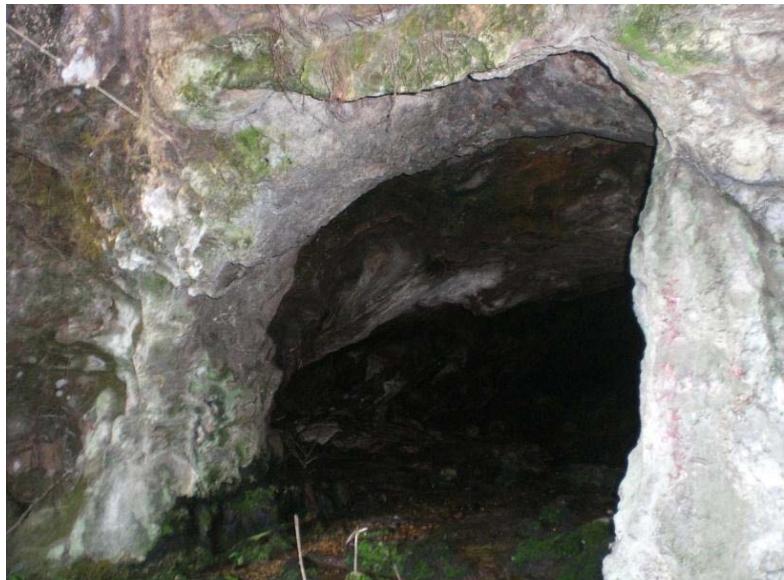 Source: Fieldwork (2023) Plate 1: Front View of the Abongphen Cave.
According to a Kingmaker, each year sacred rites were performed at the cave to appease or feed the gods of the hills with food such as oil, cooked corn flour and egusi. The Kingmakers who visit the cave must be 50 years old and above. Inside the cave, no one could make three steps forward as a sign to respect the gods of the hill (nyi-ngutata). The purpose of this rite was to seek the protection of the land and end all calamities affecting the land.[^43] In this light, traditional manifestations carried out by the kingmakers to communicate with the god of the hills, will attract visitors to Kedjom Keku. To add, oral tradition holds that around the reign of Fon Kebeng (1770-1805),[^44] there were impending attacks from the Bali-Kumbat at Fekeng-Monkam's men raiding for wives and slaves. The old and disabled who could not run fast and who if captured would be tortured to release war secrets were sequestered in a house and roasted alive. Most of the art treasures gotten from this old and disabled home were rushed to the caves at the edge of Mbuangang and preserved in charcoal. These artefacts can only be recovered after the performance of complex rituals whose procedures may already have been lost in memory.[^45] Significantly, this cave acted as a storehouse where some cultural artefacts were protected against defacement from the enemies who raided the fondom. This cave held great historical importance to the people's heritage.
More so, these caves are natural attractions that animate the minds of visitors because they are naturally inherited features. Apart from being used as refuge points during inter-tribal wars, the insides of the caves harbour all kinds of bats, reptiles and spotted animal bones.[^46] According to Kemie, the animal bones prove that the cave was a safe place for animal socialization. The presence of these bones could be explored and studied by paleontologists to know the type of animal that lived in the cave. In the present day, bats are the most visible birds. When these bats hear strange sounds, they fly and produce shrilling sounds. Culturally, the spirits of bats are used as a protective charm to protect warriors against pandemics such as flu, cold, virus and other infections.[^47] As earlier mentioned, the rituals performed here make the site not harmful to the visitors who abide by the rules and regulations of the cave as affirmed by our informants. Therefore, carved stools with bats are among the animal species represented in artistic objects in Kedjom Keku which visitors could explore to understand the people's history and way of life. The historical experience and psychological thoughts of this cave project the indigenous museum of chiefdom that attracts visitors.
### b) Traditional Architecture
The organization and structure of Fondoms (palaces) in the North West Region showcase the beauty of traditional architecture constructed by the indigenous people as a sign of loyalty to their Fon.
These traditional architectures, found in fondoms in the Bamenda Grassfields, serve various functions and preserve the people's cultural heritage. The Kedjom Keku Palace is a complex of traditional buildings that serves as the seat of the Kedjom dynasty. It comprises several interconnected structures, including the Fon's residence, the queen's residence, and the council chambers.[^48] Visitors can explore the palace grounds and gain insight into the history and culture of the Kedjom people. Traditional architecture represents an ancient craft in building construction that has long been employed by local communities. It is regarded as a primary form of artistic expression and forms an integral part of their indigenous museum. In the context of Kedjom Keku, traditional architectures served as dwellings where families resided, showcasing both decorative values and construction techniques. These houses were often constructed using materials such as mud blocks, stones, sticks (bamboos), and grasses.[^49]
Moreover, the architectural designs of these houses varied, with occupants opting for rectangular structures, houses grouped closely together, or isolated dwellings. These traditional architectures hold a rich historical significance for the local community, particularly within the realm of architectural history. In addition to the materials used for construction and decoration, these building also contain household decorative objects crafted with traditional ingenuity such as carved bowls, stools, clay drinking pots, drinking horns, chains and Dane guns. In this context, visitors will have the opportunity to delve into and discover the intricacies of architectural history within the Kedjom Keku Fondom. The traditional architecture within the fondom, particularly the royal architecture, receives significant attention. The organization of the fondom not only acts as a hospitable venue for visitors but also serves as a host for various events, thereby transforming it into an indigenous museum. Additionally, the fon of Kedjom Keku fondom has three well-constructed local traditional houses roofed with grass called Ntsi (see plate 5a). The ntsi (Fon's house or building) is the oldest structure in the palace compound and is considered a shrine in which ancestors of the Kedjom people live. Again, ntsi accommodate the things used by the Fon, such as throne (kefoyn), cup (ku), dress (ketunu), spear (ntus) and umbrella (kelyenu). At the same time, wooden pillars were attached to the buildings where he resides, which gave beauty to the building.[^50]
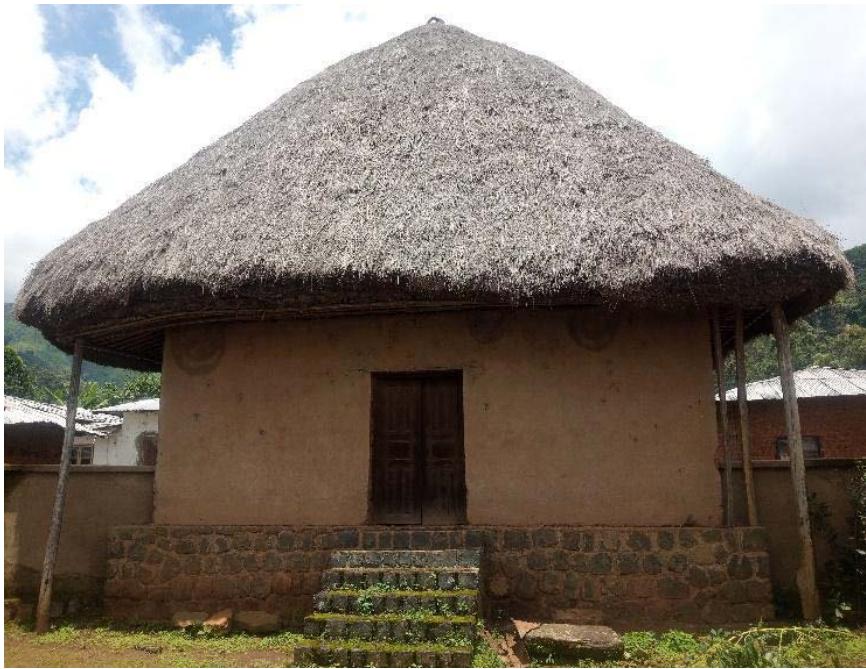 Source: Fieldwork (2023). Plate 2: Front View of Nsti, Kedjom Keku.
Furthermore, the buildings within the palace were deliberately separated from each other for security reasons. In the event of a raid, such as inter-tribal wars or evil plots to harm the fon, it would be difficult to locate the Lion (fon) among the Ntsi buildings in the palace.
The palace guards were also kept unaware of where the fon spent his nights to avoid any potential traitors to the throne. To address these uncertainties, the fon implemented a rotational security roster between the Ntsi buildings at night to ensure stringent security measures in the fondom. This strategy allowed the fon to remain relatively free from possible exposure and attacks from enemies, opponents, and conspirators who disagreed with his traditional policies. These memories of royal architecture attract tourists to the community interested in learning the people's history, understanding how the thatched royal houses were constructed and taking photographs in front of the Ntsi.[^51]
### c) Ceremonial Objects
Ceremonial objects hold indispensable importance in the cultural tapestry of the Bamenda Grassfields, particularly in Kedjom Keku. These objects are employed for various purposes and play an integral role in preserving the rich cultural and social heritage of the Bamenda Grassfields in Cameroon. Examples of ceremonial objects found in Kedjom Keku Fondom include the masks, sculptures, musical instruments, regalia, calabash, baskets, drinking horns, and spears and carries profound meaning and serves specific functions within the community's cultural practices and traditions.[^52] In relation to field observations, these ceremonial objects play a central role in various ceremonies, rituals, and traditional practices while serving as tangible representations of the community's values, beliefs, and history. They are imbued with symbolic meanings and often have deep spiritual or religious significance well-known as tribal museum. Within the Fondom, the production of these ceremonial objects involves the expertise of skilled craftsmen and women who employ traditional techniques that have been handed down through generations.[^53] Furthermore, the ceremonial objects hold both utilitarian and ritualistic importance, serving as visual manifestations of the community's history, traditions, and collective memory. A selection of ceremonial objects from the Kedjom Keku Fondom will be showcased to highlight their significance and their role in fostering the continuity and vibrancy of cultural traditions.
The scepter or staff in Ga-ah Kedjom was called Mbang. The staff was an inseparable ceremonial object of the community used by the fon, dignitaries and common indigenes which played a significant role in the lives of its users. During enthronement of the Fon, he carried a scepter of office as a sign of power and authority. This emblem was the first symbol that the new Fon appeared with in public. On the July 22, 1979 when Fon Simon Vugah II was enthroned in Kedjom Keku, his first appearance in dancing was graced with a glass- beaded staff. According to Kedjom culture, this staff was meant for protection and a protective medicine wastied to it (see plate 3).54 Besides, some informants testified that before the use of scepters, long bamboos were used as Fon's staff with a red feather of a bird called bantermans turaco tied to it. This symbolized royalty and the highest position to the monarch was planted at the apex.55 Presently, there is high esteem attached to the use of staffs in Kedjom culture valorized both the elders and youths making gestures on particular events such marriage, birthday and installation ceremonies. However, whatever type of staff used by the dignitaries and youths must have no hint of being embroidered with cowries as shown in plate 3. From the field observations, the Royal Staff originated since the reign of Fon Kensante (c.1400-c.1425) and signifies authority, majesty and the absolute rule of law. The Fon was authorized as an ancestral god and was supposed to be worshipped by all his subjects.56
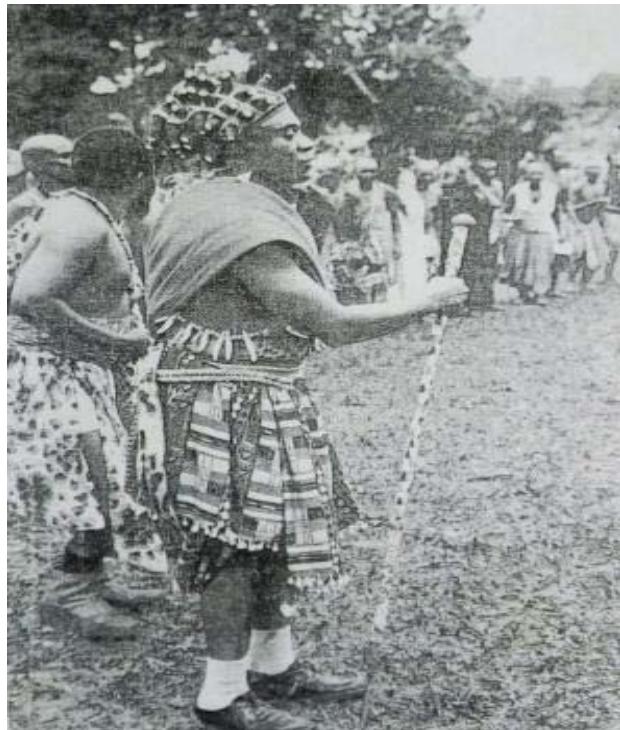 Source: Fieldwork (2023). Plate 3: Fon Simon Vugah II of Kedjom Keku.
More so, the single or double-toned gongs called fangem in Kedjom were made from iron by skilled Kedjom blacksmiths and others from the Bamenda Grassfield Chiefdoms. Gongs were made in various sizes (from about 15 to 100 centimeters in length) and wrought in hallow cones. In the case of double gongs, two single iron cones were connected by an iron bow which was wrapped with clean split cane. The result was a nice-looking, comfortable and warm handle.[^57] It was tuned by gently bending the rim inward or outward. The double gong was occasionally seen as motif on carved stools. However, we saw it used more often as an icon on door frames, house posts, title cups and embroidered robes. The gong, single or double toned was a symbol of authority. No one except the Fon dared to beat the gong for war. The Fon also sounded it to summon his people to the palace. Secondly, when sending men to war, and thirdly when the warriors returned victorially from the battlefields. However, during inter-tribal wars the Fon beat the gong that alerted and informed the warriors.[^58]
Ngitir elaborates on the strength and usefulness of gongs as follows; ngongs were beaten by kwifon on important occasions such as making of sacrificial offering to royal ancestors, when announcing the death of their member; when knighting a new member; when installing a kingmaker; sub-chief or quarter-heads; during burial proper of the above personalities; when commemorating an improperly buried member; when the Fon had disappeared (death of a Fon) and when sacrifices were made to late Fons.[^59] In Kedjom, the role of the gong remained vital and regular throughout the performance of religious rites. The double gong was also one of the sacred instruments and symbols of Kwifon, the regulatory society which served as the executive wing of most Grassfields traditional governments. It was the highest traditional authority in every Grassfields kingdom. The gong was thus beaten by kwifon members.[^60] From folklore, gongs became popular in the early nineteenth century under the reign of Fon Akumbu (c.1805-1835). The royal herald used it to announce the arrival of a Fon while the double gongs were used for messages and for music by church groups (see plate 4).[^61]
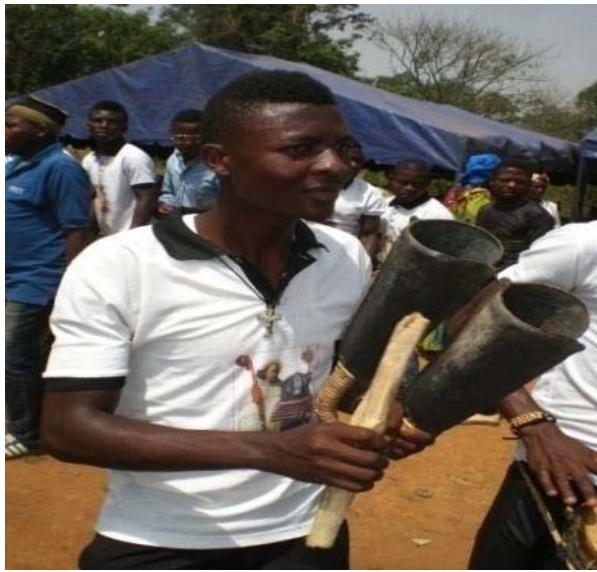 Source: Fieldwork (2023). Plate 4: Double Iron Ngong (Fangem) in Kedjom.
### d) Photographs
Photographs serve as living memories of the past in the present, and they can attract visitors to study area because they help the receiver (visitor) accept the message as trustworthy and authentic. According to a veteran photographer, people are interested in institutional photographs displayed on photographic stalls or walls in the house, which showcase the tangible heritage of the people. Again, photographs are a tool that renders information authentic, as they embrace all communication media and can tell a story more effectively than words. They command the viewer's attention and create more sensations than written narratives.[^62] Besides, photographs have played a significant role in documenting the history of Kedjom society, spanning various aspects such as politics, administration, economics, and social and cultural lifestyles. It is noteworthy that photographs have the power to make history, document events, preserve memories, and move us to act. They have the ability to capture moments and preserve them for eternity, reinforcing personal integrity in both good and bad times.[63] In this light, photographs exhibited on photographic stalls, hung on wall house and preserved in Family albums are consider as indigenous museum by the viewers. Additionally, photographs provide insight into people's past lifestyles, offer meaningful evidence of events, and promote social networking among people, groups, and institutions.
Therefore, viewers who view these photographs are left with various emotions, from creating memories and smiles to experiencing excitement or sadness as they revive memories. Hence, destroying a photograph, whether at a personal or official level, is a ruthless gesture of rejection because it conveys memories of past events that interest viewers.[64] Igene emphasizes that when people or individual gazed on pictures-reactions are either to smile, to get excited, to frown or it brings back memories, or it helps you to develop a feeling of pride about yourself (personality) so much that you want to send copies to your loved ones or to hang it in the wall of your room.[^65] In this light, pictures recount individual memories like who you are, what you are, and encourages you to say what you want to say about yourself. Thus, the use of photographs can guide viewers through a sequential path to understand past and present memories in families.
Therefore, selected photographs from Gemoh Nazarius Vustile's Family Album are use as attributes of an indigenous museum.
Gemoh Nazarius Vustile, born on May 25th, 1939, in Kedjom Keku, had a rich and fulfilling life. He received his primary education in Kedjom Keku during the 1940s and continued his secondary education in Victoria (Limbe) during the 1950s. In 1968, he entered into marriage and became the proud father of six daughters. Gemoh Nazarius Vustile embarked on a career in the Ministry of Labour and Rural Development, serving in both Victoria and Buea. Throughout his professional journey, he held various positions, including Chief of Bureau Housing and Staff of Allocated Stories. His dedication and commitment to his work were evident until his retirement. Beyond his professional life, Gemoh Nazarius Vustile had a passion for music and actively participated in various choirs. He was a member of the Holy Trinity Choir, Holy Family Choir, Victoria Church Choir, St. Anthony Choir in Buea Town, and the Redemption Choir. He actively engaged in community and cultural activities. He was part of the First Executive of the Kedjom Keku Cultural Development Association, contributing to the promotion and preservation of the cultural heritage of his community. He
also participated in the Child Birth Club in Buea, supporting expecting mothers and fostering a sense of community. Sadly, Gemoh Nazarius Vustile passed away on December 13th, 2000, in Kedjom Kenu. His legacy lives on through his family, his contributions to his profession, his dedication to music, and his involvement in community and cultural development initiatives (see plate 5).[^66]
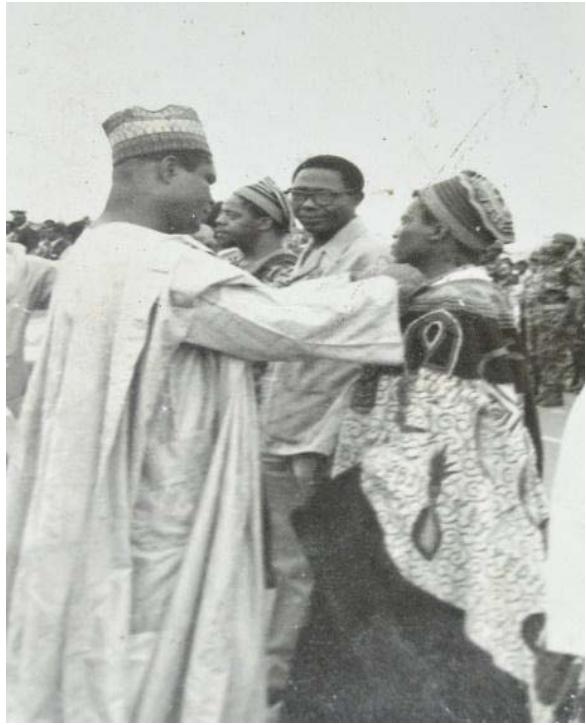 Source: Fieldwork (2023). Plate 5: Gemoh Nazarius Vustile.
Plate 5 showcases Governor Fon Fossi Yakum-Taw bestowing Gemoh Nazarius Voutsile with his first labor medal on May 20th, 1980. The ceremony took place at Bongo Square (Clerk's Quarter) in Buea, where Gemoh Nazarius Voutsile was dressed in the traditional attire of the Bamenda region known as "daleh" in the Kedjom dialect. The image captures this significant moment of recognition and celebration.[^67] According to his successor (Gemoh Julius), families preserved photographs for diverse reasons. First, photographs can be used to write biographies of individual leaders, artist, and dignitaries who have contributed in the development of the family. Secondly, they serve as valuable documentation of indigenous life while capturing facets like dress, crafts, cultural events, and traditional ceremonies. Thirdly, photographs are to create visual narratives that tell stories about indigenous history, traditions, and contemporary issues. Fourthly, photographers act as source to information because the viewer finds it easy to accept the message as credible and authentic. When these photographs are carefully arranged, specific treasures associated with it makes them to be photographic museums at homes.[^68]
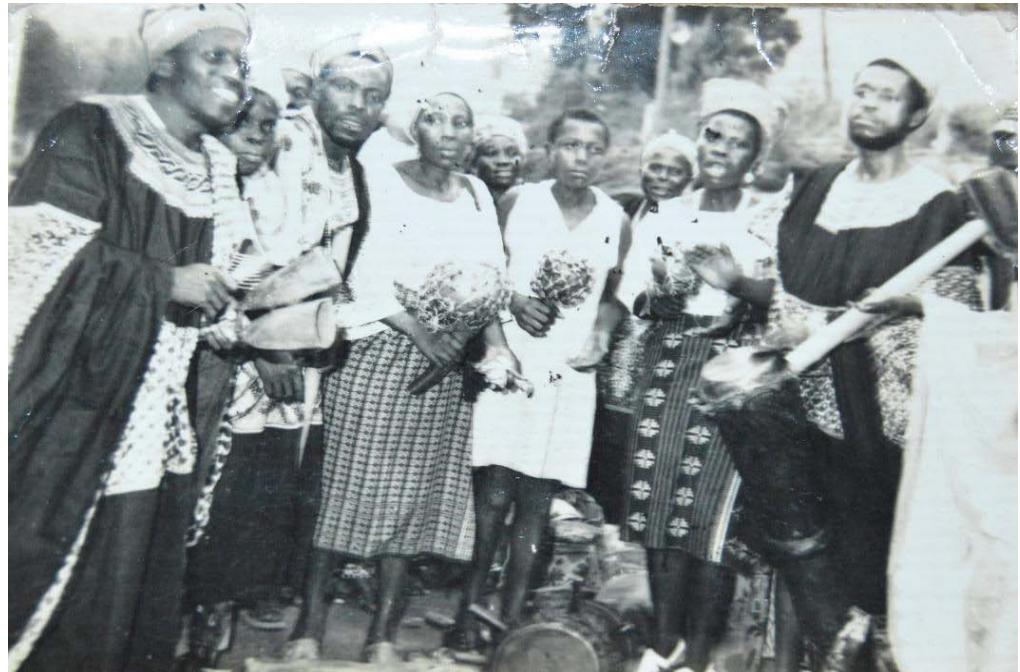 Source: Fieldwork (2023). Plate 6: Kedjom Keku Cultural Development Association.
For example, plate 6 conveyed a message of visitation to the then Governor of South West Province, Cameroon Fon Fossi Yakum-Taw by the Kedjom Keku Cultural Development Association (KEKCUDA) Buea on January 18, 1976. From the picture, they were singing and performing with instruments like calabash rattles, double iron ngong and drum. From the photographer caption, Gemoh Nazarius was very instrumental playing the double iron ngong called Fangem in the Babanki dialect.
Also, plate 7 illustrate sons from the Kedjom Kekeu fondom who took part in the death celebration of Fon Philip Vubangsi who was the successor of Fon
Vugah Simon I. Besides, Fon Vubangsi ruled Kedjom from 1936 to 1979 (43 years) and disappeared/missing (died) on June 22, 1979 at the age of 90 while serving the Basel Mission Church as a catechist and was fluent in speaking English and German languages. More so, Fon Vubangsi was a remarkable woodcarver who preserved the traditional crafts and arts of the fondom. Examples of his arts expertise were displayed in the palace.[69] This memorable celebration took at the Fon's palace on December 27, 1980 and pulled the sons and daughters across to globe to witness it and learnt the Kedjom traditions.
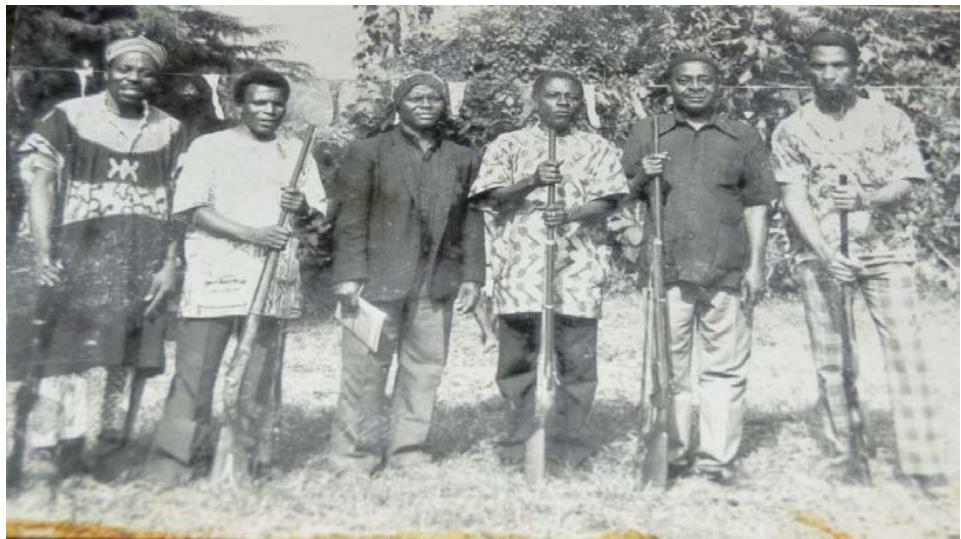 Source: Fieldwork (2023) Plate 7: Kedjom Indigenes during Fon Vubangsi Death Celebration.
More so, plate 8 represents Kedjom Keku notables with Fon Simon Vugah II on a tour as leader of sixteen other chiefs from the Cameroon-Nigeria Borders to visit Yaoundé, Buea and Sonara (Limbe). In the course of this tour, the Fon lodged in Tohtuh's house (a notable in Buea) while Commandant Fusi entertained the Kedjom people's in Buea. This photograph was taken on July 4, 1982 in Buea. In this light, Fon Vugah Simon II, who succeeded Fon Philip Vubangsi and was born in 1940. He received his education at the Basel Mission School in Kedjom Keku. He underwent a three-year training program at the Catechist Training Institute of the Presbyterian Church in Nyassoso from 1961 to 1963. After his training, he served as an Assistant Pastor in various congregations of the Bamenda Grassfields. In 1974, he was summoned by his father and started a private business as a chemist. Fon Vugah Simon II was enthroned as fon in 1979 and disappeared in 2004.[^70]
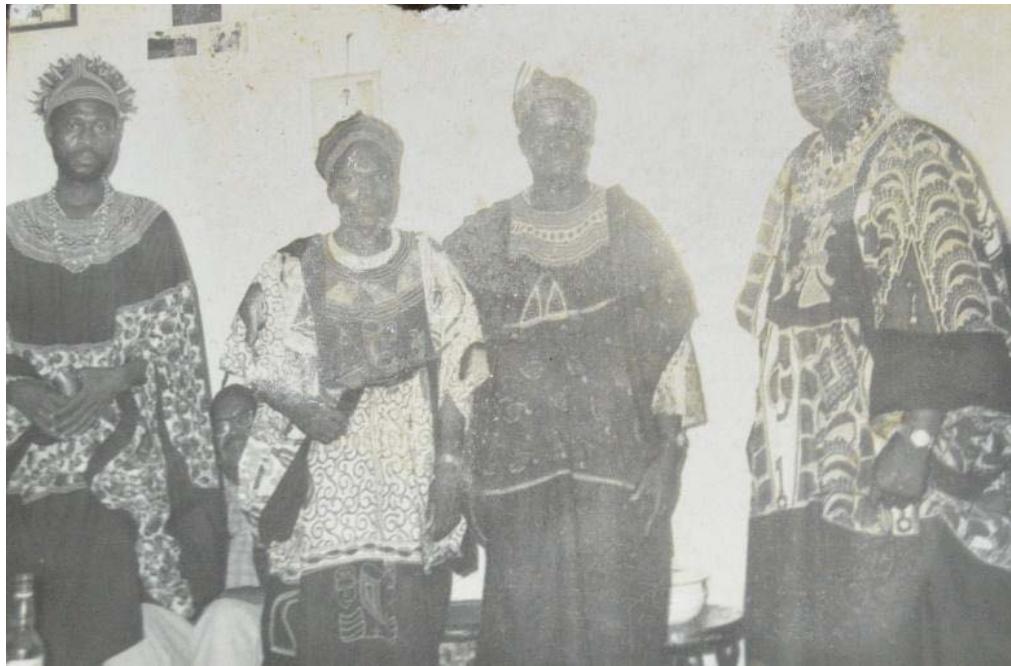 Plate 8: Kedjom Notables with Fon Vugah Simon II (First from R-L). Source: Fieldwork (2023).
### e) Artisanal Workshop
Like in ancient Egypt, Kedjom people, for remembrance, carved the statues and monuments of important people like Fons and Heroes who died. Their faces are kept in the palace, as they acted in place of photographs. According to Tum (2021), Kedjom village in Tubah sub-division is well noted for its craftsmanship in articles like chairs, tables, statues, pillars, out of wood. These antiquity materials are stored in private museums and are sold. Buyers come from different parts of the world to buy. The palace has a royal museum for people to visit. Kedjom art is a central part of traditional religious expression. It is known worldwide for its powerful ability to represent abstract ideas and spiritual forces. Kedjom artists produce sacred icons and symbols of traditional religions in an enormous array of forms, both abstract and representational. Traditional artists typically carve images that express the powers of God, the gods, ancestors, and spirits as intermediaries between deities and humans. A royal stool may depict powerful animals such as leopards and tigers. Practitioners of African traditional religions are generally familiar with the symbols and icons, but often only a few trained individuals can interpret the significance of such symbolic and iconic forms, which are used to imply religious meaning in initiation, divination, and secret societies. Two characteristics of the traditional cultural heritage of the people are that it is religious and it is oral. Craftsmen working with wood, metal, beads, clay, bark fibres, nutshells, gourds, skins and ivory give a spiritual dimension to everyday objects.[^71]
Artisanal workshops play a crucial role in the tribal museum of the Bamenda Grassfields, particularly in the Kedjom Keku Fondom, where craftsmanship has deep historical roots. These workshops serve as a means of conveying oral information about specific societies through the exhibition of objects. Traditional arts in the Bamenda Grassfields, with a specific focus on Kedjom Keku, reflect the people's understanding of their customs, traditions, and way of life. Within the study area, a wide range of craftsmanship can be found, including woodcarving, weaving, blacksmithing, embroidery, pottery, and the designing of calabashes and horns. The existence and continuity of these local craft industries are facilitated through the apprenticeship training provided to new generations.[^72] In this context, craft workshops provide a space for indigenous artisans to continue practicing and passing down traditional crafts and skills to future generations. According to informants, these local cottage industries also serve as educational platforms for visitors, allowing them to learn about the cultural significance and techniques associated with the exhibited objects. Artisans take on the role of guides, sharing information about the processes, materials, and meanings behind each object. Through these interactions, visitors gain a deeper appreciation for indigenous traditions as they learn about the history, and cultural insignias embedded within the crafts.[^73]
During the fieldwork conducted for this paper's objectives, the researchers made visits to several craft workshops situated in the Kedjom Keku Fondom. The purpose of these visits was to gain an understanding of how these workshops have come to be recognized as indigenous museums. For example, we visited local cottage blacksmithing industries at Mughe owned by Ninying Robert Lobte, a well-known and renowned metal producer with creative skills in blacksmithing. In Ga'ah Kedjom, the blacksmith's workshop was called kalam. This is an extract of his life history:
Ninying Robert Lobte, born in 1940, hails from Kedjom Keku and attended the Saint Peter's Practicing School Bambui. In 1954, he was trained as a blacksmith in Ndop precisely in Babungo. He got married to Miriam Lobte Akimbom in 1961 and is a father of nine children. He started blacksmithing in 1964 and was a founding member of the Cameroon Handicraft Company in Kedjom Keku 1967. He produced articles such as Dane guns, wine tapping knives, traps, axes, spears and cutlasses. The less lucrative nature of the business had forced him to specialize in producing rings, bangles, and local chains out of copper and brass.[^74]
Lobte was among the skillful smiths in Kedjom who contributed to the blacksmithing activity while his repertoire included hoes, cutlasses, spears, knives, dog bells, craft tools, tapping tools, axes, arrows, finger rings, bracelets, pipe stems, needles, flint guns, gongs (single and double) and anklet bells. Geary supports the view that the repertoire of the Grassfields and Bamum smiths included many implements and jewelry, particularly hoes for cultivation, axes, swords of the same types as knives and daggers, spears and arrow heads, rings daggers, handcuffs for the prisoners, razor blades, needles, and tools for woodcarving.[^75] In this light, plate 9 depicts Lobe in his workshop doing polishing of objects such as rings, bangles and neck chains. In Ga'ah Kedjom a ring is called fankwinkwin, while a bangle is called mfiŋ and neck chain is called vəlɔ'.
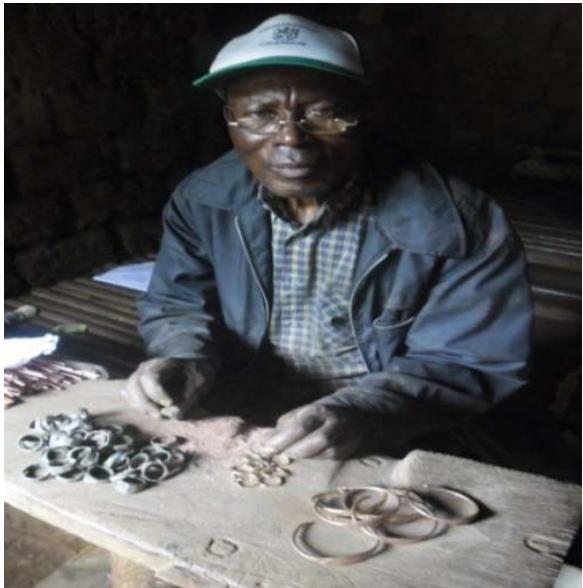 Source: Fieldwork (2023).
Plate 9: Ninying Robert Lobte.
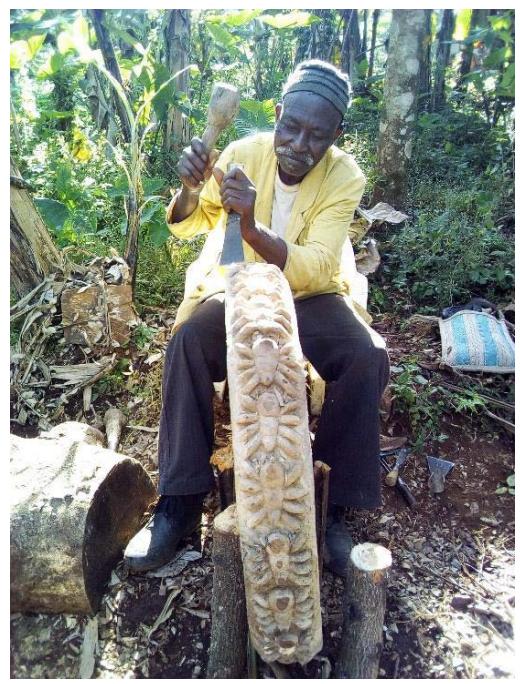
Additionally, the researchers also visited the woodcarving workshop located in the Ndeloh Quarter, which is owned by Vugah Joseph Vubangsi (see plate 10), the son of the late Fon Philip Vubangsi. His is widely recognized as a skilled and esteemed woodcarver within the fondom, and his exceptional craftsmanship has led him to participate in workshops held across Cameroon. Woodcarving holds significant cultural and religious importance in Kedjom, representing an integral part of the indigenous people's way of life and the daily practices of the craftsmen. This can be observed in various carved items, such as stools, masks, royal beds, drums, statues, bowls, thrones, doorposts, and house posts, all adorned with traditional-style carvings.
 10a
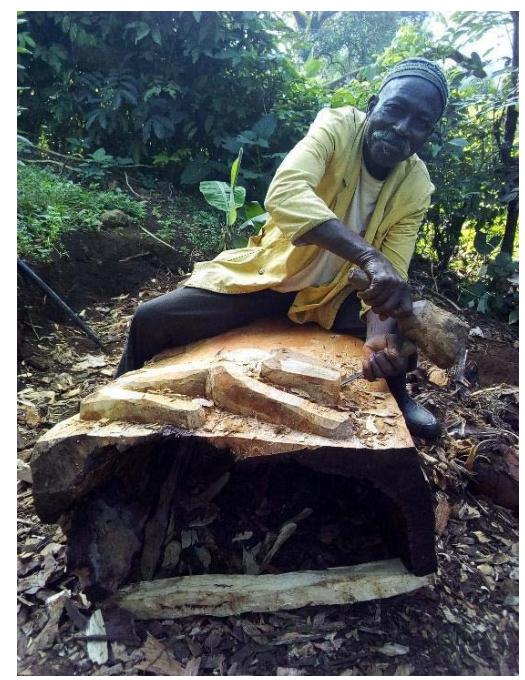 Source: Fieldwork (2023). 10b Plate 10 a-b: Vugah Joseph Vubangsi.
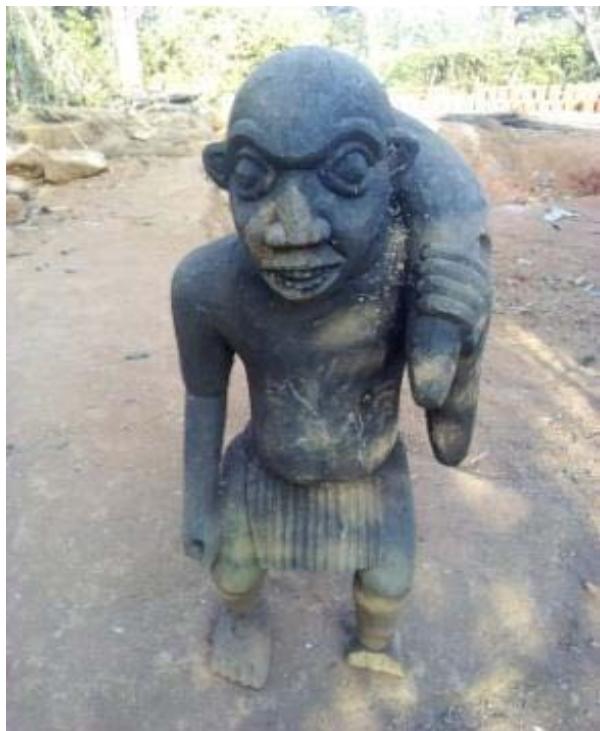
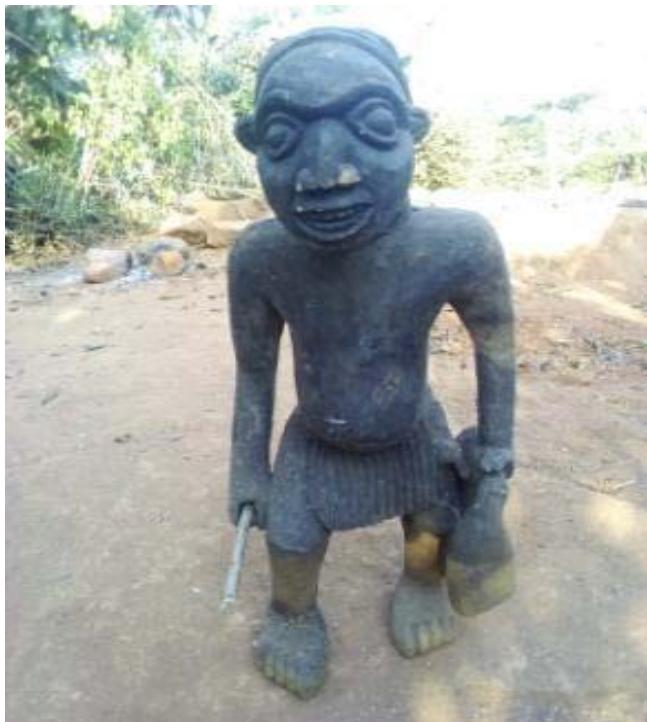
Within the workshop, a collection of these intricately carved objects showcased significant messages that provided valuable insights into the historical trajectory of the fondom. Thus, extensive discussions were held with Vubangsi, focusing on the profound significance of these carved objects and their role in illuminating the significance of indigenous museums within the fondom. One particular area of interest for the researchers was the collection of carved human statuettes (known as "fənfusə" in ga-ah Kedjom) displayed in Vubangsi's workshop. Vubangsi provided an explanation, stating that these statuettes were traditionally positioned alongside and behind the Fon's throne in the palace. The statuettes, adorned with scabbards, held mystical significance as they symbolically represented real human beings who served as guardians of the throne. It was believed that they were always prepared for battle, as depicted in plate 11. They symbolized the strength and support of a Kingdom's human resources upon whom the king sat metaphorically. Hence, some human figures represented the ancestors and gods.[^76] Woodcarvers in Kedjom had a notable propensity for creating numerous human images, a practice that occasionally revealed the fondom's prehistoric origins. Similar to other cultures, it becomes possible to gain insights into the lives of ordinary people in historical eras through the artifacts of their everyday life, which have been passed down through generations as enduring legacies of civilization.[^77]
 11a
 Source: Fieldwork (2023). 11b
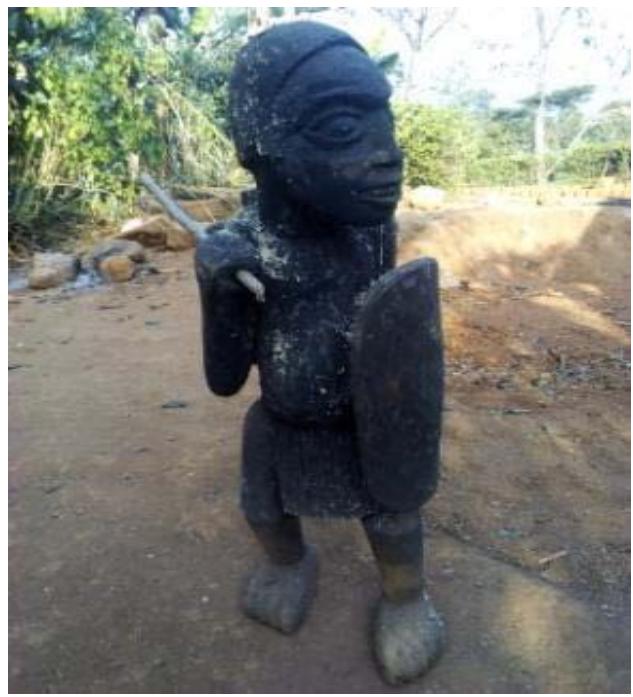 Plate 11 a-b: Carved Human Statutes. 11c
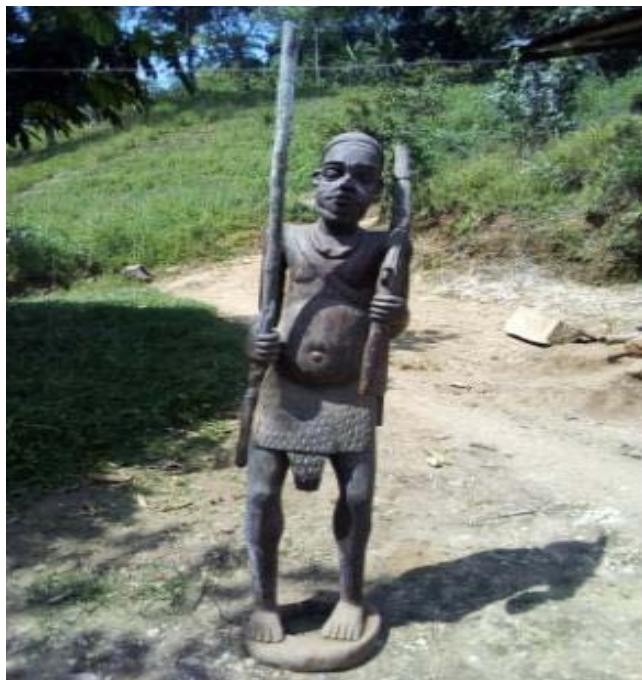 Source: Fieldwork (2023). 11d Plate 11 c-d: Carved Human Statutes.
In this light, Plate 11 visually portrays a woodencarved human statue that serves as a testament to the political, economic, socio-cultural, and religious aspects of the Kedjom people's lives. Moving on to Plate 11a-b, we encounter effigies featuring elephant tusks and gongs, which were used to gather the community in times of migration and inter-tribal wars. Additionally, Plate 11c showcases the utilization of war shields for protection and safety, while Plate 11d displays the introduction of firearms as a foreign influence, employed for protection, safety, and hunting purposes. These artifacts were discovered during the reigns of Fon
Kebeng (c.1770-c.1805), Fon Awonti (c.1865-c.1896), and Fon Pfuanchu (c.1881-c.1919) respectively.[^78] Similarly, carved thrones featuring human figures symbolized the presence of slaves who held integral roles within the Fon's power structure and court. The significance attributed to these figures lies in the fact that the Fon's attendants would carry him on their heads wherever he went, even in death. This practice should be interpreted in light of the historical laws and customs, wherein a Fon would be interred with a group of slaves who served as attendants in the realm of the afterlife. Younger and middle-aged individuals explain that the human figures represented the entire populace of the country, embodying the notion that "Country ide carry king an I de look out we fine" (meaning, the people support the Fon, and the Fon takes care of them).[^79] Therefore, objects displayed in artisanal workshops referred as indigenous museum revitalizes connections with the past, offers interpretations of the present, and provides previews into the future of a community.
### f) Traditional Institutions (Te-Nkəŋ Shrine)
According to Tum et al, like all Africans, Kedjoms are a deeply spiritual people. They believed in the existence of the Supreme Being called Mbom or Nyingong. He was believed to be invisible, omnipotent, omniscience and omnipresent. A large proportion of Kedjom Keku indigenes have converted to Christianity, and this religion has been assimilated into Kedjom Keku culture, and many Kedjom Keku Christians maintain traditional spiritual beliefs. The cultural practices contain elements of indigenous religion. Most of them strongly uphold their African traditional practices while claiming to be Christians. The new convert is poised between two worlds: the old traditions and customs of his culture which he is striving to uphold or leave behind, and the new beliefs, and practices to which he is still a stranger. They run to the traditional medical doctor in times of trouble, to the miracle worker for signs and wonders, and to the main stream church for serious funeral rites. They visit the traditional healers, the prophets from faith healing churches and western style hospitals and clinics for health and healing.[^80] In the traditional Kedjom Keku practices, religion and spirituality constitute key elements of the health and healing practices.
Like most Africans, the Kedjoms are syncretic Christians. Despite professing Christianity and participating in Christian rituals, they concurrently honour their dead ancestors and seek protection from them against misfortune and ill-health by participating in traditional rituals.[^81] In this light, ancestral reverence were given to these gods or deities placed on temples or shrines literally considered as the house of god surrounded with carved statue and even clothed and fed. Okoro confirms that shrines are dotted with several images of the deities that they dedicated to, which represents the union of the visible and the invisible world as living reality in their worldwide.[^82] Aniago agrees that a shrine is the common place of worship, belief, custom or way of doing something that existed for a long time among a particular group of people; a set of these belief and custom.[^83] In Bamenda Grassfields, the practiced of polytheism was common because they belief on their traditional religion before they embraced Christianity with Kedjom Keku not an exception. Oral tradition attests that around 1913 in the fondom, shrines were commonly found at the found of big trees, besides streams, rivers, waterfalls, forests and homes. According to Nwankwo and Agboeze secular point of view, shrines can be categorized into typologies according to their ownership and functions. These include family, community, religious, individual and villages, state and festival shrines.[^84] Therefore, in Kedjom Keku fondom some homes persistently had the te-nkəŋ shrine considered to be family shrine because they belief on their traditional religion (see plate 12).
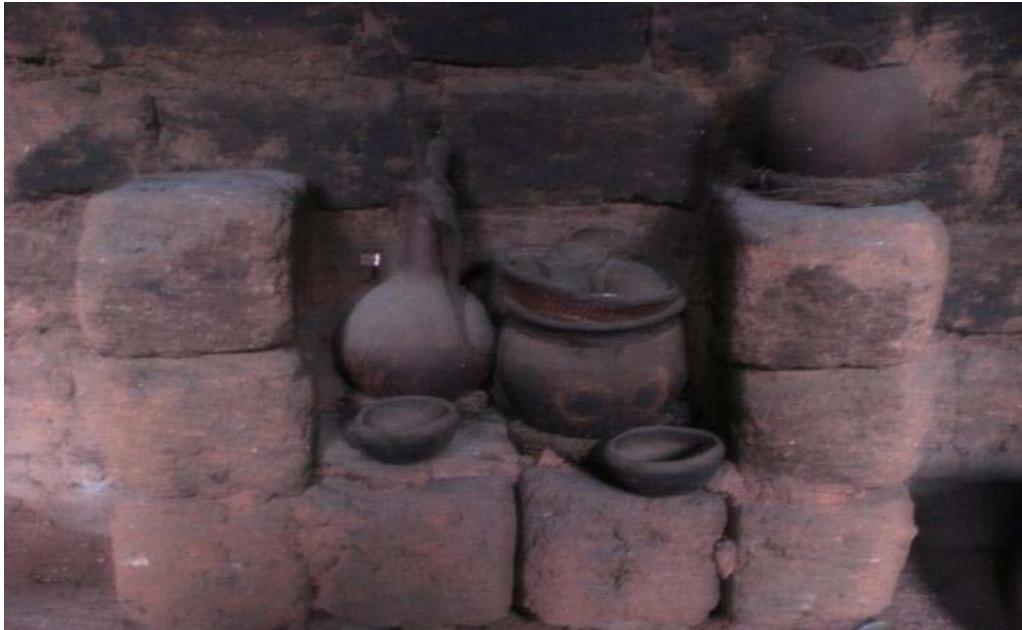 Source: Fieldwork (2023). Plate 12: Te-Nkən Shrine.
In every home in Kedjom society, te-nkəŋ shrine known as "altar" was built inside the kitchen with sundried bricks or raffia palm bamboos, attached to the wall of the kitchen. This shrine contained cultural artifacts such as calabashes, baskets and clay pots. The Kedjom people have asserted in their traditional and cultural beliefs that these artifacts represented Vunyingong (children of God) meaning the children of that family. This ritual was performed; if a child was born with umbilical cord wrapped round the neck considered as "single twin" or "weh nyingong", and when there was family problem and social illness within the family. Thus, shrines were places of consultation with esteemed extra-human forces to answer unanswered questions in order to calm fear and provide a way out to resolve problems.[^85] In the course of performing this rite, the head of the family called Njingga (successor) had a specific dressing style. He wore his cap, beads, held his drinking horn cup and creeping leaves called Lour were wrapped round his neck. Thus, all the children of the family sat inside the kitchen with each child having his or her own ritual names. Therefore, the objective was to wash out the misfortunes from the family. Some informants testify that the veneration of ancestors stood for cleansing and purification. This was not different from what Knöpfli's assertion that the motivation for the veneration of ancestors was threefold. In the first place, ancestors were venerated by the living in order to obtain help from them. The living invoked the ancestors' help and protection against diseases and death. Again, people beseeched them for timely sunshine and rain to ensure a good harvest and for good fortune. Lastly, ancestors were venerated in order to forestall a possible outbreak of anger. The ancestors' anger may be aroused if the living abandoned a set of traditional values.[^86] Again, Aniago supports that as long as the ancestral spirits are pleased with proper sacrifices, propitiation and ceremonial attention, they are believed to guarantee life and amicable relationships in the community.[^87]
In continuation with the rite, palm wine or local corn beer called sha was poured inside a calabash while a calabash filled with water was mixed with charms and stalks of the peace plants (nkeng). Here, the calabash filled with water was used to wash the hands, face and legs of each child as a sign of blessing. Equally, the calabash filled with palm wine or local corn beer was poured to the successor's drinking horn while libation was performed seeking their forefathers' protections. After this libation, every child drank from this cup indicating that rstente dih kedioh (unity is strength). An informant explained that when the last lineage of that family died, he or she was buried with the cultural artefacts found on the te-nkəŋ shrine.[^88] From this perspective, shrines functioned as channels for resolving conflicts, maintaining social order, and fostering moral growth. Today, majority of the Africans now see shrines as homes of demons, evil dwelling and archaic or those who still practice the traditional religion as pagan and heathens[^89] while Mbiti emphasis that to ignored these traditional beliefs, attitudes and practices can only lead to a lack of understanding African behavior and problems.[^90] Based on this premise, there is evidence indicating that the te-ŋkəŋ shrine was included as part of the indigenous museum within the fondom. Visitors had the opportunity to study the religious institutions in order to gain an understanding of the polytheistic nature of the society.
## V. CONCLUSION
The unsung open-air museum in Kedjom Keku Fondom is a storehouse with enormous cultural and historical agencies. These museums discussed in the paper serve as repositories treasure of the rich heritage and traditions of the local communities, offering valuable insights into their indigenous knowledge systems, artistic expressions, and religious practices. Also, the indigenous museums reflect as a testament preserving the cultural legacy of the Fondom. Therefore, visitors visiting this museum have an urge to study the vibrant traditions of the Grassfields people while gaining a deeper understanding of their customs, beliefs, and way of life. Though, these indigenous museums were valuable tangible materials but most indigenes have worn a colonial lens in appreciating them wrongly as result of infringement of modernity, Christianity and globalization. Consequently, the significance remains understudied and underappreciated by locals. It is essential to recognize and support the efforts made by these museums and the communities behind them to preserve and promote their cultural heritage.
Nevertheless, it is important to recognize that the Western model of museums may not be suitable for Kedjom Keku Fondom, as the local community may lack the resources and capacity to sustain such institutions. In light of this, it is recommended that traditional authorities and cultural practitioners take steps to decolonize the implementation of modern museums and their associated philosophies, which were introduced during the colonial period. This approach would ensure that indigenous museums are given the meaning and importance they deserve, both for present generations and posterity. Therefore, there is a growing interest and concern among individuals and organizations to preserve and appreciate the rich cultural heritage of the Kedjom Keku Fondom and the broader Bamenda
Grassfields region. By embracing a decolonized approach to museum practices, the indigenous museums can be sustained and valued in a manner that aligns with the cultural values and aspirations of the local community. This approach will help safeguard the unique traditions, knowledge systems, and artistic expressions that define the cultural identity of the Kedjom Keku Fondom and contribute to the broader cultural landscape of the Bamenda Grassfields.
[^3]: J. Bowechop and P.P. Erikson, "Forging Indigenous Methodologies on Cope Flattery: The Makah Museum as Center of Collaborative Research," America Indian Quarterly 291(1/2), 2005, 264. _(p.1)_
[^4]: (4), Serial No. 17, October, 2010, 532. _(p.3)_
[^7]: Interview with Ewang Grace, Former Regional Delegate of Arts and Culture, South West Region, 8 th April 2023. _(p.2)_
[^11]: Orhioghene Benedict Akpomuvie, "Museums and Development in Africa," An International Multi-Disciplinary Journal, Vol. _(p.3)_
[^12]: $^{12}$ Interview with Ewang Grace, Former Regional Delegate of Arts and Culture, South West Region, $8^{\text{th}}$ April 2023. _(p.3)_
[^13]: Richard T. Talla, Mark B. Funteh and Louis A. Wihbongale, "Utilitarian and Ritualistic Significances of the Calabash in the Kedjom Chiefdoms (Babanki) of the Bamenda Grassfields of Cameroon," International Journal of Arts and Literature, Volume 1, Issue 1, November, 2020, 16. _(p.3)_
[^17]: Ibid. _(p.3)_
[^18]: Raymond N. Asombang, "Museums and African Identity: The Museum in Cameroon - A Critique," In Cultural Resource Management: An African Dimension ed. Bassey W. Andah (Ibadan: Wisdom Publishers Limited, 1990), 189. _(p.3)_
[^19]: $^{19}$ https://wwwjstor.org-Conventional Museum and the Quest for Relevance in Africa. Accessed on 16 th September 2022 _(p.3)_
[^20]: Orhioghene Benedict Akpomuvie, "Museums and Development in Africa," An International Multi-Disciplinary Journal, Vol. _(p.4)_
[^21]: $^{21}$ https://en.m.wikipedia.org, International Museum Day. Accessed on the 21st April, 2023 _(p.4)_
[^22]: Interview with Kimah Debora Abato, Regional Chief of Service for Arts, Performance, Cultural Enterprises and creative Industries in the Regional Delegation of Arts and Culture, North West Region, $13^{\text{th}}$ June 2023. _(p.4)_
[^23]: P. Curtin et al., African History (London: Longman Group Limited, 1978), 464. _(p.4)_
[^24]: http://palaisderoisbamoun.com-History about Foumban Kingdom and Museum. Accessed on the 20 th August 2022. _(p.4)_
[^25]: He was the $16^{\text{th}}$ Ruler of Nchare Yen Dynasty _(p.4)_
[^26]: Geary C. M, Things of the Palace (Weesbaden: Franz Steiner Verlag, 1983), 61. Also, V. G. Fanso Former Director of the Department of Cultural Heritage, Ministry of Culture in the Republic of Cameroon, 1999 maintains that the museum was created in 1920. _(p.4)_
Generating HTML Viewer...
References
72 Cites in Article
Evaristus Abam,Nyong (2019). Examining the Role Played by Museums in the Development of Cultural Tourism in Cameroon - A Case Study of the Babungo Meseum of the North West Region.
Kimah Abato,Debora (2023). Regional Chief of Service for Arts, Performance, Cultural Enterprises and creative Industries in the Regional Delegation of Arts and Culture.
Akumbom Abong,Irad (2023). Student. Fuphense Quarter in Kedjom Keku.
Lorna Abungu (2005). Museum and Communities in Africa: Facing the new Challenges.
Che Afumbi,James (2023). Chief of Archive and Records Management.
Mathem Aithnard,Kokou (1976). Museums and Socioeconomic Development in Africa.
Orhioghene Akpomuvic,Benedict (2010). Museums and Development in Africa.
Bassey Andah (1990). The Museum and Related Institutions and Cultural Resources Management.
Magnus Aniago (2015). Deities and Shrine in African Traditional Religion: The "Spark" in Igboland.
Raymond Asombang (1990). Museums and African Identity: The Museum in Cameroon -A Critique.
Nkiene Baneh,Meli-Ellen (2020). The Bamenda Regional Museum, 1972-2018.
J Bowechop,P Erikson (2005). Forging Indigenous Methodologies on Cope Flattery: The Makah Museum as Center of Collaborative Research.
Ngeajung Chumbom,Frankline,Kingmaker (2023). Futang Quarter in Kedjom Keku.
Philip Curtin,Feierman Thompson,Leonard (1978). African History.
Umberto Eco (1976). A Theory of Semiotics.
Grace Ewang (2023). Former Regional Delegate of Arts and Culture.
Elizabeth Ezenweke,Chikaodili Nwachukwu (2017). The Instrumentality of African Shrines and Sacred Places to Sustainable Development in Africa: A Phenomenological Approach.
Gediminas Petrauskas,Lijana Muradian,Augustina Kurilienė (1920). Archaeology of Modern Conflict and Heritage Legislation in Lithuania during Thirty Years of Restored Independence.
Fon Vutsiboung,Vubangsi Benjamin In,Kedjom Keku (2023). Unknown Title.
Mathias Fubah,Alubafi (2016). Modern Museums in the Palaces of the Western Grassfields, Cameroon.
Aluyendoh Gemoh,Julius (2023). Successor of Pa. Gemoh N. Vustile in Germany.
Sheavuboh Gemoh,Georgette (2023). Daughter of Pa. Gemoh N. Vustile in Germany.
Wusigah Gemoh,Magdalene (2022). Daughter of Pa. Gemoh N. Vustile in Germany.
Richard Hull (1980). Modern Africa Change and Continuity.
Benedict Igene,Ogbole (1990). The Use of Photography for Information Reinforcement.
Erica Jones,Perlmutter (2014). The Multiple of Objects: Museum, Memory and Modernity in the Cameroon Grassfields.
Erica Jones,Pertmutter (2016). A Lending Museum: The Movement of Objects and the Impact of the Museum Space in the Grassfields (Cameroon).
Evelyn Kabisumo (2023). Farmer/Twin Mother. Fuphense Quarter in Kedjom Keku.
George Kemah,Maison (2023). Futang Quarter in Kedjom Keku.
Christopher Kemie (2023). Clayton, Rear Adm. Christopher Hugh Trevor, (born 21 May 1951), Assistant Director Intelligence, NATO International Military Staff, 2004–07.
Hans Knöpfli (2002). Living in Style Crafts and Technologies: Some Traditional Craftsmen and Women of the Western Grasslands of Cameroon part 4: Handicrafts, Music and the Fabric of Social Life.
Hans Knöpfli (1997). Sculpture and Symbolism Crafts and Technologies: Some Traditional Crafts men of the Western Grasslands of Cameroon part 2: wood carvers and Blacksmiths.
Cornelius Lambi,Martha Tumnde,Simo (2001). Cultural Significance of Works of Art in the Grassfields Region of Cameroon.
Julius Mbicho,Photographer (2023). Tokorh Quarter in Kedjom Keku.
John Mbiti (1969). African Religions and Philosophy.
Exodus Moffor,Tikere (2022). An Insight into the Cultural Significance of Indigenous Bowls in the Cameroon Grassfields Cosmology.
K Momin,A Okpoko,Ikechukwu Museums and People.
W Bassey,Andah (1990). Unknown Title.
Jeremiah Mundi,Toh (1990). Serving God My Way.
Ndimba (2023). Franey, David Francis, ( born 23 June 1965), Regional Employment Judge, North West Region, since 2020.
Victor Ngitir,Rene Bayena,Monteh Ngek (2021). The Survival of Community Museums in Cameroon.
Victor Ngitir,Bayena (2011). Bamenda Grassfields Art Collections and Museums:.
Victor Ngoh,Julius (1996). History of Cameroon Since 1800.
Peter Ngole (2023). Retired Pioneer Curator/Museum Attendant of the Buea Public Museum.
Joseph Ngong (2023). Former Chairman of Kwifon society.
Eric Njinuwo (2010). Communication the meaning of Objects in Community Museums in Anglophone Cameroon. Case Study: Mankon Community Museum.
Eric Njinuwo (2015). Community Museum and Meaning Making: A Survey of Community Museums in the Grassland Region of Anglophone Cameroon.
Solomom Njuh,Njuh (2023). Kingmaker/Farmer, Bamutoh Quarter in kedjom Keku.
E Nkwankwo,M Agboeze (2014). Community Development Approaches and preservation of Heritage Resources in Igboland.
Paul Nkwi,J Warnier (1982). Elements for a History of the Western Grassfields.
Paul Nkwi (1996). A Conservation Dilemma Over Africa Royal Art in Cameroon.
Che Nshom,Patrick (2023). Retired Red Cross Worker/ Custodian. Futang Quarter in Kedjom Keku.
Kingsley Nwannennaya (2020). Chapter 4: Religious Functionaries in African Traditional Religions.
Ngambouk Pemunta,Tabenyang,Tabi-Chama Communitarianism and the Obasinjom mask performance in ritual healing among the Bayang and Ejagham of Southwest Cameroon.
Johnson Smith,B Georgia (2013). Unknown Title.
Richard Talla,Funteh,B Mark,Louis Wihbongale (2020). Utilitarian and Ritualistic Significances of the Calabash in the Kedjom Chiefdoms (Babanki) of the Bamenda Grassfields of Cameroon.
Unesco (2023). Convention Concerning the Protection of the World Cultural and Natural Heritage Paris, 16 November 1972.
Maurice Toh (2023). Famer/Quarter Head. Futang Quarter in Kedjom Keku.
Gemoh Tsongwain,Christopher (2015). The Kedjom Culture Series One.
Eric Tum,Exodus Moffor,Louis Wihbongale (2023). Royalty and Ancestral Venerations: Commemorating /Teh Pfu Teh Vu’ntuh/ the Death of Palace Children of Kedjom Keku Fondom in the Cameroon Grassfields.
Eric Tum,Makiyighome (2021). Spiritual Debts as Idioms of Wellness and Distress: Tsuteh Nyu in the Conceptualization of Illness amongst the Kedjom Keku People.
(2023). The United Nations Declaration on the Rights of Indigenous Peoples.
Bumuh Viyu,Martin (2023). Martin, Rev. Hugh, (7 April 1890–1 July 1964), Retired.
Michael Vugah,Photographer (2023). Ndeloh Quarter in Kedjom Keku.
Patrick Vuku (2023). Chair of Village Council in Kedjom Keku.
Frankline Vuyof,Kingmaker (2023). Chubali Quarter in Kedjom Keku.
Chia Wihbongale,Vincent (2023). Maison/Quarter Head in Muyuka.
Louis Wihbongale,Aghogah,Abonge Nkongwibuen,Laura (2023). Toristic Attractions in the Bamenda Grassfields: The Kedjom Keku Natural Landscapes.
Linda Ankiambom (2022). THE ORIGIN, EVOLUTION AND CHANGING PERSPECTIVES OF WIDOWHOOD IN THE BAMENDA GRASSFIELDS OF CAMEROON SINCE THE PRECOLONIAL PERIOD.
Louis Wihbongale,Aghogah (2015). The production and Symbolism of Kedjom Keku Works of Arts, 1961-2014.
Ian Woodword (2007). Understanding Material Culture.
Explore published articles in an immersive Augmented Reality environment. Our platform converts research papers into interactive 3D books, allowing readers to view and interact with content using AR and VR compatible devices.
Your published article is automatically converted into a realistic 3D book. Flip through pages and read research papers in a more engaging and interactive format.
Our website is actively being updated, and changes may occur frequently. Please clear your browser cache if needed. For feedback or error reporting, please email [email protected]
Thank you for connecting with us. We will respond to you shortly.