
I. INTRODUCTION
Prodigies such as Francis Galton (1822-1911) had taught himself to read by the age of two and a half. Enid Blyton (1931), a former primary teacher found such 'natural readers' amongst ordinary learners. Much later Marie Clay (1973) showed that children's first impulse was to write not read and Carol Chomsky (1971) found that when children were asked to read on entry to school they said they could not because they had not yet been taught to. However when asked to write they settled down straight away to make 'marks on paper'. Clay (1986) later found that what children could write freeform they could also read.
Natural readers or self-teachers are those children in preschool who have somehow learned some basic skills enabling them to read simple storybooks because they have some phonological (knowledge of sounds in words) awareness and linked this to letter sounds. Although this knowledge will be incomplete on entry to school these features were found to be the best predictors of later reading achievement (Liberman, 1973; Bryant et al., 1985; Snowling, 2000 and many others since).
Phonological awareness is the ability to segment words into their separate phonemes, recognition of rhymes and alliteration, blending of phonemes and recognition of puns. Word awareness is the ability to recognise a word is part of speech and the ability to segment a sentence and phrases into words (Tunmer et al., 1985 p.295).
The theory of self-teaching of reading development was proposed by David Share (1995). His idea was, that once learners had established their knowledge of sound and symbol correspondences, successful identification (decoding) of new words in the course of the children's independent reading of text enabled them to recode them back into the spoken language form. However his studies overlooked the fact that self-teaching had been observed in preschoolers or early in the Reception year and somehow the students had already taught themselves some sound-symbol correspondences.
The assumption of many teachers appeared to be that most children would be able to write a little amount independently towards the end of the Reception year not before. In England children enter formal school in the year they become 5 years old so that there will be a range of ages usually from 4.9 to 5.5 years in classes from 20 to 25 in number. Several of teachers on in-service training courses were encouraged to ask their Reception class 5 year-old children to write their news or story freeform after 2 or 3 weeks in the class when they had settled in. The teachers were convinced that none of their children would be able to do this as they had not yet taught them to do so. However it was a surprise to them that several of the children were able to write readable messages even when they were from disadvantaged backgrounds and had had no preschool tuition. The teachers in this era were using the 'Look and Say' methods of teaching reading and no phonics at all until a vocabulary of at least 50 words was known, if then.
Some clues were available from the study of dyslexics' difficulty in acquiring phonological awareness but exploratory case studies showed that it could be overcome. This was if a particular long known strategy used by dyslexia pioneers in the US was used. In a pilot study school in a disadvantaged area of North West London its effect was tested and increased school results in the national literacy SATs by (Montgomery, 1997a). The question was, could the strategy have the same effect in the Phonics First era of the century or was it now unnecessary?
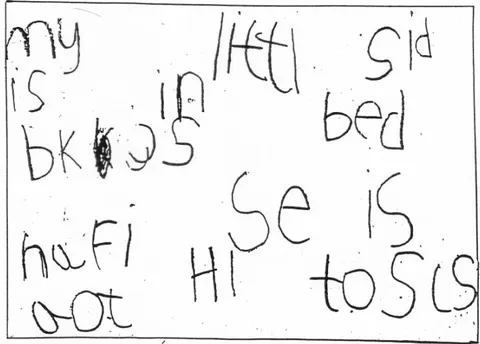
of consonants with occasional vowels and word bits patched in, later termed orthographic mapping by Ehri (2006). Later some phonetic skeletons appeared then words. Figures 1a to 1c below show illustrations of self-teaching scripts in the pilot data collection in that era (Montgomery, 1997a). Kelly and Faye are a little more advanced than William.
II. THE BEGINNINGS OF SELF-TEACHING
What was noticeable in the scripts of the self-teaching infants was that their stories were mainly built
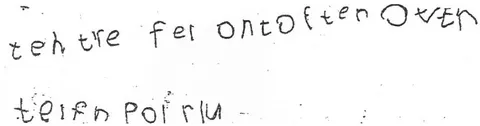
William has phonological awareness, he is beginning to segment words into separate phonemes, he has some symbol-sound knowledge, uses initial consonants and some blends and is beginning to be word aware.
Faye has phonological awareness and word awareness.
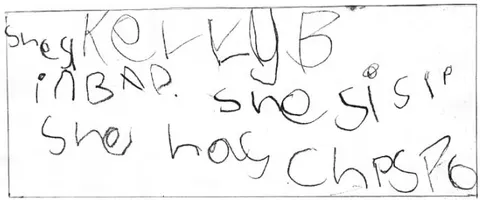
Kelly also has phonological and word awareness.
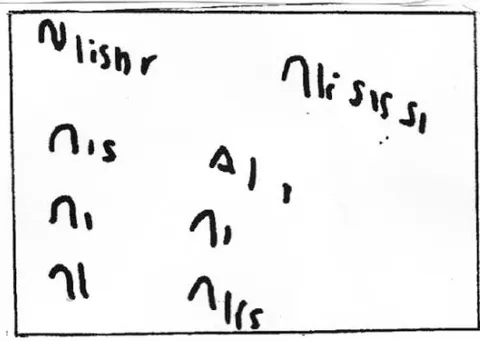
Figure 2 below for comparison shows a dyslexic boy's script in the same Look and Say era and he was already receiving individual reading support in Year 1.
We think he writes: 'I went to nanny's'.
Steven uses some letters from his name but does not have phonological awareness. He makes a representation of the lines of word forms he sees in his reading books.
Case study Michael also aged 6.5 years was privately referred for his dyslexia and had an IQ of 147 on WISC-R but he had:
- Failed to learn to read or write.
- Did not know any of the sounds or names of the letters.
- He could read some familiar common words and appeared to know most of his reading books off by heart.
- The school had given him extra phonics and some one-on-one tuition in phonological skills.
Because his parents were informed about dyslexia and affluent they had him tested privately and this enabled him to be more rapidly referred to a specialist tuition centre. It seems incomprehensible with his high ability that he had not learnt a few sounds to use in reading and writing by normal teaching methods.
Michael was unable to play the I-Spy game with any success e.g. "I spy something beginning with 'd'." (door). He had no phonological awareness despite his high ability.
The question such examples pose is, how is it possible for two children of average ability such as Faye and Steven to perform so differently? How did Faye gain this knowledge and go on to build her own reading and writing skills? How did she 'crack the alphabetic code'? The requirements of the early acquisition task are to learn a few sounds and their symbols to support the reading task seems to be beyond Steven. In relation to Faye and William age difference did not seem to play a part.
The questions for this research were, how did some students develop phonological and word awareness then connect this with symbol knowledge without being taught? Why others do not or come to the knowledge very slowly even with explicit teaching? If they were all taught the special strategy would this raise the SATs levels in their schools?
III. SOME CLUES TO SELF-TEACHING
How some children learned to write unaided and dyslexics could not, became clearer when the history of the medium, the alphabet, was investigated. According to Gelb (1963) the alphabet unlike other writing systems appears to have been invented only once. This was by the Phoenicians in about 700 BCE. Theirs was a consonantal Semitic language and it had 22 consonants. Roughly speaking so does the English alphabet at 21, eureka! Consonants each have different patterns of articulation and key contacts with lips, tongue and teeth whereas vowels only have open mouth and place cues, no contacts. The appearance of consonants in free writing is the first indicator that students have begun to make progress with reading. They will write 'b' to stand for 'bed' or 'wt' for 'went'. Similar results were found by Heald-Taylot (1984) when analysing children's scribble writing and in Gentry's studies (1981) discussed later also found consonants appeared first especially in the initial positions.
It was suddenly evident that a dyslexic could not have invented an alphabetic system and thus might have an articulation awareness problem. After a series of pilot studies to design a test to identify such a problem in the absence of any overt speech difficulties the hypothesis was put to the test and the results are shown in Table 1 below.
| Nos. | Reading Age | Spelling Age | PS (15) | Artic Aw (10) | IQ | Chron. Age | |
| Controls | 84 | 8.61 | 8.02 | 11.94 | 7.75 | 110.03 | 7.94 |
| Dyslexi | 114 | 7.95 | 7.62 | 10.27 | 4.31 | 110.43 | 12.90 |
| Dyslexic Waiting list | 30 | 6.71 | 6.00 | 4.13 | 5.87 | 112.67 | 8.97 |
Key: PS Phoneme Segmentation (sing minus 's' gives 'ing' etc.) a 15 items test of graded difficulty. AA sound-symbol Articulation Awareness Test of 10 items
TRTS - Teaching Reading Through Spelling programme (Cowdery et al, 1983-87; Reprint 1994) an English variant of the original US Gillingham and Stillman (1956) program.
The AA test involved asking the dyslexics and controls to make the sound of an alphabetic letter and describe how and where the tongue, lips and teeth might be shaped or touching. The subjects could not see the experimenter's face. It was strange to observe individuals who had no idea where the tip of their tongue was touching when making e.g. the sound 'I', or if the mouth was open or shut.
Table 1 above shows that dyslexics do appear to have an AA problem in comparison with controls when both IQ and reading matched dyslexic groups were compared with them.
In the TRTS programme the first 5 initial sounds i l t p n s were taught by a procedure originally termed 'multisensory mouth training' (Montgomery, 1984). Figure 3 below shows the effect upon Steven after -minute sessions on these sounds.
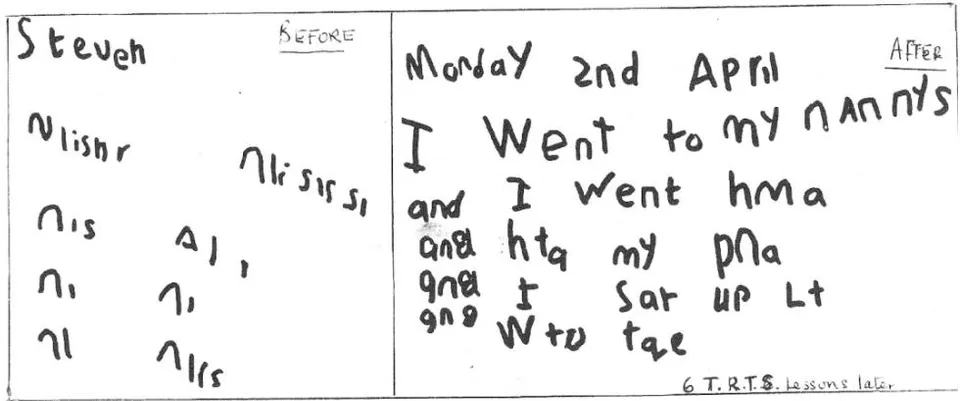
He writes Monday 2nd April: 'I went to my nanny's and I went home and had my dinner and I sat up late and watched TV'
He now has some phonological and word awareness and can patch in segments from his reading from storybooks and copywriting of 'news'.
Once the alphabetic code is broken the dyslexic spelling appears to follow the same pattern as that of normal subjects (Montgomery, 2007). Dyslexics fail to acquire alphabetic and phonic knowledge are the reasons why they are said to have a verbal processing deficit in the phonological area (Vellutino, 1979; Frederickson et al., 1997). It is the main theory of the cause of dyslexia even today. But it could perhaps be a result of a sound-symbol AA deficit or delay rather than the cause.
It would appear that self-teachers such as Faye, William, and Kelly were making the connection between the symbol, the sound and the feel of key letters even in the Look and Say era. It meant that when they wrote their news freeform the consonantal structure of words appeared first and from their reading and copywriting they patched in bits of familiar words.
Invented spelling was a significant area of investigation with kindergartners (Ferreiro, et al..1982; Read, 1986; Richgels, 1995). The results were termed children's 'creative spellings'. Creative spelling refers to the practice of having children invent their own spellings in their writing, using what they know about letters and sounds. In the early stages teachers were advised not correct them because the spelling allowed children to focus on developing their knowledge. This was how the development in both phoneme awareness and letter-sound knowledge were found to occur by Stahl et al, (1998). Studies also showed that invented spelling greatly improved phonemic awareness, phonics knowledge and other word recognition skills (Gentry, 1981; Read, 1986; Montgomery, 1997a). More recent support for this was found by Ouellette et al., (2008). They showed that orthographic learning also took place incidentally during spelling when words to be learnt were presented visually. Conrad (2019) with 20 Canadian children in Grade 2 showed that orthographic learning could occur during independent spelling even when children generated their own spellings for pseudowords.
IV. STAGES IN NORMAL LITERACY DEVELOPMENT
Gentry (1981) identified the steps that occurred in children's writing as follows:
- Pre-communicative Step: In which the children made scribbles and marks to represent their messages or as they told a story (Figure 4a below)
- Pre-phonetic: This was the creative or invented spelling stage where a single letter might represent Pre-communicative
a word or a group of letters e.g. 'w' or 'wt' for 'went' but it might not be the correct letter. (Figure 4b below)
- Phonetic Transcriptions: Pupils began to patch in some correct visually recalled segments and some whole common words into consonantal structures and sentences.(Figure 4c below)
- Traditional Orthography: In this final stage they arrived at more or less correct spellings or traditional orthography. (Figure 4d below).
Illustrations of Gentry's steps
The following examples were collected in the present research in the 'phonics first' era and illustrate the main steps. They gradually merge into one another as development proceeds.
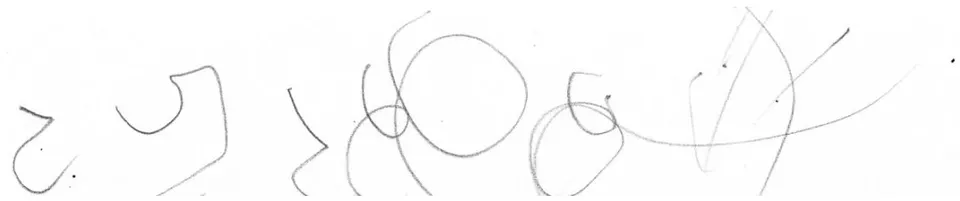
She is writing from right to left. And has no phonological awareness
Pre-phonetic
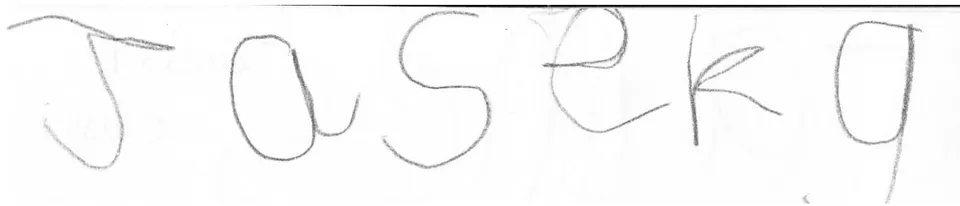
Jason is on the verge of phonological awareness but has not yet connected symbols to sounds or become word aware.
Early Phonetic
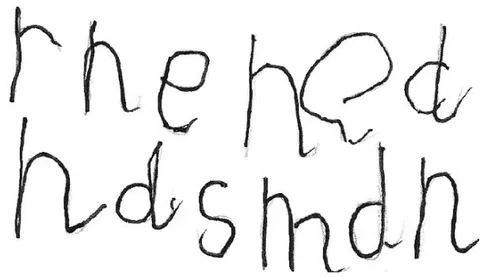
He has broken the alphabetic code and become phonologically aware, and is not yet quite word aware. Traditional orthography
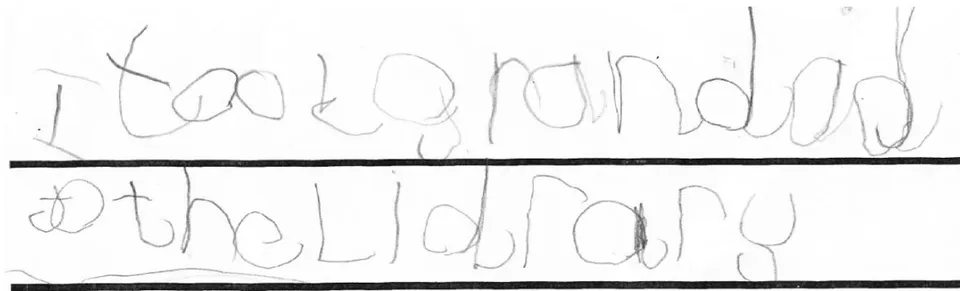
Richard's script is very faint and with other cues indicates a mild handwriting coordination difficulty (See appendix 1). He is both phonologically and word aware.
Later, Ehri (2006) also identified 4 stages in the development of learning to read and spell in normal readers as follows: Pre-alphabetic stage; Partial alphabetic stage; Full alphabetic stage; Consolidated alphabetic stage.
V. THE WRITING WINDOW AND MAPT
In literacy and dyslexia research the main emphasis has been upon reading and reading skills. For example in special needs guidance the English Department for Education document (DES, 1997 p.15) states 'dyslexia or reading problems'. This presents difficulties because dyslexia is both a reading AND a spelling problem and it is the spelling that is less responsive to remediation. It can last into adulthood (Gillingham et al., 1956; Naidoo, 1972; Frith, 1985; Montgomery, 1997a; Hornsby, 2001) and many more since).
Reading is a recognition skill because all the words are already present on the page. The processes involved can only be inferred so that many interpretations are possible and new terms are invented to describe them. The ability to spell is a recall skill and much harder to do. It is usually only observable when we write something but early in Reception freeform writing is not generally required. This appears to be an important omission. This is because research by James et al.. (2012) uncovered an important contribution that handwriting makes to reading. Her preliterate five-year old children printed, typed, or traced letters and shapes, then were shown images of these stimuli while undergoing fMRI scanning. A previously documented 'reading circuit' was recruited during letter perception only after handwriting not after typing or tracing experiences. She found that this initial duplication process mattered a great deal. When children had drawn a letter freehand, they exhibited increased activity in three areas of the brain that are activated in adults when they read and write. By contrast children who typed or traced the letter or shape showed no such effects. It indicated that freeform writing must be a specific component in reading teaching in the acquisition phase in Reception.
Berninger's (2012) analysis was that handwriting differed from typing because it required executing sequential strokes to form a letter, keyboarding involves selecting a whole letter by touching a key. Brain scans illustrated that only sequential finger movements activated massive regions involved in thinking, language and working memory. This is the system for temporarily storing and managing information and makes teaching methods for handwriting much more significant than tracing and copying.
Another advantage of asking children to write freeform is because Rosencrans (1998, p. 9) found that,
'The errors children made when they wrote were neither random nor thoughtless, if examined diagnostically they revealed the systematic application of the child's level of understanding'.
Bearing these findings in mind the following diagnostic investigation of freeform writing was undertaken, this time in the era of the current 'phonics first' (Rose, 2006) regime.
It is important to note at this point that the educational climate had radically changed. It was no longer relaxed and informal. Teachers in England now reported being bombarded by documents from the Department for Education to order educational changes such as 'phonics first'. They must follow each of the hundreds of annual DfE directives on teaching content, and method, write and continually update school policies. School inspections by Ofsted (Office for Standards in Education) could fail them if they did not follow the guidance and they would lose place in the League Tables or could even be closed down. Students were being tested too much and although this was scaled back it was never sufficient. Access to schools now proved more difficult and there were data protection policies in place and children and staff behind locked gates. Research grants could only be obtained if the researcher was part of an approved research conglomerate so the research to be reported had no grant and no official status and had to rely on goodwill and the interest of teachers in the topic. Questioning the current orthodoxy and guidance was not popular especially at the DfE.
VI. AN INVESTIGATION OF SELF-TEACHING
The best predictors of later reading achievement are phonological awareness, alphabetic knowledge and letter sound knowledge (Liberman, 1973; Bryant et al., 1985; Snowling, 2000; Hietland et al., 2017). These are all easily revealed in freeform writing as already shown in Figures 1 to 4 above.
In the present research articulatory knowledge would be built into the teaching of five initial sounds to prime the children's awareness. The majority of schools already begin with 's a t p i n' (Cochrane et al., 2022). The results would be shared in the reports on each child's work and sent to their teachers, the technique was MAPT - Multisensory Articulatory Phonogram Training. An example of this can be found in Appendix Two. Many teachers would already be using some multisensory training by associating a sound with making its symbol in multisensory training but this omits the key component the articulatory dimension, the feel of the letter sounds.
In this hostile environment details of registers of full names and ages were not made available nor was access allowed to meet and observe any teacher working. By comparison in the previous Look and Say era 1250 full lessons had been observed in a project on appraisal of teaching (Montgomery, 2002). In this new project the strategy was to list the first names from the scripts and assign the age of 5.1 on entry to the study and 5.7 on exit. In England children start formal schooling in the September of the year in which they become 5 years old so the age range would be from 4.9 to 5.5 years. Actual age in months did not appear to be the most important variable in the pilot studies instead social background and preschool experience seemed to play a more important role.
The background data from annual national school inspections by the English Office for Standards in Education (Ofsted) for 11/12 year-old students in Year 6 and about to enter secondary schools showed that boys perform less well than girls in both reading and especially in writing. Students in disadvantaged areas also performed poorly and those in the north of England and the Midlands less well than in the South east of the country. In terms of ethnicity poor white boys were in the lowest performing group. Subsequently coastal area schools (Ofsted 2011) were also found to be performing very poorly.
Sutton Trust research by Jerrim (2013) showed that by the end of the first year of formal schooling (the Reception year) children from disadvantaged areas were 11.5 months behind advantaged peers in reading and never did catch up. This was an important issue to be addressed and the freeform writing project might help give some answers and some improvement for the disadvantaged learners.
The children's difficulties appeared to the researcher to be caused in large measure by the literacy teaching methods promoted in the Colleges and the Governmental documents defining them (Montgomery, 2023). This was based on the 1250 lessons previously observed (Montgomery, 2002) and the feedback from the 3 distance learning MA programmes (1993-2010) written and tutored by the researcher (MA SEN, MA SpLD, MA Gifted Education) at Middlesex University, London.. Adding to this data were the results of a handwriting investigation project with 60 cases from the Potential Plus UK (formerly the NAGC) 2016-2018 and random cases since through the LDRP website.
To try to improve the situation the P.E.A.R.L Project (Promoting and Enhancing Achievement in Reception Learners) was devised and presented at conferences and Continuing Professional Development courses on literacy, underachievement and dyslexia. The delegates seemed very interested and carried off dozens of the glossy Project folders with the details of data they needed to collect and share and the teaching methods to use. There were few returns and so a new tactic was developed.
a) Method
It was determined to try to trace the origins of underachievement in reading and writing and intervene. Secondary school C, in a small coastal town had taken part in a 20-minute essay writing survey with new entrants to the school's year 7 (Montgomery, 2008). This project was to find the effects of the implementation of the National Literacy Strategy-NLS (DfEE, 1998) for primary schools and particularly for students in the Reception Year.
Now, 15 primary schools in School C's area (feeder schools) that sent most of their students to School C were invited to join a slimmed down version of the P.E.A.R.L. Project. The promise was that it would cost nothing in terms of teacher time or money.
Of the 15, two schools refused and three opted to join the study, the rest did not reply. The sample was thus a volunteer one. At a regional conference on overcoming underachievement (UAch) the revised project was described and more schools were invited to join. One literacy coordinator from a private school in the Midlands agreed to participate. In all there were 8 teachers and 175 students now in the study.
The communications were initially by letter to the head teacher and the deputy head setting out the purpose, and a description of the 2 tasks in September and a repeat of 1 task in the following March. There was a confidentiality contract. The promise was that the tasks would be part of the everyday teaching routine and would take no extra time and involve no extra costs. Each teacher would receive a written report on the skills level of each of their students in November and May with suggestions for intervention and the school would be sent summary reports of the overall project at each stage.
The instructions for the teachers were:
Before the end of the first month in Reception each child (N=175) to be asked to copy write their 'news' or a story. This is a standard task in most classrooms.
A few days later to ask the children to write a story or their news freeform (no help must be given).
At the end of 6 months (March) the children were to be asked again to write their news or a story freeform.
By these means the entry-level or baseline skills for handwriting (1) and spelling (2) could be recorded and then again after 6 months to see what progress had been made.
In addition each teacher was sent a Spelling Development Handbook of 100 mini lessons.
(Montgomery, 1997b) originally designed for the NW London pilot project school. The mini-lessons covered MAPT with i t p n s, synthetic phonics and problem solving approaches to spelling (see example in Appendix 2).
Each school was also offered a free in-service workshop on the project and the methods. None accepted.
The written instructions for the 8 teachers explained that for the copy writing they should just follow the procedure the school normally used. For the free writing task students should only offered encouragement to make some suitable marks on paper and write their names if possible. The actual 'message' should then be asked of the child and the Teaching Assistant (TA) or teacher was asked to write it down on the named paper for the researcher.
Copy writing of news in most English Reception classrooms is as follows. The child tells the teacher or TA what their news is (the message). The adult then writes it down in a form s/he thinks is suitable for the child to copy. (From this data a number of teaching strategies can be detected e.g. lines of no lines, letter formation methods.
In Figure 5 below Sahana is from an advantaged background. This is written in her first few weeks in the private school.
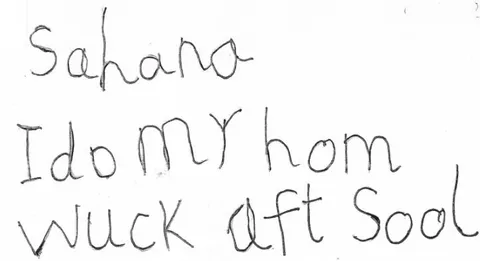
She had already developed phonological and word awareness and some sound and symbol knowledge. From the content it is likely that she has had some reading experiences in preschool at home and possibly attended a nursery or playgroup.
b) Development of the spelling and handwriting assessment scales
Because there were no baseline assessment scales for spelling and handwriting for school beginners they had to be invented for the study. This procedure was:
One large class's set of scripts (N=25) was ranked in piles of increasing spelling skill and descriptors were assigned. The process was then repeated with all the scripts including those of the original class and an assessment scale was drawn up. A similar procedure was adopted for the copywriting scripts to examine handwriting motor skills coordination. A rank of 5 was found to be the critical borderline at which the freeform scripts showed that the child had recognised and used some sounds and their symbols, these were termed 'phones'. The appearance of phones indicated that the pupil had 'cracked the alphabetic code' and was on the way to becoming literate. This was best seen in their attempts to make words using initial sounds and 'skeletal phonics' such as 'wt' for 'went', 'ws' for 'was' 'goig' for 'going' and 'se' for 'she' etc..'. Phonetics would be represented by e.g. 'kwiz' for 'quiz', 'buk' for 'book' 'apl' 'nite', 'marster', 'berd', 'butiful.
(Inter-observer reliability coefficient for this spelling scale was +0.93).
The spelling assessment scale demonstrated what children can achieve if given the opportunity to show it:
Ranks for free-form spelling used in the analysis of freeform scripts:
Mainly correct spelling, legible, systematic word spaces.
More correct spelling, skeletal phonics, meaning clear.
Some correct words, phonics, phonetics, meaning clear
Skeletal phonics, phonetics, some words, meaning apparent
Pre-phonetics, phones, phonetic skeletons, some meaning.
Word forms, letters, phone(s) evident (The critical achievement)
Letters, possible phones
Some letter shapes and letters, in a line
Marks, mandalas roundels, occasional letters, possibly in lines
Scribble, marks in some order
Random marks c) The Year 2 follow-up study
Although two thirds of the students had progressed in literacy skills by the second freeform writing test in March a measure was needed that would show some comparison with the expected national norms. These would become available at the end of
d) Results
Year 2 (8 year olds) in the national SATs. An analysis of research on the relationship between developing phonological awareness and reading skills (Christensen, 1995) found that previous researches showed very significant effects when undertaken by the researchers and much lower effects, about 10 to if any at all when teachers undertook them. Thus in the present study an improvement overall might be expected if any at all in the order of .
She also found at least one-year delay in all the studies between the intervention and the lifting of reading achievement was necessary. Allowing a pause of one year in the present study was therefore needed to allow for consolidation, more scrutiny of the reports by the different teachers in Year 1 and some potential self-teaching by the children. It seemed a fair test.
The three State schools in the study were invited once again to participate in the research. This time they were requested to ask all their students after two to three weeks in the Year 2 classes to write a story unaided and as fast as possible about a favourite topic for exactly 10 minutes. The topics might be a favourite holiday, pet, sport, or friend etc. They should guess at spellings they were unsure of and go on to a second topic if there was any time left over.
In addition, to encourage participation £25 would be paid into the School Fund for each set of class results (funded by the researcher). The schools are always in need of money!
As a result there were 93 matched scripts from the original study of 112. School B opted out of this task (new head teacher).
Disadvantage in the study was determined by the percentage of free school meals (FSM ref. now the Pupil Premium) compared to the national rate of . FSM x2 indicates they had twice the national average qualifying for the Pupil Premium.
| Schools | Boys | Girls | N | |
| A + B Social housing | 2.38 | 3.03 | 56 FSM x2.0 | |
| C | Owner occupier | 4.52 | 6.81 | 55 FSM x0.5 |
| D | Private school | 3.34 | 4.06 | 64 FSM zero |
| Spelling means | 3.51 | 4.41 | 175 | |
| Motor skills means | 4.21 | 5.67 | 175 | |
The scores in table 2 above show that poorer environments (low socio-economic status indicated by the numbers having FSMs) give rise to lower spelling and handwriting scores on entry to school. In reading we already know that they will be 11.5 months behind at the end of Reception year and remain so throughout education (Jerrim, 2013, 2021, Sutton Trust Research). Some will slip even further behind creating the UK's 'long tail of underachievement'. In table 2 above it shows that the same effect is likely to be found for writing because the poorer children start at a disadvantage. It is noticeable that girls in all 4 schools
significantly outperformed the boys in both spelling and handwriting just as they do at 11 years in the National SATs. Poorer children were less skilled on entry than richer ones. The 'Matthew effect' – to those that have shall be given (Stanovich, 1986).
e) Scoring 'first marks on paper' for the copy writing
- Letters all the same moderate size on a line
- With clear ascenders and descenders
- Spaces between words
- With appropriate capitals
- Bodies sit on the line, real or imaginary
- Letters formed in a single fluid movement
- Distinct letter shapes
- Drawn letters
- Mandelas and letter-like shapes in a line
- Some letter-type marks in a line across the paper
- Random scribble and faint marks
The same ranking procedure was used for copy writing motor skills as for the spelling scale. In the motor scale the points up to 5 were assigned in ascending order of skill. After this the next 5 points can be awarded in any order of appearance as etc. It was argued that handwriting skill appropriately encouraged and trained could improve the situation for all children enabling them to learn to write more easily and fluently. This would enhance reading and spelling development and lift later achievement (Montgomery, 2020). Unfortunately handwriting is currently given little attention in the education and training of teachers in England (Medwell et al. 2008; DfE 2021). A Handwriting Interest Group from the 1980s has evolved into the National Handwriting Association to try to provide help for children and their teachers, however they still follow the 'custom and practice' line of the DfE that needs to be questioned.
f) Spelling profile of the student group on entry to Reception
On entry of the original 175 children had 'cracked the alphabetic code, scored at least 5 points. Overall there were 25 girls and 23 boys in this group. The variation between the schools was significant and is shown in Table 3 below. There are lower scores for those from disadvantaged areas.
| Scored 8-10 | FSM | |||
| School A | 1 girl | 0 boys | 2.5 | |
| School B | 3 girls | 1 boy | 1.5 | |
| School C | 12 girls | 16 boys | 0.5 | (Included Richard Fig. 4d above) |
| School D | 9 girls | 6 boys | zero | (Included Sahana Fig. 5 above) |
| 25 | 23 | |||
Table 3 above shows that of the cohort was reading and writing well scoring 8-10 on entry to the schools. The ratio of girls to boys who had already started to read and write was 4 to 1 in the disadvantage areas and reflected the socioeconomic levels. School B was in a more mixed area than school A. School C was in an advantaged area and it looks likely that in preschool some reading teaching had also been undertaken especially for the boys. School D, the private school should be expected to have more readers and writers than schools A and B and possibly school C but literacy standards in the midlands and the north of England tend to be lower than in the south according to national inspection reports. The private school ID eft the project after F1.
| Class | Nos | Free Writing 1 | Free Writing 2 | Nos 'at risk |
| A1 | 18 | 2.33 | 7.12 | 3 + 2 |
| A2 | 18 | 2.44 | 4.30 | 11 |
| B 1 | 21 | 3.24 | 6.13 | 4 + 2 |
| C 1 | 28 | 6.11 | 6.76 | 0 |
| C 2 | 27 | 5.37 | 6.10 | 5 |
| Totals | 112 | 4.29 | 5.32 | 23 Borderline scores of 4 4 'dyslexics' with scores 2-3 |
National data suggest that roughly could be expected to become poor readers and dyslexic.
Here not were definitely at risk and indicates the feedback in the reports could be having some effect.
For ease of teacher diagnosis the spelling scale was later exemplified as 4 levels. The strategy is to identify the statement that most typifies the writing example and award that rank and then work to move the child on to the next level e.g. The 4 levels were:
- Random marks and scribbles
- Letter-like shapes and marks
- Some letter sounds 'phones' and word bits
- Decipherable 'stories'
g) The spelling profile of the cohort after 6 months (F2)
After 2 terms in Reception 37 out of had spelling scores between 8-10,
25 (22%) children had moved into the competent range scored 5-7.
35 (31%) of children in the 3 schools had not cracked the code after 6 months.
Of these, 23 boys and 12 girls were still not using 'phones', a ratio of 2 to 1.
16 pupils had both dyslexic and dysgraphic type difficulties ; 13 boys and 3 girls a ratio of roughly 4 to 1.
| Scores | 0-4 | 5-7 | 8-10 | N | 6 mos. later | ||
| School A1 | 15 | (6F 9M) | 2 (1F 1M) | 2 (2F 0M) | 18 | 8M 1F | |
| A2 | 12 | (5F 7M) | 1 (1F 0M) | 5 (5F 0M) | 18 | 8M 2F | |
| School B1 | 12 | (6F 6M) | 6 (3F 3M) | 2 (2F 0M) | 21 | 6M 0F | |
| 39 | (17F 20M) | 9(5F 4M) | 9 (9F 0M) | 57 | 20M 3F | ||
| School C1 | 13 | (5F 8M) | 9 (3F 6M) | 5 (4F 1M) | 26 | 5M 2F | |
| C2 | 14 | (4F 10M) | 9 (3F 6M) | 5 (5F 0M) | 28 | 4M 1F | |
| School D1 | 5 | (3F 2M) | 10 (6F 4M) | 6 (4F 2M) | 21 | ----- | |
| D2 | 4 | (1F 3M) | 12 (4F 8M) | 6 (4F 2M) | 22 | ||
| D3 | 7 | (2F 5M) | 9 (5F 4M) | 5 (5F 0M) | 21 | ||
| 43 | (31F 28M) | 49 (21F 28M) | 27 (22F 5M) | 811 | 9M 3F | ||
Table 5 above shows that on entry to school more boys (M) had generally more copy writing developmental difficulties than the girls (F) in each score level on the assessment scale in all the schools. After 6 months many of these difficulties especially among the girls had been resolved. This still left a number of students potentially with dysgraphic difficulties 20M to 3 F in the disadvantaged area schools as judged by the level of Free School meals. The ratio in the advantaged area school was 9M to 3F . This indicates that poorer children are born and brought up with more coordination difficulties than richer children. They are also slower to overcome them and this is seen in the data after 6 months especially with regard to the boys.(20 M and 9 M). The girls scores are the same (3F and 3F). The possible implication and origins of these differences will be discussed later.
In school A 14 boys and 3 girls showed coordination difficulties. In school B there were 6 boys and no girls. This made a ratio of 20 to 3 boys to girls, nearly 7 to 1 in the disadvantaged areas.
In school C there were 9 boys and 3 girls a ratio of 3 to 1, in an advantaged area.
In school D, the private school there were 11 boys and 6 girls this makes a ratio of roughly 2 to 1 (on entry only).
In total 35 out of 112 children in the State schools had dysgraphic symptoms or nearly a third of the cohort. The same number was found in their coastal town secondary school for the Year 7 group in a previous survey already noted.
The national average for handwriting difficulties was found by Barnett et al., (1997) to be . They used DASH-Developmental Assessment of Handwriting. It is an individually administered assessment that takes 45 minutes with each student from the ages of 7. It appears likely that their survey was based on data from more advantaged areas than the present one and it did not use the same coordination criteria.
In the present study there were more students with writing coordination difficulties in the State schools and particularly in the most disadvantaged areas. Higher levels of skill were found in the advantaged area and the private sector school.
Handwriting speed: Lyth (2004) using the MIDYIS (Middle Years Information System) additional test data on 10,000 pupils also found differences between the State and Private school sectors on a handwriting speed test. Students take this assessment in Year 8 (age 13) and go on to take Key Stage 3 exams in Year 9 and GCSEs in Year 11. The students were asked to copy the single same sentence repeatedly for two minutes 'I can write clearly and quickly all day long'.
They were told their writing must be clear and legible and each sentence must fit exactly onto one line. The result was that the mean number of lines completed was 5.8 with a mean of 112 characters per minute. At 9 words per line this gives an average speed of 26 words per minute. This is a faster rate than that obtained by Allcock (2001) in Table 6 below but the tasks were radically different. It is easier to write the same sentence rapidly for 2 minutes than words from memory in a 20-minute essay as in Allcock's study. The essays or story composition had to be written as fast as possible without any help. She concluded that those with a speed slower than the mean needed extra writing speed training support and those who were slower needed a scribe for all examinations and tests.
| Year 7 12 | Year 8 13 | Year 9 14 | Year 10 15 | Year 11 16 years | |
| 13.9 wpm. | 14.6 | 15.7 | 16.3 | 16.3 | |
| 25% slower | 10.4 | 10.9 | 11.8 | 12.2 | 12.7 |
| 40% slower | 8.3 | 8.8 | 9.4 | 9.9 | 10.1 |
The table shows that the mean speed was roughly one word per minute more that the student's chronological age just as Britton found in 1970. However Roaf (1998) found that a writing speed of 15 words per minute was needed to cope with the secondary school curriculum. Those who did not achieve this were failing in all curriculum subjects, including maths and had low self-esteem.
Lyth's MIDYIS (2004) study had also found that the speed varied from students writing 1 line to 13 lines and showed a normal distribution. Boys' writing speed (5.4 lines) was slower overall than girls' (5.7 lines) and showed more variability. State school students' writing was slower than that of Independent (private) school students (6.0 Boys; 6.3 Girls). He concluded that generally average ability (achievement in school subjects) rises with handwriting speed but this trend broke down at the extremes. Those with the slowest speeds had ability higher than expected or predicted from the speed and at the upper end very high writing speed was associated with lower ability than expected.
The problem of handwriting difficulties was found by Silverman (2004) to have important implications in gifted education because she found it was the major cause of underachievement worldwide.
Slow handwriting speed was also found to lower compositional quality in the later ages in primary and secondary schools (Connelly et al., 2001; Berninger 2008) and poorer quality composition lowered achievement. Slow handwriting was also found to constrain the overall performance of undergraduate students in examination essays (Connelly and Dockrel et al, 2005). Thus the significance of mechanical skills in school achievement must not be underestimated. But teachers do need a short form test that can be incorporated into their everyday teaching to inform them of student's speed writing needs. For this a 10-minute speed writing test such as given by Roaf (1998) in her secondary school study was used with some in Years 2-5 as background information to the present study and the results showed a similar pattern, girls outperformed boys and poorer students performed more poorly than the rest and thus became disadvantaged in all the school's handwritten assessments.
| School | Year | Numbers | w.p.m. | Age expect |
| Mixed SES | Year 2 | 152 | 7.32 | 7+1 |
| Mixed SES | Year 3 | 21 | 7.50 | 8+1 |
| Middle SES | Year 4 | 84 | 9.95 | 9+1 |
| Mixed SES | Year 5 | 137 | 9.20 | 10+1 |
| Mixed SES | Year 6 | 15 | 12.5 | 11+1 |
| N | w.p.m. | predicted | |
| Middle SES W (Advantaged area, small town) | 59 | 10.66 | 10+1 |
| Middle SES X (Church school, rural) | 85 | 10.04 | 10+1 |
| Mixed SES Y (Rural area school) | 60 | 8.05 | 10+1 |
| Disadv SES Z (Costal area. disadvantaged estate) | 52 | 7.81 | 10+1 |
| N=393 | Mean 9.15 | 11 | |
| SES stands for Socio economic status | |||
At age 10 years the mean speed should be . Once again the same pattern is detectable. Overall none of the students are writing fast enough at this stage to reach 15 w.p.m. by Year 7.
h) Coordination difficulties in writing
Developmental Coordination Disorders (DCD) was the term used to refer to the dyspraxias or types of clumsiness found in children by the American Psychiatric Association (APA DSM-IV, 1994). The incidence appears to be between 5 and with 1 to of them severe cases.
DCD is a difficulty that affects the motor coordination skills, such as in locomotion, daily living and learning.
In DCD there is usually an absence of any overt physical cause and it is found across the ability range. The origins of DCD may arise in a number of ways:
- Developmentally immature brain
- Inherited or family difficulty
- Anoxia at birth so that small areas of the brain are damaged. Early training can help other areas to take over these functions whilst the brain is plastic.
- Premature or difficult births
- Deprivation problems, e.g. in spina-bifida children are confined by lack of mobility in the early years and so lack integrative experience in the perceptuomotor areas.
DCD is frequently associated with attentional and social skills difficulties and the APA DSM-V (2000) p. 56) states".
'The essential feature of Developmental Coordination Disorder (DCD) is a marked impairment in the development of motor coordination.... that significantly interferes with academic achievement or the activities of daily living'
Types of DCD
i) Gross motor skills difficulties in running, walking, swimming etc. They used to be termed 'clumsy' children (Gubbay, 1975). They take much longer than others to learn a new skill such as riding a bicycle.
ii) Fine motor skills such as difficulties in drawing, handwriting, sewing, buttoning, bead threading etc. Handwriting disorders/difficulties are also termed 'dysgraphia'. iii) Visuo-spatial skills difficulties as in ball skills, completing jigsaws, knot-tying, orientation and spatial difficulties. iv) Specific difficulties such as in motor speech difficulties (dysarthria).
The gross motor difficulties become apparent during games and P.E. and the child will not be picked by others to join teams and they will often be bullied. As they walk down the corridors those with gross coordination difficulties will be seen to veer to one side and the gait may be unsteady and the balance poor. Most students with gross motor difficulties will have fine motor problems as well but the reverse is not the case. Writing difficulties such as dysgraphia may be the only area of difficulty. The term disorder is generally only used for the at the more extreme end of the continuum. The ratio of boys to girls with DCD in the UK is estimated to be 3 to 1 (Kirby, 2020).
Handwriting difficulties are highly significant in causing educational underachievement. But they are the poor relation or Cinderella of the special needs provision in schools and the wider community.
What is not often realised is that handwriting difficulties are the biggest contributor to underachievement in schools amongst the gifted worldwide (Silverman, 2004, Berninger 2015) and across the range of ability (Montgomery, 2020). In this research the ratio of boys to girls with handwriting DCD on entry to Reception classes was 4 to 1.
- Boys' handwriting skills overall were poorer than girls' on entry to the Reception classes.
- The pupils in the disadvantaged area schools were poorer at handwriting than those in the advantaged areas.
It is unhelpful to leave children to copy write if they have not been taught to make the letter forms in one continuous movement. They need to be taught this with a few letters before being left to copy. Tracing over letters is also not found to be an effective or efficient way of establishing handwriting skill. Even so most teachers in England use tracing and copying as part of early literacy teaching. But a child's attention devoted periodically to looking at the visual image while writing keeps the image of the letterform in short term memory, thus preventing it from moving into long-term memory
(Bara et al. 2011). Independent handwriting practice in tracing or copying even perfectly formed letters, impaired the development of fluency by preventing the conscious visual memory of the letter from flowing unconsciously to the muscle memory (Overvelde et al. 2011).
An example of this problem is illustrated by Harry in Figure 6 below.
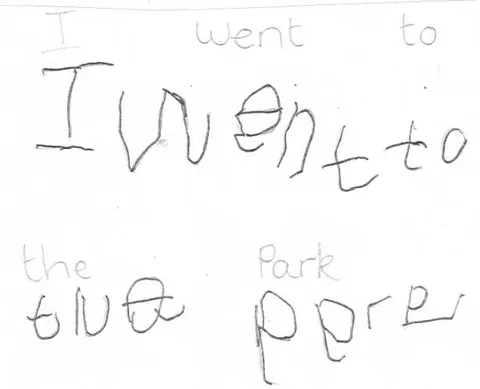
It would be better if Harry's teacher had first taught him to draw letters in the air with a single fluid arm movement - monoline form, then gradually reduce the movement in size to make it fit on paper then his performance would be improved. When he can make the shape on paper with his eyes shut he will have learned it and the TA can check. There are other important things to learn about in writing such as pencil grip and paper position.
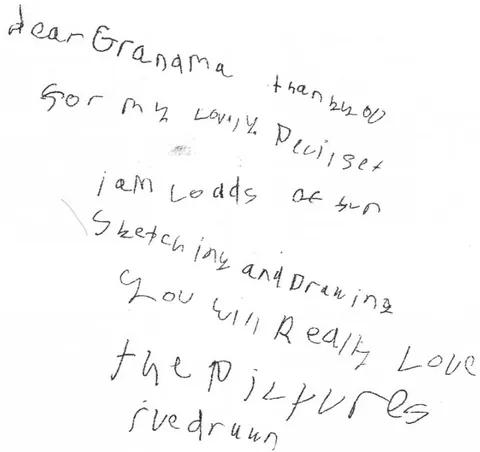
He writes 'Dear grandma thank you for my lovely pecil set I am loads of fun sketching and Drawing you will Really Love the pictures ive drawn' His spelling is good. The writing speed is 2.6 words per minute.
Ben's script shows most of the coordination difficulties shown in the assessment scale below with the exceptions that it was not too faint and there were no ridges or holes in the paper. In this he was probably helped by the fluidity of the biro, see Figure 7b below.
i) Assessing coordination difficulties in dysgraphia
Coordination difficulties may become confused with legibility issues because poor coordination can result in malformed letters and problems in positioning letters and words on the lines. There are however distinct indicators of coordination difficulties that observation of children writing and the scripts produced can reveal. A list of 13 indicators is shown below. Usually at least half of them will be present in mild dysgraphia.
Script drags in from the margin
Rivers of space run down the page
The script is very faint
The script is spiky
Words wave about above the lines and drag below them
There is a variation in pressure seen in darker and lighter letters and words
Pressure may be so strong ridges appear on the reverse of the paper
Script may be very large and faint
The writer may complain of pain after a few minutes
Particular lower case letters may look like capitals e.g. S, K, W, F because they are more difficult to form precisely and small
T's appear as capitals because the cross bar cannot be added precisely enough down the upright
Other letters such as U and M and N may randomly be formed extra large as the coordination control is lost
There may be holes in and ink blots on the paper.
Many of these difficulties can be overcome by teaching for fluency, and attention to penhold, special penhold moulds for grip improvement, and paper position (Montgomery, 2017a, 2020)
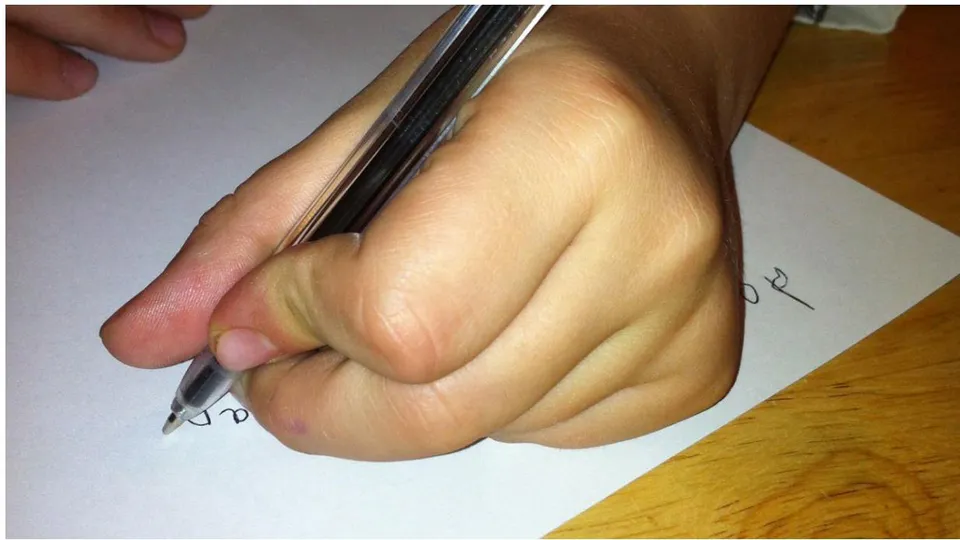
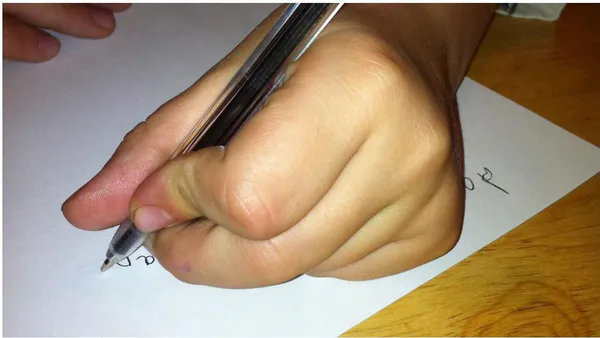
The photograph shows he is left-handed, has a weak grip shown in reddening/darkness of thumb and finger ends as he tries to tighten his hold to guide the pen. The tripod grip is incomplete. Joints are not fully formed so has 'bendy' fingers. The paper position should follow the line of his forearm then the writing will go horizontally across the page. He will tire easily and develop pain in his hand and arm if the writing goes on for more than a few minutes. He will need to take rests and this will slow his writing speed. This will lower his school achievements. Using a laptop will improve legibility but may not improve his speed but should always be tried as an alternative.
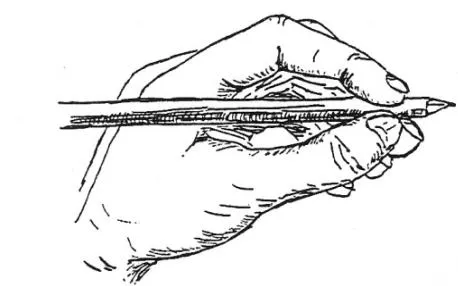
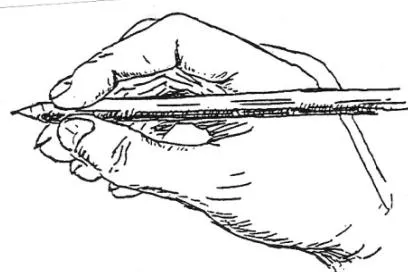
Left handers should hold the pencil a little further from the point so they can see the script. The rigid tripod grip has 2 fingers on top of the pen. There are other less frequent variants.
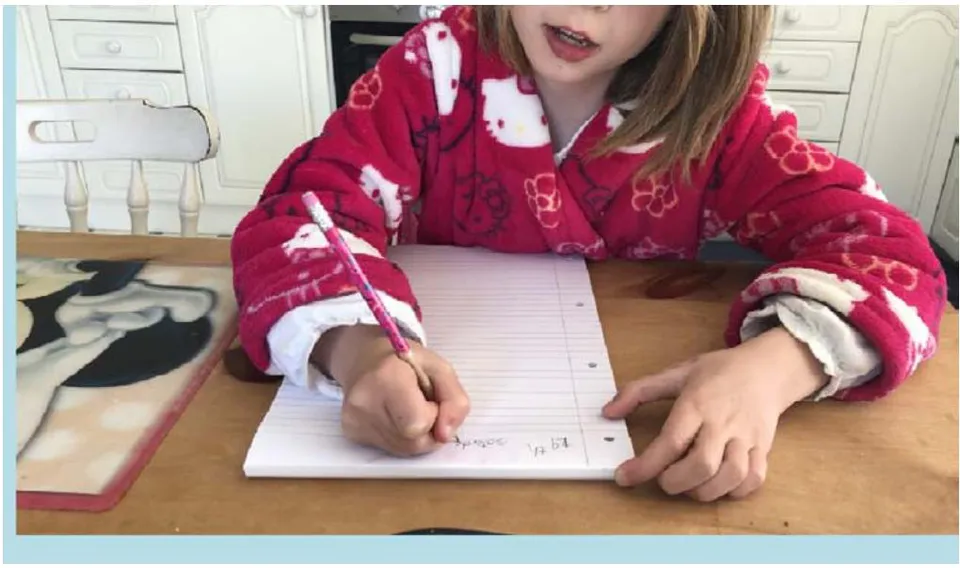
Amy's thumb-over grip indicates a weak finger grasp. The paper position is incorrect it should follow the line of her right forearm. The pencil hold is far too near the point this means she has to lean over to see the writing under her hand.
The inventory of handwriting coordination difficulties/dysgraphia shown above was based upon clinical diagnosis of many hundreds of cases referred to the Learning Difficulties Research Project www.ldrp.org. uk over several decades and on cases reported by teachers in the MA programmes. The indicators were also checked in previous handwriting projects and surveys. Intervention techniques were developed during this period and tested with parents' and school's participation.
However the early signs of dysgraphia can begin to be seen in this Reception survey scripts and they will become more evident during each year. Reception and Year 1 is the period when intervention can be most successful because they are developing writing skill. Once a handwriting skill is established it is more difficult to change or improve it.
j) The
The 10-minute free writing test (N=93 matches) given at the beginning of Year 2 revealed only 1 dyslexic (Hisham) and he also had by then cracked the code and was writing some semi-phonetic readable text, see Figure 7 below. This is an incidence of dyslexia of nearly whereas nationally it is (BDA 2023). In their feeder coastal area secondary school it had been (Montgomery, 2008). Hisham gained spelling rank zero on F1 and rank 2 on F2.
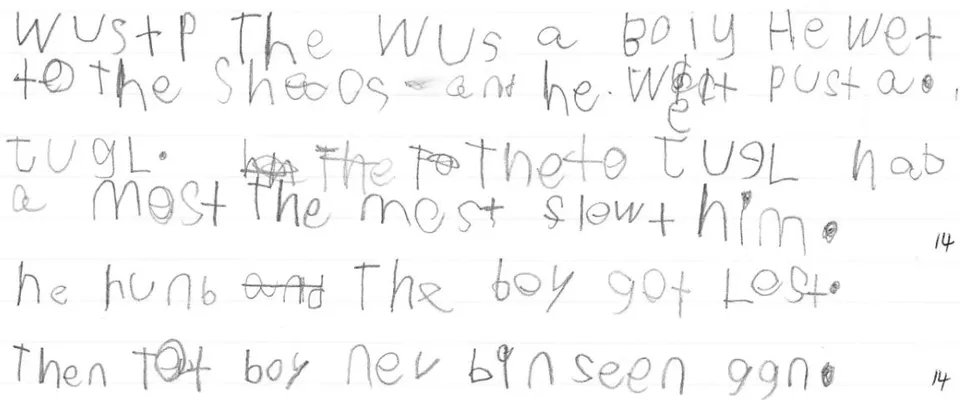
In Year 2: He writes: 'wusrp. (Once upon a time) The wus a Boiy (There was a boy) He wet to the sheoos (He went to the shops) and He wet pust a. Tugl (He went past a tugl). The to tugL hab a most (The tugl had a monster) The most (monster) flew + him. (The monster flew at him). he runb (he run) and the boy got lost. then tat boy nev bin seen agn' (Then that boy never been seen again)
He came from the Reception class where they made the least progress and it was evident that the teacher was not making use of the case notes. S/he was the one who appeared to favour correct spelling rather than promoting beginners' creative spellings and this was likely to have delayed the onset of his experimentation until Year 1 with a new teacher.
On entry to Year 2 the overall speed totals for the two schools A and C were:
- Mean writing speed 7.11 words per minute. School A in the disadvantaged category wrote 2 w.p.m slower than school C in the advantaged area.
- Mean spelling error rate was 12.85 per script.
- The predictive capacity of the spelling scale (F1 + F2) used in the Reception year was tested against
spelling error results in Year 2 and was significant at .
The mean writing speed in the large coastal area secondary school (N=251) was 12.4 words per minute at age 12. However Roaf (1998) as already noted had found that in her school pupils who did not write at a speed of 15 w.p.m. were failing in all areas of the curriculum. The slower writing speed in the coastal area schools accounts for some of the lower achievements in SATs and GCSEs for such groups found in national data.
Key Stage 1 SATS at the end of Year 2 in Table 7 below showed that there had been an uplift of in the literacy results over the previous three years' in the disadvantaged areas and uplift in the advantaged area results. This confirmed an earlier (1997-8) pilot study in a North West London school in special measures and for which a Spelling Development Handbook (1997b) detailing MAPT had been written. This as noted had been distributed to each of the Reception year teachers in the present study.
| 2011 | 2012 | 2013 | 2014 | ||||
| Reading | Writing | Maths | |||||
| School A | 35% | 47% | 48% | 78% | 85% | 80% | 66% |
| School B | 37% | 37% | 50% | 66% | 76% | 78% | 46% |
| School C | 77% | 87% | 88% | 96% | 95% | 98% | 96% |
It was hoped to follow the student group to the secondary school and give them the Year 7 10-minute speedwriting test but this was not possible because of incoming Covid-19 restrictions.
VII. DISCUSSION
The study showed that self-teaching could be promoted after children's entry to their Reception classes especially when MAPT a multisensory articulatory phonogram strategy was used. Sounds and their alphabetic symbols are abstract perceptual units and the only concrete clue to them is only the articulatory feel. If students are encouraged to speak clearly there is more chance that they will notice the 'feel' and make the connections to the sound and become phoneme aware. This may be made explicit by the teacher or by implicit brain-work in the students. Playing the I-Spy game can cue them to notice the initial sounds and become not only phoneme aware but also word aware. In the study those who benefitted most were pupils from disadvantaged circumstances and mild dyslexics because they had the chance to catch up on what they had missed. They had not had so many opportunities in pre-school to make these discoveries because of lack of shared reading and conversation. This is because it is known that children in advantaged situation are more exposed to extended opportunities for dialogue in their homes. They speak more and develop a larger vocabulary. Parents read more to them and share reading with them so they can see the words they are reading. Learning nursery rhymes and songs and then seeing them in print also helps them read. The eye and brain are processing and connecting much more behind the scenes than we might realise. There are far cleverer pattern processors in the human brain than in AI machines. Children are born scientific investigators and continually test hypotheses (Kelly, 1955; Gopnick, 2021). They can learn languages without being taught just by listening and practising their language skills. It is therefore important to give them opportunities to apply these skills to reading. First by finding out what they know by the freeform writing task and then teaching them some useful letters and how to build words with them from the beginning. Word building should take place as soon as two letter sounds have been learned such as 'i' and 't' to make 'it and 'tit'. In addition students need to learn to become 'Spelling Detectives' rather than develop 'learned helplessness' as many do. An example of a problem-solving approach to learning more about sounds can be found in a minilesson for more accomplished spellers than beginners in Appendix 2.
In addition to some self-teaching promoted by MAPT five further factors are important.
- The theory of optimal instruction propounded by Solity et al. (2009, p. 9):
'There is an optimal amount of information to teach that will lead to maximum generalisation' In applying this to reading teaching Solity (2018) found that only a handful of letters and their sounds needed to be explicitly taught for the children to grasp the alphabetic principle and go on to acquire more sounds and their symbols and read words. This is what we can achieve starting with the word-builders i l t p n s. Only after these have been learned move on to the
next handful starting with a A f etc. Teach the short and long sounds (names) only of the vowels at this stage.
Solity asserted that too much phonics was damaging to beginning readers. In the present research 5 starter symbols, the 'word builders' were recommended to teach simple syllable structures with a short vowel sound (CVC, CVCC, CCVC, CCVCC). The letters in 'satnip' (Cochrane et al., 2022) are also a handful of letters recommended for use in many phonics reading schemes such as Jolly Phonics (Lloyd, 1993).
With i t p n s 25 words and many nonsense words can be built e.g. pit tip nip and sip., then initial blends, spit, snip, stip. The short and long sound of vowels can be introduced with i and I to deal with word 'I' and 'pint'. Once the students have grasped the basic principle letters 'a' and 'f' etc. can be introduced and by self-teaching more will appear in their story scripts and can be used for decoding during reading. It is a case of 'less is more' and making sure all the students have grasped the basic idea. This is how the principle of optimal instruction works. Solity found that the phonic drills and regular weekly or even daily spelling test was a feature that students did not enjoy and put many off reading and had little effect on those who were poor spellers.
The DfE guidance and usual practice is to try to get the students to memorise 6 letter sounds and their symbols per week by multisensory copy writing and tracing drills and by being heard to read. They do not usually encourage problem solving and discussion about words and rhymes. This is a process of metalinguistic awareness meaning thinking about the language as it is being learned.
- The importance of freeform handwriting for beginners.
The fMRI research of James et al. (2012) cited earlier had shown that reading areas of the brain were activated during handwriting but not during tracing or copying. In the MAPT approach it is the freeform handwriting that activates the reading areas of the brain and helps connect sounds and words with their symbols.
Ray et al. (2021) in Australia used a Write Start-K, strategy that emphasised the recall, retrieval, reproduction, and repetition (their 4Rs model) of grapheme-phoneme relations in a handwriting project. It took place in 2 schools with 4 Reception classes children) comparing standard teaching copy writing and tracing with the project method. The results indicated that a handwriting intervention, incorporating repeated practice in recalling and reproducing letterforms from memory had a statistically significant impact on early reading skills. MAPT is also a system that promotes grapheme-phoneme relations with the advantage that it is more than the rote reproduction and repetition that is generally relied upon. The Pyramid model of the linkages being made during MAPT are shown in Figure 12 to Figure 11 below.
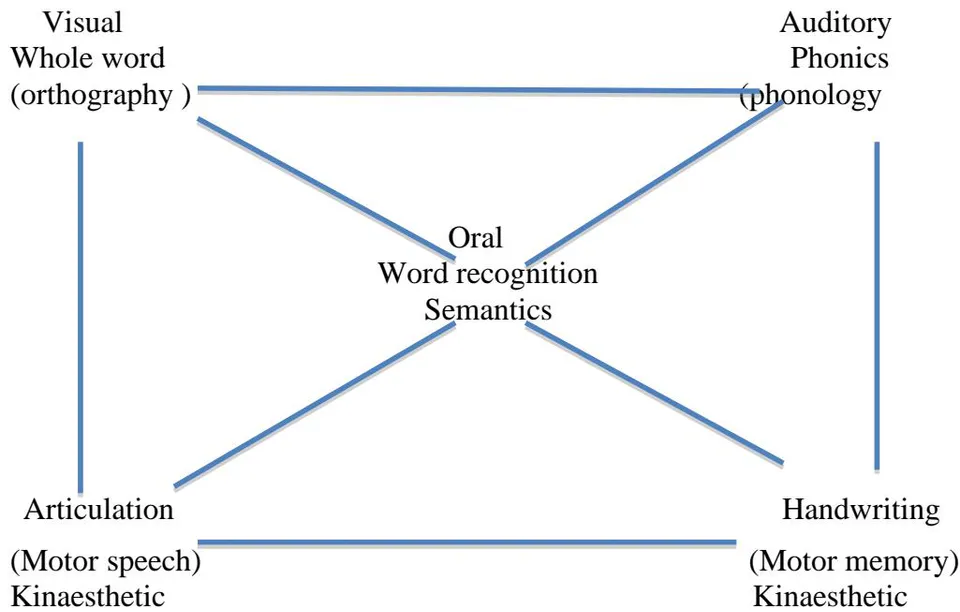
The importance of the articulatory training was identified by the early dyslexia pioneers. This was particularly by Fernald and Keller (1921) and Gillingham and Stillman (1940, 1956). Gillingham (1963) introduced the technique into England at training courses in London. It is not surprising therefore that potential dyslexics in the Reception and Year 1 classes in this research appeared to benefit and finally learned to read and write.
- Teaching cursive (joining) from the outset. This is still rejected by most English primary head teachers
(DfE, 2021). They prefer staff to teach for legibility over fluency, e.g. print first then joining. At the beginning of the century all children in the UK learned the 'Civil Service hand' an ovoid joined form of writing. It was a fluent style suitable for clerks to use because in those days they had so much recording of business to do before typewriters were introduced.
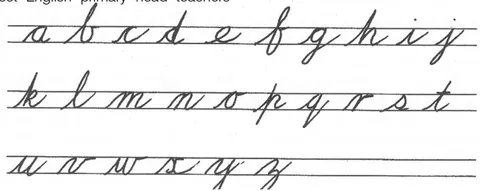
The letters have lead-in and lead-out lines. The modern versions omit the loops above the bodies of the letters but keep those below the line to assist joining.
The early dyslexia pioneers in the US also all taught cursive from the outset (Gillingham et al., 1940, 1956; Monroe 1932; Fernald et al., 1921), using the VAAKs - Visual Aural Articulatory Kinaesthetic model - MAPT above. This was because they had found it important in overcoming the dyslexia and because many of their dyslexics also had coordination difficulties that cursive helped to deal with. Some of this influence moved into mainstream teaching of letterforms when an anglicised version of the G & S programme was imported into England for example by Hickey (1977). But the articulatory element was lost.
In this same period the print forms used in the regular classroom changed from 'Ball and Stick' to monoline (made by one continuous line) to make them easier for children to write. In addition many Reception teachers adopted multisensory phonogram training (MPT) to connect the letters and sounds in children's minds as remedial teachers did but MPT omitted the articulatory dimension.
DfE (2014) guidance however advised that joining should begin to develop by the time children were 8 years old! In the 'look and say' era some schools had banned teaching cursive until the age of 8 or until the child could write neatly! This means that children have to learn one set of motor programmes (print) and then another (cursive), the transition is not easy for many. Such switching is inefficient and handicaps all the children with weak motor skills and especially those with dysgraphia (Wedell, 1973; Montgomery, 2017a). Ergonomically we should start as we mean to go on and this means 'joining' for beginners on entry to school as in the 1920s. Children in Francophone countries are taught to do this quite successfully (Thomas, 1998).
In Primary School C 2 classes on entry to Year 5 (10 year-olds) undertook the 10-minute speed writing test and their data was analysed to find if they had all successfully switched from print to cursive. It revealed the following results shown in Table 8 below:
| Class 1 | Class 2 | Totals | ||||
| • | 3 | 3F 0M | 16 | 8F 8M | 19 | |
| • | Casual joining | 20 | 15F 5F | 12 | 4F 8M | 32 |
| • | Cursive | 3 | 3F 0M | 1 | 1F 0M | 1 |
The data show that of the 52 children 51 in Table 8 above have not achieved an efficient cursive style. It demonstrates that switching is not an effective strategy in producing a fluent joined style. It also means students will be delayed in achieving a speed of 15 words per minute needed in Year 7 to meet the curriculum needs (Roaf, 1998). Table 9 shows the writing speed of School C compared with some other Year 5.
| SES | Numbers | w.p.m. | coord diffs |
| School X Church School | N=85 | 10.04 | 7.0% |
| School Y Rural School | N=60 | 8.05 | 20.83% |
| School C Coastal School | N=52 | 7.81 | 36.54% |
| Mean | N=197 | 8.84 |
It demonstrates that in schools there is a hierarchy of handwriting skill that needs to be addressed to promote all pupils' achievement. Church schools usually recruit from a more advantaged group in their areas. Once gain the coastal area school that in its own area is an advantaged one appears to be disadvantaged among this group.
- Both phonics and Look and Say methods need to be used from the outset but separately at first. Phonics helps word attack for decoding in reading whilst meaning emphasis methods develop comprehension skills both are needed by beginning readers. So it is wise to give both strategies time to have their effects and not prefer one over the other. Just at first they need to be taught in separate lessons as was originally done before the Look and Say era in the New Beacon Readers scheme (Fassett, 1929). In purely Look and Say regimes the
percentage of dyslexics was found to be higher than in phonics ones (Chall, 1985, Read, 1986).
Children who learn to speak clearly have more chance to note the initial sounds and in the syllables in words and it can help them become self-teachers. The encouragement of shared reading in class and at home is particularly important because. Look and Say methods promote comprehension and reading development.
- The medium, English orthography. A final contribution to this tale is the hidden role that English orthography plays in the task of learning to read or not. English is considered a difficult language to learn as well as read especially for beginners. It is considered 'opaque' whereas most others especially European languages are 'regular' that is, they have one sound for each symbol. German for example has 31 sounds and 31 symbols (26 letters, 3 umlauts and 'sc' and 'sch'). As a result such languages are much easier and quicker to
learn and tend to lead to fewer dyslexics and a gender ratio of 3:2 (Rutter et al., 2004; Barbiero, 2020).
In contrast English orthography is only phonically regular, it has 44 sounds and only 26 symbols. It is also based on morphology (meaningful units) and etymology, its history in other languages such as Latin, Greek, Norse, Anglo-Saxon, and Norman French. It is thus harder to learn and teach.
However when the English alphabet was regularised to make 44 symbols reflect its 44 phonemes most children learned to read fluently and easily by the age of 6 years. The system was the initial teaching alphabet, i.t.a. (Pitman, 1961) but parents and those who did not teach it found it looked too strange to accept even though transfer to traditional orthography was also easy for reading and a bit slower for spelling (Downing, 1965; Southgate, 1970).
Sue Lloyd (1993) developed 'Jolly Phonics' with its 42 regular symbols based on her experience with i.t.a. It has proved highly successful and its use was endorsed by the DfE following the publication the Rose Report (2006) on 'Phonics First'. Jolly Phonics begins with s at n i p.
However it too needs an update and this involves teaching the following:
- 6 short vowel sounds a e i o u and oo as in book,
- 6 long vowel sounds as in the vowel names AEIOU and oo as in school,
- 21 consonants, bcdfghjklmnpqrstvwxyz
- 6 consonant digraphs ch, ph, sh, wh, th, and th (voiced)
- 2 diphthongs ou as in 'round' the 'ahoo' sound and 'oi' as in oil
- semi-vowel as in 'my' and 'mystery' and 'story'
- qu-and-ng
This gives a total of 44 standard symbols that are so easy to use to regularise the system. In addition 5 simple rules can facilitate further progress and tidy up several thousand spellings (Montgomery, 2023).
VIII. CONCLUSION
What this research has shown is that understanding how self-teaching infants learn to read gives clues to how dyslexia and disadvantage can be overcome using teaching methods that follow their example. Teachers need no special training to do this. They can just include the extra articulatory element in their normal methods that will help dyslexics and disadvantaged children.
The freeform writing task shows a teacher what the students already know about the language and how much progress they are making each week with the current teaching methods. It shows them what an individual student or a group need to be taught next. No expensive diagnostic tests, programs or extra working time is needed. All that is required is the regular teacher's teaching skill.
Background and historical studies have left a legacy that can inform and improve current practice when the 'best bits' are taken and used again as has been tried here.
The research has shown how important handwriting is in the early stages of learning to read because it activates the reading areas of the brain to prepare them for making the necessary linkages. Using the fast running cursive style from the beginning will help counteract later underachievement by improving handwriting speed.
By regularising the English alphabet to make its 44 sounds connect with 44 symbols the process of learning to read is simplified and speeded up. This has special benefits for all students but particularly those from disadvantaged environments and dyslexics.
Teachers can begin by trying just one technique. To make a start try the freeform writing of news nothing is easier.
In Appendix One below is a example of a typical MAPT lesson. The students soon get used to the strategy and can do more themselves. By the end of the first 5 or 6 mini lessons with i l t p n s the process speeds up and can be integrated into other typical reading activities.
Appendix One: MAPT Lesson 3. Teach letter sound and feel of (t) and clue word
Ask who can remember the first letter 'i' and its sound.
Several children write the letter 'i' on the board and give its short sound (i).
Now write a large lower case letter 't' on a line on the board with lead in and lead out lines and also 'ghost in' line.
Ask the pupils to copy the letter in the air with index and middle fingers together as pointers.
Teacher talks them through the movement 'from the lineup-down-round and then add the cross bar'.
Ask if anyone knows the sound the letter makes (t).?
All say the sound (t) several times.
Now they look at their partner's face as he or she makes the sound (t)
Get them to try to describe the look and feel of (t). What is the tongue doing this time?
Put fingers in front of mouth and say (t) 'What do you feel?' The puff.
Pupils copy the 't' movements in air rhythmically and say the sound as they do so
They now 'draw' a letter 't' on the desk with fingers and say the sound
Demonstrate letter 't' for left-handers if necessary.
Several pupils come up and draw a letter 't' on the board with the original covered and talk themselves round it. Then they check theirs with the original. Discuss.
Teacher writes a line of three joined letter 't's on the board.
Pupils do the same in their books saying the sound.
Ask if anyone knows a word that begins with the sound-tin, table, tie.
Ask if anyone has a name that begins with (t).
Play the I-Spy game (having ensured there are a few t objects around)
Pupils draw their clue word for (t).
'Our first word': Put 'i' and 't' close together on a line on the board and ask pupils to try to say the word. (i-t). Demonstrate.
- Pupils write a line of the word 'it' in their books and as they do so say the word each time.
- Write the word 'tit'. Can they say the word (ignore body part!) show pictures of the bird family blue tit, coal tit, great tit. long-tailed tit. Encourage any seen locally to be discussed and to report where.
Appendix Two: A mini problem-solving lesson on the letter 'c'
This strategy can be used once students have developed some fluency in reading. It shows a cognitive method for overcoming difficulties with spelling not just by repeated practice – rote learning. For example:
"The letter named 'c' does not have a sound of its own so it has to borrow from its friends. Its friends are 's' its soft sound and 'k' is its hard sound. The problem you have so solve is when does 'c' use 's' and when does 'c' use 'k' in words? How do you think we can find out?"
If they want to say some words the teacher will need to write them down. All work for teacher and nothing much from most of the students!
Instead ask the students to study the pages in their storybooks and write down any that begin with 'c' in their workbooks. After a while, ask them to read out some of the words they have found. This time the teacher can write them on the board/whiteboard. They can add others as they think of them and also look around the room for other possible words. About 10 words can be a useful start.
The task now is for students to study the words with a partner to try to discover when 'c' uses the sound 's' and when it uses he sound 'k' at the beginning of a word.
A class of older students can be given a sheet of a local newspaper or magazine to find words beginning with 'c' and use a yellow marker pen to highlight them then with a partner discuss when 's' or 'k' are used.
After time to consider the problem they will probably need a clue and some extra examples:
cat city clean car cycle came cup cut clear curl ceremony circle cyst cease corn cross clip come clay certain cream clock create credit close
The clue is: "Collect all the 'ca' words into a group, then the 'ce' words and so on for each vowel sound, then for consonants 'cl' and 'cr'. Now see if you can work out the rule."
('c' followed by 'a' 'o' 'u' and when blended with 'cl' and 'cr' makes its hard 'k' sound. When 'c' is followed by 'e' 'i' and 'y' it makes its soft sound 's').