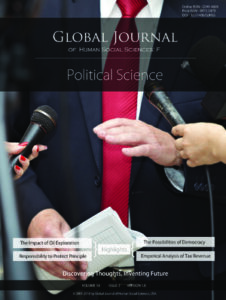
An Emperical Analysis of Tax Revenue and Economic Growth in Nigeria from 1980 To 2015

Article ID

N1ZAJ

An Emperical Analysis of Tax Revenue and Economic Growth in Nigeria from 1980 To 2015

Abomaye-Nimenibo
Abomaye-Nimenibo
Williams Aminadokiari Samuel
Michael Jack Eyo
Michael Jack Eyo
Mni
Mni
Friday
Friday
Hope Chika
Hope Chika
DOI

Abstract

The contribution of taxation to any economy globally is so much in terms of quantification and cannot be therefore be ignored as unimportant. It is a source of revenue or income to the government be it the Central, State or Local government in achieving their macro-economic objectives in the areas of fiscal and monetary policies. For Nigerian government to effectively carry out its primary function and other subsidiary functions, she requires adequate funding. Government responsibilities has continued to increase over time especially in developing countries like Nigeria due to the increasing nature and size of her population, and infrastructural deterioration. This study was therefore poised to empirically examine the tax revenue and economic growth in Nigeria from 1980 to 2015 by employing Gross Domestic Product (GDP) as the dependent variable and Petroleum Profit Tax (PPT), Company Income Tax (CIT), and Customs and Excise Duties (CED) as the independent variables. The analysis of the study was carried out using the method of Multiple Regression Analysis. The Ordinary Least Square (OLS) method of econometrics was the main analytical technique that was employed using Econometric software (E-Views 9.0).Our broad objectives were to examine the relationship that exists between Petroleum Profit Tax, Company Income Tax, Customs and Excise Duties; and Economic Growth in Nigeria. The Cointegration results revealed that there was a long-run relationship among the variables. The short run regression result also revealed that Petroleum Profit Tax and Company Income Tax has no significant relationship with economic growth in Nigeria. Custom and Excise Duties was found to have a significant relationship with Economic Growth in Nigeria during the period under study. The study therefore concluded that government should ensure that tax revenue is used judiciously to make expenditures on Education, Housing, Ttransportation, Aagriculture, Health, Power, Road construction, Natio

An Emperical Analysis of Tax Revenue and Economic Growth in Nigeria from 1980 To 2015

The contribution of taxation to any economy globally is so much in terms of quantification and cannot be therefore be ignored as unimportant. It is a source of revenue or income to the government be it the Central, State or Local government in achieving their macro-economic objectives in the areas of fiscal and monetary policies. For Nigerian government to effectively carry out its primary function and other subsidiary functions, she requires adequate funding. Government responsibilities has continued to increase over time especially in developing countries like Nigeria due to the increasing nature and size of her population, and infrastructural deterioration. This study was therefore poised to empirically examine the tax revenue and economic growth in Nigeria from 1980 to 2015 by employing Gross Domestic Product (GDP) as the dependent variable and Petroleum Profit Tax (PPT), Company Income Tax (CIT), and Customs and Excise Duties (CED) as the independent variables. The analysis of the study was carried out using the method of Multiple Regression Analysis. The Ordinary Least Square (OLS) method of econometrics was the main analytical technique that was employed using Econometric software (E-Views 9.0).Our broad objectives were to examine the relationship that exists between Petroleum Profit Tax, Company Income Tax, Customs and Excise Duties; and Economic Growth in Nigeria. The Cointegration results revealed that there was a long-run relationship among the variables. The short run regression result also revealed that Petroleum Profit Tax and Company Income Tax has no significant relationship with economic growth in Nigeria. Custom and Excise Duties was found to have a significant relationship with Economic Growth in Nigeria during the period under study. The study therefore concluded that government should ensure that tax revenue is used judiciously to make expenditures on Education, Housing, Ttransportation, Aagriculture, Health, Power, Road construction, Natio


Abomaye-Nimenibo
Abomaye-Nimenibo
Williams Aminadokiari Samuel
Michael Jack Eyo
Michael Jack Eyo
Mni
Mni
Friday
Friday
Hope Chika
Hope Chika

No Figures found in article.

Prof. Abomaye-Nimenibo Williams Aminadokiari Samuel. 2018. “. Global Journal of Human-Social Science – F: Political Science GJHSS-F Volume 18 (GJHSS Volume 18 Issue F3): .

Download Citation

Journal Specifications

Crossref Journal DOI 10.17406/GJHSS

Print ISSN 0975-587X

e-ISSN 2249-460X

Classification
GJHSS-F Classification: FOR Code: 910103
Keywords
Article Matrices
Total Views: 3090
Total Downloads: 1529
2026 Trends
Research Identity (RIN)
Related Research
Our website is actively being updated, and changes may occur frequently. Please clear your browser cache if needed. For feedback or error reporting, please email [email protected]

Request Access

Please fill out the form below to request access to this research paper. Your request will be reviewed by the editorial or author team.
X

Quote and Order Details

Contact Person

Invoice Address

Notes or Comments

This is the heading

Lorem ipsum dolor sit amet, consectetur adipiscing elit. Ut elit tellus, luctus nec ullamcorper mattis, pulvinar dapibus leo.

High-quality academic research articles on global topics and journals.

An Emperical Analysis of Tax Revenue and Economic Growth in Nigeria from 1980 To 2015

Abomaye-Nimenibo
Abomaye-Nimenibo
Williams Aminadokiari Samuel
Michael Jack Eyo
Michael Jack Eyo
Mni
Mni
Friday
Friday
Hope Chika
Hope Chika

Research Journals