Role of Solar & Atmospheric disparity on Climate of Western India, Kota, Rajasthan, India

Article ID

52G3Z

Role of Solar & Atmospheric disparity on Climate of Western India, Kota, Rajasthan, India

Vinay Kumar Pandey
Vinay Kumar Pandey
DOI

Abstract

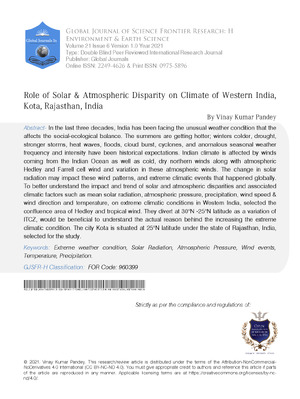
In the last three decades, India has been facing the unusual weather condition that the affects the socialecological balance. The summers are getting hotter; winters colder, drought, stronger storms, heat waves, floods, cloud burst, cyclones, and anomalous seasonal weather frequency and intensity have been historical expectations. Indian climate is affected by winds coming from the Indian Ocean as well as cold, dry northern winds along with atmospheric Hedley and Farrell cell wind and variation in these atmospheric winds. The change in solar radiation may impact these wind patterns, and extreme climatic events that happened globally. To better understand the impact and trend of solar and atmospheric disparities and associated climatic factors such as mean solar radiation, atmospheric pressure, precipitation, wind speed & wind direction and temperature, on extreme climatic conditions in Western India, selected the confluence area of Hedley and tropical wind. They divert at 30°N -25°N latitude as a variation of ITCZ, would be beneficial to understand the actual reason behind the increasing the extreme climatic condition. The city Kota is situated at 25°N latitude under the state of Rajasthan, India, selected for the study. After the detailed data interpretation, it observed that the average solar radiation has decreased by 1.15%, 0.28%, and 2.33% for the yearly, Ist half, and IInd half-year, the atmospheric pressure has increased by 0.066%, 0.035%, and 0.097% in the yearly, Ist half and IInd half-year respectively, the precipitation has decreased by 26.16 % the yearly, 10.61% and 28.66% in the the yearly, Ist half and IInd half-year respectively from the year 1988-1997 to the year 2008-2019. The maximum and minimum temperature was increased by 3.29% and 4.62% from the year 1988-1997 to the year 2008-2019. The Ist half and IInd half-year average maximum and minimum temperature were increased by 3.91% & 4.09%, and 4.04% & 5.14% respectively. Based on data out comes, predicted the future climatic condition for the years 2051-2060 and possible extreme climatic conditions over Western India that could be helpful in mitigation and land use plan for the extreme climatic conditions.

Role of Solar & Atmospheric disparity on Climate of Western India, Kota, Rajasthan, India

In the last three decades, India has been facing the unusual weather condition that the affects the socialecological balance. The summers are getting hotter; winters colder, drought, stronger storms, heat waves, floods, cloud burst, cyclones, and anomalous seasonal weather frequency and intensity have been historical expectations. Indian climate is affected by winds coming from the Indian Ocean as well as cold, dry northern winds along with atmospheric Hedley and Farrell cell wind and variation in these atmospheric winds. The change in solar radiation may impact these wind patterns, and extreme climatic events that happened globally. To better understand the impact and trend of solar and atmospheric disparities and associated climatic factors such as mean solar radiation, atmospheric pressure, precipitation, wind speed & wind direction and temperature, on extreme climatic conditions in Western India, selected the confluence area of Hedley and tropical wind. They divert at 30°N -25°N latitude as a variation of ITCZ, would be beneficial to understand the actual reason behind the increasing the extreme climatic condition. The city Kota is situated at 25°N latitude under the state of Rajasthan, India, selected for the study. After the detailed data interpretation, it observed that the average solar radiation has decreased by 1.15%, 0.28%, and 2.33% for the yearly, Ist half, and IInd half-year, the atmospheric pressure has increased by 0.066%, 0.035%, and 0.097% in the yearly, Ist half and IInd half-year respectively, the precipitation has decreased by 26.16 % the yearly, 10.61% and 28.66% in the the yearly, Ist half and IInd half-year respectively from the year 1988-1997 to the year 2008-2019. The maximum and minimum temperature was increased by 3.29% and 4.62% from the year 1988-1997 to the year 2008-2019. The Ist half and IInd half-year average maximum and minimum temperature were increased by 3.91% & 4.09%, and 4.04% & 5.14% respectively. Based on data out comes, predicted the future climatic condition for the years 2051-2060 and possible extreme climatic conditions over Western India that could be helpful in mitigation and land use plan for the extreme climatic conditions.

Vinay Kumar Pandey
Vinay Kumar Pandey

No Figures found in article.

Vinay Kumar Pandey. 1970. “. Global Journal of Science Frontier Research – H: Environment & Environmental geology GJSFR-H Volume 21 (GJSFR Volume 21 Issue H6): .

Download Citation

Journal Specifications

Crossref Journal DOI 10.17406/GJSFR

Print ISSN 0975-5896

e-ISSN 2249-4626

Classification
GJSFR-H Classification: FOR Code: 960399
Keywords
Article Matrices
Total Views: 20651
Total Downloads: 11011
2026 Trends
Research Identity (RIN)
Related Research
Our website is actively being updated, and changes may occur frequently. Please clear your browser cache if needed. For feedback or error reporting, please email [email protected]

Request Access

Please fill out the form below to request access to this research paper. Your request will be reviewed by the editorial or author team.
X

Quote and Order Details

Contact Person

Invoice Address

Notes or Comments

This is the heading

Lorem ipsum dolor sit amet, consectetur adipiscing elit. Ut elit tellus, luctus nec ullamcorper mattis, pulvinar dapibus leo.


High-quality academic research articles on global topics and journals.

Role of Solar & Atmospheric disparity on Climate of Western India, Kota, Rajasthan, India

Vinay Kumar Pandey
Vinay Kumar Pandey

Research Journals