To: Author
Article Fingerprint
ReserarchID
MBRS7986

Choose where you want to hide AI Takeaway. Your site-wide choice will be remembered in this browser.
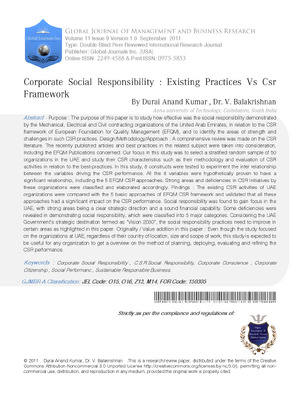
Purpose : The purpose of this paper is to study how effective was the social responsibility demonstrated by the Mechanical, Electrical and Civil contracting organizations of the United Arab Emirates, in relation to the CSR framework of European Foundation for Quality Management (EFQM), and to identify the areas of strength and challenges in such CSR practices. Design/Methodology/Approach : A comprehensive review was made on the CSR literature. The recently published articles and best practices in the related subject were taken into consideration, including the EFQM Publications concerned. Our focus in this study was to select a stratified random sample of 50 organizations in the UAE and study their CSR characteristics such as their methodology and evaluation of CSR activities in relation to the best-practices. In this study, 8 constructs were tested to experiment the inter relationship between the variables driving the CSR performance. All the 8 variables were hypothetically proven to have a significant relationship, including the 5 EFQM CSR approaches. Strong areas and deficiencies in CSR initiatives by these organizations were classified and elaborated accordingly. Findings : The existing CSR activities of UAE organizations were compared with the 5 basic approaches of EFQM CSR framework and validated that all these approaches had a significant impact on the CSR performance. Social responsibility was found to gain focus in the UAE, with strong areas being a clear strategic direction and a sound financial capability. Some deficiencies were revealed in demonstrating social responsibility, which were classified into 5 major categories. Considering the UAE Government’s strategic destination termed as “Vision 2030”, the social responsibility practices need to improve in certain areas as highlighted in this paper. Originality / Value addition in this paper : Even though the study focused on the organizations at UAE, regardless of their country of location, size and scope of work, this study is expected to be useful for any organization to get a overview on the method of planning, deploying, evaluating and refining the CSR performance.
Dr. KUMAR. 1970. "Corporate Social Responsibility : Existing Practices Vs CSR Framework". Global Journal of Management and Business Research, Global Journal of Management and Business Research - A: Administration & Management GJMBR-A Volume 11 (GJMBR Volume 11 Issue A9).

Crossref Journal DOI 10.17406/GJMBR
Print ISSN 0975-5853
e-ISSN 2249-4588
v1.2
Explore published articles in an immersive Augmented Reality environment. Our platform converts research papers into interactive 3D books, allowing readers to view and interact with content using AR and VR compatible devices.
Your published article is automatically converted into a realistic 3D book. Flip through pages and read research papers in a more engaging and interactive format.
Total Score: 159
Country: India
Subject: Global Journal of Management and Business Research
Authors: Dr. Durai Anand Kumar, Dr. V.Balakrishnan (PhD/Dr. count: 2)
View Count (all-time): 218
Total Views (Real + Logic): 4934
Total Downloads (simulated): 230
Publish Date: 2011 08, Wed
Monthly Totals (Real + Logic):
We use cookies and similar technologies to improve site performance, understand traffic, and enhance your publishing experience. Cookie Policy
Choose which optional cookies Global Journals can use. Your preference applies across this platform and can be updated any time.
These cookies are required for core website functionality and security.

Lorem ipsum dolor sit amet, consectetur adipiscing elit. Ut elit tellus, luctus nec ullamcorper mattis, pulvinar dapibus leo.