Determinant of Land Management Practices among Crop Farmers in South-Western Nigeria

Article ID

K32U9

Determinant of Land Management Practices among Crop Farmers in South-Western Nigeria

Dr. Raufu
Dr. Raufu
M.O.
M.O.
Adetunji M.O.
Adetunji M.O.
DOI

Abstract

The study examined the determinants of land management practices among crop farmers in South-Western Nigeria. A total of 360 respondents were selected from the three agroecological zones of the State typical of some Nigeria South-Western States. Well-structured questionnaires with few open-ended questions were administered out of which 301 were found to be very useful for the study. Analysis of data was done using descriptive statistics and probit models were employed as the inferential statistics.The result showed that 90 percent of the farmers are male and married while 85.5 percent of their household members are literate. About 40 percent of the farmers are in their active age. The male education at secondary and tertiary level has significant impact on land management practices contrary to female education. Also the livelihood strategy of the household head has limited impact on most land management practices. Investment on land encourages fallowing and incorporation of crop residues while assess to credit favors non-farm rather than farm activities.

Determinant of Land Management Practices among Crop Farmers in South-Western Nigeria

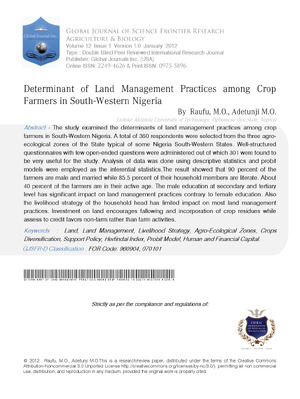
The study examined the determinants of land management practices among crop farmers in South-Western Nigeria. A total of 360 respondents were selected from the three agroecological zones of the State typical of some Nigeria South-Western States. Well-structured questionnaires with few open-ended questions were administered out of which 301 were found to be very useful for the study. Analysis of data was done using descriptive statistics and probit models were employed as the inferential statistics.The result showed that 90 percent of the farmers are male and married while 85.5 percent of their household members are literate. About 40 percent of the farmers are in their active age. The male education at secondary and tertiary level has significant impact on land management practices contrary to female education. Also the livelihood strategy of the household head has limited impact on most land management practices. Investment on land encourages fallowing and incorporation of crop residues while assess to credit favors non-farm rather than farm activities.

Dr. Raufu
Dr. Raufu
M.O.
M.O.
Adetunji M.O.
Adetunji M.O.

No Figures found in article.

Raufu Mufutau Oyedapo. 2012. “. Global Journal of Science Frontier Research – D: Agriculture & Veterinary GJSFR-D Volume 12 (GJSFR Volume 12 Issue D1): .

Download Citation

Journal Specifications

Crossref Journal DOI 10.17406/GJSFR

Print ISSN 0975-5896

e-ISSN 2249-4626

Classification
Not Found
Article Matrices
Total Views: 5160
Total Downloads: 2779
2026 Trends
Research Identity (RIN)
Related Research
Our website is actively being updated, and changes may occur frequently. Please clear your browser cache if needed. For feedback or error reporting, please email [email protected]

Request Access

Please fill out the form below to request access to this research paper. Your request will be reviewed by the editorial or author team.
X

Quote and Order Details

Contact Person

Invoice Address

Notes or Comments

This is the heading

Lorem ipsum dolor sit amet, consectetur adipiscing elit. Ut elit tellus, luctus nec ullamcorper mattis, pulvinar dapibus leo.


High-quality academic research articles on global topics and journals.

Determinant of Land Management Practices among Crop Farmers in South-Western Nigeria

Dr. Raufu
Dr. Raufu
M.O.
M.O.
Adetunji M.O.
Adetunji M.O.

Research Journals