
Quantum mechanics, cosmic acceleration and CMB radiation

Article ID

SFR37RG5

Quantum mechanics, cosmic acceleration and CMB radiation

Dr. U. V. S. Seshavatharam
Dr. U. V. S. Seshavatharam Andhra University,Visakhapatnam-03, AP, India.
Prof. S. Lakshminarayana
DOI

Abstract

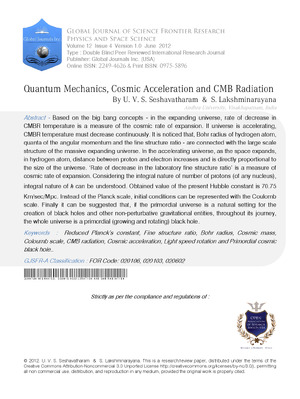
Based on the big bang concepts – in the expanding universe, rate of decrease in CMBR temperature is a measure of the cosmic rate of expansion. If universe is accelerating, CMBR temperature must decrease continuously. It is noticed that, Bohr radius of hydrogen atom, quanta of the angular momentum and the fine structure ratio – are connected with the large scale structure of the massive expanding universe. In the accelerating universe, as the space expands, in hydrogen atom, distance between proton and electron increases and is directly proportional to the size of the universe. ‘Rate of decrease in the laboratory fine structure ratio’ is a measure of cosmic rate of expansion. Considering the integral nature of number of protons (of any nucleus), integral nature of ℏ can be understood. Obtained value of the present Hubble constant is 70.75 Km/sec/Mpc. Instead of the Planck scale, initial conditions can be represented with the Coulomb scale. Finally it can be suggested that, if the primordial universe is a natural setting for the creation of black holes and other non-perturbative gravitational entities, throughout its journey, the whole universe is a primordial (growing and rotating) black hole.

Quantum mechanics, cosmic acceleration and CMB radiation

Based on the big bang concepts – in the expanding universe, rate of decrease in CMBR temperature is a measure of the cosmic rate of expansion. If universe is accelerating, CMBR temperature must decrease continuously. It is noticed that, Bohr radius of hydrogen atom, quanta of the angular momentum and the fine structure ratio – are connected with the large scale structure of the massive expanding universe. In the accelerating universe, as the space expands, in hydrogen atom, distance between proton and electron increases and is directly proportional to the size of the universe. ‘Rate of decrease in the laboratory fine structure ratio’ is a measure of cosmic rate of expansion. Considering the integral nature of number of protons (of any nucleus), integral nature of ℏ can be understood. Obtained value of the present Hubble constant is 70.75 Km/sec/Mpc. Instead of the Planck scale, initial conditions can be represented with the Coulomb scale. Finally it can be suggested that, if the primordial universe is a natural setting for the creation of black holes and other non-perturbative gravitational entities, throughout its journey, the whole universe is a primordial (growing and rotating) black hole.

Dr. U. V. S. Seshavatharam
Dr. U. V. S. Seshavatharam Andhra University,Visakhapatnam-03, AP, India.
Prof. S. Lakshminarayana

No Figures found in article.

Dr. U. V. S. Seshavatharam. 2012. “. Global Journal of Science Frontier Research – A: Physics & Space Science GJSFR-A Volume 12 (GJSFR Volume 12 Issue A4): .

Download Citation

Journal Specifications

Crossref Journal DOI 10.17406/GJSFR

Print ISSN 0975-5896

e-ISSN 2249-4626

Issue Cover
GJSFR Volume 12 Issue A4
Pg. 17- 21
Classification
Not Found
Article Matrices
Total Views: 5189
Total Downloads: 2626
2026 Trends
Research Identity (RIN)
Related Research
Our website is actively being updated, and changes may occur frequently. Please clear your browser cache if needed. For feedback or error reporting, please email [email protected]

Request Access

Please fill out the form below to request access to this research paper. Your request will be reviewed by the editorial or author team.
X

Quote and Order Details

Contact Person

Invoice Address

Notes or Comments

This is the heading

Lorem ipsum dolor sit amet, consectetur adipiscing elit. Ut elit tellus, luctus nec ullamcorper mattis, pulvinar dapibus leo.


High-quality academic research articles on global topics and journals.

Quantum mechanics, cosmic acceleration and CMB radiation

Dr. U. V. S. Seshavatharam
Dr. U. V. S. Seshavatharam Andhra University,Visakhapatnam-03, AP, India.
Prof. S. Lakshminarayana

Research Journals