Article Fingerprint
ReserarchID
MBRR4U72

Choose where you want to hide AI Takeaway. Your site-wide choice will be remembered in this browser.
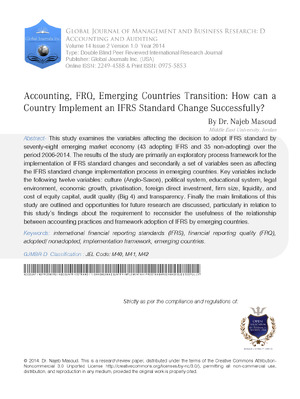
This study examines the variables affecting the decision to adopt IFRS standard by seventy-eight emerging market economy (43 adopting IFRS and 35 non-adopting) over the period 2006-2014. The results of the study are primarily an exploratory process framework for the implementation of IFRS standard changes and secondarily a set of variables seen as affecting the IFRS standard change implementation process in emerging countries. Key variables include the following twelve variables: culture (Anglo-Saxon), political system, educational system, legal environment, economic growth, privatisation, foreign direct investment, firm size, liquidity, and cost of equity capital, audit quality (Big 4) and transparency. Finally the main limitations of this study are outlined and opportunities for future research are discussed, particularly in relation to this study’s findings about the requirement to reconsider the usefulness of the relationship between accounting practices and framework adoption of IFRS by emerging countries.
Dr. Masoud. 2014. "Accounting, FRQ, Emerging Countries Transition: How can a Country Implement an IFRS Standard Change Successfully?". Global Journal of Management and Business Research, Global Journal of Management and Business Research - D: Accounting & Auditing GJMBR-D Volume 14 (GJMBR Volume 14 Issue D2).

Crossref Journal DOI 10.17406/GJMBR
Print ISSN 0975-5853
e-ISSN 2249-4588
v1.2
Explore published articles in an immersive Augmented Reality environment. Our platform converts research papers into interactive 3D books, allowing readers to view and interact with content using AR and VR compatible devices.
Your published article is automatically converted into a realistic 3D book. Flip through pages and read research papers in a more engaging and interactive format.
Total Score: 153
Country: Jordan
Subject: Global Journal of Management and Business Research
Authors: Dr. Najeb Masoud (PhD/Dr. count: 1)
View Count (all-time): 271
Total Views (Real + Logic): 1254
Total Downloads (simulated): 94
Publish Date: 2014 01, Wed
Monthly Totals (Real + Logic):
We use cookies and similar technologies to improve site performance, understand traffic, and enhance your publishing experience. Cookie Policy
Choose which optional cookies Global Journals can use. Your preference applies across this platform and can be updated any time.
These cookies are required for core website functionality and security.

Lorem ipsum dolor sit amet, consectetur adipiscing elit. Ut elit tellus, luctus nec ullamcorper mattis, pulvinar dapibus leo.