I. INTRODUCTION
a) Transporting Humanity: The Internal Combustion Engine (ICE)
The internal combustion engine has powered vehicle transportation on an enormous scale for the last century from people finding freedom to travel 24/7 using passenger cars to freight transported by trucks. The internal combustion engine has played a fundamental part in developing this transportation system and modern society as we know it today.
As of 2016 the estimated global vehicle transport fleet stood at 1.416 billion (Michaux, 2021a), by 2022 global transportation contributed to approximately of global emissions or 7.97 Gigatons, road or vehicle transportation contributed to of global emissions (Statista, 2023). By 2050 global passenger demand alone is expected to double (OCED, 2023) with urban passenger (vehicle, bus, train) emissions increasing by to 3012 million tons per annum (OCED, 2023a). Given the growth forecasts our 2015 Paris agreement commitments and transition to net zero by 2050 are simply not achievable without fundamental change in our consumption of hydrocarbons or change in demand for global mobility.
b) What problems need to be solved?
To achieve a Zero Carbon Transportation system will require many problems to be solved, with some likely still unknown.
Vehicle transport is low cost, efficient and accessible on a global scale; for example, at the end of 2021 there were approximately 250 million passenger cars in the European Union (Eurostat, 2023), with access to 113,642 services stations (Fuels Europe, 2022) giving a staggering accessibility ratio of 1 service station for every 2200 passenger cars, undoubtedly we take this ease of access for granted, and this gives rise to two problems that will take decades to solve:
How do you replace the existing vehicle transportation system on a like for like basis? That is to say that any alternative system must be at a minimum as efficient, accessible, and low cost as the existing system.
Practically transition from hydrocarbons to an equivalent zero carbon fuel bearing in mind hydrocarbons have powered society through generating electricity on a global scale, produced plastics, medicines and even DVDs. Couple this with the employment and economic benefits of the last century and you have what I call 'The Hydrocarbon Complex' This complex will be extremely difficult to replicate or replace from a fuel or energy perspective let alone from a self-preservation point of view.
This short communication will address these problems by discussing why hydrogen should be the zero carbon alternative to hydrocarbon fuels for vehicle transportation and through 'Repurposing' how we can utilize almost all our existing transportation infrastructure and the internal combustion engine to support hydrogen as the zero emission vehicle ZEV standard (emit less than 1g of CO2 per kWh per km) fuel of the future with minimal life cycle environmental impact. (European Commission, 2023)
**Note 1,2,3
II. ANALYSIS OF THE SOLUTION
a) Mobility is Needed 24/7/365
Mobility is not only needed 24/7/365 but demanded and, in many ways, taken as a given. The COVID pandemic accelerated demand for mobility through the growth in home deliveries, drive through convenience services and mobility services like Uber and Lyft. In 2022 Uber drivers completed 7.6 billion trips surpassing its previous peak of 6.9 billion trips in 2019 (Business of Apps, 2023) coupled with population growth which by 2050 will grow to 9.8 billion from 7.6 billion an increase of (United Nations, 2023) and it reinforces inevitable growth of people and freight transportation and with it increased demand for hydrocarbons. Now more than ever we need to start transitioning to hydrogen as the zero emissions fuel for future mobility. To put into perspective the urgency needed one gallon of gasoline contains 5.5 pounds of carbon by weight and emits 20 pounds of when combusted (Fuel Economy Gov, 2021). By comparison hydrogen chemically contains no carbon and will meet ZEV European standards when used in internal combustion engines.
Aside from emerging electrolysis and engine technologies that will enable hydrogen as the future fuel for mobility it also creates circularity through continuously repurposing and recycling not only existing vehicle engines but also existing hydrocarbon fueling infrastructure. Why mine Lithium and Cobalt and other metals for EV batteries with their associated environmental impacts: deforestation, water pollution, etc. (Washington Post, 2018) when we can create a circular zero carbon hydrogen mobility ecosystem?
b) The Alternatives
In the vehicle and engine technology race there are three main alternatives to hydrogen: biofuels, electric, and fuel cell vehicles. I now discuss these including their benefits, issues, technology readiness, and environmental impacts summarized.
i. Biofuel Vehicles
Biofuels are fuels composed of or produced from biological raw materials such as Ethanol (bio-alcohol), Palm Oil, Fatty Acid Methyl Ester (FAME) and Hydrotreated Vegetable Oil (HVO), these raw materials are almost always used as a bio-blend to standard gasoline or diesel, with the exception being pure ethanol fuels. Biofuels are classified as Low Carbon Fuels (US Energy Information Administration, 2022) and not Zero Carbon Fuels, with existing concerns including environmental and social (food and agriculture for fuels), engine compatibility and low fuel economy. Vehicles that use bio-blends above E15 namely E20, E25 and E85 are commonly referred to as flex-fuel vehicles and require specially coated fuel lines and engine components due to corrosion issues. E85 fuel efficiency is less than that of regular gasoline (which contains up to ethanol) and requires more frequent engine oil changes due to fuel dilution. (The Drive, 2023) The highest ethanol blend E100 is only available in Brazil and cannot be used in standard flex fuel engines since they are designed to work with a maximum of E85, an additional major drawback of E100 is its unavailability at retail fuel stations in the USA. (Protech Fuel, 2023) Given this there is still a case for biofuels as a low carbon fuel alternative but realistically only a transition fuel. The most often overlooked drawback with alternative energy sources including fuels is the energy penalty and on average energy outputs from ethanol production is less than the respective fossil fuel energy inputs. (Pimentel, D., Patzek, T.W., 2005)
It is inescapable that gasoline and diesel are needed for ethanol blending and when you consider the production energy penalty, biofuels become less attractive as a future fuel solution and will never achieve zero carbon emissions.
ii. Electric Vehicles (EV's)
Electric vehicles or EV's as they are commonly referred to have come to the fore as the zero emission solution primarily for passenger cars and to a lesser extent heavy duty vehicles and motorcycles. Demand for EV's is surging as can be noted by Tesla's recent production record of 1,845,985 EV units in 2023 (CNBC, 2023). However, perception versus reality in the EV ecosystem that they are zero emission vehicles is questionable especially when we consider the full lifecycle of an EV.
EV's use either NMC (Nickel Manganese Cobalt) or LFP (Lithium Iron Phosphate) batteries as their power source with LFP batteries now preferred as they can accommodate 2.5 times the discharge cycles of a NMC battery (ZeCar, 2023). Aside known negative environmental impacts of mining minerals such Cobalt and Nickel and associated labor exploitation practices (Earth Org, 2022) EV's have a higher environmental footprint than combustion vehicles when they are first produced at the factory (ZeCar, 2022) for example "it takes the all-electric Volvo XC40 to drive 146,000km until it breaks even the carbon footprint of the gasoline XC40 (assuming grid charging)". (ZeCar, 2022a) The counter argument is that EV's will be charged using wind or solar power only, but that is wishful thinking as daily wind and solar only account for a maximum of of US electricity generation (EIA, 2022) and assumes favorable weather conditions.
EV battery recycling is a growing area of concern from an environmental perspective. Not only do you have to consider the metallurgical recycling processes but also the disposal processes for electrolytes and their additives. The two main recycling processes Pyrometallurgical and Hydrometallurgy both emit carbon as part of the process (5.81 kg - eq/kwh) for the former given the high temperature smelting required through using hydrocarbons and (2.86 kg -eq/kwh) for the latter. (Floodlight, 2023) Although Hydrometallurgy is less energy intense it produces significant toxic gases and wastewater adding to environmental concerns.
Direct Physical recycling is a promising technology, albeit there are still carbon emissions associated with the process (3.65 kg -eq/kwh) but much less secondary waste, however it is still in its infancy as the technology is not mature. (Floodlight, 2023a)
Both NMC and LFP batteries contain electrolyte additives to stabilize the cathodes, organic compounds such as 1,3,2-dioxathiolane 2,2-dioxide in NMC electrolytes (Nature, 2022) and Fluoroethylene Carbonate in LFP electrolytes (JACS, 2018) are toxic substances and extremely harmful to humans and the environment. (ECHA, 2023 & 2023a)
The EV revolution is well underway but to claim zero emissions is simply not true. Considering the questionable sustainability and ethics in battery production and end of life environmental concerns it is reasonable to state that EV's do not provide a pathway to a zero emissions transportation system.
iii. Hydrogen Fuel Cell Vehicles
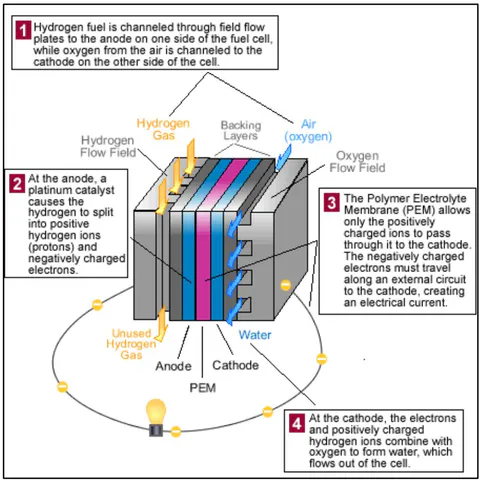
Fuel Cell Vehicles (FCV's) are electric vehicles powered by hydrogen fuel cells instead of batteries (batteries are still used albeit on a smaller scale to capture energy from the regenerative braking system, to be used when extra power is required). Hydrogen fuel cells convert hydrogen into electricity using a Proton/ Polymer Electrolyte Membrane (PEM) and Platinum catalyst at the anode which is then used to power the vehicles electric motor. Figure 1.0 illustrates how a typical PEM Hydrogen Fuel Cell works (Fuel Economy, 2023).
At the major vehicle component level there is very little difference between a fuel cell vehicle and electric vehicle with only the power sources and the hydrogen fuel tank the major differences. Figure 1.1 illustrates a Fuel Cell Vehicle vs. Electric Vehicle (AFDC, 2023 and 2023a).
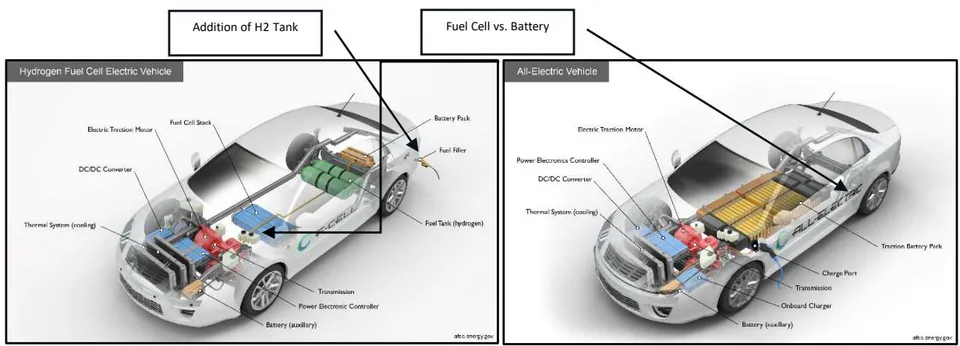
The benefit of FCV's is the use of hydrogen as fuel instead of large battery cells such as those in EV's, however it is critical that green hydrogen is used to ensure fewer carbon emissions, or the emissions argument is weak. Other benefits include less time to refuel with hydrogen versus EV recharging and a lower vehicle weight. A Tesla battery on average weighs 1190lbs (The Motor Digest, 2023) this extra weight negatively impacts stopping distance and inflicts additional damage to road infrastructure (Streets NM, 2016).
The downside of FCV's and likely the reason for slow adaption are numerous but three main challenges stand out, low voltage produced by the fuel cell, the cost of platinum for use as a catalyst and the absence of hydrogen fueling infrastructure. A typical fuel cell produces less than 1.16volts (Fuel Economy, 2023a) not near enough to drive an electric motor, therefore fuel cells are stacked together to achieve the desired voltage for example the Toyota Mirai has 330 fuel cells stacked together to power the 310-volt electric motor (Toyota, 2023). The fuel cell anode Platinum catalyst is a costly precious metal making fuel cell stacks prohibitively expensive. The biggest issue though is the absence of hydrogen fueling infrastructure, California leads the way in hydrogen infrastructure investment with the remainder of the US as of December 2023 having one hydrogen refueling station in Hawaii with others on the east coast under construction (GLP Autogas, 2024). The issue of available hydrogen infrastructure applies equally to the proposed hydrogen fueled internal combustion engine; however, a novel solution is proposed that significantly reduces cost and timeline for deployment.
c) The Hydrogen Fueled Internal Combustion Engine (H2 for ICE)
The public perception of the internal combustion engine (ICE) one could argue is flawed and by that, I mean that it is seen by the public as simply a gasoline or diesel engine for vehicles and nothing more, you can therefore reasonably conclude that the drive to abolish the internal combustion engine by governments
(CNET, 2023) is based on this perception. Fundamentally this is false, the internal combustion engine is nothing more than a heat engine that converts heat to mechanical work. Heat generation is through combustion of fuel with oxygen, usually air. Gasoline and diesel dominate as the preferred fuel for the internal combustion engine, however using hydrogen as a fuel is physically no different than using diesel or gasoline, at the same time hydrogen achieves the European ZEV standards. A zero carbon transportation system can only be achieved using hydrogen as a fuel while preserving our future demand for global population mobility.
Development of the internal combustion engine has historically always focused on gasoline or diesel as the primary source of fuel, however recent industry developments have focused on re-purposing the existing internal combustion engine to use hydrogen with on road trials expected mid-2024. The technology package for ICE conversion to hydrogen consists of three main activities, engine modification, vehicle integration, calibration and testing, all discussed below:
i. Internal Combustion Engine Modifications Required for Hydrogen Fuel
Maximizing reuse of existing components is critical as it reduces cost and ensures the simplest solution. Taking this into consideration repurposing the existing internal combustion engine involves, at the highest level, three fundamental tasks where original component removal or replacement is needed. There are many lesser sub-tasks that could be discussed, and these are also dependent on the type of engine being converted, but for the purposes of this discussion the focus is on three engine modifications:
- Removal of Exhaust Gas Recirculation (EGR): The primary function of the EGR system is to reduce nitrogen oxide emissions. This is achieved through routing a percentage of oxygen deficient exhaust gases back to the engine intake to limit peak combustion temperatures and thus limiting NOx production. Whether the EGR needs to be removed
or can be disabled will be determined through on road testing.
Intake Manifold Modification: Existing intake manifolds need to be modified for hydrogen fuel. Modification will likely be through adoption of a dedicated hydrogen manifold spacer that includes provision for hydrogen injection and pressure sensing along with ports to direct flow to the intake valves. A consequence of this modification and a vehicle integration task to be addressed is increased engine width.
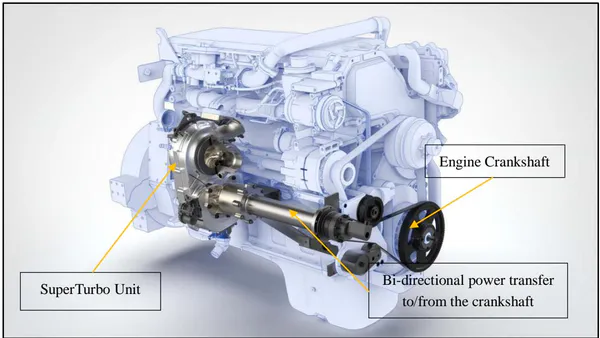
Boosting: Installation of a Super Turbo: The function of a Super Turbo is to allow increased performance and efficiency across the engine's range of duty
cycles. The Super Turbo is a mechanically driven turbocharger that enables bi-directional power transfer and speed ratio control between the turbocharger and the engine. It is an on-demand boost system that responds to the engine's command for air flow. (SuperTurbo Technologies, 2020) The Super Turbo enables the hydrogen engine to achieve the European ZEV standards while maintaining diesel or gasoline ICE power, efficiency and on road performance.
Figure 1.2 Innovative High Speed Traction Drive (SuperTurbo Technologies, 2020) illustrates a Super Turbo installed in a typical Internal Combustion Engine.
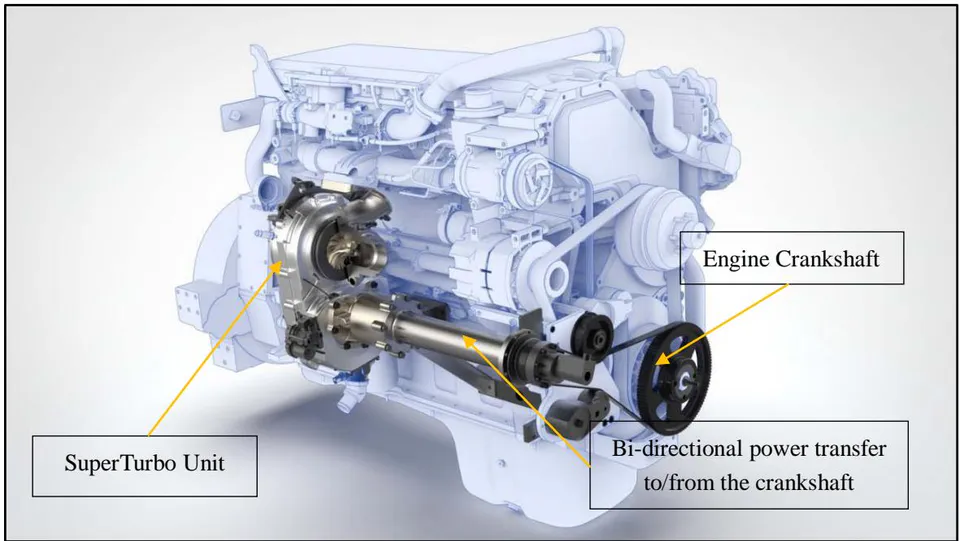
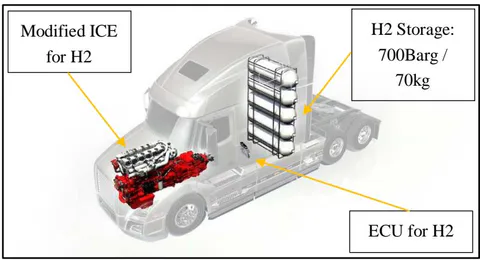
Figure 1.3 illustrates a hydrogen vehicle integration package using a Cummins base engine (Cummins, 2022).
ii. Hydrogen Vehicle Use Cases
Hydrogen fuelled internal combustion engines are currently being developed for Heavy Duty vehicles (any vehicle exceeding 26,000lbs) along with government research funding now being available for development of in ICE for the rail sector (US DOE, 2024). In the longer term when infrastructure starts to develop there is no reason that medium and light duty trucks along with passenger cars cannot transition to hydrogen fuelled internal combustion engines.
d) The Hydrogen Refuelling Platform
We already have global retail or service stations in place designed and optimized over decades for not only fuel but everyday items such as groceries, would it not therefore seem logical to repurpose this existing infrastructure for hydrogen? What would need to be done to the existing infrastructure to achieve this? Let's discuss the two technology platforms needed to repurpose existing infrastructure for hydrogen fuel on a global scale.
i. Hydrogen Forecourt Production Technology
The end goal is a zero carbon transportation system therefore, all sources of emissions need to be eliminated, whether being in supply, production, or demand. Forecourt production technology objectives are to eliminate supply and production emissions, there are two key activities:
On site production of green hydrogen: The proposal is to use the same in-situ modular AEM Electrolysis concept as discussed in 'Mobile Modular Hydrogen Power Generation – a Zero Carbon Energy System' (https://doi.org/10.5296/ijgs.v7i1.xxxx) to generate on-site green hydrogen with the electrolyzer capacity sized to expected daily demand. No other method of hydrogen production is considered.
Reduced Cost and Environmental Impact: Producing on-site hydrogen eliminates distribution via compressed gas trucking reducing significantly overall supply costs but more importantly eliminating all emissions from trucking. A standalone renewable energy source would need to be installed should the grid not be green.
ii. Hydrogen Retail Technology Platform
Retail sales of hydrogen have evolved very slowly and only to a small extent in California. To scale for a global market a hydrogen retail technology platform needs to focus on safety, quality, and customer experience with high utilization, there are three key activities:
Retail safety: Safe scaling of hydrogen fueling infrastructure requires focus on developing safety activities and standards that differ significantly from gasoline and diesel. Baseline safety standards are in place but need refining and developed further for highly utilized service stations in densely populated areas.
Hydrogen quality sensor: Off-spec hydrogen will damage internal combustion engines and can cause spurious emissions. Quality sensors to detect CO and water will need refining for high utilization.
Hydrogen dispenser design: Current dispensers are designed for dispensing on a small scale and require upgrading to accommodate high volume dispensing and further mistake and error proofing before mass adaption by the public.
iii. Comparing Future Fuel Vehicles
Table 1.0 compares the differences of biofuel, electric and fuel cell vehicles versus hydrogen for internal combustion engine (H2 for ICE).
Table 1.0: Comparison of Biofuels, Electric and Fuel Cell Vehicles vs. (H2 for ICE)
| Biofuel Vehicle | Electric Vehicle | Fuel Cell Vehicle | H2 for ICE | |
| Technology Readiness | 9 – System proven and operational | 9 – System proven and operational | 9 – System proven and in service at small scale | 7 – Prototype demonstrated; road trials planned |
| Benefit 1 | Fuel sourced from partly renewable sources | High on road performance | Zero on road emissions | Zero emission lifecycle |
| Benefit 2 | Low carbon fuel classification | Zero on road emissions | Supported by several states including California | Circularity and ability to repurpose existing engines and vehicles |
| Benefit 3 | Practicable interim solution | Access to EV charging solutions growing rapidly | Hydrogen fuelling infrastructure attracting investment | Equal performance versus gasoline engine |
| Benefit 4 | Starting to be price competitive with mass adaption | Hydrogen safety concerns already mitigated | Existing infrastructure can be used with modifications | |
| Issue 1 | Needs blended with gasoline and diesel | Environmental impact of battery materials including recycling | Needs fuel cells to be stacked to achieve required voltage for the electric motor | Hydrogen fuelling infrastructure needs to expand rapidly |
| Issue 2 | Social concerns. 'Food for fuels' | Fossil fuel charging is the norm not the exception | Platinum catalyst makes vehicle costly | AEM electrolysis technology needs fully proved at scale |
| Issue 3 | Lower fuel efficiency at higher blends E85 for example | Heavier vehicle negatively impacts infrastructure | Low power vehicle needs battery to boost under certain conditions | Low public awareness and still concerns with using hydrogen |
| Issue 4 | Needs specific flex fuel vehicles to be successful | High mileage needed for emissions to break even with ICE vehicles | Hydrogen fuelling infrastructure needs to expand rapidly | Scarcity of parts for hydrogen engine modifications |
III. DISCUSSION
Our modern transportation system has taken over a century to establish and often taken for granted is the scale it has achieved, the convenience provided through service or retail stations where you can purchase gasoline to groceries and quite simply how humanity could not function without this network that exists today. As already discussed, there are approximately 113,000 service stations in Europe, why not repurpose these to accommodate hydrogen as the zero-carbon fuel of the future?
Biofuel, electric and fuel cell vehicles present alternative solutions to reducing carbon emissions, some achieve this better than others, but none achieve hydrogen's lifecycle of zero carbon emissions.
Biofuels with their reliance on hydrocarbons for blending and the need for flex fuel vehicles are not the solution and electric vehicles are surely just an interim fix as we cannot ignore the environmental and societal impacts of mineral mining and the sources of electricity for re-charging. The USA as an example, generates most of its electricity from hydrocarbon fueled power stations, EV charging using renewable power is the exception rather than the norm. Fuel cell vehicles are an anomaly somewhere in between EV and H2 for ICE, but with no game-changing benefits for the user, coupled with the need for expensive precious metals as a catalyst and their longevity as a solution is questionable.
Hydrogen is the most abundant element in the universe and up until now there has been no reason to develop it as a source of fuel, but this needs to change. Hydrocarbon resources are finite, and we underestimate the transition from them to an efficient, globally accessible, and cost-effective alternative such as hydrogen at our peril. Using hydrogen as a pathway to a zero carbon transportation system comes with many challenges but they are not all conceptual we have engineered exceptionally efficient internal combustion engines, to not capitalize on them is a waste of technological progress, modifying them for hydrogen fuel is well within our technical capabilities. The infrastructure is in place but repurposing this is more a challenge to our 'Group Think' on energy transition solutions than a technical hurdle. Producing green hydrogen using AEM water electrolysis will be the production solution, scaling the electrolyzer output to the huge volumes needed for global transportation will be the final challenge.
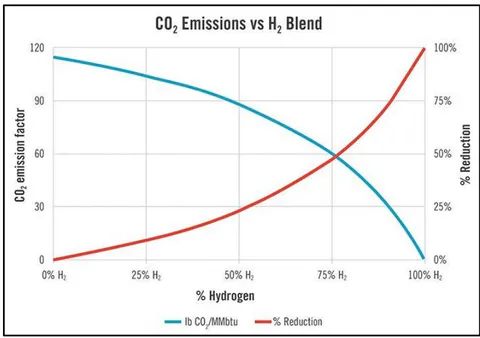
Lastly, I leave you with a very elegant graph that leaves no doubt the positive impact using hydrogen as fuel has on emissions. Figure 1.4 illustrates the relationship between emissions versus using hydrogen (Power Magazine, 2021).