Many sustainable practices to reduce footprints in scientific research have been described. Plenty were proven to reduce environmental impacts while not affecting data quality. However, many scientists struggle with initiating change due to a lack in sustainability orientated education. A thorough understanding of sustainable practices is urgently needed to enable efficient and safe implementation. Therefore, the focus of this review is to provide a comprehensive collection and discussion of practices in chemical, biochemical, biologic and medical laboratories. Amongst others, strategies to reduce plastic waste, lessen energy consumption, reducing footprints when handling equipment and optimizing protocols or procurement will be included.
## I. INTRODUCTION
To drive change safely, a thorough understanding of the specific processes involved is essential. However, one major limitation for the advance of sustainable practices is that many approaches are not published after peer review. This is in part due to the fact that sustainable practices aim at keeping research outcomes unaffected, thereby not generating new knowledge. Secondly, changes have to be tailored to individual circumstances, thus, making generalization difficult.
Nevertheless, impactful examples have been demonstrated, such as an 11-fold reduction in footprints by reusing labware[1] and a $43\mathrm{kg}$ reduction in plastic waste within a single month in a microbiology group adopting minimizing as a design principle[2]. Also, a range of informative guides have been published<sup>3-6</sup>.
Although a footprint in scientific research cannot be avoided due to the need of specific reagents, sterile work environments, and repeated replication, investigating options for sustainable practices is required to limit the steady growth of environmental pollution.
Growing awareness and increasing initiative are restricted by the lack of sustainability orientated education. Not just practical training but also the knowledge of alternative actions is missing. As a result, worries about potential process impairments prevail. Existing educational resources are often limited on a particular field. Furthermore, most are focused on a limited set of actions.
Therefore, this review covers sustainable opportunities in multiple fields such as chemical, medical, biochemical and even dry lab work. It offers both, general considerations as well as concrete actions alongside their benefits in reducing expenses, enhancing efficiency or improved cooperation. In essence, this review aims to equip scientists with a comprehensive understanding of what sustainable actions precisely entail. In the first third of this work, options for individual scientists are compiled. Later, actions that involve groups as well institutes and thus, address other professions are discussed as well (see figure 1).
## II. PRACTICES FOR INDIVIDUAL RESEARCHERS
### a) Reducing Plastic Waste
The issue of plastic waste stands as a prominent concern within many laboratories. Given the requirement of sterile work environments, plastic products are often the preferred choice. This is exacerbated by the low production costs and feasibility of large-scale manufacturing, which diminishes the incentive for recycling, despite existing recycling routes[7,8]. The COVID pandemic demonstrated the substantial use of plastic waste, with the major portion of about $97\%$ being incinerated[9-11]. Nevertheless, plastic labware is of high quality and purity due to the stringent requirements e.g., ensuring transparency, theoretically making them valuable in recycling processes.
To provide a memorable framework to lessen waste, the 3R framework—reduce, reuse, recycle—was established $^{12}$ and further expanded to encompass rethink, reject and repair within the 6R framework $^{13}$. In essence, one should be incentivized to reject practices that prevail due to convenience. Afterwards, one can identify alternatives through rethinking common approaches. This ultimately leads to reducing is not feasible, motivating recycling. How these principles can be translated into actionable steps, was addressed before[13].
## i. Reducing and Reusing
As shown in table 1, reduction can be implemented by using reusable materials like glass or by revising experimental designs to decrease number and minimize size of consumables. Studies in running laboratories indicate that such measures can result in a substantial reduction of up to $69\%$ in plastic waste which in turn reduce expenses significantly[2,14].
Reusing emerges as another powerful approach in reducing carbon footprints. In fact, reusing plastic articles can in some cases reduce impacts more strongly than the use of glassware[1]. For instance, optimizing pipetting sequences by adding solvents first, reusing tubes as containers for frequently needed solutions, or implementing tip washing procedures can significantly limit plastic waste[2]. Notably, these protocol optimizations not only reduce operational time but also decrease error frequencies due to heightened researcher awareness and better adherence to protocols. Reusing tips during noncontaminating procedures is also possible but should be considered meticulously given that repetition of experiments is even more costly.
## ii. Alternative Approaches
The type of plastic an article is made of can significantly alter its footprint. Lately, it was demonstrated that with proper reuse and recycling schemes in place, opting for deep well-plates made out of Polypropylene instead of Polystyrene can reduce footprints by about $70\%^{15}$.
Moreover, recent innovations such as pipette washing machines or technology like acoustic droplet ejection, which avoid the need for disposable tips entirely, have emerged[16].
In summary, it was shown that the reduction in plastic waste is achievable without compromising data quality or sterility, while resulting in cost savings<sup>1,2</sup>. Nevertheless, proper experimental planning offers further opportunities.
### b) Experimental Design and Conduct
While data generation remains of highest priority, adopting a sustainable approach motivates workflows optimization without affecting experimental outcomes (see table 2).
## i. Planning and Preparation
Although being an upfront investment of time, a comprehensive review of existing literature is instrumental in preventing unnecessary duplication. Of note, the goal is not to entirely avoid duplication but to motivate through interaction with previously published work. Unnecessary duplication not only goes along with a carbon footprint but also wastes times, energy and financial resources. Although it might feel less industrious to read than doing experiments, the long-term benefit can be substantial.
Of note, initiating collaborations or outsourcing experiments to core facilities proves advantageous, circumventing resource-intensive and time-consuming method establishment while fostering expertise and international cooperation.
## ii. Experimental Design and Strategizing
Time constraints and limited experience can often lead to suboptimal experimental design. As common practice in rodent focused research, statistical planning before starting a project can enhance power and thus, significance of results. As a result, this might offer opportunities to reduce sample sizes through optimized experimental design $^{17-19}$.
Outlying entire long term experimental plans will help with avoiding unnecessary experiments that are conducted because of missing perspective. Above that, it helps to deal with negative emotions when a series of experiments yields unsatisfying outcomes. Of note, long term planning also focuses on size and scope of preliminary experiments directed at initial hypothesis. Thus, initially variable and lean approaches are certainly welcome but require long-term planning to be of maximal value.
As widely appreciated, controls are crucial in every experiment. However, they should be chosen according to future research orientation. For instance, a control involving a painkiller may be valuable, but without understanding the painkiller's mechanism, subsequent studies may require additional experiments to account for analgesic effects.
## iii. Reviewing Experimental Conduct
Once a research framework is established, a close examination of current protocols and methods is useful. Exploring alternative analytical routes using combination techniques such as Liquid chromatography-mass spectrometry or non-invasive methods, for example, Near-infrared spectroscopy and Raman spectroscopy can enhance analysis without compromising samples[20,21]. This extends to considering the use of alternative chemicals for tasks like mounting slides or fixing samples, which also provide more safety for researchers[22-25]. Exchanging solvents and adjusting reagent quantities can yield substantial benefits, especially in the context of expensive chemicals or antibodies[26,27]. By the same token, reuse of materials such as nucleic acid extraction columns after regeneration is possible without carryover contamination as previously demonstrated[28].
Importantly, conscientiously archiving and sharing negative results contributes can minimize unnecessary repetition while providing useful information that is often forgotten later on.
Changes, like titrating antibodies to lower concentrations while changing incubation times, demonstrate how a focus on sustainability can simultaneously reduce environmental footprints, cut expenses, and improve data quality[29]. Other specific examples especially evolving around analytical methods such as chromatography, enable reduced running times, higher efficiency and reduction of handling toxic chemicals[27,30].
### c) Green Chemistry
Apart from the possibility to distill back solvents, few chemicals and reagents can be reused or even recycled, thus, being discarded on landfills<sup>31,32</sup>. Consequently, the concept of green chemistry emerged, aiming to mitigate environmental footprints. Numerous strategies, such as the 12 principles of green chemistry and other reviews offer a roadmap for making chemical research more sustainable<sup>21,33</sup>. In essence, these principles evolve around the conscious choices of chemicals, synthesis routes that reduce the use of environmentally impactful chemicals, and the avoidance of energy-intensive steps. Of note, exchanging solvents and alternative methods such as solid phase microextraction or optimizations for chromatography well reviewed elsewhere<sup>27,34</sup>.
While an immediate overhaul of experimental setups may not always be feasible, it is worth educating on these topics to enable future change. Materials for involving such topics in courses and lectures has been created and published<sup>35,36</sup>.
Nevertheless, it should be noted that there is no complete standardization of vocabulary and life cycle calculations. As a result solutions need to be chosen according to current circumstances, and undoubtedly a degree of subjectivity remains<sup>37,38</sup>.
### d) Computational Biology
The environmental impact of computational approaches often goes overlooked, despite the significant energy consumption with more than $15\mathrm{kg}$ of $\mathrm{CO}_{2}$ -equivalents for simulating a Satellite Tobacco Mosaic Virus for 100ns depending on the tool used[39-41]. Recently, useful principles and guides have been published to address this concern[42,43]. In general, the assessment of carbon footprints is of great importance, as these metrics offer a comprehensive understanding of the environmental impact and serve as a means to raise awareness. Various publicly available tools are designed to facilitate impact assessments, even for complex and energy-intensive tasks like training deep learning models[44,45].
While overarching actions, such as increasing code efficiency, implementing checkpoints, and conscious chose of both software and hardware, can be applied universally, tailored solutions have been developed for specific applications. Examples include optimizations in whole genome regression and neuroimaging studies $^{46,47}$. Undoubtedly, the development of more sustainable practices is urgently needed given the ubiquitous importance of modern computation versus outdated ways of operation.
### e) Avoiding Paper use
Reducing paper is trivial but often avoided given that printed materials provide a unique sensory experience. However, the adoption of digital solutions allows for convenient features such as highlighting, text searching, copy-pasting, bookmarking. Thereby functionality and handling to find notes even after long time periods are greatly enhanced. Additionally, sharing and forwarding becomes much easier. As addressed in table 3, when the use of printed materials is unavoidable, considerations should include opting for recycled paper, printing on both sides of the sheet, or utilizing already used sheets to minimize environmental impacts.
### f) Reducing Water Consumption
Efforts to enhance the sustainability of laboratories with respect to water usage are often closely linked to considerations of energy consumption. However, minimizing water use is possible by employing mechanical force or allowing impurities to soak during cleaning procedures. However, addressing water usage in laboratories remains a complex issue, influenced by geographical location.
Nevertheless, for many cleaning steps, tap water should be preferred, especially for the initial washing phase, as it is significantly less energy-intensive compared to using distilled or otherwise treated water and the feasibility given the large awareness of the issue[48]. Additionally, using ice consciously is beneficial given the energy costs for cooling down water.
### g) Lessen Energy usage
Since electricity costs are often not paid by research groups themselves, energy consumption is not of particular importance for many scientists. However, energy conserving practices often come with other benefits. Conscientious practice such as shutting the sashes on fume hoods or turning off machines can increase life times, for example, by avoiding unnecessary filter clotting[49]. Furthermore, trivial but inconvenient practices such as reducing the time doors of fridges and freezers are left open reduces frost accumulation that makes defrosting necessary. Even more importantly, this practice prevents the accumulation of ice-crystals on lids which cause unwanted air-exchange. The result can be temperature variances within the freezer and additional burden on compressors that become more likely to fail due to overload.
As mentioned in table 3, maintaining a well-organized cloud system for experimental data and ensuring tidy inboxes can enhance efficiency and reliability in finding data. If data is stored on a cloud, every additional backup should be made on hard drives to lessen energy consumption but also to ensure proper data security.
Another often overlooked source of energy consumption stems from the use of artificial intelligence and search engines. Of course, it is not possible to avoid the use of these technologies, however, preventing unnecessary use is certainly valuable.
### h) Personal Engagement
Quantifying one's own footprint is essential not only to provide much needed data but also to be able to monitor improvement. Although it is not easy, resources such as a tool that helps to calculate emissions exist[50].
Participating in conferences and meetings often is a highlight of academic work, but comes at a considerable carbon footprint $^{51,52}$. While travel is traditionally deemed essential for professional success $^{53,54}$, evidence suggests that the benefits of frequent travel are limited $^{51}$. Nevertheless, there are multiple avenues to address this issue, such as merely reducing flight frequency or implementing incentives to discourage excessive travel $^{55}$.
Moreover, also journal clubs and talk series can be designed more sustainably. For instance, opting for local colleagues instead of inviting speakers from foreign countries or transitioning entirely to online meetings is possible. Even if it involves using more interactive online software, these solutions can pave the way for new ways of exchange. For larger events that are mostly held in person, hybrid formats should be considered as a way to alleviate sustainable impacts but also allow scientists from disadvantaged backgrounds to participate.
If scientists present their work at conferences or their local institute, addressing sustainable practices is a great way to raise awareness and inspire colleagues. Thereby, it is easy to connect with like-minded scientists who may be hesitant to express their interest or seek advice. Furthermore, open sharing can lead to collaborative initiatives, including opportunities such as funding or invitations to publish papers on the topic.
Still, it remains crucial to extend consideration beyond personal travel, especially in research scenarios that involve the movement of patients or samples $^{52,56}$. Nevertheless, such decisions can often not be made by a single individual but require the consent of an entire group.
## III. GROUP FOCUSED ACTIONS
The effective and safe implementation of sustainable practices relies on individual researchers taking actions that are well integrated into the overall activities of their group.
### a) Internal Communication & Integration
Openly planning and discussing sustainable practices during lab meetings is crucial, not only to raise awareness but also to guarantee their proper implementation.
Furthermore, it can contribute to a strong feeling of unity by working on a common goal.
To start such discussions, it is feasible to animate team members to share the changes they learned about or already implemented in their protocols during their presentations. It is important to openly acknowledge the challenges that arise with change no matter how big enthusiasm might be. To ensure that sustainability remains an actively discussed topic even after successful implementation, dedicating a few minutes at the beginning or end of each meeting for exchanging new opportunities is often feasible. For very ambitious groups, planning entire sustainability meetings once every quarter is possible to ensure buy-in from all members, especially new ones.
Objections to attempted change should be handled with care and understanding. Given that sustainability is often considered a threat to established practices, proper communication and education are crucial. Changes should not be made unless a strategy is crafted that ensures that potential impairments in workflows are detected and readily reversible. Additionally, understanding priorities of superiors and addressing benefits beyond environmental protection can prove powerful. A rejection might demotivate and intimidate, but often it needs some time until decision makers open up to new approaches given they carry responsibility for overall success.
### b) Optimizing Procurement
According to a recent study, procurement could contribute to more than $50\%$ of the carbon footprint of a laboratory, particularly due to the substantial impact of scope 3 emissions, i.e., the emission in part caused by producers and shipments[57]. While the selection of products must align with the needs of scientific endeavors, ordering practices can be designed to be more sustainable (see table 4).
Establishing a robust management system is a first step that will also benefit laboratory operations greatly. The goal is to ensure that reagents and consumables are ordered only when necessary, but thereby guaranteed to be available when needed. Such systems are available as commercial software, relatively easy to code or even manageable as an Excel sheet. These systems can be integrated to monitor the location of reagents, significantly reducing search times for researchers. Even in underfunded settings, where priorities evolve around opting for the cheapest option, these systems can contribute to this end. The avoidance of ordering when items are still available as well as reinforcing choosing options with the smallest necessary volume while saving on delivery fees when ordering in bulk help cutting expenses. Furthermore, merely reducing ordering frequency by incentivizing long term planning and collecting order potentially across groups can reduce fees and footprints.
Undoubtedly, procurement strategies can only effectively be changed when feasible alternative exists. Although scientists have other priorities than comparing products, and deciding to order new articles always comes at a certain risk, sustainability should act as a motivator to at least monitor potential beneficial alternatives until change becomes possible. In fact, many companies have already adopted practices, such as reducing packaging or utilizing eco-friendly delivery methods e.g., shipping polymerases without cooling or oligos in powder form. Decisions can be based on the provider's location thereby reducing delivery times and minimizing reliance on supply chains. Some providers offer take-back programs or engage in other sustainable practices, making them preferable choices.
Reading life cycle analyses for products may require considerable effort and is highly dependent on specifics. By the same token, caution is needed, as green washing and carbon offsetting remain problematic practices. As a solution, information by initiatives and certification programs offer guidance for choosing more sustainable products.
### c) Using Equipment Sustainably
As mentioned before, groups often do not pay for the energy consumption themselves but in many cases parts of their grants are deducted from the institute for those expenses. Therefore, conscious choices for less energy machines can help to partially reclaim those. However, a plethora of other benefits goes along with sustainable practices as well.
## i. Choosing the Right Equipment
When acquiring new machines, special care should be taken given that many companies offer equipment that reduces reagent use, has optimized components or even makes use of alternative working procedures (see table 5). For instance, for mass spectrometers this could be reduced nitrogen consumption. For chromatography this could mean a reduced inner diameter of the columns. More advanced changed could involve switching to hydrogen as a more sustainable carrier gas for GC/MS or even alternative cooling mechanism and refrigerants for freezers $^{58}$. Indeed, the various models available can be overwhelming at first but conversations with salespeople can help. Often, these interactions can also inform about new methods that are dedicated to certain experimental questions. Of note, in cases of sterilizers, ovens and incubators capacity is an important factor to be considered.
However, it is not always feasible to replace, for example, water baths with more efficient alternatives.
Then, proper use can be important, for example, by using covers to prevent evaporation of the heated water. Finally, addressing equipment that is not used anymore is advised. This can involve repairing old machines or selling machines on the secondary market. At this point it should be also mentioned that buying secondhand machines with proper refurbishment-certification can improve finances. Of note, also programs to donate machines with laboratories in developing countries can be explored. Nevertheless, how long a machine will be in action depends on its operation.
## ii. Operating Machines Effectively
Operating machines sustainably fundamentally refers to increasing lifetime and reducing unnecessary expenses.
Given the rise of very complex softwares and hardwares proper operation and maintenance often require sa deeper understanding than the limited set of functions a single researcher needs would require. Indeed, the stressful settings in which scientists work makes general introduction often appear sufficient. Investing in more elaborate introductions should avoiding damages that occur by accident and adequate handling when incidents happen[59]. Ordering engineers when issues are irreparable goes along with high prices and also long waiting times and thus, downtime of machines. Furthermore, often seldomly used features can offer improvements for certain experiments and analyses.
Ensuring proper use of fume hoods, contributes to ensure protections of researchers health. Additionally, maximizing use of samples and test resins, for example, in mass spectrometry target plates or deep well plates, should be prioritized above convenience. Without doubt, settings and resulting running times should be considered in detail but have to be optimized for every piece of equipment and experiment individually. Still, they offer opportunities for improving sample integrity, while potentially reducing reagent and energy consumption.
### d) Reducing Energy and Water Consumption
Another way to reduce electricity consumption is reducing the operating times of machines. In turn, this will also reduce wearing off components and thereby save on expenses and downtime. Especially for sterilizers, it was shown that energy requirements can be reduced significantly, about $26\%$ in one case when completely turned off in times they are not in use[61,62]. Therefore, it is often useful to create an energy plan and make everybody aware of which machine can be turned off and under which conditions. Also, how different features are used such as settings when scanning with modern high resolution microscopes or the holding temperature of PCR cyclers are factors to be considered.
Efforts to reduce water expenses in machines are often not immediately apparent and more difficult to implement, but they play a crucial role in promoting sustainability. One effective strategy involves implementing close cycle cooling, particularly in cases of condensers. These alternatives can significantly decrease water consumption and contribute to resource conservation. Additionally, installing low-flow aerators on faucets is a straightforward yet impactful step. Lowflow aerators control the flow of water from faucets, reducing the overall water usage without compromising functionality.
Furthermore, actions mirroring those taken at home can adopted. Those include using multi-plugs to completely shut down equipment when not in use, turning off lights, and running dishwashers at full capacity.
Moreover, optimizing the settings of freezers from $-80^{\circ}\mathrm{C}$ to $-70^{\circ}\mathrm{C}$ is a frequently discussed practice that allows for remarkable savings on energy. Various initiatives work on list for samples that did not suffer from such a change, especially given that $-70^{\circ}\mathrm{C}$ was the common operating temperature a few years ago. While a detailed discussion is not feasible at this point, open discussions should be had given that some "buffer" in case of failure can be avoided by proper monitoring while regulations for the storage of certain samples must be addressed on other levels. Still, best practices include defrosting and cleaning of filters and compressors that will contribute to longer lifetimes and lower energy consumption as well. Proper organization of samples remains key to ensure time efficient workflows. Especially in academic research environments, proper planning early on will also enable to only keep selected samples instead of losing track of contents because of retaining every specimen without clear organization.
### e) Handling Waste Properly
Handling waste in laboratories is a critical aspect, ensuring both the safety of researchers and the protection of the environment downstream.
Theoretically is required to be familiar with all chemicals used, and general introduction are given. Still, clearly pointing out that these practices should protect the health of researchers and nature is crucial to provide an intelligible motivation that goes beyond a mere rule. Then, motivating scientists to create their own guides and overviews of how consumables and chemicals should be treated can offer a much more powerful and efficient way to have every member engaged with the topic.
Given that chemical-related incidents are the most common in harming scientists, making best practice a habit is essential[59]. Preventing evaporation is an insightful example. Finishing work due to stress is often of higher priority, thus, chemicals are handled wherever feasible, thereby endangering colleagues as well. Even when working in hoods, evaporation poses danger to scientists in case they do not adhere to best practices but more importantly, chemicals still freely dissipate into nature.
Nudging is a simple but often helpful way to boost adherence to best practice (see table 6). Labeling waste bins and centonates with easily graspable visual explanation or articles helps differentiate where specific types of waste should be disposed while serving as a constant reminder. Ensuring proper separation is crucial because failures can render entire fractions of waste unre cyclable.
Reusing old flasks or containers and participating in takeback programs offered by some companies, offer further options. In contrast, addressing the proper handling of items such as cooling packs, animal bedding, and Styrofoam is more challenging. While composting and recycling is possible, initiation often falls to individual groups.
Old pipettes and broken glass can be repaired through university facilities and technicians. Lab coats can easily be reused. Although it often needs a responsible person to take care, these practices often involve not more than proper organization within a particular group.
### f) Improving Organization
Sustainability should be implemented without causing too much pressure on individual members. To do so laying out a strategy can be of tremendous value. As discussed before, that means open communication (see table 7). Additionally, implementing features from "Smart-Labs," that aim to connect software and hardware to improve processes such as database operation, monitoring, or ensuring access to information at any time can help. These systems can approximate footprints, monitor energy consumption, and prevent catastrophic sample losses by alerting to freezer failures. Tracking and organizing samples and experimental outcomes contributes to a well-structured data system, allowing insights even years after experiments were conducted. While these changes may initially seem technological and involve costs, the long-term efficiency gains make them valuable investments for laboratory sustainability.
Optimizing lab space utilization is valuable both in terms of monetary aspects especially for facilities while facilitating a safer and more efficient workflow for individual scientists. Insufficient space or too long distances between workspaces can cause avoidable accidents that might impair results or prevent data acquisition entirely. However, some of these changes have to be approved by other groups or even the entire institute.
## IV. INSTITUTE-WIDE CHANGES
Sustainability is a multifaceted topic, and it is essential for both grassroots initiatives and top-down approaches to complement each other, as discussed elsewhere[63]. Currently, grassroots initiatives are more prevalent, however, the significance of top-down approaches should not be underestimated.
### a) Leveraging Governance
Institutes play a crucial role in promoting sustainability by issuing guidelines and regulations that can create a much needed framework for sustainable actions. These changes could even be enforceable, thus providing a strong momentum. As included in table 8, guidelines are essential to facilitate buy-in from superiors and overcoming inertia, especially considering the novelty of the topic.
These guidelines can include proper waste separation with providing necessary bins and infrastructure. Institutes often also have control over electricity and air conditioning as discussed below. Of note, making laboratories report about their use of energy, water or waste generation is an easy way to raise awareness and collect valuable data.
Without doubt, establishing such guidelines can be challenging due to the variability of techniques used in laboratories and the difficulty to not hinder research. Still, institutes and universities optimize towards more sustainable actions also outside the laboratory. These processes can be used to initiate support for scientific endeavors as well. A remarkable example is the Laboratory Efficiency Assessment Framework that was developed at the University College London. Of note, a number of other universities share their sustainability guidelines that were created by scientists, such as the University of Pennsylvania Green Labs program or the Sustainable Labs by the Sustainability Office from Harvard University.
Whatever steps are taken, institutes adapting strategies early will benefit when political regulations and enforcements are introduced. How well these new regulations will be received might also depend on how these are introduced internally and how easily staff can adopt.
### b) Internal Communication and Strategizing
Institutional communication is vital even if often considered trivial. Clearly stating values and priorities can happen in dedicated meetings, through newsletters, or specifically organized get-togethers. Making such activities focused on providing value to and listening to challenges that occur when implementing sustainable practices can foster a sense of community engagement. Educational resources can be created internally or by cooperating with external initiatives that often come with a plethora of experiences. Offering support for projects evolving around assessing footprints and drafting solutions allows for excellent insights into current circumstances. An outstanding example is the University of British Columbia providing a plethora of financial support for such projects to engage and use their human resources.
### c) Enhancing Organizations Structurally
However, learning about sustainability is often demanding. Establishing roles like green lab experts or sustainability managers can accumulate expertise and provide positions with the necessary recognition, capacity, and judgment to drive change. While such roles are still relatively new and clear requirements are difficult to establish, they come with the needed variability to help groups individually. Their role can involve screening, evaluating, and advancing sustainable actions. By the same token, they can also help to combat the challenge of high turnover rates and personnel that is often encountered in scientific environments[64].
Regarding future benefits, sustainability efforts can contribute to branding and attracting new talent, showcasing engagement and responsible action. As mentioned before, the University of British Columbia is a great example that is famously known for its commitment to sustainability.
Although less common, institutes have the ultimate authority to establish guidelines for sustainable procurement, influencing the choices made by researchers and administrators. As mentioned above, creation often requires effort but will serve as a scaffold for the entire institute thereby aligning with future requirements.
While the scope of this review may not cover cafeterias, addressing ways to reduce their environmental footprint and waste generation is an additional aspect worth considering.
### d) Selecting Third Parties Carefully
Handling third parties that provide electricity, take care of waste and are responsible for refurbishment or construction of laboratories plays a role in sustainable conduct as well.
While it is the responsibility of scientists to appropriately separate waste, institutes can play a vital role in educating their researchers on proper waste separation. Furthermore, selecting a third-party waste management service that ensures proper handling is necessary to ensure that waste is actually recycled downstream. Of note, effective recycling but also mitigates potential dangers to overall health associated with improperly treated waste are resulting $^{65,66}$.
Designing and planning new laboratories with sustainable practices in mind, or choosing a $3^{\text{rd}}$ party that has expertise in this area, is beneficial. These measures should include commonly known aspects such as efficient laboratory design. Above that, they might comprise also less obvious measures, for example, where and how to incorporate emergency power systems. Of course, one essential aspect in such planning includes the setting ventilation and heating systems.
### e) Addressing HVAC
The Heating, Ventilation, and Air Conditioning (HVAC) systems in laboratories are often overlooked by scientists due to limited experience and expertise in this field. However, optimized strategies in HVAC management as summarized in table 9, can significantly contribute to reducing the overall environmental footprint, with potential reductions of up to $50\%$ [67]. Institutes or specialized technicians have the opportunity to adjust and decrease air flows in laboratory spaces, particularly with the capabilities of modern systems that allow for close monitoring and variation. Merely adjusting air flow has been shown to yield reductions in energy consumption of about $18\%$ by Kitzberger et al.[68]. Air conditioning should regularly be reviewed given that levels are seldomly reported or changed.
Furthermore, the organization of freezers and the set temperature in these rooms are crucial considerations for ensuring their proper functioning. Freezers should be orientated so that exhausted air can easily dissipate. Temperatures at different locations within a room should be closely controlled given that extreme temperatures can lead to a higher probability of freezer failures. Although best practices have to be guided by individual circumstances, paying attention to avoiding obvious blunders can often reduce unnecessary footprints significantly.
## V. DISCUSSION
The numerous actions can be taken in the pursuit of environmental protection also enable cost savings, time preservation, enhanced workflows, or in some cases improved data quality (see figure 2). The key is to choose initial steps that align with the scientist's experience and that can be effectively integrated into current circumstances. Informing and involving the entire team or institute is crucial, as colleagues may harbor more passion for sustainability than initially apparent.
Even if far-reaching changes are not immediately feasible, initiating discussions, openly communicating, and refining current training practices hold significant potential, although they may initially seem less tangible[69].
Scientists and staff should not be overwhelmed by the multitude of possibilities but start small with clear goals and manageable expectations. Changing habits takes time, and unforeseen challenges will arise. However, with experience, approaches and understanding will evolve.
Although many examples of successful implementation of sustainable practices are not formally published in papers, internet searching will provide a multitude of insights. By the same token, many initiatives can be found that offer help, guidance and shared experiences.
Nevertheless, is important to refine the current apprehension of sustainability. In a research context, sustainability must be implemented beyond merely political or ideological agendas. Sustainability orientated thinking offers a new perspective combining environmental, societal, psychological and economical aspects. It is an approach that maintains the ultimate goals of science but emphasizes the rather hidden opportunities to increase efficiency. Sustainability is not an obligation, it is an opportunity, both for better preserving our ecosystems and further optimizing scientific workflow.
Table 1: A Summary of Options to Reduce Waste
<table><tr><td>Choosing providers that avoid unnecessary packaging or opt for more easily degradable solutions like paper</td></tr><tr><td>Reducing plastic waste in the laboratory can be achieved by: · Using alternatives such as glass or metal items for flasks, dishes, serological pipettes and weighing boards · Minimizing the size of consumables (especially tubes, serological pipettes, pipette tips) · Pouring solutions where precises volumes are not decisive (e.g., washing steps) · Reusing Falcon tubes, potentially after rinsing, especially for frequently used solutions · Reusing pipette tips, tubes where cross-contamination is not an issue</td></tr><tr><td>Precise calculation and bulk preparation of reagents and solutions</td></tr><tr><td>Conscious use of gloves</td></tr><tr><td>Making use of take-back programs for plastic items, including Styrofoam</td></tr></table>
Table 2: A Summary of Options for Improving Experimental Conduct and Design
<table><tr><td>Proper experimental planning can be achieved by:
• Leveraging existing literature to avoid redundant experiments
• Robust statistical planning (especially power analysis) help reduce sample sizes and enhance statistical validity
• Carefully chosen experimental conditions with proper controls
• Reviewing consumable utilization ahead of conduct (including material, size and number of consumables)
• Preparation procedures (e.g., optimizing pipetting schemes and master-mixes to reuse tips and tubes)
• Adopting safer and more benign alternatives for commonly used reagents in experiments (e.g., DNA staining solutions, microscopic slide mounting agents, lysing agents, or protease inhibitors)
• Alternative experimental approaches (e.g., using Supercritical fluid chromatography (SFC) to avoid organic solvents needed in HPLC)
• Consider potential for downstream use or regeneration (e.g., regeneration of nucleic acid extraction columns)</td></tr><tr><td>Implementing strategies and frameworks to ensure best practices (e.g., handling pipettes upright when pipetting)</td></tr><tr><td>Awareness of toxicity of reagents in use for proper handling and discarding (e.g., including closing lids to avoid evaporation)</td></tr><tr><td>Initiating collaboration with
• Colleagues in co-preparation of solutions, sharing of samples or co-use of machines (e.g., water baths)
• Other groups to share equipment
• Core facilities or partners to avoid unnecessary establishment of new methods</td></tr><tr><td>Implementing the 12 rules of Green Chemistry, including</td></tr><tr><td>• Conscious solvent and reagent selection (according to safety, LCA and impact assessment, e.g., Ethanol instead of Acetonitrile)
• Optimize procedures by using catalyzers and reducing resource-intensive processes like heating or distillation
• Using renewable feedstock and designing products for degradation</td></tr><tr><td>Refining computational experiments by:
• Adapting practices that reduce running times and optimize code efficiency
• Measuring carbon footprints (and potential reductions)
• Considering relocating computational tasks to energy-efficient data centers
• Planning to run jobs during times of low demand
• Implementing check pointing strategies to streamline computational processes and reduce unnecessary energy consumption
• Storing only essential data for regenerating large datasets, reducing energy demands and use hard drives instead of cloud-storage only
• Avoiding usingscreensavers to minimize needless energy consumption
• Selecting energy-efficient hardware especially when buying anew</td></tr></table>
Table 3: A Summary of Sustainable Practice to Reduce Paper, Water and Energy use
<table><tr><td>Paper</td></tr><tr><td>• Transition to digital sources like electronic lab journaling and online publications</td></tr><tr><td>• When printing is necessary, using recycled paper and opt for double-sided printing on previously used paper</td></tr><tr><td></td></tr><tr><td>Water</td></tr><tr><td>• Minimize water use, for example by soaking steps and mechanical cleaning</td></tr><tr><td>• Consciously discern water types (tap, distilled, double distilled etc.)</td></tr><tr><td>·Use only as much ice as needed</td></tr><tr><td></td></tr><tr><td>Energy</td></tr><tr><td>·Regularly organizing and cleaning digital inboxes to prevent unnecessary data storage</td></tr><tr><td>·Maintain a tidy system for experimental data, avoiding unnecessary duplication and keeping a safety copy securely stored on a hard drive</td></tr><tr><td>·Exercise caution with AI technologies and use of search engines due to their potential high energy consumption</td></tr><tr><td>·Evaluate the necessity of video in online meetings and switch to audio-only when possible to minimize data and energy usage</td></tr><tr><td>·keep laboratory fume hood sashes shut and turn machines off when not in use (e.g., water baths)</td></tr></table>
Table 4: A Summary of Changing Procurement and Purchasing Processes to be More Sustainable
<table><tr><td>Planning orders carefully by:
• Creating an internal system to track chemical inventory and consumable supplies to minimize unnecessary orders
• Collaborating with other laboratories or facilities to collect orders</td></tr><tr><td>Choosing products consciously by:
• Procuring items in quantities aligned with future usage
• Emphasizing sustainable packaging practices, favoring minimal material usage and biodegradable materials where possible
• Opting for specific shipping methods and alternatives to conventional cooling methods (e.g., when ordering polymerases without cooling or oligos dry)
• Thoroughly evaluating feasible alternatives based on certifications, life cycle analyses, and sustainability practices</td></tr><tr><td>Choosing the optimal supplier
• Preferring local suppliers to reduce transportation-related emissions and dependency on global supply routes
• Preferring certified suppliers and articles
• Exploring take-back programs and consider second - hand purchases to enhance sustainable procurement practices</td></tr></table>
Table 5: A Summary of Actions for Sustainable use of Equipment
<table><tr><td>Choose instruments with reference to lifetime (e.g., photomultiplier tubes have longer lifetimes) capacity (e.g., volume of sterilizers & autoclaves) components (using low-boiling-point solvents in air-cooled condensers to reduce energy consumption)</td></tr><tr><td>Running equipment that minimizes reagent use (e.g., Nitrogen consumption in MS or HPLC columns with smaller inner diameter to reduce solvent consumption and waste creation) enables change to more sustainable alternatives (Hydrogen as carrier gas instead of He in GC/MS) enables internal reuse (e.g., automated recycling of the mobile phase for example after absorption of the impurities)</td></tr><tr><td>Making a conscious choice about what methodology to use (e.g., wet vs dry blotting, on site analysis, high throughput analysis, combination techniques such as LC-MS)</td></tr><tr><td>Exercising best practices (e.g., not let elution fractions from chromatography columns evaporate or using all spots on matrix array plates for MS, putting as many samples on one microscopy slide as possible)</td></tr><tr><td>Being aware of the robustness of methods (e.g., ability to reuse TLC capillaries after rinsing)</td></tr><tr><td>Reducing energy use by:
·Developing an energy plan, i.e., when to turn on and off individual machines
·Using strategies like multi-plugs to turn off ovens and water baths during inactivity or employing smart plugs for automated on/off cycles
·Considering carefully how you use equipment (e.g., the holding temperature of PCR-cyclers or settings including scanning area in microscopy)
·Modifying freezer temperatures, such as increasing from -80 to -70
·Using covers for water baths and replace oil baths with more efficient alternatives like metal heating blocks or efficient oil pumps
·Operating dishwashers and autoclaves only at full capacity
·Consciously choosing levels for the A/C set-up</td></tr><tr><td>Reducing water use by
·Implementing low-flow aerators to conserve water
·Using closed-cycle cooling systems and waterless liquid-cooled condensers with low-boiling-point solvents as an alternative to single-pass cooling methods</td></tr></table>
Table 6: A Summary of Sustainable Practices that Optimize Waste Treatment
<table><tr><td>Making sure that evaporating waste is handled properly (e.g., stored in a hood or closed container)</td></tr><tr><td>Using old jerry cans/flasks/container as waste containers (or already contaminated tubes)</td></tr><tr><td>Create a plan how to handle cooling packs, animal bedding, Styrofoam etc</td></tr><tr><td>Establishing education and indication systems (e.g., exhaustive stickers on waste bins, using and a database with necessary educational resources)</td></tr><tr><td>Repairing broken glassware and old pipettes</td></tr></table>
Table 7: A Summary of Changes for Internal Organization to Align with Sustainability as a Priority
<table><tr><td>Exploring "Smart-Lab" innovations to monitor and quantify lab processes (e.g., monitoring old freezers to control failures or assess energy consumptions)</td></tr><tr><td>Have open conversations and discussion in lab meetings</td></tr><tr><td>Reusing Labcoats</td></tr><tr><td>Freeing and optimizing use of lab-space by:</td></tr><tr><td>• Only buying/installing equipment that is certainly needed
• Promoting the use of spacing or energy saving alternatives e.g. ventilated storage cabinets instead of fume hoods for storage
• Encouraging the removal of unused equipment</td></tr></table>
Table 8: A Summary of Possibilities to Include Sustainability in Institute Governance
<table><tr><td>Creating clear guidelines, regulations or position papers</td></tr><tr><td>Creating a position for a Sustainability Manager/Green Lab Expert</td></tr><tr><td>Conscious assessment of space use and encouraging shared utilization of equipment</td></tr><tr><td>Consciously choosing 3rd parties (e.g., for waste treatment or power providers)</td></tr><tr><td>Initiating conversations with cafeteria staff to explore ways to mitigate their carbon footprint</td></tr></table>
Table 9: A Summary of Practices to Optimize HVAC in a Sustainable Fashion
<table><tr><td>Adjusting and decreasing air flow within laboratory spaces during periods of inactivity at night or during vacations</td></tr><tr><td>Prioritizing smart design principles when constructing new laboratories (e.g., including proper insulation, strategic window and vent placement, strategic placement and employment of emergency power systems)</td></tr><tr><td>Precisely reviewing and setting A/C levels</td></tr><tr><td>Organizing freezer placement and air conditioning systems properly to ensure efficient air circulation</td></tr><tr><td>Removing or replacing energy inefficient equipment (e.g., sucking pumps)</td></tr></table>
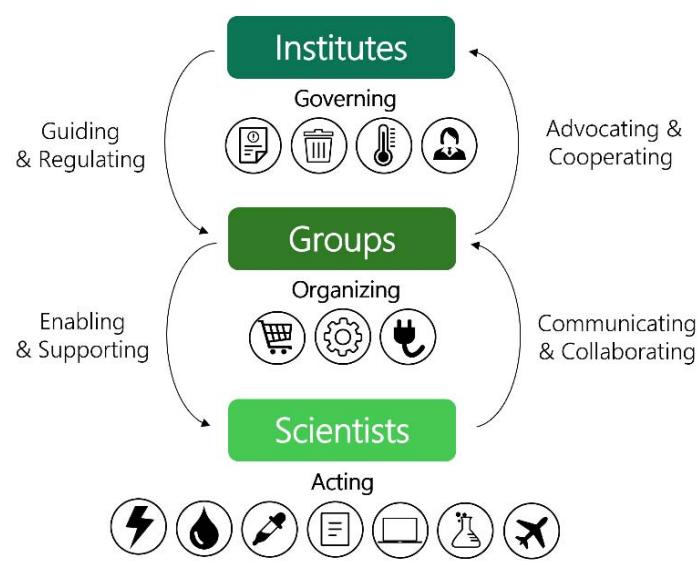 Figure 1: Sustainable actions within a research environment need to be implemented on multiple levels. Institutes play a pivotal role by providing guidance and regulations for research groups. Beyond governance, they are responsible for organizing third-party involvement in waste processing or HVAC management. The appointment of a green labs manager can be beneficial in coordinating these efforts. Research groups and Principal Investigators are essential in implementing these guidelines while their voice in advocating for further sustainable changes is often required. Groups need to organize purchasing, machine handling, energy consumption, and internal practices, facilitating discussions and enabling scientists to adopt sustainable practices. Individual scientists have a range of sustainable options to implement, including reducing energy, water, chemical, paper, and plastic consumables, and optimizing experimental strategies in both dry and wet lab research. Additionally, individual actions like opening sharing practices during meetings or talks and reducing international travel help to minimize environmental footprints. Effective communication of these actions and collaboration within groups are crucial to ensure the safe implementation of changes and gain support from superiors
## Sustainable Practices
Institutes
Groups
Scientists
 Panel label: Future Compliance.
 Panel label: Reduced Expenses.
 Panel label: Enhanced Teamwork.
 Panel label: Increased Efficiency.
 Panel label: Increases Safety.
 Improved Data Quality Figure 2: Sustainable practices implemented reduces environmental impact by enhancing efficiency and effectiveness of laboratory processes. For instance, establishing sustainability positions institutes and laboratories well for the future, where regulations may be introduced, and applications for funding may include the establishment of sustainable practices. Adhering to the principle of reduction in sustainability often results in decreased expenses, stemming from reduced consumption of consumables, chemicals, and energy. Choosing more benign reagents and chemicals inherently enhances safety. Reviewing laboratory processes and optimizing machine operations not only increases efficiency but also fosters improved teamwork, as sustainable changes require awareness and participation from all team members. Proper planning and optimization of experimental strategies and protocols can elevate data quality and increase statistical robustness. Although these benefits can be considered separately, benefiting one actor will reinforce their commitment and support for the establishment of sustainable practices at other levels
Generating HTML Viewer...
References
64 Cites in Article
Martin Farley,Benoit Nicolet (2023). Re-use of laboratory utensils reduces CO2 equivalent footprint and running costs.
Joana Alves,Fiona Sargison,Hanne Stawarz,Willow Fox,Samuel Huete,Amany Hassan,Brian Mcteir,Amy Pickering (2021). A case report: insights into reducing plastic waste in a microbiology laboratory.
Thomas Freese,Renate Kat,Suzanne Lanooij,Tanja Böllersen,C De Roo,Nils Elzinga,Meagan Beatty,Brian Setz,Roza Weber,Irene Maltagliati,Timea Gandek,Peter Fodran,Robert Pollice,Michael Lerch (2023). A guidebook for sustainability in laboratories.
Francesca Farlie,Giles Palmer,Jacques Cohen,Charles Calcagni,Anna Gorbunova,James Lawford Davies,Carol Loscher,Roisin O'raghallaigh,Timothy Sharp,Daniela Smale,Pernilla Sörme,Cassandra Thiel,Alessandra Alteri,Alison Campbell,Kirsty Crompton,Sharon Mortimer,Valerio Pisaturo,Annelies Tolpe,Mina Alikani (2024). Sustainability in the IVF laboratory: recommendations of an expert panel.
Logan Leak,Janina Tamborski,Antony Commissaris,Jennifer Brophy (2023). Forging a path toward a more sustainable laboratory.
Joseph Lopez,Tony Badrick (2012). Proposals for the mitigation of the environmental impact of clinical laboratories.
Ichiro Tsuchimoto,Yuya Kajikawa (2022). Recycling of Plastic Waste: A Systematic Review Using Bibliometric Analysis.
Tadele Aragaw,Bassazin Mekonnen (2022). Understanding disposable plastics effects generated from the PCR testing labs during the COVID-19 pandemic.
Shahrah Al Qahtani,Fatimah Al Wuhayb,Hacene Manaa,Adnan Younis,Shama Sehar (2022). Environmental impact assessment of plastic waste during the outbreak of COVID-19 and integrated strategies for its control and mitigation.
José Celis,Winfred Espejo,Esteban Paredes-Osses,Sonia Contreras,Gustavo Chiang,Paulina Bahamonde (2021). Plastic residues produced with confirmatory testing for COVID-19: Classification, quantification, fate, and impacts on human health.
Laura Howes (1904). Can Laboratories Move Away from Single-Use Plastic?.
Patrick Penndorf,Johannes Jabs (2023). A new approach to making scientific research more efficient – rethinking sustainability.
Jane Kilcoyne,Yvonne Bogan,Conor Duffy,Toni Hollowell (2022). Reducing environmental impacts of marine biotoxin monitoring: A laboratory report.
Qing Guo,Xiao Su,Xingguo Zhang,Mengchuan Shao,Haixia Yu,Dachao Li (2021). A review on acoustic droplet ejection technology and system.
Wan Wan Mohammad (2017). Sample Size Calculation in Animal Studies Using Resource Equation Approach.
V Bonapersona,H Hoijtink,R Sarabdjitsingh,M Joëls (2019). <i>RePAIR</i> : a power solution to animal experimentation.
V Bonapersona,H Hoijtink,R Sarabdjitsingh,M Joëls (2021). Increasing the statistical power of animal experiments with historical control data.
D Bakkalci,M Farley,F Kessler,U Cheema (2023). Charting our sustainability journey within the Division of Surgery and Interventional Science at University College London.
Paul Anastas (1999). Green Chemistry and the Role of Analytical Methodology Development.
Rubayat Rezoana,Latifa Akter,Rafiqul Islam,Sonali Bhakta,Ummay Ayman,Mohammad Rabiul Karim,Ziaul Haque (2022). The hazardous effects of formalin and alcoholic fixative in mice: A public health perspective study.
Kevin Bourzac,Lori Lavine,Margaret Rice (1292). Analysis of DAPI and SYBR Green I as Alternatives to Ethidium Bromide for Nucleic Acid Staining in Agarose Gel Electrophoresis.
Reena Kandyala,Sumanth Raghavendra,Saraswathi Rajasekharan (2010). Xylene: An overview of its health hazards and preventive measures.
Md. Rahman,Nasrin Sultana,Ummay Ayman,Sonali Bhakta,Marzia Afrose,Marya Afrin,Ziaul Haque (2022). Alcoholic fixation over formalin fixation: A new, safer option for morphologic and molecular analysis of tissues.
Ángela López-Lorente,Francisco Pena-Pereira,Stig Pedersen-Bjergaard,Vânia Zuin,Sibel Ozkan,Elefteria Psillakis (2022). The ten principles of green sample preparation.
Heba Mohamed,Green (2015). Green, environment-friendly, analytical tools give insights in pharmaceuticals and cosmetics analysis.
Nagadenahalli Siddappa,Appukuttan Avinash,Mohanram Venkatramanan,Udaykumar Ranga (2007). Regeneration of Commercial Nucleic Acid Extraction Columns without the Risk of Carryover Contamination.
Carly Whyte,Damon Tumes,Adrian Liston,Oliver Burton (2022). Do more with Less: Improving High Parameter Cytometry Through Overnight Staining.
H Shaaban (2016). New insights into liquid chromatography for more eco-friendly analysis of pharmaceuticals.
Tomris Ozben,Mariana Fragão-Marques (2023). Chemical strategies for sustainable medical laboratories.
Raeshun Glover,Garrett Booth,Joesph Wiencek (2023). Opportunities for recycling in an automated clinical chemistry laboratory produced by the comprehensive metabolic panel.
S Armenta,S Garrigues,M De La Guardia (2008). Green Analytical Chemistry.
Moussa Yabré,Ludivine Ferey,Issa Somé,Karen Gaudin (2018). Greening Reversed-Phase Liquid Chromatography Methods Using Alternative Solvents for Pharmaceutical Analysis.
Vânia Zuin,Ingo Eilks,Myriam Elschami,Klaus Kümmerer (2021). Education in green chemistry and in sustainable chemistry: perspectives towards sustainability.
Natalie O’neil,Star Scott,Rachael Relph,Ettigounder Ponnusamy (2021). Approaches to Incorporating Green Chemistry and Safety into Laboratory Culture.
Lidija Čuček,Jiří Klemeš,Zdravko Kravanja (2012). A Review of Footprint analysis tools for monitoring impacts on sustainability.
Kyle Reyes,Kyla Bruce,Shegufta Shetranjiwalla (2023). Green Chemistry, Life Cycle Assessment, and Systems Thinking: An Integrated Comparative-Complementary Chemical Decision-Making Approach.
La Guardia,M Armenta,S (2014). Green Analytical Chemistry. Theory and Practice.
Jason Grealey,Loïc Lannelongue,Woei-Yuh Saw,Jonathan Marten,Guillaume Méric,Sergio Ruiz-Carmona,Michael Inouye (2022). The Carbon Footprint of Bioinformatics.
Charlotte Freitag,Mike Berners-Lee,Kelly Widdicks,Bran Knowles,Gordon Blair,Adrian Friday (2021). The real climate and transformative impact of ICT: A critique of estimates, trends, and regulations.
L Lannelongue,J Grealey,A Bateman,M Inouye (2021). Ten simple rules to make your computing more environmentally sustainable.
Loïc Lannelongue,Hans-Erik G. Aronson,Alex Bateman,Ewan Birney,Talia Caplan,Martin Juckes,Johanna Mcentyre,Andrew Morris,Gerry Reilly,Michael Inouye (2023). GREENER principles for environmentally sustainable computational science.
Loïc Lannelongue,Jason Grealey,Michael Inouye (2021). Green Algorithms: Quantifying the Carbon Footprint of Computation.
Lucía Bouza,Aurélie Bugeau,Loïc Lannelongue (2023). How to estimate carbon footprint when training deep learning models? A guide and review.
J Mbatchou (2021). Computationally efficient wholegenome regression for quantitative and binary traits.
N Souter (2023). Ten recommendations for reducing the carbon footprint of research computing in human neuroimaging.
Reem Abou Assi,Theam Ng,Jing Tang,Mohd Hassan,Siok Chan (2018). Statistical Analysis of Green Laboratory Practice Survey: Conservation on Non-Distilled Water from Distillation Process.
Aldred Cheek,K Wells,N (2020). Changing Behavior Through Design: A Lab Fume Hood Closure Experiment.
J Mariette (2022). An open-source tool to assess the carbon footprint of research.
Seth Wynes,Simon Donner,Steuart Tannason,Noni Nabors (2019). Academic air travel has a limited influence on professional success.
Wouter Achten,Joana Almeida,Bart Muys (2013). Carbon footprint of science: More than flying.
Melissa Nursey-Bray,Robert Palmer,Bridie Meyer-Mclean,Thomas Wanner,Cris Birzer (2019). The Fear of Not Flying: Achieving Sustainable Academic Plane Travel in Higher Education Based on Insights from South Australia.
Agnes Kreil (2021). Does flying less harm academic work? Arguments and assumptions about reducing air travel in academia.
S Görlinger,C Merrem,M Jungmann,N Aeschbach (2023). An evidence-based approach to accelerate flight reduction in academia.
Robert Chuter,Catherine Stanford-Edwards,James Cummings,Clare Taylor,Gerry Lowe,Eleanor Holden,Rehanah Razak,Eloise Glassborow,Stephen Herbert,Genotan Reggian,Thomas Mee,Katie Lichter,Marianne Aznar (2023). Towards estimating the carbon footprint of external beam radiotherapy.
M Paepe,De,L Jeanneau,J Mariette,O Aumont,A Estevez-Torres (2023). Purchases dominate the carbon footprint of research laboratories.
D Berchowitz,Y Kwon (2012). Environmental Profiles of Stirling-Cooled and Cascade-Cooled Ultra-Low Temperature Freezers.
Inaam Nasrallah,Assem El Kak,Lina Ismaiil,Rihab Nasr,Wafa Bawab (2022). Prevalence of Accident Occurrence Among Scientific Laboratory Workers of the Public University in Lebanon and the Impact of Safety Measures.
Paul Mathew,Dale Sartor,Geoffrey Bell,David Drummond (2007). Major energy efficiency opportunities in laboratories—Implications for health and safety.
Forbes Mcgain,Graham Moore,Jim Black (2016). Hospital steam sterilizer usage: could we switch off to save electricity and water?.
Forbes Mcgain,Graham Moore,Jim Black (2017). Steam sterilisation’s energy and water footprint.
Nikola Winter,Raphaël Marchand,Christian Lehmann,Lilian Nehlin,Riccardo Trapannone,Dunja Rokvić,Jeroen Dobbelaere (2023). The paradox of the life sciences.
Jeroen Dobbelaere,Jan Heidelberger,Nikoline Borgermann (2022). Achieving sustainable transformation in science – green grassroots groups need nurturing from the top.
L Fazzo,F Minichilli,M Santoro,A Ceccarini,M Della Seta,F Bianchi,P Comba,M Martuzzi (2017). Hazardous waste and health impact: a systematic review of the scientific literature.
Explore published articles in an immersive Augmented Reality environment. Our platform converts research papers into interactive 3D books, allowing readers to view and interact with content using AR and VR compatible devices.
Your published article is automatically converted into a realistic 3D book. Flip through pages and read research papers in a more engaging and interactive format.
Our website is actively being updated, and changes may occur frequently. Please clear your browser cache if needed. For feedback or error reporting, please email [email protected]
Thank you for connecting with us. We will respond to you shortly.