I. INTRODUCTION
Institutions have been recognized to play a greater role in economic development, management and utilization of natural resources (North, 2002). Institutions, which can be categorized into formal and informal, can have long-standing impacts on the activities which they are commissioned to guide (Mohan, 2016), both negatively and positively. The formal institutions which is the focus of this study, are rules and regulations which are designed to govern the interaction of the people in social settings (Richter, 2005). In the forest sector for instance, there are forest regulations which guide all activities that are connected to forest resources. Including the activities that are associated with value addition in timber forest products.
These rules and regulations are there to ensure not only that the forest resources are not depleted but also the produced products are of high quality and the revenue collected goes to right place. Formal institutions however, cannot hold water without a laid foundation of the informal institutions of that particular society (Clever, 2012).
In recent years, the global forests have been facing a lot of challenges including climate change, illegal logging and forests being considered as open accessed resource (Adams, 2020). In addition to that, wood is considered a cheap form of energy (Held et al., 2017). As a result, the natural forest cover is decreasing whereby, the global forest cover is estimated to have decreased by 87.1 million hectares over the past 60 years (Estoque et al., 2022). Furthermore, the forest sectors in developing countries Tanzania included, is said to be contributing less to the National GDP (FAO, 2020) despite having good rules and regulations that are in place. But with effective implementations of the rules, regulations as well as viable and continual support from the government, the forest sector could contribute much to the country's economy.
In the timber sub-sector, recent trends show that the value of timber product is rapidly increasing in the global market (Mhando et al., 2022). In Tanzania, the product has not been fully utilized as a result of low technology (Banikoi et al., 2018). This has led to a mismatch between the amount of the trees harvested per annum and the income that the timber sub-sector is contributing to the national GDP (URT, 2021). On the other hand, there was not enough information on how formal institutions influence the timber value chain (Hulusjo, 2013) as a result they are seen as aliens in the development of timber value chain.
This paper provides evidence on how institutions can play important roles in the timber value chain in a micro level. The study focused on village forests in Liwale and Ruangwa districts, Lindi Tanzania. The districts provide a good setup for this study due to the fact that, they are among the timber producers from natural forests in Tanzania.
II. CONCEPTUAL AND THEORETICAL FRAMEWORK
The conceptual framework for this paper article was built upon the institutional and the legal and regulatory frameworks. The actors in the value chain are engaging themselves in the activities for the purpose of earning money. In the process, their behaviours and actions along the chain are dependent on the institutional environment. In this case the regulatory framework plays a vital role under the ground on which the actors operate. Regarding the institutions, human capital and investment in human are factors checked in this study.
In this study, there are some background variables which are actors' interest in their involvement in timber value chain, goals and appetency of actors in the value chain on their businesses. The background variables set ground for the existence of indictors mentioned on the factors that are considered on the independent variable, institutions. It should be noted that, there should be a balance in rules and regulations intervention so as to maximize profit along the chain.
III. METHODOLOGY
a) The Study Areas
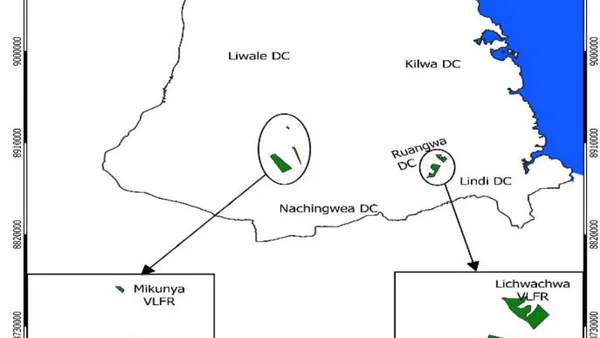
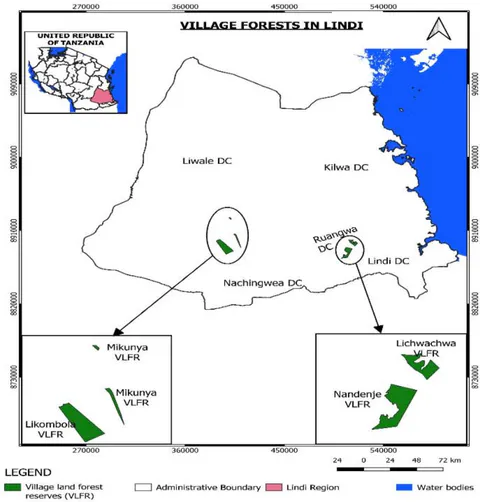
The study was conducted in Liwale and Ruangwa districts, Tanzania (Figure 3.1). The districts are endowed with natural forests which are characterized by dry miombo tree species, dense forests and wet miombo with some highly valuable timber species of Brachystegia sp., Julbernadia sp., and pterocarpus angolensis.
The districts are characterized by two rainy seasons per year, over 2 and 3 months respectively in November to January and March to May. Annual precipitation is in the range .
b) Data collection
Data were collected from four villages in Liwale and Ruangwa districts, which were Mikunya and Likombola in Liwale district and Nandenje and Lichwachwa in Ruangwa district. Data were collected using interviews, secondary data, focus group discussion and observations. Whereby, A checklist of questions of open-ended questions was used to guide collection of primary data from timber dealers, forest officers and villagers. Data collected were timber dealing experiences, socio-economic data, preferred tree species for timber and the rules and regulations that are guiding timber value chain. The sample of timber dealers was obtained from a list of names provided by the district forest officer in Liwale and Tanzania Forest Service agency in Ruangwa district. For the villagers, a sample frame of names was obtained from the village chairmen offices.
Prior the beginning of each interview, each person was given a thorough explanation of the study, including how their identity would be secured and how the data they provided would be used and verbal free and informed consent from each participant was required. Participants were also informed that they could opt out of the study at any moment and have their personal information erased. The participants were also aware that they are free to not answer a question that they were not comfortable answering during the interview process.
The majority of the participants for this study were men, as is usual in rural African communities (99%). A current weakness for this study is the lack of women narratives on the timber dealing activities involvement and hence the lack of women insights on the rules and regulations that guide timber value chain, which should be addressed in future research designs (Goldman et al., 2021). The study also involved forest officers and Tanzania Forest Service TFS agents. Whereby, the data collected from them were on how they do the enforcement of the rules and regulations and how abiding are the timber dealers to the rules and regulations. The study also involved village chairmen from the four villages and the village natural resource committees from the four districts. Data collected from the preceding groups were on the contribution of the timber business on the socio-economic aspect of the communities. Data collected from the villagers were how they benefit from the timber business industry and issues on management of the forest resources. Secondary data were collected from the 2004, 2019 and 2022 forest regulations and the National Forest Policy (1998). Data collected from the document were the fees for various requirements to make timber business successful.
All interviews were conducted and recorded in Swahili language by the researcher, then the researcher had to go through the recorded interviews and discussions and transcribe then then translate the replies into English language. The researcher was accompanied by one village resident who assisted in locating the villagers' residences. It should be noted that, each interview was conducted in a conservational fashion, which was more culturally relevant and helpful to put participants at ease.
c) Data analysis
This qualitative study aims to assess the formal institutions that guide activities along the timber value chain in Liwale and Ruangwa districts, Tanzania. Therefore, thematic analysis was done on the transcribed data. Institutional framework which is one among the important frameworks in analysing value chains, was used to come up with the themes for this study which are awareness, enforcement, compliance and costs of the rules and regulations that are guiding activities along the value chain.
Analysis started by transcribing all the recorded narratives, then the researcher had to review the transcriptions to ensure accuracy and remove any information that would not maintain the confidentiality. After that the researcher had to get familiar with the data by reading and re reading the data so as to gain a comprehensive understanding of the content and what really happens in the Liwale and Ruangwa districts in relation to timber value chain.
After that, the researcher had to start creating initial codes by identifying and labelling initial concepts that emerge from the data in relation to the institutional framework. Then the researcher had to connect those concepts into broader themes. Then related codes were grouped together and patterns on the data were identified. The data were then condensed to focus on the meaningful findings.
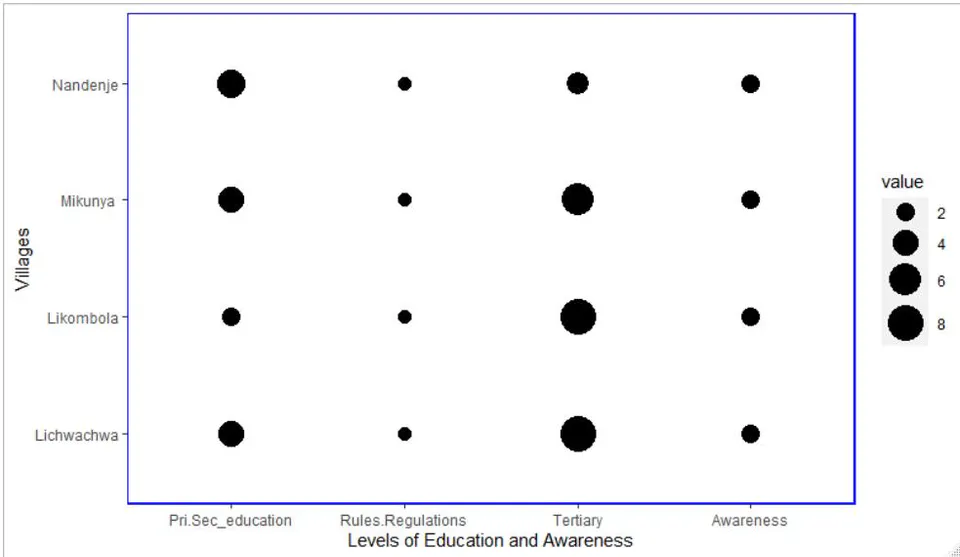
On the first theme on the awareness on the rules and regulations, there were different factors that were noted to be in association with the level of awareness that the timber dealers had on the rules and regulations that guide them in their activities. Level of education was one of the themes that were identified. To analyze data for the particular section R-studio was applied to plot an association between the level of awareness on the rules and regulation and the level of education that timber dealers had. A gg-plot was employed in to come up with the association.
d) Results
The data collected for this study, came up with four themes which were noted to resonate throughout the data collection process in order to answer the research questions. The themes that emerged inductively from the interviews and focus group discussions include, rules and regulations awareness, enforcement, compliance, and costs.
e) Rules and regulations awareness
Under this theme, data were collected using interviews. Regarding this theme a binary scale of YES OR NO was made and the interviews revealed that, all the timber dealers were aware that there are rules and regulations that are guiding them in their activities. But their awareness seemed to differ and the difference lay on how they were explaining the rules and regulations that are guiding them on their activities. Education, time of exposure in the timber business and appetency that individual timber dealers had concerning their business were factors that were noted to cause the variations in their awareness.
Regarding the education factor it was noted that, those with high education were more aware of the rules and regulations than those with low education. Most of the timber dealers who had tertiary level of education, gave explanations of the rules and regulations that are guiding them on the licences acquisition, production, transportation and trading
nodes as provided under the Forest Act, No. 14 of 2002, unlike those with primary and secondary education (Figure 3.2).
Rules and regulations awareness also varied with time of exposure that the timber dealer has been involved in the timber business, where those involved for the longest time starting from two years and more seemed to be more aware of the rules and regulations than those new in the business. It should also be noted that, some of the new comers in the timber business seemed to have a lot of information concerning the rules and regulations based on the researches they conducted prior starting involving themselves in the timber business. Which didn't reflect the real situations that are faced timber business industry.
Lastly, the appetency that individual timber dealers had concerning their business was another factor that seemed to cause the difference on the awareness of the rules and regulations that are guiding timber dealers in their activities. Timber dealers who had high appetency concerning their businesses seemed to be more aware of the rules and regulations that are guiding their activities than those with low appetency.
"I expect to be involved in a timber exportation in two years to come, so to me understanding the rules and regulations is very important for the prosperity of my business and achieving my goals in the business"
One of the timber dealers with high appetency in the timber business in Liwale district.
f) Rules and regulations enforcement
Regarding the enforcement of rules and regulations along the timber value chain, the interviews which were conducted among the four forest officers, Tanzania Forest Service agents and representatives from the village governments revealed that there are different initiatives that are taken to enforce the rules and regulations that are guiding actors of the value chain in the two districts. In both districts, it was found that they have a five years forest management plan which direct them towards sustainable utilization of the forest including timber harvesting.
This was common in all the four villages that I visited and a common thing that was quoted from the village natural resource committee was
"A five years management plan is prepared, considering the contexts and promotes sustainable use of the forest resources."
It should be noted that, in order to facilitate easy rules and regulations enforcement these village natural resource committees had to be made to reduce a burden on the forest officers which had been there for years. The forest officers in Liwale and Ruangwa were quoted saying "As a result of the decentralization, managing the forest resources has become easy compared to the past years where we were acting like polices, doing patrols around the forest areas. It was very hard for us considering the quantity of human resources that we had. Currently, it is the village government with its natural resource management committee who are responsible for the overall management of the forests."
The natural resource committee in these villages are imparted with knowledge concerning sustainable use of forest resources and how they can be used to improve social service facilities in the villages. In Liwale, three forest officers were interviewed on how they equip the village natural resource committee in their jurisdiction and this is what they said
"Members in the committee are provided with the necessary knowledge concerning the forest resources and how they can sustainably use the forest resources especially the timber-based products to improve social services in the villages."
While, the district forest officer in Ruangwa who was interviewed on the same issue said "In each village, we have imparted knowledge into a group of people who are members of the village natural resource committee concerning the management of the forest resources and how sustainably these resources can be used to improve livelihood of the people in the villages."
For the Tanzania Forest Service agents who were interviewed had this to say on the issue:
"We are responsible for providing business licenses to the timber dealers. And also, we have these checkpoints in which timber dealers have to pass through to be checked whether the amount of timber that they are transporting, matches with the amount of timber that is written on the transit pass and if it is found that the transported logs or timber exceeds the amount written then the exceeding amount is held behind, so it's only the amount written on the transit pass that gets to pass."
In spite of the diligent efforts to enforce rules and regulations throughout the timber value chain, timber dealers voiced their concerns regarding certain stringiest regulations that they find burdensome and the impact of their enforcement on their businesses. One of the areas where the timber dealers seemed to encounter stringiest enforcement of the rules and regulations pertains to the TFS agents and forest officers stationed at the checkpoints. They are reputed for unwaveringly adhering to the rules and regulations, particularly when transporting logs to other regions. In case where the load exceeds the specified amount mentioned on the transit pass, penalties are imposed without hesitation.
g) Rules and regulation compliance
This is another theme that was created from the key informant interviews and focus group discussions that were conducted among timber dealers. There are a lot of rules and regulations that are governing timber value chain and expected to affect the behaviours of the actors along the value chain timber dealers specifically. Not only that but also, the key informant interviews that were conducted among the district forest officers and the village government officials were also used to confirm to what extent the timber dealers operating in their jurisdiction act according to the rules and regulations.
In complying with the rules and regulations, the timber dealers from both districts were said to be trying to abide with the rules and regulations that are guiding them in their activities. The timber dealers involved in this study were registered and during the time of data collection in Liwale district for instance, the timber dealers were seeking permits for removing logs from the village forests to industries where logs are processed into timbers. Also, some of the timber dealers were seeking transit passes for transporting their timbers to Pwani a place called Ikwiriri (Rufiji) and Dar es Salaam where they said they have customers and some said they own saw mills for furniture making.
The District Forest Officer (DFO) of Liwale acknowledged an improvement in compliance with rules and regulations compared to previous years. However, he also highlighted the challenges faced. There are instances where some timber dealers transport non degraded timbers which is considered an offense under the timber regulations guideline, leading to penalties. In contrast, in Ruangwa district, the DFO confirmed that timber dealers are making sincere efforts to adhere to the rules and regulations but there're cases where still some timbers are caught transporting timber to other regions, these timbers are usually exceeding the amount written on the transit pass.
On the processing node however, it was noted that the compliance level on both sides is sometimes low as a result of the use of chainsaws in producing sawn timber which is not allowed since it results in production of low-quality timber.
h) Rules and regulations costs
These are the costs that are incurred by timber dealers at the identified nodes in the areas of study which are: harvesting, processing, distribution and consumption. The costs are brought about by either adhering to the rules and regulations or failure in adhering to the rules and regulations. The costs that are related to adherence of the rules and regulations include the registration of the business, attainment of the business license, permits and transits passes, these costs have increase as portrayed in (Table 3.1) below. On the other hand, penalties and fines are costs connected to lack of compliance to the rules and regulations.
| 2004 (TSHS) | 2019 (TSHS) | 2022 (TSHS) | |
| Permit for felling trees per m3 | 70,000 for class I | 70,000 for class I | 350,000 for class IA |
| 290,000 for class IB | |||
| Registration fee for harvesting | 100,000 | 100,000 | 200,000 |
| Registration license for large wood industries/ sawmill | 200,000 | 200,000 | 800,000 |
| Registration license of small wood industries/furniture making/wood works | 30,000 | 30,000 | 400,000 |
| Grading fee for commercial consignments such as timber | 2,500 per tonne | 2,500 per tonne | 100,000 per less or equal to 20 m3 |
| Transit pass for a 7-ton vehicle or lessAbove 7-ton vehicle | Same as provided in the 2004 forest regulations document | 15,000 | |
| 20,000 |
Following the key informant interviews that were conducted among timber dealers, some complained about the regulation which instruct them to pay for a of the tree of which its only of the tree that they obtain, the of the tree, is composed of withies. So, to them it's a loss and they occasionally have to incur other costs on their way to other regions. This regulation seemed to be an open for corruption. The village government officials were also interviewed on the matter and they had a say which is summarized and presented in Table 3.2. Tanzania Forest Service agents were also interviewed on the issue for some of the complaints pointed to them directly in the timber value chain and they too had something to say:
"As Tanzania Forest Service (TFS) we have formulas that help us to calculate the volume of the timbers that are passed through our checkpoints. So, if it happens that the volume of timber exceeds the written amount then the timber dealer will have to leave the exceeding amount of the timbers at the checkpoint".
| Sn | Village | Description on the Complain |
| 1 | Mikunya (1 person) | "Yes, it is true that this issue is contradicting, for the timber dealer always pay for 100% of the tree but to them, the branches and roots are of no value. So, the recovery percent is always 70%, and we get complaints from the timber dealers that we sometimes have to give them the 30% from another stand tree. In some years back, when we didn't know well about the issue of value addition, the withies were left to decay in forest areas, but now we can use them for furniture making in our timber value addition community industry to make chairs for offices and our health facility." |
| 2 | Likombola (1 person) | "We offer our clients, the amount of timber that is written on their harvesting permits, but also, they always do not take the branches and roots of the tree that they are buying from us since it's a burden to them so, they only take 70% of the tree." |
| 3 | Lichwachwa (1 person) | "We are selling our clients' the amount that their permits require them to take and most of the time they leave the withies behind that we use them for other activities like making chairs for offices like these ones we are seating on." |
| 4 | Nandenje (1 person) | "The trees are sold in cubic meters as it is written on the client's harvesting permit and we give them the same amount that their permit show." |
IV. DISCUSSION
The findings indicate that the level of awareness regarding the rules and regulations is higher in Liwale district compared to Ruangwa district, this difference can be attributed to variations in education levels among timber dealers, with timber dealers with higher education being more aware of the guiding rules and regulations.
Additionally, the length of exposure to the timber business and goals that individual timber dealers had toward their businesses also played a role, as individuals involved in the business for a longer period displayed higher awareness of the regulations. The study by Jasinta Msamula et al. (2017) supports these findings by highlighting that awareness of rules and regulations can be influenced by factors such as the education level of actors in the value chain. This suggests that education plays a crucial role in enhancing awareness and understanding of the regulations governing the timber value chain.
Efforts to enforce the rules and regulations in both districts involve capacity building activities conducted by forest officers in collaboration with Non-Governmental Organizations like MJUMITA and TFCG and partner development programs. However, despite these enforcement efforts, challenges persist due to the emphasis kept on following the regulations for instance, the issue that most of the timber dealers complained on strictness that the forest officers and TFS agents on checkpoints are when they transit the logs. As a result, some costs are increased along the value chain and the timber dealers obtain a merge profit. A study conducted by Respikius Martin (2021) along the timber value chain in the Southern highland region of Tanzania, also found the same results. Whereby, he found out that there was scarcity of forest officers that hampers effective enforcement of the rules and regulations along the timber value chain. This highlights the need for the increased resources and personnel to ensure proper enforcement regulations.
Compliance among timber dealers in the value chain was found to be balanced, due to the fact that, following every rule and regulation set to guide them jeopardize their ability to get profit and also not following some rules would make them penalized and sometimes make a room for corruption loopholes. Timber dealers also recognized the costs incurred due to bureaucratic systems associated with following the rules and regulations. This finding aligns with the results of Martin's (2021) study, which revealed that timber dealers face challenges in their activities at different nodes along the value chain and may feel compelled to engage in corruption due to the bureaucratic hurdles they encounter.
V. CONCLUSION AND RECOMMENDATIONS
Understanding the formal institutions that guide timber value chain is one among the essential efforts in ensuring sustainable utilization of the timber forest product. However, educational and awareness programs should be considered to be conducted more in Ruangwa district so as to increase the efficiency of the Village Natural Resources Committee in doing their activities. Not only that but also, the government should make sure that there is conducive environment for the rules and regulations on timber value chain to operate. This will help in closing the loopholes of corruption. Hence, help the timber dealers get the profit they deserve. Formal institutions which are established rules and regulations have a great influence in the activities that are taking place along the timber value chain. Importantly, the government should ensure that intervention of these rules and regulations are done in such a way that it does not negatively affect the activities taking place along the timber value chain.
ACKNOWLEDGEMENTS
We are grateful to the FORVAC program for the financial support that they offered to us to conduct this study. Additionally, to the Sokoine University of Agriculture for granting the first author a permission to collect data for this study. Lastly, we extend our sincere gratitude to the respondents that participated in this study and to the village and districts governments in which this study was conducted for their cooperation during the whole period of data collection.