As a promising quantum gravity theory, the newly developed fractal quantum gravity theory (FQG) has introduced the smallest constant of the product of space, time and energy of STQAs (Space-Time Quantum of Action). The product of space, time and energy of every particle is integer times of this smallest constant-STQA. Based on the FQG equation, we have deduced that every physical parameter of existing or possibly existing particle takes some special or limited extrema values.
## I. INTRODUCTION
Dark matter's existence was first inferred by Swiss American astronomer Fritz Zwicky in 1933, who discovered that the mass of all the stars in the Coma cluster of galaxies provided only about 1 percent of the mass needed to keep the galaxies from escaping the cluster's gravitational pull. The reality of this missing mass remained in question for decades, until in the 1970s when American astronomers Vera Rubin and W. Kent Ford confirmed its existence by the observation of a similar phenomenon. The mass of the stars visible within a typical galaxy is only about 10 percent of that required to keep those stars orbiting the galaxy's center. In general, the speed with which stars orbit the center of their galaxies is independent of their separation from the center; indeed, orbital velocity is either constant or increases slightly with distance rather than dropping off as expected. To account for this, the mass of the galaxy within the orbit of the stars must increase linearly with the distance of the stars from the galaxy's center. However, no light is seen from this inner mass — hence the name "dark matter."
Commonly observable matter accounts for only 30.6 percent of the universe's matter-energy composition. Only 0.5 percent is in the mass of stars and 0.03 percent of that matter is in the form of elements heavier than hydrogen. The rest is dark matter. Two varieties of dark matter have been found to exist. The first variety is about 4.5 percent of the universe and is made of the familiar baryons (i.e., protons, neutrons, and atomic nuclei), which also make up the luminous stars and galaxies. Most of this baryonic dark matter is expected to exist in the form of gas in and between the galaxies. The dark matter that comprises the other 26.1 percent of the universe's matter is in an unfamiliar, nonbaryonic form. The rate at which galaxies and large structures composed of galaxies coalesced from density fluctuations in the early universe indicates that the nonbaryonic dark matter is relatively "cold" or "non-relativistic", meaning that the backbones of galaxies and clusters of galaxies are made of heavy, slow-moving particles. The absence of light from these particles also indicates that they are electromagnetically neutral. These properties lead to the particles' common name, weakly interacting massive particles (WIMPs).
The precise nature of these particles is not currently known, and they are not predicted by the standard model of particle physics. However, a number of possible extensions to the standard model such as supersymmetric theories predict hypothetical elementary particles such as axions or neutralinos that may be the undetected WIMPs [1]. Dark matter problem is one of the biggest mysteries in modern physics.
Quantum theory and the theory of relativity has given us a deeper understanding of the properties of matter and the nature of space and time. However, due to the lack of new physical framework, the research on unifying relativity and quantum mechanics has been unable to make desirable progress. Through many years of hard work, we have introduced a novel framework, a new theory - the fractal quantum gravity (FQG) theory. FQG theory suggests that there is a smallest constant of the product of the energy, space interval, and time interval - Space-Time Quantum of Action (STQA). The product of the energy, space interval, and time interval of a particle is the integer times of this smallest constant STQA. Combined with fractal geometry, the fractal quantum gravity (FQG) equation is created and can prove that every particle or physical system consists of these smallest units (STQAs) in a fractal structure [2]-[4].
There are abundant physical meanings behind the fractal quantum gravity (FQG) equation with a simple and elegant format. All the physical parameters of a particle or a physical system can be calculated using the FQG equation. Through mathematical derivations, many more important predictions can be obtained. There is a transformation between current physical parameters and FQG parameters. All matter in the universe consist of various STQA sets in fractal microstructure, including black holes and the common state of matter in the universe. We have obtained a framework that works both microscopically and macroscopically.
From a spatial perspective, a particle is neither a point of classical mechanics nor a wave of quantum mechanics. A particle is a group of STQAs that are distributed in space in a fractal pattern that is similar to the wave function pattern; however, the fractal pattern can define a particle's spatial distributions that do not need a probability explanation of a wave function. Thus, we can provide a new approach to explain wave – particle duality that reconciles the controversy between the locality of Einstein and the non-locality of Copenhagen.
We have shown that the fractal quantum gravity equation satisfies almost all the requirements of quantum gravity theory. The general relativity is an approximation of the FQG equation when the quantum effect is negligible, while the quantum theory is an approximation of the FQG equation when the interaction between space, time, and energy is very weak or negligible. In other words, it looks promising that we may have discovered a novel way to unite the quantum theory and general relativity. Therefore, fractal quantum gravity theory is a promising self-consistent quantum gravity theory.
It is quite amazing that there is no infinity in FQG. Every physical parameter can be calculated, and their value is limited and reasonable. This is a huge advantage for FQG as a physical theory that it can make so many predictions to solve many of the challenging problems in modern physics. The standard model of elementary particle physics theory is one of the most successful theories of modern physics. Through standard model, we have discovered 17 elementary particles [5]. In FQG point of view, these 17 elementary particles are not really elementary particles, but they still consist of more basic unit of STQAs.
We can transform the physical parameters, such as mass, electric charge, magnetic moment and spin angular momentum into the FQG parameters of space, time, energy and the numbers of STQAs, the a, b, d and n. After drawing a map of the relationship of a, b, d and log n, we discovered that there are five lines in the map that corresponding to five equations about a, b, d and log n for heavy particles and leptons. Then we can deduce that the FQG parameters of every particle or physical system in the universe should fit in these five equations. By extending the range of calculations, we have discovered that every physical parameter of FQG corresponding to one or more limited extrema values that should be the parameters of the possibly existing particles.
During the calculation of the extrema value of electric charge, we found that there is a very tiny electric charge carried by the particle that is about 1/10 of the electrons. After the calculation of its mass, spin angular momentum, inherent speed and magnetic moment, we have discovered that it has very small magnetic moment, very big mass, slow inherent speed and very special spin angular moment. It seems to be a very special particle, which is comparable with the most popular thinking about the characters of dark matter that are electromagnetically neutral, heavy, slow-moving particles, the weakly interacting massive particles (WIMPs). We think that this newly calculated particle should be the dark matter particles (DMP) or (WIMPs).
There are many possible candidates for dark matter: hypothetical particles such as axions, sterile neutrinos, weakly interacting massive particle (WIMPs), supersymmetric particles, atomic dark matter, or geons; and primordial black holes. Among these the weakly interacting massive particle (WIMPs) is most likely candidate of dark matter particles [6]. This is the first time that the specific physical parameters of the particles have been calculated and match all the descriptions of WIMPs. We will describe the detailed calculations in the following chapter.
## II. THE CALCULATIONS OF THE PHYSICAL PARAMETERS OF DMP (DARK MATTER PARTICLES)
Based on the fractal quantum gravity (FQG) theory, we have the FQG equations \[4\]:
$$
E = E _ {0} n ^ {a}, x = x _ {0} n ^ {b}, \tau = \tau_ {0} n ^ {d} \qquad \qquad \qquad (1) (2) (3)
$$
$$
a + b + d = 1
$$
$$
Ex\tau = n k_{0}
$$
Where $E$ is the energy, $x$ is the space interval, $\tau$ is the time interval of a particle. And
$$
x _ {0} = \sqrt {\frac {G h}{2 c ^ {3}}} = 2. 8 6 4 3 7 \times 1 0 ^ {- 3 3} \mathrm {c m}
$$
$$
\tau_ {0} = \sqrt {\frac {G h}{2 c ^ {5}}} = 9. 5 5 4 5 1 \times 1 0 ^ {- 4 4} \mathrm {s}
$$
$$
\mathrm {E} _ {0} = \sqrt {\frac {h c ^ {5}}{2 G}} = 3. 4 6 7 5 1 \times 1 0 ^ {1 6} \mathrm {e r g} = 2. 1 \times 1 0 ^ {1 9} \mathrm {G e V}
$$
$$
k_{0} = E_{0} x_{0} \tau_{0} = \sqrt{\frac{G h^{3}}{8 c^{3}}} = 9.48977 \times 10^{-60} \mathrm{erg} \cdot \mathrm{cm}
$$
n is a positive integer, a, b, and d are real numbers.
$$
D _ {x} = \frac {1}{b} = \frac {\log n}{\log (\frac {x}{x _ {0}})} \quad , \quad D _ {E} = \frac {1}{a} = \frac {\log n}{\log (\frac {E}{E _ {0}})} \quad , \quad D _ {\tau} = \frac {1}{d} = \frac {\log n}{\log (\frac {\tau}{\tau_ {0}})}
$$
Where $D_{\mathrm{X}}, D_{\mathrm{E}}$ and $D_{\tau}$ correspond to the space, energy, and time fractal dimensions of the particles, respectively.
For particles with rest mass, electric charge, and spin angular momentum, $m$ is the rest mass, $e$ is the electric charge, $l$ is the spin angular momentum of the particles. We can obtain Eq. (6), where $A = m / m_0$, $B = e^2 / e_0^2$, $D = l / l_0$, $m_0 = E_0 / c^2$, $e_0 = (E_0 x_0)^{1/2}$, $l_0 = E_0 \tau_0$. Using Eq. (6), the values of $a$, $b$, $d$, and $n$ for leptons, quarks, some bosons, and some heavy particles can be calculated, as listed in Table I.
$$
a = \frac {\log A}{\log n}, \quad b = \frac {\log \frac {B}{A}}{\log n}, \quad d = \frac {\log \frac {D}{A}}{\log n}, \quad n = \frac {B D}{A} \tag {6}
$$
For particles with a rest mass, magnetic dipole moment, and spin angular momentum, we can calculate $a$, $b$, $d$, and $n$ using Eq. (7), where $H = \mu / \mu_0$, $\mu_0 = (\tau_0 e_0 c) / 2$, $\mu$ is the magnetic dipole moment of the particles, and $c$ is the speed of light. Using Eq. (7), the values of $a$, $b$, $d$, and $n$ for protons, neutrons, and other heavy particles can be calculated, as shown in Table I.
$$
a = \frac {\log A}{\log n}, b = \frac {\log \frac {A H ^ {2}}{D ^ {2}}}{\log n}, d = \frac {\log \frac {D}{A}}{\log n}, n = \frac {A H ^ {2}}{D} \tag {7}
$$
And
$$
m = \frac {E}{c ^ {2}} = \frac {E _ {0} n ^ {a}}{c ^ {2}} = m _ {0} n ^ {a} \tag {8}
$$
$$
e = \sqrt {E x} = \sqrt {E _ {0} x _ {0}} \sqrt {n ^ {a + b}} = e _ {0} n ^ {\frac {a + b}{2}} \tag {9}
$$
$$
I = E \tau = E _ {0} \tau_ {0} n ^ {a + d} = I _ {0} n ^ {a + d} \tag {10}
$$
Where $m$ is the mass, $e$ is the electric charge, $l$ is the spin angular momentum of a particle.
Based on the parameters in table I, we can draw a diagram as Fig. 1. According to this diagram, these equations can be found as follows:
For heavy elementary particles, we have the Eq. (11):
$$
a = 0. 0 5 8 1 \mathrm {g} n - 2. 1 1 5
$$
$$
b = - 0. 0 0 3 1 \mathrm {g} n + 1. 0 9 9
$$
$$
d = - 0. 0 5 5 1 \mathrm {g} n + 2. 0 1 6 \tag {11}
$$
Based on Eq. (11), the electric charge of heavy particles can be calculated using equation as shown in Eq. (12):
$$
e = e _ {0} n ^ {\frac {a + b}{2}} = e _ {0} n ^ {0. 0 2 7 5 l g n - 0. 5 0 8} \tag {12}
$$
Take logarithm
$$
lge = lge_{0} + 0.0275(lgn)^{2} - 0.508lgn
$$
Calculate the extreme value
$$
\frac{d(lge)}{d(lgn)} = 0.055\,lgn - 0.508 = 0 \rightarrow lgn = 9.236363637
$$
We get $n = 1.723311 \times 10^9$. Then we can do the calculations as follows:
Calculation 1: Mass, electric charge, spin, magnetic momentum, and inherent speed
<table><tr><td>Particles</td><td>n</td><td>a</td><td>b</td><td>d</td><td>β</td><td>e/e0</td><td>I/IO</td><td>μ/μ0</td><td>m</td></tr><tr><td>electron</td><td>1.5670127E+19</td><td>-1.1717</td><td>1.0414</td><td>1.1302</td><td>2.026265E-02</td><td>0.048215</td><td>0.159150</td><td>3.25005E+20</td><td>1.24823E-27</td></tr><tr><td>DMP</td><td>1.7233109E+09</td><td>-1.5793</td><td>1.0713</td><td>1.5080</td><td>9.658786E-05</td><td>0.004508</td><td>0.219549</td><td>3.82296E+11</td><td>9.98783E-20</td></tr><tr><td>DMP/electron</td><td></td><td></td><td></td><td></td><td>4.766793E-03</td><td>0.093494</td><td>1.379509</td><td>1.16279E-09</td><td>8.00160E+07</td></tr></table>
<table><tr><td>Particles</td><td>n</td><td>a</td><td>b</td><td>d</td><td>β</td><td>e/e0</td><td>I/IO</td><td>μ/μ0</td><td>m</td></tr><tr><td>electron</td><td>1.5670127E+19</td><td>-1.1717</td><td>1.0414</td><td>1.1302</td><td>2.026265E-02</td><td>0.048215</td><td>0.159150</td><td>3.25005E+20</td><td>1.24823E-27</td></tr><tr><td>DMP</td><td>1.7233109E+09</td><td>-1.5793</td><td>1.0713</td><td>1.5080</td><td>9.658786E-05</td><td>0.004508</td><td>0.219549</td><td>3.82296E+11</td><td>9.98783E-20</td></tr><tr><td>DMP/electron</td><td></td><td></td><td></td><td></td><td>4.766793E-03</td><td>0.093494</td><td>1.379509</td><td>1.16279E-09</td><td>8.00160E+07</td></tr></table>
Calculation 2: Parameters of space, time, and energy
<table><tr><td>Particles</td><td>n</td><td>a</td><td>b</td><td>d</td><td>DE</td><td>DX</td><td>DT</td><td>E</td><td>x</td><td>τ</td></tr><tr><td>electron</td><td>1.5670127E+19</td><td>-1.1717</td><td>1.0414</td><td>1.1302</td><td>-0.8535</td><td>0.9602</td><td>0.8848</td><td>1.12185E-06</td><td>2.79938E-13</td><td>4.73512E-22</td></tr><tr><td>DMP</td><td>1.7233109E+09</td><td>-1.5793</td><td>1.0713</td><td>1.5080</td><td>-0.6332</td><td>0.9335</td><td>0.6631</td><td>8.97661E+01</td><td>2.24834E-23</td><td>8.10298E-30</td></tr></table>
<table><tr><td>Particles</td><td>n</td><td>a</td><td>b</td><td>d</td><td>DE</td><td>DX</td><td>DT</td><td>E</td><td>x</td><td>τ</td></tr><tr><td>electron</td><td>1.5670127E+19</td><td>-1.1717</td><td>1.0414</td><td>1.1302</td><td>-0.8535</td><td>0.9602</td><td>0.8848</td><td>1.12185E-06</td><td>2.79938E-13</td><td>4.73512E-22</td></tr><tr><td>DMP</td><td>1.7233109E+09</td><td>-1.5793</td><td>1.0713</td><td>1.5080</td><td>-0.6332</td><td>0.9335</td><td>0.6631</td><td>8.97661E+01</td><td>2.24834E-23</td><td>8.10298E-30</td></tr></table>
We can see that the new dark matter particle (DMP) has the minimum electric charge, its $\mathrm{e} / \mathrm{e}_0 = 0.004508$. As compared to the electric charge of electrons $\mathrm{e} / \mathrm{e}_0 = 0.048215$, the electric charge of dark matter particle is less than 1/10 of the electric charge of electrons. And the magnetic moment of the DMP is about $10^{-9}$ of the magnetic moment of electrons. This means that dark matter particles have very tiny electromagnetics interactions or may totally not able to join the electromagnetics interactions. The spin angular momentum of the DMP is 1.37951 times of the spin angular momentum of electrons, which means that the spin of the new particles is not the integer times of $\frac{1}{2}$ or integer times of 1 in the standard model of current particle physics. It is about 20/29. This intriguing spin of DMP comes from our new theory of fractal quantum gravity, which cannot be explained by the current physics theories.
The mass of the new particle is about $10^{8}$ times of electron's mass. We know that the heaviest detected particle is the top quark, its mass is $172.76 \pm 0.3 \mathrm{GeV} / c^{2}$, so the mass of the new particle is 56032 GeV/c $^2$ or $56\mathrm{TeV} / c^2$, or about 324 times of the mass of top quark. Its inherent speed is $\beta = 9.7 \times 10^{-5}$, which is at a much slower speed as compared to electrons. DMP's space dimension is 0.9335, time dimension is 0.6631, energy dimension is -0.6332, and its space size is $2.24834 \times 10^{-23}$ cm. This is a very huge mass, but it is still possible to detect in the experiment of Large Hadron Collider (LHC). During the shutdown of LHC between 2013 and 2015, the LHC has gone through some significant upgrades. After those upgrades, it has reached 6.5 TeV per beam (13.0 TeV total collision energy) and may expect some further upgrades [7]. The calculated absolute error is about $10^{-4}$ of the calculated values. These calculated values can provide significant insight to the ranges of error.
According to table I, the space size or radius of the particles can be calculated based on FQG theory. We can see that the biggest radius of the subatomic particles is the $x$ of electrons, which is $2.8 \times 10^{-13}$ cm. In the history of discovery order of subatomic particles the electron was the first discovered by J. J. Thomson in 1897. This may mean that the larger the particle size, the easier it is to detect. If that is true, beside the tiny electric charge and the magnetic moment of the DMP particle, the size may be another important factor to detect the DMP particle by experiment. Because its radius is about $10^{-10}$ of electrons', the DMP particle might be very difficult to produce any interaction with other particles.
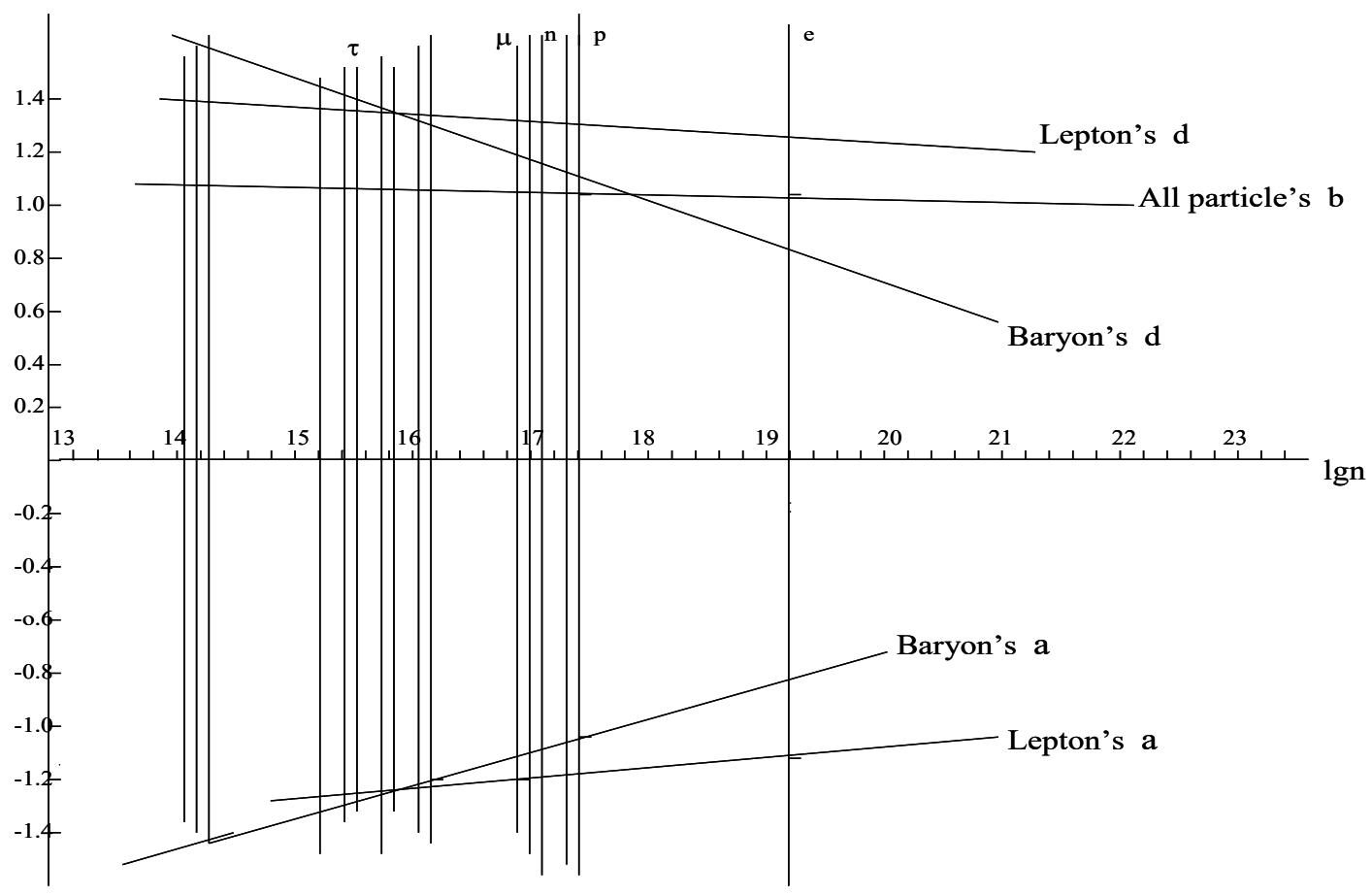 Fig. 1: The relationship between Ig n and a, b, or d of elementary particles
<table><tr><td rowspan="2" colspan="2">Particles</td><td>1</td><td>2</td><td>3</td><td>4</td><td>5</td><td>6</td><td>7</td><td>8</td><td>9</td><td>10</td><td>11</td></tr><tr><td>\({\mathrm{D}}_{\mathrm{E}} \)</td><td>\({\mathrm{D}}_{\mathrm{x}} \)</td><td>\({\mathrm{D}}_{\tau} \)</td><td>n</td><td>E erg</td><td>X cm</td><td>\(\tau \) s</td><td>β</td><td>H(E)</td><td>\(\mathbf{H}\left(\mathbf{x}\right) \)</td><td>\(\mathbf{H}\left(\tau \right) \)</td></tr><tr><td rowspan="3">Leptons</td><td>\({\mathrm{e}}^{\pm} \)</td><td>-0.85</td><td>0.96</td><td>0.88</td><td>\({1.57} \times {10}^{19} \)</td><td>\({8.19} \times {10}^{-7} \)</td><td>\({2.82} \times {10}^{-{13}} \)</td><td>\({6.44} \times {10}^{-{22}} \)</td><td>0.0146</td><td>\({1.5} \times {10}^{5} \)</td><td>\({8.9} \times {10}^{-{13}} \)</td><td>\({2.3} \times {10}^{-{19}} \)</td></tr><tr><td>\({\mu}^{\pm} \)</td><td>-0.83</td><td>0.95</td><td>0.87</td><td>\({7.58} \times {10}^{16} \)</td><td>\({1.69} \times {10}^{-4} \)</td><td>\({1.36} \times {10}^{-{15}} \)</td><td>\({3.11} \times {10}^{-{24}} \)</td><td>0.0146</td><td>\({1.4} \times {10}^{3} \)</td><td>\({6.4} \times {10}^{-{15}} \)</td><td>\({4.6} \times {10}^{-{21}} \)</td></tr><tr><td>\({\tau}^{\pm} \)</td><td>-0.82</td><td>0.95</td><td>0.86</td><td>\({4.51} \times {10}^{15} \)</td><td>\({2.85} \times {10}^{-3} \)</td><td>\({8.11} \times {10}^{-{17}} \)</td><td>\({1.85} \times {10}^{-{25}} \)</td><td>0.0146</td><td>\({1.2} \times {10}^{2} \)</td><td>\({4.9} \times {10}^{-{16}} \)</td><td>\({6.8} \times {10}^{-{22}} \)</td></tr><tr><td rowspan="6">Quarks</td><td>U</td><td>-0.83</td><td>0.96</td><td>0.86</td><td>\({1.55} \times {10}^{18} \)</td><td>\({3.68} \times {10}^{-6} \)</td><td>\({2.78} \times {10}^{-{14}} \)</td><td>\({1.43} \times {10}^{-{22}} \)</td><td>0.0065</td><td>\({3.1} \times {10}^{4} \)</td><td>\({1.0} \times {10}^{-{13}} \)</td><td>\({1.7} \times {10}^{-{19}} \)</td></tr><tr><td>d</td><td>-0.80</td><td>0.96</td><td>0.83</td><td>\({1.85} \times {10}^{17} \)</td><td>\({7.69} \times {10}^{-6} \)</td><td>\({3.34} \times {10}^{-{15}} \)</td><td>\({6.86} \times {10}^{-{23}} \)</td><td>0.0016</td><td>\({1.2} \times {10}^{4} \)</td><td>\({1.5} \times {10}^{-{14}} \)</td><td>\({4.5} \times {10}^{-{19}} \)</td></tr><tr><td>C</td><td>-0.80</td><td>0.95</td><td>0.84</td><td>\({2.79} \times {10}^{15} \)</td><td>\({2.04} \times {10}^{-3} \)</td><td>\({5.02} \times {10}^{-{17}} \)</td><td>\({2.58} \times {10}^{-{25}} \)</td><td>0.0065</td><td>\({1.4} \times {10}^{2} \)</td><td>\({3.2} \times {10}^{-{16}} \)</td><td>\({2.5} \times {10}^{-{21}} \)</td></tr><tr><td>S</td><td>-0.78</td><td>0.95</td><td>0.82</td><td>\({9.37} \times {10}^{15} \)</td><td>\({1.52} \times {10}^{-4} \)</td><td>\({1.69} \times {10}^{-{16}} \)</td><td>\({3.46} \times {10}^{-{24}} \)</td><td>0.0016</td><td>\({9.9} \times {10}^{2} \)</td><td>\({9.5} \times {10}^{-{16}} \)</td><td>\({7.0} \times {10}^{-{20}} \)</td></tr><tr><td>t</td><td>-0.78</td><td>0.94</td><td>0.82</td><td>\({2.05} \times {10}^{13} \)</td><td>\({2.78} \times {10}^{-1} \)</td><td>\({3.70} \times {10}^{-{19}} \)</td><td>\({1.90} \times {10}^{-{27}} \)</td><td>0.0065</td><td>\({2.7} \times {10}^{0} \)</td><td>\({4.1} \times {10}^{-{18}} \)</td><td>\({1.5} \times {10}^{-{22}} \)</td></tr><tr><td>b</td><td>-0.77</td><td>0.95</td><td>0.80</td><td>\({2.13} \times {10}^{14} \)</td><td>\({6.70} \times {10}^{-3} \)</td><td>\({3.83} \times {10}^{-{18}} \)</td><td>\({7.87} \times {10}^{-{26}} \)</td><td>0.0016</td><td>\({4.6} \times {10}^{1} \)</td><td>\({3.2} \times {10}^{-{17}} \)</td><td>\({8.4} \times {10}^{-{21}} \)</td></tr><tr><td rowspan="10">Heavy Particles</td><td>p</td><td>-0.90</td><td>0.96</td><td>0.94</td><td>\({2.66} \times {10}^{17} \)</td><td>\({1.50} \times {10}^{-3} \)</td><td>\({4.79} \times {10}^{-{15}} \)</td><td>\({3.51} \times {10}^{-{25}} \)</td><td>0.4554</td><td>\({3.5} \times {10}^{2} \)</td><td>\({2.0} \times {10}^{-{14}} \)</td><td>\({1.1} \times {10}^{-{23}} \)</td></tr><tr><td>n</td><td>-0.88</td><td>0.96</td><td>0.92</td><td>\({1.25} \times {10}^{17} \)</td><td>\({1.51} \times {10}^{-3} \)</td><td>\({2.25} \times {10}^{-{15}} \)</td><td>\({3.50} \times {10}^{-{25}} \)</td><td>0.2142</td><td>\({3.1} \times {10}^{2} \)</td><td>\({1.0} \times {10}^{-{14}} \)</td><td>\({3.0} \times {10}^{-{23}} \)</td></tr><tr><td>Λ</td><td>-0.84</td><td>0.95</td><td>0.88</td><td>\({1.52} \times {10}^{16} \)</td><td>\({1.79} \times {10}^{-3} \)</td><td>\({2.74} \times {10}^{-{16}} \)</td><td>\({2.95} \times {10}^{-{25}} \)</td><td>0.0310</td><td>\({2.0} \times {10}^{2} \)</td><td>\({1.5} \times {10}^{-{15}} \)</td><td>\({3.4} \times {10}^{-{22}} \)</td></tr><tr><td>\({\sum}^{+} \)</td><td>-0.90</td><td>0.96</td><td>0.94</td><td>\({2.61} \times {10}^{17} \)</td><td>\({1.91} \times {10}^{-3} \)</td><td>\({4.70} \times {10}^{-{15}} \)</td><td>\({2.77} \times {10}^{-{25}} \)</td><td>0.5667</td><td>\({2.9} \times {10}^{2} \)</td><td>\({2.0} \times {10}^{-{14}} \)</td><td>\({6.8} \times {10}^{-{24}} \)</td></tr><tr><td>\({\sum}^{-} \)</td><td>-0.87</td><td>0.95</td><td>0.91</td><td>\({5.86} \times {10}^{16} \)</td><td>\({1.92} \times {10}^{-3} \)</td><td>\({1.05} \times {10}^{-{15}} \)</td><td>\({2.74} \times {10}^{-{25}} \)</td><td>0.1279</td><td>\({2.3} \times {10}^{2} \)</td><td>\({5.1} \times {10}^{-{15}} \)</td><td>\({4.9} \times {10}^{-{23}} \)</td></tr><tr><td>\({\sum}^{0} \)</td><td>-0.89</td><td>0.96</td><td>0.92</td><td>\({1.12} \times {10}^{17} \)</td><td>\({1.91} \times {10}^{-3} \)</td><td>\({2.02} \times {10}^{-{15}} \)</td><td>\({2.76} \times {10}^{-{25}} \)</td><td>0.2445</td><td>\({2.6} \times {10}^{2} \)</td><td>\({9.2} \times {10}^{-{15}} \)</td><td>\({2.1} \times {10}^{-{23}} \)</td></tr><tr><td>\({\Xi}^{-} \)</td><td>-0.85</td><td>0.95</td><td>0.89</td><td>\({2.03} \times {10}^{16} \)</td><td>\({2.12} \times {10}^{-3} \)</td><td>\({3.66} \times {10}^{-{16}} \)</td><td>\({2.49} \times {10}^{-{25}} \)</td><td>0.0490</td><td>\({1.9} \times {10}^{2} \)</td><td>\({1.9} \times {10}^{-{15}} \)</td><td>\({1.6} \times {10}^{-{22}} \)</td></tr><tr><td>\({\Xi}^{0} \)</td><td>-0.88</td><td>0.95</td><td>0.92</td><td>\({7.47} \times {10}^{16} \)</td><td>\({2.11} \times {10}^{-3} \)</td><td>\({1.34} \times {10}^{-{15}} \)</td><td>\({2.50} \times {10}^{-{25}} \)</td><td>0.1791</td><td>\({2.2} \times {10}^{2} \)</td><td>\({6.3} \times {10}^{-{15}} \)</td><td>\({2.9} \times {10}^{-{23}} \)</td></tr><tr><td>\({\Omega}^{-} \)</td><td>-0.89</td><td>0.98</td><td>0.90</td><td>\({8.27} \times {10}^{16} \)</td><td>\({2.68} \times {10}^{-3} \)</td><td>\({4.96} \times {10}^{-{16}} \)</td><td>\({5.90} \times {10}^{-{25}} \)</td><td>0.0280</td><td>\({1.9} \times {10}^{2} \)</td><td>\({9.6} \times {10}^{-{16}} \)</td><td>\({1.5} \times {10}^{-{22}} \)</td></tr><tr><td>\({\Lambda}^{+}{}_{\mathrm{c}} \)</td><td>-0.82</td><td>0.95</td><td>0.86</td><td>\({3.50} \times {10}^{15} \)</td><td>\({3.66} \times {10}^{-3} \)</td><td>\({6.31} \times {10}^{-{17}} \)</td><td>\({1.44} \times {10}^{-{25}} \)</td><td>0.0146</td><td>\({9.9} \times {10}^{1} \)</td><td>\({3.9} \times {10}^{-{16}} \)</td><td>\({5.7} \times {10}^{-{22}} \)</td></tr><tr><td rowspan="2">Bosons</td><td>W*</td><td>-0.82</td><td>0.97</td><td>0.84</td><td>\({1.99} \times {10}^{14} \)</td><td>\({1.29} \times {10}^{-1} \)</td><td>\({1.79} \times {10}^{-{18}} \)</td><td>\({8.19} \times {10}^{-{27}} \)</td><td>0.0073</td><td>\({5.4} \times {10}^{0} \)</td><td>\({7.1} \times {10}^{-{18}} \)</td><td>\({9.3} \times {10}^{-{23}} \)</td></tr><tr><td>\({Z}^{0} \)</td><td>-0.82</td><td>0.97</td><td>0.84</td><td>\({1.79} \times {10}^{14} \)</td><td>\({1.46} \times {10}^{-1} \)</td><td>\({1.61} \times {10}^{-{18}} \)</td><td>\({7.22} \times {10}^{-{27}} \)</td><td>0.0074</td><td>\({4.8} \times {10}^{0} \)</td><td>\({6.4} \times {10}^{-{18}} \)</td><td>\({8.4} \times {10}^{-{23}} \)</td></tr><tr><td rowspan="3">Mesons</td><td>\({\pi}^{\pm} \)</td><td>-0.84</td><td>0.97</td><td>0.87</td><td>\({1.15} \times {10}^{17} \)</td><td>\({2.24} \times {10}^{-4} \)</td><td>\({1.03} \times {10}^{-{15}} \)</td><td>\({4.72} \times {10}^{-{24}} \)</td><td>0.0073</td><td>\({1.2} \times {10}^{3} \)</td><td>\({2.7} \times {10}^{-{15}} \)</td><td>\({6.2} \times {10}^{-{21}} \)</td></tr><tr><td>\({\pi}^{0} \)</td><td>-0.84</td><td>0.97</td><td>0.87</td><td>\({1.18} \times {10}^{17} \)</td><td>\({2.16} \times {10}^{-4} \)</td><td>\({1.06} \times {10}^{-{15}} \)</td><td>\({4.88} \times {10}^{-{24}} \)</td><td>0.0073</td><td>\({1.2} \times {10}^{3} \)</td><td>\({2.8} \times {10}^{-{15}} \)</td><td>\({6.4} \times {10}^{-{21}} \)</td></tr><tr><td>\({\mathrm{k}}^{0} \)</td><td>-0.83</td><td>0.95</td><td>0.86</td><td>\({1.90} \times {10}^{16} \)</td><td>\({7.97} \times {10}^{-4} \)</td><td>\({3.42} \times {10}^{-{16}} \)</td><td>\({6.61} \times {10}^{-{25}} \)</td><td>0.0172</td><td>\({3.7} \times {10}^{2} \)</td><td>\({1.8} \times {10}^{-{15}} \)</td><td>\({1.3} \times {10}^{-{21}} \)</td></tr></table>
## III. CONCLUSIONS
The newly developed theory of fractal quantum gravity has unveiled a new prediction regarding dark matter particles. Based on the physical properties of the DMP (Dark Matter Particle), it might be a very promising candidate for the Weakly Interacting Massive Particle (WIMP).
This is the very first dark matter particle with precisely calculated physical properties. Since this new particle carries very tiny electric charge which is about 1/10 of the electric charge of 'electron' and has very small magnetic moment that is about $10^{-9}$ of electrons', and its spin angular momentum is very special that is about 20/29, and its mass is very large that is about 56 TeV/c $^2$.
Our calculation not only provides much insight into the understanding of dark matter, it also makes it possible to explore the possibility of experimental verification. Between 2013 and 2015, the Large Hadron Collider (LHC) was shut down and went through further upgrades. With the most recent upgrades, it can reach 6.5 TeV per beam (13.0 TeV total collision energy) and expect further upgrades that may be reaching 56TeV total collision energy. It is hopeful that the newly discovered DMP particle can be detected in LHC in the near future.
However, there might be a concern that the size of the particle affects the interaction between particles. Since the DMP particle's space size is so small, it may penetrate the gap inside any particle without interaction with the particle at all, this may cause the detector's incapability to capture the DMP particle even when the total collision energy reached 56TeV and generated a DMP particle in LHC. Plus, the DMP particle does not carry much electric charge and magnetic moment. It might present a big challenge for detecting DMP in LHC.
We hope that this paper can draw more attention of many researchers to collaborate with each other to study more deeply to find the approaches to detect this new particle. It is promising that we can work together to solve the mysteries of the dark matter. Furthermore, we can solve the mysteries of dark energy and many other challenges.
Funding Statement: The study has no funding.
Ethical Compliance: The study was approved by the Ethics Committee of Example University.
Data Access Statement: Research data supporting this publication are available in this document.
Conflict of Interest declaration: The authors have declared that no competing interests exist.
Generating HTML Viewer...
References
6 Cites in Article
Adam Riess (2024). Dark matter.
L Shuming,L Lihua,L Shuwei (2023). The smallest constant of physics.
L Shuming,L Lihua,L Shuwei (2023). Space-time curvature and cosmic evolution.
L Shuming,L Lihua,L Shuwei (2023). The Fractal Quantum Gravity.
Guido Altarelli (1999). Electroweak Standard Model.
Explore published articles in an immersive Augmented Reality environment. Our platform converts research papers into interactive 3D books, allowing readers to view and interact with content using AR and VR compatible devices.
Your published article is automatically converted into a realistic 3D book. Flip through pages and read research papers in a more engaging and interactive format.
Our website is actively being updated, and changes may occur frequently. Please clear your browser cache if needed. For feedback or error reporting, please email [email protected]
Thank you for connecting with us. We will respond to you shortly.