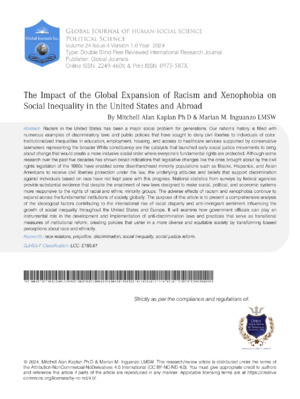
The Impact of the Global Expansion of Racism and Xenophobia on Social Inequality in the United States and Abroad

Article ID

EJ0BZ

Explores how racism and xenophobia deepen social inequalities and affect marginalized groups.

The Impact of the Global Expansion of Racism and Xenophobia on Social Inequality in the United States and Abroad

Mitchell Alan Kaplan
Marian M. Inguanzo
Marian M. Inguanzo
DOI

Abstract

Racism in the United States has been a major social problem for generations. Our nation’s history is filled with numerous examples of discriminatory laws and public policies that have sought to deny civil liberties to individuals of color. Institutionalized inequalities in education, employment, housing, and access to healthcare services supported by conservative lawmakers representing the broader White constituency are the catalysts that launched early social justice movements to bring about change that would create a more inclusive social order where everyone’s fundamental rights are protected. Although some research over the past five decades has shown broad indications that legislative changes like the ones brought about by the civil rights legislation of the 1960s have enabled some disenfranchised minority populations such as Blacks, Hispanics, and Asian Americans to receive civil liberties protection under the law, the underlying attitudes and beliefs that support discrimination against individuals based on race have not kept pace with this progress. National statistics from surveys by federal agencies provide substantial evidence that despite the enactment of new laws designed to make social, political, and economic systems more responsive to the rights of racial and ethnic minority groups. The adverse effects of racism and xenophobia continue to expand across the fundamental institutions of society globally. The purpose of this article is to present a comprehensive analysis of the ideological factors contributing to the international rise of racial disparity and anti-immigrant sentiment influencing the growth of social inequality throughout the United States and Europe. It will examine how government officials can play an instrumental role in the development and implementation of anti-discrimination laws and practices that serve as transitional measures of institutional reform, creating policies that usher in a more diverse and equitable society by transforming biased perceptions about race and ethnicity.

The Impact of the Global Expansion of Racism and Xenophobia on Social Inequality in the United States and Abroad

Racism in the United States has been a major social problem for generations. Our nation’s history is filled with numerous examples of discriminatory laws and public policies that have sought to deny civil liberties to individuals of color. Institutionalized inequalities in education, employment, housing, and access to healthcare services supported by conservative lawmakers representing the broader White constituency are the catalysts that launched early social justice movements to bring about change that would create a more inclusive social order where everyone’s fundamental rights are protected. Although some research over the past five decades has shown broad indications that legislative changes like the ones brought about by the civil rights legislation of the 1960s have enabled some disenfranchised minority populations such as Blacks, Hispanics, and Asian Americans to receive civil liberties protection under the law, the underlying attitudes and beliefs that support discrimination against individuals based on race have not kept pace with this progress. National statistics from surveys by federal agencies provide substantial evidence that despite the enactment of new laws designed to make social, political, and economic systems more responsive to the rights of racial and ethnic minority groups. The adverse effects of racism and xenophobia continue to expand across the fundamental institutions of society globally. The purpose of this article is to present a comprehensive analysis of the ideological factors contributing to the international rise of racial disparity and anti-immigrant sentiment influencing the growth of social inequality throughout the United States and Europe. It will examine how government officials can play an instrumental role in the development and implementation of anti-discrimination laws and practices that serve as transitional measures of institutional reform, creating policies that usher in a more diverse and equitable society by transforming biased perceptions about race and ethnicity.

Mitchell Alan Kaplan
Marian M. Inguanzo
Marian M. Inguanzo

No Figures found in article.

Mitchell Alan Kaplan. 2026. “. Global Journal of Human-Social Science – F: Political Science GJHSS-F Volume 24 (GJHSS Volume 24 Issue F4): .

Download Citation

Journal Specifications

Crossref Journal DOI 10.17406/GJHSS

Print ISSN 0975-587X

e-ISSN 2249-460X

Classification
Not Found
Keywords
Article Matrices
Total Views: 940
Total Downloads: 10
2026 Trends
Research Identity (RIN)
Related Research
Our website is actively being updated, and changes may occur frequently. Please clear your browser cache if needed. For feedback or error reporting, please email [email protected]


Request Access

Please fill out the form below to request access to this research paper. Your request will be reviewed by the editorial or author team.
X

Quote and Order Details

Contact Person

Invoice Address

Notes or Comments

This is the heading

Lorem ipsum dolor sit amet, consectetur adipiscing elit. Ut elit tellus, luctus nec ullamcorper mattis, pulvinar dapibus leo.

High-quality academic research articles on global topics and journals.

The Impact of the Global Expansion of Racism and Xenophobia on Social Inequality in the United States and Abroad

Mitchell Alan Kaplan
Marian M. Inguanzo
Marian M. Inguanzo

Research Journals