## I. SUMMARY & INTRODUCTION
"Everything should be made as simple as possible, but not simpler." (A. Einstein).
I sn't it noteworthy that an agreement reached in the 1990's to combat climate change has triggered to this day so much conflict (with strong deniers of the existence of the problem and militant supporters of the need to address the issue)? Are the temperature increases over the last decade an indication that global warming is finally catching up with us? Or are the paltry changes in our energy matrixes and policies an indication of failure of the decarbonization effort, or the inherent limitations of human endeavors to address emerging global issues? Perhaps both obviously contradictory postures may signal that the discussion has become overly ideologized, and thus impervious to proper diagnoses that provide technically sound answers for effective response to the issue.
The current discussion is loaded with partial and often poorly thought-out responses. Economic problems would be solved with more efficiency and growth; environmental concerns with more incentives and market signals – or others may argue for more controls, if not downright banning of coal, gas and any form of hydrocarbons, and their substitution by renewables to decidedly reduce emissions.[^1] Everyone in love with their own answers and solutions. The time is ripe to put questions to the forefront, subjecting answers and solutions to scrutiny and review of evidence. As long as we maintain our infatuation with questions and not answers, there is hope. After all, responses are transitory; the questions, permanent.
Similarly, the empirical evidence of greenhouse emissions is equally unclear, leading to unsettled discussions whether investments and policy actions will lead to internationally agreed goals. The following article summarizes the main statistical trends, to disentangle the different outcomes and range of projection, and identify possible causes and courses of action to achieve more effective results.
## II. THE RECORD
"Dig the Well Before You Are Thirsty." 未雨绸缪 (Chinese Proverb)
All things considered; indications are that we are reaching the warning points of crossing 400 ppm carbon in the air. This suggests that we are already exceeding the yearly average temperature threshold of $+1.5\mathrm{c}$, and upper ranges of 2.4 c above pre-industrial levels. Moreover, of all countries, just four explain over half of the CO2 dischargers, and emitters concentrate on large economies — i.e., China, the US, the EU27, India, Russia and Japan, which discharge over $65\%$ of global fossil emissions. While this does not provide a full answer to all problems that must be addressed, these numbers alone, already put some perspective on where to concentrate attention to achieve global impact. This should avoid the temptation to deal with the myriad of issues that may deflect from achieving tangible and much needed overall progress.
Temperatures; Global Warming
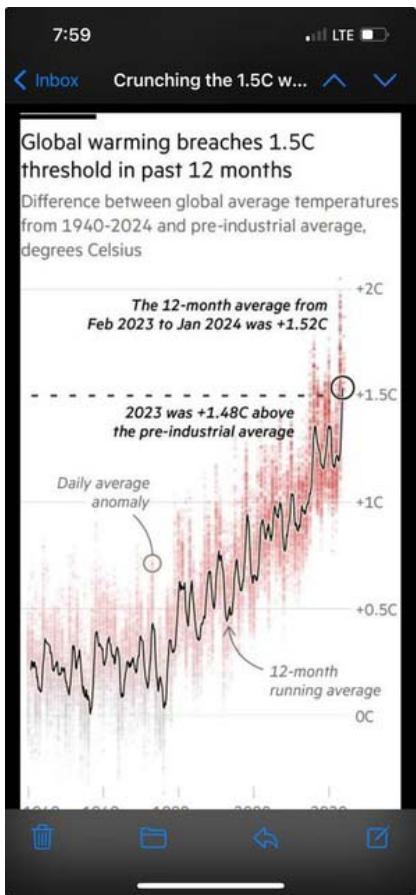 Figure 1
CO2 emissions by country
<table><tr><td>#</td><td>Country</td><td>Share of world</td></tr><tr><td>1</td><td>China</td><td>29.18%</td></tr><tr><td>2</td><td>United States</td><td>14.02%</td></tr><tr><td>3</td><td>India</td><td>7.09%</td></tr><tr><td>4</td><td>Russia</td><td>4.65%</td></tr></table>

An interesting contrast in outcomes can be seen between major emerging and developed economies. In India and China, heavy reliance on coal and higher electricity demand following the post pandemic economic recovery pushed emissions significantly higher, offsetting reductions in other economies.
Emissions rose more than $7\%$ last year in India, where a weaker monsoon season drove hydropower output lower. In China, emissions from energy combustion rose by $5.2\%$ to 12.6 billion tons—by far the largest on a global scale despite the country's leading position in the deployment of clean-energy technology. The agency's report refers to emissions from all uses of fossil fuels for energy purposes and industrial processes.
On the other hand, in advanced economies, emissions fell $4.5\%$ to a 50-year low last year, supported by a stronger deployment of renewables and energy-efficiency measures, but also weaker industrial production and milder weather in some regions resulting in lower energy demand.
According to the International Energy Agency (IEA), electricity generation from renewable sources and In thousands of purchasing power parity (PPP) per person
nuclear power in those economies reached $50\%$ of total generation. Renewables alone accounted for $34\%$ of electricity output, while the share of coal fell to a historic low of $17\%$.
In the European Union, emissions from energy combustion fell by almost $9\%$ in 2023 driven by a surge in renewables generation and drop in both coal and gas generation, despite economic growth of around $0.7\%$. In the U.S., emissions fell $4.1\%$ on higher electricity generation from renewables and gas rather than coal, in spite of economic growth of $2.5\%$.
Still, the deployment of clean-energy sources remains heavily concentrated in advanced economies, and to a lesser extent China. Increasing attention will be required to enhance investment and deployment in emerging economies. It is there where economic growth, industrialization (in part stemming from a migration of industries from OECD to emerging economies) and growing economic "catch up" is bound to take place. As a result, the bulk of energy growth will be in non-OECD countries (particularly China and India), which by mid-century may well lead energy demand worldwide.
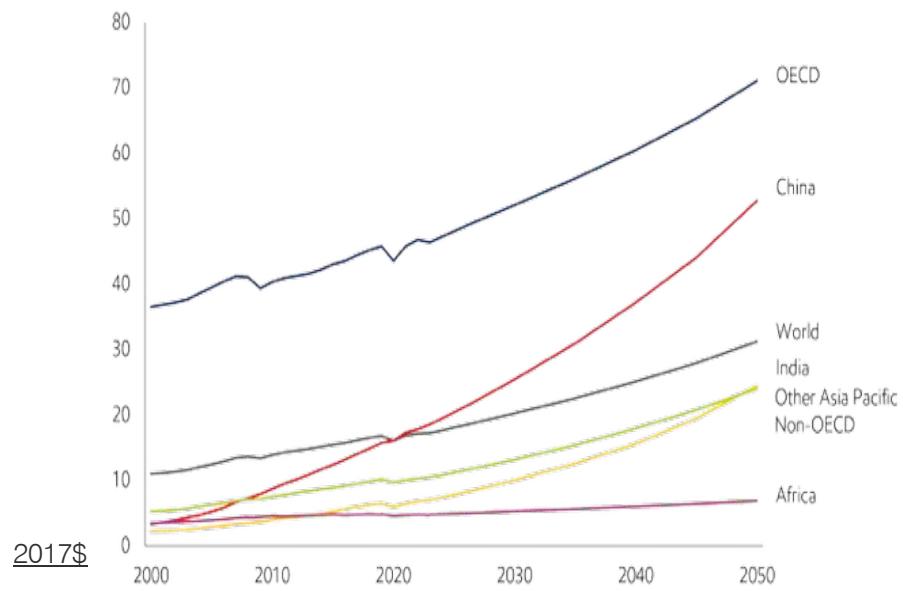 Figure 2
Primary energy demand - Quadrillion Btu
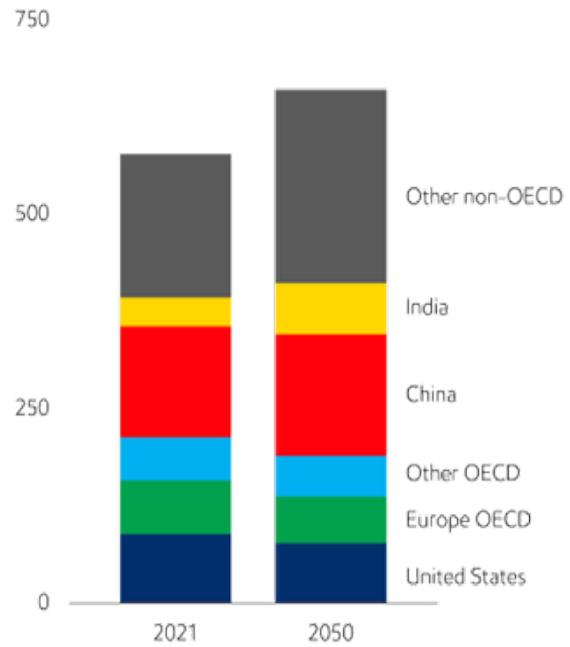 Figure 3
This will put an entirely different perspective on the energy and environment perspective. As a billion more people move towards greater prosperity, we may well see emissions decline as a variety of low-carbon solutions advance. However, achieving net-zero emissions, as aspired in the international agreements, seems rather unlikely, requiring adoption of constructive policies that can facilitate new technologies, including market-driven policies, more in line with institutional capabilities of emerging economies.[2] As the bulk of growth is bound to concentrate in emerging economies, it will become an increasingly critical for success and sustainability of the decarbonization effort to focus on the need to provide the reliable, affordable energy that drives economic Global Primary energy demand – Quadrillion Btu
prosperity and better living standards, while reducing greenhouse gas emissions.
This will inevitably still include oil and natural gas, which will still be required to drive critically needed economic growth in the developing world, particularly as some industrial activity may bound to migrate to emerging as part of narrowly understood environmental concerns, which may be bound to remain unchanged from a global perspective, and emissions for such activities may just migrate to emerging economies.
As a result, demand for energy-intensive activities (mainly industry and electricity generation) is bound to continue to grow globally, and is likely going to remain by far the largest share of energy consumption globally by mid-century:
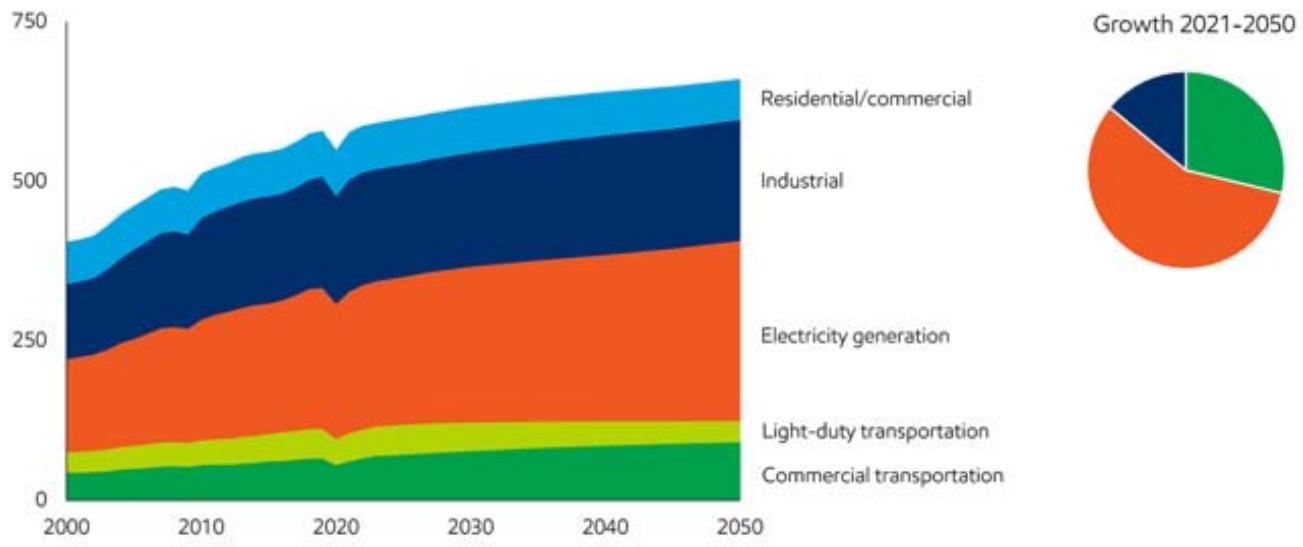 Figure 4
Short of major technological breakthrough. Renewables are going to continue growing, though from a still small base (and coal decline), leaving hydrocarbons still as the major (though with a larger share of lower emitting gas) as the predominant share of energy supply.
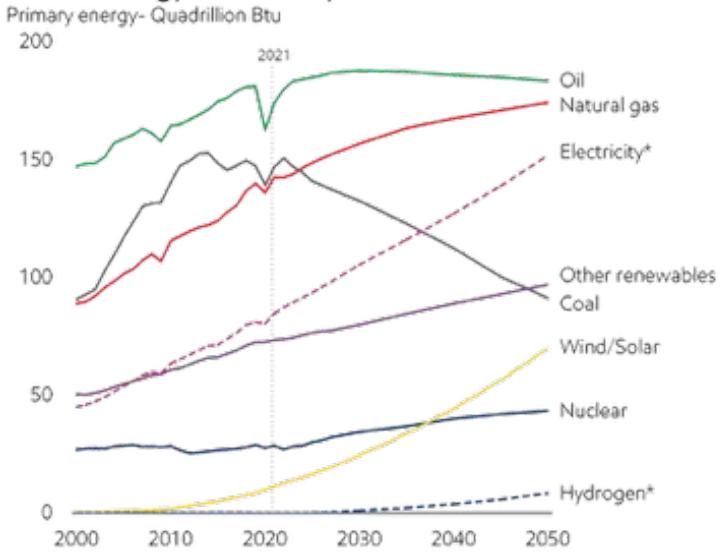
Global energy demand by fuel
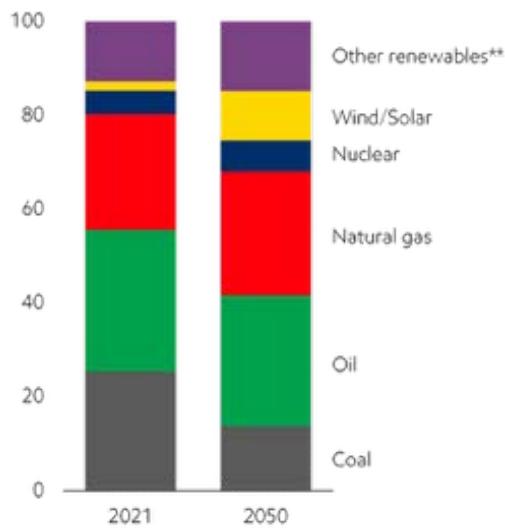
Percent of primary energy Figure 5
Every day, billions of people around the world benefit from the ability to heat and cool their homes, cook their food, access medical equipment and modern medicine, and travel for work and pleasure. Affordable and reliable energy is at the core of every key measure of human development – elevating living standards, life expectancy, education, and income per person. Yet for billions of more people, modern living conditions are still far out of reach.
In developing countries, such as India, gross domestic product (GDP) per person is only about \(2,000 per year1, and many people earn far less and lack access to basic necessities, including clean drinking water, heat, and cooking fuel. This challenge will only grow as the world's population increases from about 8 billion people today to nearly 10 billion in 2050 – a rate of about 1 million people every six days. And just as human progress has been fueled by higher energy use, further expansion of economic prosperity will depend on increased access to abundant, affordable energy.
In other words, energy use and economic development are inseparable. Where there is energy poverty, there is poverty. And where energy availability rises, living standards rise as well. Economic development and the integration of emerging economies have to go hand-in-hand to generate greater world prosperity, including meeting increasing energy needs to fuel much needed economic expansion.
Between now and 2050, developing countries will see GDP per capita more than double, driving higher demand for energy. Meeting that demand with lower-emission energy options is vital to making progress toward society's environmental goals. At the same time, failing to meet demand would prevent developing nations from achieving their economic goals and their citizens from living longer, more fulfilling lives, and constrain economic expansion, including in developed economies.
The critical question is how that growing energy demand will be met. Renewable energy continues to hold great promise, and we see wind and solar providing $11\%$ of the world's energy supply in 2050, five times today's contribution. Other lower- emission options, such as bio fuels, carbon capture and storage, hydrogen, and nuclear, will also play important roles. And even with this unprecedented rise in lower-emission options, oil and natural gas are still projected to meet some $52 - 54\%$ of the world's energy needs in 2050.
As lower-emission options grow, the world's energy-related CO2 emissions may well decline $25\%$ by 2050. That's a major change as these emissions rose by $10\%$ over the past decade. While the progress is substantial, larger reductions are needed to keep global warming from exceeding $2^{\circ}$ Celsius, according to the United Nations Intergovernmental Panel on Climate Change (IPCC).
The world will thus need to dramatically scale up lower-emission solutions - beyond the current trajectory - that preserve the advantages of today's energy system while significantly and efficiently reducing emissions. Doing this will require policy support from governments, significant advances in technology to reduce costs, and ultimately, market-driven solutions to incentivize emission reductions in a manner that is more

in line with institutional capabilities with public sectors around the word, and efficiency and skills to be provided by private sectors.
## III. POWERING HUMAN PROGRESS, WHILE REDUCING EMISSIONS
"It's not the size of the dog in the fight, it's the size of the fight in the dog" (Mark Twain)
Energy use and improved living standards thus go hand in hand. One can't have one without the other, and powering human progress to increase standards of living will have to embed reducing emissions, but in an efficient manner.
When China's per capita GDP was around $2,000, its energy use was low – about 36 million British thermal units (MMBtu) per person per year, deep in the realm of energy poverty. By 2021, when per capita GDP passed $11,000, China's energy use had risen to 101 MMBtu per person, well above the global average.
In contrast with China, Africa's energy use per person has remained at a low 27 MMBtu for the past two decades, and its per capita GDP has only risen by about $500 during that time. Areas that remain mired in energy poverty struggle to raise the living standards of their people.
As we look ahead to 2050, how much more energy must the world produce to meet the needs of 2 billion additional people and a global economy that has doubled in size? About $15\%$ more, with nearly all of it going toward meeting the higher living standard of a developing world with a larger population. Contrast that with the developed world, where there will be little population growth, and greater efficiency is projected to cause energy use to decline across all sectors of the economy.
But all energy types are needed to raise living standards and reduce emissions:
- Energy from solar and wind is projected to more than quintuple, from $2\%$ of the world's supply to $11\%$. Coal will increasingly be displaced by lower-emission sources of electricity production – not just renewables but also natural gas, which has about half the carbon intensity of coal. Overall, electricity use may grow $80\%$ by 2050.
- Oil and natural gas are projected to still make up more than half of the world's energy supply. The utility of oil and natural gas in meeting the world's needs remains unmatched. They are energy dense, portable, available, and affordable — and serve as essential raw materials for many products we use today. Given that oil and natural gas are projected to remain a critical component of a global energy system through 2050, sustained investments are essential to offset depletion as production naturally declines by $5 - 7\%$ per year.
- Oil use is expected to decline significantly in personal transportation but will remain essential for the industrial processes and heavy-duty transport like shipping, long-haul trucking, and aviation that underpin economic growth. Even if every new passenger car sold in the world in 2035 were an electric vehicle, oil demand in 2050 would still be 85 million barrels per day, the same as it was around 2010.
- Natural gas use is projected to increase by more than $20\%$ by 2050 given its utility as a reliable and lower-emissions source of fuel for electricity generation, hydrogen production, and heating for both industrial processes and buildings.
## IV. ADDING ALL UP: WHERE'S THE PROBLEM?
"El papel agua mucho" (Spanish expression to denote that on paper everything is possible).
We are flooded with an overdose of reports, so extensive and elegantly crafted that it is difficult to distill what they are conveying, distinguishing the fundamental from the trivial, and what to conclude. In the process, we seem to have lost a clear and unapologetic sense of: (i) whether and where we are (or aren't) making progress; (ii) why, and ultimately (iii) what needs to be done.
After all, the above projections are based on assumptions of the degree of introduction of renewables on the supply side, and consumer adoption on the market demand side. The declining costs of solar and wind technologies has certainly helped the adoption of such technologies, but their heavy location and weather dependence still limits their load factor capabilities, and with it the continuing need of traditional technologies to serve the needs of industry and urban centers that need high reliabilities to respond to major market requirements.[^3]
It should thus not be surprising that the range of projections of global energy-related emissions remains high, even assuming compliance with international pledges and agreements, as can be observed in the following graph of generally accepted projections from different sources:
### CO2 billion metric tons
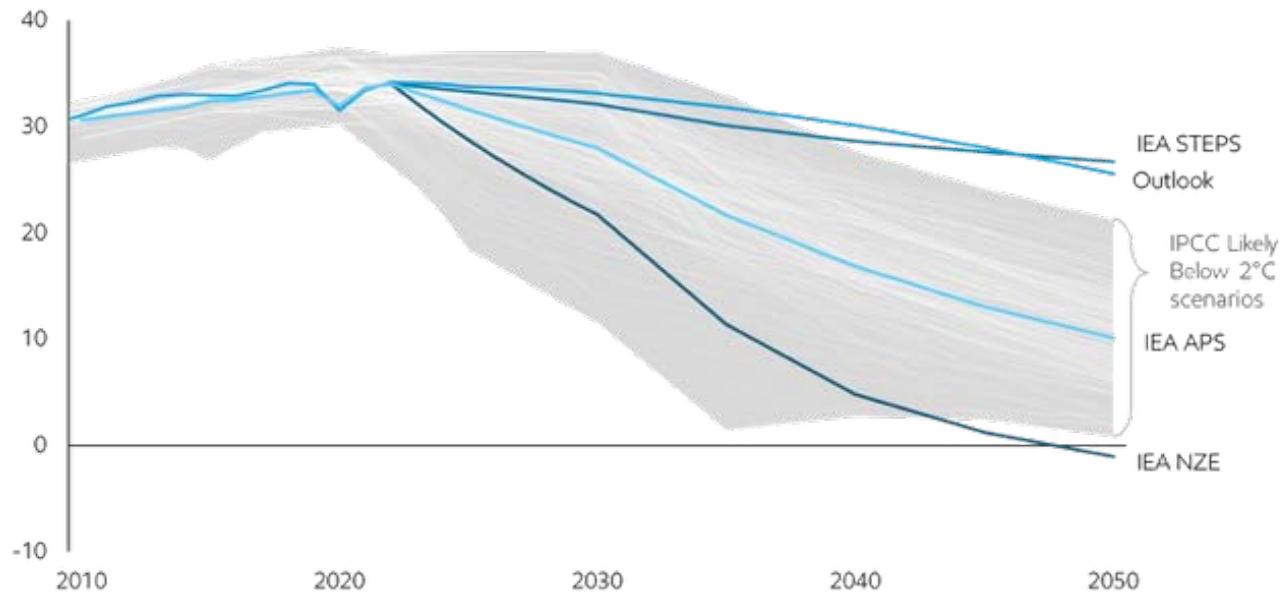
Source: IEA World Energy Outlook 2023, IPCC Sixth Assessment Report Figure 6
Broadly speaking, views of the future path of the world's energy system and emission levels can be grouped into three categories.
- Society's Current Trajectory
- Generally Presented Global Outlooks tend to be grounded on views of energy demand and supply through 2050 on observable trends in population, economic development, policy, technology and consumer preferences.
- The International Energy Agency's Stated Energy Policies Scenario (STEPS) that reflects a sector-by-sector assessment of current policy in place or announced by governments around the world.
Paris-Aligned Scenarios
- The U.N. Intergovernmental Panel on Climate Change's (IPCC) database contains 311 scenarios defined as pathways with a $67\%$ likelihood of limiting peak warming to below $2^{\circ}\mathrm{C}$ throughout the 21st century. These are labelled IPCC Likely below $2^{\circ}\mathrm{C}$ scenarios.
- The International Energy Agency's Announced Pledges Scenario (APS)1 assumes that all aspirational targets announced by governments are met on time and in full, including their long-term net zero and energy access goals.
Net zero by 2050
The International Energy Agency's Net-Zero Emissions by 2050 Scenario (NZE)1 is an aggressive pathway that assumes all necessary changes in policy, technology and human behavior occur for the global energy sector to reach net-zero $\mathrm{CO}_{2}$ emissions by 2050.
It is important to note that according to the U.N. Environment Program Emissions Gap Report the current Nationally Determined Contributions (NDCs) to emissions reductions that countries have pledged to make by 2030 are not yet within a Likely Below $2^{\circ}\mathrm{C}$ pathway. It further states that G20 members as a group do not have policies in place to achieve their current NDCs.
All considered, the projections are based on fairly mechanical criteria, and that in the majority of countries, accountability for results, institutional competencies to regulate effectively the transition and incentives prevailing in the private sector remain generally weak, and thus conditions for compliance with estimated agreed goals may be still rather lose to provide much credence to such (even wide ranging) projections.
Crisp assessments are thus needed on where priorities should be placed, what is being done in these economies to seek tangible decarbonization results impacting globally, and at least pose probing questions on whether the current record shows if countries and sectors are on the right track, and if not, what corrective actions may be needed to assure genuine progress towards the international goals. Without clear responses to these questions, it is unlikely to identify steps to contribute to achieve proper global impact.
Such approach should facilitate where progress is made, and where not, which policies and actions are taken, and what this can tell us of successful or failing policies. This may help move the discussion towards much needed transparency, and the build-up of accountability for improvements. A valid discussion on increasing temperatures and greenhouse gas emissions
can be engaged to assess whether sufficient progress, is being made, and a more disciplined approach to focus on results, the build-up of proper analytic underpinnings of what polices and actions work, and which ones not, to define a more discerning contribution to the subject.
## V. ITS HALF-TIME - POISING TO ACHIEVE GENUINE DECARBONISATION
"A man will fight harder for his interests than for his rights" (Napoleon).
Improved outcomes over the current record are far from trivial. All indications are that we may be seeing "tipping points" (or points of no return) in action, such as sustained melting of the Greenland, Arctic and Antarctic ice masses, Pacific islands going under water, the dieback of the Amazon and other forests with no other plausible explanations than human caused climate change. Scientific consensus is sparse, but one them is that planetary tipping points represent one of the gravest threats. In the absence of clear frameworks, four areas merit specific attention:
- Through regulatory and/or institutional compulsion: quite aside of the institutionally-intensive requirements of such processes to manage these types of changes, they tend to demand increasing costs and time, and are difficult or burdensome to manage, particularly in emerging economies, and thus hard to see how they could contribute to tangible outcomes in the foreseeable term solution of the issue, as they probably may be a rather taxing and burdensome avenue.
- Through enabling pricing and/or taxation policies reflecting energy scarcity and/or "pricing" carbon emissions, as successfully done in Chile and a growing number of countries,[4] and the face-out of chlorofluorocarbons (CFCs pursuant to the Montreal Protocol to stem ozone depletion) in essence "internalizing" external costs to reflect societal harm and align incentives to minimize the latter, as in the EU, with its emissions trading system and national carbon taxes. For such policies to work, it is indispensable to have a working private sector and enabling conditions that further the development of enterprises capable to respond to such policy environment.[5]
- Through proactive management of transformative policy, such as tax credits, focused policies like the Inflation Reduction Act aimed at supporting renewable energy incentive opportunities to help US businesses manage and reduce their energy costs and improve security by enhancing renewable infrastructure providing public sector support for decarbonized sources of energy supply, or the European Union measures to cut off Russian
gas. Within five years they have been instrumental in reducing Russian gas as a percentage of total gas piped in to Europe, and new facilities for changing energy matrix. Such policy, inevitably depends on significant public sector resources (which in times of fiscal constraints, is bound limit sustainability) and management inputs for appropriate resource allocations. Overall, the EU is now introducing its ambitious supply-side measures through industrial plans to enhance competitiveness of Europe's net-zero industry to accelerate the transition to climate neutrality by scaling up its manufacturing capacity for the net-zero technologies and products.
- Mobilization of financial and technical resources (with public policy, legal, engineering, project management and a wide range of other skills) to achieve net zero goals. Public and private sector entities across the globe will need approximately $3.8 trillion in additional annual investment flows [equivalent to 3.8 percent of global GDP through 2030.<sup>6</sup> But only a fraction of this capital is currently being deployed. Even when viewed with a wider lens that considers funding such as transition finance, expected needs still outweigh flows by $66\%$.[^7] In sum, with the significant cost reductions, and increased adoption of renewables, the case the case for them has already been made. The promise of lowered aggregate CO2 emissions and consequent mastering of climate change is, however, far from materialized.
## VI. CONCLUSION - THE ROAD TO PERFECTION
"Let's build a city, with a tower that reaches heavens"; (Genesis 11)
Readers expecting a methodological tight analysis and conclusive results will surely be disappointed. For the time being, there is no alternative than to dig deeper and experiment systematically on the subject. The world is messy; perfection is the enemy of the good, and partial evidence and aggregate statistical information on overall outcomes are informative. Under the circumstances, there is no alternative but to admit that technical expertise is and will continue to be a key ingredient for success in a wide range of pending issues – from policy formulation to technological innovation.
Over recent years there have been plenty of turbulence around the economy. We had the pandemic, wars, climate disasters (all with considerable externalities), but we have witnessed remarkable resilience and imagination. While we have plenty to worry about, despite multiple (and complex) shocks and tight financial constraints, growth and development are firmly in positive territory, as is the levelling of emissions and improvements in energy matrixes around much of the world. But the problems are not gone, and we have a long and complex road ahead.
We recognize one-size-fits-all does not fit all. The pace and speed of consolidation will vary depending on country circumstances, so will also the balance between mobilizing revenue and improving spending efficiency. In the interest of international stability, to face this adjustment, we cannot forget that the burden should not fall on the most vulnerable people.
All this will require foundational reforms, strengthening governance, cutting red tape, improving access to capital, combating corruption. These factors are all essential for growth, and even more so are productivity-enhancing structural reforms and investment in human capital, the green and the digital transition. With artificial intelligence already upon us, coordination on global rules is as important as having the technology and the skills to tap into it.
Although, all this may sound formidable, strictly speaking, for millennia, the universe went through major changes, causing human beings to migrate, changing their survival practices by adapting themselves to their changing environment. The Bible's recording of the ambitious construction, and subsequent disastrous fall of the Tower of Bible may well be one such event. As human beings keep developing, beyond a certain point they need to rethink the underlying ways of living, materials they use and other ways of developing. It may well climate change and associated problems we are starting to face may be a manifestation of this problem – i.e., the need to adjust our modes of living, construction and even the surrounding environment we create to adapt and live in a world operating at much larger scale.
In fact, Galileo in his principle of similitude had already defined the issue by showing that size and strength do not increase or decrease at the same ratio, and that beyond certain scales structures and practices need to be recast. It is not inconceivable that this principle goes beyond structural engineering, and could apply just as well to human development, and that climate change is another manifestation of human beings having developed with technologies beyond the capabilities of nature to keep responding to population growth and associated increased availability of materials, without adjustments in the modes of living and practices for further development.
With such major change in hue to conceive further development, it is easy to see the conflict between neither climate change deniers and asserters as the underlying facts seem so unclear:
- Climate change deniers refuse to believe that there is a problem, and thus oppose any policy or investments to counter the trend of temperature increases;
- Asserters, refuse to understand the implications of the scale (requiring an annual increase of investments of the order noted above to achieve the net zero target), and complexity of technological changes to operate in a world with significantly different energy feedstock.
Accordingly, a more agnostic and eclectic approach may be necessary — avoiding the fanatics on both sides, to achieve a balanced and viable investment framework while undertaking the necessary adaptation measures, within the scale of what is absorbable — some of this is already taking place spontaneously to get us out of the current bind and achieve longer-term sustainable results. Resisting reforms and/or adaptation just involves digging ourselves deeper into the existing problems we are getting into. Changing the energy matrix within what is absorbable with the current knowledge, while at the same adapting to the warming environment through migration, construction of defenses for increased water levels, etc. Seem to provide a viable option to address development under emerging conditions.[9]
At the same time, a more integrated approach to the issue needs to be undertaken to seek more effective answers to overcome inherent limitations of renewables (such as their lack of reserve capacity and heavy location-and climate-dependence). This will require greater attention and complementary investments in energy storage and transmission to overcome their low load-factor conditions and location constraints, and further diversification and technical development to seek enhanced security in emerging conditions.
In the end, more economically-driven analyses are necessary for proper policy formulation, to capture the varying institutional and contextual conditions that need to be properly integrated in the above-mentioned policy options for enhanced outcomes.
Generating HTML Viewer...
References
11 Cites in Article
Miguel Schloss (2021). Unknown Title.
Miguel Schloss (2023). Unknown Title.
Geoffrey Heal (2017). Endangered Economies.
Miguel Schloss (2023). Energy Transition in Unsettled Times.
Annie Dufey (2023). Lecciones que Se Desprenden del Proceso de la Política Energética de Largo Plazo-Energía 2050.
Bruno Frey (2023). How Influential is Economics?.
Claudiu Doltu (2026). The Option for Graduation: Rethinking Romania’s Role in Bretton Woods Multilateral Development Banks.
Joshua Pearce (2023). How to ensure Alberta’s oil and gas workers have jobs during the energy transition.
Alessandro Casaburo,Giuseppe Petrone,Francesco Franco,Sergio Rosa (2019). A Review of Similitude Methods for Structural Engineering.
Abraham Lustgarten On the Move: The Overheating Earth and the Uprooting of America.
Jacek Gutorow (2024). Review: Lydia Davis. 2019. Essays One. New York: Farrar, Straus and Giroux. Lydia Davis. 2021. Essays Two. New York: Farrar, Straus and Giroux. Lydia Davis. 2009. The Collected Stories. New York: Farrar, Straus and Giroux..
No ethics committee approval was required for this article type.
Data Availability
Not applicable for this article.
How to Cite This Article
Dr. Miguel Schloss. 2026. \u201cChasing the Unknown the Quest for Decarbonization\u201d. Global Journal of Science Frontier Research - H: Environment & Environmental geology GJSFR-H Volume 24 (GJSFR Volume 24 Issue H1).
Explore published articles in an immersive Augmented Reality environment. Our platform converts research papers into interactive 3D books, allowing readers to view and interact with content using AR and VR compatible devices.
Your published article is automatically converted into a realistic 3D book. Flip through pages and read research papers in a more engaging and interactive format.
Our website is actively being updated, and changes may occur frequently. Please clear your browser cache if needed. For feedback or error reporting, please email [email protected]
Thank you for connecting with us. We will respond to you shortly.