
I. INTRODUCTION
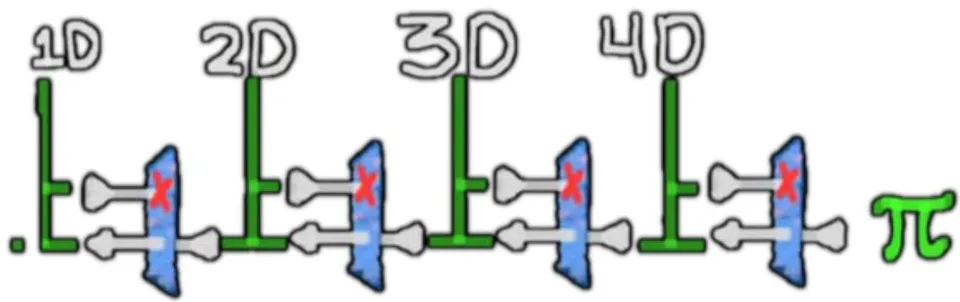
"Half-silvering Dimensions" Each dimension having a distinctive boundary called a "Half-silvering" that acts like a two-way mirror. This means that beings or objects existing in a higher-dimensional space can look down into lower-dimensional spaces but cannot see or perceive the higher-dimensional spaces above them. For example, entities in 3D can observe and interact with 3D, 2D, and 1D, but they cannot see or comprehend dimensions beyond 3D.
To develop this concept further, we could consider the implications and characteristics of these "half-silvering" boundaries:
Dimensional Perception: Beings or objects within a particular dimension can perceive and interact with dimensions below them but lack awareness or comprehension of dimensions above them. This limitation might be due to the inherent nature of their existence within a specific dimension.
Transitioning Across Dimensions: Travel or movement between dimensions could occur by crossing the "half-silvering" boundaries. For example, a 3D entity could pass through the 2D
boundary and enter the 2D space, but it would be unable to perceive or interact with 3D space once it has crossed the boundary.
Properties of "Half-silvering" Boundaries: These boundaries might possess unique properties, such as being impermeable to certain types of energy or matter. This characteristic would maintain the integrity and separation between dimensions.
Limitations and Constraints: Each dimension may have specific laws and properties governing its behavior, which might influence the interactions and possibilities within that dimension. These laws could differ from one dimension to another.
Multidimensional Observatories: Beings or technologies residing in higher dimensions could create observatories or devices capable of peering into lower dimensions. These observatories would exploit the two-way mirror effect of the "half-silvering" boundaries to observe and study the dimensions below.
Higher-dimensional Existence: Exploring the concept of dimensions beyond 3D raises intriguing questions about the nature of higher-dimensional existence and the potential laws that govern those dimensions.
a) Positive Implications
Expanding Our Understanding: The theory presents an opportunity to broaden our understanding of the universe by exploring dimensions beyond our current grasp. It offers a framework for investigating higher dimensions and the laws that govern them, potentially revealing profound insights into the nature of reality.
Interdimensional Communication: Imagine the potential for communication and interaction between beings residing in different dimensions. By deciphering the mechanics of these "half-silvering" boundaries, we may uncover ways to establish communication channels, exchanging knowledge and perspectives with entities existing in other dimensions.
Novel Technological Applications: Research into the "Half-silvering Dimensions" theory could lead to the development of technologies that enable observation and manipulation of lower-dimensional spaces. Such advancements could have applications in areas such as materials science, quantum computing, and data storage.
Multidimensional Observatories: Building upon the theory, we could envision the creation of observatories capable of peering into lower dimensions, offering unprecedented insights into the workings of lower-dimensional realms. This could pave the way for discoveries and advancements previously unimaginable.
b) Challenges and Negative Implications
Practical Limitations: Exploring dimensions beyond our own presents immense challenges due to our inherent 3D existence. It would require innovative approaches, sophisticated technologies, and a profound shift in our scientific methodologies to overcome these limitations.
Ethical Considerations: As we delve into the realm of higher dimensions, ethical dilemmas may arise. How would contact with beings from lower dimensions affect their societies and development? It is crucial to address these ethical concerns and ensure responsible exploration and interaction.
Paradigm Shift: Accepting the "Half-silvering Dimensions" theory demands a paradigm shift in our understanding of reality. Scientists may face scepticism and resistance from those rooted in traditional frameworks. However, history has shown that scientific progress often emerges from bold ideas that challenge prevailing knowledge.
II. CONCLUSION
In conclusion, the "Half-silvering Dimensions" theory holds immense potential to expand our understanding of the universe and unveil hidden realms of existence. While it presents challenges and raises ethical considerations, the positive implications are significant, offering exciting opportunities for scientific exploration, technological advancements, and even interdimensional communication. I urge you to embrace this theory, explore its possibilities, that may forever transform our perception of reality.