## I. INTRODUCTION
Autism, a complex neurodevelopmental condition, presents with communication challenges, difficulties in social interaction, and repetitive behaviors [31]. Autistic people often perceive social cues differently, leading to hurdles in initiating conversations [90], and cultivating lasting social relationships [9]. Such challenges can reduce their inclination towards active social engagement. For some, this translates into a preference for solitary activities and an aversion to social scenarios, complicating social participation [12]. Nevertheless, not every autistic person exhibits these tendencies; some eagerly pursue social engagements [14].
To enhance the social engagement of autistic people, tailored interventions prove essential [46]. These strategies encompass social skills coaching, peer support mechanisms, and customized inclusive settings [60]. Addressing autism's unique challenges can elevate social involvement, thereby enhancing their quality of life [24].
Given the rising global prevalence of autism, discerning its underlying intricacies and pinpointing effective interventions hold immense research value [45]. Employment, vital for fostering independence and social inclusion, improves life quality for those living with autism [40]. Skill development boosts workplace competence and success for these individuals [23]. Yet, a staggering $85\%$ of degree-holding autistic individuals remain unemployed [7]. Such unemployment not only curtails financial autonomy and growth prospects but can also engender feelings of isolation, diminishing overall well-being [27, 48].
### a) Autism in the workplace
The transition to workplace environments often precipitates burnout in individuals with autism [50]. During a focus group, inclusive employers elucidated the complexities associated with assimilating autistic employees into the workforce, underscoring the necessity for swift contextual understanding as conventional emotional communication methods often prove inadequate [25]. A salient consideration is the exertion to align with neurotypical standards in workplaces, which can precipitate substantial fatigue in autistic employees [82]. This alignment, termed "masking" or "camouflaging," entails curtailing innate autistic traits to resonate with neurotypical peers [35]. Such continuous adaptation can be mentally taxing, compelling the individual to suppress sensory sensitivities or navigate complex social contexts, elevating stress levels and escalating the potential for burnout [44].
The presence of alexithymia further complicates workplace dynamics for the autistic, impairing effective social interaction navigation [73]. Predominantly observed within the autistic demographic, alexithymia is marked by challenges in discerning and articulating emotions, with a pronounced emphasis on factual details over emotional experiences [36]. Such emotional navigation barriers can foster misinterpretations, hampering the formation of constructive work relationships, and subsequently affecting job efficacy and overall well-being [43].
Anticipated miscomprehension or discrimination due to autism exacerbates the emotional strain of workplace adaptation [39]. Masking, sensory overload management, and unaided social challenge navigation cumulatively amplify resignation likelihoods [62]. The current research spotlights burnout detection via tangible physiological indicators while acknowledging burnout's multifaceted nature, including its psychological facet [50]. The hypothesis posits that tangible markers—cognitive stress, mental workload, and emotional self-regulation, anchored in respiratory sinus arrhythmia—exert pronounced effects on emotional well-being in delineated scenarios. Accurate measurements necessitate individualized calibrations, defying universal benchmarks.
Studies on social cognition underscore the burgeoning demand for social skill instruction among autistic individuals, yielding affirmative outcomes in improving interpersonal capacities [30]. Notwithstanding, adept job readiness doesn't immunize against unanticipated social impediments, which can culminate in distressing encounters and subsequent fatigue [6]. Such challenges frequently remain undetected, unarticulated, or unaddressed until they intensify, prompting some to vacate their positions [69]. While inclusive employers acknowledge the merits of bespoke support for autistic employees, they pinpoint a prevailing predicament: extant assistive tools for social exchanges often adopt a generic stance, operating more reactively than proactively, thereby attenuating their potential to cater comprehensively to the autistic workforce's distinct requirements.
### b) Related research works
Literature encompassing the application of virtual reality (VR) technology for the autistic population predominantly pivots around two cardinal domains. The initial domain pertains to the cultivation and instruction of social skills [20], while the subsequent realm delves into the discernment, interpretation, and emotional receptivity of autistic individuals [55]. Albeit the anterior research promises encouraging outcomes, certain constraints associated with deploying VR interventions for these stipulated objectives have been documented [11, 20, 47].
Substantial empirical evidence underscores the efficacy of VR in augmenting self-assurance during job interviews [77], attenuating aversive attitudes during driving [70], enriching transportation literacy [76], bolstering navigational aptitudes [72], and diminishing errors associated with road sign interpretation [71]. Notwithstanding these affirmative outcomes manifested by preceding research [49], the research calls for an augmented deployment of VR/AR in interventions targeting autism-related social skills. Such a call accentuates the imperative for novel research, the exploration of head-mounted displays (HMDs) in light of technological advancements and cross-disciplinary collaboration, and the paramount importance of redressing gender disparities in research participation [20].
A review of insights from 23 empirical studies focusing on VR-anchored behavioral interventions for autistic individuals discerned that a preponderant segment targeted vocational competencies [13]. Yet, an overarching emphasis seemed to be placed on the selection trajectory with limited elucidations on how such interventions could buttress sustained employment post-interview. Such insights fortify the potential of VR in instructing driving, enhancing interview competencies, bolstering safety, and advocating training generalization. The bespoke features of VR interventions, coupled with additional practice and the propitiousness for skill generalization, might find resonance in an array of vocational frameworks.
However, instances of immersive environments curated to support autistic individuals beyond the interview phase appear to be scant. The pioneering work of Bozgeyikli, et al. [10] showcased VR4VR, a virtual reality apparatus conceptualized for vocational rehabilitation of those diagnosed with Autism Spectrum Disorder (ASD). Their findings elucidated the insights gathered from testing sessions, wherein participants honed transferable occupational skills such as cleaning and money management. Likewise, Sher, et al.'s [75], research exploited VR to bolster culinary competencies among autistic high school attendees. In a parallel vein, Amat, et al. [4], proffered ViRCAS, a collaborative VR interface fashioned for both autistic and neurotypical adults to augment team coordination. Such innovative endeavors corroborate the reception and potential of virtual realms in refining occupational social skills for autistic individuals. Yet, these explorations seldom broach the pivotal challenge of articulating discomfort within cooperative milieu, prior to its manifestation.
A nuanced examination of 185 articles focusing on autism-specific technologies delineated six cardinal categories, encompassing behavior analysis and wellbeing [57]. A recurrent lacuna, however, lies in these technologies' propensity to superimpose neurotypical standards, thereby depriving autistic individuals of self-determination. A pressing exigency thus emerges for technologies advocating autonomous involvement that mirrors the principles of neurodiversity.
To meet such a demand, VR learning realms tailored for autism could accentuate interactional perceptions [2]. Through integrative designs amalgamated with autism-centric learning paradigms, these milieu could optimize cognitive engagement and bolster efficacy [88]. The confluence of such interactive methodologies within VR platforms enables the replication of real-world social situations, fostering regulated practice and instilling confidence.
Moreover, a surging call for bespoke learning experiences heralds the merger of avant-garde technologies [3]. Personalized, experiential, and immersive learning opportunities are crucial to closing gaps in traditional methods. These technologies offer customized pathways, enhancing engagement and knowledge retention by adapting to diverse learning styles.
Customizable, immersive, and experiential learning avenues become indispensable to address the lacunae inherent in conventional methodologies [51]. Through adaptive pedagogical trajectories, immersive platforms become more alluring, championing proactive engagement, exploration, and a profound assimilation of academic content [67]. Additionally, the imperative of eschewing profit-driven imperatives in curricular design has been underscored [34], placing developmental imperatives at the zenith to cultivate genuinely inclusive learning realms.
Building upon this extensive research corpus, the current exploration ventures into discerning how VR could serve as a conduit to facilitate understanding between autistic individuals and their support network, particularly concerning emotional wellness in occupational settings, thereby engendering affirmative vocational experiences for autistic individuals.
### c) Research question
Central to the anticipations of autistic individuals and inclusive employers is the elucidation of determinants during interactions that potentially precipitate discomfort. Consequently, the primary inquiry of the current study posits: How pertinent is it for users to garner real-time feedback concerning physiological indices indicative of cognitive stress and emotional regulation?
### d) Objectives
Through achieving the following objectives, this research aspires to significantly contribute to the creation of more inclusive and supportive work environments for autistic people:
- Design and implementation (Objective 1): Develop a real-time, self-calibrating VR simulation system for social interactions, aimed at fostering a deeper understanding of social dynamics for autistic people in professional settings.
- Self-Awareness and synchrony (Objective 2): Enhance self-awareness among autistic employees by providing indicators of physiological well-being, and establish synchrony between neurotypical and neurotypical individuals during simulated social interactions.
- Quality of interaction and well-being (Objective 3): Identify and interpret indices that can shed light on the quality of social interactions and the overall wellbeing of autistic employees in the workplace, using data gathered from the VR simulation.
- Usability assessment (Objective 4): Evaluate the effectiveness, relevance, and user-friendliness of the VR simulation system from the perspective of autistic individuals, aiming to identify areas for improvement.
- Analysis of system limitations (Objective 5): Discuss and analyze the potential limitations and challenges associated with the implementation of VR-based adaptation systems in real-world professional settings, guiding future research and development in this area.
### e) Outline of the article
The ensuing sections of the article adhere to the following structure: The initial segment delves into the methodologies applied in the design, construction, and experimentation of the system. Subsequent to that, the findings derived from the experimentation involving five autistic participants will be detailed, with a focus on RSA, physiological synchrony, cerebral activity, and their subjective evaluation of interactions, all within the purview of the CVS. Concluding the article, an emphasis will be placed on the paramountcy of the study's direction in tackling the challenges of integration and retention experienced by autistic individuals within professional environments. Concurrently, a discourse on the study's present constraints will be provided, coupled with an overview of anticipated future endeavors.
## II. METHODS
Our methodology is based in mixed approaches, aiming to design and construct an adaptive system for measuring physiological well-being indicators, simulating workplace social interactions for collaboration in the workplace purposes, and assessing the usability and relevance of our system within a demographic of autistic individuals.
The adopted methodology hinges upon a confluence of mixed-method approaches, with the primary objective of designing and constructing a responsive system. This system is poised to gauge indicators pertinent to physiological well-being, emulate workplace social dynamics for collaborative engagements, and evaluate the system's usability and pertinence amongst a cohort of autistic individuals. In the subsequent segments, an articulation of the formulated hypotheses and distinct contributions will be presented. Following that, an in-depth exploration of the collaborative workplace simulation will ensue. Concluding this section, an elaboration on the instruments and measurement apparatuses utilized for the assessment of the CVS will be provided, accompanied by a comprehensive delineation of the study's experimental procedure.
### a) Hypothesis and contributions
The current work is a study on the utilization of a CVS aimed at enhancing the employability of individuals with autism in the workplace, employing real-time monitoring of various physiological indicators. This exploratory study explored different physiological markers that could indicate the manifestation of quality social interaction between the autistic-companion dyad when using this collaborative VR platform. We wanted to provide a proof of principle based on (1) physiological synchrony by assessing the time series of parasympathetic activity, adapting a modern statistical methodology proposed in the literature to determine the degree of physiological synchrony in the RSA responses of the participants during these sessions, as well as on (2) the physiological responses of the autistic participants from brain activity during these sessions. We present the following hypotheses:
H1: Will the respiratory sinus arrhythmia (RSA) synchrony between the autistic participant and their companion surpass that of the surrogate controls, thereby indicating the presence of physiological synchrony at a distance during the use of the collaborative platform?
H2: Will there be a progressive improvement in brain activity markers, suggesting that the mode of collaboration facilitated by the system is effective in enhancing the comfort of the autistic participant?.
This work offers the following contributions:
- First, we propose and evaluate a conceptual VR system called Virtual Companion (VC) that is designed to address the social and emotional challenges of individuals with autism in the workplace. This fills a gap in the existing literature because most of the technology research on autism
involving physiology-based measures focuses on children and adolescents.4
- Second, our research adds to the body of research in the underexplored area of autism technology by taking a social perspective rather than a medical approach. We identify alack of VR systems that emphasize training for social interaction and provide emotional well-being in the workplace. Accordingly, we propose a VR environment that not only prioritizes promoting social interactions and aims to improve the adaptability of autistic individuals to their work environment, but also enables self-awareness of physiological reactions during workplace interactions in order to ensure emotional wellbeing in the workplace.
- Finally, our present study is so far one of the few that have addressed physiological signals in VR sessions and, to our knowledge, the first study to explore the synchronicities of autonomic nervous system regulation markers (respiratory sinus arrhythmia) using a validated surrogate test window cross-correlation (SUSY) approach, between the neurotypical-neuroatypical pair, in a remote context simulating the workplace.
### b) Collaborative workplace simulation designed for social interaction training
The development of social competencies in individuals with autism stands out as a pivotal initiative in fortifying their employability prospects [34]. Methodologies to develop the social skills of autistic people for corporate training are usually based on behavioral imitation of movements and speech [42], which are merged with well-described tasks in the workplace associated with goals to be achieved [56]. Getting them to carry out more collaborative activities therefore requires positive social interdependence as defined by Johnson and Johnson [33], where the achievement of each team member's personal goals is affected by the actions of others. Negative social interdependence, on the other hand, is mobilised when individuals perceive that their peers must fail if they are to achieve theirs.
VR interventions have shown promise in helping autistic people in various contexts, including the workplace [11]. VR provides great technological support for promoting workplace adaptation, as it could simulate a work environment and provide a non-judgmental place to prepare for real-world social expectations [38]. Autistic people benefit significantly from VR interventions as they allow them to better understand social dynamics and respond to them with the expected attitude [41].
Expanding upon this body of research, we explored how virtual reality could aim to ensure emotional well-being and foster positive work experiences for the neuroatypical. The Virtual Companion (VC) research project, which contextualizes this study, is based on this principle of virtual simulation of a work environment based on an ergonomic study of the space, an analysis of the tasks and work habits of employees in an inclusive company [25]. The VC project stems from the
inclusive companies' call that while the development of social skills enabled people with autism to get a job, their job retention would be determined by their ability to maintain their mental health at work [92]. Burnout seems to be one of the main causes that lead autistic people to leave their job or to reduce their workload considerably [5].
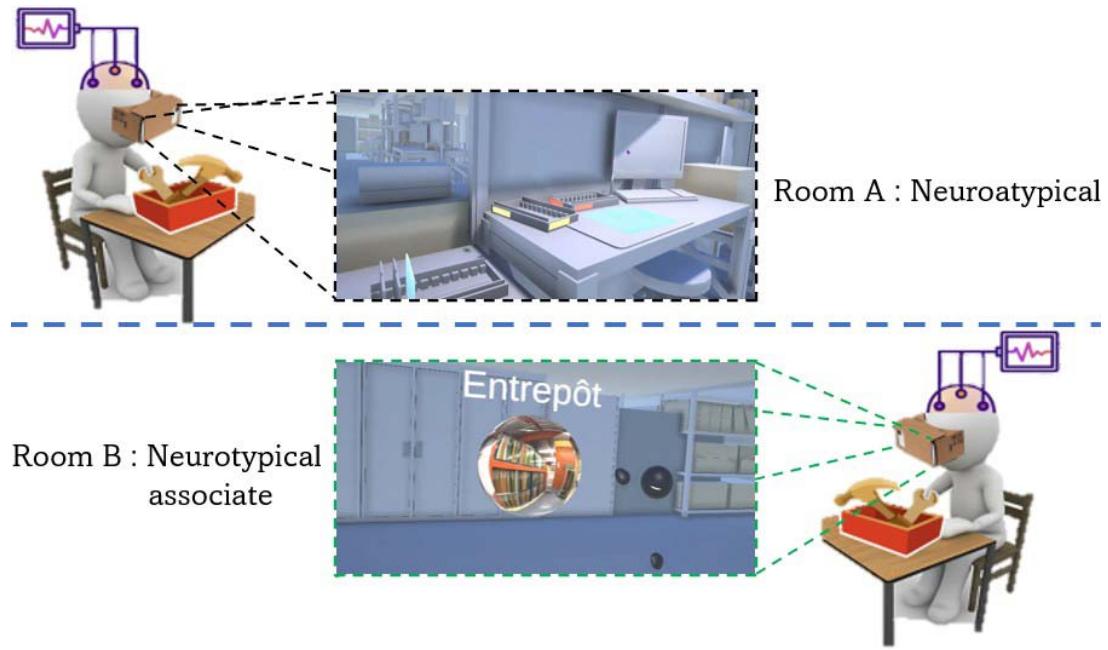 Fig. 1: Representative diagram of the configuration of the virtual companionship system. The neurotypical is in a different room from his neurotypical counterpart. Both wear a virtual reality headset connected to the internet, which they use to communicate in real-time (via the integrated microphone and headset) and to move and interact in the virtual environment. Both can see each other through an avatar within the virtual environment. Additionally, both wear physiological sensors that store time series of parasympathetic and brain activity.
The VC simulation is based on the application of TRIZ theory, a problem-solving algorithm that seeks to refine the use of VR systems to improve adaptability and efficiency. The application, described extensively in prior work by Proulx-Guimond 2023 [25], aims primarily to improve employers' understanding of issues related to autistic employees and to identify the most critical challenges they face in the workplace. Through literature reviews, surveys and focus groups, the VC project investigates the factors affecting autistic people in the workplace. It identifies the key components for developing a more effective VR system to support workplace integration based on the following aims.
The VC system is experienced remotely and allows the collection and display of biometrics in real-time. Figure 1 illustrates the setup of a VC session, where the autistic and a neurotypical associate, in separate rooms, use internet-connected VR headsets for real-time communication and interaction.
Seeking to provide a safe and controlled environment to support the autistic in their workplace adaptation, we have integrated the following components that constitute the VC system. Firstly, the virtual reality simulation aims to develop social communication, problem-solving and interpersonal skills, where a human associate (which we have called "companion") provides real-time information and guidance within the virtual environment (Figure 2a). Often, people with autism present sensory sensitivities that can be challenging in traditional work environments [81]. To this end, the VC application allows for the creation of customizable and controlled sensory experiences that allow people to gradually adapt to different stimuli sources, thereby helping the autistic to reduce sensory overload in the workplace. We have integrated a modulator panel into the VR environment to adjust the levels of different stimulus sources, such as the sound level, the light level inside and outside the virtual working environment, the scrolling speed and the number of non-playable characters (NPCs) around the scene (Figure 2b). Within the simulation, we simulate work tasks to help people with autism learn and practice work-related skills in a realistic and immersive virtual environment (Figure 2c). Job task replication can be particularly beneficial for people with autism to perform tasks that require spatial awareness, attention to detail or complex procedures, as it provides a controlled
environment to learn and practice work-related skills while reducing real-world stressors. Furthermore, stress and anxiety in the workplace can be significant challenges for people with autism. To this end, we have integrated a panel of physiological measures that reflect in real-time different metrics related to parasympathetic activity (respiratory sinus arrhythmia) and brain activity (level of attention and relaxation) in order to promote self-awareness about the autistic's physiology and help them manage stress and anxiety levels (Figure 2d). Additionally, some people with autism may have difficulties adapting to new environments or changes in the workplace. So, the application can familiarize individuals with the work environment before they enter it. By integrating interactive capsules of 360-degree panoramic photographs of real locations, we aim to help reduce anxiety by providing a sense of predictability and control (Figure 2e and Figure 2f).
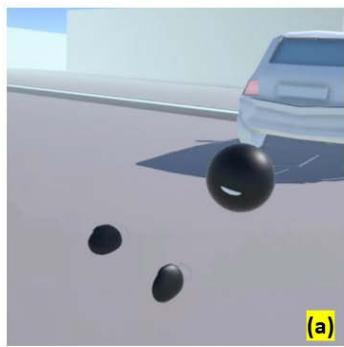
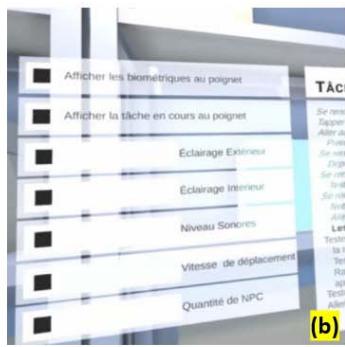
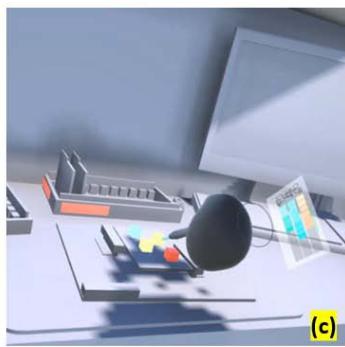
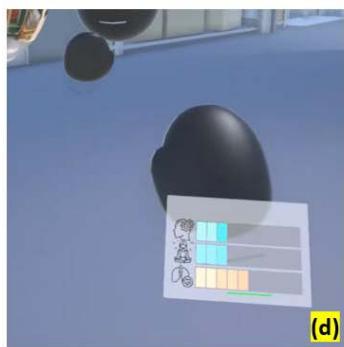
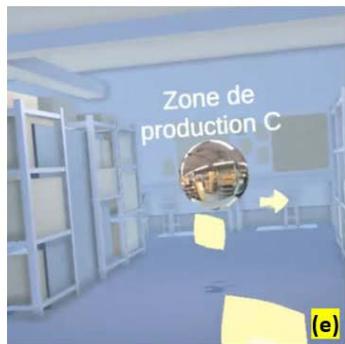
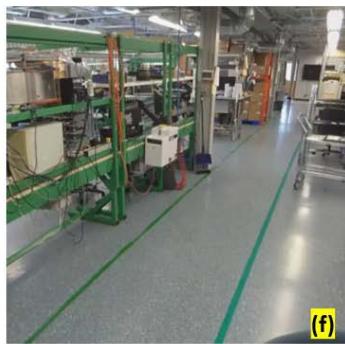 Fig. 2: The virtual companionship (VC) platform, designed for neurodiverse individuals, simulates a work environment to enhance social skills and workplace adaptation. It's accessed through a VR headset connected to the internet, providing a synchronous, remote experience. Features include: a) Avatar's view: users, represented as 'black blobs,' interact in the VR workspace using voice and movement, enabled by integrated headset microphones, speakers, and controllers.
b) Modulatory panel: This panel in the VR setup allows users to adjust various stimuli levels, such as sound and light intensity inside and outside the virtual workspace, movement speed, and the presence of non-playable characters (NPCs).
c) Welding task simulation: The platform includes tasks like a simplified manual welding test, helping users familiarize with specific workstations without needing extensive technical skills.
d) Physiological signal panel: Located on the virtual avatar's wrist, this panel displays indicators of the user's physiological state, including respiratory sinus arrhythmia and brain activity metrics (Meditation and Attention), gathered from sensors on the user's arm and head.
e) Interactive panoramic spheres (outside view): Distributed throughout the VR environment, these spheres offer 360-degree views of real company sites, aiding in familiarization before actual visits.
f) Interactive panoramic spheres (inside view): This feature provides an internal perspective of the panoramic spheres. For comprehensive details on this simulation and its components, consult prior work by Proulx-Guimond et al. 2023 [25]; This platform represents a groundbreaking approach in using VR technology to assist autistic individuals in integrating into professional environments, emphasizing the potential of interactive and adaptive virtual tools in occupational therapy and support.
### c) Respiratory sinus arrhythmia
With these clues in mind, we explored the corpus of polyvagal theory, which includes adaptive behavioural strategies of nervous systems, describing at the physiological level how social engagement might occur [65]. Hofheimer [32] presents respiratory sinus arrhythmia (RSA) as a physiological measure that could give some clues about the quality of interaction during a social exchange, even for non-verbal individuals, such as newborns.
RSA is described as a natural variation of heart rate during the respiratory cycle. It is characterized by a rhythmic fluctuation of the heart rate, which increases during inhalation and decreases during exhalation. During inhalation, the sympathetic nervous system is activated, resulting in a slight increase in heart rate. Conversely, during exhalation, the parasympathetic nervous system predominates, leading to a decrease in heart rate. Therefore, this phenomenon is therefore influenced by the interaction between the respiratory and cardiovascular systems.
RSA is considered a normal physiological response and is observed in healthy individuals. It is most pronounced during relaxed breathing and can be affected by age, physical and emotional state [65]. RSA has been extensively studied and is often used as an indicator of autonomic nervous system function. It can be measured and analyzed by electrocardiography (ECG) and heart rate variability (HRV) analysis [15].
RSA is influenced by specific contexts because it is mediated by changes in emotional states, breathing patterns, physical activity, levels of attention, and other factors that affect the regulation of heart rate by the autonomic nervous system. RSA also measures a person's cardiac vagal tone by reflecting the activity of the parasympathetic nervous system, where higher RSA implies better vagal tone and autonomic flexibility. Furthermore, RSA assesses the quality of interaction [91], as it responds to emotional states during social engagement, providing information about a person's physiological reaction to various social contexts and emotional regulation capabilities [18].
In addition to the relationship between RSA and autonomic nervous system regulation, RSA is an indicator of social cognition that refers to the mental processes involved in perceiving, interpreting, and responding to social information [58]. It plays a crucial role in understanding social cues, empathy with others, and successful social interactions [89].
Our interest in utilizing RSA is additionally rooted in its application for comprehending the unique aspects of emotion regulation in autism [26]. Some studies have found that RSA plays an important role in social engagement and social approach behaviours in people with autism [61]. When an autistic is socially engaged, such as during positive social interactions, the parasympathetic nervous system tends to dominate, leading to an increase in RSA. This increase in RSA reflects the body's adaptive response to facilitate communication and emotional regulation, promoting social cohesion and empathy [89]. On the other hand, lower RSA has been associated with social withdrawal and social anxiety [64]. Social cognition involves motivation and willingness to relate to others, and RSA is related to this aspect of social functioning [66]. In addition, RSA may be related to the ability to respond accurately to social cues and non-verbal communication [63]. Thus, RSA serves as a physiological marker of the body's ability to respond and adapt to social cues and interactions.
### d) Physiological synchrony
Physiological synchrony is part of the social cognition corpus and refers to the phenomenon where the physiological signals of two or more individuals become synchronized or aligned during social interactions or shared experiences [52, 53, 80]. It reflects the coordination and mirroring of physiological processes between individuals [28]. Physiological synchrony can occur in various interpersonal contexts, such as romantic partners [17], parent-child interactions [19], therapeutic relationships [8], or group activities [22]. When individuals are emotionally attuned or engaged with each other, their physiological systems can become synchronized, reflecting a physiological connectedness [54].
Several physiological measures can be studied to examine physiological synchrony, including heart rate, respiration, electrodermal activity (EDA), blood pressure, and hormonal responses [78], and recently, RSA synchrony between a romantic adult partners [29] and parents and their autistic children [87], to investigate the autonomic nervous system activity and the body's physiological responses to social and emotional cues.
It's important to note that physiological synchrony does not imply causation and, while it can be a positive aspect of interpersonal interactions, the absence of synchrony does not necessarily indicate a lack of connection or understanding. Researchers use various techniques to study physiological synchrony, including measures of coherence, cross-correlation, or time-series analysis of physiological data [52]. These methods allow for the examination of the temporal relationship and alignment of physiological signals between individuals.
### e) Experimentation
#### Virtual companion sessions
The data collected here are from fifteen virtual companion sessions led by a companion who, by means of an avatar in a virtual environment, introduced the virtual platform and guided the participants through the activities in the simulation. The study was held during the first 3 months of 2023; during this period, a total of 15 virtual companion sessions were provided to five autistic participants, each lasting up to 40 minutes and normally at weekly intervals. All sessions were physiologically monitored; they had a mean duration of 25 min (SD = 8.6; range 8-45 min).
### g) Monitoring devices
All participants and the companion wore the Emotibit© and Mindwave© Mobile 2 (Neurosky©) ambulatory measurement devices during all VC sessions while using the HMD. To measure parasym- pathetic activity, we used the Emotibit© sensor, a portable, lightweight, non-invasive, and wireless sensor, which can collect more than 16 biometric signals. Its 3-wavelength Photoplethysmogram (PPG) sensor enabled us to detect volumetric variations in blood circulation. The heart rate data extracted from the PPG was collected at a frequency of one sample every 100 ms, and it was transmitted via WiFi to a computer. To measure electrical brain activity, we used the Mindwave© Mobile 2 headset, a portable, lightweight, non-invasive, and wireless EEG system, which can safely collect EEG power spectra (alpha waves, beta waves, etc.), NeuroSky eSense© meters (Attention and Meditation) and eye blinks (not reported nor analyzed in this study). The device consists of a headset, an ear clip and a sensor arm. The reference and ground electrodes of the earphones are in the ear clip and the EEG electrode is in the sensor arm, resting on the forehead above the eye corresponding to the FP1 position of the 10/20 system. Both sensors were wirelessly connected via WiFi (Emotibit©) and Bluetooth (Mindwave© Mobile 2) to an external computer, allowing for unobstructed movement. The two recording devices were aligned by their internal clocks; in addition, manual markers were used by means of a script to mark the start and end of a session. The recording was manually started and stopped by a laboratory assistant.
### h) Metrics Computation
i. Respiratory sinus arrhythmia (RSA). We used the method described in Porges and Bohrer [66], extended by Abney [1] to estimate the RSA value using a time-based approach. This method for estimating the RSA consists of three main steps:
entire time series to isolate the variance in the frequency range of spontaneous respiration.
(3) or each time window defined as 120 seconds (5 second step) the RSA value is obtained from the filtered time series by calculating the natural logarithm of the high frequency components of the heart rate variability (0.15 to $0.4\mathrm{Hz}$ ) [21].
It's worth noting that RSA is often employed with a fixed standard value applicable to everyone since it is a physiological phenomenon reflecting variations in heart rate associated with breathing, yet individual baseline RSA values can vary widely. What's considered low or high RSA depends on an individual's baseline, a methodology we have employed in this paper. Therefore, throughout the rest of this article, an RSA value that may be considered low or high for one person would be evaluated based on that individual's own baseline or specific reference values established within this research context, rather than against a universal standard or scale.
ii. $\text{eSense}^{\text{TM}}$ metrics. The EEG headset used in this study provides two $\text{eSense}^{\text{TM}}$ metrics: Attention and Meditation. The Attention metric indicates the intensity of the user's level of mental "concentration" or "focus", such as that which occurs during intense concentration and directed (but stable) mental activity. According to the manufacturer, distractions, wandering thoughts, lack of concentration or anxiety can reduce the levels of this metric. The Meditation metric indicates the user's level of mental "calmness" or "relaxation" and is based on a person's mental levels. Meditation is related to reducing the activity of active mental processes in the brain, and the effect of closing the eyes has been observed to shut down the mental activities that process the images in the eyes, so closing the eyes is often an effective method of increasing the level of the Meditation meter. According to the manufacturer, distractions, wandering thoughts, anxiety, agitation and sensory stimuli can lower Meditation meter levels. For the two $\text{eSense}^{\text{TM}}$ metrics mentioned, the value of the meter is indicated on a relative scale from 1 to 100.
iii. Physiological synchrony computation. In general, synchrony means that two processes are, or correlate at a level that exceeds casual correspondences [59], in this study, we explored the dyadic behavioral time series of the respiratory sinus arrhythmia of the autistic participant and his companion. Algorithms exist for estimating synchrony between two individuals from reading their physiological signals, which address the coupling between two emotional and behavioural processes, mostly operating in the time domain, using cross-correlations of the paired time series [37, 59, 73].
Here we have employed the surrogate synchrony method (SUSY, cf. www.embodiment.ch), used in the study of non-verbal synchrony in psychotherapy based on the relationship of coordinated body movement and therapeutic success outcome [68], in an experiment on dyadic social interaction on non-verbal synchrony and affect [85] and in the study of physiological synchrony of heart rate and heart rate variability during psychotherapy sessions [84].
SUSY (cf. www.embodiment.ch, accessed in July 2023) is based on the cross-correlation function of the time series estimating dyadic synchrony defined as cross-correlations between two time series A and B. The core procedure lies in the control of real synchrony by surrogate synchrony. To test for this, time series A and B are firstly cut into segments according to a "segment size" parameter. Then, SUSY computes cross-correlations within each segment across a certain range of lags. For example, for a "maximum lag" parameter $= \pm 3$, all cross-correlations within a six-unit window (i.e. seconds or minutes) are considered. Twofold aggregation of these cross-correlations (across all segments and lags) yields a measure for real synchrony. Beforehand, cross-correlations are Fisher's Z-transformed to allow for aggregation. SUSY consequently provides two indices based on absolute and non-absolute Z values: $Z_{\mathrm{noabs}}$ and $Z_{\mathrm{abs}}$. Whereas $Z_{\mathrm{abs}}$ indicates overall synchrony, $Z_{\mathrm{noabs}}$ distinguishes between in-phase and anti-phase synchrony. The complete procedure of dyadic SUSY generates a surrogate control condition for $Z_{\mathrm{noabs}}$ and $Z_{\mathrm{abs}}$ by shuffling the sequence of segments of the original time series, so that segments of A are "falsely" aligned with segments of B. Shuffling can be repeated and produces many different surrogates. Then $Z_{\text{noabs-surr}}$ and $Z_{\text{abs-surr}}$ as markers of surrogate synchrony are computed. Mathematical details of SUSY methodology were described by Tschacher and Meier in [84] and Tschacher and Haken in [83].
To explore the first goal of the present article, dyadic SUSY were applied to the RSA time series. We computed synchronies of all dyadic combinations of the fifteen time series pairs of each session. With regard to parameter settings, a segment size of 3 minutes was chosen for this dyadic. We set the number of surrogates to the maximum. The lag parameter in dyadic SUSY was fixed at $\pm 1$ minute across time series. To obtain global synchrony measures, absolute and non-absolute effect sizes were aggregated across all 15 dyads for both approaches yielding $ES_{\mathrm{abs}}$, and $ES_{\mathrm{noabs}}$. The general formula for effect sizes is $ES = \text{mean}(Z) - \text{mean}(Z_{\text{surr}})/SD(Z_{\text{surr}})$, also described in [84] and in [83]. Then, we performed one-sample t-tests against the null hypothesis that the respective aggregated effect sizes, $ES_{\mathrm{noabs}}$, were not different from zero. Paired t-tests of $ES_{\mathrm{abs}}$ and $ES_{\mathrm{abs-surr}}$ were conducted to test whether synchrony was present based on absolute values. In the case of negative absolute effect sizes, additional paired t-tests were considered redundant (thus, not performed) because surrogate synchrony exceeded real synchrony if ESabs $< 0$. Statistical analysesand plots were performed using the software environment R [79] and python scripts [86].
Table 1: Table of descriptive statistics of the RSA values calculated per session and per participant. The values are presented unitless since a natural logarithm is performed on the high frequency components of the HRV or In(ms2), as described in the methodology section. Pxx represents the participant in anonymized code, and Sxx represents the VC session.
<table><tr><td></td><td>P01-S01</td><td>P01-S02</td><td>P01-S03</td><td>P02-S01</td><td>P02-S02</td><td>P02-S03</td><td>P03-S01</td><td>P03-S02</td><td>P03-S03</td><td>P04-S01</td><td>P04-S02</td><td>P04-S03</td><td>P05-S01</td><td>P05-S02</td><td>P05-S03</td></tr><tr><td>Mean</td><td>1.91</td><td>2.08</td><td>2.16</td><td>1.89</td><td>2.18</td><td>2.47</td><td>1.68</td><td>1.90</td><td>1.84</td><td>1.78</td><td>1.93</td><td>2.08</td><td>1.81</td><td>1.59</td><td>1.37</td></tr><tr><td>S.D.</td><td>0.22</td><td>0.31</td><td>0.44</td><td>0.39</td><td>0.35</td><td>0.31</td><td>0.32</td><td>0.25</td><td>0.37</td><td>0.20</td><td>0.18</td><td>0.41</td><td>0.28</td><td>0.21</td><td>0.39</td></tr><tr><td>Min</td><td>1.43</td><td>1.68</td><td>1.52</td><td>1.23</td><td>1.43</td><td>2.03</td><td>1.11</td><td>1.51</td><td>1.03</td><td>1.29</td><td>1.60</td><td>1.54</td><td>1.32</td><td>1.22</td><td>0.85</td></tr><tr><td>Max</td><td>2.45</td><td>2.98</td><td>3.09</td><td>2.65</td><td>3.07</td><td>3.23</td><td>2.59</td><td>2.51</td><td>2.87</td><td>2.47</td><td>2.35</td><td>2.95</td><td>2.33</td><td>1.94</td><td>2.10</td></tr></table>
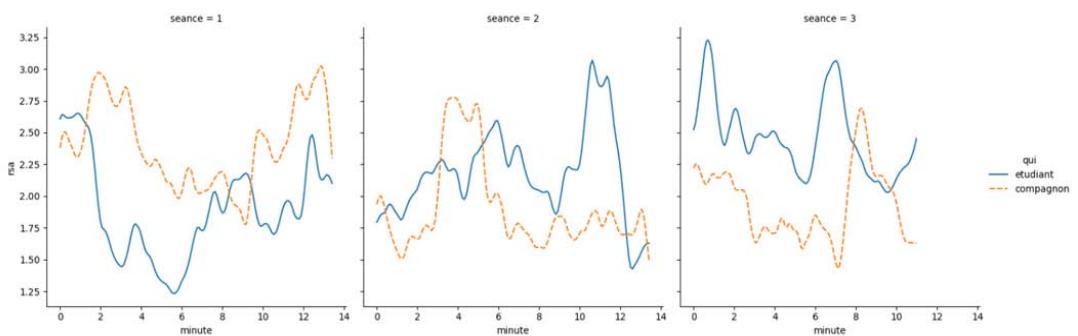 Fig. 3: Curves of calculated RSA values of a participant and his companion during 3 sessions of virtual companionship. The PPG signal is processed by applying a sliding window to obtain the systolic peaks in each period and applying a band-pass filter to isolate the variation in the frequency range of spontaneous breathing. The natural logarithm of the high-frequency component of the heart rate variability is then calculated from the signal obtained in the previous step, resulting in a (RSA) time series sampled at a rate of 10 samples per minute (the solid line represents the participant's RSA, the dotted line represents the companion's RSA).
### i) Questionnaire to assess remote social interaction
At the end of the last of 3 sessions with a participant, a questionnaire was provided by which the participant evaluated the quality of the exchanges and interactions when using the virtual companionship system using seven-point Likert scales. This post-use questionnaire was developed by the research group through a focus group [16]. This participant report consists of 17 items, was administered in French and can be consulted upon request.
## III. RESULTS
This section is structured as follows: first, we present the results of individual RSA calculations, specifically for each user. Next, we report on the results of physiological synchronization obtained from applying SUSY between the RSA of the neurotypical-neuroatypical pair. Following that, we present the individual physiological responses derived from eSenseTM metrics (Attention and Meditation), culminating with the outcomes of the questionnaire designed to assess the perceived quality of remote interactions.
### a) Individual RSA and RSA synchrony
RSA time series were calculated for each session at a frequency of ten samples per minute, for the participant and for the companion, using the methodology described in the previous section. The shorter time series pair contained 88 total samples in their time series while the longer one contained 254 samples (equivalent to 9 and 25 minutes in duration respectively). The descriptive statistics of the RSA values calculated per session and per participant are shown in Table 1. The purpose of measuring RSA over three consecutive sessions has allowed us to gather information on an individual's physiological responses over time. This establishes a baseline, identifies trends, and evaluates response consistency. It is important to emphasize that while this approach does not create a traditional self-referential scale, it provides a personalized understanding of an individual's physiological dynamics, which is valuable for research and interventions aimed at enhancing well-being and stress management. An example of RSA curves across time for a single participant- companion dyad for their three collaborative sessions are shown in Figure 2.
Fifteen pairs of RSA time series corresponding to the sessions between the participant and the companion were obtained and then analysed using the SUSY algorithm [87] developed by Meier and Tschacher. It has been possible to perform the correlation function between the RSA pair (neurotypical-neuroatypical) with different values and amplitudes by normalizing both signals to bring them to a similar scale. Within the SUSY algorithm, there exists a preliminary normalization stage. Once both signals are normalized, the correlation function can be applied, enabling the comparison of their patterns and synchronization without being affected by the original differences in amplitude. This normalization step ensures that the analysis focuses on the shape and timing of the signals rather than their raw amplitudes, allowing for significant correlation analysis even when the signals have different scales and amplitudes.
Figure 3 shows the correlation function of RSA time series for a single participant-companion dyad for their three collaborative sessions. We chose lags -1 minute $\leq$ L $\leq$ 1 minute, segment size 3 min, and did not restrict the number of surrogates. Mean synchrony was Zabs =.390 (SD =.034; Cohen's d = 0.08) and, for the non-absolute correlations, Znoabs = -.009 (SD =.075; Cohen's d = -0.51). The synchrony effect sizes across all sessions ESabs were significant and positive (mean ESabs =.47, SD =.30; p \<.05), as well as ESnoabs (mean ESnoabs = 0.25, SD = 3.19; p \<.05), which supports H1 concerning the presence of physiological synchrony.
The three graphs in Figure 4 represent dyadic synchrony in different sessions using the CVS. The green graph depicts real RSA-based synchrony cross-correlations as a function of the respective lag.
The red graph represents the average of all surrogate time series, indicating pseudo-synchronies (see methodology section). The left (A) and right (C) panels display physiological synchrony based on RSA between the autistic individual and the neurotypical participant in the first and third sessions, respectively. The green graph is above the red, indicating significant in-phase synchrony (positive correlations). In the central panel (B), physiological synchrony based on RSA between the autistic individual and the neurotypical participant during the second session is depicted. Here, the green graph is below the red pseudo-synchrony graph, showing antiphase synchrony (negative correlations). The rationale behind using SUSY was to generate surrogate time series that retain certain statistical properties of the original data (such as mean, variance, and distribution) while eliminating temporal dependencies or correlations in the original time series (RSA calculations). These surrogate time series serve as a reference to assess whether the observed synchrony or correlations in the original data are statistically significant or could have occurred by chance. We conducted this analysis to distinguish between real synchronization or correlations in time series data and spurious or random correlations that might arise due to noise or other factors.
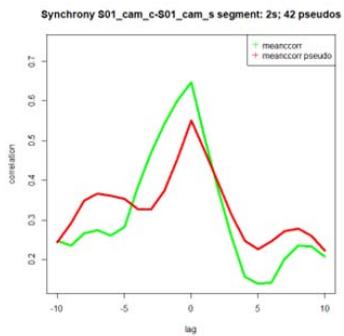
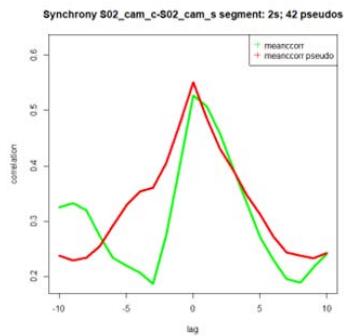
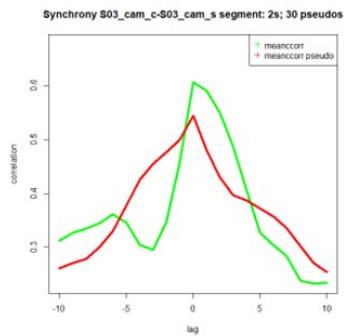 Fig. 4: Absolute cross-correlations Z-values by L-delay of aggregated RSA time series of one participant from their three virtual companionship sessions (green) and for all surrogates (red). The effect size (ES) are the areas under the green curve minus the areas under the red curves (surrogate), divided by the standard deviations of the Z-surrogate. These results and graphs were obtained using the SUSY code developed by [84] and [83].
### b) Brain activity responses
While the Mindwave Mobile 2 utilizes its own scale to measure levels of attention and relaxation based on user EEG data, it's essential to recognize that this scale is not universally standardized and may not be consistently applicable to all individuals. EEG responses can vary significantly among individuals, and the device's scale is calibrated based on general patterns observed in the general population, potentially overlooking individual variations. It is these relative measurements of attention and relaxation under the device's proprietary scale that we have included in our analyses. Figure 5 show value curves of the eSense Attention and Meditation metrics obtained from one participant during 3 virtual companionship sessions.
A one-way ANOVA was conducted to test for differences between levels of the eSense Attention and Meditation metrics between sessions. For the eSense Attention metric the group means were 49.38 $95\%$ CI(48.74, 50.03) for the first session; 47.11 $95\%$ CI(46.53, 47.69) for the second session; and 47.21 $95\%$ CI(46.29, 48.13) for the third session. Figure 6 shows boxplots of the eSense Attention and Meditation metrics collected with the Mindwave sensor for all sessions and participants. There is a statistically significant difference between the session means, $F = 13.75$, $p$ -value $< 0.05$. For the eSense Meditation metric the group means were 54.86 $95\%$ CI(54.34, 55.38) for the first session; 53.79
95% CI(53.19, 54.38) for the second session; and 54.44 95% CI(53.74, 55.15) for the third session. For this eSense metric, there is also a statistically significant difference between the session means, $F = 3.39$, p-value $= 0.03$. Figure 7 show confidence intervals for the eSense Attention and Meditation metric values of the 5 participants during VC sessions.
The use of Tukey HSD to test for differences between groups (sessions) indicates that there is a statistically significant difference in both eSense Attention and Meditation metrics between the first and second virtual coaching session, which may suggest that levels of mental workload and levels of relaxation have progressively decreased between sessions, which partially supports H2 concerning an improvement in the brain activity patterns.
### c) Questionnaire
Table 2 presents the scores obtained from the VC post-use questionnaire on usability of the social interactions assessment system, based on the responses of participants. The survey used a rating scale ranging from 1 to 7, where 1 represents the lowest score and 7 the highest score. The table includes the mean scores for each survey item, and the data was collected from a total of 5 participants $(n = 5)$.
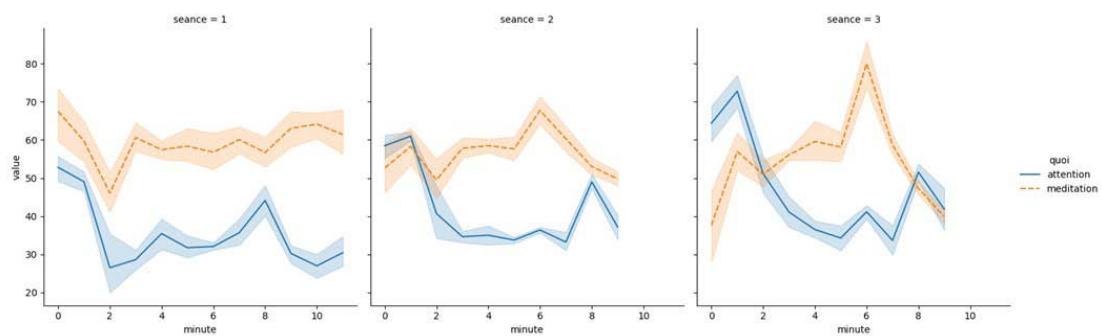 Fig. 5: Curves of the values of the eSense Attention and Meditation metrics obtained from one participant during 3 virtual companionship sessions (the physiological synchrony of the brain activity of the participant- companion dyad was not explored in this study). The solid line represents the time series corresponding to the eSense Attention values (mental load), the dotted line represents the time series corresponding to the eSense Meditation values (relaxation).
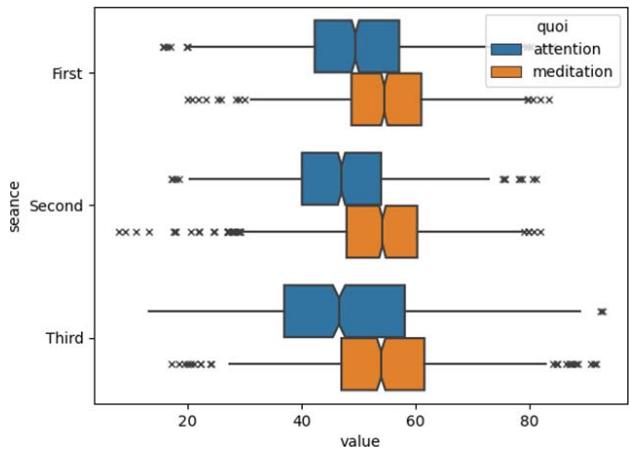 Fig. 6: Boxplot of the eSense Attention and Meditation metrics collected with the Mindwave sensor corresponding to the first, second, and third sessions of all participants (Note: in this work we did not study the response of the brain activity of the companion or the physiological synchrony of their brain activity markers with participants').
The questionnaire assessed various aspects related to social interactions within the context of the virtual companionship (VC) system. Participants were asked to rate their experiences and perceptions on different dimensions, such as understanding their strengths and challenges, the comfort of remote interactions, usefulness of the company's welcome, self-regulation of physiological reactions, overall positive experience, ability to share emotional states with the companion, willingness to use the system, compatibility with professional expectations, adaptability to remote learning, responsiveness to individual needs, interest in the provided activities, relevance of skill development, satisfaction with companion support, and appreciation of companion discussions.
The mean scores for each item provide insights into the participants' overall evaluation of the VC system's effectiveness and their satisfaction with the social interactions facilitated by the system.
Table 2: Scores on the VC post-use questionnaire on social interactions
<table><tr><td>Survey - Student Version (1 to 7)</td><td>Mean (n = 5)</td></tr><tr><td>1. Better Know My Strengths</td><td>4,4</td></tr><tr><td>2. Better Know My Challenges</td><td>4,8</td></tr><tr><td>3. Same As In-person Attendance</td><td>4,2</td></tr><tr><td>4. Remote Interaction Is Comfortable</td><td>4,6</td></tr><tr><td>5. Company Welcome-Like Usefulness</td><td>5,2</td></tr><tr><td>6.</td><td></td></tr><tr><td>13. Interesting And Impelling Activities</td><td>4,4</td></tr><tr><td>14. Relevant Skills Development</td><td>5,0</td></tr><tr><td>15. Companion Support Satisfaction</td><td>6,9</td></tr><tr><td>16. Companion Discussion Appreciation</td><td>7,0</td></tr></table>
Higher mean scores indicate more positive feedback and stronger agreement with the respective statements. The results from this questionnaire can help assess the success and user experience of the VC system, particularly in terms of the perceived quality of social interactions and emotional well-being.
## IV. DISCUSSION
The primary aim of developing the Virtual Companion (VC) was to enhance workplace adaptation for the autistic through the employment of immersive technologies and fostering self-awareness of their emotional-cognitive state based on physiological measurements. Immersive technologies offer a controlled and secure platform for training and accommodation, proving advantageous for effective workplace adaptation. This initiative was driven by the growing demand from inclusive companies to support the integration of neurotypicals facing burnout in the workplace. Burnout, stemming from factors like masking and the deliberate suppression of sensitivities, prompted the need for innovative solutions. A significant challenge identified by inclusive company representatives, corroborated in literature including Guimond et al. [25], is the inherent difficulty for both the autistic employee and the company representatives' counterpart to gauge emotional states during the integration process. To address this, we introduced a real-time physiological measures panel, serving two key functions. Firstly, it allows the autistic to establish a baseline of their parasympathetic activity based on physiological markers about their environmental engagement, relational capacity, and emotional wellbeing. This information is integrated within a collaborative VR system, aiding in the resolution of potential challenges during interactions and facilitating their workplace adaptation. Secondly, it highlights the feasibility of achieving quality interactions within a collaborative and remote context between the neurotypical-neuroatypical pair, utilizing cardiac vagal tone signals. This quality interaction is predicated on physiological synchrony, a phenomenon previously documented exclusively in face-to-face settings. By implementing the validated SUSY algorithm, commonly used for studying physiological synchrony in psychotherapy sessions [84], we discovered that physiological synchrony between the dyad surpasses surrogate values. This synchronization underscores the subconscious alignment of bodily responses during social interactions, illuminating the establishment of profound social bonds and emotional resonance beyond conscious awareness. While traditional physiological synchrony is often observed in close-proximity face-to- face interactions, research reveals its persistence in remote settings, such as video calls or other communication mediums [74]. Facial expressions, emotional cues like tone of voice, and gestures contribute to a sense of synchrony and connection even in physically separated contexts. The degree of physiological synchrony is influenced by factors including communication technology quality, interaction dynamics, and interpersonal rapport. Although remote physiological synchrony may not match the robustness of in-person interactions, it underscores humans' exceptional capacity to connect and resonate across distances. To enhance the accuracy and depth of insights, we have employed respiratory sinus arrhythmia (RSA) to study physiological synchrony, as it provides distinct insights compared to other physiological indicators like heart rate. RSA, characterized by heart rate fluctuations during respiration phases, offers a window into coordinated breathing patterns during social interactions, which sheds valuable light on the emotional and cognitive processes underlying the formation of social bonds. In contrast to relying solely on conventional physiological markers like heart rate (HR) or skin conductance (EDA), the use of respiratory sinus arrhythmia (RSA) offers a more nuanced insight into interpersonal dynamics. While heart rate alone reflects overall physiological activation and responses, RSA captures the influence of the parasympathetic branch of the autonomic nervous system on heart rate variability. This signifies that RSA is closely associated with emotional regulation, social engagement, and cognitive flexibility. Consequently, investigating RSA synchrony in this study, has provided a valuable window into the intricate interplay of emotions and cognitive states during social interactions. Therefore, one of our main contributions is aligned with the exploration of high-quality remote social interactions facilitated by a virtual reality headset and remote connectivity. Furthermore, it contributes to the existing body of research by demonstrating the utility of respiratory sinus arrhythmia in studying physiological synchrony that underpins emotional and cognitive interconnectedness between the autistic-neurotypical dyad. While interpreting the results of this study warrants careful consideration due to its methodological and contextual dependencies, the findings reinforce the foundational concept that immersive and collaborative applications, exemplified by the VC system, hold the potential to assist neuroatypical individuals in adapting to workplace demands. This
potential is derived from the opportunity we have provided the autistic to compare their subjectively perceived emotional state with the objective data gathered by the system's sensors. However, the outcomes of the analysis of brain activity lend partial support to this hypothesis. Notably, a gradual decline in Attention metric levels was observed across sessions. The initial session exhibited the highest value, averaging 49.5, which progressively reduced to an average of 47 during the subsequent sessions. The Attention eSense metric typically involves monitoring the ratio of specific brainwave frequencies, such as beta waves, mainly present during wakefulness and active mental engagement, linked to conscious thought, cognitive processing, problem-solving, and decision-making. They predominate during focused attention and cognitive tasks. Consequently, a higher Attention eSense value would generally indicate heightened engagement, focus, and attentiveness, while a lower value suggests a more relaxed or distracted state. The observed decline in the Attention eSense metric across sessions could imply a diminishing level of focused cognitive engagement, possibly indicating reduced concentration, potential distraction, or a transition toward a more relaxed mental state. This decline is likely attributable to the latter, as the experimental observations did not indicate disinterest or distraction. Instead, this trend may signify a growing familiarity with the system, with the proposed activities within, and with the virtual environment's co-participant. In contrast, a reduction in the eSense Meditation metric values was also detected, with the highest values (55) recorded during the initial session and the lowest (53,75) during the subsequent session. While the mean values demonstrated a potential increase toward the third session, this increase was not statistically significant. A progressive decrease in the Meditation eSense metric potentially indicates a diminishing level of mental relaxation and calmness between VC sessions. This trend may suggest heightened restlessness, distraction, or challenges in achieving a deeper state of mindfulness.
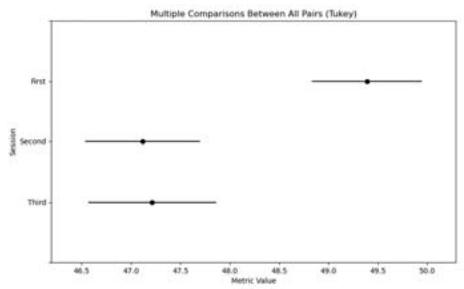
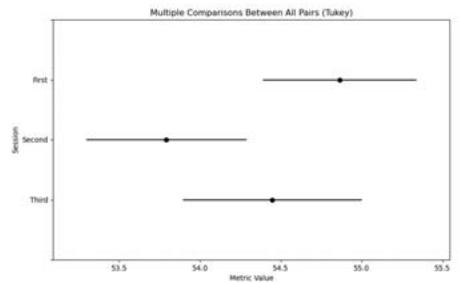 Fig. 7: (Left) Confidence intervals with individual confidence levels of 95 percent for the eSense Attention metric values of the 5 participants during the first, second, and third virtual companionship sessions. A significant difference is observed between the first and the second session, between the first and the third session, but not between the second and the third session. (Right) Confidence intervals with individual confidence levels of 95 percent for the eSense Meditation metric values of the 5 participants during the first, second, and third virtual companionship sessions. A significant difference is observed only between the first and second session.
However, a simultaneous shift toward a more relaxed mental state (decreased Attention) while experiencing a reduction in physiological relaxation (decreased Meditation) during a social interaction could be explained by emotional engagement and cognitive stimulation. In the context of utilizing the VR system for social interaction, engaging in conversations or stimulating activities may have contributed to a sense of mental relaxation and positive emotions, even if the physiological relaxation response diminished. Notably, these socially stimulating interactions might prompt the neurotypical to activate their cognitive and emotional faculties, potentially leading to a more relaxed mental state despite shifts in physiological parameters. This dynamic aligns with the concept of eustress, a positive form of stress that can emerge during social interactions involving excitement, engagement, or a sense of accomplishment. Consequently, these interactions could guide the autistic towards a state of heightened mental alertness and relaxation, while a decrease in physiological relaxation might be attributed to increased cognitive and emotional engagement [16]. Yet, we acknowledge the potential influence of individual variability among participants and external stressors unrelated to social interactions or the use of the system, which may have impacted physiological relaxation. However, the interactions themselves appear to provide a form of mental respite despite these mixed physiological responses. Several notable limitations are inherent in this study: The relatively small sample size in the context of autism research involving virtual reality (VR) restricts the comprehensive exploration of responses and individual nuances within the diverse autistic population. The significant variability in cognitive, sensory, and emotional profiles among neurotypicals can profoundly influence their interactions within immersive environments. Consequently, our modest sample size $(n = 5)$ may only offer a limited representation of this intricate variability, potentially limiting the extent to which we can draw robust and generalizable conclusions regarding the effectiveness and relevance of the VR interventions aimed at enhancing their employability. A second noteworthy limitation revolves around the variability in session duration for the VC interventions (ranging from 15 to 45 minutes) and the lack of standardized scheduling. This irregularity in session length and timing could have presented challenges in establishing routines and predictability, which are often crucial for the neurotypical. Adhering to consistent session duration and timing could foster a stable and comfortable environment, thereby enhancing focus, participation, and the overall efficacy of the VR intervention. Moreover, it would contribute to the reliability of physiological marker readings across sessions.
In the context of analyzing Respiratory Sinus Arrhythmia (RSA) synchrony between a neurotypical-neuroatypical dyad using a Collaborative Virtual Simulation (CVS), careful attention must be given to the windowing process employed in surrogate synchrony (SUSY) analyses. The selection of an optimal window size is paramount; too small windows may neglect to encapsulate the entirety of the physiological phenomena, leading to incomplete analyses, while excessively large windows could incorporate an overwhelming amount of data, potentially obscuring the synchrony effects. Given the non-stationary nature of physiological data, especially RSA, the assumption of data stationarity within each window could introduce bias, necessitating sophisticated approaches to mitigate this issue. Edge effects, where data at the boundaries of windows are less accurately represented, further compound the challenge, demanding meticulous handling to ensure reliability in synchrony detection.
The decision on whether to allow overlap between windows and determining the extent of this overlap is another critical consideration. While overlapping windows can yield a smoother temporal representation of synchrony, they also introduce redundancy that could bias the results. Short-term artifacts or outliers in the data can disproportionately influence the outcomes, leading to potential misinterpretations of synchrony. The choice of window function, whether it be rectangular, Hamming, or Hanning, is equally crucial as it directly impacts the fidelity of the analysis, potentially leading to information loss or distortion.
Furthermore, the sampling rate of the physiological data necessitates careful deliberation. Insufficient sampling could result in missed nuances, while excessive sampling could render the analysis computationally burdensome. Ensuring consistency in windowing parameters across subjects and sessions is vital to maintain the integrity of the comparison and interpretation of results.
Given these intricate considerations, adopting rigorous and well-validated windowing parameters and methods is imperative in the pursuit of a robust surrogate synchrony analysis, particularly when investigating the complex physiological interactions in a neurotypical-neuroatypical dyad within a CVS environment.
Lastly, the inclusion of a single companion for interactions may have inherently constrained our understanding of workplace social interaction dynamics. The absence of multiple companions may have hindered the opportunity to contrast different companionship styles, assistance strategies, interaction dynamics, and their resulting effects on workplace adaptation outcomes. Neglecting the inherent variability and nuances arising from diverse interactions might limit the broad applicability of our findings to a wider array of workplace scenarios. Thus, the involvement of representatives from various companies could mitigate potential limitations and enrich the depth of analysis regarding the diverse contributions of different companies to workplace dynamics.
## V. CONCLUSION
The Virtual Companion (VC) system was meticulously crafted as an innovative, real-time VR simulation platform, meticulously designed to facilitate a nuanced understanding of social dynamics for autistic individuals within professional environments. Through the integration of self-calibrating mechanisms and immersive technologies, the system provides a secure and controlled training milieu, thereby enhancing workplace adaptation and integration (Objective 1). The VC system plays a pivotal role in fostering augmented self-awareness among autistic employees by delivering real- time physiological metrics, enabling individuals to establish a baseline of parasympathetic activity and gain insights into their emotional and cognitive states. This, in turn, facilitates the establishment of physiological synchrony between neuroatypical and neurotypical individuals during simulated social interactions, as evidenced by the successful application of the SUSY algorithm and the observation of physiological synchrony surpassing surrogate values (Objective 2).
In evaluating the quality of social interactions and the overall well-being of autistic employees within the workplace, the study leverages indices such as the Attention and Meditation eSense metrics, providing a window into the participants' mental and emotional states. The system's design and implementation underscore its potential to guide autistic individuals toward a relaxed mental state, even in the face of reduced physiological relaxation, highlighting the complex interplay between cognitive engagement and emotional well-being (Objective 3). The study does explicitly detail a formal usability assessment from the autistic individuals' perspective, highlighting the intuitive design and the tailored feedback mechanism of the VC system implying a user-centric approach, ensuring relevance and accessibility (Objective 4).
The research also offers a comprehensive analysis of the inherent limitations and challenges associated with the deployment of VR-based adaptation systems in real-world professional settings. Among the challenges highlighted are the small sample size, the variability in session durations, and the intricate nature of analyzing (RSA) synchrony using surrogate synchrony analyses (Objective 5). The authors advocate for rigorous and validated methodologies to address these challenges, paving the way for future advancements in this domain. Ultimately, this research epitomizes a commitment to fostering an inclusive work culture, celebrating neurodiversity, and catering to a broad spectrum of cognitive and sensory needs, thereby contributing significantly to the body of knowledge in this field.
### ACKNOWLEDGMENTS
We extend our heartfelt gratitude to the Canadian funding bodies, namely FRQSC - Fonds de recherche du Québec (Société et culture) Impulsion program, and CRSH - Conseil de recherches ensciences humaines as well as the Cirris research center at Laval University for their unwavering support. Additionally, we are indebted to the corporate entities OVA.IA (https://www.ova.ai/) and M2Selectronique (https://www.m2selectronique.com), alongside Mr. Yanick Racicot and Ms. Gilda Boffa from the Quebec Association for Equity and Inclusion in Postsecondary Education (AQEIPS) (https://aqeips.qc.ca/fr/home/), for their invaluable contributions to this research work.
Generating HTML Viewer...